Bean Bag Chair Market Statistics, Trends & Forecasts for 2026
Introduction
The global bean bag chair market is undergoing a quiet but consequential transformation. Once regarded as a novelty item confined to children's bedrooms and college dormitories, the bean bag chair has evolved into a versatile, ergonomically relevant seating solution that is finding its place in co-working spaces, corporate lounges, gaming environments, hospitality venues, and modern residential interiors. The bean bag chair market is now a recognized segment of the broader casual and flexible furniture industry — one that is being shaped by structural shifts in how and where people work, live, and socialize.
Three converging forces are redefining the market's trajectory in 2026: the normalization of hybrid work models that are driving demand for informal, adaptable seating; the rapid expansion of e-commerce channels that are democratizing access to casual furniture globally; and a growing consumer mandate for sustainable, eco-friendly materials that is compelling manufacturers to rethink their product formulations. For institutional investors, furniture manufacturers, and commercial real estate decision-makers, understanding these dynamics is essential to identifying where the most durable growth opportunities lie within the bean bag chair market.
Hybrid Work, Co-Working Spaces, and the New Demand Architecture for Bean Bag Chairs
The Workplace Has Changed — And So Has Its Furniture
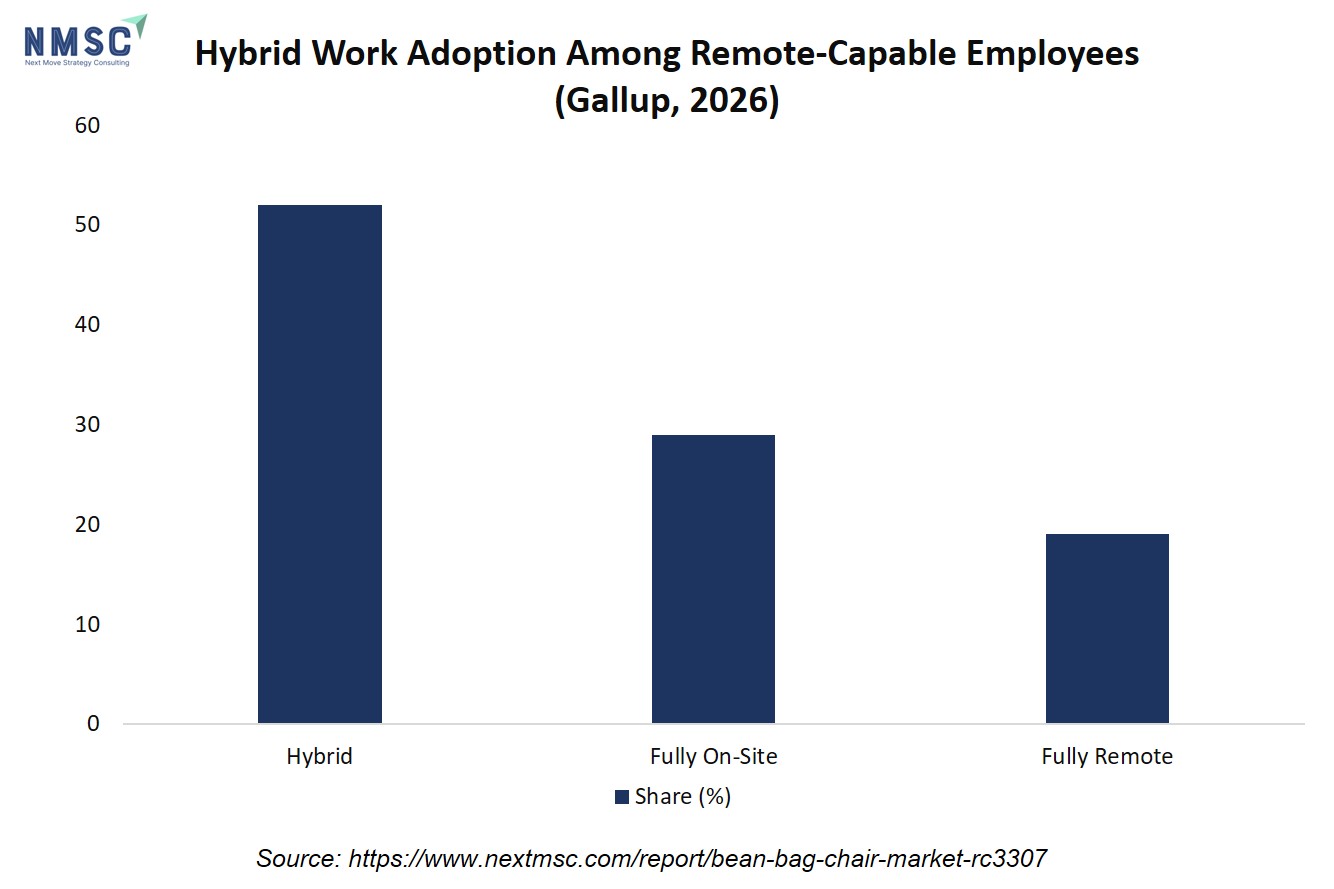
The most globally impactful structural shift driving the bean bag chair market in 2026 is the permanent normalization of hybrid work. According to Gallup's 2026 workplace data, 52% of remote-capable employees now work in a hybrid arrangement — splitting their time between home, office, and third-party co-working environments. This is not a transitional phase; it is the established baseline of modern work culture. The CoworkingCafe 2026 Remote Work Well-Being Survey further confirms that among employees who expressed workplace improvement requests, the most common were practical and ergonomic in nature — specifically, better chairs and more comfortable seating arrangements.
For More Information – Download FREE Sample on Bean Bag Chair Market Report
This behavioral shift has direct procurement implications. As businesses — particularly in the technology, creative, and professional services sectors — redesign their physical footprints to accommodate hybrid teams, the demand for flexible, lightweight, and aesthetically versatile seating has accelerated. Bean bag chairs, with their portability, adaptability, and ability to foster informal collaboration, are increasingly specified for break rooms, lounge areas, creative studios, and co-working hubs. Government-backed entrepreneurship programs are amplifying this trend: India's Startup India initiative, which actively promotes flexible workspace development, has contributed to a measurable expansion of co-working infrastructure across South and Southeast Asia, generating new institutional demand for adaptable furniture solutions including bean bag chairs.
In Europe, government support for innovation ecosystems and startup funding has similarly proliferated informal work environments in the United Kingdom, Germany, and the Nordic countries. The European Urban Initiative notes that approximately 75% of the European Union's population — around 447 million people — resides in urban areas, driving sustained demand for space-efficient, multifunctional furniture that aligns with compact urban living and flexible commercial interiors.
NMSC Strategic Perspective: Co-Working and Commercial Demand as a Structural Growth Engine
From Next Move Strategy Consulting's analytical standpoint, the commercial end-user segment — encompassing offices, gaming lounges, cafes and restaurants, and hotels and resorts — represents one of the most strategically significant demand vectors for the bean bag chair market through 2030. The shift toward open-plan, activity-based working environments is not a temporary accommodation to hybrid work preferences; it reflects a fundamental rethinking of how commercial space is designed and furnished.
NMSC's research identifies the gaming lounge sub-segment as a particularly high-growth commercial category. The global gaming industry's continued expansion — driven by esports, casual gaming, and gaming café culture across Asia-Pacific and North America — is generating sustained demand for ergonomic, immersive seating solutions. Gaming bean bags, a dedicated sub-segment within the indoor bean bag chair category, are increasingly specified by gaming lounge operators for their combination of postural support, aesthetic appeal, and durability under high-frequency use conditions.
The residential segment, while the largest by volume, is being complemented by this commercial diversification. NMSC's segmentation analysis indicates that the commercial end-user category — spanning offices, hospitality, and entertainment venues — is growing at a faster rate than the residential segment, reflecting the broader institutionalization of casual seating as a standard component of commercial interior design.
Section Summary: The normalization of hybrid work and the proliferation of co-working and informal commercial environments are creating a durable, structurally driven demand base for the bean bag chair market. Government-backed entrepreneurship programs and urban densification are amplifying this trend across Asia-Pacific and Europe.
Key Takeaways:
-
Gallup's 2026 data confirms 52% of remote-capable employees work in a hybrid arrangement, sustaining demand for flexible, informal seating in commercial environments.
-
The CoworkingCafe 2026 Well-Being Survey identifies better chairs and ergonomic seating as the most common practical workplace improvement requests.
-
India's Startup India initiative and Europe's innovation funding programs are expanding co-working infrastructure, generating new institutional demand for bean bag chairs.
-
NMSC identifies gaming lounges and hospitality venues as high-growth commercial sub-segments within the bean bag chair market.
Industry Impact Analysis
E-Commerce Expansion: Democratizing Access to Casual Seating Globally
The rapid expansion of e-commerce channels is one of the most consequential structural enablers of the bean bag chair market's global growth. Online platforms have fundamentally altered the competitive dynamics of furniture retail by eliminating geographic barriers, enabling direct-to-consumer distribution, and providing manufacturers with access to previously unreachable consumer segments in emerging markets.
The International Trade Administration reports that Brazil's e-commerce market is projected to grow at 14.3% annually, reaching over USD 200 billion by 2026 — a trajectory that is enhancing consumer access to international furniture brands, including bean bag chair manufacturers, across Latin America's rapidly urbanizing population centers. The U.S. Small Business Administration's support for digital transformation through grants and training programs for small businesses has similarly empowered furniture retailers to strengthen their online presence and compete effectively in the digital marketplace.
India's Digital India campaign, which promotes e-commerce growth and digital infrastructure development, has facilitated the rise of online furniture marketplaces, enabling small and medium enterprises to market bean bag chairs effectively to a growing middle-class consumer base. India's per capita income rose to USD 2,544 in 2022–23, reflecting increased purchasing power among the country's expanding middle class — a demographic that is actively seeking affordable, stylish, and space-efficient furniture solutions.
Sustainability Imperative: The Polystyrene Problem and the Eco-Innovation Response
The bean bag chair market faces a material-level sustainability challenge that is simultaneously its most significant restraint and its most compelling growth opportunity. Traditional bean bag fillings — predominantly expanded polystyrene (EPS) beads — are non-biodegradable, contribute to microplastic pollution, and are increasingly incompatible with the environmental standards being adopted by institutional buyers and sustainability-conscious consumers.
The U.S. Environmental Protection Agency's ongoing emphasis on sustainable materials and waste reduction is creating regulatory and reputational pressure on manufacturers that continue to rely on polystyrene-based fillings. In response, a cohort of manufacturers is pioneering eco-friendly alternatives that are redefining the product category. White Lotus Home's organic bean bags, introduced in 2023, are manufactured with shredded natural latex and GOTS-certified organic cotton covers — a formulation that directly addresses consumer demand for certified sustainable home furnishings. The Big Beanbag Company has introduced BioFoam — a plant-based, compostable filling material — that aligns with the EPA's sustainability guidelines and positions the brand favorably among environmentally conscious institutional and residential buyers.
Residential Construction Boom Sustains Volume Demand
The sustained expansion of residential and commercial construction activity is providing a reliable volume demand base for the bean bag chair market. According to the U.S. Census Bureau, residential construction spending in the United States reached USD 963.8 billion in 2023, reflecting a robust housing market that continues to generate demand for innovative, affordable home furnishings — particularly among millennial and Gen Z buyers who prioritize style, functionality, and value. India's Smart Cities Mission, which supports urban infrastructure and commercial real estate development, has similarly generated a surge in modern office and retail spaces, further driving the adoption of adaptable furniture solutions including bean bag chairs.
Key Takeaways:
-
Brazil's e-commerce market is projected to reach USD 200 billion by 2026 at 14.3% annual growth, expanding consumer access to bean bag chair brands across Latin America.
-
India's rising per capita income (USD 2,544 in 2022–23) and Digital India campaign are accelerating online furniture adoption among the country's growing middle class.
-
Polystyrene-based fillings represent the market's primary sustainability liability; manufacturers adopting GOTS-certified, plant-based, or compostable alternatives are gaining competitive advantage.
-
U.S. residential construction spending of USD 963.8 billion (2023) and India's Smart Cities Mission are sustaining robust baseline demand for affordable, versatile home and commercial furnishings.
Key Data & Statistics
Key Institutional Data Points Driving the Bean Bag Chair Market (2023–2026)
|
Data Point |
Value |
Source |
Relevance to Market |
|
U.S. Residential Construction Spending (2023) |
USD 963.8 Billion |
U.S. Census Bureau |
Sustains demand for affordable home furnishings including bean bag chairs |
|
EU Urban Population Share |
~75% (447 Million People) |
European Urban Initiative |
Drives demand for space-efficient, multifunctional furniture in compact urban homes |
|
India Per Capita Income (2022–23) |
USD 2,544 |
India Ministry of Statistics & Programme Implementation |
Reflects rising purchasing power among India's middle class, fueling furniture demand |
|
Brazil E-Commerce Market Growth Rate |
14.3% Annually |
International Trade Administration |
Expands online access to bean bag chair brands across Latin America |
|
Brazil E-Commerce Market Size (Projected, 2026) |
USD 200+ Billion |
International Trade Administration |
Signals major digital retail opportunity for furniture manufacturers in emerging markets |
|
Remote-Capable Employees Working Hybrid (2026) |
52% |
Gallup (via Neat, 2026) |
Drives commercial demand for casual, flexible seating in offices and co-working spaces |
|
U.S. Remote/Hybrid Workforce (April 2025) |
~34.3 Million Workers (~21% of Workforce) |
U.S. Bureau of Labor Statistics (via Gable, 2026) |
Quantifies the scale of the hybrid workforce driving home and office furniture demand |
Future Outlook & Forecast
Market Trajectory: USD 5.10 Billion by 2030
According to Next Move Strategy Consulting's proprietary research, the global bean bag chair market is projected to reach USD 5.10 billion by 2030, expanding at a CAGR of 4.4% from 2025 to 2030. This steady, sustained growth trajectory reflects the market's transition from a discretionary consumer product to a recognized component of commercial interior design and ergonomic workspace planning.
The residential segment will continue to represent the largest share of market volume, driven by urbanization, rising disposable incomes in emerging markets, and the enduring appeal of bean bag chairs as affordable, space-efficient seating for compact living environments. However, the commercial segment — encompassing offices, gaming lounges, hospitality venues, and educational institutions — is expected to grow at a faster rate, reflecting the structural demand shifts associated with hybrid work normalization and the expansion of experience-oriented commercial spaces.
Product Innovation: Gaming, Licensing, and Wearable Bean Bags
The competitive landscape of the bean bag chair market is being reshaped by product innovation across multiple vectors. PM&J's November 2024 launch of Squishmallows-branded bean bag chairs — featuring 30-inch designs based on licensed characters including Archie, Bubba, and Cam — demonstrates the commercial viability of licensing strategies in broadening the product's appeal to younger demographics and the gift market. In Japan, the introduction of wearable bean bags reflects the Asia-Pacific region's emphasis on novelty, functionality, and compact living solutions — a product innovation trajectory that is likely to influence global design trends over the forecast period.
The gaming bean bag sub-segment warrants particular attention from investors and manufacturers. As the global esports and gaming café industry continues its structural expansion across North America, Europe, and Asia-Pacific, the demand for purpose-designed gaming seating — combining ergonomic support, immersive aesthetics, and durability — is creating a defensible, high-margin niche within the broader bean bag chair market.
Sustainability as a Competitive Differentiator Through 2030
The transition from polystyrene-based fillings to sustainable alternatives will be one of the defining competitive dynamics of the bean bag chair market through 2030. Manufacturers that invest in certified eco-friendly materials — including recycled foam, natural latex, GOTS-certified organic cotton, and plant-based compostable fillings — will be positioned to capture the growing premium segment of environmentally conscious institutional and residential buyers. The EPA's ongoing regulatory emphasis on sustainable materials provides a policy tailwind that will progressively disadvantage manufacturers that fail to transition their product formulations.
Section Summary: The bean bag chair market is on a well-supported growth path toward USD 5.10 billion by 2030, driven by commercial sector diversification, product innovation in gaming and licensing, and the sustainability transition. The market's long-term competitive landscape will be defined by manufacturers that successfully combine eco-friendly material innovation with targeted commercial and digital distribution strategies.
Key Takeaways:
-
The commercial end-user segment — offices, gaming lounges, hospitality, and education — is expected to outpace residential growth through 2030.
-
Licensed product strategies (e.g., Squishmallows bean bags) and wearable bean bag innovations in Japan signal the market's expanding product design frontier.
-
Eco-friendly material adoption is transitioning from a brand differentiator to a baseline competitive requirement, driven by EPA regulatory pressure and institutional buyer mandates.
Next Steps for Stakeholders
For Furniture Manufacturers and Product Designers:
Prioritize R&D investment in sustainable filling materials — including plant-based foams, recycled polyester, and GOTS-certified natural fibers — to align with EPA guidelines and the growing institutional demand for certified eco-friendly products. Develop dedicated gaming bean bag product lines with ergonomic certifications to capture the high-growth gaming lounge and esports venue segment. Explore licensing partnerships with entertainment and character IP holders to broaden demographic reach and generate incremental revenue streams.
For Institutional Investors and Private Equity:
The bean bag chair market's 4.4% CAGR through 2030, combined with the structural demand tailwinds of hybrid work normalization, Asia-Pacific urbanization, and e-commerce expansion, presents a stable, diversified investment thesis within the broader casual furniture sector. Focus on manufacturers with proprietary sustainable material capabilities, established e-commerce distribution infrastructure, and exposure to the commercial end-user segment — particularly gaming, hospitality, and co-working verticals. Emerging market e-commerce growth — particularly in Brazil (14.3% annual growth) and India — represents a significant untapped revenue opportunity for digitally capable furniture brands.
For Commercial Real Estate Developers and Facility Managers:
Incorporate bean bag chairs and casual seating solutions into the standard furniture specifications for co-working spaces, corporate lounge areas, gaming zones, and hospitality environments. The hybrid work model's permanence — confirmed by Gallup's 2026 data showing 52% hybrid adoption among remote-capable employees — means that investment in flexible, informal seating is a long-term operational requirement, not a discretionary amenity. Prioritize suppliers offering certified sustainable products to align with corporate ESG commitments and institutional procurement standards.
For E-Commerce Retailers and Digital Marketers:
Leverage targeted digital campaigns, social media influencer partnerships, and SEO-driven content strategies to capture the growing online demand for bean bag chairs among millennial and Gen Z consumers. Invest in augmented reality (AR) visualization tools that allow consumers to preview bean bag chairs in their home or office environments — a capability that is increasingly becoming a baseline expectation in online furniture retail. Expand distribution into high-growth emerging markets, particularly Brazil, India, and Southeast Asia, where e-commerce infrastructure is scaling rapidly.
Conclusion
The global bean bag chair market is no longer defined by its origins as a casual, low-cost seating novelty. It has matured into a strategically relevant segment of the commercial and residential furniture industry, shaped by the permanent normalization of hybrid work, the global expansion of e-commerce, the rise of experience-oriented commercial spaces, and an accelerating sustainability imperative. The market's growth from USD 3.93 billion in 2024 to a projected USD 5.10 billion by 2030 — at a CAGR of 4.4% — reflects a demand base that is both broadening geographically and deepening across end-user categories.
For manufacturers, the competitive imperative is clear: sustainable material innovation, commercial segment diversification, and digital distribution capability are the three axes on which market leadership will be determined through 2030. For investors, the bean bag chair market offers a stable, structurally supported growth thesis within the broader casual furniture sector — one that is insulated from cyclical demand volatility by its expanding commercial end-user base and its alignment with durable global megatrends including urbanization, hybrid work, and sustainability.
About the Author
 Sanyukta Deb
— Sanyukta Deb is Digital Marketing Team Lead at Next Move Strategy Consulting, where she has led content strategy and technical SEO for the firm's B2B market research publications for over 2 years. Her editorial process translates NextMSC's primary and secondary research — spanning technology, industrial, and consumer sectors — into commercial narratives, backed by search-intent, keyword, and competitive analysis. She brings 5 years of overall experience in digital marketing and content strategy.
Sanyukta Deb
— Sanyukta Deb is Digital Marketing Team Lead at Next Move Strategy Consulting, where she has led content strategy and technical SEO for the firm's B2B market research publications for over 2 years. Her editorial process translates NextMSC's primary and secondary research — spanning technology, industrial, and consumer sectors — into commercial narratives, backed by search-intent, keyword, and competitive analysis. She brings 5 years of overall experience in digital marketing and content strategy.
About the Reviewer
 Debashree Dey
— Debashree Dey is Assistant Manager at Next Move Strategy Consulting, where she supports cross-vertical market content and communications across diverse industries for 6 years. Her professional background includes senior content writing, communications, and published manuscript authorship, with experience developing audience-focused business narratives and maintaining clear, consistent messaging. Her role supports research-led content development and editorial quality across NextMSC publications.
Debashree Dey
— Debashree Dey is Assistant Manager at Next Move Strategy Consulting, where she supports cross-vertical market content and communications across diverse industries for 6 years. Her professional background includes senior content writing, communications, and published manuscript authorship, with experience developing audience-focused business narratives and maintaining clear, consistent messaging. Her role supports research-led content development and editorial quality across NextMSC publications.
















Add Comment