Audiology Devices Market: How AI Chips Redefine Hearing Aids | NextMSC
Introduction
On November 12, 2026, Sonova Holding AG reported first-half sales of CHF 1,834.1 million for its 2026/27 financial year and raised its full-year guidance, crediting the Phonak EON launch and an eleventh consecutive quarter of wholesale market share gains. Six days earlier, GN Store Nord and Amplifon confirmed that every regulatory approval for Amplifon's acquisition of GN's hearing business had been secured, and Demant A/S had just estimated that US commercial hearing aid unit sales rose 8% in the third quarter after a flat second quarter. Taken together, these announcements show the audiology devices market leaving a period of uneven demand and entering a product-cycle upswing led by on-device artificial intelligence.
According to Next Move Strategy Consulting's Audiology Devices Market report, the global audiology devices market was valued at USD 9.67 billion in 2023 and is projected to reach USD 15.06 billion by 2030, growing at a CAGR of 6.5% from 2024 to 2030. That implies an absolute increase of USD 5.39 billion over seven years. This blog tests that trajectory against the last six months of developments, from AI silicon in premium hearing aids to FDA-cleared consumer devices.
For More Information: Download FREE Sample on Audiology Devices Market Report
Audiology Devices Market Enters an AI Platform Race, From Phonak EON to Oticon Reveal and Omega AI+
Phonak EON and Oticon Reveal: Neural Processing Moves Into Every Premium Launch
Phonak launched EON on August 24, 2026, the third generation of Sonova's real-time artificial intelligence hearing aids, built around a newly developed HYPERSONIC chip. Reuters reported on August 24, 2026 that Anders Rosengren, head of research and development at Sonova, described a smaller, lighter device whose AI makes speech twice as understandable while demanding less listening effort. The US launch began the same day, with Australia, Germany, France, Italy and the United Kingdom following in mid-September. The commercial effect is already visible: in its November 12, 2026 half-year release, Sonova Holding AG said EON was contributing above expectations according to CEO Eric Bernard, and Hearing Instruments sales rose 9.0% in local currencies to CHF 1,716.7 million.
Demant A/S moved in parallel. Its Interim Report 2026, published on August 11, 2026, announced the rollout of Oticon Reveal, which Demant describes as the first hearing aid with a Dual AI sound processing system that handles speech and contextual sounds separately, and it raised the 2026 organic growth outlook to 6-7% from 3-6%. Its Interim Management Statement for Q3 2026, dated November 3, 2026, confirmed Hearing Aids organic growth of 17% in the third quarter and Group organic growth of 11%. Demant raised its 2026 organic growth outlook again on October 9, 2026 to 7-8%, and it has committed at least DKK 3 billion to share buybacks from the fourth quarter of 2026 to the end of 2027, a signal of management confidence in the product cycle.
Starkey Omega AI+ and Connectivity: Hearing Aids Become Multifunction Wearables
Starkey Hearing Technologies introduced Omega AI+ on October 1, 2026 at its annual Starkey Day event in Minneapolis, in front of about 700 hearing care professionals, according to HearingTracker. The platform centers on a G4 Gen AI Neuro Processor with a Quad DNN architecture and adds Auracast broadcast audio and sleep quality tracking. On November 2, 2026, Phonak EON, Oticon Reveal and Signia's four-neural-network Pure C&G MaX platform were each announced as available through the US Department of Veterans Affairs channel, according to AudiologyOnline press release listings.
Cochlear Nexa and the Implant Segment: Volume Gains, Price Pressure
The same intensity is visible in implantable devices. Cochlear Limited's FY26 results, lodged with the ASX on August 18, 2026, reported cochlear implant units up 5% to 56,692, with the Nucleus Nexa System, a smart implant with upgradeable firmware, reaching more than 95% of implant sales in developed markets by June 2026 at an average price increase of 3%. Implant revenue was nonetheless flat in constant currency because a higher share of lower-priced emerging-market units diluted the mix.
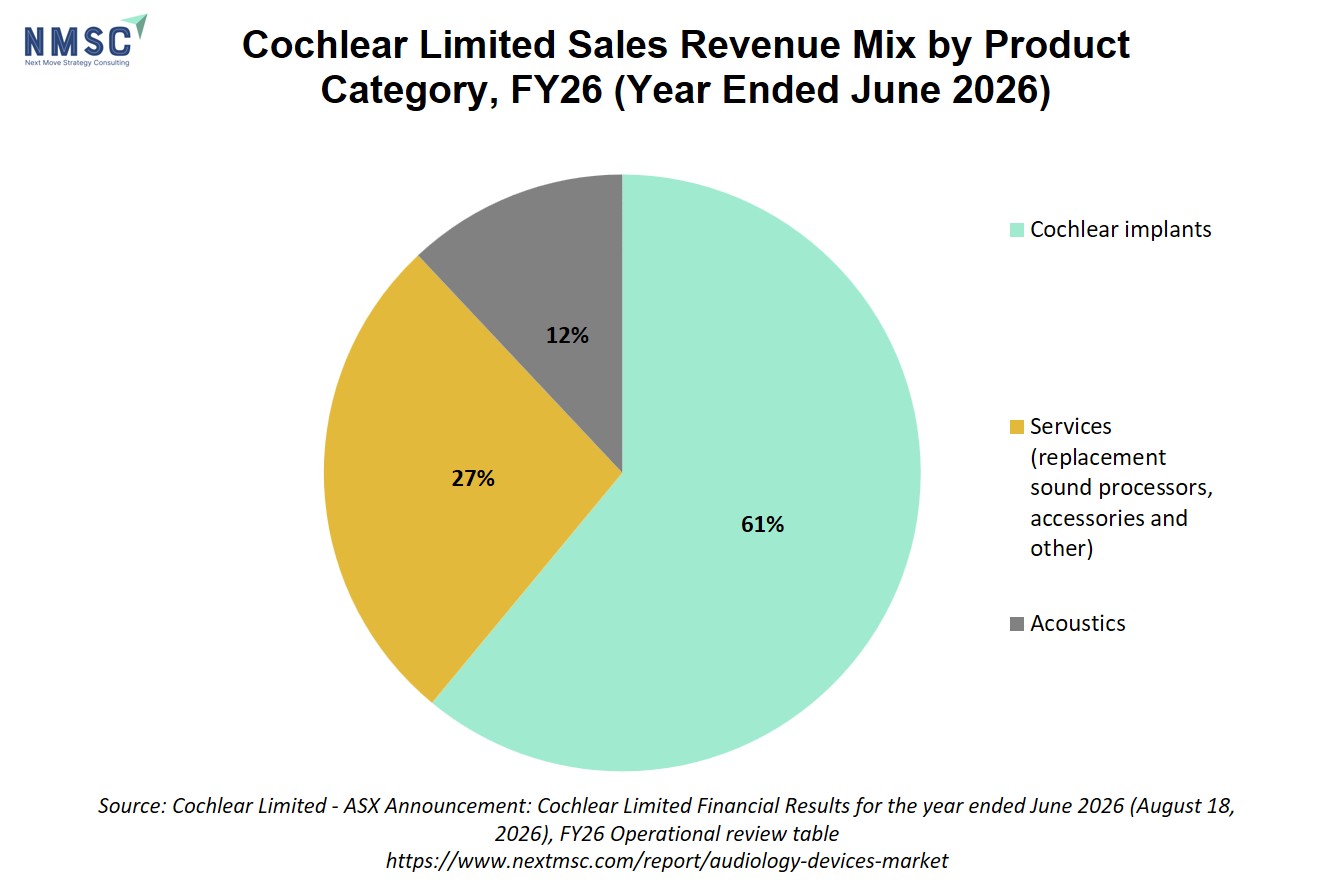
Cochlear Limited's FY26 results announcement of August 18, 2026 reports sales revenue of A$2,343.4 million, with cochlear implants contributing 61%, services (replacement sound processors, accessories and other) 27% and acoustics 12%. Services revenue grew 6% in constant currency, which is the same recurring category that sustains revenue between new implant surgeries.
Consumer Electronics Joins the Fitting Queue: Samsung, Meta and Apple
Consumer electronics groups are now competing for the mild-to-moderate segment. Samsung Electronics announced on August 11, 2026 that its Galaxy Buds Hearing Aid feature had received FDA clearance as an over-the-counter hearing aid for adults aged 18 and older with perceived mild to moderate hearing loss, with a US rollout targeted for the fourth quarter of 2026, as reported by The Hearing Review on August 14, 2026. The U.S. Food and Drug Administration cleared Meta's Hearing assist software for smart glasses on July 13, 2026, and Meta announced the feature at its Connect event on September 23, 2026 with a USD 149.99 software upgrade price. Apple, whose AirPods Pro Hearing Aid feature became the first FDA-authorized over-the-counter hearing aid software in 2024, extended the feature to five Canadian provinces with iOS 27.2 on October 26, 2026, according to MacRumors.
NMSC Strategic Perspective: AI Becomes the Entry Ticket, Channel Control Becomes the Moat
NextMSC primary research and analysis draws three conclusions from the past six months. First, dedicated neural processing has moved from a premium differentiator to a baseline specification. Sonova's EON, Demant's Oticon Reveal and Starkey's Omega AI+ each place AI-specific silicon inside the device, so advantage now depends on how efficiently that silicon runs inside a battery-limited ear-level form factor. Sonova's core research and development expense of CHF 107.4 million in the first half of 2026/27 indicates the investment needed to stay on this platform cycle.
Second, consumer devices are enlarging the funnel rather than visibly displacing the clinic. The Samsung, Meta and Apple clearances widen the e-commerce on-ramp for adults with perceived mild to moderate hearing loss, yet Demant estimated that global hearing aid unit growth accelerated from 3% in the second quarter to 6% in the third quarter of 2026, with product introductions contributing about one percentage point, so reported unit data do not yet show substitution. The greater risk lies in price anchoring around Meta's USD 149.99 upgrade.
Third, control of the fitting channel has become the strategic asset. Amplifon's acquisition of GN's hearing business joins a manufacturer to one of the world's largest hearing care retailers, Demant's acquisitions, led by KIND, added 23% to its Hearing Care business area in the first half of 2026, and Sonova targets annual retail investment of CHF 80 million to CHF 100 million. Manufacturers are buying access to the patient because self-fitted devices make the professional relationship the scarce asset.
Regionally, NextMSC's report identifies North America as the dominant region for audiology devices and expects it to remain so through the forecast period, with Asia-Pacific showing a steady rise. External 2026 data are consistent with that ordering: Sonova's North American sales of CHF 654.3 million were 36% of group sales and grew 7.5% in local currencies, while Asia/Pacific, at 10% of sales, grew 11.4%, and Cochlear's cochlear implant revenue in Asia Pacific rose 7% while Western Europe declined 8%.
Section Summary:
The audiology devices market is in an AI platform race in which Sonova, Demant and Starkey each launched neural-network flagships between August 11 and October 1, 2026, while consumer electronics groups now hold FDA clearance or authorization to sell hearing aid software to adults with mild to moderate loss. NextMSC sees channel control, rather than algorithms alone, as the durable advantage.
-
Sonova, Demant and Starkey each launched a neural-network flagship platform between August 11 and October 1, 2026.
-
Cochlear implant units grew 5% in FY26 while implant revenue was flat in constant currency.
-
Samsung, Meta and Apple now offer FDA-cleared or authorized hearing aid software on consumer wearables.
-
NextMSC identifies ownership of the fitting channel as the most defensible position.
Industry Impact Analysis: How Regulation, Consolidation and Trade Shape the Audiology Devices Market
Regulation and Reimbursement
Regulation is widening the addressable base faster than reimbursement is widening clinical access. The U.S. Food and Drug Administration classifies air-conduction hearing aid software under 21 CFR 874.3335, and its July 13, 2026 clearance letter for Meta's Hearing assist included review of a Predetermined Change Control Plan, a mechanism that lets software features evolve after clearance within pre-agreed limits. For manufacturers of clinic-fitted devices, that template lowers the barrier for consumer electronics entrants to ship incremental hearing improvements as software updates, which shortens the interval between competing feature releases.
In implants, reimbursement design determines revenue more directly. Cochlear Limited reported that China's volume-based procurement lowered average selling prices, and that conflict in the Middle East disrupted market access. Elective surgery backlogs in the United Kingdom and industrial action in Spain also constrained procedure volumes, and Western Europe revenue fell 8%. Together these pressures explain why implant revenue lagged unit growth even as clinical demand held up.
Consolidation and Capital Allocation
Consolidation is the second force. On November 6, 2026, GN Store Nord and Amplifon announced that the European Commission had completed the regulatory clearance process for Amplifon's acquisition of GN's hearing business, following earlier clearances in the United States and Australia, and both companies kept their expectation of closing by December 31, 2026, according to Hearing Health & Technology Matters. The transaction was valued at DKK 17.0 billion on announcement, and Amplifon's shareholders approved the related capital increase on October 29, 2026. GN's Interim Report Q3 2026 showed Hearing division revenue of DKK 1,831 million, up 5% organically.
Sonova took a different portfolio decision. On March 23, 2026 it announced its intention to divest the Consumer Hearing business, and its November 12, 2026 release reported the business held for sale with first-half sales of CHF 114.8 million and a CHF 68.3 million fair value loss on measurement. Demant, meanwhile, committed to share buybacks of at least DKK 3 billion from the fourth quarter of 2026.
Trade Policy and Currency
Trade policy has turned from headwind to a one-time tailwind. Demant stated in its Interim Report 2026 that it no longer expected additional tariff impact in 2026, against a previous estimate of DKK 25 million, because it expected a refund of previously paid US tariffs. GN's Interim Report Q3 2026 also cited tariff refunds as a contributor to quarterly gross profit.
Section Summary:
Regulation, consolidation and trade policy are each reshaping the audiology devices market in different directions: FDA clearances open new entry points, Amplifon and GN are combining technology with retail, and tariff refunds are flattering 2026 results while reimbursement reform weighs on implants.
-
The FDA's software-based hearing aid pathway, including change control plans, lowers the cost of entry for consumer electronics groups.
-
China's volume-based procurement and Western European surgery backlogs held back cochlear implant revenue in FY26.
-
Amplifon and GN received all regulatory approvals on November 6, 2026 and expect to close by December 31, 2026.
-
US tariff refunds are flattering manufacturers' 2026 earnings.
Pros and Cons of Recent Market Developments
The table below weighs the most material developments of the past six months, pairing each advantage with the constraint that accompanies it.
Pros and Cons of Recent Developments in the Audiology Devices Market
|
Pros |
Cons |
|
Demant estimated that hearing aid market value growth accelerated to 7% in the third quarter of 2026, up from about 4% in the first half. |
Growth is uneven: Demant reported that US managed care volumes continued to decline in the third quarter, and VA unit sales rose only an estimated 1%. |
|
Sonova reported positive average selling price development in both Wholesale and Retail, lifting its reported gross margin to 74.4% from 72.2%. |
Cochlear implant units rose 5% in FY26, yet implant revenue was flat in constant currency and gross margin fell to 71% from 74% on mix and manufacturing variances. |
|
Samsung, Meta and Apple now offer FDA-cleared or authorized hearing aid software, widening access for adults with perceived mild to moderate hearing loss. |
The clearances cover perceived mild to moderate loss only, and a USD 149.99 Meta software upgrade creates a new price reference for professionally fitted devices. |
|
Amplifon and GN secured every regulatory approval on November 6, 2026, creating an integrated manufacturer and hearing care retailer. |
Closing is still pending until December 31, 2026, and Sonova's divestment of Consumer Hearing carried a CHF 68.3 million fair value loss. |
|
Demant's Hearing Care area grew 6% organically in the first half of 2026, with acquisitions such as KIND adding a further 23%. |
Connected hearing devices add cyber exposure: HearingTracker reported on November 4, 2026 that WS Audiology was investigating a cybersecurity incident affecting IT systems. |
Key Data & Statistics: Audiology Devices Market Performance in 2026
Company disclosures from August to November 2026 provide the clearest quantitative read on demand. The first table splits Sonova's Hearing Instruments segment by business model, showing wholesale growing almost twice as fast as the retail network.
Sonova Hearing Instruments Segment, April 1 to September 30, 2026
|
Business |
Sales (CHF million) |
Share of Hearing Instruments sales |
Growth in local currencies |
|
Wholesale business |
968.1 |
56% |
11.0% |
|
Retail business |
748.6 |
44% |
6.5% |
|
Hearing Instruments segment |
1,716.7 |
100% |
9.0% |
Regional data from the same release show where that growth is concentrated. EMEA and LATAM contributed 54% of group sales, North America 36% and Asia/Pacific 10%, but Asia/Pacific grew fastest at 11.4% in local currencies.
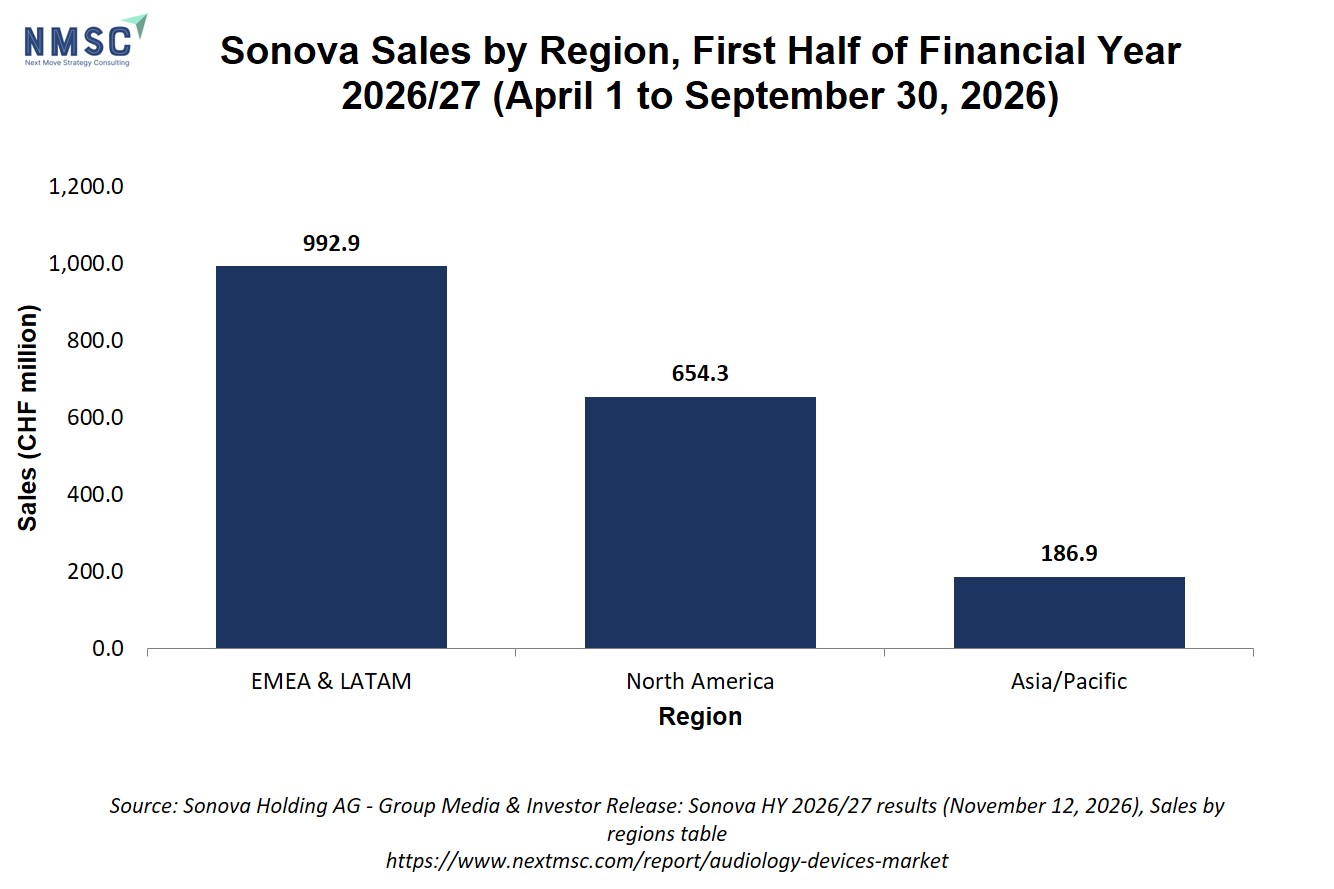
In the six months to September 30, 2026, Sonova reported sales of CHF 992.9 million in EMEA and LATAM, CHF 654.3 million in North America and CHF 186.9 million in Asia/Pacific. In local currencies, sales grew 6.8%, 7.5% and 11.4% respectively, so the smallest region delivered the fastest growth.
Demant's Interim Report 2026 offers a second, independent view across the full hearing healthcare value chain. Hearing Aids and Diagnostics grew organically by 9% and 6% respectively, while Hearing Care combined 6% organic growth with 23% acquisitive growth, so that group revenue reached DKK 12,913 million.
Demant Revenue by Business Area, First Half of 2026
|
Business area |
H1 2026 (DKK million) |
H1 2025 (DKK million) |
Organic growth |
Acquisitive growth |
|
Hearing Aids, external revenue |
5,153 |
4,914 |
9% |
-1% |
|
Hearing Care |
6,538 |
5,149 |
6% |
23% |
|
Diagnostics |
1,222 |
1,190 |
6% |
0% |
|
Group |
12,913 |
11,253 |
7% |
10% |
Guidance revisions complete the picture. Both Sonova and Demant raised their full-year outlooks and lifted their hearing aid market growth assumptions.
Guidance and Market Assumption Upgrades, 2026
|
Company |
Metric |
Previous |
Current |
Date of revision |
|
Sonova Holding AG |
Sales growth guidance, 2026/27 (local currencies) |
5-8% |
6-8% |
November 12, 2026 |
|
Sonova Holding AG |
Core EBIT growth guidance, 2026/27 (local currencies) |
7-10% |
10-13% |
November 12, 2026 |
|
Sonova Holding AG |
Global hearing aid market growth assumption, 2026/27 |
2-4% |
3-5% |
November 12, 2026 |
|
Demant A/S |
Organic growth outlook, 2026 |
3-6% |
6-7%, then 7-8% |
August 11, 2026 and October 9, 2026 |
|
Demant A/S |
Hearing aid market value growth, 2026 |
3-4% |
4-5% most likely |
November 3, 2026 |
Future Outlook & Forecast: Audiology Devices Market Trajectory to USD 15.06 Billion
NextMSC projects the audiology devices market to reach USD 15.06 billion by 2030, up from USD 9.67 billion in 2023, at a CAGR of 6.5% from 2024 to 2030. While Demant estimates global hearing aid value growth of 4-5% in 2026 after a 7% increase in the third quarter, and Sonova assumes market growth of 3-5% for 2026/27, NextMSC's model, which combines top-down and bottom-up approaches with techniques including multilinear regression, exponential smoothing, ARIMA and Monte Carlo simulation, covers a wider device scope than hearing aids alone, so the figures are not directly comparable.
Company guidance points to continued expansion into 2027. Sonova raised its 2026/27 guidance to sales growth of 6-8% and core EBIT growth of 10-13% in local currencies, Demant guides to 7-8% organic growth for 2026, and Cochlear expects low single-digit constant currency sales growth in FY27.
Several dated catalysts will test the forecast over the next two quarters. The Amplifon and GN closing is expected by December 31, 2026. Samsung targets a US rollout of its Galaxy Buds hearing aid feature in the fourth quarter of 2026, and Cochlear's Osia 3 Sound Processor has received FDA and CE Mark approval. Starkey's Omega AI+ has also been named a CES 2027 Innovation Awards honoree.
Three risks could slow the path. Demant estimates that US managed care volumes kept declining in the third quarter. Implant markets face pricing resets from reimbursement reform in China. Connected devices carry cybersecurity exposure: HearingTracker reported on November 4, 2026 that WS Audiology was investigating a cybersecurity incident affecting IT systems, and on November 6, 2026 that core functions of the Widex MOMENT app had been restored.
Section Summary:
The audiology devices market enters 2027 with company guidance, regulatory clearances and consolidation all pointing toward continued expansion, while managed care weakness, reimbursement resets and cybersecurity remain the principal constraints.
-
NextMSC projects USD 15.06 billion by 2030 at a CAGR of 6.5% from 2024 to 2030.
-
Sonova, Demant and Cochlear all guide to positive growth for their current fiscal years.
-
The Amplifon and GN closing and the Samsung and Meta rollouts are the next measurable catalysts.
-
Managed care weakness, China reimbursement and cyber incidents are the main downside risks.
Next Steps for Stakeholders
The 2026 evidence supports a set of concrete actions for decision-makers across the audiology devices market:
-
Manufacturers: protect research and development budgets for power-efficient AI silicon and Auracast connectivity, and time platform launches to replacement-cycle demand, as Phonak EON and Oticon Reveal did in the third quarter.
-
Hearing care retailers: build a defined pathway from over-the-counter and consumer-device users to professional fitting, because Samsung, Meta and Apple are expanding the first step of that journey.
-
Implant manufacturers: invest in medical referral channels, since Cochlear reports that only 40% of US adult cochlear implant referrals come from medical or professional sources.
-
Investors: track US commercial unit growth after Demant's 8% third-quarter estimate, the Amplifon and GN closing, and the Samsung and Meta launches before adjusting 2027 assumptions.
-
Chief information and security officers: audit app, cloud and remote-fitting dependencies in connected hearing devices after the WS Audiology incident of November 2026.
Conclusion
The audiology devices market is being redefined by neural-network hearing aids, consumer devices cleared as hearing aids and a wave of channel consolidation. NextMSC's forecast of USD 15.06 billion by 2030 at a 6.5% CAGR is supported by the direction of company guidance, regulatory clearances and market growth estimates in 2026, although the strongest advantage will belong to the organizations that combine competitive AI platforms with control of the fitting relationship.
About the Author
 Priyanshu Das
— Priyanshu Das is SEO Executive at Next Move Strategy Consulting, where he has led on-page and off-page SEO, keyword research, and SEO audits for the firm's B2B market research publications for 2 years. His audit process combines technical crawl analysis, backlink profile review, and competitor keyword gap mapping — using tools including Screaming Frog and Google Search Console — to prioritize fixes by organic search-visibility impact, informed by his own prior in-house and agency SEO experience.
About the Reviewer
 Sanyukta Deb
— Sanyukta Deb is Digital Marketing Team Lead at Next Move Strategy Consulting, where she has led content strategy and technical SEO for the firm's B2B market research publications for over 2 years. Her editorial process translates NextMSC's primary and secondary research — spanning technology, industrial, and consumer sectors — into commercial narratives, backed by search-intent, keyword, and competitive analysis. She brings 5 years of overall experience in digital marketing and content strategy.













Add Comment