Care Diagnostics Market Size & Share: $84.3Bn, 8.7% CAGR | NextMSC
Introduction
The global care diagnostics industry is undergoing a structural transformation — one driven not by incremental product upgrades, but by the convergence of artificial intelligence, decentralized testing infrastructure, and a chronic disease burden that is reshaping healthcare delivery at its foundation. According to Next Move Strategy Consulting's Care Diagnostics Market report, the global care diagnostics market was valued at USD 47.0 billion in 2023 and is projected to reach USD 84.3 billion by 2030, growing at a CAGR of 8.7% from 2024 to 2030.
This trajectory is not incidental. The World Health Organization reports that noncommunicable diseases (NCDs) — the primary demand engine for diagnostic services — killed at least 43 million people in 2021, accounting for 75% of all non-pandemic-related deaths globally. As chronic conditions including cardiovascular disease, diabetes, and cancer continue to escalate in both incidence and complexity, the pressure on diagnostic systems to deliver faster, more accurate, and more accessible results has never been greater. The market's response — from billion-dollar M&A activity to AI-powered imaging clearances — signals that care diagnostics is entering a period of accelerated, structurally supported growth.
For More Information: Download FREE Sample on Care Diagnostics Market Report
Abbott's $21 Billion Bet and the AI Imaging Revolution Reshaping Care Diagnostics
The Landmark Acquisition That Redrew the Oncology Diagnostics Map
On March 23, 2026, Abbott Laboratories completed its acquisition of Exact Sciences for approximately USD 21 billion — the largest diagnostics-sector M&A transaction of the decade. Exact Sciences, the maker of Cologuard — the leading non-invasive colorectal cancer screening test — brought with it a commercially validated liquid biopsy and multi-cancer early detection (MCED) platform that Abbott could not have built organically within the same timeframe. The deal was announced in August 2025 and closed in Q1 2026 following shareholder and regulatory approvals.
The strategic logic is precise: Abbott's existing diagnostics infrastructure — spanning point-of-care (POC) instruments, immunoassay platforms, and a global commercial network — now integrates Exact Sciences' molecular oncology capabilities. The combined entity positions Abbott as the dominant player across the full cancer diagnostics continuum, from early screening to treatment monitoring. This is not a portfolio diversification move; it is a direct response to the growing clinical and payer demand for non-invasive, early-stage cancer detection tools that can be deployed outside hospital settings.
The acquisition also signals a broader industry shift: care diagnostics is moving from disease confirmation to disease interception. As Abbott's Q1 2026 earnings release noted, the Exact Sciences integration is expected to "strengthen Abbott's growth profile and establish the company as a leader in the oncology diagnostics segment."
Siemens Healthineers' Optiq AI Imaging Chain: FDA Clearance Redefines Interventional Diagnostics
Simultaneously, on May 12, 2026, Siemens Healthineers received FDA clearance for six new systems in its Artis interventional imaging portfolio, each equipped with the Optiq AI Imaging Chain. The Optiq AI system applies real-time AI optimization and deep-learning noise reduction across fluoroscopy, acquisition, and roadmap imaging modes — delivering consistent image quality independent of patient anatomy or clinical setting.
This clearance is significant for the care diagnostics market because it demonstrates that AI is no longer a supplementary feature in imaging — it is now the core architecture. The Optiq AI chain reduces radiation dose while maintaining diagnostic image quality, directly addressing one of the most persistent clinical and regulatory barriers to broader imaging adoption.
NMSC Strategic Perspective: AI as a Structural Market Expander, Not a Feature Add-On
NextMSC primary research and analysis identifies AI integration as the single most consequential structural driver of care diagnostics market expansion through 2030. The mechanism is specific: AI-enabled diagnostic platforms reduce the per-test cost of high-complexity imaging and molecular analysis, which lowers the clinical threshold for ordering diagnostic tests and expands the addressable patient population beyond those presenting with acute symptoms.
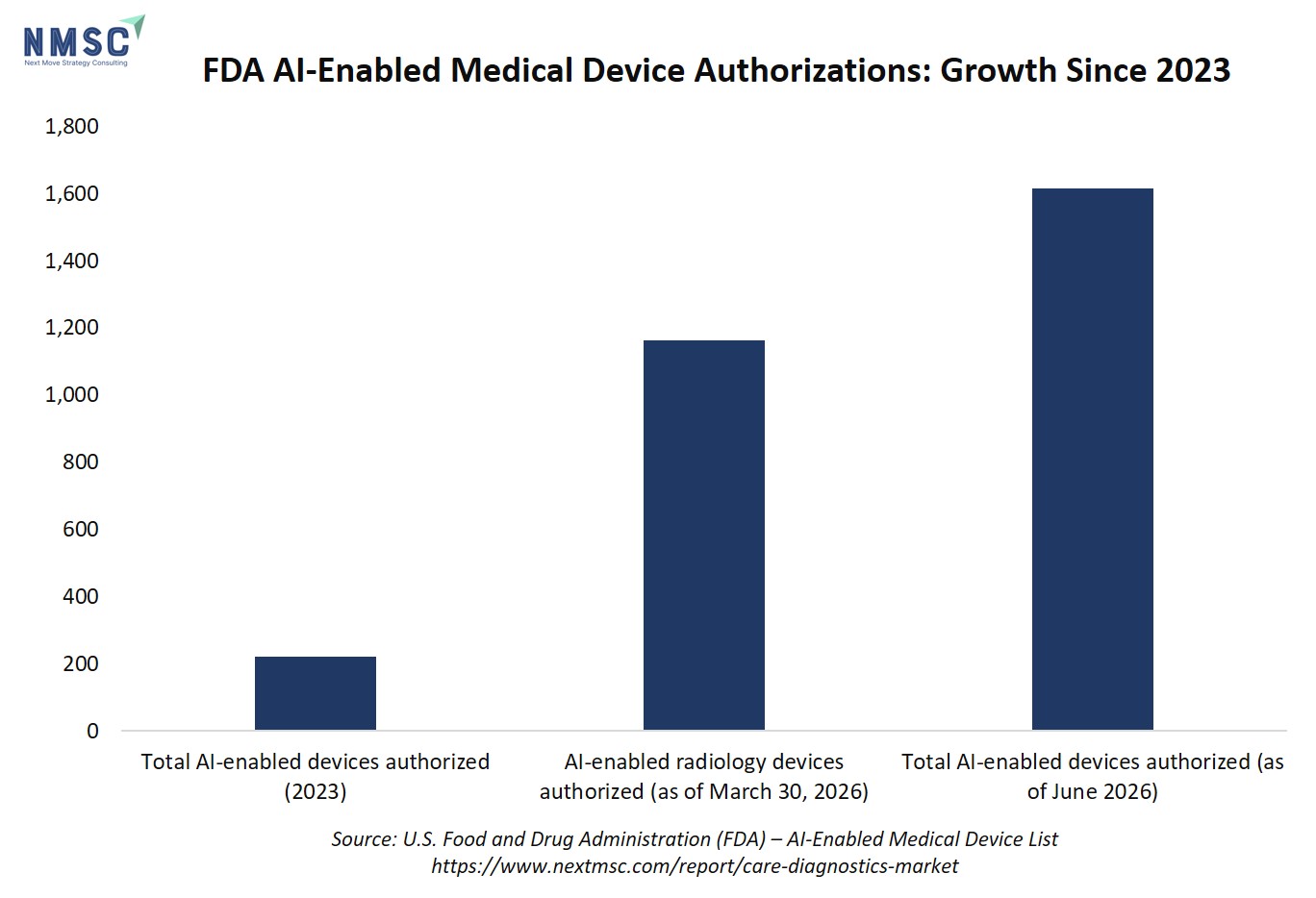
The FDA's own data corroborates this trajectory. As of September 2026, the FDA has authorized over 1,600 AI-enabled medical devices for marketing in the United States, with radiology accounting for the dominant share of authorizations. The FDA maintains the AI-enabled medical-device list, but avoid directly translating authorization counts into market expansion without supporting evidence. This regulatory momentum directly expands the commercial opportunity for AI-integrated diagnostic devices across hospitals, diagnosis centers, and decentralized care settings — all three of the primary end-user segments tracked in NMSC's care diagnostics market model.
Section Summary: The care diagnostics market is being reshaped by two simultaneous forces — consolidation through landmark M&A and regulatory validation of AI-powered diagnostic tools.
Key Takeaways:
-
Abbott's USD 21 billion acquisition of Exact Sciences, completed March 23, 2026, establishes a new competitive benchmark in oncology diagnostics and non-invasive cancer screening.
-
Siemens Healthineers' FDA clearance for six Artis interventional systems with Optiq AI (May 2026) demonstrates that AI is now the foundational architecture of next-generation imaging diagnostics.
-
The FDA has authorized 1,614 AI-enabled medical devices as of June 2026, with radiology accounting for the majority — directly expanding the addressable market for AI-integrated diagnostic platforms.
-
NextMSC analysis identifies AI integration as a structural market expander that lowers the clinical threshold for diagnostic testing, broadening the patient population served by care diagnostics providers.
Industry Impact Analysis
Chronic Disease Burden: The Non-Negotiable Demand Driver
The demand foundation for care diagnostics is anchored in an irreversible demographic and epidemiological reality. The WHO projects that the global population aged 60 and above will rise from 12% in 2015 to 22% by 2050 — a demographic cohort that carries disproportionately high rates of cardiovascular disease, diabetes, cancer, and respiratory conditions, all of which require ongoing diagnostic monitoring. The OECD's Health at a Glance 2025 report confirms that OECD countries allocated an average of 9.3% of GDP to health expenditure in 2024 — above the pre-pandemic average of 8.8% — with average per-capita health spending reaching nearly USD 6,000 when adjusted for purchasing power.
This sustained elevation in health spending is not a post-pandemic anomaly — it reflects a structural recalibration of public and private healthcare budgets toward chronic disease management, early detection, and preventive diagnostics. Each percentage point of GDP directed toward health infrastructure translates into expanded procurement of diagnostic devices, reagents, and digital health platforms.
Decentralization of Diagnostics: From Hospital Corridors to Pharmacy Counters
IQVIA MedTech's January 2026 analysis of the POC diagnostics landscape identifies decentralized testing as "the new norm," with homes, pharmacies, and workplaces now functioning as distributed diagnostic hubs delivering results within minutes. Across the U.S. and Canada, pharmacies now routinely conduct flu, strep, and COVID-19 tests under CLIA waiver certification — a regulatory framework that has permanently expanded the geographic and institutional footprint of care diagnostics beyond traditional hospital and laboratory settings.
This decentralization has a direct market-size implication: it multiplies the number of testing touchpoints, increases testing frequency per patient, and creates new revenue streams for diagnostic device manufacturers in the retail and direct-to-consumer channels. For the care diagnostics market, which NMSC segments across hospitals, diagnosis centers, and "others" (a category that now increasingly encompasses pharmacy chains, telehealth platforms, and employer wellness programs), this structural shift is expanding the total addressable market beyond what hospital-centric demand models would project.
Regulatory Frameworks Accelerating, Not Constraining, Innovation
The Emergency Use Authorization (EUA) framework deployed during the COVID-19 pandemic demonstrated that regulatory bodies could act with speed without compromising safety standards. In response, authorities in Europe, Asia, and North America are now piloting "agile review" models for POC and wellness diagnostics, according to IQVIA MedTech's January 2026 analysis. The FDA's AI-enabled device authorization pipeline — which added 68 new radiology algorithms in the period ending March 30, 2026, bringing the radiology-specific total to 1,163 — is the most concrete evidence of this accelerated regulatory posture.
Data Privacy Regulations: The Persistent Headwind
The primary restraint on care diagnostics market growth is not technological or clinical — it is regulatory in a different dimension: data privacy and security. As diagnostic platforms become increasingly connected — syncing results with electronic health records, cloud-based analytics engines, and public health surveillance systems — they generate patient data at a scale and sensitivity that attracts stringent regulatory scrutiny under frameworks including HIPAA in the U.S., GDPR in Europe, and equivalent national legislation across Asia-Pacific. Compliance costs, data localization requirements, and liability exposure for data breaches create friction in the deployment of connected diagnostic platforms, particularly for smaller manufacturers and emerging-market operators.
Section Summary: The care diagnostics industry is being shaped by a convergence of chronic disease epidemiology, healthcare spending elevation, decentralized testing infrastructure, and an accelerating AI regulatory pipeline — with data privacy compliance remaining the primary structural constraint.
Key Takeaways:
-
OECD countries allocated an average of 9.3% of GDP to health in 2024, sustaining elevated procurement budgets for diagnostic devices and platforms.
-
Pharmacy-based and home-based testing has permanently expanded the institutional footprint of care diagnostics beyond hospitals and centralized laboratories.
-
The FDA authorized 1,163 AI-enabled radiology devices as of March 2026, reflecting a regulatory posture that is actively enabling, rather than constraining, diagnostic innovation.
-
Data privacy compliance — under HIPAA, GDPR, and equivalent frameworks — remains the most significant operational headwind for connected diagnostic platform deployment.
Pros and Cons of Recent Market Developments
|
Development |
Pros |
Cons |
|
Abbott's USD 21B Exact Sciences Acquisition (March 2026) |
Establishes a vertically integrated oncology diagnostics leader; accelerates non-invasive cancer screening adoption globally |
Significant integration risk; potential for reduced competitive pricing pressure in the MCED segment |
|
Siemens Healthineers Optiq AI FDA Clearance (May 2026) |
AI-driven noise reduction lowers radiation dose while maintaining image quality; expands clinical utility of interventional imaging |
High capital cost of AI-integrated imaging systems limits adoption in resource-constrained settings |
|
FDA's 1,600+ AI-Enabled Device Authorizations |
Regulatory validation accelerates commercial deployment; builds clinician and payer confidence in AI diagnostics |
Rapid authorization pace raises post-market surveillance concerns; algorithm bias risks in underrepresented patient populations |
|
Decentralization of POC Testing (Pharmacy/Home) |
Expands testing access; increases testing frequency; creates new revenue channels for device manufacturers |
Quality control variability outside laboratory settings; risk of misinterpretation of self-administered test results |
|
Agile Regulatory Review Models (EU, Asia, North America) |
Shortens time-to-market for innovative diagnostic platforms; encourages R&D investment |
Compressed review timelines may increase post-market safety monitoring burden on manufacturers and regulators |
|
Rising Healthcare Expenditure (OECD avg. 9.3% of GDP) |
Sustained public and private procurement budgets support diagnostic infrastructure investment |
Fiscal pressure in high-debt economies may trigger reimbursement cuts that compress diagnostic pricing |
Key Industry Benchmarks — Care Diagnostics Market (Institutional Sources, 2025–2026)
|
Indicator |
Figure |
Source |
Year |
|
Global NCD-related deaths annually |
43 million (75% of non-pandemic deaths) |
World Health Organization |
2021 data, published 2025 |
|
Global population aged 60+ (projected) |
22% of world population by 2050 (up from 12% in 2015) |
World Health Organization |
2022/2025 |
|
OECD average health expenditure as % of GDP |
9.3% |
OECD Health at a Glance 2025 |
2024 estimate |
|
OECD average per-capita health spending |
~USD 6,000 (PPP-adjusted) |
OECD Health at a Glance 2025 |
2024 estimate |
|
FDA-authorized AI-enabled medical devices |
1,614 (as of June 2026) |
U.S. Food and Drug Administration |
June 2026 |
|
FDA-authorized AI radiology devices |
1,163 (as of March 2026) |
Radiology Business / FDA |
March 2026 |
|
Abbott–Exact Sciences acquisition value |
USD 21 billion |
Abbott Laboratories official announcement |
March 2026 |
|
POC diagnostics market CAGR (global) |
6–7% |
IQVIA MedTech |
January 2026 |
Future Outlook & Forecast
NMSC Forecast: USD 84.3 Billion by 2030
NextMSC proprietary research and analysis projects the global care diagnostics market to reach USD 84.3 billion by 2030, growing at a CAGR of 8.7% from 2024. This growth trajectory is underpinned by three converging forces that NMSC's model weights as primary: the accelerating chronic disease burden (particularly in Asia-Pacific, where cancer incidence in India alone is projected to rise 12.8% by 2025 relative to 2020 levels), the structural expansion of AI-integrated diagnostic platforms validated by the FDA's 1,614-device authorization pipeline, and the sustained elevation of healthcare expenditure across OECD economies.
North America: Sustained Dominance Through Infrastructure Investment
North America holds the dominant share of the care diagnostics market and is expected to maintain this position through 2030. The Healthcare Information and Management Systems Society (HIMSS) has documented a USD 36.7 billion commitment to public health infrastructure investment over a ten-year horizon, specifically targeting the modernization of diagnostic facilities and the adoption of advanced diagnostic technologies. The U.S. population aged 65 and older is projected to grow from 58 million in 2022 to 82 million by 2050 — a 47% increase that will sustain demand for chronic disease monitoring, imaging, and genetic testing services across the forecast period, according to the Population Reference Bureau.
Asia-Pacific: The Fastest-Growing Diagnostic Frontier
Asia-Pacific is positioned as the fastest-growing regional market, driven by rising cancer and diabetes incidence, expanding government-private sector collaboration in diagnostic manufacturing, and a growing middle-class population with increasing access to private healthcare. The Government of India's Production Linked Incentive (PLI) scheme — under which Siemens Healthineers established an MRI manufacturing facility in Bengaluru in April 2023 — exemplifies the policy-driven manufacturing localization that is reducing diagnostic device costs and expanding access across the region.
The Next Competitive Frontier: Multiplex Molecular Diagnostics and Biosensor Innovation
IQVIA MedTech's January 2026 analysis identifies portable PCR systems, multiplex platforms, and nanotechnology-based biosensors as the next wave of POC diagnostic innovation — platforms that will compress laboratory-grade molecular analysis into near-patient, chip-scale formats. For the care diagnostics market, this means the imaging and blood test segments — currently the dominant test-type categories — will face increasing competition from molecular and genetic testing modalities as cost curves decline and regulatory pathways mature.
Section Summary: The care diagnostics market's path to USD 84.3 billion by 2030 is supported by a convergence of demographic, technological, and policy-level tailwinds, with North America sustaining dominance and Asia-Pacific emerging as the highest-growth regional opportunity.
Key Takeaways:
-
NMSC projects the care diagnostics market to reach USD 84.3 billion by 2030 at an 8.7% CAGR, driven by chronic disease prevalence, AI platform adoption, and sustained healthcare expenditure.
-
North America's USD 36.7 billion public health infrastructure commitment and a projected 47% growth in the 65+ population sustain its market leadership position.
-
Asia-Pacific's government-private manufacturing partnerships — exemplified by Siemens Healthineers' PLI-scheme MRI facility in India — are reducing device costs and expanding diagnostic access.
-
Multiplex molecular diagnostics and biosensor platforms represent the next competitive frontier, with the potential to shift market share from traditional imaging and blood test segments.
Next Steps for Stakeholders
For C-Level Executives at Diagnostic Device Manufacturers:
The Abbott–Exact Sciences transaction has reset the competitive baseline in oncology diagnostics. Manufacturers without a credible non-invasive cancer screening or liquid biopsy capability now face a structural gap. Executives should evaluate whether organic R&D timelines are compatible with the market's pace of consolidation, or whether targeted acquisitions or licensing agreements in the MCED space are necessary to maintain competitive positioning.
For Healthcare System Administrators and Hospital Procurement Leaders:
The FDA's authorization of 1,614 AI-enabled medical devices — with radiology accounting for 1,163 — means that AI-integrated diagnostic platforms are no longer experimental; they are commercially available and clinically validated. Procurement strategies should prioritize platforms with demonstrated interoperability with existing EHR systems and cloud-based analytics infrastructure, as connectivity is now a baseline requirement, not a premium feature.
For Institutional Investors and Private Equity:
The care diagnostics market's 8.7% CAGR through 2030, as projected by NMSC, is supported by non-cyclical demand drivers — chronic disease burden and demographic aging — that are insulated from macroeconomic volatility. The most attractive investment theses are in AI-native diagnostic software companies with FDA-cleared algorithms, decentralized POC platform manufacturers with pharmacy-channel distribution, and Asia-Pacific diagnostic infrastructure plays benefiting from government PLI-equivalent schemes.
For Regulatory Affairs and Compliance Teams:
The FDA's agile review posture for AI-enabled devices creates a faster path to market but also elevates post-market surveillance obligations. Teams should build proactive real-world evidence (RWE) collection frameworks into product launch plans from day one, particularly for AI algorithms deployed in radiology and oncology diagnostics, where algorithm performance drift in diverse patient populations is a documented regulatory concern.
For Market Entrants and Emerging-Market Operators:
Data privacy compliance — HIPAA, GDPR, and national equivalents — is the most underestimated barrier to scaling connected diagnostic platforms. Regulatory compliance architecture should be built into product design at the component level, not retrofitted post-launch. Partnerships with established local healthcare networks in Asia-Pacific and Latin America can accelerate market entry while distributing compliance risk.
Conclusion
The care diagnostics market is not simply growing — it is being structurally redefined. Abbott's USD 21 billion acquisition of Exact Sciences has established a new competitive standard in oncology diagnostics. Siemens Healthineers' FDA-cleared Optiq AI Imaging Chain has demonstrated that AI is now the foundational architecture of interventional imaging, not an optional enhancement. And the FDA's authorization of more than 1,600 AI-enabled medical devices has provided the regulatory validation that institutional buyers require before committing capital to next-generation diagnostic platforms.
Against this backdrop, NextMSC proprietary research and analysis projects the global care diagnostics market to grow from USD 47.0 billion in 2023 to USD 84.3 billion by 2030 — a trajectory supported by the irreversible epidemiological reality of a world in which NCDs account for 75% of non-pandemic deaths, OECD health expenditure has stabilized above 9.3% of GDP, and the global population aged 60 and above is on course to represent 22% of humanity by 2050. For executives, investors, and policymakers, the strategic imperative is clear: the window to establish leadership positions in AI-integrated, decentralized, and oncology-focused care diagnostics is open — and it will not remain so indefinitely.
About the Author
 Sanyukta Deb
— Sanyukta Deb is Digital Marketing Team Lead at Next Move Strategy Consulting, where she has led content strategy and technical SEO for the firm's B2B market research publications for over 2 years. Her editorial process translates NextMSC's primary and secondary research — spanning technology, industrial, and consumer sectors — into commercial narratives, backed by search-intent, keyword, and competitive analysis. She brings 5 years of overall experience in digital marketing and content strategy.
Sanyukta Deb
— Sanyukta Deb is Digital Marketing Team Lead at Next Move Strategy Consulting, where she has led content strategy and technical SEO for the firm's B2B market research publications for over 2 years. Her editorial process translates NextMSC's primary and secondary research — spanning technology, industrial, and consumer sectors — into commercial narratives, backed by search-intent, keyword, and competitive analysis. She brings 5 years of overall experience in digital marketing and content strategy.
About the Reviewer
 Debashree Dey
— Debashree Dey is Assistant Manager at Next Move Strategy Consulting, where she supports cross-vertical market content and communications across diverse industries for 6 years. Her professional background includes senior content writing, communications, and published manuscript authorship, with experience developing audience-focused business narratives and maintaining clear, consistent messaging. Her role supports research-led content development and editorial quality across NextMSC publications.
Debashree Dey
— Debashree Dey is Assistant Manager at Next Move Strategy Consulting, where she supports cross-vertical market content and communications across diverse industries for 6 years. Her professional background includes senior content writing, communications, and published manuscript authorship, with experience developing audience-focused business narratives and maintaining clear, consistent messaging. Her role supports research-led content development and editorial quality across NextMSC publications.
















Add Comment