Coffee Packaging Market: Trends & Forecasts for 2026
Introduction
The global coffee packaging market is navigating one of its most consequential regulatory and technological transitions in decades. As of August 12, 2026, the European Union's Packaging and Packaging Waste Regulation (PPWR) has entered into application — a landmark policy shift that is already compelling roasters, converters, and brand owners worldwide to fundamentally reassess their packaging material strategies, laminate constructions, and end-of-life compliance frameworks. For an industry that serves one of the world's most universally consumed beverages, the implications are both immediate and far-reaching.
The Coffee Packaging Market sits at the intersection of several powerful forces: rising global coffee consumption, accelerating premiumization, the structural shift toward sustainable materials, and the growing complexity of omnichannel retail and e-commerce logistics. According to Next Move Strategy Consulting, the global coffee packaging market was valued at USD 3.29 billion in 2025 and is expected to reach USD 3.44 billion in 2026, with the industry projected to expand significantly to USD 4.95 billion by 2035, registering a CAGR of 4.66% from 2026 to 2035. For C-level executives, investors, and packaging strategists, understanding the forces reshaping this market is no longer optional — it is a prerequisite for competitive positioning.
For More Information: Download FREE Sample on Coffee Packaging Market Report
The EU PPWR Goes Live: The Most Consequential Regulatory Shift for the Coffee Packaging Market in 2026
A Regulatory Watershed Moment — August 12, 2026
On August 12, 2026, the European Union's Packaging and Packaging Waste Regulation (PPWR) — formally designated as Regulation (EU) 2025/40 — began applying across all EU member states, marking the most significant overhaul of European packaging law in a generation. The regulation entered into force in February 2025 and its rules are now being applied on a phased basis, with the first critical measure — a strict restriction on per- and polyfluoroalkyl substances (PFAS) in food-contact packaging — taking immediate effect.
PFAS — commonly known as "forever chemicals" — have historically been used in food packaging such as takeaway containers, fast-food wrappers, microwave popcorn bags, and bakery paper to repel water or grease. From August 12, 2026, food-contact packaging containing PFAS above strict limits can no longer be placed on the EU market. For the coffee packaging industry, this restriction has direct implications for certain barrier coatings and specialty paper-based formats used in coffee pod secondary packaging, takeaway cup liners, and food-service coffee packaging.
The PPWR's phased implementation timeline is equally critical for strategic planning:
-
August 12, 2026 (Now in effect): PFAS restrictions in food-contact packaging; harmonized EU framework for packaging and packaging waste replaces fragmented national rules.
-
2028: A harmonized labeling system for packaging applies across the EU to facilitate waste sorting and increase recycling efficiency, expected to save the packaging industry several billion euros.
-
2030: Concrete measures to reduce packaging waste generation take effect — including new limits on empty space, restrictions on certain single-use plastic packaging, reuse targets, mandatory use of recycled plastic waste in new plastic packaging, and the requirement that all packaging is recyclable.
The urgency of this regulatory framework is underscored by the scale of the challenge. Without action, packaging waste in the EU was projected to grow by 19% by 2030, while plastic packaging waste could rise by as much as 46%. According to Eurostat data published in October 2025, the EU generated 79.7 million tonnes of packaging waste in 2023 — equivalent to 177.8 kg per inhabitant — with plastic accounting for 19.8% of total packaging waste generated, or 35.3 kg per person. The EU's plastic packaging waste recycling rate stood at 42.1% in 2023, up from 38.2% in 2013, but still well below the targets the PPWR is designed to achieve by 2030.
"The new Packaging and Packaging Waste Regulation is an investment in Europe's future: it will help reduce waste, increase recycling, make food-contact packaging safer for the consumers by limiting harmful substances such as PFAS, and reduce our dependence on virgin raw materials. These are essential steps towards a truly circular economy."
— Jessika Roswall, EU Commissioner for Environment, Water Resilience and a Competitive Circular Economy
Industry Response: Mono-Material Innovation and M&A Consolidation
The industry's response to the PPWR and broader sustainability imperatives has been swift and strategically significant. In October 2024, Mondi and Paulig jointly launched one of the world's first mono-material structures suitable for vacuum-packed coffee — a breakthrough that directly addresses the recyclability challenge inherent in traditional multi-layer laminates containing polyamide and aluminium layers. The new mono-material solution delivers the same protective qualities as conventional multi-material packaging — strong barriers, tightness, easy opening, and resealing — without the materials that make recycling difficult or impossible. Paulig's recyclable vacuum packaging uses nearly 20% less material than previous versions, and the solution has been available to consumers in Finland and Estonia since spring 2024.
On the consolidation front, Amcor plc completed its all-stock combination with Berry Global on April 30, 2025 — one of the most consequential M&A transactions in the global packaging industry in recent years. The combined entity is now positioned as a global leader in consumer and healthcare packaging solutions, with $650 million in identified synergies expected to be fully realized by the end of fiscal year 2028. In fiscal year 2026 alone, Amcor expects delivery of $260 million in pre-tax synergies, driving approximately 12% adjusted EPS accretion. The combination brings together material science and innovation capabilities that are directly relevant to the coffee packaging market's transition toward recyclable mono-materials and sustainable barrier films.
NMSC Strategic Perspective: Regulation as a Market Accelerator
From Next Move Strategy Consulting's analytical standpoint, the PPWR's entry into application on August 12, 2026 is not merely a compliance event — it is a structural market accelerator that will compress the timeline for mono-material adoption, reshape competitive dynamics among packaging converters, and create new investment opportunities across the sustainable packaging value chain.
The PPWR effectively transforms sustainability from a brand marketing differentiator into a hard legal requirement for market access across the EU's 27 member states. For coffee brands and roasters that export to Europe — or operate within it — the audit of current laminate constructions and the validation of mono-polyethylene alternatives on production lines is no longer a medium-term aspiration; it is an immediate operational imperative. NMSC's analysis indicates that companies that proactively invest in recyclable mono-material formats, certified degassing valve systems, and digital printing capabilities for short-run SKU flexibility will be best positioned to capture the premium and specialty coffee segments that are growing fastest across European and Asia-Pacific markets.
The Amcor-Berry Global combination further reinforces this thesis: scale, material science depth, and global manufacturing footprint are becoming decisive competitive advantages as the regulatory environment raises the technical and financial bar for sustainable packaging compliance. NMSC expects M&A activity in the coffee packaging converter space to remain elevated through 2028 as mid-tier players seek scale to absorb compliance costs and accelerate innovation pipelines.
Section Summary: The EU PPWR's entry into application on August 12, 2026 represents the most consequential regulatory development for the coffee packaging market in the current decade, compelling immediate material strategy reassessment across the value chain while simultaneously accelerating innovation in mono-material and sustainable packaging formats.
Key Takeaways:
-
The EU PPWR is now in application as of August 12, 2026, with PFAS restrictions in food-contact packaging taking immediate effect; recyclability mandates and reuse targets follow in 2030.
-
Without regulatory intervention, EU packaging waste was projected to grow 19% by 2030, with plastic packaging waste potentially rising 46% — the scale of the challenge that the PPWR is designed to address.
-
Mondi and Paulig's world-first mono-material vacuum coffee pack (October 2024) and Amcor's USD 8.4 billion acquisition of Berry Global (completed April 30, 2025) signal that the industry's leading players are already repositioning for the post-PPWR competitive landscape.
-
NMSC identifies the PPWR as a structural market accelerator that will compress mono-material adoption timelines and create new investment opportunities in sustainable packaging infrastructure across the EU and beyond.
Industry Impact Analysis
The coffee packaging market's growth trajectory is shaped by a confluence of supply-side pressures, demand-side premiumization trends, and regulatory forces that are simultaneously creating challenges and opportunities across every major end-user segment and geography.
Global Coffee Consumption: The Foundational Demand Driver
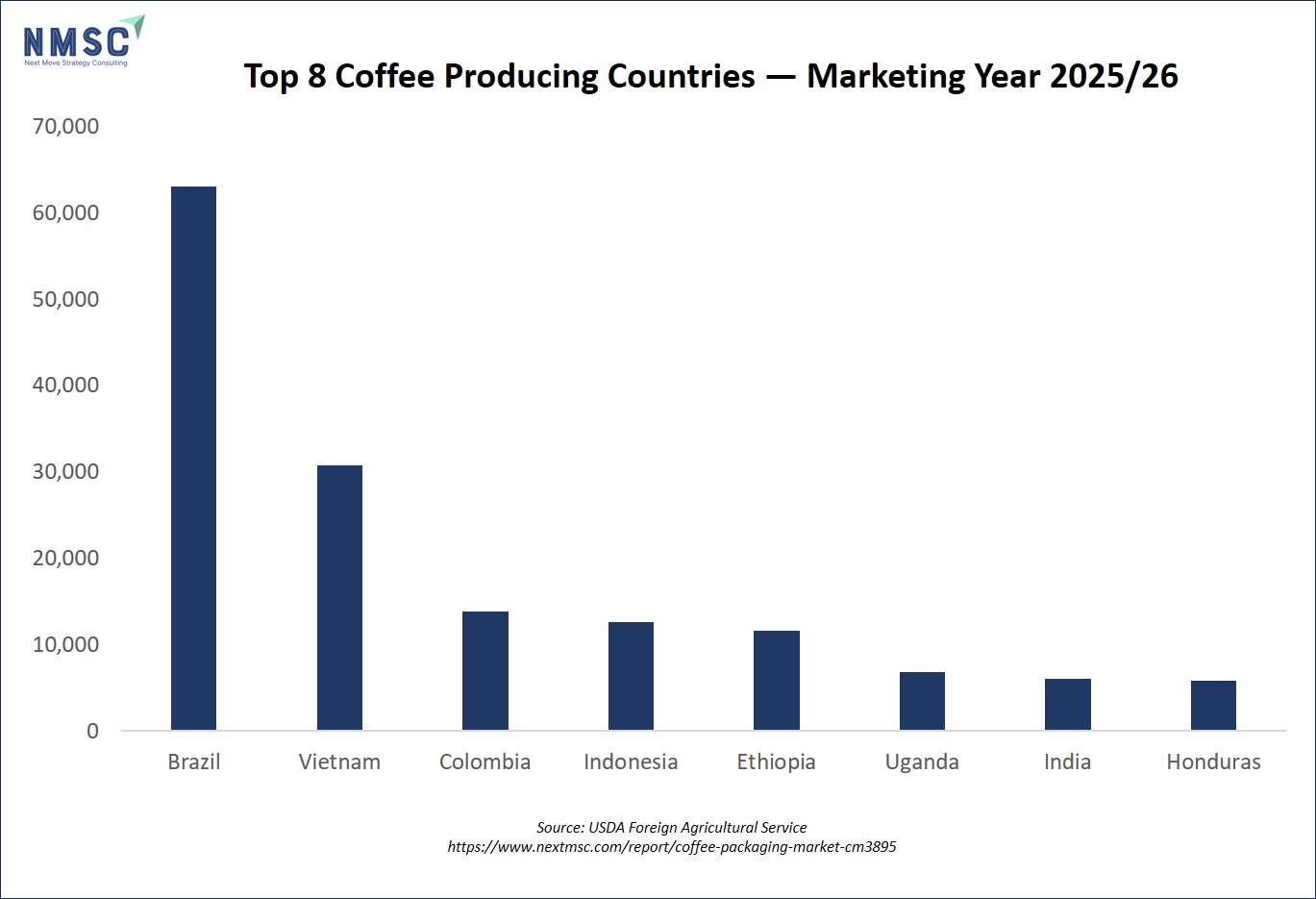
The primary engine of coffee packaging market growth is the sustained and broad-based expansion of global coffee consumption. According to the International Coffee Organization's June 2026 Monthly Coffee Market Report, global coffee consumption in coffee year 2024 reached 175,071 thousand 60-kg bags — a 1.4% increase from the prior year. Asia and Oceania recorded the strongest regional consumption growth at 7.4%, reaching 47,447 thousand bags, while Europe remained the largest consuming region at 53,552 thousand bags.
Global coffee production in coffee year 2024 reached 177,513 thousand bags — a 5.2% increase from the prior year — with Arabica production growing 4.5% to 102,065 thousand bags and Robusta production growing 6.2% to 75,448 thousand bags. This production growth, combined with rising consumption across non-producing countries, directly fuels demand for more sophisticated and diverse packaging solutions — from high-barrier valve pouches for specialty whole beans to moisture-proof sachets for instant coffee in emerging markets.
However, the ICO's June 2026 report also highlights significant supply-side volatility. The ICO Composite Indicator Price averaged 248.90 US cents/lb in June 2026, down 2.8% from May 2026, but rebounded sharply by 17.4% within the month following growing confidence that a Super El Niño event would develop by end-2026 — raising concerns about harvest disruptions across Brazil, Central America, and Southeast Asia. For packaging manufacturers, this price volatility in the underlying commodity reinforces the strategic importance of packaging as a value-preservation tool — protecting aroma, freshness, and quality across increasingly complex and extended supply chains.
Flexible Packaging: The Dominant Format Under Sustainability Pressure
Flexible packaging formats — particularly stand-up pouches, valve bags, and flat pouches — continue to dominate the coffee packaging market due to their superior barrier performance, lightweight logistics efficiency, and cost competitiveness. According to NMSC's segmentation analysis, pouches and bags collectively represent the largest share of the coffee packaging market by format, supported by wide acceptance among roasters of all scales and compatibility with both retail and e-commerce channels.
However, the PPWR's 2030 recyclability mandate is placing the dominant multi-layer laminate construction — which typically combines polyethylene, polyamide, and aluminium layers — under direct regulatory pressure. The transition to mono-material polyethylene pouches with certified recyclable degassing valves is now the central technical challenge for the flexible coffee packaging segment. Machine makers have introduced vertical baggers and valve applicators compatible with mono-polyethylene pouches, and certified recyclable valve systems have been demonstrated in live production runs, confirming that barrier and degassing function are retained while meeting recycling criteria.
Digital Printing: Enabling Specialty Coffee's Short-Run Revolution
The specialty coffee segment's rapid growth is creating structural demand for digital printing capabilities that enable short-run, high-quality, and rapidly iterable packaging designs. Digital flexible packaging reduces make-ready waste and enables on-demand pouches with full-color variable data — supporting traceability claims, limited-edition releases, and subscription-brand personalization. For small roasters and emerging brands, digital printing eliminates the high plate costs of analogue printing, making premium packaging economically viable at low minimum order quantities.
Asia-Pacific: The Fastest-Growing Regional Market
Asia-Pacific's coffee packaging market is expanding at the fastest rate globally, driven by rapid urbanization, expanding middle classes, and the accelerating adoption of café culture across China, India, South Korea, and Southeast Asia. The region's consumption growth of 7.4% in coffee year 2024 — the highest of any region globally — directly translates into packaging demand across a diverse range of formats: high-barrier pouches for specialty beans in China and Japan, portioned stick packs and sachets for emerging consumers in India and Indonesia, and robust chilled packaging for the RTD beverage segment growing across the region.
Section Summary: The coffee packaging market's industry impact is shaped by the convergence of rising global consumption, PPWR-driven material innovation, digital printing adoption, and Asia-Pacific's accelerating demand growth — each creating distinct but complementary opportunities for packaging manufacturers, converters, and investors.
Key Takeaways:
-
Global coffee consumption reached 175,071 thousand bags in coffee year 2024 (ICO), with Asia & Oceania recording the strongest regional growth at 7.4% — directly driving packaging demand across diverse formats.
-
Super El Niño concerns and supply-side volatility in 2026 reinforce the strategic importance of high-performance packaging in preserving coffee quality across extended and disrupted supply chains.
-
The transition from multi-layer laminates to mono-material polyethylene pouches with certified recyclable valves is the central technical challenge for the flexible coffee packaging segment ahead of the PPWR's 2030 recyclability mandate.
-
Digital printing is enabling specialty coffee brands to compete on packaging quality and design agility without the capital requirements of analogue printing — a structural democratization of premium packaging access.
Pros and Cons of Recent Market Developments
|
Recent Development |
Pros |
Cons |
|
EU PPWR Application (August 12, 2026) |
Creates a harmonized EU-wide framework, reducing compliance complexity for cross-border operators; drives innovation in recyclable materials; protects consumers from PFAS exposure; supports circular economy investment |
Significant adjustment costs for roasters and converters; 2030 recyclability mandates require capital investment in new production lines; recycling infrastructure gaps in many EU member states limit practical recyclability |
|
Mondi-Paulig Mono-Material Vacuum Coffee Pack |
World-first recyclable solution for vacuum-packed coffee; ~20% less material than previous versions; directly addresses PPWR compliance; preserves aroma and barrier performance |
Higher material cost vs. conventional multi-layer laminates; requires new machinery or retrofit kits; limited availability of certified recyclable valve systems at scale |
|
Amcor-Berry Global Merger (April 30, 2025) |
Creates a global packaging leader with enhanced R&D and material science capabilities; $650M in synergies by FY2028; broader product portfolio for coffee packaging customers |
Integration complexity and execution risk; potential reduction in supplier diversity for roasters; regulatory scrutiny in certain markets |
|
Digital Printing Adoption |
Enables short-run, cost-effective premium packaging for specialty roasters; supports traceability and batch-level QR coding; reduces make-ready waste and inventory write-offs |
Requires investment in digital pouch printing partnerships; color consistency across substrates remains a technical challenge; not yet cost-competitive for very high-volume commodity formats |
|
Single-Serve Pod and Capsule Growth |
Convenience-driven demand growth; premium price realization; strong brand loyalty in at-home brewing segment |
Sustainability concerns over single-use formats; recyclable and compostable pod alternatives face collection infrastructure gaps; higher per-unit packaging cost |
|
Bioplastics Adoption |
Reduces reliance on petroleum-based plastics; supports ESG reporting and brand sustainability credentials; aligns with PPWR circular economy objectives |
Higher cost than conventional plastics; limited industrial composting infrastructure in many markets; performance gaps in barrier properties for high-sensitivity coffee formats |
|
E-Commerce Channel Growth |
Expands addressable market for specialty and subscription coffee brands; drives demand for transit-durable, digitally printed short-run packaging |
Requires robust secondary packaging for damage prevention; increases packaging material use per unit; sustainability credentials of e-commerce packaging under consumer scrutiny |
Future Outlook & Forecast for the Coffee Packaging Market
NMSC Market Forecast: Steady Growth Anchored by Sustainability and Premiumization
According to Next Move Strategy Consulting's proprietary analysis, the global coffee packaging market is projected to grow from USD 3.44 billion in 2026 to USD 4.95 billion by 2035, at a CAGR of 4.66% during the forecast period 2026–2035. This steady growth trajectory reflects the market's dual character: a mature, high-volume commodity segment anchored by ground and instant coffee, and a rapidly expanding premium and specialty segment that commands higher packaging investment per unit and drives disproportionate innovation activity.
From a material segmentation perspective, plastic — particularly mono-polyethylene — is expected to maintain its dominant position through the forecast period, but with a fundamental shift in construction from multi-layer laminates to recyclable mono-material formats as the PPWR's 2030 recyclability mandate approaches. Paper and paperboard will gain share in secondary packaging and premium carton applications, supported by mature recycling infrastructure in Europe and North America. Bioplastics will transition from pilot applications to selective mainstream adoption, particularly in markets with established industrial composting infrastructure.
Smart Packaging, Traceability, and the Next Frontier of Differentiation
Beyond material innovation, the coffee packaging market's competitive frontier is increasingly defined by smart packaging capabilities. QR-enabled storytelling, freshness indicators, and supply-chain traceability features are gaining momentum — particularly for premium and specialty brands that use packaging as a vehicle for communicating origin, roast date, and ethical sourcing credentials. NMSC expects smart freshness indicators and traceability features to move from niche to mainstream within the forecast period, reshaping competitive differentiation in the premium and super-premium price tiers.
The UNIDO-ICO joint initiative to develop a global investment vehicle for sustainable packaging infrastructure and circular economy solutions in the coffee value chain represents a significant institutional catalyst for the market's long-term development. By channeling capital into mono-material recyclable film production, compostable pouch manufacturing, and take-back collection systems in both producing and consuming regions, this initiative directly addresses the infrastructure gaps that currently constrain the practical recyclability of coffee packaging at scale.
Supply-Side Risk: Super El Niño and Its Packaging Implications
The ICO's June 2026 report highlights a critical supply-side risk that carries direct implications for the coffee packaging market: growing confidence — at a 67% probability level, the highest on record — that a Super El Niño event will develop by end-2026. Super El Niño events are generally associated with reduced rainfall in Central America and Mexico, drought conditions in Southeast Asia, and erratic rainfall in East Africa — all major coffee-producing regions. For the packaging industry, sustained supply disruptions and elevated commodity prices reinforce the value proposition of high-performance packaging that extends shelf life, reduces waste, and protects quality across longer and more complex supply chains.
Section Summary: The coffee packaging market's future outlook is defined by the convergence of PPWR-driven material innovation, Asia-Pacific consumption growth, smart packaging adoption, and supply-side climate risks — all of which reinforce the strategic importance of packaging as a value-creation and risk-mitigation tool through 2035.
Key Takeaways:
-
NMSC projects the global coffee packaging market to reach USD 4.95 billion by 2035, growing at a CAGR of 4.66% from 2026 to 2035.
-
The PPWR's 2030 recyclability mandate will drive a fundamental shift from multi-layer laminates to mono-material polyethylene formats — the single most consequential material transition in the coffee packaging market's near-term future.
-
Smart packaging features — including QR traceability, freshness indicators, and digital provenance storytelling — are expected to transition from niche to mainstream within the forecast period, particularly in premium and super-premium segments.
-
Super El Niño supply risks, confirmed at a 67% probability by NOAA and the Japan Meteorological Agency in June 2026, reinforce the strategic value of high-performance, freshness-preserving packaging across extended and disrupted coffee supply chains.
Next Steps for Stakeholders
For C-Level Executives and Packaging Decision-Makers:
-
Conduct an Immediate PPWR Compliance Audit: With the PPWR now in application as of August 12, 2026, roasters and packaging buyers operating in or exporting to the EU must audit current laminate constructions for PFAS content and assess compliance pathways for the 2028 labeling and 2030 recyclability requirements. Engaging a certified packaging converter with demonstrated mono-material capabilities is a priority action.
-
Accelerate Mono-Material Transition Planning: The Mondi-Paulig mono-material vacuum coffee pack demonstrates that recyclable alternatives to conventional multi-layer laminates are technically viable at commercial scale. Executives should initiate pilot programs with mono-polyethylene pouches and certified recyclable valve systems to validate seal strength, barrier performance, and production line compatibility before the 2030 mandate creates a compliance bottleneck.
-
Invest in Digital Printing Capabilities: As specialty coffee and subscription models continue to grow, the ability to execute short-run, high-quality, and rapidly iterable packaging designs is becoming a competitive necessity. Partnerships with digital pouch printing facilities that offer finishing integration will reduce time-to-shelf and lower inventory write-off risk.
-
Diversify Supply Chain Exposure Ahead of Super El Niño: With a 67% probability of a Super El Niño event by end-2026, procurement teams should assess their exposure to coffee-producing regions most vulnerable to climate disruption — particularly Central America, Southeast Asia, and East Africa — and ensure that packaging specifications support extended shelf life and quality preservation across potentially longer and more complex supply chains.
For Investors:
-
Target the Mono-Material Converter Opportunity: Companies developing scalable mono-material recyclable film and pouch solutions for the coffee packaging market are positioned to capture disproportionate value as the PPWR's 2030 mandate creates a structural demand shift. Converters with certified recyclable valve systems and established relationships with major roasters represent particularly attractive investment targets.
-
Monitor the UNIDO-ICO Sustainable Packaging Investment Vehicle: The proposed global investment mechanism for sustainable packaging infrastructure in the coffee value chain represents an institutional-grade capital deployment opportunity. Investors with ESG mandates should track the development of this initiative as a potential co-investment or anchor opportunity in circular packaging infrastructure.
Conclusion
The global coffee packaging market in 2026 is defined by a regulatory watershed, a material innovation imperative, and a consumption growth story that spans every major geography. The EU PPWR's entry into application on August 12, 2026 has transformed sustainability from a brand aspiration into a legal requirement for market access — compelling immediate action from roasters, converters, and brand owners across the value chain. The Mondi-Paulig mono-material vacuum coffee pack and the Amcor-Berry Global merger signal that the industry's leading players are already repositioning for a post-PPWR competitive landscape defined by recyclability, material science depth, and scale.
According to Next Move Strategy Consulting, the global coffee packaging market is projected to reach USD 4.95 billion by 2035, growing at a CAGR of 4.66% from 2026 to 2035. For executives and investors, the strategic imperative is clear: organizations that invest proactively in mono-material innovation, digital printing capabilities, smart packaging traceability, and PPWR-compliant material strategies will be best positioned to capture the value creation opportunities this market offers across the forecast horizon.
About the Author
 Sanyukta Deb
— Sanyukta Deb is Digital Marketing Team Lead at Next Move Strategy Consulting, where she has led content strategy and technical SEO for the firm's B2B market research publications for over 2 years. Her editorial process translates NextMSC's primary and secondary research — spanning technology, industrial, and consumer sectors — into commercial narratives, backed by search-intent, keyword, and competitive analysis. She brings 5 years of overall experience in digital marketing and content strategy.
Sanyukta Deb
— Sanyukta Deb is Digital Marketing Team Lead at Next Move Strategy Consulting, where she has led content strategy and technical SEO for the firm's B2B market research publications for over 2 years. Her editorial process translates NextMSC's primary and secondary research — spanning technology, industrial, and consumer sectors — into commercial narratives, backed by search-intent, keyword, and competitive analysis. She brings 5 years of overall experience in digital marketing and content strategy.
About the Reviewer
 Debashree Dey
— Debashree Dey is Assistant Manager at Next Move Strategy Consulting, where she supports cross-vertical market content and communications across diverse industries for 6 years. Her professional background includes senior content writing, communications, and published manuscript authorship, with experience developing audience-focused business narratives and maintaining clear, consistent messaging. Her role supports research-led content development and editorial quality across NextMSC publications.
Debashree Dey
— Debashree Dey is Assistant Manager at Next Move Strategy Consulting, where she supports cross-vertical market content and communications across diverse industries for 6 years. Her professional background includes senior content writing, communications, and published manuscript authorship, with experience developing audience-focused business narratives and maintaining clear, consistent messaging. Her role supports research-led content development and editorial quality across NextMSC publications.














Add Comment