Coffee Packaging Market By Packaging Format {Pouch (Stand Up Pouch, Flat Pouch, and Others), Bag, Rigid Container, Sachet and Stick Pack, and Others}, By Material (Plastic, Paper and Paperboard, Metal, Glass, and Bioplastics), By Product Form (Whole Bean Coffee, Ground Coffee, and Instant Coffee), By Distribution Channel (Retail, Online, and Industrial), By Price Tier (Value Tier, Standard Tier, Premium Tier, and Super Premium Tier) – Global Analysis & Forecast, 2025–2035
Industry: Construction & Manufacturing | Publishing Date: December 17, 2025 | Last Updated: January 20, 2026 | No of Pages: N/A | No. of Tables: N/A | No. of Figures: N/A | Format: PDF | Report Code: CM3895
Industry Outlook
The global Coffee Packaging Market size was valued at USD 3.29 billion in 2025 and is expected to reach USD 3.44 billion by 2026. Looking ahead, the industry is projected to expand significantly, reaching USD 4.95 billion by 2035, registering a CAGR of 4.66% from 2026 to 2035.
The market today occupies a critical position within the global food and beverage landscape, driven by the continued rise of speciality coffee, expanding retail formats, and the increasing emphasis on product freshness. Packaging solutions serve varied applications, including whole bean, ground, instant, single-serve pods, and ready-to-drink formats, each requiring tailored barrier properties, closures, and material structures.
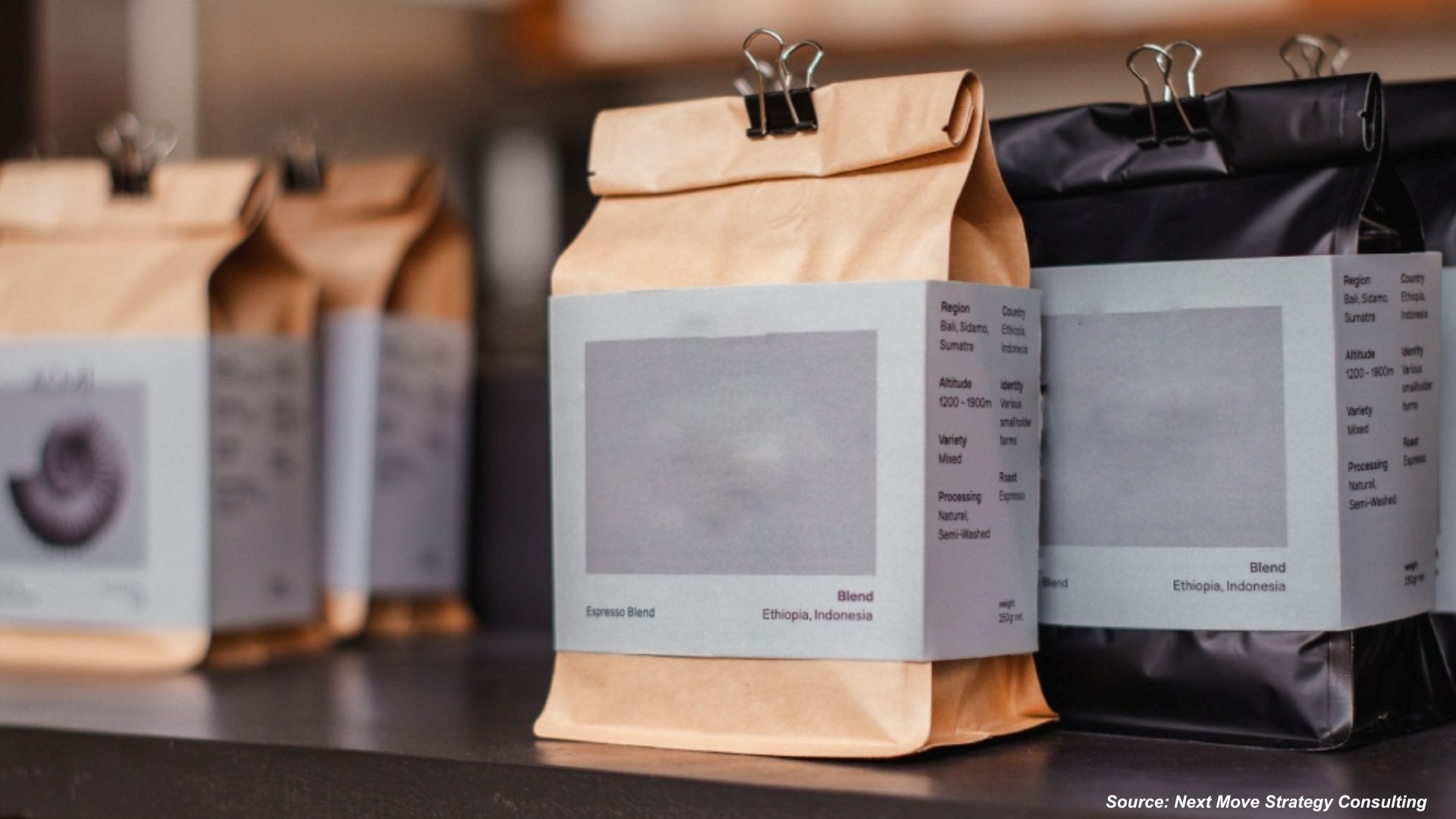
Brands are prioritizing functional features such as degassing valves, resealable systems, and lightweight flexible formats to preserve aroma and flavour while ensuring convenience for both retail and commercial users. With e-commerce growing, packaging also plays a central role in branding, shelf appeal, and safe product delivery.
Future prospects for the coffee packaging industry continue to expand as consumer expectations evolve toward sustainability, premiumization, and differentiated experiences. Companies are increasingly adopting recyclable mono-materials, compostable films, and reduced-plastic laminates to align with environmental goals. Digital printing and customizable short-run formats are enabling small roasters and emerging brands to compete with established players.
Meanwhile, automation and advanced filling technologies are enhancing efficiency across roasting, grinding, and dispensing operations. As consumption shifts toward speciality offerings and omnichannel retailing, the market is expected to see broader innovation in design, material science, and functional performance, reinforcing packaging as a strategic differentiator.

The above chart illustrates the global trend in coffee production and consumption from 2018/19 to 2023/24, showing that both figures are steadily rising, with occasional fluctuations in the balance between the two. As coffee consumption continues to approach or even surpass production levels in certain years, the demand for efficient, protective, and sustainable packaging also grows correspondingly. For the coffee packaging industry, this means expanding opportunities to innovate and scale up sustainable solutions, ensuring the safe transport and extended shelf life of coffee to match rising global consumption trends.
What Are the Key Trends in the Coffee Packaging Industry?
How are Sustainability and Regulation Reshaping the Coffee Packaging Market?
Sustainability is moving from brand marketing to hard rules that change which materials and formats are viable, and this is already forcing companies to rethink pack design. In the European Union, regulators expect packaging to be recyclable by 2030, and the scale of the challenge is large, with nearly 79.7 million tonnes of packaging waste generated in 2023 across the bloc, so coffee packs that cannot be sorted or recycled will face rising disposal costs and restricted market access.
This regulatory push is accelerating the adoption of mono-material films and clearer recyclability labels while also increasing interest in take-back and refill systems. For a roaster or packer, they audit current laminate constructions and test mono polyethylene alternatives on production lines so that seal strength, valve function and barrier performance are validated before wide rollout. These steps reduce regulatory risk and preserve shelf life as rules tighten.
The chart below illustrates that, across major economies, consumers overwhelmingly see brand owners and packaging producers as the key drivers responsible for making packaging more sustainable. In the context of the coffee packaging market trends, this insight means that coffee brands and their packaging suppliers are expected to take the lead in adopting eco-friendly solutions, such as bioplastics or recyclable materials, to meet growing consumer demands for sustainability. As customers prioritize packaging with lower environmental impact, coffee brands that embrace sustainable packaging strategies strengthen consumer loyalty and improve their market reputation.

How is Digital Printing Transforming the Coffee Packaging Market?
Digital printing is changing economics and design speed for coffee brands by making short runs and rapid iterations commercially viable, and that matters as more roasters launch limited editions and subscription offerings. Advances showcased at drupa and by major vendors show that digital flexible packaging reduces make-ready waste and enables on-demand pouches with full colour variable data, which supports traceability and promotional agility.
That means a small roaster cost effectively test premium designs or localized campaigns without the high plate costs of analogue printing. Practically, companies evaluate digital pouch factories for pilot SKUs and negotiate minimums with printers that offer finishing integration. Doing so shortens time to shelf and lowers inventory write-offs while enabling personalized packaging and batch-level traceability for quality claims.
How is Machinery and Mono Material Adoption Enabling Recyclable Coffee Packs?
New packaging equipment and valve technologies are making recyclable mono material coffee packs technically feasible at scale, which closes the gap between sustainability claims and circularity. Machine makers have introduced vertical baggers and valve applicators compatible with mono polyethylene pouches, and certified recyclable valve systems have been demonstrated in live production runs, showing that barrier and degassing function are retained while meeting recycling criteria.
For packers, they pilot retrofit kits or new lines that support mono film handling and work with valve suppliers certified for recyclability so that packs pass local sorting and recycling tests. This reduces complexity in waste streams and shortens compliance timelines when regulations require recyclable formats, while preserving aroma protection through gas flush and valve technology.
How is the Rise of Convenience Formats Changing the Coffee Packaging Market?
Demand for single-serve pods, capsules RTD beverages, and small portion sachets continues to expand across urban markets and omnichannel retail, and packaging must balance convenience with environmental and cost constraints. As consumers seek grab-and-go experiences and subscription deliveries, brands offer portioned packs that deliver freshness and easy preparation while also fitting e-commerce and retail logistics.
That drives more demand for high-barrier single-serve formats and robust secondary packaging for online fulfilment. Companies map their SKU portfolio to channel economics and test protective shipping solutions that reduce damage in transit while evaluating recyclable or refillable pod systems where collection infrastructure exists.
Aligning convenience formats with sustainable end of life creates a competitive advantage as consumers push for both ease and responsibility. For a broader market context, world consumption trends and structural shifts are documented by global coffee bodies and industry analyses.
What Are the Key Market Drivers, Breakthroughs, and Investment Opportunities That Will Shape the Coffee Packaging Industry in the Next Decade?
Globally, the coffee packaging market demand is being driven by steady growth in coffee consumption and evolving consumer expectations. As specialty coffee culture gains traction, more roasters and brands are investing in premium packaging, such as high-barrier pouches with degassing valves and resealable closures, to maintain aroma and freshness. At the same time, sustainability concerns are pushing the industry to rethink its materials and design choices.
Innovation in sustainable materials and value-chain resilience is a critical breakthrough in this space. UNIDO and ICO are jointly promoting a global investment vehicle to support climate-adaptation and circular economy solutions in the coffee value chain. Compostable films, mono-material recyclable laminates, and digital printing are becoming more widely used by packagers to reduce waste and strengthen brand differentiation.
However, the sector also grapples with cost penalties, material complexity, and regulatory pressures. Looking ahead, there is major opportunity in funding sustainable packaging infrastructure and leveraging high-performance packaging to support emerging markets’ roasters as demand grows.
Growth Drivers:
What is Driving Coffee Packaging Market Growth as Global Coffee Consumption Rises?
One of the strongest growth drivers is the sustained increase in global coffee demand. According to the ICO, consumption is on the rise, particularly among non-producing countries, which are expected to contribute significantly to overall growth. As consumption grows, roasters and brands invest in packaging that preserves freshness over longer supply chains and handles increasingly diverse product formats, from whole bean to single-serve pods to ready-to-drink. This rising demand for more varied coffee formats directly fuels demand for more sophisticated and flexible packaging solutions, pushing innovation in barrier films, resealable systems, and eco-friendly materials.
How is the Sustainability Agenda Creating a Breakthrough for Coffee Packaging Innovation?
Sustainability is reshaping the way coffee is packaged and connecting deeply with consumer and regulatory priorities. The ICO’s development report highlights circular economy models for coffee, where packaging is a key lever to reduce waste and improve resilience. Public-private partnerships, such as the joint UNIDO-ICO initiative, are channelling investments into climate-friendly value-chain upgrades, including packaging.
As brands feel increasing pressure to lower environmental footprints, they are turning to recyclable mono-material pouches, compostable films, and digital printing to reduce waste, improve recycling, and deliver fresh coffee in greener formats. These innovations help brands meet sustainability goals while preserving product quality.
Growth Inhibitors:
What Key Challenge or Inhibitor Could Slow the Adoption of Next-Generation Coffee Packaging?
A major inhibitor in the coffee packaging market expansion is the cost and complexity associated with sustainable or high-performance packaging. While consumers are demanding eco-friendly solutions, transitioning from traditional barrier laminates to recyclable or compostable alternatives comes with higher production costs or supply chain hurdles. These materials are more expensive to source, and recyclability depends heavily on local waste infrastructure.
Moreover, consumers may not always pay a premium for green packaging, limiting the business case for roasters. This cost-utility trade-off, combined with limited access to advanced recycling systems in many regions, slows the wide adoption of next-gen packaging.
Growth Opportunities:
Where is There a High-Potential Investment Opportunity in Coffee Packaging Over the Next Few Years?
A compelling emerging opportunity lies in developing a dedicated global investment vehicle for sustainable packaging innovation across the coffee value chain. The UNIDO-ICO report proposes precisely such a mechanism to channel capital into climate adaptation, packaging infrastructure, and circular economy solutions.
Investors back scalable platforms that produce mono-material recyclable films or compostable pouches tailored for roasters. They also support take-back or collection systems in both producing and consuming regions. By financing these kinds of systems, investors not only tap into growing demand for sustainable coffee packaging but also help build more resilient, future-proof value chains.
How Is the Coffee Packaging Market Report Segmented, and What Are the Key Insights from the Segmentation Analysis?
By Packaging Format Insights
Is Flexible and Single-Serve Packaging Shaping the Future of the Coffee Packaging Market?
Based on packaging format, the market is segmented into pouch, bag, rigid container, sachet and stick pack, capsule and pod, bag in box, carton and box pack, and ready to drink container.
The sector today is influenced by rising coffee consumption, sustainability pressures, and the shift toward convenience formats. According to the International Coffee Organization, world coffee consumption is expected to grow by 2.2% to 177 million bags, with non-producing countries making the biggest contribution to the overall increase, which directly drives the demand for diverse packaging formats across retail and foodservice channels. Flexible formats such as pouches and bags continue to dominate due to lower material use and transport efficiency, while single-serve options like pods and capsules gain momentum in premium at-home brewing. Overall, pouches and bags collectively represent the largest share, supported by cost efficiency, high barrier protection, and wide acceptance among coffee roasters. Meanwhile, rigid containers and ready-to-drink formats address niche but fast-growing functional beverage segments. Each format caters to distinct consumer behaviours, creating a highly diversified and opportunity-rich market landscape.
By Material Insights
Is Material Choice the Primary Force Shaping Coffee Packaging Strategies in 2025?
On the basis of material, the market is segmented into plastic, paper and paperboard, metal, glass, and bioplastics.
Plastic continues to dominate coffee packaging globally because it delivers the best combination of barrier performance, light weight and cost efficiency needed for pouches, valve bags and single serve formats, and packaging accounts for a very large share of overall plastic use worldwide, which keeps plastic the first choice for volume-focused roasters and retail channels. Paper and paperboard lead in secondary and premium carton applications and score highly on recycling performance in regions with mature paper recovery systems, while metal and glass serve premium and reusable niches backed by strong recycling streams that support circularity claims.
Bioplastics are an emerging alternative with accelerating capacity and meaningful uptake in packaging, but adoption is constrained by infrastructure and cost, so most companies are piloting selective applications rather than full portfolio conversions. Bioplastics significantly enhance the sustainability of the coffee packaging industry by offering renewable, plant-based materials that reduce reliance on traditional petroleum-based plastics.

By Product Form Insights
Is Product form Shaping Consumption and Packaging Strategies in 2025?
On the basis of product form, the market is segmented into whole bean coffee, ground coffee, and instant coffee.
Whole bean coffee continues to gain momentum as speciality consumption rises, supported by consumers’ preference for fresher aroma and greater control over brewing. The International Coffee Organization has noted steady growth in global demand for higher-quality arabica varieties in recent years, which aligns with rising whole bean purchases across premium retail channels. This segment relies heavily on high-barrier packaging with valves to maintain freshness, especially for e-commerce shipments.
Ground coffee remains the most widely used format globally due to its convenience, affordability and suitability for mass retail. It is particularly dominant in European markets where per capita consumption is among the highest in the world, according to Eurostat food consumption trends. Ground coffee requires effective oxygen and moisture protection, making multi-layer pouches and rigid containers important.
Instant coffee serves a large and diverse global audience, especially in the Asia Pacific and parts of Eastern Europe, where demand for convenience formats is high. The International Coffee Organization notes that instant coffee contributes significantly to consumption growth in emerging markets as it requires less equipment and offers a long shelf life. Its packaging spans sachets, stick packs, jars and metalized pouches, all designed to protect against humidity.
By Distribution Channel Insights
Are Distribution Channels Reshaping Coffee Packaging Demand Dynamics in 2025?
On the basis of distribution channel, the market is segmented into retail, online, and industrial.
Retail distribution represents the dominant channel globally due to its broad accessibility, strong consumer footfall and extensive product assortment, making it the core driver of coffee packaging demand. Online continues to rise quickly, especially for premium and speciality purchases, and requires packaging optimised for transit durability and small unit formats. Industrial channels remain an important volume contributor, especially for food service and commercial consumption, shaping demand for bulk packaging solutions and durable high-capacity formats.

By Price Tier Insights
Are Price Tiers Redefining How Coffee Packaging is Positioned in 2025?
On the basis of price tier, the market is segmented into Value tier, standard tier, premium tier, and super premium tier.
The standard tier dominates the coffee packaging market due to its broad consumer base and consistent sales across both retail and online channels. Value tier products capture significant volume in price-sensitive regions, while premium and super premium tiers are expanding rapidly as speciality coffee and ethically sourced offerings gain traction. Together, these tiers shape distinct packaging needs ranging from cost efficiency to luxury aesthetics, influencing material choices, barrier design, and branding strategies across the market.
Regional Outlook
The coffee packaging market share is geographically studied across North America, Europe, Asia Pacific, Middle East & Africa, and Latin America and each region is further studied across countries.

The above chart highlights the significant differences in B2B e-commerce market size across regions, indicating that countries like Germany, the UK, and France remain dominant hubs for digital business transactions, while markets such as Australia and Canada may experience slower growth.
As these countries lead in e-commerce adoption, coffee brands and packaging suppliers can better connect, automate buying and selling processes, and rapidly respond to demand for sustainable packaging through online platforms. In turn, this digital maturity accelerates the adoption of advanced packaging technologies and eco-friendly materials in these high-growth regions, shaping the evolution and competitiveness of the coffee packaging industry globally.
Coffee Packaging Market in North America
North America combines mature consumption with rapid premiumization and growing e-commerce demand, which together shape packaging preferences toward convenient flexible formats and high-barrier pouches that preserve freshness for home brewing. The United States, in particular, has seen past-day coffee drinking climb and speciality coffee share rise, pushing roasters to adopt resealable valve pouches, single-serve solutions and digitally printed short runs for limited editions.
Canada mirrors these trends with stable per capita consumption and rising interest in premium and sustainable packaging. Industrial channels such as food service and corporate coffee programs also sustain demand for bulk and refillable packaging. Packaging regulation and recycling programs vary by province and state so brands align material choices to local systems to avoid collection gaps and to support circularity commitments.
Coffee Packaging Market in the United States
The United States market is characterised by high per-person consumption, strong speciality coffee growth and heavy e-commerce penetration, which together increase demand for packaging that balances freshness, shelf appeal and transit resilience. Recent National Coffee Association findings show past-day coffee consumption at multi-year highs and a growing share for speciality formats, prompting roasters to invest in valve pouches, single-serve capsules and subscription-friendly small packs.
Packaging choices increasingly reflect sustainability commitments through recyclable mono films or programs that increase recycled content, while digital printing enables rapid SKU testing. Because consumer willingness to pay for premium products remains robust, brands use higher quality packaging to justify price tiers and to support traceability storytelling.
Coffee Packaging Market in Canada
Canada’s coffee bags & pouches sector shows steady demand and an appetite for premium and ethically sourced products, which influences packaging toward higher quality pouches, recyclable cartons and single-serve options for convenience. Industry groups report resilient consumption and continued interest in speciality blends and single-origin claims, encouraging roasters to use packaging that highlights provenance and roasting date while preserving aroma.
Climate and municipal recycling programs vary across provinces, so packagers considering recyclable mono materials must test local infrastructure to ensure end-of-life pathways exist. For companies operating cross-border, the Canadian coffee packaging market offers the benefit of consumers receptive to sustainability and premium cues, but requires careful alignment of pack claims with demonstrable circular outcomes.
Coffee Packaging Market in Europe
Europe’s market combines mature per capita coffee demand, stringent packaging rules and strong sustainability expectations, creating a landscape where recyclable mono materials and refillable systems are increasingly important. Regulatory moves, including the EU Packaging and Packaging Waste Regulation and recycling targets, push brands away from complex multi-layer laminates toward recyclable alternatives, and Eurostat data shows large absolute volumes of packaging waste that policy aims to reduce.
Consumers value premium and speciality offerings in Western Europe, while Eastern Europe shows growing instant coffee demand. For packagers, this means investing in mono polymer pouches, certified paperboard and refill solutions to stay compliant and to meet shopper expectations across varied national recycling infrastructures.
Coffee Packaging Market in the United Kingdom
The UK market is high volume and experience-driven, with a strong out-of-home culture and growing premiumization that favours attractive shelf packaging and single-serve formats for convenience. Estimates of roughly 98 million cups consumed daily underline broad coffee habit penetration and significant out-of-home spending, which drives demand for premium ready-to-drink and takeaway compatible packaging as well as high-barrier retail pouches for at-home use.
The UK also sees rapid e-commerce adoption for subscriptions and small batch roasters, favouring digitally printed short runs and robust shipping-friendly packaging. Regulatory and retailer sustainability expectations require recyclable or reusable solutions to remain competitive.
Coffee Packaging Market in Germany
Germany is one of Europe’s largest coffee markets with high per capita consumption and a strong roasting industry, which supports a robust market for retail pouches, premium cans and industrial bulk packaging. German consumers show interest in organic and speciality coffee, and the country is a major importer and re-exporter of roasted coffee, so barcodes, traceability and packaging provenance are important.
Packaging choices lean toward recyclable fiber and metal containers where collection systems support circularity. Recent reports indicate small declines in per capita volumes typical of mature markets, but premiumization and sustainability investments keep packaging demand steady for higher margin segments.
Coffee Packaging Market in France
France maintains a vibrant coffee culture with a preference for both out-of-home espresso-style consumption and premium retail roasted products, driving demand for visually strong, high-barrier pouches and premium cartons. French shoppers value origin and artisan credentials, so clear labelling and roast dates on packaging help premium brands capture value.
Circular economy and single-use plastic reduction policies across the EU also push French packagers to test mono-material and recyclable solutions. For exporters and roasters aiming at domestic shelves, lightweight carton sleeves and resealable valve pouches deliver both on presentation and aroma preservation needs while conforming to evolving sustainability standards.
Coffee Packaging Market in Italy
Italy’s coffee culture is espresso-centred with intensive out-of-home consumption, which places emphasis on portioned pods, aluminium capsules and robust single-serve systems alongside traditional roasted bean and ground formats for home consumption. Italian brands use metal and foil-based packaging for capsule compatibility and aroma retention, while the country’s proud roasting heritage supports premium jar and tin offerings.
Growing sustainability awareness and EU rules encourage the expansion of recyclable capsule systems and the increased use of recycled metal content. For packagers, aligning capsule design with local recycling streams and promoting refillable or compostable alternatives where appropriate helps manage regulatory risk and appeal to eco-conscious consumers.
Coffee Packaging Market in Spain
Spain’s coffee market blends strong out-of-home cafe culture with rising retail premiumization, driving demand for coffee packaging that supports both on-premise supply and at-home convenience. Consumers show steady interest in roast and ground formats and an increasing appetite for single-serve options and RTD beverages for on-the-go consumption.
Packaging needs include compact retail pouches and portion-controlled sachets that suit vending and travel markets. Companies consider market-specific formats that reflect Spanish consumption habits and partner with retailers to optimise shelf-ready packaging that balances design appeal with recyclable materials to match EU sustainability expectations.
Coffee Packaging Market in the Nordics
Nordic markets combine very high per capita coffee consumption with a preference for premium, ethically sourced coffee, which drives demand for high-quality packaging that emphasizes freshness, traceability and sustainability. Consumers in these markets accept higher prices for speciality and organic offerings, pushing packagers to use robust resealable pouches, recyclable cartons and clear provenance labelling.
Strong waste collection and recycling systems in many Nordic countries make recyclable mono materials and deposit return schemes more viable than in less developed systems, encouraging brands to pilot circular packaging solutions such as refill stations and bulk dispensers in speciality retail. For suppliers, this environment rewards transparent supply chains and verified sustainable materials.
Coffee Packaging Market in the Asia-Pacific
Asia Pacific is the fastest changing region where rising urbanization, expanding middle classes and increasing cafe culture drive rapid growth in both premium roasted coffee and convenient formats such as single serve sachets and RTD beverages. China, Japan and South Korea show strong demand for premiumization and single-serve convenience, while India and Southeast Asian markets rely heavily on instant and sachet formats.
Packaging demand across APAC, therefore, spans high-barrier pouches for speciality beans, portioned stick packs for emerging consumers, and robust chilled packaging for RTD growth. Companies localize materials and pack sizes to match diverse distribution channels and varying recycling infrastructure across countries.
Coffee Packaging Market in China
China’s coffee packaging market is expanding rapidly from a low base as urban middle classes adopt cafe culture and premium home brewing, fueling demand for capsules, pouches and RTD beverages. Growth is concentrated in tier one and two cities, where speciality cafes and domestic roasters introduce premium roasted bean products that require valve pouches and attractive retail packaging.
Domestic e-commerce and delivery platforms accelerate small batch sales, which favour short-run digital printing and subscription-friendly packs. For international suppliers, adapting pack sizes and messaging to local taste preferences and ensuring accessibility through online channels are key to scaling in China’s fragmented but fast-growing market.
Coffee Packaging Market in Japan
Japan combines high per capita RTD consumption with a taste for quality and design, leading to strong uptake of canned RTD coffee, premium ground and single-serve sachets. Consumers value convenience and presentation, so packaging emphasizes functional seals, portion control and attractive labels.
Japan also has advanced recycling and collection systems for metal and PET, making those materials viable for RTD and bottled coffee. For packagers, designing packaging that meets stringent quality and labelling norms while supporting brand storytelling helps capture discerning Japanese consumers, and collaboration with convenience store chains is a critical route to market.
Coffee Packaging Market in India
India’s coffee market is rapidly evolving from traditional instant and filter styles toward speciality and cafe-driven consumption, especially in urban centers, which increases demand for premium roasted packs and single-origin offerings. Government and industry efforts to boost domestic consumption and coffee tourism complement private investment in retail and e-commerce, expanding opportunities for small roasters.
Local preferences for smaller pack sizes and sachets in many regions mean packaging must be cost-effective and shelf-stable. Companies entering India focus on affordable premiumization, scalable low-cost barrier pouches, and partnerships with retail and online platforms to tap rising youth and premium consumer segments.
Coffee Packaging Market in South Korea
South Korea’s coffee scene is highly dynamic with strong cafe culture, widespread RTD and canned coffee consumption, and a penchant for premium single-serve formats. The market favours stylish packaging and portioned products, and value-added offerings such as flavoured and sweetened RTD coffees are popular.
E-commerce and subscription channels also support speciality roasters that require small batch packaging and attractive retail pouches. For packagers, aligning designs with trendy aesthetics and ensuring convenient single-serve options for on-the-go consumers are essential while evaluating recyclable alternatives to meet growing sustainability awareness among urban buyers.
Coffee Packaging Market in Taiwan
Taiwan’s market shows steady coffee growth driven by cafe culture and a preference for premium single origin and ready to drink products, which increases demand for small format packaging, sachets and RTD bottling. The island’s consumers appreciate design and provenance, prompting roasters to adopt high-quality retail pouches and transparent labelling.
Strong retail and convenience channel networks favour compact, shelf friendly packs and premium cans for RTD. For packagers, localizing sizes and ensuring barrier performance for humid climates are practical priorities, along with exploring recyclable sachet solutions where municipal composting or recycling infrastructure exists.
Coffee Packaging Market in Indonesia
Indonesia is both a major coffee producer and a growing domestic market where instant coffee and sachet formats dominate local consumption while speciality roasters expand in urban centers. Domestic demand for RTD and premium roasted beans is rising alongside export-oriented production, encouraging diverse packaging needs from low-cost sachets to high-barrier pouches for speciality beans. Companies operating in Indonesia balance cost-efficient materials for mass market sachets with premium packaging for export and speciality domestic sales, and invest in logistics and humidity-resistant packaging to preserve quality in tropical conditions.
Coffee Packaging Market in Australia
Australia’s mature cafe culture and speciality scene drive strong demand for premium roasted beans, single origin offerings and sustainable packaging, with consumers expecting high-quality pouches, recyclable cartons and refill options. The country has a sophisticated speciality market that prizes freshness and design, pushing roasters to adopt resealable valve pouches and small batch printing.
Growing awareness of circular packaging and deposit systems influences material choices, and the robust coffee out-of-home sector keeps industrial and retail bulk packaging relevant. For packagers, aligning premium aesthetics with verified sustainability claims is critical to maintain brand credibility among discerning Australian consumers.
Coffee Packaging Market in Latin America
Latin America’s market is unique as both a major production region and an expanding domestic consumer market where local preferences include both instant and traditional brewed coffee, shaping packaging toward sachets, bulk bags and retail pouches. Economic diversity means adoption of premium formats varies by country, with growing speciality scenes in urban areas pushing for better packaging to preserve bean quality for local consumption.
Export-oriented packaging standards also influence domestic practices as roasters leverage improved barrier materials and traceable labelling to access higher value markets. For packagers, balancing export-grade packaging capabilities with affordable domestic formats offers growth potential.
Coffee Packaging Market in the Middle East & Africa
The Middle East and Africa present a mix of strong traditional coffee cultures and rapid modern retail growth that drives demand for both instant sachets and premium roasted formats in urban centers. Gulf countries see rising RTD and single-serve capsule adoption among affluent consumers, while many African markets remain focused on bulk and sachet formats that are cost-effective and shelf-stable.
Infrastructure for recycling varies widely, influencing material choices and limiting the rapid adoption of recyclable mono materials in some regions. For companies, market entry strategies are country-specific, focusing on sachets and affordable pouches in high-volume markets and premium packaging for urban premium segments.
Competitive Landscape
Which Companies Dominate the Coffee Packaging Industry and How do they Compete?
Major players like Amcor, Mondi, Constantia Flexibles, ProAmpac, Sealed Air, Huhtamäki, Coveris, and Smurfit Kappa lead the coffee packaging market landscape by leveraging global scale, broad product portfolios, and sustainable packaging innovation. Amcor’s global footprint and strong R&D let it offer high-barrier recyclable pouches, while Mondi combines paper and plastic-based formats to appeal to eco-conscious roasters.
Constantia Flexibles is pushing mono-material laminates tailored for coffee, and ProAmpac competes with flexible pouch formats and degassing-valve solutions. These companies aggressively target roasters, instant-coffee producers, and premium bean sellers, driving the core competitive dynamics in the market.
Market Dominated by Coffee Packaging Giants and Specialists
The coffee packaging industry is shaped by both giant flexible packaging multinationals and specialized film or foil converters. Giants like Amcor and Mondi bring vast manufacturing capacity, global reach, and sustainability credentials, enabling them to serve large roasters and multinational coffee brands.
On the other hand, specialists such as Goglio S.p.A., Taghleef Industries, Klockner Pentaplast, and Novolex focus on performance films, barrier laminates, or valve systems, allowing them to address niche demands in premium and speciality coffee packaging. This dual structure keeps the market competitive: large firms battle on scale and sustainability, while specialists vie through technical differentiation.
Innovation and Adaptability Drive Market Success
Innovation is a key battleground, where Constantia Flexibles recently launched its EcoVerHighPlus, a mono PP laminate with a built-in degassing valve, developed with Delica AG to deliver recyclable-ready coffee bags. Meanwhile, Mondi is showcasing its recyclable mono-material SoftPacks and its VentPack pre-applied valve solution at HOST Milano 2025, reducing plastic use significantly. These innovations reflect a broader industry trend toward circular economy design.
Market Players to Opt for Merger & Acquisition Strategies to Expand their Presence
M&A activity is heating up among coffee packaging providers, where Amcor is finalizing a huge USD 8.4 billion all-stock acquisition of Berry Global, which will massively boost its scale across flexible films, closures, and containers. At the same time, Constantia Flexibles acquired Aluflexpack, a European flexible packaging firm, gaining access to new technologies and expanding its geographic footprint. These moves show that both giants and mid tier players are consolidating to win more share in coffee and food packaging.
Key Players
-
Klockner Pentaplast Group
-
Taghleef Industries
-
Smurfitkappa Group Plc
-
Constantia Flexibles
-
Goglio S.P.A
-
Coveris
-
Printback Inc
-
ProAmpac Holding LLC
-
Sonoco Asia
-
Huhtamaki Oyj
-
Sealed Air Corporation
-
Qingdao Cloud film Packaging materials Co., Ltd.
-
Novolex
What Are the Latest Key Industry Developments?
-
October 2024 - Mondi and Paulig launched one of the first recyclable mono-material vacuum coffee packs, combining barrier protection with sustainability.
-
May 2024 - Mondi introduced a 100% kraft paper TrayWrap to replace shrink-film for bundling coffee packs, reducing plastic use and improving recyclability.
What Are the Key Factors Influencing Investment Analysis & Opportunities in the Coffee Packaging Market?
Investment in the coffee packaging market space is increasingly flowing toward sustainability and process efficiency, with investors favouring startups and scale-ups that offer recyclable mono-material films, compostable alternatives, and certified take-back or refill systems. There is strong interest in speciality machinery and automation that enable mono film handling, valve application, and digital printing for short runs, because these technologies reduce waste and unlock premium margins for small roasters and direct-to-consumer brands.
Valuations tend to reward companies that combine durable revenue models with demonstrable sustainability credentials or proprietary tech, such as high-throughput recyclable valve systems or packaging as a service platform for subscription brands. Hotspots for investment include converters moving to mono solutions, co-packers offering quick-turn digital capabilities, and infrastructure plays that improve recycling and collection in key consuming regions.
Key Benefits for Stakeholders:
Next Move Strategy Consulting (NMSC) presents a comprehensive analysis of the Coffee Packaging Market, covering historical trends from 2020 through 2025 and offering detailed forecasts through 2035. Our study examines the industry at regional and country levels, providing quantitative projections and insights into key growth drivers, challenges, and investment opportunities across all major coffee packaging segments.
The industry creates value for multiple stakeholders by aligning economic benefits with evolving consumer expectations and sustainability goals. Investors benefit from the sector’s steady demand, driven by rising global coffee consumption and the shift toward premium and specialty products that rely on high-quality packaging for freshness and branding.
Customers gain improved convenience, better shelf life, and increasingly eco-friendly packaging options that match their values and purchasing preferences. Brands and roasters also profit from differentiated packaging that enhances product identity, supports higher price realisation, and strengthens loyalty in competitive retail and online markets. Together, these dynamics create a stable and attractive environment for long-term growth across the value chain.
Report Scope
|
Parameters |
Details |
|
Market Size in 2026 |
USD 3.44 Billion |
|
Revenue Forecast in 2035 |
USD 4.95 Billion |
|
Growth Rate |
CAGR of 4.66% from 2025 to 2035 |
|
Analysis Period |
2025–2035 |
|
Base Year Considered |
2025 |
|
Forecast Period |
2026–2035 |
|
Market Size Estimation |
Billion (USD) |
|
Growth Factors |
|
|
Companies Profiled |
15 |
|
Countries Covered |
33 |
|
Market Share |
Available for 10 companies |
|
Customization Scope |
Free customization (equivalent to up to 80 analyst-working hours) after purchase. Addition or alteration to country, regional & segment scope. |
|
Pricing and Purchase Options |
Avail customized purchase options to meet your exact research needs. |
|
Approach |
In-depth primary and secondary research; proprietary databases; rigorous quality control and validation measures. |
|
Analytical Tools |
Porter's Five Forces, SWOT, value chain, and Harvey ball analysis to assess competitive intensity, stakeholder roles, and relative impact of key factors. |
Coffee Packaging Market Key Segments
By Packaging Format
-
Pouch
-
Stand-up Pouch
-
Flat Pouch
-
Side Gusset Pouch
-
Block Bottom Pouch
-
Valve Pouch
-
-
Bag
-
Paper Bag
-
Kraft Bag
-
Tin Tie Bag
-
-
Rigid container
-
Tin Can
-
Jar
-
Glass Jar
-
-
Sachet and Stick Pack
-
Capsule and Pod
-
Bag in Box
-
Carton and Box Pack
-
Ready-to-Drink Container
By Product Type
-
Block Pallet
-
Stringer Pallet
-
Double‑Face Deck Pallet
-
Engineered pallet
By Material
-
Plastic
-
Polyethylene
-
Polyethylene Terephthalate
-
Polyamide
-
Polypropylene
-
-
Paper and Paperboard
-
Kraft Paper
-
Cardboard
-
-
Metal
-
Aluminum
-
Steel
-
-
Glass
-
Bioplastics
By Product Form
-
Whole Bean Coffee
-
Ground Coffee
-
Instant Coffee
By Distribution Channel
-
Retail
-
Supermarkets and Hypermarkets
-
Convenience Stores
-
Specialty Stores
-
-
Online
-
Industrial
By Price Tier
-
Value Tier
-
Standard Tier
-
Premium Tier
-
Super Premium Tier
Geographical Breakdown
-
North America: U.S., Canada, and Mexico.
-
Europe: UK, Germany, France, Italy, Spain, Sweden, Denmark, Finland, Netherlands, and rest of Europe.
-
Asia Pacific: China, India, Japan, South Korea, Taiwan, Indonesia, Vietnam, Australia, Philippines, Malaysia and rest of APAC.
-
Middle East & Africa (MEA): Saudi Arabia, UAE, Egypt, Israel, Turkey, Nigeria, South Africa, and rest of MEA.
-
Latin America: Brazil, Argentina, Chile, Colombia, and rest of LATAM.
Conclusion & Recommendations
Our report equips stakeholders, industry participants, investors, and consultants with actionable intelligence to capitalize on the transformative coffee packaging market potential. By combining robust data-driven analysis with strategic frameworks, NMSC’s Market Report serves as an indispensable resource for navigating the evolving landscape.
The market for coffee packaging solutions is entering a period of steady transformation driven by sustainability expectations, evolving consumer behaviour, and ongoing innovation across materials and formats. As global consumption rises and premiumization deepens, demand for advanced packaging solutions that preserve aroma, extend shelf life, and support environmental commitments continues to strengthen.
Technology integration, such as smart freshness indicators and traceability features, is expected to move from niche to mainstream, reshaping competitive differentiation. Together, these trends position the industry for continued expansion, with the most agile players gaining from shifting regulatory frameworks and changing retail dynamics.
Executives and investors act on these insights by prioritizing materials innovation, expanding partnerships within the recycling and biopolymers ecosystem, and investing in packaging formats aligned with the rapid growth of speciality coffee, e-commerce, and ready-to-drink beverages. A strategic focus on sustainability readiness, digital traceability, and flexible production capabilities will help organizations capture emerging value pools, build long-term resilience, and remain competitive in a market where packaging is increasingly central to brand identity and consumer choice.


About the Author
 Mayurima Roy
— Mayurima Roy is Research Analyst at Next Move Strategy Consulting, where she has spent 4 years working across the firm's full industry coverage rather than a single fixed vertical. Her work centers on structured research, ongoing trend tracking, competitive assessment, and insight-led content development, translating complex market data into clear, decision-ready narratives that support informed client decision-making across diverse global industries, market sectors, and world regions every day.
Mayurima Roy
— Mayurima Roy is Research Analyst at Next Move Strategy Consulting, where she has spent 4 years working across the firm's full industry coverage rather than a single fixed vertical. Her work centers on structured research, ongoing trend tracking, competitive assessment, and insight-led content development, translating complex market data into clear, decision-ready narratives that support informed client decision-making across diverse global industries, market sectors, and world regions every day.
About the Reviewer
 Supradip Baul
— Supradip Baul is an accomplished business consultant and strategist with over a decade of rich experience in market intelligence, strategy, technology, and business transformation. His work has included rigorous qualitative and quantitative analysis across multiple industries, helping clients shape investment decisions and long-term roadmaps. Earlier in his career, he was associated with Gartner, where he contributed to industry-leading reports and market share analyses. He has worked with leading global companies and holds an MBA with a dual specialization in Marketing and Finance.
Supradip Baul
— Supradip Baul is an accomplished business consultant and strategist with over a decade of rich experience in market intelligence, strategy, technology, and business transformation. His work has included rigorous qualitative and quantitative analysis across multiple industries, helping clients shape investment decisions and long-term roadmaps. Earlier in his career, he was associated with Gartner, where he contributed to industry-leading reports and market share analyses. He has worked with leading global companies and holds an MBA with a dual specialization in Marketing and Finance.
At Next Move Strategy Consulting, we understand that insightful market research is the cornerstone of successful business decisions. That's why we employ a robust and multifaceted approach, combining various methodologies to deliver the most accurate and actionable data for our clients.

Research Landscape
We navigate the world of research with two primary approaches:
Qualitative Approach
Our qualitative research methodologies involve immersive techniques such as in-depth interviews, focus groups, and observational studies. By engaging directly with individuals and stakeholders, we uncover valuable insights that quantitative data alone may overlook.

Quantitative Research
In tandem with qualitative methodologies, NMSC leverages the power of Quantitative Research to provide a robust foundation of numerical insights. Through systematic data collection and analysis, we quantify patterns, preferences, and market trends, offering a comprehensive view of the business landscape.
Our quantitative research approach employs diverse tools, including surveys, experiments, and statistical modelling. These methodologies enable us to gather data from a large and representative sample, ensuring the statistical significance of our findings. By employing structured questionnaires and standardized data collection methods, we guarantee the reliability and validity of the information we present to our clients.
Quantitative research is particularly effective in measuring the prevalence of trends, assessing market size, and gauging the impact of various factors on consumer behavior. The numerical precision attained through this approach equips our clients with actionable insights, facilitating data-driven decision-making and strategy formulation.


Our Specialized Toolbox for Industry-Specific Market Research
We deploy a specialized arsenal of techniques tailored to meet your unique requirements. Here's a glimpse into our comprehensive toolbox:

Information Procurement
The stage entails acquiring market data or relevant information through various sources and methodologies.


Market Research Approach
We utilize both top-down and bottom-up approaches in market research analysis to achieve a comprehensive understanding of the market dynamics, leveraging the broad perspective of industry trends and macroeconomic factors alongside detailed insights from specific segments and individual companies.

Porters Five Forces Analysis
We conduct Porter's Five Forces analysis to evaluate the competitive landscape of an industry, providing us with insights into factors that affect profitability and strategic positioning.

SWOT Analysis

Forecasting
We utilize a forecasting model to predict future consumption by considering parameters like population, economics, regulations, market competition, drivers, constraints, technology, and pricing. We also employ statistical techniques such as multilinear regression, exponential smoothing, moving average, ARIMA, and Monte Carlo simulations for accurate predictions. In econometric forecasting, we analyzed short-term and long-term event impacts, attributing values based on regulatory frameworks, economic factors, and market events.





 Speak to Our Analyst