CRISPR in Agriculture Market: EU Rules and AI Fuel 19.4% Growth | NextMSC

Introduction
For decades, developing a new crop variety with meaningful improvements in yield, disease resistance, or nutritional content required seven to ten years of conventional breeding cycles. CRISPR-Cas genome editing has compressed that timeline to four to six years — and in some applications, even less. That compression is not merely a scientific achievement; it is a commercial inflection point that is reshaping how seed companies, agricultural biotechnology firms, and institutional investors allocate capital.
According to Next Move Strategy Consulting's CRISPR in Agriculture Market report, the global CRISPR in agriculture market was valued at USD 1.34 billion in 2025 and is projected to reach USD 3.26 billion by 2030, growing at a CAGR of 19.4% from 2025 to 2030. This trajectory is being shaped by three simultaneous forces: a landmark regulatory shift in the European Union that has opened the world's most restrictive major market to CRISPR-edited crops; a wave of AI-integrated multiplex editing platforms that are compressing trait development timelines further; and a global food security imperative — the World Bank projects that food demand will increase by 30% between now and 2050 — that is converting CRISPR from a research tool into a commercial necessity.
For More Information: Download FREE Sample on CRISPR in Agriculture Market Report
The EU NGT Regulation: The Most Consequential Regulatory Event in Agricultural Biotechnology in Two Decades
Europe Opens Its Market to CRISPR-Edited Crops
On June 17, 2026, the European Parliament voted to give final approval to the regulation on plants obtained through New Genomic Techniques (NGTs), completing a legislative process that began with a provisional agreement between Parliament and Council in December 2023 and a formal Council adoption on April 21, 2026. The regulation creates a two-tier framework: NGT-1 plants — which include the majority of crops produced through CRISPR-Cas editing that contain no foreign DNA — are now treated as equivalent to conventionally bred varieties and are exempt from the strict GMO rules that have governed European agriculture since 2001. NGT-2 plants, which have undergone more extensive or complex genetic modifications, remain subject to existing GMO risk assessment requirements.
The commercial significance of this regulatory shift cannot be overstated. The European Union represents one of the world's largest agricultural markets, and its 2001 GMO framework had effectively barred CRISPR-edited crops from commercial cultivation and sale for over two decades. The NGT regulation does not merely open a new geography — it removes the single most powerful regulatory deterrent that had discouraged multinational seed companies from investing in CRISPR trait development pipelines targeting European markets.
KWS SAAT SE & Co. KGaA, one of the world's largest independent seed companies, stated publicly that the EU NGT approval will allow genome editing to move from research into product development and field trials, potentially accelerating the development of crop varieties with improved resilience, plant health, and resource-use efficiency. Agricultural biotechnology company Cibus stated that the framework validates its long-standing gene-editing approach and could accelerate deployment of crops with traits such as disease resistance, improved resource-use efficiency, and reduced reliance on agricultural chemicals across European markets.
The Commercialization Gap: Science Accelerates, Market Pathways Do Not
While the EU NGT regulation removes a critical regulatory barrier, industry practitioners are clear-eyed about the remaining distance between a successful gene edit and a commercially available crop variety. At the 2026 American Seed Trade Association (ASTA) Vegetable and Flower Seed Conference, a panel discussion on the road from concept to crop produced a candid assessment of the commercialization challenge. Dan Jenkins, Vice President of Regulatory and Government Affairs at Pairwise, noted that CRISPR accelerates breeding but does not replace it: "One of the important points about CRISPR that isn't always mentioned is that you're still doing whatever you're doing in a breeding program. This just helps it go faster, makes it more efficient."
Jenkins also noted that the regulatory landscape in the United States is not as restrictive as many assume: "Generally speaking, the gene editing regulations are in a really good place. I don't consider them to be much of a burden at all in most of the places we are." The real bottleneck, the panel concluded, is not regulatory clearance but value chain alignment — ensuring that farmers, processors, retailers, and consumers each have a clear reason to participate in the adoption of a gene-edited product.
NMSC Strategic Perspective: The EU NGT Regulation as a Market-Expanding Event
NextMSC primary research and analysis identifies the EU NGT regulation as the single most consequential external event for the CRISPR in agriculture market since the USDA's 2020 SECURE rule established a light-touch regulatory framework for gene-edited crops in the United States. The EU regulation does not merely add a new geography to the addressable market — it fundamentally changes the investment calculus for CRISPR trait development pipelines globally.
Prior to June 2026, a seed company developing a CRISPR-edited drought-tolerant wheat variety faced a binary choice: optimize the trait for markets with permissive regulatory frameworks (the U.S., Canada, Australia, Japan) and forgo European commercialization, or invest in a parallel conventional breeding program to introduce the same trait through non-CRISPR methods for European markets. The NGT regulation eliminates that bifurcation for NGT-1 crops, allowing a single CRISPR-edited variety to be developed, registered, and commercialized across both regulatory environments. This consolidation of development pipelines will, in NextMSC's assessment, accelerate the conversion of CRISPR research investment into commercial product launches — a dynamic that directly supports the market's projected 19.4% CAGR through 2030.
Section Summary:
The EU NGT regulation and the ongoing commercialization maturation of CRISPR platforms are the defining structural developments of the current market cycle:
-
The EU NGT regulation (final approval June 17, 2026) treats NGT-1 CRISPR-edited crops as equivalent to conventionally bred varieties, removing the 25-year regulatory barrier that had excluded gene-edited crops from European commercial markets.
-
KWS and Cibus have both publicly confirmed that the regulation will accelerate their transition from research to product development and field trials in European markets.
-
The commercialization bottleneck is no longer primarily regulatory in the U.S. or, now, in the EU — it is the multi-year process of value chain alignment, multi-season field validation, and consumer communication that follows a successful gene edit.
-
NextMSC analysis identifies the EU NGT regulation as a pipeline-consolidating event that will accelerate the conversion of CRISPR R&D investment into commercial product launches, directly supporting the market's 19.4% CAGR trajectory.
Industry Impact Analysis
Multiplex Editing and AI Integration Expand the Trait Development Frontier
The CRISPR toolbox available to agricultural researchers in 2026 is materially more powerful than it was even two years ago. In June 2026, researchers published results demonstrating that multiplex CRISPR-Cas editing of five genes simultaneously generated tomato lines enriched in seven health-promoting compounds — including vitamins D₃ and C, β-carotene, lycopene, and GABA — with no major growth or fruit-quality penalties. The multibiofortified tomatoes also demonstrated enhanced suppression of colorectal tumour growth in both in vitro and mouse models, establishing a direct link between CRISPR-enabled nutritional enhancement and measurable health outcomes.
In the same reporting period, researchers demonstrated that prime editing efficiency in soybean — one of the world's most commercially significant row crops — was substantially improved through engineering of the editor itself, achieving editing efficiencies of up to 81.3%. A Csy4-mediated multiplex platform enabled simultaneous editing of up to 12 genes in a single transformation event, providing efficient and heritable genome-editing tools for soybean breeding at a scale that was not achievable with earlier prime editing systems.
Artificial intelligence is accelerating this trajectory further. An AI-designed CRISPR nuclease, OpenCRISPR-1, was adapted for rice in 2026 and demonstrated efficient gene knockout, base editing, and prime editing with performance broadly comparable to the industry-standard SpCas9 — and in some contexts, higher base-editing efficiencies. The integration of AI-driven nuclease design with high-throughput phenotyping and multi-omics datasets — what the NMSC report describes as "Breeding 4.0" — is enabling precise, multi-trait genome edits in major crops including maize, soybean, and wheat at a pace that conventional breeding programs cannot replicate.
Climate Stress Drives Demand for Precision Trait Engineering
The food security imperative underpinning CRISPR investment is not abstract. The Food and Agriculture Organization of the United Nations has projected that feeding a world population of 9.1 billion people in 2050 would require raising overall food production by approximately 70% compared to 2005–2007 levels. Climate stress is compressing the window available to achieve that increase through conventional means.
Researchers at the Hebrew University of Jerusalem published results in September 2026 demonstrating that CRISPR editing of two auxin-response genes (SlARF8A and SlARF8B) in tomato enabled parthenocarpic fruit development — the production of seedless fruit without fertilization — that yielded six times more ripe tomatoes in cold-winter greenhouse trials compared to unedited plants. Preliminary heat trials produced equally striking results: while unedited plants failed to produce fruit under high-temperature conditions, the gene-edited plants continued to produce. Professor Naomi Ori of the Hebrew University noted: "Our findings show how tomato plants use a carefully balanced genetic system to coordinate flower development, pollen release and the beginning of fruit growth. Understanding this system may eventually help us develop crops that produce fruit more reliably when temperatures make normal fertilization difficult."
Separately, Tropic Biosciences, a UK biotechnology company, is using CRISPR-Cas gene editing to develop Cavendish bananas resistant to Tropical Race 4 (TR4), a fungal disease that threatens global banana production. Field trials are underway in major growing regions, and the company expects commercial cultivation to begin in 2027, with harvests potentially reaching consumers in 2028.
Venture Capital Validates AI-Guided Multiplex Editing as a Distinct Investment Category
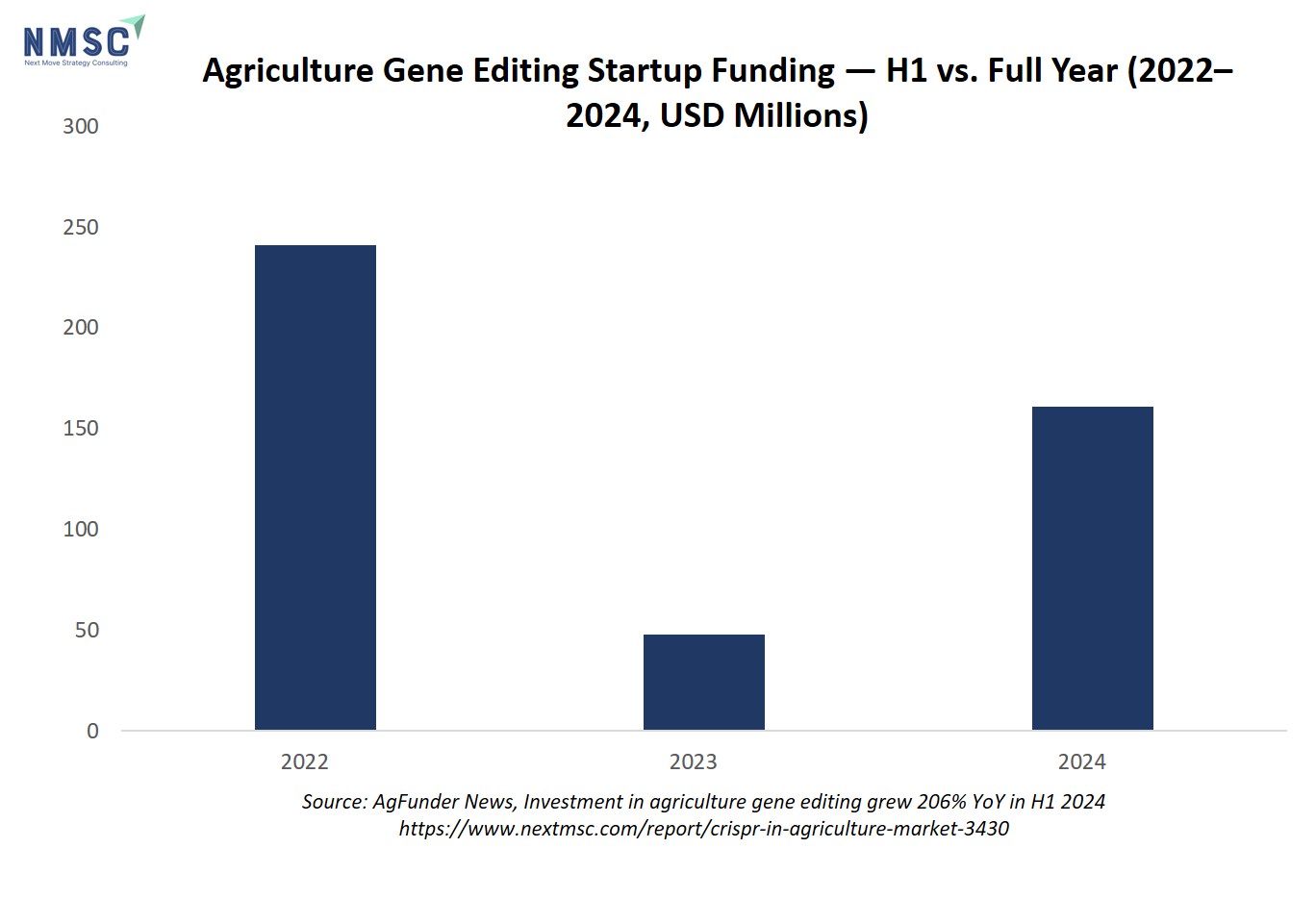
In June 2026, Belgian startup Rainbow Crops raised €9.7 million in seed funding to advance an AI-guided multiplex gene-editing platform designed to improve complex traits such as yield, drought tolerance, and heat resilience. The company combines artificial intelligence, large-scale genome editing, and high-throughput phenotyping to identify and engineer combinations of genes and regulatory elements, with the goal of accelerating crop breeding through the simultaneous modification of dozens of targets. This investment follows the NMSC report's documentation that funding for agri-gene-editing startups surged 206% in H1 2024, reaching USD 161 million — a baseline that the 2026 Rainbow Crops raise suggests has continued to attract institutional capital.
Platform Licensing Accelerates Technology Diffusion
Dutch plant biotechnology company Hudson River Biotechnology and Pairwise announced their Fulcrum licensing agreement on May 26, 2026, gaining access to additional CRISPR-based editing tools, enzymes, and trait libraries for integration into its services for vegetable, soft-fruit, and other crop breeders developing transgene-free improved varieties. This licensing transaction is representative of a broader market dynamic: as CRISPR platform companies accumulate proprietary editing tools and trait libraries, licensing and intellectual property revenues are becoming a structurally significant revenue stream — one that carries higher margins and longer contract durations than hardware or consumable sales.
Section Summary:
Four industry-level developments are simultaneously expanding the CRISPR in agriculture market's commercial scope:
-
Multiplex editing advances — including 81.3% prime editing efficiency in soybean and simultaneous enrichment of seven nutritional compounds in tomato — are converting CRISPR from a single-trait tool into a multi-trait platform capable of addressing complex agronomic challenges in a single transformation event.
-
Climate-driven trait demand is generating commercially viable CRISPR applications across temperature extremes: Hebrew University's cold-weather tomato research (6x yield improvement) and Tropic Biosciences' TR4-resistant banana program (commercial cultivation targeted for 2027) demonstrate the breadth of the addressable problem set.
-
Venture capital continues to validate AI-guided multiplex editing as a distinct investment category, with Rainbow Crops' €9.7 million seed round in June 2026 representing the latest institutional endorsement of the AI-CRISPR convergence thesis.
-
Platform licensing is emerging as a high-margin revenue stream, with the Pairwise-Hudson River Biotechnology Fulcrum platform agreement exemplifying how CRISPR IP is being monetized beyond direct product sales.
Pros and Cons of Recent Market Developments
|
Development |
Pros |
Cons |
|
EU New Genomic Techniques (NGT) Regulation (June 2026) |
Removes 25-year regulatory barrier for NGT-1 CRISPR-edited crops in the EU; consolidates development pipelines for global commercialization; accelerates transition from research to field trials for companies like KWS and Cibus |
NGT-2 crops remain subject to full GMO risk assessment; labeling requirements for NGT-1 crops may still create consumer communication challenges; implementation timelines across EU member states may vary |
|
Multiplex CRISPR Editing (81.3% efficiency in soybean; 7-compound biofortified tomato) |
Enables simultaneous modification of multiple genes in a single transformation event; dramatically reduces the number of breeding cycles required to stack complex traits; opens biofortification as a commercially viable application |
Higher multiplexing complexity increases the risk of unintended off-target effects; regulatory review of multiplex-edited crops may require more extensive safety dossiers than single-gene edits |
|
AI-Guided Multiplex Platforms (Rainbow Crops €9.7M raise; OpenCRISPR-1 for rice) |
AI-designed nucleases and predictive genomic models reduce guide RNA design costs and improve editing specificity; high-throughput phenotyping accelerates trait validation; enables smaller companies to access CRISPR capabilities without large internal R&D teams |
AI-guided platforms require large, high-quality genomic datasets that are not uniformly available across all crop species; early-stage companies face long timelines from platform development to commercial product launch |
|
Climate-Resilient Trait Development (Cold-weather tomatoes; TR4-resistant banana) |
Directly addresses the most commercially urgent agricultural challenge — climate-driven yield loss; parthenocarpy mechanism may protect crops at both temperature extremes; TR4-resistant banana addresses a disease threatening a USD 25+ billion global industry |
Academic research-to-commercial variety timelines remain multi-year; specific genotypes developed in research settings require further breeding into elite commercial lines before market entry |
|
Platform Licensing (Pairwise Fulcrum → Hudson River Biotechnology) |
Creates recurring IP revenue streams with higher margins than hardware or consumable sales; accelerates technology diffusion to smaller breeders without requiring them to build internal CRISPR capabilities |
Licensing agreements concentrate IP value in a small number of platform holders; smaller licensees may face royalty structures that limit their commercial margins on edited varieties |
Key Data & Statistics
Key Industry Milestones and Institutional Data Points — CRISPR in Agriculture Ecosystem]
|
Data Point |
Figure / Detail |
|
EU NGT Regulation — Council adoption |
April 21, 2026 |
|
EU NGT Regulation — European Parliament final approval |
June 17, 2026 |
|
NGT-1 regulatory treatment |
Equivalent to conventionally bred varieties; exempt from 2001 GMO rules |
|
Prime editing efficiency in soybean (GmPEplus system) |
Up to 81.3%; simultaneous editing of up to 12 genes |
|
Multiplex CRISPR biofortified tomato |
7 health-promoting compounds enriched simultaneously (vitamins D₃, C, β-carotene, lycopene, GABA) |
|
Rainbow Crops seed funding |
€9.7 million (AI-guided multiplex gene-editing platform) |
|
Hebrew University cold-weather tomato yield improvement |
6x more ripe tomatoes vs. unedited plants in cold-winter greenhouse trials |
|
Tropic Biosciences TR4-resistant banana |
Field trials underway; commercial cultivation targeted 2027; consumer availability targeted 2028 |
|
Agri-gene-editing startup funding surge |
206% increase in H1 2024, reaching USD 161 million |
|
Global food demand increase required by 2050 |
~30% increase from current levels |
|
FAO food production increase required by 2050 |
~70% increase vs. 2005–2007 levels to feed 9.1 billion people |
|
Conventional breeding cycle for elite hybrid development |
7–10 years |
|
CRISPR-accelerated breeding cycle |
4–6 years |
Future Outlook & Forecast
The Path to USD 3.26 Billion: Three Structural Demand Vectors Through 2030
NextMSC primary research and analysis projects the global CRISPR in agriculture market to reach USD 3.26 billion by 2030 at a CAGR of 19.4%, with growth concentrated in three structural demand vectors that are each independently verifiable and mutually reinforcing.
First, the regulatory liberalization vector. The EU NGT regulation's June 2026 final approval is not the end of a regulatory process — it is the beginning of a commercial deployment cycle. Companies including KWS, Cibus, Syngenta, and Corteva now have a clear regulatory pathway to commercialize CRISPR-edited NGT-1 crops in the EU without the cost and timeline burden of full GMO risk assessment. As these companies transition CRISPR traits from research pipelines into European field trials and variety registration processes over the 2026–2030 period, demand for CRISPR tools, consumables, and services will expand proportionally. Asia-Pacific regulatory reforms — with India, China, Japan, and Australia having adopted product-based regulations that exempt certain CRISPR-edited crops from GMO restrictions — further expand the global regulatory addressable market, supporting the region's position as the fastest-growing CRISPR agriculture market in NextMSC's forecast.
Second, the AI-CRISPR convergence vector. The demonstration of 81.3% prime editing efficiency in soybean and the deployment of AI-designed nucleases like OpenCRISPR-1 in rice represent a qualitative shift in what CRISPR can achieve in commercially relevant crop species. As AI-guided platforms reduce the cost and time required to identify optimal editing targets, design guide RNAs, and validate trait performance, the number of commercially viable CRISPR trait development programs that can be run simultaneously by a single organization will increase — directly expanding demand for CRISPR tools, instruments, and bioinformatics software subscriptions. Rainbow Crops' €9.7 million seed raise in June 2026 confirms that institutional investors are pricing this convergence into early-stage valuations.
Third, the climate-resilience demand vector. The FAO's projection that global food production must increase by approximately 70% by 2050 to feed a population of 9.1 billion people is not a distant planning horizon — it is a procurement driver that is already influencing R&D investment decisions at major seed companies. The Hebrew University's cold-weather tomato research, Tropic Biosciences' TR4-resistant banana program, and KWS's CRISPR-edited mildew-resistant barley and low-water-usage sugar beet cultivars all represent commercial-stage applications of CRISPR to climate-driven agricultural challenges. As climate stress intensifies and the economic cost of crop failure increases, the return on investment from CRISPR trait development will improve — accelerating adoption across both large-scale commercial growers and smallholder farming programs in Asia-Pacific and Sub-Saharan Africa.
Section Summary:
The CRISPR in agriculture market's path to USD 3.26 billion by 2030 is supported by three independently verifiable structural demand vectors:
-
Regulatory liberalization — led by the EU NGT regulation and Asia-Pacific product-based frameworks — is converting CRISPR from a research tool into a commercially deployable crop improvement platform across the world's largest agricultural markets.
-
AI-CRISPR convergence is expanding the number of commercially viable trait development programs that can be run simultaneously, driving demand for tools, instruments, and bioinformatics platforms across the CRISPR value chain.
-
Climate-resilience demand is improving the return on investment from CRISPR trait development, accelerating adoption across commercial growers, seed companies, and government-backed food security programs in Asia-Pacific and Sub-Saharan Africa.
-
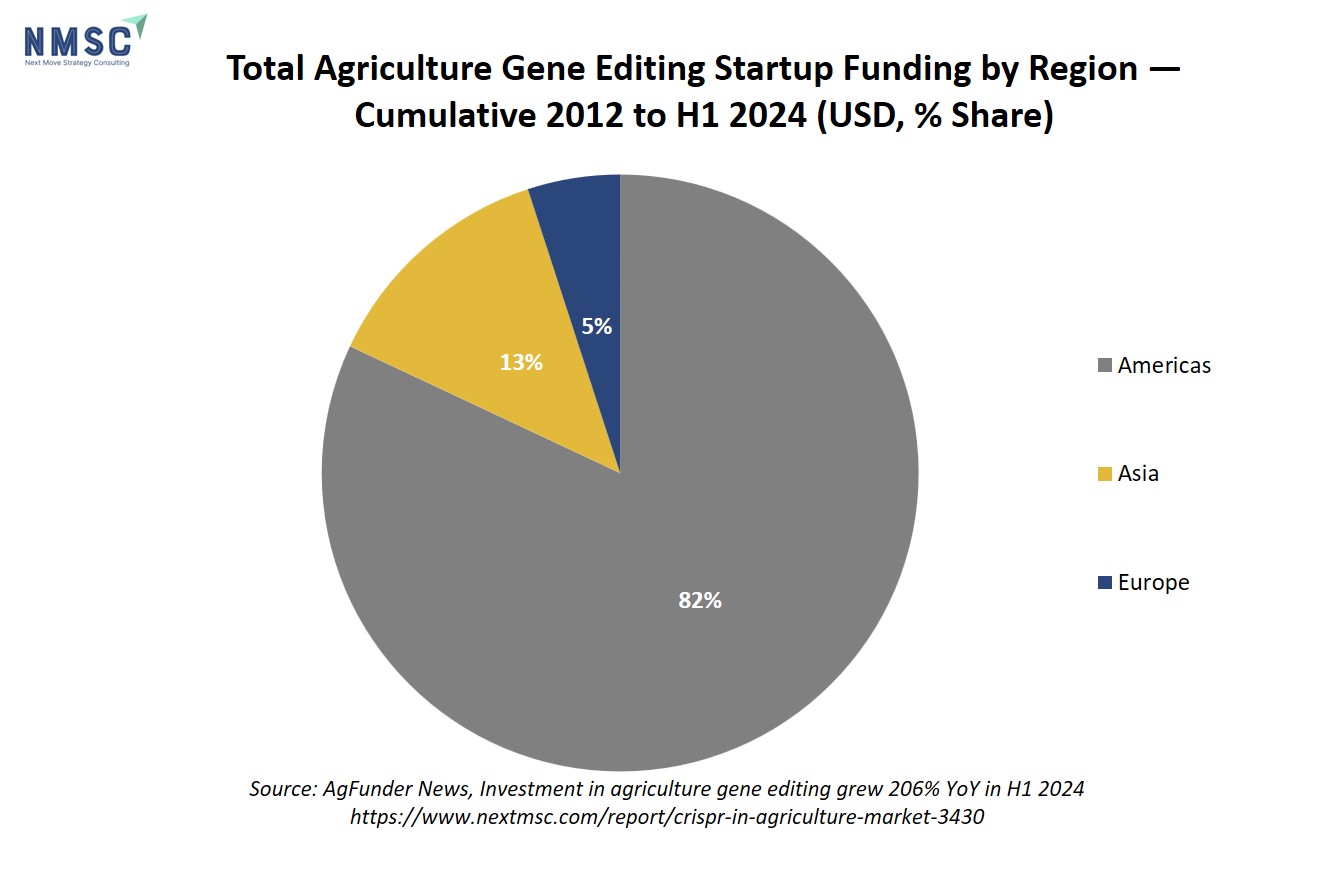
North America maintains its dominant market position through supportive regulatory frameworks, substantial private R&D investment, and leadership from firms including Pairwise, Corteva, and Bayer; Asia-Pacific is the fastest-growing region, driven by regulatory reforms, food security imperatives, and government-backed innovation programs.
Next Steps for Stakeholders
For C-Level Executives and Agricultural Biotechnology Decision-Makers:
-
Initiate EU market entry planning for NGT-1 CRISPR traits immediately. The EU NGT regulation's June 2026 final approval means that companies with CRISPR-edited NGT-1 crop varieties in development now have a defined regulatory pathway to European commercialization. Organizations that begin variety registration processes and European field trial programs in 2026–2027 will have a meaningful first-mover advantage over competitors that wait for full implementation guidance before acting.
-
Evaluate AI-guided multiplex editing platforms as a core R&D infrastructure investment, not a peripheral technology. The demonstration of 81.3% prime editing efficiency in soybean and simultaneous 12-gene editing capability signals that AI-integrated CRISPR platforms are no longer experimental — they are production-grade tools. Organizations that integrate AI-guided guide RNA design, high-throughput phenotyping, and multi-omics analysis into their CRISPR workflows will compress trait development timelines and reduce the per-trait cost of development relative to competitors using conventional CRISPR approaches.
-
Prioritize value chain alignment before commercial launch. The 2026 ASTA conference panel's central message — that commercialization runs at the speed of systems, not the speed of science — is directly applicable to any organization planning a CRISPR-edited product launch. Engaging retailers, processors, and grower associations during the trait development phase, rather than after regulatory clearance, reduces the risk of commercial failure despite technical success.
-
Assess licensing and IP strategy as a revenue diversification opportunity. The Pairwise-Hudson River Biotechnology Fulcrum platform licensing agreement demonstrates that CRISPR platform IP can generate recurring, high-margin revenue streams independent of direct product sales. Organizations with proprietary editing tools, trait libraries, or delivery system innovations should evaluate whether licensing those assets to non-competing breeders and academic institutions represents a viable revenue diversification strategy.
-
Build Sub-Saharan Africa and Southeast Asia into long-term market planning. The International Institute of Tropical Agriculture's CRISPR training program in Nairobi — targeting 80–100 scientists over five years — and public-private partnerships targeting flood-tolerant rice in Southeast Asia represent the early-stage infrastructure development that precedes commercial market formation. Organizations that establish research partnerships and regulatory engagement in these regions now will be positioned to participate in the commercial markets that follow.
For Institutional Investors:
-
The EU NGT regulation is a market-expanding event that will increase the total addressable market for CRISPR agriculture companies with European commercial ambitions. Companies with established NGT-1 trait pipelines — including KWS, Cibus, Corteva, and Syngenta — are the primary near-term beneficiaries.
-
The AI-CRISPR convergence is creating a new category of agricultural biotechnology company — AI-native crop improvement platforms — that is attracting early-stage venture capital (Rainbow Crops' €9.7 million raise in June 2026) and is likely to attract growth-stage capital as platform companies demonstrate commercial traction.
-
The CRISPR in agriculture market's licensing and IP revenue streams carry structurally higher margins than hardware or consumable sales, improving the quality of earnings for platform companies and supporting higher valuation multiples relative to pure-play seed or agrochemical businesses.
Conclusion
The CRISPR in agriculture market is at a structural inflection point. The EU New Genomic Techniques regulation — the most consequential regulatory development in agricultural biotechnology in over two decades — has opened the world's most restrictive major market to CRISPR-edited crops, removing the bifurcation that had forced companies to choose between European and non-European development pathways. Simultaneously, the convergence of AI-guided multiplex editing platforms with high-throughput phenotyping and multi-omics analysis is compressing trait development timelines and expanding the number of commercially viable CRISPR programs that can be run in parallel. And the climate-resilience imperative — quantified by the FAO's projection that global food production must increase by approximately 70% by 2050 — is converting CRISPR from a scientific capability into a commercial necessity.
The evidence from 2026 is concrete: Hebrew University researchers demonstrated a 6x yield improvement in cold-weather tomatoes through CRISPR editing of auxin-response genes; Belgian startup Rainbow Crops raised €9.7 million to scale an AI-guided multiplex editing platform; Tropic Biosciences is advancing CRISPR-edited TR4-resistant bananas toward commercial cultivation in 2027; and KWS, Cibus, and the broader European seed industry are preparing to transition CRISPR traits from research pipelines into European field trials under the new NGT framework.
About the Author
 Sanyukta Deb
— Sanyukta Deb is Digital Marketing Team Lead at Next Move Strategy Consulting, where she has led content strategy and technical SEO for the firm's B2B market research publications for over 2 years. Her editorial process translates NextMSC's primary and secondary research — spanning technology, industrial, and consumer sectors — into commercial narratives, backed by search-intent, keyword, and competitive analysis. She brings 5 years of overall experience in digital marketing and content strategy.
Sanyukta Deb
— Sanyukta Deb is Digital Marketing Team Lead at Next Move Strategy Consulting, where she has led content strategy and technical SEO for the firm's B2B market research publications for over 2 years. Her editorial process translates NextMSC's primary and secondary research — spanning technology, industrial, and consumer sectors — into commercial narratives, backed by search-intent, keyword, and competitive analysis. She brings 5 years of overall experience in digital marketing and content strategy.
About the Reviewer
 Debashree Dey
— Debashree Dey is Assistant Manager at Next Move Strategy Consulting, where she supports cross-vertical market content and communications across diverse industries for 6 years. Her professional background includes senior content writing, communications, and published manuscript authorship, with experience developing audience-focused business narratives and maintaining clear, consistent messaging. Her role supports research-led content development and editorial quality across NextMSC publications.
Debashree Dey
— Debashree Dey is Assistant Manager at Next Move Strategy Consulting, where she supports cross-vertical market content and communications across diverse industries for 6 years. Her professional background includes senior content writing, communications, and published manuscript authorship, with experience developing audience-focused business narratives and maintaining clear, consistent messaging. Her role supports research-led content development and editorial quality across NextMSC publications.
















Add Comment