Gas Detector Market: How Methane Leak Rules Are Reshaping Demand | NextMSC
Introduction
On November 2, 2026, MSA Safety Incorporated reported third-quarter net sales of USD 536.4 million, a 15% increase on a reported basis and 6% on an organic basis. Within that total, its Detection product group, which covers fixed and portable gas detection, grew 22% as reported but only 2% organically. Four days earlier, on October 29, 2026, Drägerwerk AG & Co. KGaA had disclosed that its safety division order intake rose 20.2%, net of currency effects, in the same quarter. Taken together, the two disclosures describe a gas detector market in which order books are filling faster than shipments, and in which acquisitions are doing part of the work that organic demand once did.
According to Next Move Strategy Consulting's Gas Detector Market report, the global gas detector market was valued at USD 3.16 billion in 2023 and is projected to reach USD 4.42 billion by 2030, growing at a CAGR of 4.9% from 2024 to 2030. That trajectory implies an incremental USD 1.26 billion of annual revenue over the period, spread across fixed systems, portable devices and wearable monitors that protect workers in oil and gas, chemical processing, mining and utilities.
For More Information: Download FREE Sample on Gas Detector Market Report
This analysis examines company-reported demand signals, the European Commission's October 14, 2026 proposal to postpone importer methane obligations, and what NMSC's 4.9% CAGR means for buyers, suppliers and investors in the gas detector market.
Gas Detector Market Signals After MSA Safety's USD 563 Million Autronica Acquisition
MSA Safety Incorporated: Detection Growth Is Acquisition-Led
MSA Safety Incorporated's results for the quarter ended September 30, 2026, released on November 2, 2026, show where reported growth and organic growth diverge. Net sales reached USD 536.4 million against USD 468.4 million a year earlier. The Detection product group, which MSA defines as fixed gas and flame detection plus portable gas detection, contributed USD 233.9 million, or 44% of consolidated net sales, up from 41% in the third quarter of 2025. Detection sales rose 22% on a reported basis, but acquisitions accounted for 20 percentage points of that increase and organic growth was 2%.
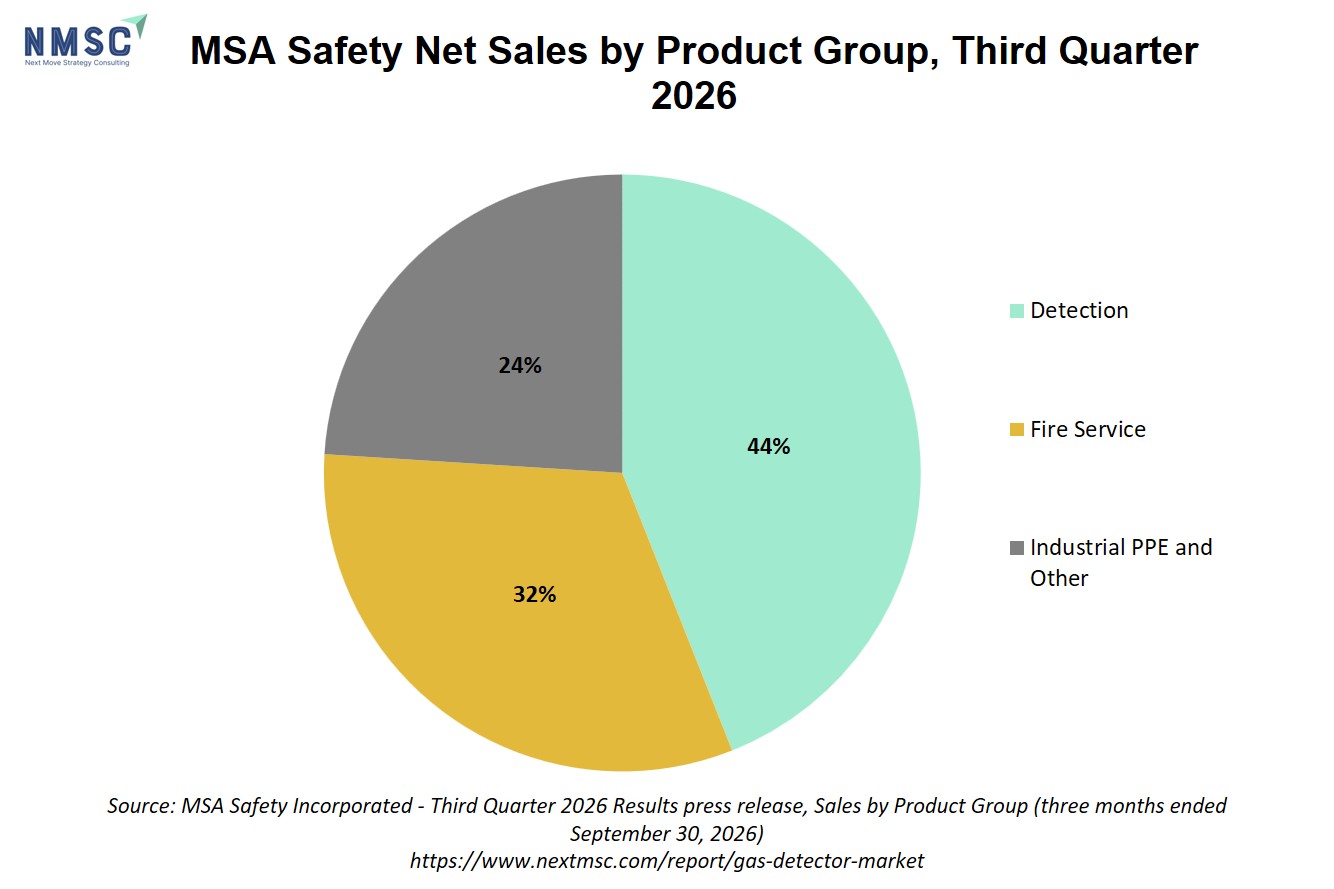
MSA Safety Incorporated reports Detection at 44% of third-quarter 2026 net sales, Fire Service at 32% and Industrial PPE and Other at 24%. Detection includes fixed gas and flame detection and portable gas detection, and includes sales from the Autronica Fire and Security acquisition from July 9, 2026 onward.
The acquisition in question is Autronica Fire and Security, which MSA completed for USD 563 million, net of cash acquired, and whose sales have been reported within Detection since July 9, 2026. MSA's long-term debt rose from USD 572.7 million at December 31, 2025 to USD 1,088.1 million at September 30, 2026. Over nine months, Detection grew 13% on a reported basis and just 1% organically, so the acquisition explains 11 of the 13 points of headline expansion in 2026.
The regional split is uneven. In the Americas segment, Detection organic sales rose 4% in the third quarter and 6% over nine months. In the International segment, Detection organic sales fell 4% in the quarter and 10% over nine months, even though International Detection reported sales rose 55% in the quarter because of the acquisition. MSA also described an ALTAIR io 6 order as its largest MSA+ connected safety order to date.
Drägerwerk AG & Co. KGaA: Safety Orders Are Outrunning Sales
Drägerwerk AG & Co. KGaA reported on October 29, 2026 that its safety division order intake rose 20.2% in the third quarter, net of currency effects, to EUR 451.9 million from EUR 371.4 million a year earlier. Safety division net sales over the same period were EUR 381.3 million against EUR 362.0 million, an increase of 4.1% net of currency effects. Order intake therefore exceeded net sales by EUR 70.6 million in the third quarter of 2026, compared with a gap of EUR 9.4 million in the third quarter of 2025, based on NextMSC's calculation from the published figures.
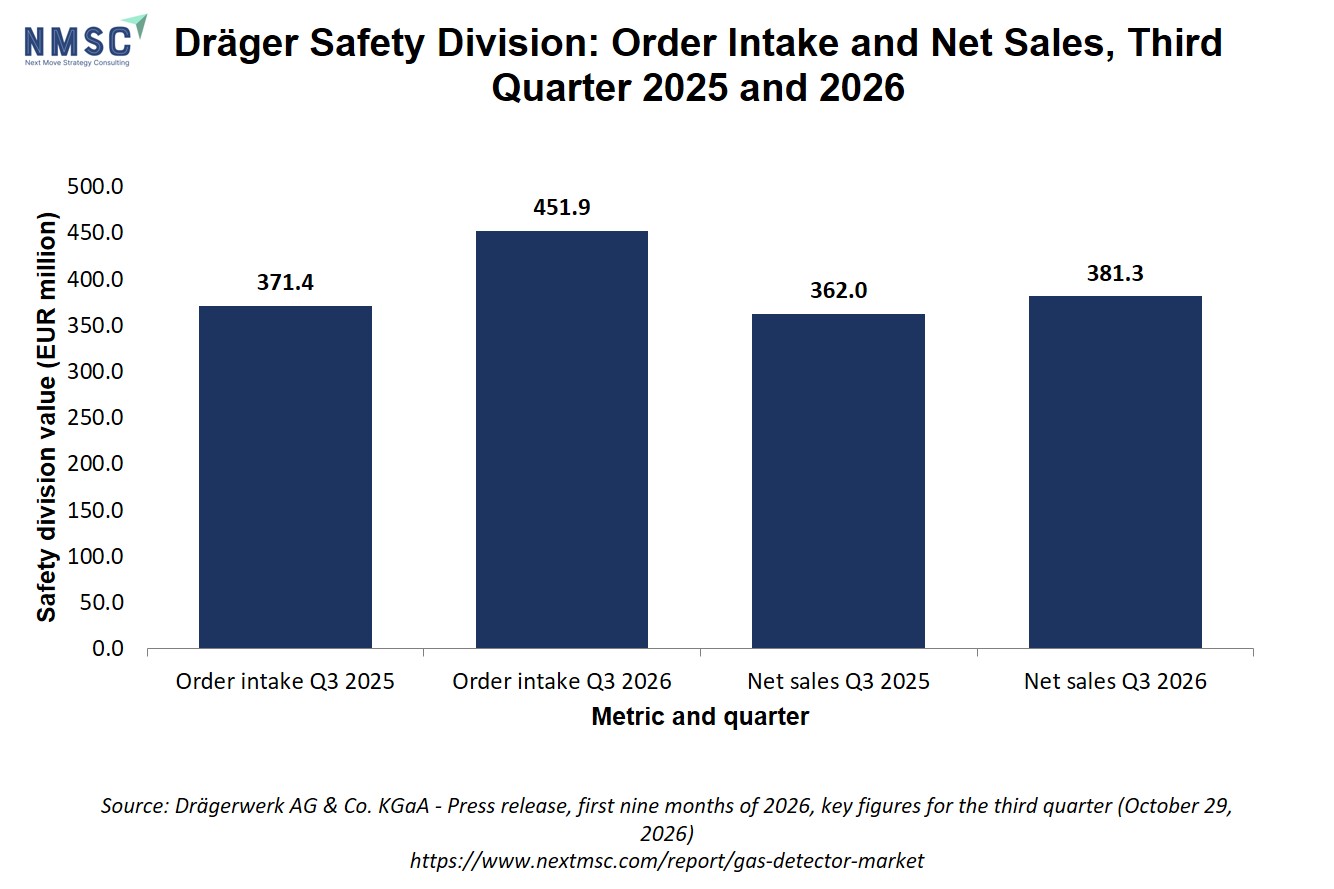
Drägerwerk AG & Co. KGaA reports safety division order intake of EUR 371.4 million in the third quarter of 2025 and EUR 451.9 million in the third quarter of 2026. Safety division net sales were EUR 362.0 million and EUR 381.3 million in the same quarters. The safety division spans several product areas in addition to gas detection.
Two qualifications matter. First, the safety division covers more than gas detection, and Drägerwerk AG & Co. KGaA attributed the third-quarter order growth in Germany, which rose 59% net of currency effects, in particular to a major order in its defense business. Second, over nine months the division's order intake increased 13.1% to EUR 1,242.8 million, with all regions and all product areas contributing, while net sales grew 6.5% to EUR 1,087.0 million. The division's EBIT margin was 11.4% in the quarter against 12.6% a year earlier, so growth is not yet translating into higher profitability.
Honeywell and Teledyne: Software and Instruments Widen the Detector's Role
Honeywell International Inc. announced on June 2, 2026 enhanced capabilities for its Safety Suite 2.0 platform, which gives safety leaders in refineries, chemical plants, utilities and first responder operations broader visibility into portable gas detection fleets. The update adds historical data, enhanced dashboards and forecasting capabilities, together with real-time alerts, guided workflows for onboarding, calibrating and returning devices, and tools to track and forecast compliance metrics. The announcement positions the detector as a data source whose value sits in fleet management.
Teledyne Technologies Incorporated reported on October 21, 2026 that Instrumentation segment net sales were USD 370.5 million against USD 363.6 million a year earlier, an increase of 1.9%. Within the segment, environmental instrumentation sales rose USD 8.3 million, of which USD 6.2 million came from a recent acquisition. Management said on the third-quarter earnings call that environmental instrument sales increased 7.1%, helped by gas monitoring instrumentation.
NMSC Strategic Perspective: Why the Gas Detector Market Is Becoming a Compliance Infrastructure Market
NextMSC primary research and analysis reads the third-quarter disclosures as evidence of a structural change in how gas detection is purchased. NMSC's 4.9% CAGR describes a mature safety category with mid-single-digit underlying growth. MSA Safety Incorporated's 2% organic Detection growth in the quarter and 1% over nine months sit below that rate, which indicates that above-trend headline growth in 2026 has been assisted by acquisitions rather than by a surge in unit demand.
The second signal is the direction of order books. Drägerwerk AG & Co. KGaA's safety division booked EUR 70.6 million more in orders than it recorded in sales in the third quarter, and NextMSC's analysis treats a widening gap of this kind as an early indicator of replacement and compliance-driven purchasing in oil and gas, chemicals and utilities, subject to the caveat that part of the quarter's growth came from a defense order. NMSC's report identifies North America as the largest regional contributor, consistent with MSA Safety Incorporated's 4% Americas Detection organic growth against a 4% International decline.
The third signal is the migration of value from hardware to software and services. Honeywell International Inc.'s Safety Suite 2.0 update and the connected-fleet order described by MSA Safety Incorporated point to buyers that evaluate detectors by the compliance data they generate, not by the sensor alone. NextMSC's analysis therefore indicates that suppliers with calibration, analytics and fleet-management offerings are better placed to defend pricing than suppliers that sell sensors alone, particularly because NMSC's report identifies the high cost of equipment as the main restraint among small businesses.
Section Summary:
Third-quarter 2026 disclosures show demand strengthening in orders while organic shipment growth remains moderate.
-
MSA Safety Incorporated's Detection sales rose 22% on a reported basis but 2% organically in the third quarter of 2026.
-
Drägerwerk AG & Co. KGaA's safety division order intake exceeded net sales by EUR 70.6 million in the quarter.
-
Honeywell International Inc. and Teledyne Technologies Incorporated are extending detection into fleet software and environmental instrumentation.
Industry Impact Analysis
European Union: A One-Year Importer Delay With the Leak Detection Mandate Intact
On October 14, 2026, the European Commission adopted proposal COM(2026) 569 final, which would postpone by one year the importer monitoring, reporting and verification obligations and the methane intensity provisions of Regulation (EU) 2024/1787. Under the current text, importers must demonstrate from January 1, 2027 that supply contracts concluded or renewed after August 4, 2024 are subject to equivalent measurement and verification at the producer level. The proposal moves the first such demonstration to May 31, 2029, covering 2028 supplies.
The Commission justified the delay by pointing to the disruption of the Strait of Hormuz, which it says has affected global energy trade since February 27, 2026. Based on International Energy Agency analysis cited in the proposal, about 20% of global liquefied natural gas supply and 25% of global seaborne oil trade have been affected.
The proposal does not amend the operator-level rules. The regulation continues to require regular leak detection and repair surveys, repair obligations and restrictions on venting and flaring, and the Commission states that the amendment leaves the regulation's level of ambition unchanged. It also cites International Energy Agency estimates that more than 350 billion cubic metres of gas were lost to flaring, venting and leakage worldwide in 2024, three times the supply removed from global markets by the closure of the Strait of Hormuz. For detector suppliers, the practical reading is that demand tied to on-site surveys and fixed monitoring is separate from the importer verification timeline that has been deferred.
The proposal states that the extra year lets Member States complete national penalty regimes, accreditation bodies accredit verifiers and authorities recognize compliance solution providers, so administrative readiness, not detection technology, is the pacing item for importer compliance. The Commission issued related recommendations on July 20, 2026: Recommendation (EU) 2026/1834 on model clauses and Recommendation (EU) 2026/1835 on penalties.
European Parliament: A Three-Year Position and a Compressed Timetable
According to the Latham & Watkins analysis published on October 30, 2026, the European Parliament adopted its position on October 22, 2026 and endorsed a longer postponement: importer verification would move to May 31, 2031 and first methane intensity reporting to August 5, 2031, while imports from countries subject to EU sanctions on fossil fuel imports would be excluded from the extended timeline. The same analysis notes that the current application date of January 1, 2027 leaves the Parliament, the Council and the Commission a compressed window to agree. Until they do, suppliers of detection and monitoring equipment face uncertainty in the timing, not the direction, of regulatory demand.
Oil, Gas and Industrial End Users: Regional Divergence in Spending
The disclosures also point to regional divergence among end users. MSA Safety Incorporated's Americas Detection organic sales grew in both the quarter and the nine-month period, while International Detection organic sales declined in both. Drägerwerk AG & Co. KGaA's safety orders grew in all regions over nine months. NextMSC's report attributes Asia-Pacific demand to chemical and manufacturing expansion, so regional performance should be assessed by end-use industry, not by company reporting segment.
Section Summary:
Regulation is shifting its timing without removing the detection mandate at operator sites.
-
The Commission's proposal of October 14, 2026 defers importer verification by one year but leaves leak detection and repair surveys unchanged.
-
The European Parliament's October 22, 2026 position seeks a three-year delay, which prolongs timing uncertainty.
-
Regional demand diverges: Americas detection grew organically while International detection declined at MSA Safety Incorporated.
Pros and Cons of Recent Market Developments
|
Pros |
Cons |
|
Drägerwerk AG & Co. KGaA's safety division order intake rose 20.2% in the third quarter of 2026, building a backlog for future deliveries. |
MSA Safety Incorporated's Detection organic growth was 2% in the quarter, so reported growth depends on acquisitions. |
|
Honeywell International Inc.'s Safety Suite 2.0 adds forecasting and fleet workflows, supporting recurring software revenue alongside detector sales. |
Acquisition financing raised MSA Safety Incorporated's long-term debt from USD 572.7 million to USD 1,088.1 million within nine months. |
|
The Commission's proposal leaves leak detection and repair surveys and venting restrictions in place for operators. |
Postponed importer deadlines, and a possible three-year delay, defer verification-related demand and prolong planning uncertainty. |
|
Connected portable fleets are being ordered at larger scale, as shown by MSA Safety Incorporated's largest MSA+ order to date. |
NextMSC's report identifies high equipment cost as a barrier for small businesses and budget-constrained industries. |
Key Data & Statistics
Gas Detection Indicators From Company Disclosures, Third Quarter 2026
|
Indicator |
Value |
Basis |
|
MSA Detection net sales |
USD 233.9 million (44% of net sales) |
Quarter ended September 30, 2026 |
|
MSA Detection sales change |
+22% reported, +2% organic |
Versus third quarter of 2025 |
|
MSA International Detection organic change |
-4% in the quarter, -10% over nine months |
Nine months ended September 30, 2026 |
|
Dräger safety order intake |
EUR 451.9 million (+20.2%) |
Net of currency effects, third quarter |
|
Dräger safety net sales |
EUR 381.3 million (+4.1%) |
Net of currency effects, third quarter |
|
Teledyne Instrumentation net sales |
USD 370.5 million (+1.9%) |
Third quarter of 2026 versus 2025 |
EU Methane Regulation: Importer Deadlines Under Current Law and Two Proposals
|
Obligation |
Current deadline |
Commission proposal |
Parliament position |
|
Importer verification of equivalent measurement and reporting |
From January 1, 2027 |
May 31, 2029 (2028 supplies) |
May 31, 2031 |
|
Methane intensity reporting |
August 5, 2028 |
August 5, 2029 |
August 5, 2031 |
|
Compliance with maximum methane intensity values |
August 5, 2030 |
August 5, 2031 |
August 5, 2031 (no amendment) |
Future Outlook & Forecast
Gas Detector Market Outlook: What a 4.9% CAGR Implies for 2030
NextMSC projects the gas detector market to expand from USD 3.16 billion in 2023 to USD 4.42 billion in 2030, a CAGR of 4.9% from 2024 to 2030. The increase of USD 1.26 billion over seven years equals an average of about USD 180 million of additional annual revenue each year, based on NextMSC's calculation from the published figures. The 2026 disclosures reviewed here are consistent with that pace: modest organic growth at established suppliers, supplemented by acquired revenue and rising order intake.
NMSC's report segments the market by product form (fixed systems, portable devices and wearable monitors), component (hardware, software and services), detection technology (electrochemical, catalytic bead, infrared, photoionization, semiconductor and ultrasonic), gas type, end-use industry, connectivity, power source and sales channel. The disclosures reviewed here touch several of these dimensions at once, from connected portable fleets to software, services and environmental gas monitoring instruments.
NextMSC's report identifies North America as the largest regional contributor and attributes Asia-Pacific momentum to the region's chemical and manufacturing expansion, which increases the number of facilities that require continuous gas monitoring and regulatory compliance.
Risks to the Forecast
Three risks could move the trajectory. First, equipment cost: NextMSC's report identifies the high cost of gas detector equipment as a barrier for small businesses and industries with limited budgets. Second, regulatory timing: the Commission's October 14, 2026 proposal and the European Parliament's October 22, 2026 position would move importer verification to 2029 or 2031, respectively, deferring one category of compliance spending. Third, energy supply: the Commission expects a prolonged period of supply insufficiency following the disruption in the Gulf region, which keeps energy prices high and raises the cost of every cubic metre of gas that leaks. MSA Safety Incorporated's 10% organic decline in International Detection over nine months shows that demand is also uneven by region.
Technology Pathways: Artificial Intelligence, Connectivity and Fleet Analytics
NextMSC's report identifies the integration of artificial intelligence and machine learning algorithms as an opportunity because such tools can improve detection accuracy, predict potential hazards and optimize maintenance schedules. Honeywell International Inc.'s Safety Suite 2.0 update already applies forecasting to compliance metrics and device inventory, and MSA Safety Incorporated's largest MSA+ order to date covered connected portable detectors. Together, these developments suggest that analytics, calibration services and connected fleet management can account for a larger share of supplier revenue, which supports NMSC's 4.9% CAGR even where unit growth is moderate.
Section Summary:
NextMSC projects the gas detector market to reach USD 4.42 billion by 2030 at a CAGR of 4.9%.
-
The 2023 to 2030 increase of USD 1.26 billion averages about USD 180 million of additional annual revenue each year.
-
Equipment cost, regulatory timing and uneven regional demand are the principal risks to the forecast.
-
Connectivity and analytics are the main routes through which suppliers can raise revenue per installed detector.
Next Steps for Stakeholders
For C-Level Executives and Plant Operators
Treat the operator-level leak detection and repair obligations as the planning baseline. The Commission's October 14, 2026 proposal postpones importer verification but does not change survey, repair or venting rules, so budgets for fixed monitoring, portable instruments and calibration should not wait for the legislative outcome.
Audit detector fleets for data readiness. Platforms such as Honeywell International Inc.'s Safety Suite 2.0 show that fleet visibility, calibration tracking and compliance forecasting are now product features.
Negotiate service terms, not only unit prices. With Drägerwerk AG & Co. KGaA's safety orders running ahead of sales, delivery lead times may lengthen, and framework agreements that secure calibration, maintenance and replacement sensors reduce exposure to supply timing.
For Institutional Investors
Separate organic from acquired growth when valuing detection businesses. MSA Safety Incorporated's Detection group grew 22% as reported and 2% organically in the third quarter, and its long-term debt increased by USD 515.4 million between December 31, 2025 and September 30, 2026, a period that includes the financing of Autronica Fire and Security.
Track order-to-sales ratios, not only revenue. Drägerwerk AG & Co. KGaA's EUR 70.6 million gap between safety orders and net sales in the third quarter is a more forward-looking indicator than trailing sales, provided the share of one-off defense orders is monitored. Finally, follow the legislative calendar: the Commission, the Parliament and the Council must agree on any postponement before January 1, 2027, and the outcome determines the timing of importer-facing verification and reporting demand.
Conclusion
The gas detector market entered the final quarter of 2026 with strong orders, moderate organic shipments and a regulatory timetable in flux. MSA Safety Incorporated's Detection group grew 2% organically, Drägerwerk AG & Co. KGaA's safety orders grew 20.2%, Honeywell International Inc. and Teledyne Technologies Incorporated extended detection into software and instrumentation, and the European Commission proposed to defer, but not remove, methane obligations.
Against NextMSC's projection of USD 4.42 billion by 2030 at a CAGR of 4.9%, the evidence supports a steady growth path in which compliance infrastructure, connected fleets and acquisitions, rather than a surge in unit volumes, determine which suppliers gain share. For decision makers, the priority is to plan around the leak detection mandates that remain fixed, and to treat the importer timeline as a variable until the EU legislative process concludes.
About the Author
 Priyanshu Das
— Priyanshu Das is SEO Executive at Next Move Strategy Consulting, where he has led on-page and off-page SEO, keyword research, and SEO audits for the firm's B2B market research publications for 2 years. His audit process combines technical crawl analysis, backlink profile review, and competitor keyword gap mapping — using tools including Screaming Frog and Google Search Console — to prioritize fixes by organic search-visibility impact, informed by his own prior in-house and agency SEO experience.
About the Reviewer
 Debashree Dey
— Debashree Dey is Assistant Manager at Next Move Strategy Consulting, where she supports cross-vertical market content and communications across diverse industries for 6 years. Her professional background includes senior content writing, communications, and published manuscript authorship, with experience developing audience-focused business narratives and maintaining clear, consistent messaging. Her role supports research-led content development and editorial quality across NextMSC publications.












Add Comment