Gas Detector Market Global Industry Analysis and Forecast (2026–2035)

Gas Detector Market size was USD 14.37 Billion in 2025, projected to reach USD 25.69 Billion by 2035, growing at a CAGR of 5.98% from 2026 to 2035. Key drivers include occupational exposure limit enforcement, aging asset replacement cycles, and expansion of gas processing capacity, with North America leading the global market.

Download Free Sample PDF
Base Year (2025)
$14.37 Billion
Forecast (2035)
$25.69 Billion
CAGR (2026-2035)
6.0%
Top Region
North America

What Is the Gas Detector Market Size?

The global gas detector market reached USD 14.37 Billion in 2025 and is estimated at USD 15.23 Billion in 2026, forecast to reach USD 25.69 Billion by 2035 at a CAGR of 5.98% between 2026 and 2035. North America leads with approximately 34% revenue share in 2025, while Fixed Gas Detectors is the dominant product type, holding approximately 63% of total market revenue.

We observed that Technological shifts are reshaping how gas detector systems are specified and deployed across heavy industry. Electrochemical, infrared, and catalytic bead sensing elements are being refined to improve selectivity, reduce cross-sensitivity to humidity, and extend operational life in harsh environments. Manufacturers are also adopting ruggedized housings and intrinsically safe electronics suitable for explosive atmospheres. Operational scale matters as well, since large utilities and petrochemical operators increasingly standardize on fleet-wide platforms that simplify calibration scheduling, spare parts inventories, and training across multiple sites.

Key TakeawaysWe observed that technological shifts are reshaping how gas detector systems are specified and deployed across heavy industry.

By Product Type: Fixed Gas Detectors held the largest share, expanding from USD 9.01 Billion in 2025 to USD 14.3 Billion by 2035; Portable Gas Detectors are the fastest-growing at 8.04% CAGR from 2026–2035.

By Sensing Technology: Electrochemical held the largest share, expanding from USD 5.05 Billion in 2025 to USD 8.83 Billion by 2035; Integrated Multi-Technology Detectors is the fastest-growing at 8.66% CAGR from 2026–2035.

By Target Gas Configuration: Single-Family Detection held the largest share, expanding from USD 7.94 Billion in 2025 to USD 12.9 Billion by 2035; Multi-Family Detection is the fastest-growing at 7.25% CAGR from 2026–2035.

By Gas Channel Count: Single-Gas held the largest share, expanding from USD 5.1 Billion in 2025 to USD 7.83 Billion by 2035; Five or More Gas is the fastest-growing at 7.67% CAGR from 2026–2035.

Dominant Region: North America dominated the market with approximately 34% revenue share (USD 4.88 Billion) in 2025, anchored by mature commercial infrastructure, robust customer demand, and high concentrations of established industry participants.

Fastest-Growing Region: Asia-Pacific is expected to register the highest CAGR of 9.09% during 2026–2035, driven by expanding commercial adoption, rising private investments, and growing domestic consumer and business demand.

Dominant Country: The U.S. led the market with an estimated USD 3.71 Billion in 2025 (~76% of North America), supported by extensive commercial demand, established supplier networks, and strong domestic buyer participation.

Fastest-Growing Country: India is among the fastest-growing major countries, projected to expand from USD 0.78 Billion in 2025 at a CAGR of approximately 10.86%, driven by growing regional adoption, expanding domestic distribution networks, and increasing local market demand.

The gas detector market presents an absolute dollar opportunity of USD 10.46 billion between 2026 and 2035, moving from USD 15.23 billion to USD 25.69 billion. This expansion reflects both the replacement of legacy fixed and portable instruments and the installation of new monitoring networks in greenfield energy and processing projects. Growth will be particularly relevant for suppliers able to combine sensor accuracy with dependable calibration and maintenance programs. Participants that address retrofit demand in mature refining hubs alongside new build activity in expanding regions stand to capture a meaningful share of the incremental value.



Competitive consolidation in the gas detector market has accelerated as larger safety instrumentation groups seek broader product portfolios and deeper regional service coverage. MSA Safety completed its acquisition of Autronica Fire and Security for approximately USD 555 million in July 2026, extending its fire and gas detection capabilities. Earlier, MSA Safety acquired M&C TechGroup in May 2025, adding gas analysis technologies to its offering. DwyerOmega's acquisition of Macurco in October 2025 further illustrates how specialist gas detection assets are being absorbed by scaled players seeking manufacturing and distribution efficiencies.

Gas Detector Market Global Industry Analysis and Forecast (2026–2035) Revenue Forecast

Values in USD Billion

2025 $14.37 Billion
2025
2026 $15.23 Billion
2026
2027 $16.14 Billion
2027
2028 $17.11 Billion
2028
2029 $18.13 Billion
2029
2030 $19.21 Billion
2030
2031 $20.36 Billion
2031
2032 $21.58 Billion
2032
2033 $22.87 Billion
2033
2034 $24.24 Billion
2034
2035 $25.69 Billion
2035

Key Takeaways

We observed that technological shifts are reshaping how gas detector systems are specified and deployed across heavy industry.

By Product Type: Fixed Gas Detectors held the largest share, expanding from USD 9.01 Billion in 2025 to USD 14.3 Billion by 2035; Portable Gas Detectors are the fastest-growing at 8.04% CAGR from 2026–2035.

By Sensing Technology: Electrochemical held the largest share, expanding from USD 5.05 Billion in 2025 to USD 8.83 Billion by 2035; Integrated Multi-Technology Detectors is the fastest-growing at 8.66% CAGR from 2026–2035.

By Target Gas Configuration: Single-Family Detection held the largest share, expanding from USD 7.94 Billion in 2025 to USD 12.9 Billion by 2035; Multi-Family Detection is the fastest-growing at 7.25% CAGR from 2026–2035.

By Gas Channel Count: Single-Gas held the largest share, expanding from USD 5.1 Billion in 2025 to USD 7.83 Billion by 2035; Five or More Gas is the fastest-growing at 7.67% CAGR from 2026–2035.

Dominant Region: North America dominated the market with approximately 34% revenue share (USD 4.88 Billion) in 2025, anchored by mature commercial infrastructure, robust customer demand, and high concentrations of established industry participants.

Fastest-Growing Region: Asia-Pacific is expected to register the highest CAGR of 9.09% during 2026–2035, driven by expanding commercial adoption, rising private investments, and growing domestic consumer and business demand.

Dominant Country: The U.S. led the market with an estimated USD 3.71 Billion in 2025 (~76% of North America), supported by extensive commercial demand, established supplier networks, and strong domestic buyer participation.

Fastest-Growing Country: India is among the fastest-growing major countries, projected to expand from USD 0.78 Billion in 2025 at a CAGR of approximately 10.86%, driven by growing regional adoption, expanding domestic distribution networks, and increasing local market demand.

Ecosystem Analysis of the Gas Detector Industry

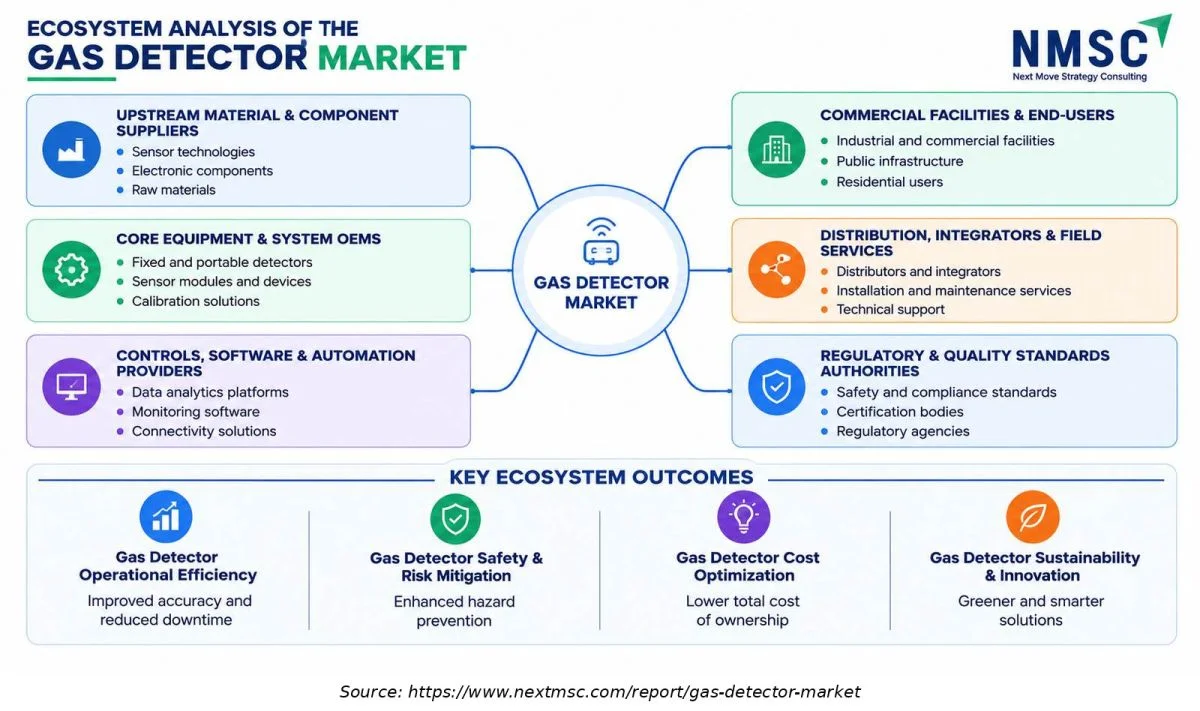
The above infographic provides a detailed ecosystem analysis of the gas detector market, mapping out key stakeholders from upstream component suppliers to core equipment OEMs and software providers. It illustrates how these interconnected players collaborate to distribute, install, and maintain gas detection systems for commercial, industrial, and residential end-users. Supported by regulatory and quality standard authorities, this network ultimately drives key outcomes such as operational efficiency, safety and risk mitigation, cost optimization, and sustainable innovation.

What Does the Gas Detector Market Encompass?

The gas detector market encompasses instruments designed to identify and quantify hazardous gases, including combustible, toxic, and oxygen deficiency conditions in industrial environments. Product categories span fixed-point detectors installed on pipelines, tanks, and process units, as well as portable personal monitors carried by field technicians. Core sensing technologies include electrochemical cells for toxic gases, infrared optical sensors for hydrocarbons, catalytic bead sensors for combustibles, and photoionization detectors for volatile organic compounds. Each technology serves distinct hazard profiles within energy and power operations.

Design specifications in the gas detector market emphasize explosion protection, ingress resistance, and stable performance across wide temperature and humidity ranges. Housings are typically constructed from stainless steel, aluminum alloys, or engineered polymers rated for corrosive plant atmospheres. Sensor materials, including noble metal catalysts and specialty membranes, are being refined to reduce poisoning and drift. Certifications such as ATEX, IECEx, and UL hazardous location approvals govern market access, and conformity to these standards is a prerequisite for procurement by major energy operators.

Market Drivers & Dynamics

Interactive Dataset
Occupational Exposure Limit Enforcement driver High Immediate
Aging Asset Replacement Cycles driver High Immediate
Expansion of Gas Processing Capacity driver Medium Medium-term
Sensor Cross-Sensitivity and Drift restraint High Immediate
Capital Budget Constraints in Utilities restraint Medium Medium-term
Fragmented Certification Requirements restraint Low Long-term
Source: Next Move Strategy Consulting

Growth Drivers

What Is the Primary Growth Driver in the Gas Detector Industry?

The primary catalyst in the gas detector market is the sustained requirement to protect workers and assets from toxic and combustible gas exposure in energy and power operations. Refineries, gas processing plants, and power stations must maintain continuous monitoring to remain compliant and avoid catastrophic incidents. This baseline requirement anchors demand regardless of short-term commodity cycles. As operators expand throughput and extend asset lives, detector coverage must scale accordingly, which translates into consistent installation and replacement activity across the forecast horizon.

How Are Industry Standards and Directives Driving the Gas Detector Market?

Industry standards and governing directives play a central role in shaping gas detector specifications and procurement decisions. Hazardous area approvals such as ATEX, IECEx, and UL classifications determine where detectors may be installed within explosive atmospheres. Occupational exposure regulations enforced by national safety authorities define alarm thresholds and monitoring obligations. Compliance with these frameworks functions as a compliance floor, ensuring steady baseline demand, while certification upgrades encourage manufacturers to refine designs continually.

Growth Inhibitors

What Is Restraining the Gas Detector Market?

The principal commercial restraint in the gas detector market is the recurring cost of sensor maintenance, calibration, and replacement. Electrochemical and catalytic elements degrade over time, requiring scheduled service that consumes technician hours and reference gas supplies. Supply chain exposure to specialty sensor components can also lengthen lead times during periods of tight availability. Buyers therefore weigh total cost of ownership carefully, which can slow adoption of premium detector platforms in cost-sensitive operations.

What Are the Growth Opportunities?

Can Multigas Fixed Systems Capture High-Density Deployments?

Multigas fixed systems offer a compelling opportunity in high-density industrial sites where numerous hazard points require simultaneous coverage. Refineries and chemical complexes often demand hundreds of detection points across process units, tank farms, and loading areas. Integrated multigas platforms reduce the number of separate instruments and simplify calibration workflows. Suppliers that deliver scalable architectures with centralized diagnostics can secure larger contracts while improving site-wide safety visibility.

How Is Mid-Tier and Regional Facility Adoption Unlocking New Market Volume?

Mid-tier and regional facilities represent a growing source of gas detector volume as smaller processing plants, municipal gas networks, and regional power assets upgrade their safety infrastructure. These operators typically seek cost-effective portable and compact fixed detectors with straightforward maintenance requirements. Distributors and local service partners play an important role in reaching these customers efficiently. Scaling commercial adoption across secondary facilities therefore broadens the addressable base beyond major energy hubs.

Can Specialized Vertical Implementations Become Distinct Premium Gas Detector Market?

Specialized vertical implementations, such as detectors engineered for LNG terminals, hydrogen production, and biogas facilities, may evolve into distinct premium niches. These applications involve unique gas species, extreme pressures, and stringent certification requirements that justify higher price points. Suppliers investing in tailored sensor chemistries and application-specific housings can differentiate their offerings. Such focused positioning allows participants to command stronger margins while reinforcing long-term customer relationships.

Segmentation Analysis

2025 (USD Billion)
2035 (USD Billion)
Fixed Gas Detectors 2025: $9.01 Billion | 2035: $9.55 Billion
Fixed Gas De
Portable Gas Detectors 2025: $5.36 Billion | 2035: $5.68 Billion
Portable Gas
Fixed Gas Detectors $9.01 Billion $9.55 Billion USD 14.3 Billion
Portable Gas Detectors $5.36 Billion $5.68 Billion USD 11.39 Billion

Which Product Type Segment Dominates the Gas Detector Market?

Within the Product Type spectrum, Fixed Gas Detectors command the foremost market share, generating USD 9.01 billion (~63% share) in 2025 on the back of widespread institutional standardization. In parallel, Portable Gas Detectors are positioned for rapid scale, projected to advance at an 8.04% CAGR through 2035 as commercial end-users transition toward specialized, next-generation gas detector capabilities.

2025 (USD Billion)
2035 (USD Billion)
Electrochemi
Catalytic Be
Metal Oxide
Photoionizat
Non-Dispersi
Segment Item 2025 (USD Billion) 2035 (USD Billion) CAGR
Electrochemical $10.0 USD Billion $40.0 USD Billion 23.0%
Catalytic Bead $17.1 USD Billion $51.1 USD Billion 13.0%
Metal Oxide Semiconductor $24.2 USD Billion $62.2 USD Billion 27.0%
Photoionization Detectors $31.3 USD Billion $73.3 USD Billion 21.0%
Non-Dispersive Infrared $38.4 USD Billion $84.4 USD Billion 14.0%

Segment-wise data is locked

Unlock complete segment-wise numbers for By Sensing Technology.

Unlock Full Data

By Sensing Technology: Electrochemical held the largest share, expanding from USD 5.05 Billion in 2025 to USD 8.83 Billion by 2035; Integrated Multi-Technology Detectors is the fastest-growing at 8.66% CAGR from 2026–2035.

2025 (USD Billion)
2035 (USD Billion)
Single-Famil
Flammable an
Toxic Gases
Oxygen Monit
Asphyxiant a
Segment Item 2025 (USD Billion) 2035 (USD Billion) CAGR
Single-Family Detection $10.0 USD Billion $40.0 USD Billion 20.0%
Flammable and Combustible Gases $17.1 USD Billion $51.1 USD Billion 14.0%
Toxic Gases $24.2 USD Billion $62.2 USD Billion 16.0%
Oxygen Monitoring $31.3 USD Billion $73.3 USD Billion 22.0%
Asphyxiant and Inert Gases $38.4 USD Billion $84.4 USD Billion 9.0%

Segment-wise data is locked

Unlock complete segment-wise numbers for By Target Gas Configuration.

Unlock Full Data

By Target Gas Configuration: Single-Family Detection held the largest share, expanding from USD 7.94 Billion in 2025 to USD 12.9 Billion by 2035; Multi-Family Detection is the fastest-growing at 7.25% CAGR from 2026–2035.

2025 (USD Billion)
2035 (USD Billion)
Single-Gas
Dual-Gas
Three- and F
Five or More
Segment Item 2025 (USD Billion) 2035 (USD Billion) CAGR
Single-Gas $10.0 USD Billion $40.0 USD Billion 22.0%
Dual-Gas $17.1 USD Billion $51.1 USD Billion 8.0%
Three- and Four-Gas $24.2 USD Billion $62.2 USD Billion 22.0%
Five or More Gas $31.3 USD Billion $73.3 USD Billion 24.0%

Segment-wise data is locked

Unlock complete segment-wise numbers for By Gas Channel Count.

Unlock Full Data

By Gas Channel Count: Single-Gas held the largest share, expanding from USD 5.1 Billion in 2025 to USD 7.83 Billion by 2035; Five or More Gas is the fastest-growing at 7.67% CAGR from 2026–2035.

2025 (USD Billion)
2035 (USD Billion)
Standalone
Wired Only
Wireless Onl
Hybrid Wired
Segment Item 2025 (USD Billion) 2035 (USD Billion) CAGR
Standalone $10.0 USD Billion $40.0 USD Billion 22.0%
Wired Only $17.1 USD Billion $51.1 USD Billion 20.0%
Wireless Only $24.2 USD Billion $62.2 USD Billion 14.0%
Hybrid Wired $31.3 USD Billion $73.3 USD Billion 12.0%

Segment-wise data is locked

Unlock complete segment-wise numbers for By Connectivity Mode.

Unlock Full Data
2025 (USD Billion)
2035 (USD Billion)
Industrial O
Utility or I
Commercial o
Residential
Government o
Segment Item 2025 (USD Billion) 2035 (USD Billion) CAGR
Industrial Owner-Operator $10.0 USD Billion $40.0 USD Billion 21.0%
Utility or Infrastructure Operator $17.1 USD Billion $51.1 USD Billion 27.0%
Commercial or Institutional Facility Operator $24.2 USD Billion $62.2 USD Billion 17.0%
Residential Purchaser $31.3 USD Billion $73.3 USD Billion 11.0%
Government or Public-Sector Agency $38.4 USD Billion $84.4 USD Billion 12.0%

Segment-wise data is locked

Unlock complete segment-wise numbers for By Purchaser Type.

Unlock Full Data
2025 (USD Billion)
2035 (USD Billion)
Direct Manuf
Authorized D
EPC and Syst
OEM and Equi
Other Third-
Segment Item 2025 (USD Billion) 2035 (USD Billion) CAGR
Direct Manufacturer Sales $10.0 USD Billion $40.0 USD Billion 25.0%
Authorized Distributor and Dealer Sales $17.1 USD Billion $51.1 USD Billion 19.0%
EPC and System Integrator Resale $24.2 USD Billion $62.2 USD Billion 25.0%
OEM and Equipment Packager Supply $31.3 USD Billion $73.3 USD Billion 19.0%
Other Third-Party Resale $38.4 USD Billion $84.4 USD Billion 20.0%

Segment-wise data is locked

Unlock complete segment-wise numbers for By Distribution Channel.

Unlock Full Data
2025 (USD Billion)
2035 (USD Billion)
Oil and Gas
Chemicals an
Power and Ut
Manufacturin
Mining and T
Segment Item 2025 (USD Billion) 2035 (USD Billion) CAGR
Oil and Gas $10.0 USD Billion $40.0 USD Billion 20.0%
Chemicals and Petrochemicals $17.1 USD Billion $51.1 USD Billion 26.0%
Power and Utilities $24.2 USD Billion $62.2 USD Billion 24.0%
Manufacturing $31.3 USD Billion $73.3 USD Billion 26.0%
Mining and Tunnelling $38.4 USD Billion $84.4 USD Billion 9.0%

Segment-wise data is locked

Unlock complete segment-wise numbers for By End-User Industry.

Unlock Full Data

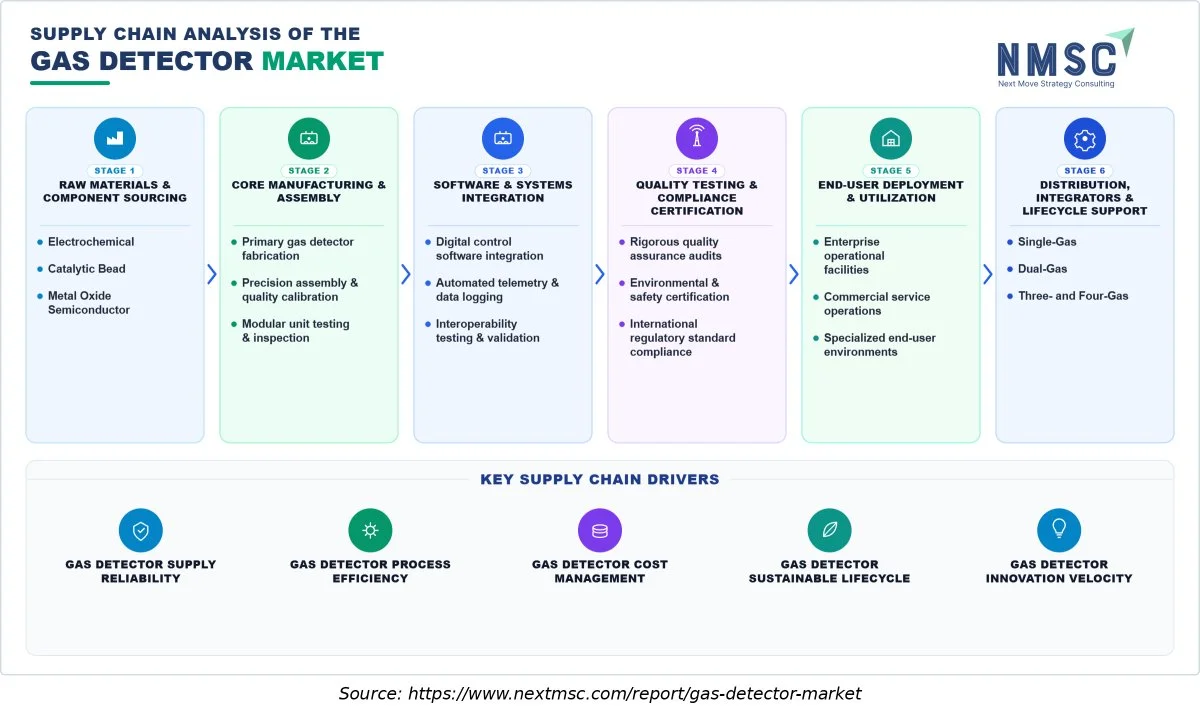
Supply Chain Analysis of the Gas Detector Industry

Supply Chain Analysis of the Gas Detector Industry
The above infographic outlines the supply chain of the gas detector market, tracing a six-stage flow from raw material sourcing and manufacturing through software integration and quality testing to end-user deployment and lifecycle support. It illustrates how specialized components like electrochemical sensors and semiconductor materials are assembled and delivered to diverse commercial and industrial operations. Ultimately, the analysis highlights key drivers such as supply reliability, process efficiency, cost management, and innovation velocity that ensure a sustainable and effective supply chain.

Growth Opportunities

Our analysis shows that three structural whitespace opportunities are positioned to generate disproportionate commercial returns in the Gas Detector Market through 2035:

Can Multigas Fixed Systems Capture High-Density Deployments?

Multigas fixed systems offer a compelling opportunity in high-density industrial sites where numerous hazard points require simultaneous coverage. Refineries and chemical complexes often demand hundreds of detection points across process units, tank farms, and loading areas. Integrated multigas platforms reduce the number of separate instruments and simplify calibration workflows. Suppliers that deliver scalable architectures with centralized diagnostics can secure larger contracts while improving site-wide safety visibility.

How Is Mid-Tier and Regional Facility Adoption Unlocking New Market Volume?

Mid-tier and regional facilities represent a growing source of gas detector volume as smaller processing plants, municipal gas networks, and regional power assets upgrade their safety infrastructure. These operators typically seek cost-effective portable and compact fixed detectors with straightforward maintenance requirements. Distributors and local service partners play an important role in reaching these customers efficiently. Scaling commercial adoption across secondary facilities therefore broadens the addressable base beyond major energy hubs.

Can Specialized Vertical Implementations Become Distinct Premium Gas Detector Market?

Specialized vertical implementations, such as detectors engineered for LNG terminals, hydrogen production, and biogas facilities, may evolve into distinct premium niches. These applications involve unique gas species, extreme pressures, and stringent certification requirements that justify higher price points. Suppliers investing in tailored sensor chemistries and application-specific housings can differentiate their offerings. Such focused positioning allows participants to command stronger margins while reinforcing long-term customer relationships.

Regional Outlook

2025 (USD Billion)
2035 (USD Billion)
North Americ
Europe
Asia-Pacific
Latin Americ
Middle East
Region 2025 (USD Billion) 2035 (USD Billion) CAGR (%)
North America $10.0 USD Billion $40.0 USD Billion 9.0%
Europe $17.1 USD Billion $51.1 USD Billion 27.0%
Asia-Pacific $24.2 USD Billion $62.2 USD Billion 25.0%
Latin America $31.3 USD Billion $73.3 USD Billion 23.0%
Middle East & Africa $38.4 USD Billion $84.4 USD Billion 12.0%

Regional data is locked

Unlock complete regional numbers for this market.

Unlock Full Data

Competitive Landscape

The gas detector market features a concentrated competitive structure led by established safety equipment manufacturers including Honeywell International Inc., Drägerwerk AG & Co. KGaA, MSA Safety Incorporated, Emerson Electric Co., Inc., Teledyne Technologies Incorporated, RIKEN KEIKI Co., Ltd., New Cosmos Electric Co., Ltd., Hanwei Technology Group Co., Ltd., Industrial Scientific Corporation, and Consilium Safety Group AB. Competition centers on sensor reliability, certification credentials, and service networks. Regional specialists in Asia-Pacific intensify price pressure while North American and European incumbents defend premium positioning through integrated safety ecosystems.

Dimension Description
Competitive Assessment Matrix — Product Quality & Durability Sensor stability, calibration retention, and ruggedized housings determine performance in harsh energy and power facilities within the gas detector market.
Competitive Assessment Matrix — Distribution & Retail Reach Access to industrial distributors, OEM integrators, and service networks shapes procurement access for fixed and portable gas detector installations.
Competitive Assessment Matrix — Design & Customization Moat Configurable channel counts, custom alarm logic, and site-specific mounting solutions create switching barriers for gas detector buyers.
Competitive Assessment Matrix — Material Innovation & Sustainability Longer sensor life, reduced consumable waste, and recyclable component design increasingly influence procurement decisions for gas detector fleets.

How Do Companies Compete in the Gas Detector Market?

Manufacturers differentiate through sensing accuracy, device durability, and connectivity features that support real-time alerts and remote diagnostics. Pricing strategies vary by segment, with premium pricing applied to multi-gas and connected platforms while cost-competitive offerings target single-gas portable units. Distribution relies on a combination of direct industrial sales, authorized distributors, and service partners who manage calibration and maintenance cycles. Long-term service contracts and recurring consumables strengthen customer retention across the gas detector market.

Which Competitive Archetypes Dominate the Gas Detector Market?

Market participants fall into three distinct archetypes within the gas detector market. Diversified safety conglomerates such as Honeywell International Inc., Emerson Electric Co., Inc., and Teledyne Technologies Incorporated combine gas detection with broader industrial automation and instrumentation portfolios. Specialist gas detection manufacturers including MSA Safety Incorporated, Industrial Scientific Corporation, RIKEN KEIKI Co., Ltd., and Drägerwerk AG & Co. KGaA focus primarily on personal and fixed detection hardware. Regional producers such as Hanwei Technology Group Co., Ltd., New Cosmos Electric Co., Ltd., and Consilium Safety Group AB compete on localized cost structures and certification access.

What Innovation and Differentiation Strategies Are Companies Pursuing?

Sustainable advantage in the gas detector market rests on proprietary sensor chemistry, validated certifications across hazardous area classifications, and long calibration intervals that reduce operating expenditure. Companies that embed connectivity, data analytics, and maintenance management into their hardware build switching costs over time. Established installed bases generate recurring service revenue that funds continued sensor research. Brand trust in life-safety applications further reinforces incumbents against new entrants lacking field-proven track records.

What M&A and Partnership Activity Is Shaping the Market?

Consolidation activity in the gas detector market accelerated through 2025 and 2026 as established players broadened portfolios. MSA Safety acquired M&C TechGroup in May 2025 to strengthen gas analysis capabilities and completed its acquisition of Autronica Fire and Security for approximately USD 555 million in July 2026. DwyerOmega acquired Macurco in October 2025, enhancing its gas detection business. These transactions reflect a strategic push toward integrated fire, gas, and analysis solutions across industrial end markets.

Key Market Players

Based on research conducted by NMSC, the following 20 companies represent the validated leadership set across Gas Detector Market developers, manufacturers, and solution providers:

Honeywell International Inc. Drägerwerk AG & Co. KGaA MSA Safety Incorporated Emerson Electric Co., Inc. Teledyne Technologies Incorporated RIKEN KEIKI Co., Ltd. New Cosmos Electric Co., Ltd. Hanwei Technology Group Co., Ltd. Industrial Scientific Corporation Consilium Safety Group AB Crowcon Detection Instruments Limited Blackline Safety Corp. GASTRON Co., Ltd. SENKO Co., Ltd. Detector Electronics Corporation GfG Gesellschaft für Gerätebau mbH Trolex Limited ION Science Limited WatchGas B.V. Sensitron S.r.l.

Latest Developments

During our market evaluation, we noticed that recent commercial activities, platform introductions, and partnerships within the industry reflect the latest market developments:

Date Event
October 2026 MSA Safety announced a contract with a major northeast U.S. utility for its ALTAIR io 6 multigas detector, its largest such contract to date.
September 2026 Industrial Scientific launched Tectra, a connected worker safety platform built around gas detection and hazard monitoring.
July 2026 MSA Safety completed its acquisition of Autronica Fire and Security, a provider of fire and gas detection systems, for approximately USD 555 million.
March 2026 Teledyne GMI announced a strategic partnership with Southern Cross, a Sparus company, to support the U.S. gas utilities market.
January 2026 Blackline Safety introduced the G8, a connected safety wearable combining multi-gas detection, lone worker monitoring, and radio communication.

Expert Insights

Stephanie Sciullo

Stephanie Sciullo

President, MSA Americas | MSA Safety

"Connected technology is changing the way organizations approach safety by simplifying gas detector maintenance and real-time alerts."

Analyst Interpretation

Statement made in connection with MSA Safety's official commercial announcement.

Investment Opportunities

Where Are Capital Inflows Concentrating in the Gas Detector Market?

Capital inflows are concentrating in connected detection platforms and multi-technology sensing architectures, where manufacturers direct research spending toward interoperability and data integration. Investment priorities also favor portable detection lines that serve the 8.04% CAGR growth trajectory of portable gas detectors through 2035. Strategic acquisitions, such as MSA Safety's purchase of Autronica Fire and Security, show how capital is redirected toward broader fire and gas safety ecosystems.

How Is Infrastructure Investment Shaping Market Capacity?

Infrastructure investment in the gas detector market centers on expanding sensor manufacturing capacity, automated calibration facilities, and regional distribution hubs that shorten delivery cycles for utilities and process plants. Asia-Pacific, the fastest-growing region at a 9.09% CAGR through 2035, attracts particular attention as producers establish local assembly and service footprints. These capacity additions help manufacturers meet rising demand while reducing lead times for certified instruments.

What ESG Considerations Are Influencing Market Investment?

Environmental and safety considerations increasingly guide investment decisions in the gas detector market, as operators seek longer sensor lifespans and reduced consumable waste. Energy-efficient electronics and recyclable housing materials reduce lifecycle environmental impact across large installed bases. Compliance with safety standards remains the central requirement, and manufacturers that document sustainable design practices gain procurement advantages with energy and power operators.

Key Benefits for Stakeholders

How Does This Report Benefit Industry Leaders and Enterprise Operators?

Operational executives, procurement directors, and commercial operators in the gas detector market gain empirical benchmarks for planning fixed and portable detection fleets. The report clarifies which product types and sensing technologies carry the largest installed base and which are accelerating. These insights support capital budgeting, vendor evaluation, and maintenance scheduling decisions across energy and power facilities, reducing exposure to unsupported procurement assumptions.

How Does This Report Benefit Investors and Financial Analysts?

Investors and financial analysts can benchmark the gas detector market, which is projected to expand from USD 14.37 billion in 2025 to USD 25.69 billion by 2035. The forecast presents a USD 10.46 billion absolute growth opportunity between 2026 and 2035 at a 5.98% CAGR. Segment-level data helps analysts assess margin profiles, valuation multiples, and the relative attractiveness of diversified safety conglomerates versus specialist manufacturers.

How Does This Report Benefit Technology Vendors and Solution Platform Teams?

Technology vendors and solution platform teams can use segment insights to guide product roadmaps within the gas detector market. The strong growth of integrated multi-technology detectors and five or more gas instruments signals where engineering resources should concentrate. Competitive analysis of differentiation strategies helps platform teams position connected offerings against established incumbents and identify viable entry points for new hardware and software capabilities.

Key Market Segments Evaluated

By Product Type

  • Fixed Gas Detectors 
    • Fixed Point Gas Detectors
      • Industrial Fixed-Point Detectors
      • Commercial Fixed-Point Detectors
      • Residential Gas Alarms
    • Fixed Open-Path Gas Detectors
    • Fixed Extractive Gas Detection Systems
      • Single-Point Sample-Draw Systems
      • Multi-Point Sample-Draw Systems
  • Portable Gas Detectors 
    • Personal Gas Monitors
    • Portable Survey Instruments
    • Portable Area Monitors

By Sensing Technology

  • Electrochemical
  • Catalytic Bead
  • Metal Oxide Semiconductor
  • Photoionization Detectors
  • Non-Dispersive Infrared
  • Laser Absorption
  • Thermal Conductivity
  • Photoacoustic
  • Integrated Multi-Technology Detectors
  • Others

By Target Gas Configuration

  • Single-Family Detection 
    • Flammable and Combustible Gases
    • Toxic Gases
    • Oxygen Monitoring
    • Asphyxiant and Inert Gases
    • Dedicated Refrigerant Detection
    • Dedicated VOC Detection
    • Others
  • Multi-Family Detection 
    • Flammable & Toxic Combinations
    • Flammable & Oxygen Combinations
    • Toxic & Oxygen Combinations
    • Others

By Gas Channel Count

  • Single-Gas
  • Dual-Gas
  • Three- and Four-Gas
  • Five or More Gas

By Connectivity Mode

  • Standalone
  • Wired Only
  • Wireless Only
  • Hybrid Wired

By Purchaser Type

  • Industrial Owner-Operator
  • Utility or Infrastructure Operator
  • Commercial or Institutional Facility Operator
  • Residential Purchaser
  • Government or Public-Sector Agency
  • EPC Contractor or System Integrator
  • OEM or Equipment Packager
  • Distributor or Reseller
  • Other Institutional Purchaser

By Distribution Channel

  • Direct Manufacturer Sales
  • Authorized Distributor and Dealer Sales
  • EPC and System Integrator Resale
  • OEM and Equipment Packager Supply
  • Other Third-Party Resale

By End-User Industry

  • Oil and Gas
  • Chemicals and Petrochemicals
  • Power and Utilities
  • Manufacturing
  • Mining and Tunnelling
  • Buildings and Facilities
  • Transportation and Marine
  • Public Safety and Emergency Response
  • Healthcare and Laboratories
  • Other End-User Industries

By Region

  • North America 
    • U.S.
    • Canada
    • Mexico.
  • Europe 
    • UK
    • Germany
    • France
    • Italy
    • Rest of Europe.
  • Asia-Pacific 
    • China
    • India
    • Japan
    • South Korea
    • Australia
    • Rest of APAC.
  • Latin America 
    • Brazil
    • Argentina
    • Colombia
    • Rest of Latin America.
  • Middle East & Africa 
    • UAE
    • Saudi Arabia
    • South Africa
    • Rest of MEA.

Conclusion & Recommendations

What Is the Long-Term Outlook for the Gas Detector Market?

The long-term outlook for the gas detector market is strongly positive, with revenue expanding from USD 15.23 billion in 2026 to USD 25.69 billion by 2035 at a 5.98% CAGR. Growth is underpinned by durable commercial demand expansion, the structural shift toward high-performance specialized solutions, and continuous technological innovation across core operational workflows. Operators in energy and power facilities will continue to prioritize reliable, connected detection as safety expectations rise.

What Strategic Positioning Recommendations Does NMSC Offer?

Market participants should prioritize integrated multi-technology sensing and five or more gas platforms to capture the fastest-growing segments of the gas detector market. OEMs should strengthen calibration service networks and connected maintenance tools that reduce total cost of ownership for fixed installations. Distributors should build portable detection inventories and certification support to serve rising personnel protection requirements across industrial sites and utility operations.

How Attractive Is the Gas Detector Market for Investment?

Investment attractiveness is high, supported by the USD 10.46 billion absolute growth opportunity between 2026 and 2035 within the gas detector market. Recurring calibration, consumable, and service revenue from large installed bases produces stable margin profiles for established manufacturers. Demand drivers, including safety compliance, industrial expansion in Asia-Pacific, and the migration toward connected instruments reinforce long-term return potential across the value chain.

What Are the Key Market Shifts and Risks in the Gas Detector Market?

Structural shifts in the gas detector market include the migration from standalone instruments toward networked, data-enabled platforms and the consolidation of specialist manufacturers into broader safety portfolios. Supply chain exposure to specialized sensor components and semiconductor inputs presents a material operational risk. Price competition from regional producers in Asia-Pacific may also compress margins for manufacturers lacking differentiated technology or service capabilities.

What Are the Primary Growth Pathways Through 2035?

The primary growth pathways in the gas detector market center on portable detection, integrated multi-technology sensing, and five or more gas configurations. Capturing a disproportionate share of the USD 10.46 billion absolute growth opportunity requires expanding into Asia-Pacific and deepening service relationships with utilities and process plant operators. Manufacturers that combine connected hardware with recurring maintenance offerings will be best positioned to convert these pathways into sustained revenue.

Delivered Customizations

We have successfully delivered the following deep-dive customizations:

Client Request Customization Delivered Value Adds
Historical Market Revenue Analysis
  • Historical gas detector market revenue and unit shipment analysis by product type and end-user industry, 2020 to latest year.
  • Establishes baseline growth rates and identifies the end-user industries driving demand.
Import-Export Trade Flow Assessment
  • Country-wise import and export analysis of gas detectors and sensing components using relevant HS codes from UN Comtrade and WITS.
  • Identifies sourcing hubs, major exporting competitors, and tariff-exposed trade lanes to support market entry and supply planning.
Market Sizing: Total, Serviceable and Value-Added Opportunity
  • Total, serviceable, and value-added market sizing by product type, sensing technology, and end-user industry.
  • Prioritizes the segments with the largest addressable opportunity for investment and portfolio focus.
Sensing Technology Adoption by End-User Industry
  • Adoption mapping of electrochemical, infrared, catalytic bead, and PID sensing technologies across oil and gas, chemicals, mining, and utilities end users.
  • Shows where technology migration, such as infrared and PID replacing catalytic sensors, creates retrofit and new-build demand.
Installed Base and Sensor Replacement Outlook
  • Fixed and portable detector installed-base estimate with sensor-life replacement cycles by target gas configuration.
  • Quantifies recurring sensor and replacement revenue pools to support aftermarket and service strategy.
Connectivity and Channel Mix Assessment
  • Share of wireless and IIoT-connected versus standalone detectors across direct, distributor, and integrator channels by purchaser type.
  • Guides channel partner strategy and prioritizes investment in connected, cloud-enabled gas detection products.

FAQs

About the Author

Sikha Haritwal

Sikha Haritwal

Sikha Haritwal is an assistant manager with strong expertise in market research, data analysis, and cross-functional coordination. She plays a key role in leading complex research initiatives, strengthening analytical rigor, and enabling data-driven decision-making across teams. Known for her leadership mindset and structured problem-solving approach, she supports process improvement, enhances operational efficiency, and contributes to building scalable frameworks that drive long-term strategic outcomes and organizational effectiveness.

About the Reviewer

Supradip Baul

Supradip Baul

Supradip Baul is an accomplished business consultant and strategist with over a decade of rich experience in market intelligence, strategy, technology, and business transformation. His work has included rigorous qualitative and quantitative analysis across multiple industries, helping clients shape investment decisions and long-term roadmaps. Earlier in his career, he was associated with Gartner, where he contributed to industry-leading reports and market share analyses. He has worked with leading global companies and holds an MBA with a dual specialization in Marketing and Finance.

Download Free Sample

Gustaf Hummel Burstrom

GUSTAF HUMMEL BURSTROM

Founder

Revline Tools AB

Joseph and the team at Next Move Strategy Consulting have been excellent to work with, in supplying us with relevant market data and forecasts for our specific category. We had some special requirements and they were able to do a custom package to suit our needs. We would definitely recommend them to any other company needing market data and forecasts

Pratyush Kumar Das

PRATYUSH KUMAR DAS

Assistant Manager

Polycab India Limited

We would like to express our appreciation for the data and insights provided by nextmsc. We are very pleased with the quality and depth of the information, which has proven to be highly valuable and beneficial for our business decision-making.

Diana Trejo

DIANA TREJO

Assistant Manager

Sumitomo Corporation de Mexico, S.A. de C.V.

Recently, we purchased a report on the Mexico Data Center Market from Next Move Strategy Consulting. The service has been excellent, with support that is always timely and thoroughly professional. The information provided is interesting, highly useful, and delivered with clarity. I would highly recommend NextMSC for anyone seeking insightful and dependable analysis.

Rishabh Jogani

RISHABH JOGANI

Strategy Analyst

Accenture Japan

We are incredibly impressed with the market report on the real estate market in India provided by Next Move Strategy Consulting. The report was thorough, insightful, and well-structured, offering deep analysis and actionable recommendations. It not only captured the current trends and dynamics but also provided a forward-looking perspective that has been invaluable for our strategic planning. Their team demonstrated exceptional professionalism, attention to detail, and a profound understanding of the industry. The data-driven insights and clarity of presentation exceeded our expectations, making complex market trends easy to understand. We highly recommend Next Move Strategy Consulting to anyone looking for reliable and comprehensive market research services. Their expertise has given us the confidence to navigate the complexities of the Indian real estate market with clarity and foresight.

Semih Kavaklioglu

SEMIH KAVAKLIOGLU

Co-Founder & Sales Manager

Decortie

I work a lot in the marketing industry and I know that research is an essential part of any campaign. I have used Market research reports for my own products and I found them to be very informative and well-researched. The team here produces insightful reports for a good price

Custom Market Research Services

We will customize the research for you if the listed report does not fully match your requirements.

Get 30% Free Customization

Select License

This website uses cookies to ensure you get the best experience on our website. Learn more

✖