HD Maps Market: 7 Powerful Trends Driving Autonomy in 2026
Introduction
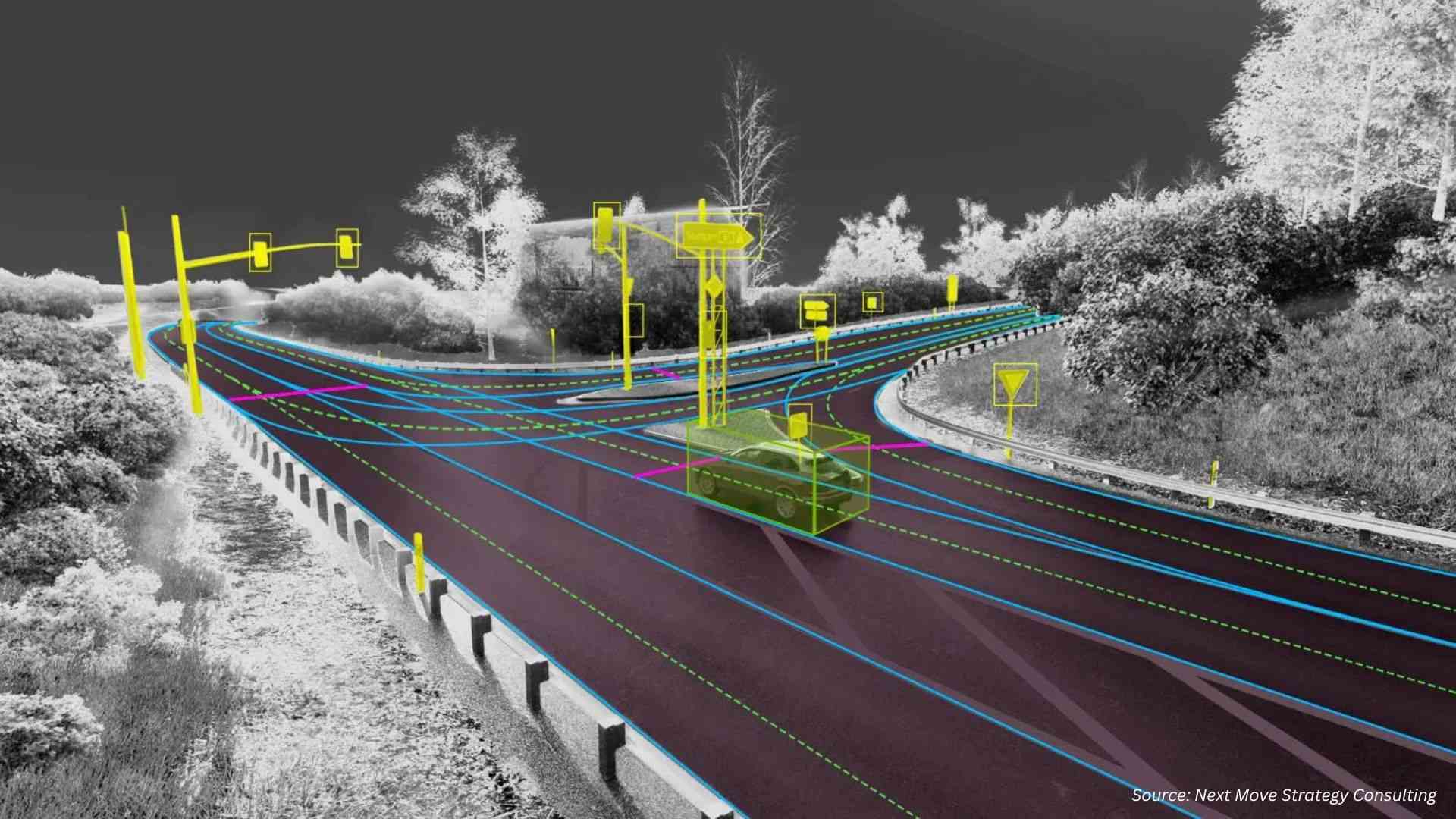
The infrastructure of autonomous mobility is not visible to the naked eye — it exists in layers of centimeter-precise geospatial data, continuously updated and streamed to vehicles navigating the world's most complex road environments. High-definition mapping, once a niche engineering discipline, has emerged as one of the most strategically significant sectors in the global technology landscape. As autonomous vehicles, advanced driver assistance systems (ADAS), and intelligent transportation infrastructure converge at an unprecedented pace, the HD maps market stands at the epicenter of a fundamental shift in how machines perceive and interact with the physical world.
For More Information – Download FREE Sample on HD Maps Market Report
In 2026, this convergence has moved decisively from theoretical to operational. From landmark regulatory actions in China and the United States to record-breaking autonomous vehicle investment rounds and transformative platform partnerships announced at CES 2026, the signals are unambiguous: high-definition mapping is no longer a supporting technology — it is foundational infrastructure for the next generation of connected mobility. This analysis examines the seven most consequential trends reshaping the HD maps market, the regulatory and investment forces accelerating its growth, and the strategic implications for institutional stakeholders navigating this rapidly evolving landscape.
The Geospatial Intelligence Revolution: Key Trends Reshaping HD Mapping in 2026
Trend 1: HERE Technologies Redefines the Location Platform at CES 2026
The most globally significant industry event of the first half of 2026 in the HD mapping sector was HERE Technologies' comprehensive showcase at CES 2026 in Las Vegas, where the company announced a series of strategic partnerships that collectively signal a fundamental redefinition of what a location platform can deliver. HERE expanded its collaboration with Hyundai AutoEver to support over one million Hyundai, Kia, and Genesis vehicles already on the road with over-the-air (OTA) map updates and lane-level guidance, moving toward streaming navigation through HERE's flexible APIs.
Simultaneously, HERE announced its integration with Lucid Motors' Gravity and Air EV models through the HERE SDK, enabling real-time isoline routing, intelligent charging stop planning, and ADAS data support for adaptive cruise control and lane departure warnings. A further collaboration with Amazon's Alexa Custom Assistant (ACA) introduced AI-powered conversational navigation, while a demonstration with Qualcomm Technologies showcased how HERE's AI-powered map intelligence integrates with the Snapdragon Ride™ Pilot system to support Level 2+ automated driving and urban navigation.
Reinforcing its market position, HERE Technologies was named the #1 location platform by Omdia in the 2025 Omdia Location Platform Index, surpassing Google, TomTom, and Mapbox based on strategy, capabilities, and market impact. This recognition follows HERE's landmark USD 1 billion, 10-year partnership with AWS, announced in January 2025, to scale AI-powered live-stream maps globally for smart mobility and urban automation applications.
Trend 2: Bosch and CARIAD Advance AI-Driven Level 2/3 Autonomous Driving
Bosch and CARIAD, Volkswagen's software arm, are jointly developing an intelligent AI system for Level 2 and Level 3 autonomous driving that fuses sensor data from cameras and radar with HD-level map and location data to interpret urban traffic and predict road user behavior. The technology is currently being tested in the Volkswagen ID.Buzz and Audi Q8 and is expected to be production-ready by mid-2026. Bosch has indicated it will make this technology available to other manufacturers worldwide, signaling a significant push toward scalable automated driving safety systems in mass-market vehicles.
Trend 3: EuroNCAP Introduces Its Most Significant Safety Protocol Change in 17 Years
EuroNCAP, which governs safety testing for cars, trucks, and vans across Europe, introduced its most significant protocol change in 17 years in 2026. The new framework assesses vehicles across four stages: safe driving, crash avoidance, crash protection, and post-crash safety. The updated system places greater emphasis on driver monitoring systems — including eye and head tracking — and awards additional credit for technologies that detect alcohol or drug impairment. Crash avoidance systems, including autonomous emergency braking and lane support, are now verified against real-life scenarios involving pedestrians, cyclists, and motorcyclists. This regulatory shift directly elevates the strategic importance of HD maps and ADAS mapping solutions as OEMs race to meet the new performance benchmarks.
Trend 4: China Moves Toward Nationwide Autonomous Vehicle Regulation
In April 2026, China's Ministry of Industry and Information Technology (MIIT) closed the public comment period on a landmark proposal titled Safety Requirements for Autonomous Driving Systems of Intelligent Connected Vehicles, covering SAE Level 3 and Level 4 systems. The proposed mandatory standards include technical requirements, safety assurance requirements, inspection protocols, and testing and validation methods. The proposal aligns with the UN Global Technical Regulation on Automated Driving Systems and UN Regulation No. 157, signaling China's intent to harmonize with international frameworks while establishing a nationwide baseline for AV operation across its more than 3 million miles of roads.
By one estimate from Goldman Sachs, 500,000 robotaxis will be on Chinese roads by 2030, rising to 1.9 million by 2035. A national mandatory standard would facilitate the expansion of operational design domains for Chinese AVs and create a uniform HD mapping requirement across the country's vast road network — representing a transformative addressable market for geospatial mapping technologies.
Trend 5: The US Department of Transportation Accelerates AV Rulemaking
On July 7, 2026, the U.S. Department of Transportation released its 2026 unified rulemaking agenda, with multiple items related to autonomous driving systems signaling the Administration's acceleration of efforts to promote the development and deployment of autonomous technologies. On June 26, 2026, the National Highway Traffic Safety Administration (NHTSA) published a proposed rulemaking to amend Federal Motor Vehicle Safety Standard No. 135 by removing requirements for hand- and foot-operated brake controls in vehicles that operate without a human driver, while retaining stopping distance performance requirements — a meaningful step in modernizing the federal regulatory framework for autonomous vehicles.
The Autonomous Vehicle Industry Association (AVIA) has simultaneously released Securing American Leadership in Autonomous Vehicles, a comprehensive policy framework covering AV safety, transparency, accountability, supply chain resiliency through autonomous trucking, and national security considerations.
Trend 6: South Korea Scales Autonomous Vehicle Infrastructure at National Level
South Korea is deploying 100 fully autonomous vehicles onto public roads as part of a government initiative targeting Level 4 autonomous driving technology by 2027. The country is simultaneously expanding its pilot zone for autonomous freight trucks from four roads to 44, covering more than 5,000 km of highway. Hyundai has successfully completed platoon trials demonstrating emergency braking and vehicle-to-vehicle communication. These deployments create substantial demand for high-precision HD maps across extended geographic corridors, particularly for autonomous navigation systems in freight logistics applications.
Trend 7: HD Maps Evolve From Static Databases to AI-Powered Inference Engines
The most technically significant trend in 2026 is the shift from HD maps as static geometric databases to active AI-powered inference platforms. HD maps for autonomous vehicles provide positional accuracies of 10–20 cm, encoding lane geometry, road topology, traffic sign positions, semantic attributes, and dynamic obstacle data at a level of spatial precision that real-time sensors alone cannot achieve at SAE Level 4 and above.
Recent patent filings from Qualcomm (WO, 2025) introduce driving policy layers for HD mapping platforms that construct trajectory value flow fields from multi-agent data — a fundamental shift from map-as-database to map-as-inference-engine. Harman International Industries has filed OTA update optimization patents combining V2V relay, infrastructure-to-vehicle links, and direct wireless communication. Toyota's 2024 patents introduce edge-device intelligence that dynamically selects which HD map tiles to transmit based on driver attention and communication channel quality.
In March 2026, Google overhauled its Maps application by introducing AI features powered by Gemini technology, further intensifying competition in the broader digital mapping ecosystem.
NMSC Strategic Perspective: Navigating the HD Maps Market Inflection Point
According to Next Move Strategy Consulting (NMSC), the global HD Maps Market is projected to reach USD 50.9 billion by 2030, representing a CAGR of 31.8%. NMSC identifies the increasing adoption of autonomous vehicles globally, the surge in demand for navigation applications, and the integration of advanced sensors — including LiDAR, GPS, and aerial imaging — as the primary growth drivers. The integration of 5G connectivity for faster data transfer with low latency is identified as a significant opportunity for market expansion in the coming years.
From a strategic standpoint, NMSC's analysis underscores that the HD maps market is entering a critical inflection point where hardware-led growth (LiDAR, camera, radar, IMU, GPS) is being complemented by software-driven value creation through SLAM algorithms, AI and machine learning technologies, and cloud-based update architectures. The automotive end-user segment remains the dominant revenue contributor, but logistics, drone mapping services, and mobility service providers are emerging as high-growth verticals that will diversify the market's revenue base through 2030. North America holds the dominant share of the HD maps market and is expected to maintain this position through the forecast period, while Asia Pacific is expected to show a steady rise driven by autonomous vehicle manufacturing in China, South Korea, and Japan.
Section Summary: The first half of 2026 has been defined by a convergence of landmark partnerships, regulatory milestones, and technological breakthroughs that collectively position HD mapping as critical infrastructure for the autonomous mobility era.
Key Takeaways:
-
HERE Technologies' CES 2026 partnerships with Hyundai AutoEver (1M+ vehicles), Lucid Motors, Amazon, and Qualcomm signal the transition to software-defined vehicle navigation at scale.
-
China's proposed mandatory AV safety standards and the US DOT's accelerated 2026 rulemaking agenda are creating regulatory tailwinds that will standardize HD mapping requirements globally.
-
The shift from map-as-database to map-as-inference-engine, evidenced by Qualcomm's 2025 driving policy layer patents, represents a fundamental expansion of the HD maps value proposition.
-
South Korea's expansion of autonomous freight truck corridors to 44 routes covering 5,000+ km illustrates the growing role of HD maps in national logistics infrastructure.
Industry Impact Analysis
Impact on Automotive OEMs and Tier-1 Suppliers
The convergence of new ADAS mandates, EuroNCAP protocol changes, and the proliferation of Level 2+ and Level 3 autonomous driving systems is creating substantial demand for HD mapping capabilities at the OEM level. In 2026, next-generation surround ADAS systems based on Mobileye's EyeQ6H platform are entering mass-market vehicles, enabling extended hands-free highway operation. These systems consolidate multiple ADAS functions — lane centering, adaptive cruise control, and traffic jam assist — into a unified platform that relies on sensor fusion from cameras, radar, and HD maps to manage longitudinal and lateral control.
More vehicles in 2026 are integrating LiDAR with radar and camera suites for improved 3D perception and longer detection range. As costs decline, these sensor suites are expanding beyond luxury vehicles to mainstream EVs and crossovers, creating a broader addressable market for HD map providers. New ADAS stacks are also increasingly embedding AI and machine learning to anticipate hazards before traditional thresholds are crossed — pedestrian intent modeling, rapid cut-in prediction — moving beyond reactive braking toward predictive situational awareness that depends on high-precision geospatial data.
Impact on Technology and Mapping Platform Providers
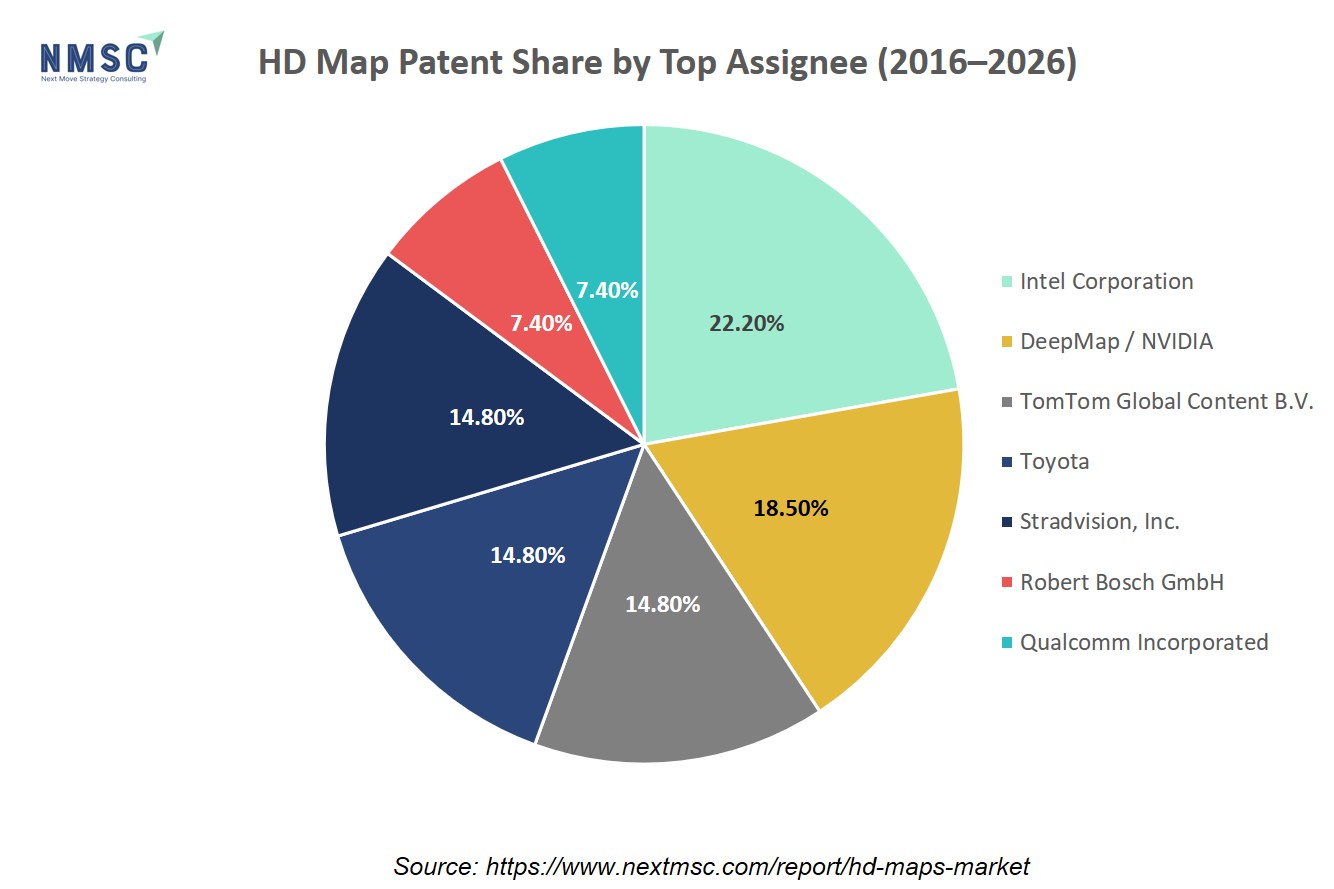
For technology companies operating in the location intelligence and geospatial mapping space, the competitive dynamics are intensifying significantly. The HD map patent landscape reveals that Intel Corporation leads patent filings with 6 patents focused on interoperability and format management, followed by DeepMap (now under NVIDIA) with 5 filings, and TomTom, Toyota, and Stradvision each with 4 filings. This IP concentration signals that interoperability and AI-driven map utilization are the most strategically contested sub-domains in the HD mapping technology stack.
Autonomous vehicle companies raised USD 19.8 billion in equity funding across 33 rounds through June 2026 alone, according to Tracxn — a dramatic acceleration from approximately USD 3.69 billion in full-year 2025. This capital influx is accelerating platform consolidation and raising the competitive bar for HD mapping providers that lack AI-powered update infrastructure or demonstrated OEM partnerships.
Impact on Government and Smart City Infrastructure
Smart city development and infrastructure digitalization are accelerating demand for advanced geospatial mapping solutions. Governments worldwide are integrating digital maps with IoT networks, connected streetlights, environmental sensors, and smart transportation systems to improve urban efficiency and sustainability. The US Congress is also considering the 2026 Surface Transportation Bill reauthorization, which presents a significant opportunity to embed AV infrastructure funding — including HD mapping requirements — into national transportation policy.
The EU has also introduced new requirements for light commercial vehicles (LCVs) between 2.5 and 3.5 metric tons used for cross-border freight transportation, mandating smart tachographs using GNSS-based positioning and remote data transmission — a development that directly expands the use case for HD mapping in commercial vehicle operations.
Impact on Logistics and Last-Mile Delivery
The logistics sector is emerging as a high-growth end-market for HD mapping solutions, driven by the expansion of autonomous freight operations. In May 2025, Dynamic Map Platform received funding through Japan's BRIDGE program to expand its HD mapping network across designated public logistics corridors, supporting Level 4 autonomous freight operations by delivering highly precise, infrastructure-ready mapping data to critical transport routes. South Korea's expansion of autonomous freight truck corridors to 44 routes covering 5,000+ km further illustrates the growing role of HD maps in national logistics infrastructure.
Section Summary: The HD maps market is creating cascading impacts across automotive OEMs, technology platforms, government infrastructure programs, and logistics operators, with each sector responding to both regulatory mandates and significant commercial opportunities.
Key Takeaways:
-
EuroNCAP's 2026 safety protocol overhaul and NHTSA's proposed AV brake standard amendments are directly elevating HD mapping requirements across the automotive supply chain.
-
USD 19.8 billion in AV equity funding raised through June 2026 signals sustained institutional confidence in autonomous mobility infrastructure, including HD mapping platforms.
-
Intel's 6-patent interoperability family and Qualcomm's AI-driven policy layer filings represent the two most strategically significant IP clusters shaping the competitive landscape.
-
Logistics and smart city applications are diversifying the HD maps revenue base beyond traditional automotive use cases, creating new addressable markets for geospatial mapping technologies.
Pros and Cons of Recent Market Developments
|
Development |
Pros |
Cons |
|
Regulatory Acceleration (US, EU, China) |
Creates standardized HD mapping requirements, expanding addressable market; reduces jurisdictional fragmentation |
Compliance timelines pressure smaller mapping providers; divergence between US self-certification and China's type-approval regime creates dual-track compliance burden |
|
AI-Powered Map Intelligence (Qualcomm, Toyota, Harman) |
Expands value proposition beyond geometry into trajectory prediction and planning; reduces reliance on expensive survey vehicles through crowdsourced updates |
Increases IP landscape complexity; AI-embedded maps introduce new cybersecurity and data integrity risks |
|
Record AV Investment Surge (USD 19.8B, H1 2026) |
Accelerates commercialization timelines; attracts talent and R&D investment to the sector |
Risk of capital concentration among dominant players; market corrections possible if commercialization timelines slip |
|
EuroNCAP Protocol Changes |
Elevates HD mapping and ADAS requirements across European OEM supply chains; creates new revenue opportunities for mapping providers |
Increases development costs for OEMs; shorter compliance windows may disadvantage smaller automakers |
|
China's Proposed Nationwide AV Standards |
Creates a uniform HD mapping baseline across 3M+ miles of Chinese roads; facilitates global export of Chinese AV technology |
Standards remain largely qualitative and open to interpretation; regulatory discretion may create market access barriers for foreign mapping providers |
|
5G and V2X Infrastructure Expansion |
Enables real-time HD map updates at scale; reduces latency for crowdsourced map data pipelines |
Infrastructure deployment remains uneven across geographies; bandwidth costs for continuous map freshness remain significant |
|
Crowdsourced Map Updates (NavInfo, Stradvision) |
Dramatically reduces cost of map maintenance; enables continuous freshness at scale using production vehicle fleets |
Data quality and validation challenges; privacy concerns around large-scale geolocation data collection under GDPR and data-localization laws |
Key Players and Strategic Developments in HD Mapping (2025–2026)
|
Company |
Key Development (2025–2026) |
Strategic Significance |
|
HERE Technologies |
Named #1 location platform by Omdia (2025); CES 2026 partnerships with Hyundai AutoEver (1M+ vehicles), Lucid Motors, Amazon Alexa, Qualcomm Snapdragon Ride™ Pilot |
Reinforces platform leadership; accelerates SDV and ADAS integration at scale globally |
|
HERE Technologies + AWS |
USD 1B, 10-year partnership for AI-powered live-stream maps (January 2025) |
Scales real-time mapping infrastructure for smart mobility and urban automation |
|
TomTom |
CES 2026: Transition from HD maps to real-time intelligence platform; leads in map metadata, confidence scoring, CDN-based distribution (US and WO filings through 2025) |
Expanding from static HD maps to dynamic, AI-enriched mapping services |
|
NVIDIA (DeepMap) |
Extended DeepMap's misalignment detection technology post-2021 acquisition; active in AI-driven map generation and occupancy map updates |
Consolidating position in LiDAR-based map generation and AV compute stack |
|
Qualcomm |
Filed driving policy layer patent for HD mapping platforms (WO, 2025); Snapdragon Ride™ Pilot integration with HERE at CES 2026 |
Pioneering map-as-inference-engine architecture for Level 2+ AVs |
|
Toyota |
Filed edge-assisted, attention-aware HD map delivery patents (2024); V2X-driven map generation patents |
Systems-level AV strategy integrating edge compute with HD map delivery |
|
Bosch + CARIAD (VW) |
AI system for Level 2/3 AVs fusing HD maps with camera/radar; production-ready mid-2026; available to third-party OEMs |
Scalable automated driving safety for mass-market vehicles globally |
|
Dynamic Map Platform |
Received Japan BRIDGE program funding for HD mapping of public logistics corridors (May 2025) |
Advancing Level 4 autonomous freight operations across Japan's logistics network |
|
Mobileye |
EyeQ6H-based Surround ADAS entering mass-market vehicles in 2026; hands-free highway operation |
Expanding HD map-dependent ADAS to mainstream automotive segment at scale |
|
Harman International |
Filed OTA update optimization patent combining V2V relay and infrastructure-to-vehicle communication (WO, 2025) |
Advancing resilient, multi-path HD map update architectures for connected vehicles |
Future Outlook & Forecast
According to Next Move Strategy Consulting, the global HD Maps Market is growing rapidly and this growth trajectory is underpinned by the increasing adoption of autonomous vehicles globally, the surge in demand for navigation applications, and the integration of advanced sensors including LiDAR, GPS, and aerial imaging across automotive and aerospace industries. North America holds the dominant share of the HD maps market and is expected to maintain this position through the forecast period, driven by the growing popularity of autonomous vehicles and the presence of key players including The Sanborn Map Company and Waymo. Asia Pacific is expected to show a steady rise, driven by autonomous vehicle manufacturing companies in China, South Korea, and Japan.
NMSC identifies the integration of 5G connectivity for faster data transfer with low latency as a significant opportunity for HD maps market expansion, alongside the integration of advanced camera and thermal imaging sensors to improve mapping accuracy and resolution. The high installation cost of high-resolution sensors and privacy concerns associated with large-scale road data collection remain the primary restraining factors.
Supporting Market Context and Investment Signals
Bloomberg has identified smart vehicles as representing a USD 742 billion annual revenue opportunity for the global automotive value chain by 2030, providing a macro-level context for the scale of demand that HD mapping will serve. The USD 19.8 billion in AV equity funding raised through June 2026 — across 33 rounds — signals that institutional capital is aligning with this long-term thesis at a pace that suggests 2026 represents a genuine inflection point for autonomous mobility commercialization.
Goldman Sachs projects 500,000 robotaxis on Chinese roads by 2030, rising to 1.9 million by 2035 — a deployment scale that will require continuous HD map coverage across China's 3 million miles of roads and represents one of the largest single-country HD mapping demand drivers in the global market.
Technology Evolution Driving Long-Term Value Creation
The HD map patent landscape reveals a clear trajectory toward AI-embedded, context-sensitive map services. The most recent filings (2023–2026) are concentrated in AI-driven map utilization — trajectory prediction, motion planning, and map quality validation — representing a fundamental shift from map-as-database to map-as-inference-engine. As regulatory requirements for AV certification mature globally — a process tracked by bodies including UNECE — map quality attestation technology will become mandatory infrastructure, representing a significant market opportunity for early movers.
Fleet-scale crowdsourcing is creating structural data advantages for HD map providers with access to large connected vehicle fleets. The EdgeMap DATE algorithm developed at the University of Nebraska-Lincoln demonstrates that AI-driven orchestration can reduce the bandwidth cost of continuous map freshness by over 30%, making real-time HD map updates economically viable at scale. The HDMapNet camera-LiDAR fusion framework from Tsinghua University achieves a 50%+ improvement over baseline methods for online HD map construction, illustrating the pace of academic innovation feeding into commercial deployments.
Section Summary: The HD maps market is positioned for exceptional growth through 2030, supported by converging demand from autonomous vehicles, ADAS adoption, smart city infrastructure, and logistics automation, with NMSC projecting a market value of USD 50.9 billion by 2030 at a 31.8% CAGR.
Key Takeaways:
-
NMSC projects the HD Maps Market to grow at 31.8% CAGR from 2024 to 2030, reaching USD 50.9 billion — among the highest growth rates in the broader technology sector.
-
Bloomberg's USD 742 billion smart vehicle revenue opportunity by 2030 provides the macro-level demand context for HD mapping's long-term growth trajectory.
-
Goldman Sachs' projection of 1.9 million robotaxis in China by 2035 represents one of the most significant single-country HD mapping demand drivers globally.
-
The transition from map-as-database to map-as-inference-engine will expand the HD maps total addressable market beyond geometric data into AI-driven prediction, planning, and validation services.
Next Steps for Stakeholders
For C-Level Executives at Automotive OEMs and Tier-1 Suppliers:
The EuroNCAP protocol changes and NHTSA's evolving AV rulemaking agenda require immediate review of ADAS and HD mapping integration roadmaps. OEMs should evaluate partnerships with leading location platform providers — particularly those with demonstrated OTA update capabilities and lane-level guidance — to ensure compliance with emerging safety standards and to capitalize on the software-defined vehicle transition. The Bosch-CARIAD AI system, available to third-party manufacturers, represents a near-term integration opportunity for OEMs seeking to accelerate Level 2/3 deployment.
For Technology Investors and Private Equity:
The USD 19.8 billion in AV equity funding raised through June 2026 signals a market at an inflection point. Investors should focus on companies operating at the intersection of HD mapping and AI-driven inference — specifically those developing map quality attestation, driving policy layers, and edge-compute delivery architectures, which represent the most underserved and strategically valuable IP clusters in the current patent landscape. Intel's interoperability patent family and Qualcomm's policy layer filings define the two most contested competitive frontiers.
For Logistics and Supply Chain Operators:
The expansion of autonomous freight corridors in South Korea (44 routes, 5,000+ km) and Japan's BRIDGE program investment in HD mapping for logistics corridors signal that Level 4 autonomous freight is transitioning from pilot to operational deployment. Supply chain operators should begin evaluating HD map data requirements for autonomous freight operations and engaging with mapping platform providers on long-term data licensing arrangements before market consolidation reduces negotiating leverage.
For Government and Smart City Planners:
The US Congress's 2026 Surface Transportation Bill reauthorization presents a critical opportunity to embed HD mapping and V2X infrastructure requirements into national transportation policy. Policymakers should align with AVIA's recommendations on AV safety, transparency, and supply chain resiliency, and engage with UNECE's evolving AV certification frameworks to ensure domestic standards are internationally compatible and do not create unnecessary barriers to trade.
For HD Map Platform Providers:
The competitive landscape is consolidating around platform providers with AI capabilities, OTA update infrastructure, and demonstrated OEM partnerships. Providers should prioritize investment in map quality attestation technology, crowdsourced update pipelines, and edge-compute delivery architectures — the three sub-domains where IP white space remains most significant and where regulatory demand will be strongest through 2030. Fleet-scale data moats are increasingly decisive; new entrants should consider partnerships or licensing arrangements rather than attempting to build independent survey fleets.
Conclusion
The HD maps market in 2026 is no longer defined by the question of whether high-definition mapping will become foundational to autonomous mobility — that question has been answered definitively. The more consequential question now is which organizations will control the platforms, the data pipelines, and the AI-powered inference layers that will determine how the world's vehicles navigate their environments. From HERE Technologies' landmark CES 2026 partnerships and the USD 1 billion AWS collaboration, to China's proposed nationwide AV safety standards and the US DOT's accelerated rulemaking agenda, the regulatory and commercial architecture of the HD maps market is being constructed in real time.
The global HD maps market is projected to reach USD 50.9 billion by 2030 at a CAGR of 31.8% — a trajectory that reflects not just the growth of autonomous vehicles, but the expanding role of geospatial intelligence across logistics, smart cities, defense, and IoT-enabled applications. For institutional investors, automotive executives, and technology strategists, the HD maps market represents one of the most compelling long-term investment theses in the global technology landscape. The organizations that establish platform leadership today — in AI-powered map intelligence, interoperability standards, and real-time update infrastructure — will define the competitive landscape of autonomous navigation for the next decade.
About the Author
 Sanyukta Deb
— Sanyukta Deb is Digital Marketing Team Lead at Next Move Strategy Consulting, where she has led content strategy and technical SEO for the firm's B2B market research publications for over 2 years. Her editorial process translates NextMSC's primary and secondary research — spanning technology, industrial, and consumer sectors — into commercial narratives, backed by search-intent, keyword, and competitive analysis. She brings 5 years of overall experience in digital marketing and content strategy.
Sanyukta Deb
— Sanyukta Deb is Digital Marketing Team Lead at Next Move Strategy Consulting, where she has led content strategy and technical SEO for the firm's B2B market research publications for over 2 years. Her editorial process translates NextMSC's primary and secondary research — spanning technology, industrial, and consumer sectors — into commercial narratives, backed by search-intent, keyword, and competitive analysis. She brings 5 years of overall experience in digital marketing and content strategy.
About the Reviewer
 Debashree Dey
— Debashree Dey is Assistant Manager at Next Move Strategy Consulting, where she supports cross-vertical market content and communications across diverse industries for 6 years. Her professional background includes senior content writing, communications, and published manuscript authorship, with experience developing audience-focused business narratives and maintaining clear, consistent messaging. Her role supports research-led content development and editorial quality across NextMSC publications.
Debashree Dey
— Debashree Dey is Assistant Manager at Next Move Strategy Consulting, where she supports cross-vertical market content and communications across diverse industries for 6 years. Her professional background includes senior content writing, communications, and published manuscript authorship, with experience developing audience-focused business narratives and maintaining clear, consistent messaging. Her role supports research-led content development and editorial quality across NextMSC publications.


















Add Comment