How Is the Medical Bed Market Adapting to New Hospital Demands in 2025?
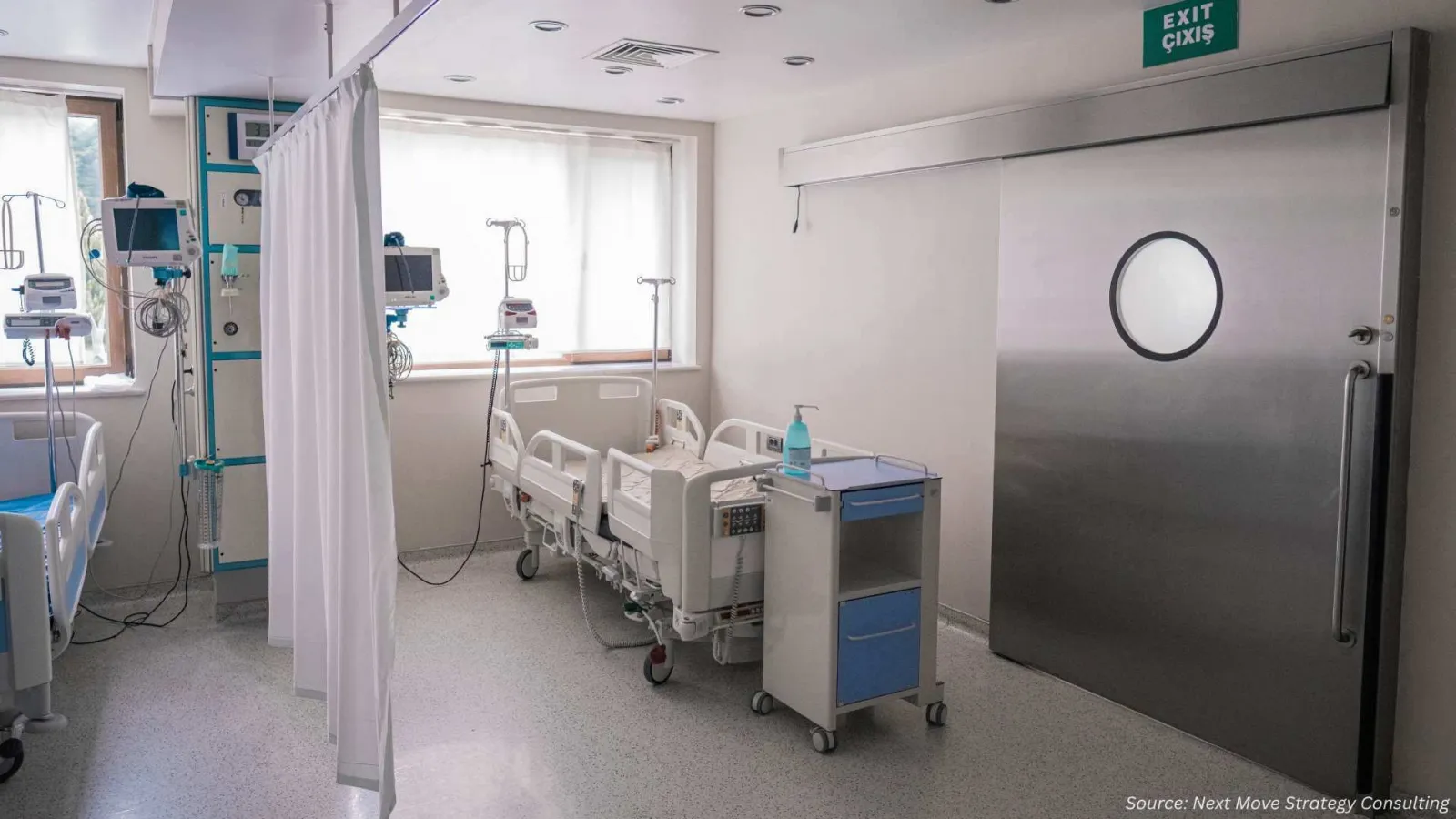
In the fast-evolving world of healthcare, have you ever wondered how hospitals keep beds flowing smoothly amid rising demands? As a market research firm focused on healthcare infrastructure, we see the medical bed market at a pivotal moment in 2025.
The global Medical Bed Market size is predicted to reach USD 4.56 billion by the end of 2025. The industry is predicted to reach USD 6 billion by 2030 with a CAGR of 5.7% from 2025 to 2030.
This sector, valued for its role in patient throughput and resource allocation, faces pressures from technological upgrades, rural expansions, and even misuse incidents. Drawing from recent developments, this post unpacks key trends, their ripple effects, and what they mean for stakeholders. Let's dive in with fresh insights to help you navigate this landscape.
What Innovations are Revolutionizing Hospital Bed Management?
Picture a bustling hospital where empty beds vanish like ghosts—frustrating, right? Enter the Michigan Medicine Command Center (M2C2), a game-changer piloted across three Ann Arbor hospitals at the University of Michigan Health. Launched to tackle inpatient bed coordination, this setup uses real-time data to slash wait times and boost efficiency.
Key highlights include:
-
A 33% reduction in total wait time for adult patients seeking available beds.
-
37% faster bed assignment for emergency department arrivals approved for inpatient stays.
-
13% quicker bed assignments for pediatric patients at C.S. Mott Children’s Hospital.
Powered by Epic's electronic health record dashboards and custom AI tools, the center features 32 large screens for monitoring patient placements and transfers. It even color-codes bed availability on an intranet for quick decisions. The result? Hospitals handle more cases without building new wings—equivalent to adding 63 adult beds in just two years.
This isn't just tech for tech's sake. It shortens stays by 8% for adults (adjusted for complexity) and speeds discharges by 12%, leading to fewer readmissions and better outcomes like timely post-surgery mobility. For the medical bed market, such tools signal a shift toward smart infrastructure, where beds become dynamic assets rather than static fixtures.
How Do these Tech Upgrades Pay Off Financially?
Costs matter in healthcare—do they deliver returns? The M2C2's initial $2.1 million build in converted space, plus $1.5 million annual staffing, yields a net $19.5 million positive impact. That's scalability in action, inspiring rollouts at UM Health-Sparrow in Lansing and UM Health-West in Grand Rapids.
In analytical terms, the implementation enhances bed turnover rates. The system increases transfer acceptance from 70% to 80% via data-driven prioritization, optimizing high-acuity care slots. This directly correlates with revenue growth from higher patient volumes and reduced operational bottlenecks.
Why Are new Hospital Builds Still Essential in Underserved Areas?
Despite tech wizardry, some regions cry out for more beds—literally. In rural Maharashtra, India, a 100-bed hospital project in Wada, Palghar district, promises to bridge that gap for nearly 1 million residents across Wada, Jawhar, Mokhada, and Vikramgad blocks. Led by the Janki Foundation and Chaktanya Health and Care Trust, the foundation stone lays on November 30, 2025, with operations slated for the next two years.
This facility draws from the Trust's 300-bed NABH-accredited Bhaktivedanta Hospital model in Mira Road. It will span neonatal care to geriatrics, plus a center for holistic healthcare and mobile outreach vans targeting high maternal and infant mortality in tribal areas. Integrated into the 70-acre Govardhan Eco Village (GEV-2) campus, it includes wellness centers and schools, fostering sustainable community health.
For the medical bed market, this expansion highlights demand in emerging economies. It emphasizes multi-specialty beds tailored for women and children, addressing gaps where tech alone falls short.
What Makes this Project a Model for Rural Healthcare?
Sustainability drives it—think eco-friendly designs alongside medical ones. Partnerships like this amplify reach, turning a 100-bed hub into a lifeline for underserved populations.
How Are These 2025 News Stories Reshaping the Medical Bed Market?
As a market research company, we analyze how headlines like these influence supply chains, investments, and strategies. The M2C2's success, for instance, accelerates demand for AI-integrated bed management software, potentially growing the smart hospital segment by emphasizing efficiency over sheer volume. Palghar's 100-bed initiative signals investor confidence in rural India, where bed shortages persist; it could spur 10-15% localized procurement hikes for modular, sustainable units.
|
Development |
Market Impact |
Key Driver |
|
M2C2 Command Center |
Boosts tech-bed integrations; $19.5M ROI model |
Efficiency in aging populations |
|
Palghar 100-Bed Hospital |
Increases rural bed supply; holistic focus |
Underserved area expansions |
These events collectively forecast a 2025 market tilt toward hybrid solutions: Tech-optimized existing beds plus targeted builds. We project sustained growth as health systems balance innovation with integrity, ultimately improving patient outcomes and operational ROI.
Key Players in the Medical Bed Market
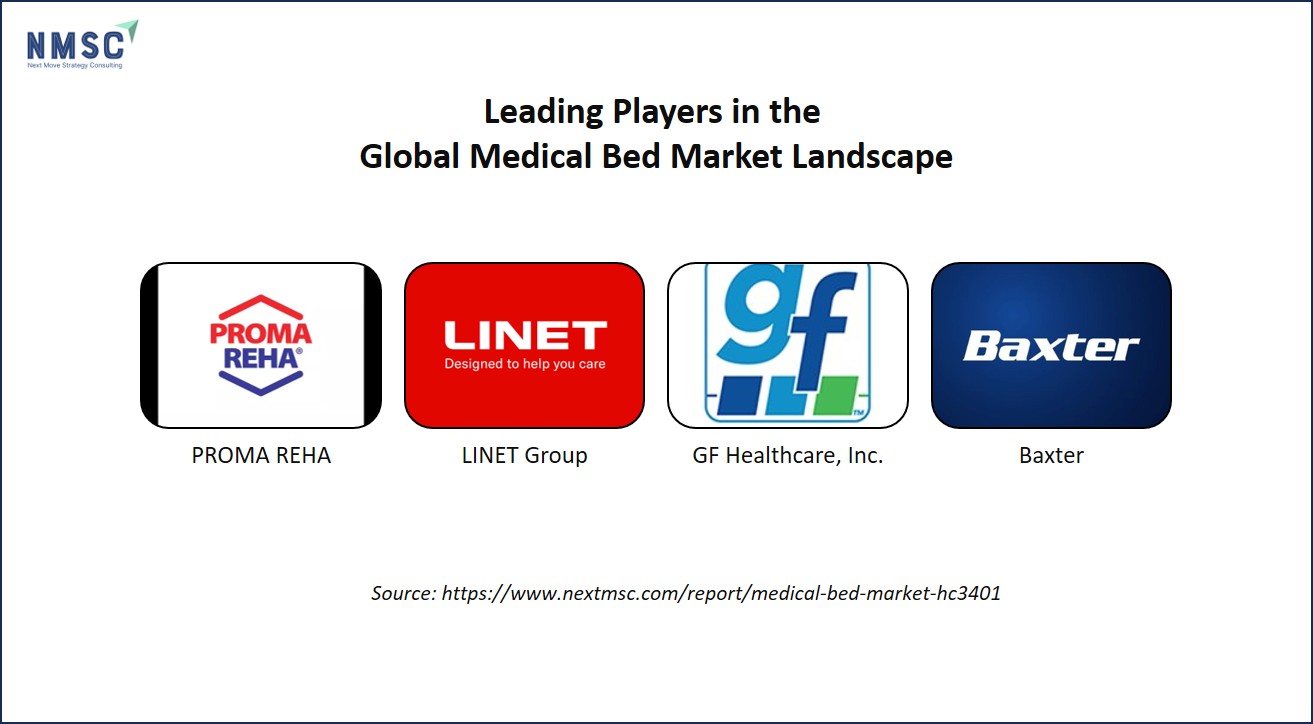
Key players in the medical bed industry are actively deploying strategic partnerships, advanced technology integration, and product diversification to strengthen their market share and meet evolving healthcare demands.
-
In June 2025, PROMA REHA participated in the Medlab West Africa international trade fair held in Lagos, Nigeria, a prominent healthcare event that attracted professionals from across the region. The event provided a strategic platform to introduce advanced medical solutions to new markets. The company’s GENEO Green Line hospital bed was showcased and received strong interest and positive feedback from visitors and local distributors. The emphasis on modern, sustainable healthcare solutions resonated well across the African continent.
-
In November 2024, LINET Group acquired the French company Domalys, enhancing its product portfolio with ergonomic furniture and advanced smart fall prevention technologies. This acquisition expands LINET’s offerings across hospitals, social care, and home care settings, while also boosting its innovation capabilities in IoT-based solutions.
-
In April 2024, GF Health Products, Inc. acquired the majority of assets from Transfer Master Products, Inc. (TMP), a company with over 30 years of experience in designing and manufacturing hi-low adjustable beds for home and healthcare environments. This acquisition enables Graham-Field to broaden its bed and sleep support system portfolio beyond its existing industry-leading brands.
-
Other Notable Players include:
-
Narang Medical
-
Famed Żywiec Sp. z o.o.
-
Paramount Bed Co., Ltd.
-
Invacare Corporation
-
Antano Group
Next Steps: Actionable Takeaways for Healthcare Leaders
Ready to act? Here are 3-5 steps to leverage these trends:
-
Assess Your Bed Tech Stack: Audit current systems against M2C2 benchmarks—implement AI dashboards to cut wait times by up to 33%.
-
Explore Rural Partnership Models: Like Palghar's eco-village integration, collaborate for 100+ bed projects targeting high-need areas.
-
Strengthen Admission Safeguards: Develop protocols to verify high-risk cases, drawing from the Gupta incident to protect bed integrity.
-
Invest in Modular Beds: Prioritize flexible, sustainable units for quick scalability in expansions or renovations.
-
Monitor ROI Metrics: Track financials like the $19.5M M2C2 gain to justify tech spends.
About the Author
 Sanyukta Deb
— Sanyukta Deb is Digital Marketing Team Lead at Next Move Strategy Consulting, where she has led content strategy and technical SEO for the firm's B2B market research publications for over 2 years. Her editorial process translates NextMSC's primary and secondary research — spanning technology, industrial, and consumer sectors — into commercial narratives, backed by search-intent, keyword, and competitive analysis. She brings 5 years of overall experience in digital marketing and content strategy.
Sanyukta Deb
— Sanyukta Deb is Digital Marketing Team Lead at Next Move Strategy Consulting, where she has led content strategy and technical SEO for the firm's B2B market research publications for over 2 years. Her editorial process translates NextMSC's primary and secondary research — spanning technology, industrial, and consumer sectors — into commercial narratives, backed by search-intent, keyword, and competitive analysis. She brings 5 years of overall experience in digital marketing and content strategy.
About the Reviewer
 Debashree Dey
— Debashree Dey is Assistant Manager at Next Move Strategy Consulting, where she supports cross-vertical market content and communications across diverse industries for 6 years. Her professional background includes senior content writing, communications, and published manuscript authorship, with experience developing audience-focused business narratives and maintaining clear, consistent messaging. Her role supports research-led content development and editorial quality across NextMSC publications.
Debashree Dey
— Debashree Dey is Assistant Manager at Next Move Strategy Consulting, where she supports cross-vertical market content and communications across diverse industries for 6 years. Her professional background includes senior content writing, communications, and published manuscript authorship, with experience developing audience-focused business narratives and maintaining clear, consistent messaging. Her role supports research-led content development and editorial quality across NextMSC publications.


















Add Comment