Identifying and Eliminating Hidden Efficiency Bottlenecks in Electronic Device Production
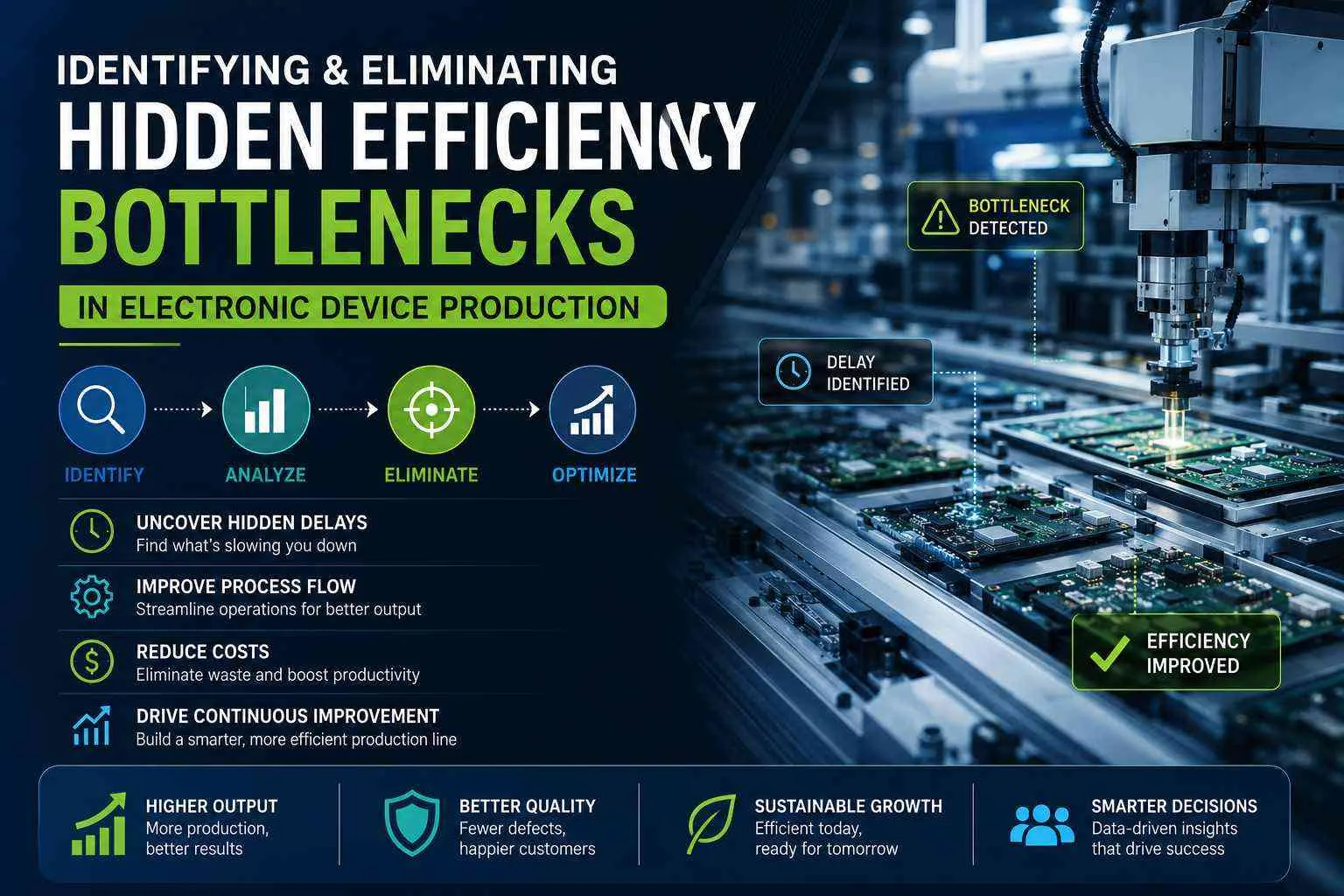
Electronic device production involves orchestrating hundreds of interdependent processes across multiple stages. From component procurement through final assembly and quality verification, each step must align precisely with the next. Yet despite technological advances, manufacturing facilities continue to underperform their theoretical capacity, with productivity losses often attributable to systemic bottlenecks that remain undetected until they significantly impact margins and delivery performance.
This analysis examines the structural inefficiencies that plague electronic device production systems and provides a framework for identifying and eliminating these bottlenecks.
The Anatomy of Production Inefficiency in Electronic Device Manufacturing
Manufacturing efficiency extends beyond raw speed. It encompasses rhythm, predictability, and seamless coordination across departments. In electronic device production, efficiency emerges when materials flow continuously through each stage with minimal waiting, rework, or unplanned delays.
When efficiency deteriorates, the consequences propagate. A quality inspection bottleneck creates an inventory backlog. Component procurement delays cascade into assembly delays. Assembly delays compress testing schedules and compromise shipping reliability. Each upstream inefficiency creates downstream pressure.
Consider a manufacturer operating 15 parallel production lines for different device variants. If component sourcing achieves 96% on-time delivery but assembly processes can only accept 92% of delivered components due to specification variations, the discrepancy creates constant friction. Units accumulate in temporary staging areas. Line workers manage inventory instead of advancing production. Cycle times extend. On-time delivery rates decline.
Structural Causes of Bottlenecks in Electronic Device Production
Departmental Silos and Information Fragmentation
Many electronics manufacturers structure operations around functional departments—design, procurement, production, quality, logistics—rather than integrated value streams. This organizational fragmentation creates predictable inefficiencies.
When the design team finalizes specifications without coordinating with procurement, component availability suffers. When procurement operates independently from production scheduling, materials arrive either too early (creating storage costs) or too late (creating production delays). When quality assurance functions as a final checkpoint rather than an integrated control system, defects propagate further through the assembly process before detection, increasing rework costs.
A 2023 manufacturing operations survey found that 64% of electronics manufacturers report delayed information transfer between departments as a significant operational challenge. This information delay forces production management into reactive rather than proactive decision-making—problems become crises rather than preventable issues.
Legacy Systems and Manual Data Management
Aging manufacturing facilities often operate with fragmented IT infrastructure. Modern production software cannot communicate with legacy quality control systems. ERP systems don't integrate with equipment controllers. Planners track inventory in spreadsheets while warehouse systems maintain separate databases. Data entry becomes redundant. Information becomes inconsistent. Errors compound exponentially.
The cost of upgrading systems feels substantial upfront. However, the hidden costs of system fragmentation—lost productivity, wasted materials, extended cycle times, quality escapes—typically exceed upgrade investments by 10:1 or more over a five-year period.
Component Flow Complexity and Coordination Failures
Electronic device production converges at assembly operations. All upstream activities—design finalization, procurement completion, quality verification of incoming components—feed into this stage. All downstream activities—integration testing, packaging, quality audits, shipping—depend on its output.
Efficient electronic device production requires precise synchronization of five critical elements:
-
Accurate demand forecasting with lead-time consideration
-
Supplier performance consistency and communication protocols
-
Real-time inventory visibility across multiple storage locations
-
Procurement-to-assembly scheduling coordination
-
Multi-stage quality verification aligned with production flow
Failure in any single element creates friction. A microcontroller supplier reduces lead time predictability from ±2 days to ±5 days. Demand forecasting error margins widen. Safety stock increases. Storage costs rise. Capital efficiency declines.
Quantifying the True Cost of Inefficiency in Electronic Device Production
Efficiency losses in electronic device production carry two cost categories: direct and indirect.
Direct Costs include measurable expenses:
-
Materials waste from quality escapes
-
Overtime premiums to meet delayed schedules
-
Expedited shipping to compensate for late components
-
Rework labor for detected defects
Indirect Costs prove far more damaging:
-
Missed delivery commitments and contractual penalties
-
Damaged customer relationships and loss of repeat business
-
Foregone revenue from delayed new product launches
-
Inability to capture seasonal or promotional demand windows
-
Safety incidents from rushed or crowded production conditions
-
Warranty claims and customer service costs from products launched with undetected defects
Research from the Institute for Supply Management indicates that indirect costs typically exceed direct costs by a factor of 3:1 in electronics manufacturing operations.
Consider a concrete example: A manufacturer of industrial control devices processes 10,000 units monthly across four product lines. An 8% efficiency loss in component assembly (representing delayed component availability, tooling issues, or coordination failures) means 800 units fall behind schedule. If the average unit margin is $180, this translates to $144,000 in monthly delayed revenue. Over twelve months, this single bottleneck costs $1.73 million in working capital degradation, plus associated carrying costs.
If indirect costs (customer penalties, lost repeat orders, expedited shipping premiums) comprise 60% of total impact, the total cost reaches approximately $2.8 million annually—representing approximately 18% of typical electronics manufacturing profit margins.
Diagnostic Framework for Identifying Bottlenecks
Quantitative Analysis
Implement structured data collection across all electronic device production stages:
-
Document cycle time for each process step
-
Track where units spend the longest periods (excluding intentional waiting periods like curing)
-
Monitor where rework occurs most frequently
-
Analyze where quality issues are discovered
-
Calculate overall equipment effectiveness (OEE) by production line
The production stage where units consistently linger longest—where quality issues concentrate, where rework is most frequent—represents your primary bottleneck.
Qualitative Insights from Operations Personnel
Production supervisors, line technicians, and maintenance staff operate within the constraints daily. They recognize where processes consistently fail. They distinguish between systemic bottlenecks and temporary disruptions. They understand why standard procedures get circumvented.
Structured interviews with operations teams often reveal bottlenecks that never surface in formal metrics.
Competitive Benchmarking
How do your cycle times compare to industry competitors producing similar products? How does your defect rate compare? Industry benchmarking data from associations like IPC (Association Connecting Electronics Industries) provides context.
If your electronic device production cycle time significantly exceeds competitors', a hidden bottleneck is almost certainly constraining performance.
Systematic Solutions for Electronic Device Production Efficiency
Complete Value Stream Mapping
Document every step in your production process: raw material receipt, inspection, storage, component kit assembly, assembly operations, testing checkpoints, rework loops, packaging, final quality audits, and shipping. Identify waiting periods between stages. Note handoff delays. Map information flows alongside material flows.
This comprehensive map typically reveals unnecessary process steps, redundant inspections, and illogical sequencing that accumulated over years.
Real-Time Production Visibility Systems
Modern manufacturing execution systems (MES) provide continuous monitoring of production status, inventory location, equipment performance, and quality metrics. This visibility transforms decision-making from reactive crisis management to proactive problem prevention.
Problems get caught before they cascade through subsequent stages.
Strategic Equipment and Capability Assessment
Sometimes bottlenecks result from equipment limitations rather than process failures. Older assembly equipment may handle standard components reliably but struggle with advanced packaging formats. Legacy testing systems may lack capacity for increased throughput. Specialized equipment designed for specific assembly tasks may outperform generalized equipment.
Investing in targeted capability upgrades—rather than attempting to optimize constrained equipment—can yield returns exceeding 40% annually in recovered capacity and reduced cycle time.
Supply Chain Partnership Development
If component availability creates bottlenecks in electronic device production, closer supplier relationships and collaborative forecasting reduce variability. If assembly quality suffers from inadequate process control, documented supplier quality agreements and incoming inspection protocols prevent defects before they reach your lines.
For manufacturers where assembly represents the primary bottleneck, outsourcing specific production stages to specialized partners represents one evaluation option. Organizations offering printed circuit board assembly services maintain dedicated infrastructure, process documentation, and quality systems specifically optimized for high-volume assembly operations. These facilities typically operate with higher equipment utilization rates than general-purpose manufacturing lines and can absorb volume fluctuations more effectively than internal operations constrained by fixed capacity.
The decision to utilize external printed circuit board assembly versus internal production should be evaluated through rigorous cost-benefit analysis: comparing direct production costs (labor, equipment utilization, materials handling) against external service fees; assessing quality performance (defect rates, rework cycles) across both options; measuring cycle time and scheduling flexibility; and evaluating capital requirements for equipment upgrades versus external partnership fees. Organizations making this evaluation should benchmark their internal assembly costs against external options using actual operational data rather than assumptions.
If testing capacity constrains throughput, evaluation of third-party testing partnerships may resolve timing conflicts. Strategic partnerships often solve systematic problems that isolated internal improvement efforts cannot address.
Best Practices for Sustained Improvement
-
Establish baseline metrics for your current electronic device production performance before implementing changes
-
Identify the single largest bottleneck before distributing resources across multiple initiatives
-
Measure impact quantitatively—assign dollar values to improvements, not just cycle time reductions
-
Involve operations teams in both diagnosis and solution development
-
Implement changes incrementally to validate assumptions before full-scale deployment
-
Monitor performance continuously to catch efficiency degradation early
Conclusion
Electronic device production inherently involves complexity. However, complexity does not mandate inefficiency. Manufacturing organizations that systematically identify and eliminate bottlenecks maintain competitive advantage through superior delivery performance, product quality, and cost efficiency.
The manufacturers who succeed differentiate themselves through disciplined diagnostic practices, data-driven decision-making, and strategic investment in targeted improvements. Those who ignore undiagnosed bottlenecks experience gradual margin compression, customer attrition, and market share erosion.
The efficiency gap between high-performing and struggling manufacturers rarely stems from advanced technology or superior capital investment. It typically results from identifying and eliminating one or two critical bottlenecks that silently undermine operational performance. Diagnosing and resolving these constraints in electronic device production delivers measurable returns that compound across years of improved delivery performance, reduced cost structure, and enhanced customer satisfaction.
About the Author
 Sanyukta Deb
— Sanyukta Deb is Digital Marketing Team Lead at Next Move Strategy Consulting, where she has led content strategy and technical SEO for the firm's B2B market research publications for over 2 years. Her editorial process translates NextMSC's primary and secondary research — spanning technology, industrial, and consumer sectors — into commercial narratives, backed by search-intent, keyword, and competitive analysis. She brings 5 years of overall experience in digital marketing and content strategy.
Sanyukta Deb
— Sanyukta Deb is Digital Marketing Team Lead at Next Move Strategy Consulting, where she has led content strategy and technical SEO for the firm's B2B market research publications for over 2 years. Her editorial process translates NextMSC's primary and secondary research — spanning technology, industrial, and consumer sectors — into commercial narratives, backed by search-intent, keyword, and competitive analysis. She brings 5 years of overall experience in digital marketing and content strategy.
About the Reviewer
 Debashree Dey
— Debashree Dey is Assistant Manager at Next Move Strategy Consulting, where she supports cross-vertical market content and communications across diverse industries for 6 years. Her professional background includes senior content writing, communications, and published manuscript authorship, with experience developing audience-focused business narratives and maintaining clear, consistent messaging. Her role supports research-led content development and editorial quality across NextMSC publications.
Debashree Dey
— Debashree Dey is Assistant Manager at Next Move Strategy Consulting, where she supports cross-vertical market content and communications across diverse industries for 6 years. Her professional background includes senior content writing, communications, and published manuscript authorship, with experience developing audience-focused business narratives and maintaining clear, consistent messaging. Her role supports research-led content development and editorial quality across NextMSC publications.


















Add Comment