How is $24 Bn Consolidation Shift Reshaping 2026 Elevator Market?
Introduction
The global Elevator and Escalator Market has entered one of the most consequential periods in its modern history. As of mid-2026, vertical mobility is no longer a back-office consideration in construction economics; it is a frontline strategic asset shaped by recurring service revenue, aging installed fleets, digital intelligence, and now a landmark industry consolidation that will redraw competitive boundaries for the next decade.
For institutional investors, real estate developers, and C-level decision-makers, understanding the Elevator and Escalator Market today requires moving beyond installation volumes toward a more nuanced reading of service portfolios, smart elevator solutions, and elevator modernization cycles. This guide synthesizes verified primary-source intelligence with proprietary forecasting from Next Move Strategy Consulting (NMSC) to deliver an institutional-grade view of where the market stands and where capital should be directed.
For More Information – Download FREE Sample on Elevator and Escalator Market Report
The KONE–TK Elevator Megadeal: A Defining Moment for the Elevator Market
The single most globally impactful event reshaping the Elevator Market in 2026 occurred on April 29, when Finland's KONE Corporation agreed to acquire German rival TK Elevator in a transaction creating the world's largest elevator maker by sales. Under the agreement, KONE will pay TK Elevator's owners—a consortium led by private-equity firms Advent and Cinven—approximately €5 billion in cash and €15.2 billion in stock, with the total enterprise value including debt reaching roughly €29.4 billion, the equivalent of approximately $34.4 billion.
The transaction has moved rapidly through governance milestones. KONE's Extraordinary General Meeting approved the proposed resolutions related to the TK Elevator transaction on June 3, 2026, signaling strong shareholder conviction in the combined entity's strategic logic. This consolidation directly affects the competitive structure that has historically defined the sector, where major global competitors include Otis, KONE, Schindler, and TK Elevator.
The deal's timing is instructive. It arrived during what financial markets characterized as a bumper year for corporate transactions, with large deals recording their strongest quarterly start ever in the first three months of 2026, even amid geopolitical uncertainty.
NMSC Strategic Perspective on the Consolidation
From NMSC's analytical vantage point, the KONE–TK Elevator combination is not merely a scale play; it is a service-led repositioning. The economics of the modern elevator industry are increasingly anchored in long-duration maintenance and modernization contracts rather than cyclical new-equipment sales. By consolidating two of the four dominant original equipment manufacturers, the combined entity gains an exceptionally large installed base to monetize through recurring service revenue—the most resilient and margin-accretive segment of the value chain.
NMSC anticipates that this transaction will accelerate three structural shifts: heightened regulatory scrutiny in mature markets where competition authorities will examine service-market concentration; a defensive premium on independent service providers, who already hold a meaningful share of service units; and renewed strategic urgency among remaining majors, particularly Otis and Schindler, to expand density through targeted acquisitions and digital differentiation. For investors, the signal is clear: the Elevator Market's value is migrating decisively toward the service flywheel.
Section Summary: The KONE–TK Elevator megadeal represents the most significant structural realignment in the global Elevator Market in decades, consolidating two of four dominant players and intensifying the strategic focus on recurring service revenue.
-
The transaction carries an enterprise value of approximately $34.4 billion, creating the world's largest elevator maker by sales.
-
KONE shareholders approved the resolutions related to the transaction on June 3, 2026.
-
NMSC expects the deal to trigger regulatory scrutiny, elevate the strategic value of service portfolios, and pressure remaining majors toward density-building acquisitions.
Industry Impact Analysis
The consolidation wave is unfolding against a backdrop of fundamental demand-side transformation. The most powerful current driver is not new construction but the modernization of an aging global installed base. According to Otis, the global installed base of aging elevators ready for modernization is anticipated to increase from 9 million units at year-end 2025 to approximately 13 million by 2030. This represents a multi-year structural tailwind for elevator modernization that is largely insulated from construction-cycle volatility.
The financial evidence is compelling. Otis reported that its modernization and refurbishment orders increased 26% in 2025, with its year-end modernization backlog rising 30% at constant currency. In several countries within Europe, the Middle East, and Africa, more than half of installed elevators are at least 25 years old, creating a substantial addressable retrofit opportunity.
Simultaneously, the new-equipment segment faces regional headwinds. The global new-equipment market remained challenging in 2025, with total industry global units declining 6% to 735,000 units, driven by a 13% decline in China. This divergence—weak new installations in China alongside robust modernization demand elsewhere—defines the current operating environment and reinforces the strategic premium on service-led business models.
Macroeconomic and regulatory forces are also material. Tariff policy is exerting measurable cost pressure; Otis disclosed an impact from new tariffs of approximately $20 million during 2025, with a similar impact anticipated in 2026. Energy efficiency regulation is another accelerant, as building owners increasingly pursue modernization to comply with evolving codes and reduce operational energy consumption.
Section Summary: The Elevator Market's growth narrative has pivoted from new installation toward modernization and recurring service, driven by a rapidly aging installed base and reinforced by energy-efficiency regulation.
-
The global installed base ready for modernization is projected to rise from 9 million units to approximately 13 million by 2030.
-
Otis modernization orders grew 26% and modernization backlog rose 30% at constant currency in 2025.
-
New-equipment volumes declined 6% globally to 735,000 units in 2025, with China down 13%.
-
Tariffs and energy-efficiency codes are creating both cost pressure and modernization demand.
Pros and Cons of Recent Market Developments
The consolidation and modernization dynamics reshaping the Elevator and Escalator Market carry distinct advantages and risks for stakeholders.
|
Pros |
Cons |
|
Service-led business models deliver resilient, high-margin recurring revenue |
Industry consolidation may attract antitrust and regulatory scrutiny |
|
Aging installed base creates a durable, multi-year modernization tailwind |
New-equipment weakness in China continues to drag overall volumes |
|
Digital and IoT-enabled solutions enhance customer retention and productivity |
Tariff and commodity cost pressures compress new-equipment margins |
|
Energy-efficiency regulation accelerates retrofit and upgrade demand |
High capital intensity and integration risk in large-scale mergers |
|
Scale advantages strengthen pricing power and global reach |
Independent service providers face competitive displacement risk |
Key Data & Statistics
The following tables draw exclusively on verified primary-source disclosures from key players' regulatory filings and annual reports. All financial figures are sourced from company reporting, not from market-research estimates.
Table 1: Leading Elevator Manufacturers — Verified 2025 Financial Performance
|
Company |
2025 Net Sales |
Key Performance Indicator |
Source Basis |
|
Otis Worldwide |
$14.4 billion |
Service organic sales +5%; modernization +9% |
2025 Annual Report |
|
KONE Corporation |
€11.2 billion |
Adjusted EBIT margin 12.2%; sales growth 4.0% |
Annual Review 2025 |
Otis reported net sales of $14.4 billion in 2025, with service organic sales increasing 5% and modernization growing 9%. KONE recorded annual sales of EUR 11.2 billion in 2025, with an adjusted EBIT of 12.2% of sales and sales growth of 4.0% in comparable currencies.
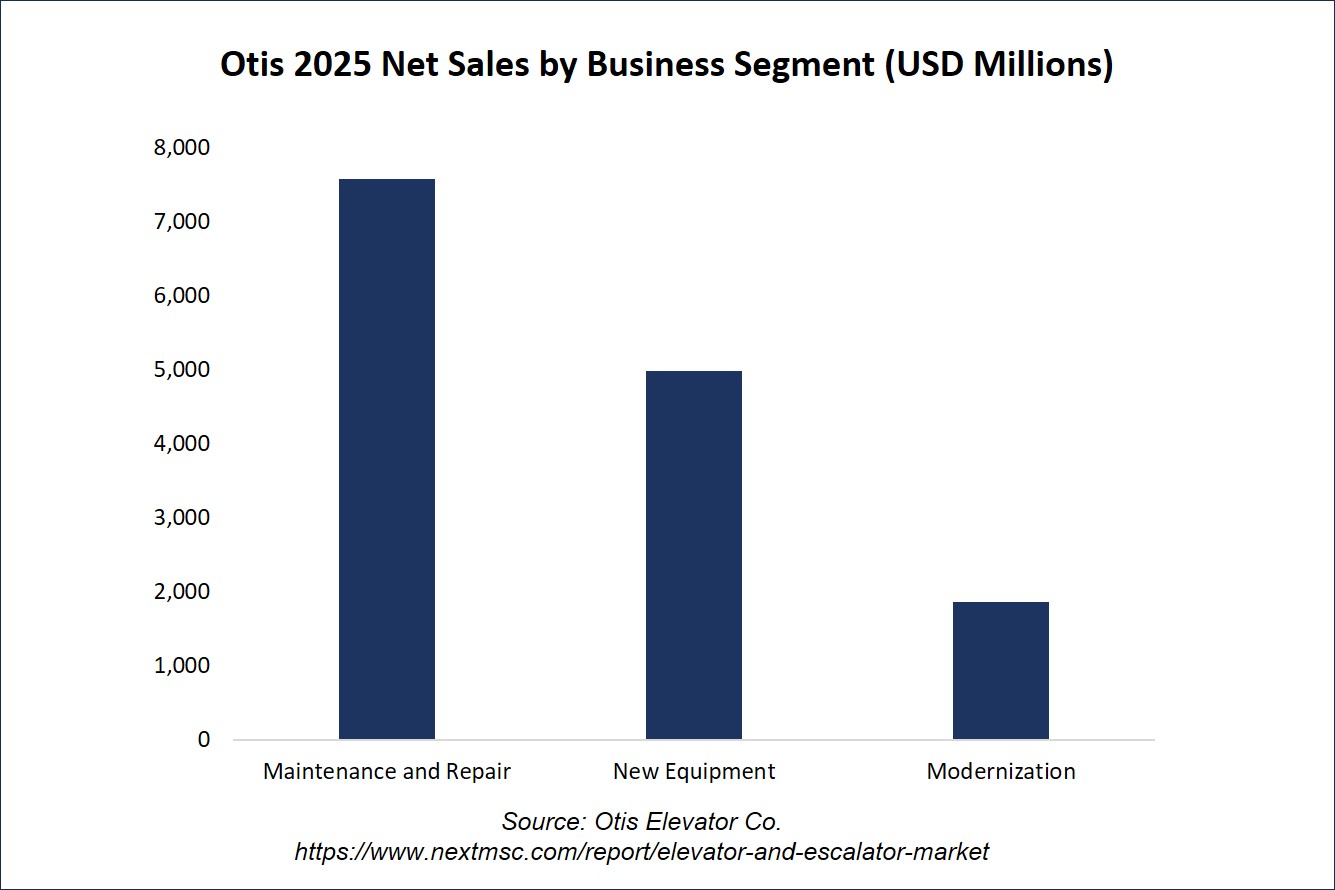
Table 2: Otis 2025 Revenue by Segment (Verified)
|
Segment |
2025 Net Sales |
Year-over-Year Growth |
|
New Equipment |
$4,989 million |
(7)% organic |
|
Maintenance and Repair |
$7,584 million |
+5% |
|
Modernization |
$1,858 million |
+10% |
|
Total |
$14,431 million |
+1% |
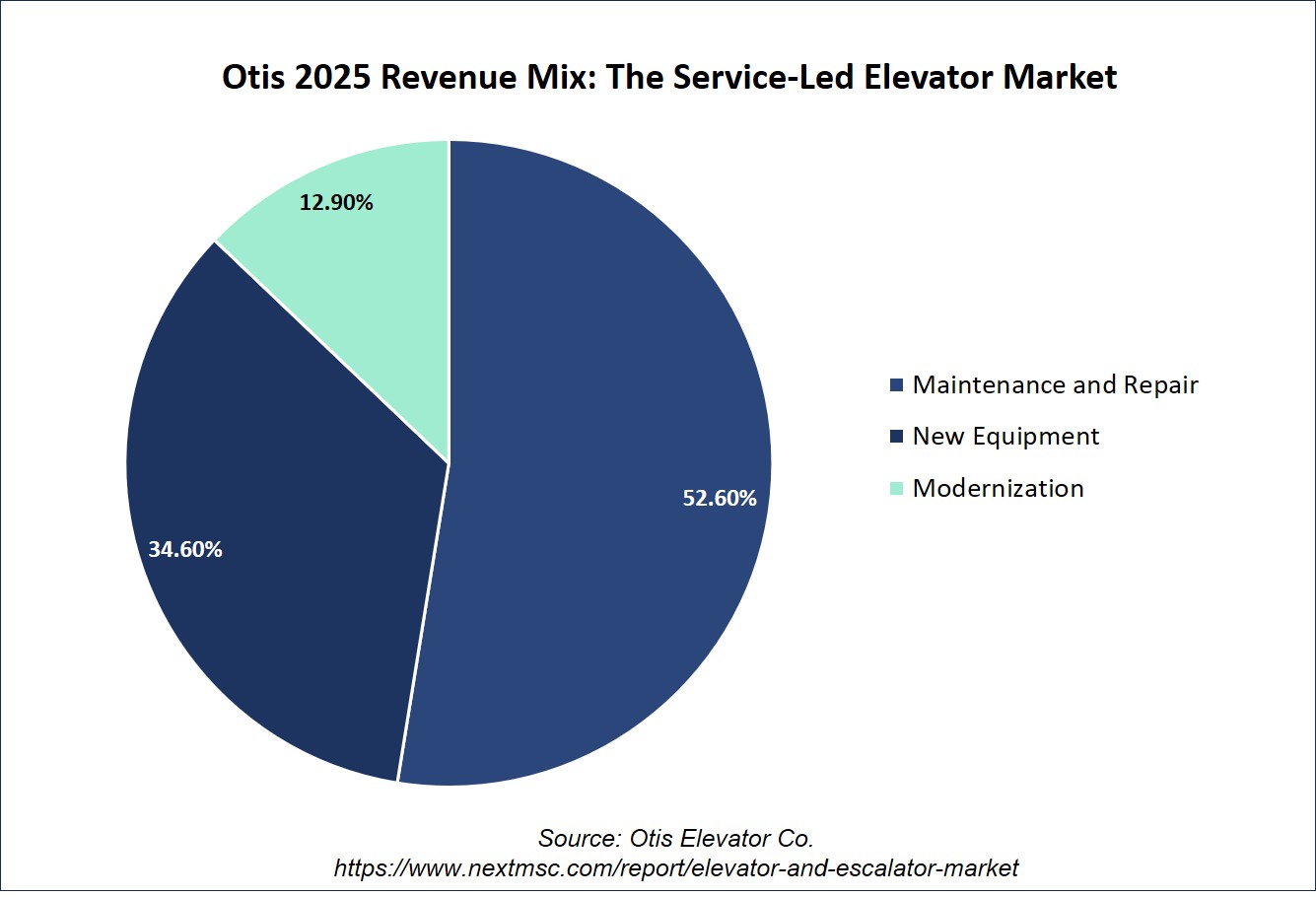
The segment breakdown confirms the service-led structure of the modern Elevator Market, with maintenance, repair, and modernization collectively representing the overwhelming majority of revenue.
Future Outlook & Forecast for the Elevator Market
The forward trajectory of the Elevator Market is defined by the convergence of consolidation, modernization, and digitalization. The aging installed base provides a structural growth engine that is largely independent of construction cycles, while smart elevator solutions—predictive maintenance, IoT connectivity, and AI-enabled dispatching—are becoming standard differentiators rather than premium add-ons. Otis ended 2025 with 1.1 million connected units globally, illustrating the pace at which digital service ecosystems are scaling.
Anchoring the long-term market sizing, Next Move Strategy Consulting's proprietary analysis values the global Elevator and Escalator Market is projected to rise to USD 183.4 billion, reflecting a CAGR of 6.5% by 2030. NMSC identifies Asia-Pacific as holding the dominant share of the market, supported by favorable raw-material availability, urbanization momentum, and the construction of high-speed lifts for skyscraper developments.
NMSC's outlook holds that the service and modernization segments will outpace new equipment over the forecast horizon, a thesis strongly corroborated by the verified order-book momentum at leading manufacturers. The combination of regulatory tailwinds, digital monetization, and consolidation-driven pricing discipline positions the sector for durable, defensible growth.
Section Summary: The Elevator Market outlook is underpinned by NMSC's USD 183.4 billion forecast by 2030 at a 6.5% CAGR, with service, modernization, and digital connectivity emerging as the principal value drivers.
-
NMSC projects the market to grow from USD 134.4 billion in 2021 to USD 183.4 billion by 2030.
-
Asia-Pacific remains the dominant regional market through the forecast period.
-
Connected and smart elevator solutions are scaling rapidly, with leading players surpassing one million connected units.
-
Service and modernization are expected to consistently outgrow new equipment.
Next Steps for Stakeholders
For C-level executives and institutional investors positioning within the Elevator Market, the strategic priorities are increasingly defined and actionable:
-
Prioritize service-portfolio exposure. Direct capital toward businesses with large, defensible installed bases and high modernization conversion rates, as these deliver the most resilient margins.
-
Monitor regulatory developments around the KONE–TK Elevator deal. Antitrust outcomes in concentrated service markets may create acquisition opportunities among displaced independent providers.
-
Evaluate digital and IoT capability as a competitive moat. Connected-unit penetration and predictive-maintenance platforms are now central to customer retention and lifetime value.
-
Factor tariff and commodity exposure into valuation models. Verified cost impacts at major players underscore the need for disciplined margin sensitivity analysis.
-
Target Asia-Pacific and modernization-heavy mature markets. These geographies offer the most attractive blend of structural growth and recurring-revenue potential.
Conclusion
The Elevator Market in 2026 is being reshaped by a rare convergence of forces: a $34.4 billion consolidation that establishes a new global leader, a structural modernization wave driven by an aging installed base set to reach 13 million units by 2030, and the rapid maturation of smart elevator solutions. Against this backdrop, NMSC's forecast of a USD 183.4 billion market by 2030 at a 6.5% CAGR provides a credible long-term anchor for capital allocation. The decisive strategic insight is unambiguous—value in vertical mobility now resides in service, modernization, and digital intelligence, and the stakeholders who align their portfolios accordingly will be best positioned to capture the next phase of growth.
About the Author
 Sanyukta Deb
— Sanyukta Deb is Digital Marketing Team Lead at Next Move Strategy Consulting, where she has led content strategy and technical SEO for the firm's B2B market research publications for over 2 years. Her editorial process translates NextMSC's primary and secondary research — spanning technology, industrial, and consumer sectors — into commercial narratives, backed by search-intent, keyword, and competitive analysis. She brings 5 years of overall experience in digital marketing and content strategy.
Sanyukta Deb
— Sanyukta Deb is Digital Marketing Team Lead at Next Move Strategy Consulting, where she has led content strategy and technical SEO for the firm's B2B market research publications for over 2 years. Her editorial process translates NextMSC's primary and secondary research — spanning technology, industrial, and consumer sectors — into commercial narratives, backed by search-intent, keyword, and competitive analysis. She brings 5 years of overall experience in digital marketing and content strategy.
About the Reviewer
 Debashree Dey
— Debashree Dey is Assistant Manager at Next Move Strategy Consulting, where she supports cross-vertical market content and communications across diverse industries for 6 years. Her professional background includes senior content writing, communications, and published manuscript authorship, with experience developing audience-focused business narratives and maintaining clear, consistent messaging. Her role supports research-led content development and editorial quality across NextMSC publications.
Debashree Dey
— Debashree Dey is Assistant Manager at Next Move Strategy Consulting, where she supports cross-vertical market content and communications across diverse industries for 6 years. Her professional background includes senior content writing, communications, and published manuscript authorship, with experience developing audience-focused business narratives and maintaining clear, consistent messaging. Her role supports research-led content development and editorial quality across NextMSC publications.

















Add Comment