Is the 5G NTN Moving from Trials to True Commercial Scale?

The 5G NTN Market entered a defining phase in 2025. What began as technical experimentation has rapidly progressed into live interoperability validation and commercial deployment. Two major announcements in February 2025 and December 2025 demonstrate that non-terrestrial 5G connectivity is no longer theoretical. It is operational.
The successful live trial by Eutelsat and the commercial launch by Myriota illustrate how satellite-enabled 5G is advancing from infrastructure testing to real-world IoT adoption.
5G NTN Market Breakthrough: Myriota’s HyperPulse Commercial Launch
In December 2025, Myriota announced the General Availability of its HyperPulse™ network, described as the first commercial 5G NTN service designed specifically for IoT applications. The network became available on 15 December 2025 in the United States, Mexico, Brazil, Australia, and Saudi Arabia. According to the announcement, customers in environmental monitoring, oil and gas monitoring, asset tracking, and animal tracking were already connected through the Early Access Program. Expansion across Europe, Southeast Asia, and additional Latin American countries is scheduled for early 2026.
HyperPulse is built on 3GPP 5G NTN standards and combines Myriota’s architecture with L-band satellite capacity leased from Viasat. The network incorporates a dynamic optimization layer that adjusts latency and data volumes based on demand or environmental conditions.
Myriota has also certified the nRF9151 module from Nordic Semiconductor, reinforcing standards-based interoperability. Additional certifications are on the roadmap.
HyperPulse complements Myriota’s UltraLite™ service by offering lower latency and higher daily data allowances, enabling richer sensing use cases such as heavy equipment tracking, container monitoring, smart utility metering, and environmental sensing.
Commercial Readiness and Ecosystem Depth
From an Experience, Expertise, Authoritativeness, and Trustworthiness perspective, the commercial activation across five countries demonstrates operational maturity. Alignment with 3GPP standards reflects technical expertise and industry integration. Certification of semiconductor modules strengthens ecosystem credibility. Clearly defined geographic expansion plans increase transparency and market confidence.
This milestone establishes that 5G non-terrestrial connectivity is commercially viable, not merely experimental.
2025 Milestones Shaping the 5G NTN Market
|
Parameter |
Eutelsat 5G NTN Trial |
Myriota HyperPulse |
|
Development Stage |
Live commercial |
Commercial service launch |
|
Standard Implemented |
3GPP Release 17 |
3GPP 5G NTN standards |
|
Satellite Infrastructure |
654 LEO satellites via |
L-band capacity |
|
Primary Focus |
Satellite–terrestrial |
IoT connectivity at scale |
|
Device Ecosystem |
MediaTek NR NTN |
Certified nRF9151 module |
|
Geographic Scope |
Global live network |
US, Mexico, Brazil, |
|
Market Impact |
Technical feasibility |
Revenue-generating |
5G NTN Market Validation: Eutelsat’s Live 5G NTN Trial
Earlier in February 2025, Eutelsat completed what it described as the world’s first trial of a 5G Non-Terrestrial Network connection over its OneWeb satellite network. The test was conducted over a live commercial network operated as Eutelsat OneWeb. The constellation consists of 654 Low Earth Orbit satellites.
The trial implemented 3GPP Release 17 specifications. It utilized a MediaTek NR NTN test chipset and an NR NTN test gNB provided by ITRI. Sharp and Rohde & Schwarz supplied the antenna array and test equipment. The satellites, built by Airbus, carry transponders using Ku-band service links and Ka-band feeder links, adopting the “Earth-moving beams” concept. During the trial, a 5G user terminal successfully connected to the 5G core through the satellite link and exchanged traffic.
Eutelsat stated that this achievement paves the way for deployment of the 5G NTN standard and future satellite-terrestrial interoperability. The integration of terrestrial networks and non-terrestrial networks enables what is described as a “network of networks,” supporting resilience and broader connectivity coverage.
Eutelsat is also one of the satellite operators selected by the European Union for the IRIS² constellation programme targeting secure connectivity across member states by 2030, as reported in the February 2025 coverage.
Commercial Relevance: From Technical Validation to IoT Deployment
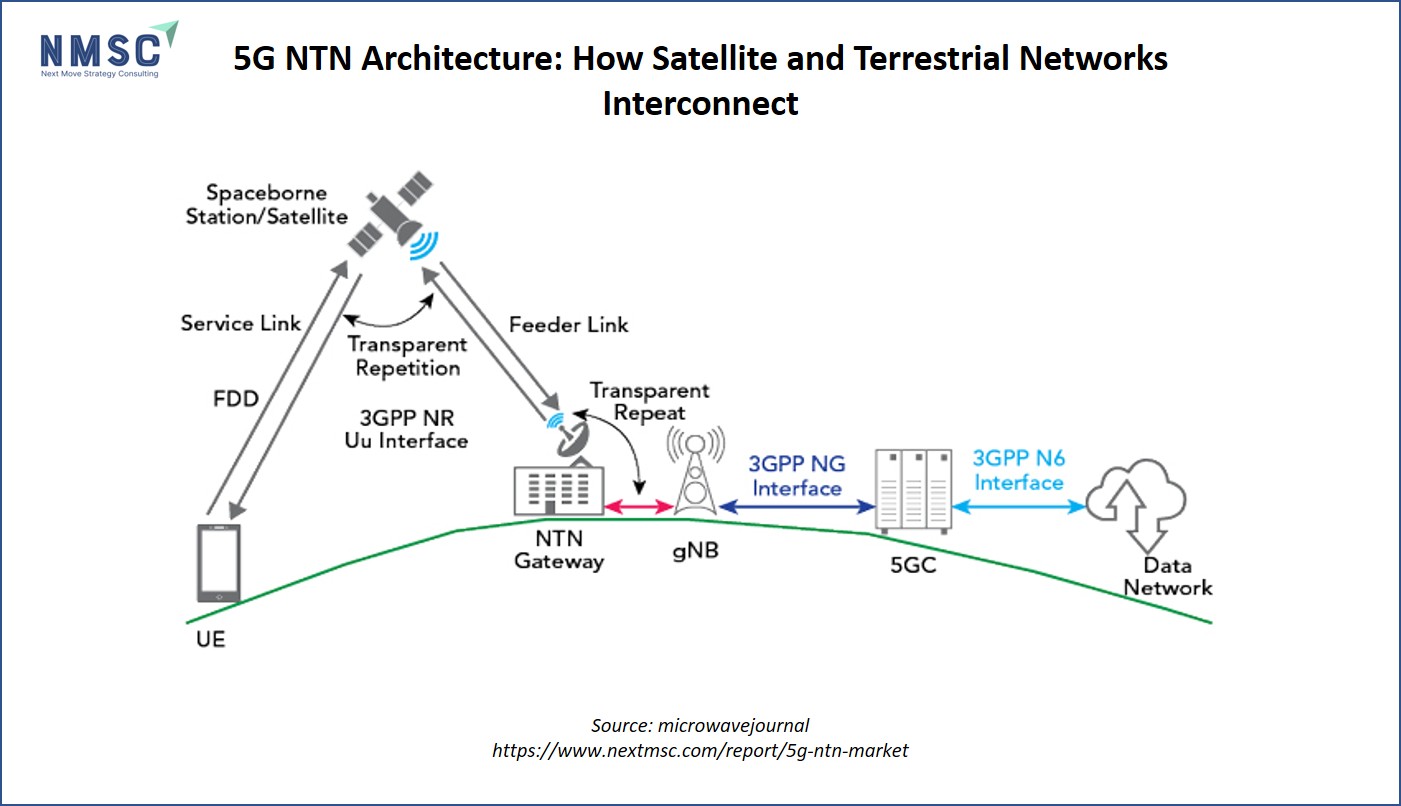
Beyond technical interoperability, the architecture shown in the image directly supports commercial deployments such as the December 2025 launch of HyperPulse™ by Myriota, described as the first commercial 5G NTN service for IoT. Built on 3GPP 5G NTN standards and supported by satellite capacity leased from Viasat, this architecture enables applications such as environmental monitoring, oil and gas asset tracking, and smart metering. The diagram therefore represents not only a technical framework but a commercially operational “network of networks,” where satellite and terrestrial systems integrate seamlessly within the 5G core, enabling scalable global connectivity in areas beyond traditional tower coverage.
Infrastructure Convergence and Standardization
Conducting the trial on a live network demonstrates real-world validation rather than laboratory simulation. The implementation of 3GPP Release 17 confirms adherence to global standards frameworks. Multi-vendor collaboration involving MediaTek, Airbus, and Rohde & Schwarz reflects ecosystem alignment.
This development strengthens industry confidence in satellite-terrestrial convergence and supports scalable deployment strategies.
From Trial to Deployment: What 2025 Signals for the 5G NTN Market
The February trial and December commercial launch represent complementary milestones. The first validated technical feasibility and standards compliance. The second established market-ready service delivery.
Low Earth Orbit satellites enable cost-efficient connectivity in hard-to-reach regions where terrestrial tower deployment is impractical. At the same time, IoT-focused commercial services provide immediate enterprise applications in sectors such as utilities, environmental monitoring, and asset tracking.
Commercial Significance: Enabling Scalable IoT and Direct-to-Device Connectivity
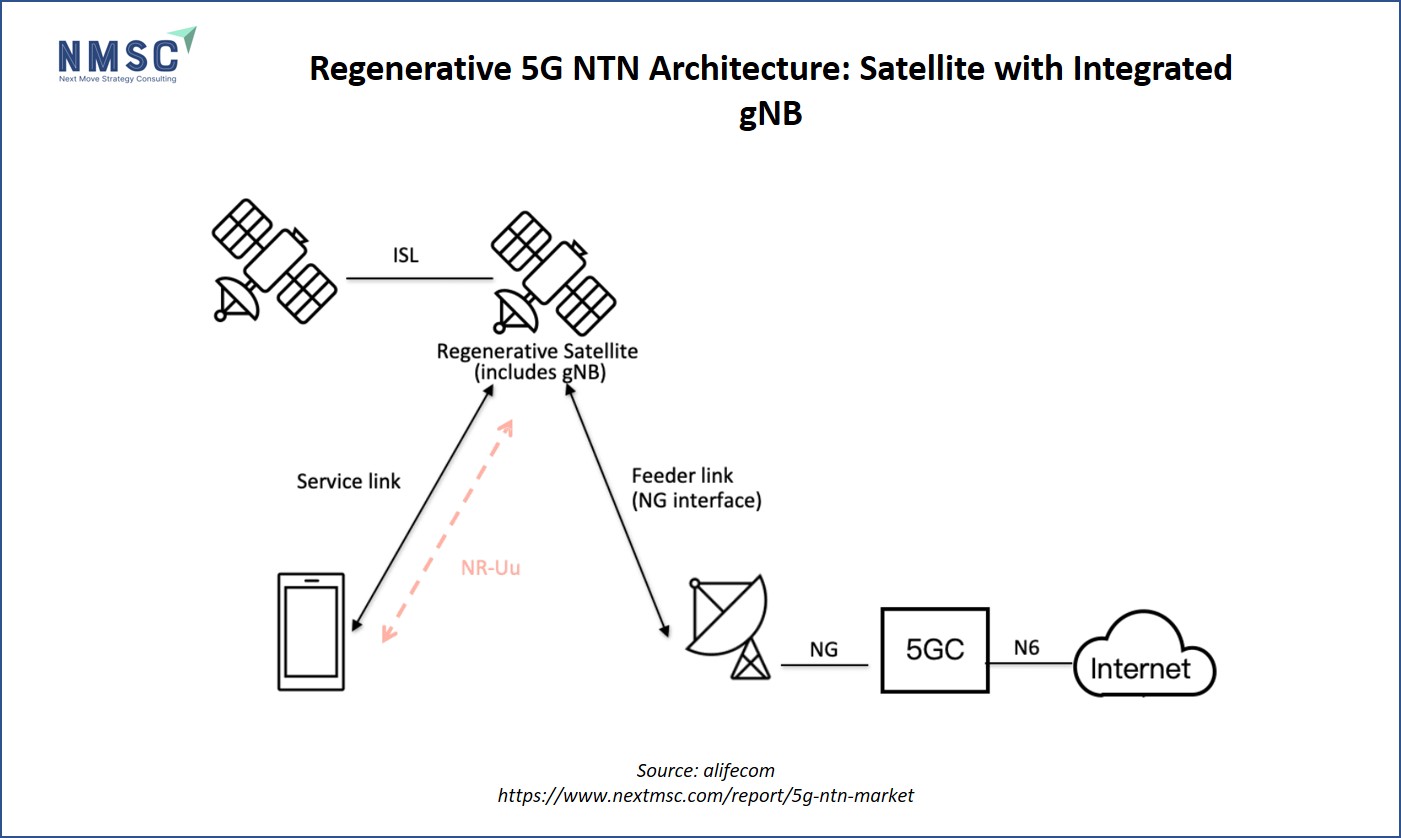
This model supports the evolution of commercial NTN deployments such as the December 2025 launch of HyperPulse™ by Myriota, described as the first commercial 5G NTN service for IoT. While Myriota’s deployment leverages satellite capacity and 3GPP-aligned architecture, the broader NTN framework illustrated here demonstrates how satellite networks can integrate seamlessly into the 5G Core to support asset tracking, environmental monitoring, and industrial IoT applications. By embedding gNB capabilities in orbit and maintaining standardized NG and N6 interfaces, the regenerative NTN approach strengthens interoperability, expands coverage into remote regions, and accelerates the commercial maturity of the 5G NTN ecosystem.
Leading Companies Driving Innovation in the 5G NTN Industry
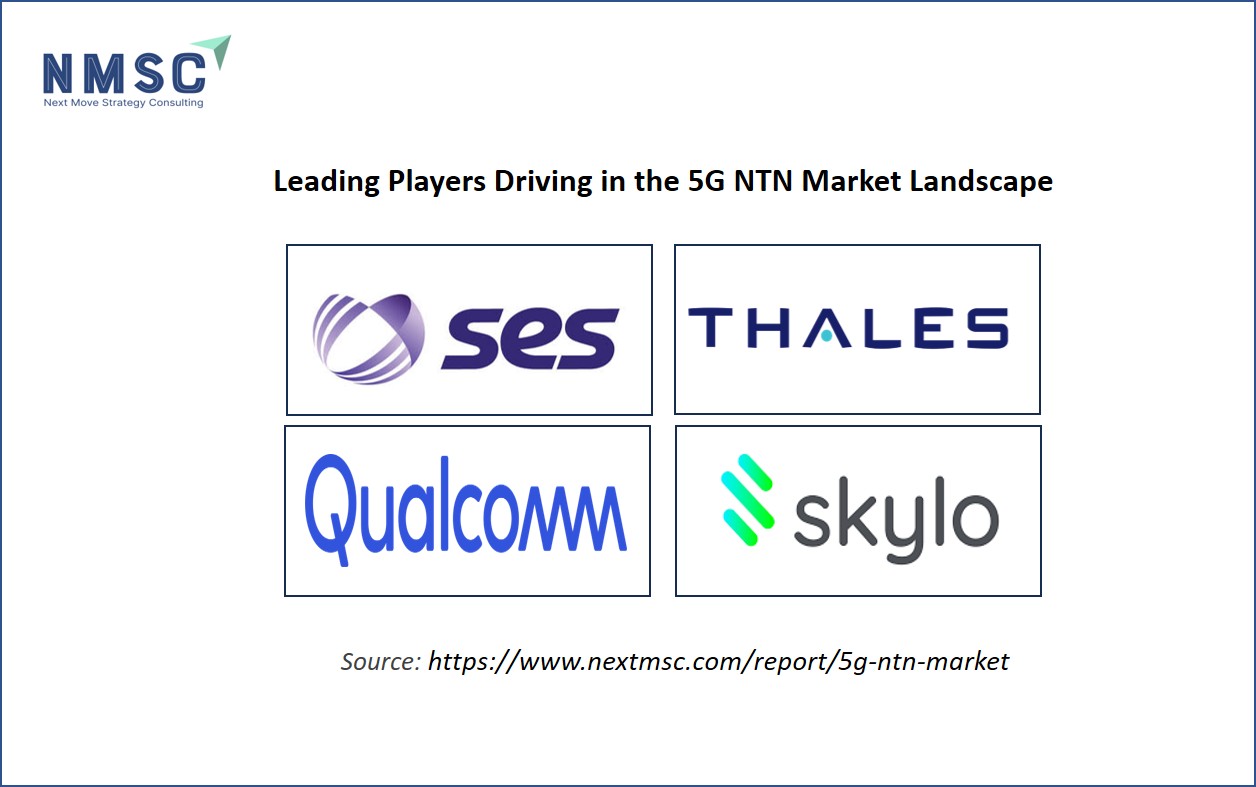
The 5G Non-Terrestrial Network industry is supported by a diverse group of technology providers, satellite operators, semiconductor firms, and telecom infrastructure companies. Prominent participants include Qualcomm Technologies, Inc., Thales Group, SES S.A., SoftBank Group Corp., MediaTek Inc., EchoStar Corporation, Keysight Technologies, Inc., Rohde & Schwarz GmbH & Co. KG, Telefonaktiebolaget LM Ericsson, Nokia, Skylo Technologies, Viasat, Inc., Telesat, Globalstar, Inc., and Intelsat. These companies are actively strengthening their market position through strategic initiatives such as product launches, technology validation trials, infrastructure expansion, and standards-based innovation to sustain competitive advantage within the evolving 5G NTN ecosystem.
Next Steps for Industry Stakeholders
-
Assess compatibility with 3GPP Release 17 NTN standards and certified modules
-
Initiate pilot IoT deployments in newly launched markets
-
Align device roadmaps with emerging NTN-capable chipsets
-
Explore hybrid terrestrial and non-terrestrial service models
-
Monitor European and Southeast Asian expansion scheduled for early 2026
Next Move Strategy Consulting View: Overall Market Outlook
The 5G NTN Market has crossed a structural threshold in 2025. Eutelsat’s live interoperability trial established technical credibility. Myriota’s HyperPulse launch confirmed commercial execution. Together, these milestones indicate reduced technological risk, ecosystem maturity, and accelerating enterprise adoption.
The focus is no longer on whether 5G non-terrestrial connectivity works. The focus is on how rapidly global operators and IoT providers can scale deployment within an increasingly standards-aligned environment.
About the Author
 Sanyukta Deb
— Sanyukta Deb is Digital Marketing Team Lead at Next Move Strategy Consulting, where she has led content strategy and technical SEO for the firm's B2B market research publications for over 2 years. Her editorial process translates NextMSC's primary and secondary research — spanning technology, industrial, and consumer sectors — into commercial narratives, backed by search-intent, keyword, and competitive analysis. She brings 5 years of overall experience in digital marketing and content strategy.
Sanyukta Deb
— Sanyukta Deb is Digital Marketing Team Lead at Next Move Strategy Consulting, where she has led content strategy and technical SEO for the firm's B2B market research publications for over 2 years. Her editorial process translates NextMSC's primary and secondary research — spanning technology, industrial, and consumer sectors — into commercial narratives, backed by search-intent, keyword, and competitive analysis. She brings 5 years of overall experience in digital marketing and content strategy.
About the Reviewer
 Debashree Dey
— Debashree Dey is Assistant Manager at Next Move Strategy Consulting, where she supports cross-vertical market content and communications across diverse industries for 6 years. Her professional background includes senior content writing, communications, and published manuscript authorship, with experience developing audience-focused business narratives and maintaining clear, consistent messaging. Her role supports research-led content development and editorial quality across NextMSC publications.
Debashree Dey
— Debashree Dey is Assistant Manager at Next Move Strategy Consulting, where she supports cross-vertical market content and communications across diverse industries for 6 years. Her professional background includes senior content writing, communications, and published manuscript authorship, with experience developing audience-focused business narratives and maintaining clear, consistent messaging. Her role supports research-led content development and editorial quality across NextMSC publications.


















Add Comment