Mobile Video Surveillance Market: AI and Drones Reshape Growth | NextMSC

Introduction
When a police drone autonomously launches from a rooftop launchpad, streams live footage to a command center, and feeds that footage into an AI-powered license plate recognition engine — all before a patrol officer has even started the engine — the phrase "mobile video surveillance" has outgrown its original meaning. The market is no longer defined by cameras mounted on vehicles or portable tripods. It is defined by the convergence of edge AI, private cellular connectivity, autonomous aerial platforms, and cloud-native video management into a single, always-on intelligence layer that moves with the threat.
According to Next Move Strategy Consulting's Mobile Video Surveillance Market report, the global mobile video surveillance market is projected to reach USD 4.4 billion by 2030, growing at a CAGR of 8.2% from 2024 to 2030. This trajectory is not driven by incremental hardware upgrades. It is being shaped by a structural shift in how governments, law enforcement agencies, and commercial enterprises define situational awareness — and by a wave of product launches, regulatory actions, and autonomous deployment programs that have materially expanded the addressable market in 2026 alone.
For More Information: Download FREE Sample on Mobile Video Surveillance Market Report
From Passive Recording to Proactive Intelligence: The Technology Shift Reshaping Mobile Surveillance
Axis Communications Redefines Deployment Flexibility at ISC West 2026
At ISC West 2026 in Las Vegas (March 25–27), Axis Communications unveiled a portfolio of innovations that directly address the single largest operational constraint in mobile video surveillance: the dependency on fixed wired infrastructure. The centerpiece of the announcement was the AXIS TP3604-E Private Cellular Back Box, which enables compatible AXIS P14 and P32 cameras to connect directly to an enterprise Private Cellular Network (PCN), eliminating the need for trenching and cabling.
The practical implication is significant: surveillance operators can now deploy high-performance IP cameras in remote construction sites, temporary event perimeters, border zones, and infrastructure-limited urban areas without the cost and lead time of physical cabling. Coverage per base station can range from a few hundred meters to several kilometers, depending on cell configuration. The AXIS TP3604-E is expected to launch in the U.S. in August 2026, with availability in select EMEA countries.
Axis also introduced the AXIS P1486-LE Global Shutter Camera — the first global shutter camera in the video surveillance industry — which eliminates motion blur and rolling shutter artifacts when capturing fast-moving vehicles and license plates. Powered by the ARTPEC-9 system-on-chip, it supports advanced edge analytics for real-time processing directly on the device, reducing server load and enabling forensic-grade identification in traffic monitoring, logistics hubs, and manufacturing environments. The camera became available through Axis distribution channels in June 2026.
Complementing these hardware launches, Axis introduced the AXIS License Plate Verifier — an edge-based analytics application running directly on compatible cameras — which enables real-time vehicle identification without dedicated servers, triggering automated allow/blocklist actions such as opening gates or barriers.
"Today's organizations demand solutions that can adapt to their evolving operational needs," said Fredrik Nilsson, Vice President, Americas, Axis Communications. "Our latest innovations — including private cellular connectivity, advanced thermal imaging, and powerful AI solutions like our newly enhanced edge-based LPR — are engineered to deliver that agility."
Motorola Solutions Converges Video, Voice, and AI into a Wearable Platform
On June 4, 2026, Motorola Solutions (NYSE: MSI) unveiled SafetyCam, a wearable AI assistant that combines evidence-grade video, two-way voice communications, a dedicated panic button, and the company's conversational Assist AI into a single device for retail and front-line enterprise teams. SafetyCam's front-facing active feedback display lets subjects see themselves being recorded — a deliberate deterrence mechanism — while a remote talk-down feature allows off-site security teams to intervene in customer conflicts in real time.
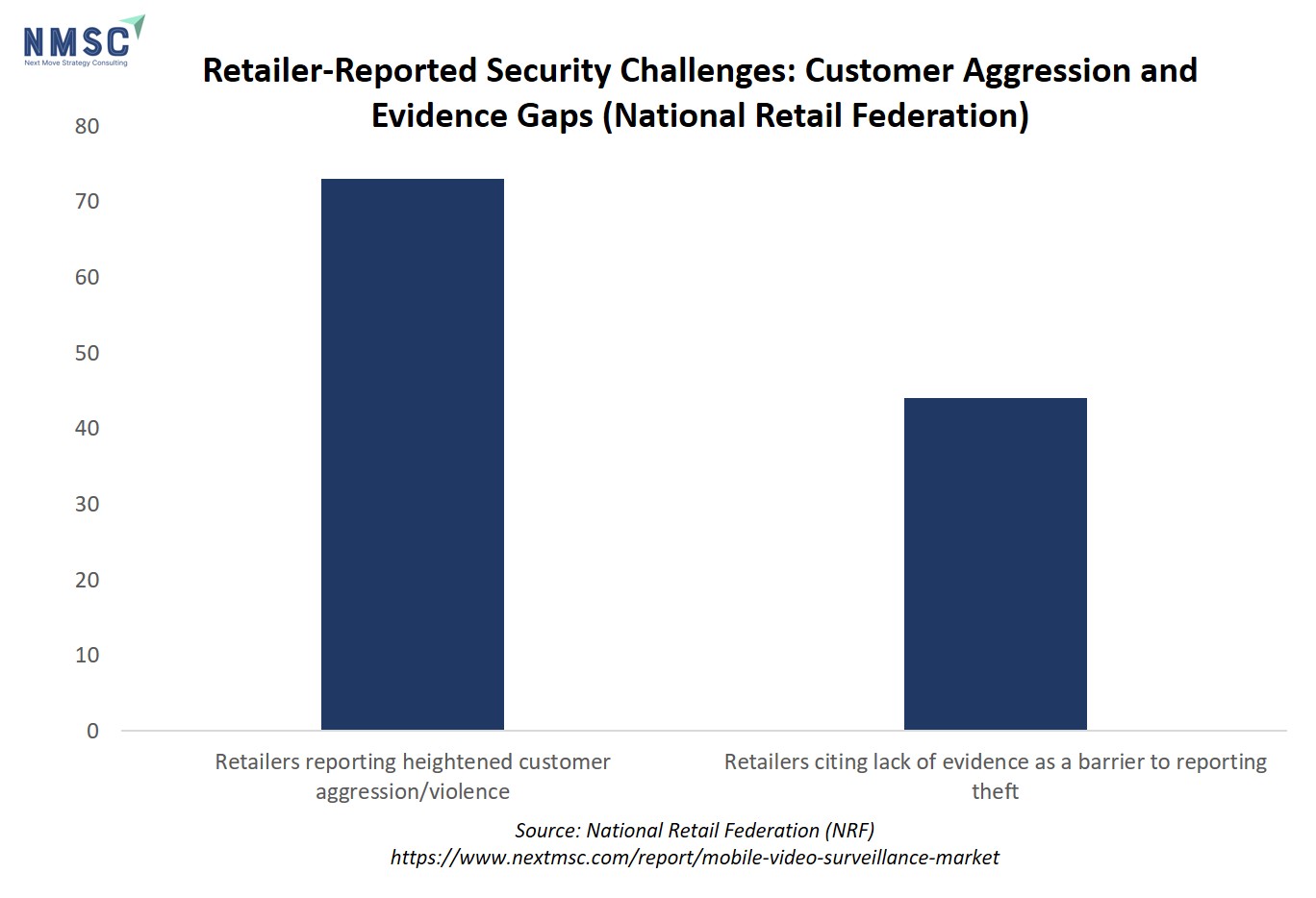
The commercial context is material: the National Retail Federation found that 73% of retailers report heightened aggression and violence from customers, and 44% cite a lack of evidence as a key barrier to reporting theft to law enforcement. SafetyCam directly addresses both constraints by converting floor-level video, voice transcripts, and location data into a real-time incident narrative accessible to remote supervisors.
"Retail threats have changed faster than the tools designed to mitigate them," said Mahesh Saptharishi, Executive Vice President and Chief Technology Officer, Motorola Solutions. "SafetyCam is purpose-built for the store floor, where a fragmented set of tools isn't an option."
NMSC Strategic Perspective: The Convergence Inflection Point
NextMSC primary research and analysis identifies 2025–2026 as a structural inflection point for the mobile video surveillance market — not because demand has accelerated uniformly, but because three previously separate technology stacks (edge AI processing, private cellular connectivity, and autonomous aerial platforms) have simultaneously reached commercial maturity and are now being integrated into unified deployment architectures.
The Axis private cellular back box, Motorola's wearable AI platform, and the FAA's accelerated Drone-as-First-Responder (DFR) waiver program are not isolated product events. They represent the convergence of IT and physical security infrastructure into a single intelligent layer — one that is mobile by design, not by adaptation. This convergence is expanding the total addressable market beyond traditional hardware procurement cycles into recurring software, analytics, and managed-service revenue streams, which carry structurally higher margins and longer contract durations. For investors and procurement decision-makers, the implication is that mobile video surveillance is transitioning from a capital expenditure category into a hybrid capex/opex model — a shift that NMSC's proprietary research and estimates indicate will accelerate through the forecast period to 2030.
Section Summary:
The 2026 product cycle has moved mobile video surveillance decisively beyond passive recording. Key takeaways:
-
Axis Communications' private cellular back box removes the wired infrastructure dependency that has historically constrained mobile deployments in remote and temporary environments, enabling camera placement wherever PCN coverage and AC power are available.
-
Motorola Solutions' SafetyCam demonstrates that the wearable body camera segment is evolving from evidence capture into real-time AI-assisted threat deterrence, with direct implications for the commercial end-user segment.
-
NMSC analysis identifies the convergence of edge AI, private cellular, and autonomous aerial platforms as the defining structural shift of the current forecast cycle — one that is expanding the market's revenue model from hardware-only to hybrid capex/opex.
-
The industry's center of gravity is shifting from reactive surveillance (record and review) to proactive intelligence (detect, alert, and intervene in real time).
Industry Impact Analysis
The FCC's Covered List Reshapes the Competitive Landscape
In April 2026, the U.S. Federal Communications Commission proposed banning the continued import of Chinese telecommunications and surveillance equipment to protect national security infrastructure. The FCC's Covered List — which includes Hangzhou Hikvision Digital Technology Co., Ltd. and Dahua Technology Co., Ltd. alongside Huawei, ZTE, and Hytera — already blocks new equipment authorizations for most Hikvision and Dahua products in the U.S. market under the Secure Equipment Act.
The competitive consequence is direct and measurable: two of the largest mobile video surveillance hardware manufacturers by global volume are being systematically excluded from the world's largest security procurement market. This creates a supply gap that Western and South Korean manufacturers — including Axis Communications, Hanwha Vision, and Motorola Solutions — are actively positioning to fill through accelerated product launches and expanded distribution. For North American procurement officers, the FCC action also introduces a compliance dimension into vendor selection that did not exist at the same regulatory intensity three years ago.
Drone-as-First-Responder Programs Scale Aerial Mobile Surveillance
As of February 2026, over 1,000 public safety agencies — including police, fire, and emergency management agencies — had received Federal Aviation Administration (FAA) Part 91 waivers enabling automated drone operations and Drone-as-First-Responder (DFR) program launches, according to a Freedom of Information Act release analyzed by the Electronic Frontier Foundation. The FAA issued more DFR waivers between April 2025 and February 2026 than it had in the previous seven years combined, following a streamlined approval process introduced in April 2025.
DFR programs rely on AI to automate drone flights from launchpads placed on municipal buildings, enabling a single operator to manage multiple devices simultaneously. Axon — known for the TASER and the Fusus camera integration platform — reported that its DFR platform has become one of the company's fastest-growing sectors, according to its SEC filing. The integration of drone footage with automated license plate reader (ALPR) networks — a capability that Flock Safety operationalized in 2025 — means that aerial mobile surveillance is no longer a standalone tool but a data input into broader law enforcement intelligence networks.
Urbanization Concentrates Demand in High-Density Environments
According to the United Nations Department of Economic and Social Affairs' World Urbanization Prospects 2025 revision, approximately 4.8 billion of the planet's 8.2 billion inhabitants — around 58% of the global population — lived in towns or cities in 2025. This concentration of population in urban environments directly expands the operational scope for mobile video surveillance: transportation networks, public event venues, construction corridors, and commercial districts in high-density cities require surveillance coverage that fixed infrastructure alone cannot provide cost-effectively.
Asia Pacific's dominance in the mobile video surveillance market — confirmed by NextMSC primary research and analysis — is structurally linked to this urbanization dynamic. The Food and Agriculture Organization of the United Nations projected in January 2023 that around 55% of Asia's population would reside in urban areas by 2030, creating sustained demand for public safety, crime prevention, and infrastructure protection systems across the region's rapidly expanding metropolitan corridors.
Cloud Adoption Reaches a Tipping Point for Video Management
Eagle Eye Networks' 2026 Trends in Video Surveillance report identifies cloud migration as "Trend Zero" — the foundational shift underpinning every other technology development in the sector. The report notes that 2026 may represent a tipping point, as the costs of maintaining on-site infrastructure for major business functions become increasingly difficult to justify against cloud-native alternatives that offer remote access, scalable storage, and AI-powered analytics without dedicated server hardware. For mobile video surveillance specifically, cloud-native video management software (VMS) eliminates the need for on-vehicle or on-site recording hardware, reducing both the physical footprint and the maintenance burden of mobile deployments.
Section Summary:
Four structural forces are simultaneously reshaping the mobile video surveillance industry's competitive and demand landscape:
-
The FCC's Covered List removes Hikvision and Dahua from U.S. procurement pipelines, creating a supply gap that Western and South Korean manufacturers are actively filling through accelerated product development.
-
Over 1,000 U.S. public safety agencies have received FAA DFR waivers as of February 2026, establishing autonomous aerial surveillance as a mainstream law enforcement tool rather than a pilot-stage technology.
-
UN DESA data confirms that 58% of the global population now lives in urban areas, concentrating surveillance demand in environments where mobile systems provide coverage that fixed infrastructure cannot replicate economically.
-
Cloud-native VMS adoption is reducing the hardware dependency of mobile deployments, shifting the market's revenue model toward recurring software and managed-service contracts.
Pros and Cons of Recent Market Developments
|
Development |
Pros |
Cons |
|
Axis Private Cellular Back Box (AXIS TP3604-E) |
Eliminates wired infrastructure dependency; enables rapid deployment in remote and temporary environments; SIM-based authentication and encryption strengthen data security |
Requires enterprise PCN coverage, limiting applicability in areas without private cellular infrastructure; higher per-unit cost than Wi-Fi-connected alternatives |
|
Motorola Solutions SafetyCam |
Converges video, voice, AI, and panic alert into a single wearable; active deterrence display reduces incident escalation before recording begins; Assist AI supports multilingual communication in 50+ languages |
Wearable form factor introduces battery life and device durability constraints in extended-shift environments; data privacy implications of continuous floor-level recording require careful policy governance |
|
FAA DFR Waiver Expansion (1,000+ agencies) |
Extends aerial mobile surveillance to areas inaccessible to patrol officers; AI automation enables single operators to manage multiple drones simultaneously; integrates with ALPR and other intelligence networks |
Raises significant civil liberties and privacy concerns; footage from backyards and private spaces captured without subject awareness; regulatory frameworks vary significantly by jurisdiction |
|
FCC Covered List / Chinese Equipment Import Restrictions |
Reduces national security risk from foreign-manufactured surveillance hardware in critical infrastructure; accelerates adoption of domestically produced and allied-nation alternatives |
Disrupts existing supply chains for operators with legacy Hikvision/Dahua deployments; replacement costs and integration complexity create short-term procurement friction |
|
Cloud-Native VMS Adoption |
Reduces on-site hardware footprint; enables remote access and centralized management across distributed mobile deployments; scales storage without physical infrastructure investment |
Introduces bandwidth dependency and latency risk in low-connectivity environments; raises data sovereignty concerns for government and law enforcement end-users |
Key Data & Statistics
Key Industry Milestones and Institutional Data Points — Mobile Video Surveillance Ecosystem
|
Data Point |
Figure / Detail |
|
Global urban population share (2025) |
~58% of 8.2 billion global population (approx. 4.8 billion people) live in towns or cities |
|
U.S. public safety agencies with FAA DFR waivers (as of Feb 2026) |
Over 1,000 agencies (police, fire, emergency management) |
|
FAA DFR waivers issued (Apr 2025 – Feb 2026) |
More than the total issued in the previous seven years combined |
|
Retailers reporting heightened customer aggression/violence |
73% of retailers |
|
Retailers citing lack of evidence as barrier to reporting theft |
44% of retailers |
|
Axis AXIS P1486-LE Global Shutter Camera availability |
June 2026 (first global shutter camera in video surveillance industry) |
|
Axis AXIS TP3604-E Private Cellular Back Box U.S. launch |
August 2026 (expected) |
|
Motorola Solutions SafetyCam launch |
June 4, 2026 |
|
FCC proposed ban on continued Chinese surveillance equipment imports |
April 2026 |
|
Companies on FCC Covered List (surveillance-relevant) |
Hikvision, Dahua, Huawei, ZTE, Hytera |
Future Outlook & Forecast
The Path to USD 4.4 Billion: Structural Drivers Through 2030
NextMSC primary research and analysis projects the global mobile video surveillance market to reach USD 4.4 billion by 2030 at a CAGR of 8.2%, with growth concentrated in three structural demand vectors that are each independently verifiable and mutually reinforcing.
First, the autonomous aerial surveillance vector. The FAA's accelerated DFR waiver program has established a regulatory pathway that did not exist at scale before April 2025. With over 1,000 agencies already cleared for autonomous drone operations as of February 2026, and Axon reporting its DFR platform as one of its fastest-growing business lines, the integration of aerial mobile surveillance into standard law enforcement operations is no longer a forecast — it is an ongoing deployment. The addressable market for drone-integrated mobile surveillance hardware, software, and managed services will expand materially as DFR programs move from pilot to permanent infrastructure.
Second, the private cellular connectivity vector. Axis Communications' AXIS TP3604-E, expected to launch in the U.S. in August 2026, represents the first commercially available solution that connects surveillance cameras directly to enterprise private cellular networks without wired infrastructure. As private 5G network deployments expand across industrial campuses, ports, airports, and smart city infrastructure, the total number of locations where mobile surveillance can be deployed without cabling will grow proportionally — directly expanding the hardware and software addressable market.
Third, the commercial end-user vector. Motorola Solutions' SafetyCam launch signals that the body-worn camera segment — historically dominated by law enforcement procurement — is being actively commercialized for retail, logistics, and front-line enterprise environments. With 73% of retailers reporting heightened customer aggression and the NRF documenting a structural evidence gap in theft reporting, the commercial segment represents a demand pool that has not been systematically addressed by purpose-built mobile surveillance hardware until now.
The cloud adoption trend identified by Eagle Eye Networks as "Trend Zero" for 2026 further supports the market's revenue durability: as cloud-native VMS replaces on-premise recording hardware, mobile surveillance operators shift from one-time hardware purchases to recurring software subscriptions — a model that sustains revenue growth even in periods of hardware procurement slowdown.
Section Summary:
The mobile video surveillance market's path to USD 4.4 billion by 2030 is supported by three independently verifiable structural demand vectors:
-
Autonomous aerial surveillance is transitioning from pilot programs to permanent law enforcement infrastructure, with over 1,000 U.S. agencies already cleared for DFR operations and Axon reporting its DFR platform as a fastest-growing business line.
-
Private cellular connectivity is removing the wired infrastructure constraint that has historically limited mobile deployment scope, with Axis's AXIS TP3604-E establishing the commercial template for PCN-connected surveillance in remote and temporary environments.
-
Commercial end-user expansion — led by Motorola Solutions' SafetyCam — is opening the retail and front-line enterprise segment to purpose-built mobile surveillance hardware for the first time at scale.
-
Cloud-native VMS adoption is converting the market's revenue model from hardware-only capex to hybrid capex/opex, improving revenue predictability and margin profiles for leading vendors.
Next Steps for Stakeholders
For C-Level Executives and Security Technology Buyers:
-
Audit vendor compliance against the FCC Covered List immediately. Organizations with existing Hikvision or Dahua deployments in U.S. facilities should initiate a structured replacement roadmap before the FCC's proposed import ban on continued Chinese surveillance equipment takes effect. Delaying this assessment increases both compliance risk and procurement lead time as Western alternatives face rising demand.
-
Evaluate private cellular connectivity as a deployment enabler, not a premium add-on. The Axis AXIS TP3604-E's August 2026 U.S. launch creates a commercially available pathway to deploy surveillance in locations where cabling costs have historically made mobile surveillance economically unviable. Organizations with distributed assets — construction portfolios, event venues, logistics hubs, or agricultural operations — should model the total cost of ownership against traditional wired deployments.
-
Incorporate DFR program governance into public safety technology strategy. For law enforcement agencies and municipal governments, the FAA's accelerated waiver process means that DFR programs are now operationally accessible. However, the Electronic Frontier Foundation's July 2026 analysis documents significant civil liberties and privacy risks associated with autonomous aerial surveillance, including footage capture in private spaces without subject awareness. Agencies should establish transparent use policies, community engagement processes, and flight-logging portals before procurement — not after.
-
Assess the commercial body-worn camera segment as a distinct procurement category. Motorola Solutions' SafetyCam demonstrates that wearable mobile surveillance is no longer exclusively a law enforcement tool. Retail, healthcare, and logistics organizations facing front-line worker safety challenges should evaluate purpose-built commercial body-worn platforms separately from law enforcement-grade body cameras, as the feature sets, data governance requirements, and integration architectures differ materially.
-
Prioritize cloud-native VMS in new mobile surveillance deployments. Eagle Eye Networks' 2026 analysis identifies 2026 as a potential tipping point for cloud adoption in video surveillance. Organizations deploying new mobile surveillance infrastructure should default to cloud-native VMS architectures to avoid locking capital into on-premise recording hardware that will face accelerating obsolescence as AI analytics capabilities migrate to the cloud.
For Institutional Investors:
-
The FCC's Covered List creates a structural demand transfer from Chinese manufacturers to Western and South Korean alternatives. Axis Communications, Hanwha Vision, and Motorola Solutions are the primary beneficiaries of this regulatory-driven market reallocation in the North American segment.
-
The DFR waiver expansion represents a new procurement category — autonomous aerial surveillance infrastructure — that did not exist at commercial scale before 2025. Companies with established DFR platforms (Axon, Flock Safety) are positioned to capture recurring software and managed-service revenue from the 1,000+ agencies that have already cleared the regulatory hurdle.
-
The mobile video surveillance market's transition toward hybrid capex/opex revenue models improves the quality of earnings for leading vendors and supports higher valuation multiples relative to pure hardware businesses.
Conclusion
The mobile video surveillance market is undergoing a technology and business model transformation that is more consequential than any single product cycle. The convergence of edge AI processing, private cellular connectivity, autonomous aerial platforms, and cloud-native video management is not producing incremental improvements to existing surveillance architectures — it is producing a fundamentally different category of mobile intelligence infrastructure.
The evidence from 2026 is concrete: Axis Communications has eliminated the wired infrastructure constraint with private cellular-connected cameras; Motorola Solutions has extended the body-worn camera market into commercial retail environments with AI-assisted deterrence; and over 1,000 U.S. public safety agencies have cleared the regulatory pathway for autonomous drone surveillance. Simultaneously, the FCC's Covered List is restructuring the competitive landscape by removing the two largest Chinese hardware manufacturers from U.S. procurement pipelines.
About the Author
 Sanyukta Deb
— Sanyukta Deb is Digital Marketing Team Lead at Next Move Strategy Consulting, where she has led content strategy and technical SEO for the firm's B2B market research publications for over 2 years. Her editorial process translates NextMSC's primary and secondary research — spanning technology, industrial, and consumer sectors — into commercial narratives, backed by search-intent, keyword, and competitive analysis. She brings 5 years of overall experience in digital marketing and content strategy.
Sanyukta Deb
— Sanyukta Deb is Digital Marketing Team Lead at Next Move Strategy Consulting, where she has led content strategy and technical SEO for the firm's B2B market research publications for over 2 years. Her editorial process translates NextMSC's primary and secondary research — spanning technology, industrial, and consumer sectors — into commercial narratives, backed by search-intent, keyword, and competitive analysis. She brings 5 years of overall experience in digital marketing and content strategy.
About the Reviewer
 Debashree Dey
— Debashree Dey is Assistant Manager at Next Move Strategy Consulting, where she supports cross-vertical market content and communications across diverse industries for 6 years. Her professional background includes senior content writing, communications, and published manuscript authorship, with experience developing audience-focused business narratives and maintaining clear, consistent messaging. Her role supports research-led content development and editorial quality across NextMSC publications.
Debashree Dey
— Debashree Dey is Assistant Manager at Next Move Strategy Consulting, where she supports cross-vertical market content and communications across diverse industries for 6 years. Her professional background includes senior content writing, communications, and published manuscript authorship, with experience developing audience-focused business narratives and maintaining clear, consistent messaging. Her role supports research-led content development and editorial quality across NextMSC publications.


















Add Comment