Stock Video Market Statistics, Trends & Forecasts for 2026

Introduction
The global Stock Video Market is undergoing one of its most consequential structural transformations in recent memory. As artificial intelligence fundamentally disrupts content creation workflows, regulatory authorities intervene in landmark consolidation attempts, and digital advertising budgets surge to historic levels, the stock video market finds itself at a critical strategic inflection point. According to Next Move Strategy Consulting (NMSC), the Stock Video Market is projected to reach USD 4.6 billion by 2035, reflecting a compound annual growth rate (CAGR) of approximately 9.8% over the forecast period.
For C-level executives, institutional investors, and content strategy leaders, understanding the forces reshaping this market is no longer a peripheral concern — it is a core strategic imperative. From the collapse of the proposed Getty Images–Shutterstock mega-merger to Getty's landmark licensing agreement with OpenAI, the industry's competitive architecture is being redrawn in real time. This report examines the key trends, regulatory developments, and market dynamics that will define the stock video market through 2035, drawing on data from primary institutions, leading trade bodies, and globally recognized media and financial outlets.
For More Information: Download FREE Sample on Stock Video Market Report
Industry Consolidation Collapses as AI Licensing Emerges as the New Battleground
The Getty–Shutterstock Merger Collapse: A Watershed Moment for the Stock Video Market
In one of the most consequential corporate developments in the stock video industry in 2026, the proposed merger between Getty Images and Shutterstock — first announced in January 2025 — was formally terminated in July 2026. The collapse was triggered by the UK Competition and Markets Authority (CMA), which conditioned its clearance of the merger on the sale of Shutterstock's editorial business — a condition Getty Images determined it was not required to accept under the terms of the merger agreement.
The market reaction was swift and severe. Shutterstock's stock declined 29% following the announcement, reflecting investor concern over the company's standalone competitive position in an increasingly AI-disrupted landscape. Getty Images, by contrast, exited the failed deal in a comparatively stronger position, having already secured a landmark strategic partnership with OpenAI.
On June 21, 2026, Getty Images announced a multi-year display partnership with OpenAI, under which Getty's licensed content libraries — encompassing images, videos, and metadata — will surface across OpenAI's search and discovery experiences, including ChatGPT. Getty's stock surged by as much as 145% following the announcement, signaling strong market confidence in the licensing-first approach to AI integration.
The failed merger and the Getty–OpenAI deal together represent a defining moment for the stock video market: the era of defensive consolidation is giving way to an era of strategic AI licensing. Rather than building scale through mergers, leading platforms are now seeking to embed their licensed content within AI ecosystems — positioning themselves as the authoritative, legally compliant source of visual content in an AI-generated world.
NMSC Strategic Perspective: Redefining Competitive Advantage in the Stock Video Market
From Next Move Strategy Consulting's analytical standpoint, the collapse of the Getty–Shutterstock merger and the subsequent pivot toward AI licensing partnerships represent a structural realignment of competitive strategy in the stock video market. The traditional model — in which scale, library depth, and subscription pricing were the primary competitive levers — is being supplanted by a new paradigm in which licensing rights, content provenance, and AI integration capabilities determine market leadership.
NMSC analysts observe that the UK CMA's intervention, specifically its focus on Shutterstock's editorial business, underscores the regulatory sensitivity surrounding editorial content in the age of generative AI. Editorial footage — which captures real-world events, public figures, and newsworthy moments — cannot be replicated by AI generation, making it a uniquely defensible and strategically valuable asset class within the stock video market. This regulatory signal is expected to drive increased investment in authentic, rights-cleared editorial video content across the industry.
Furthermore, the Getty–OpenAI partnership establishes a precedent for how stock video platforms can monetize their libraries within AI ecosystems without ceding intellectual property rights. NMSC anticipates that this model will be replicated by other major platforms, accelerating the development of a structured licensing economy for AI-assisted visual content — and creating a new, high-margin revenue stream for platforms that have invested in comprehensive, metadata-rich video libraries.
Section Summary:
The stock video market's competitive landscape has been fundamentally altered by two landmark events in mid-2026: the collapse of the Getty–Shutterstock merger and Getty's strategic licensing deal with OpenAI. These developments signal a decisive shift from consolidation-driven defense to AI-licensing-driven offense.
-
The UK CMA's requirement that Shutterstock divest its editorial business was the decisive factor in terminating the merger, highlighting the irreplaceable strategic value of authentic editorial video content.
-
Shutterstock's stock declined 29% following the merger collapse, while Getty's stock surged 145% after the OpenAI partnership announcement — a stark illustration of diverging strategic trajectories.
-
The Getty–OpenAI deal establishes a new industry template: embedding licensed, rights-cleared stock video content within AI platforms as a scalable, recurring revenue model.
-
NMSC identifies AI licensing as the primary competitive differentiator for stock video platforms through 2035, superseding traditional scale and pricing advantages.
Industry Impact Analysis
Digital Advertising Surge Creates Structural Demand for Stock Video
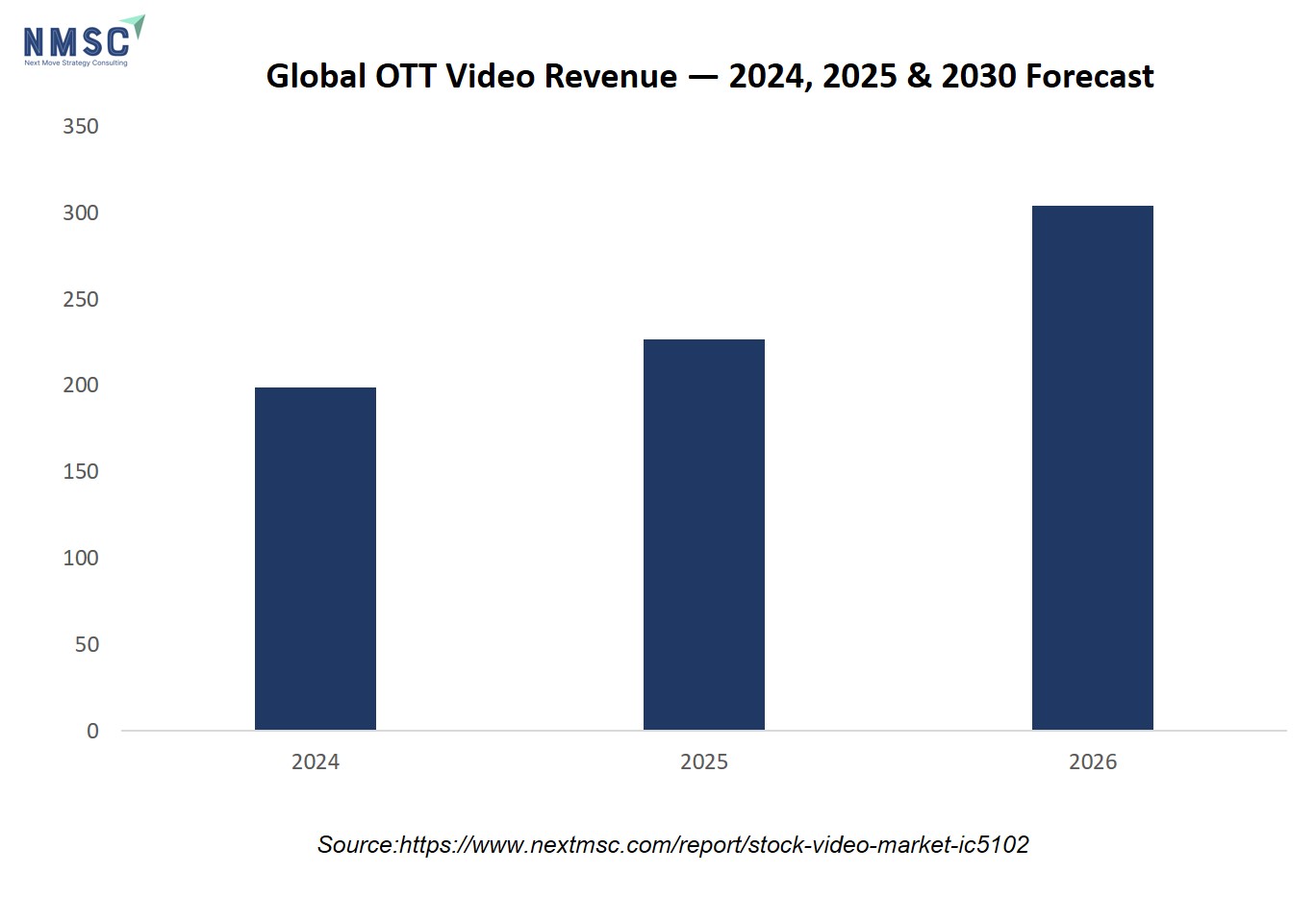
The demand fundamentals underpinning the stock video market are exceptionally strong. According to the Interactive Advertising Bureau (IAB), U.S. digital video ad spending is projected to surpass $80 billion in 2026, growing 11% year-over-year — nearly 20% faster than the total advertising market. For the first time, digital video is expected to exceed 60% of total TV and video ad spend in 2026, a structural milestone that reflects the irreversible migration of advertising budgets from linear television to digital and streaming platforms.
Social video is leading this growth, outpacing connected TV (CTV) for the first time, with social video growing at 13% compared to CTV's 11%. This shift is driven by AI-powered personalization capabilities and increased investment in the creator economy. CTV, meanwhile, continues to benefit from the structural migration of sports rights to streaming platforms — including the NBA on Amazon, NFL on Peacock and Netflix, and MLB across multiple platforms — which is generating sustained demand for high-quality stock footage to support sports-adjacent content production.
The global entertainment and media industry grew 5.3% in 2025, reaching US$3.5 trillion, with global E&M advertising revenues surpassing US$1 trillion in 2025 and projected to reach US$1.4 trillion by 2030. This macro-level growth in content consumption and advertising investment creates a powerful structural tailwind for the stock video market, as brands, agencies, and media companies require scalable, cost-effective visual content to meet accelerating production demands.
The AI Disruption: A Dual-Edged Force
Artificial intelligence is simultaneously the most significant threat and the most significant opportunity facing the stock video market. On the threat side, generative AI tools are enabling brands and agencies to produce synthetic video content at scale, reducing dependence on traditional stock footage libraries for generic, commodity-level content. According to the IAB's 2026 Digital Video Ad Spend & Strategy Report, two in three digital video buyers are already live, testing, or planning to use agentic AI for digital video campaigns in 2026, with another 28% actively investigating adoption.
On the opportunity side, AI is transforming the operational efficiency of stock video platforms through advanced content tagging, semantic search, and predictive trend analysis — enabling buyers to surface relevant footage with unprecedented precision. The U.S. Copyright Office's ongoing work on AI and copyright — including its January 2025 report on the copyrightability of AI-generated outputs — has reinforced the legal and commercial value of human-created, rights-cleared stock video content. Courts and regulators are increasingly signaling that AI training involving copyrighted material may inflict substantial economic harm through lost licensing revenues, creating a regulatory environment that favors licensed content platforms over unregulated AI generation tools.
Geographic and Sectoral Demand Patterns
North America remains the dominant market for stock video consumption, driven by the concentration of major advertising agencies, media companies, and technology platforms. Europe represents the second-largest market, with regulatory frameworks such as the EU AI Act creating additional demand for rights-cleared, provenance-verified visual content. Asia Pacific is the fastest-growing regional market, driven by mobile-first content consumption, the rapid expansion of digital advertising ecosystems in markets such as India and Southeast Asia, and the growth of short-form video platforms.
By application, the commercial segment — encompassing advertising, marketing, and corporate communications — accounts for the largest share of stock video demand. The editorial segment, while smaller in volume, commands premium pricing and is experiencing renewed strategic importance in the context of AI disruption, as authentic, real-world footage becomes increasingly differentiated from AI-generated synthetic content.
Section Summary:
The stock video market is being shaped by a convergence of structural demand growth, AI-driven disruption, and evolving regulatory frameworks. The net effect is a market that is growing in total value while undergoing significant internal restructuring.
-
IAB data confirms U.S. digital video ad spending will surpass $80 billion in 2026, growing 11% YoY and exceeding 60% of total TV/video ad spend for the first time in history.
-
AI is bifurcating the market: generic, commodity stock footage faces displacement pressure, while authentic, rights-cleared, and editorial content is gaining a strategic premium.
-
North America leads in market share; Asia Pacific is the fastest-growing region, driven by mobile-first consumption and digital advertising expansion.
Pros and Cons of Recent Market Developments
|
Development |
Pros |
Cons |
|
Getty–Shutterstock Merger Collapse |
Preserves market competition; prevents monopolistic control over editorial archives and licensing terms; maintains diversity of contributor relationships |
Eliminates potential cost synergies; leaves Shutterstock in a weakened standalone position amid AI disruption; creates regulatory uncertainty for future M&A activity |
|
Getty–OpenAI Licensing Partnership |
Establishes a scalable, legally compliant AI licensing revenue model; validates the commercial value of rights-cleared content; positions Getty as a preferred content supplier within AI ecosystems |
IP attribution and contributor compensation terms remain unclear; risk of content commoditization within AI platforms; sets a precedent that may pressure other platforms to accept unfavorable licensing terms |
|
AI Video Generation Proliferation |
Reduces production costs for brands; accelerates content velocity; enhances platform search, tagging, and discovery capabilities |
Threatens demand for generic stock footage; raises copyright and provenance concerns; may erode contributor earnings and reduce incentives for human content creation |
|
U.S. Digital Video Ad Spend Surpassing $80B |
Creates structural demand for high-quality stock video content across CTV, social, and online video channels; expands the total addressable market for stock footage licensing |
Increased competition for viewer attention may pressure content quality standards; rapid format evolution (short-form, vertical) requires continuous library adaptation |
|
UK CMA Regulatory Intervention |
Protects editorial content diversity; prevents excessive market concentration; reinforces the strategic value of authentic, real-world footage |
Creates regulatory uncertainty for future consolidation; may deter investment in the sector; increases compliance costs for cross-border M&A activity |
|
Short-Form and Vertical Video Dominance |
Expands the addressable market for stock footage clips optimized for mobile-first, vertical formats; creates new licensing opportunities for micro-content |
Compresses clip duration requirements, potentially reducing per-clip licensing value; requires significant library restructuring and metadata re-tagging investment |
Future Outlook & Forecast
NMSC Market Forecast: Stock Video Market 2025–2035
According to Next Move Strategy Consulting, the global Stock Video Market was valued at USD 1.8 billion in 2025 and is projected to reach USD 4.6 billion by 2035, representing a CAGR of approximately 9.8% over the forecast period. This growth trajectory reflects the convergence of several structural forces: the accelerating digitization of advertising and media, the proliferation of content-hungry platforms across CTV, social media, and enterprise communications, and the growing premium placed on rights-cleared, authentic visual content in an AI-saturated media environment.
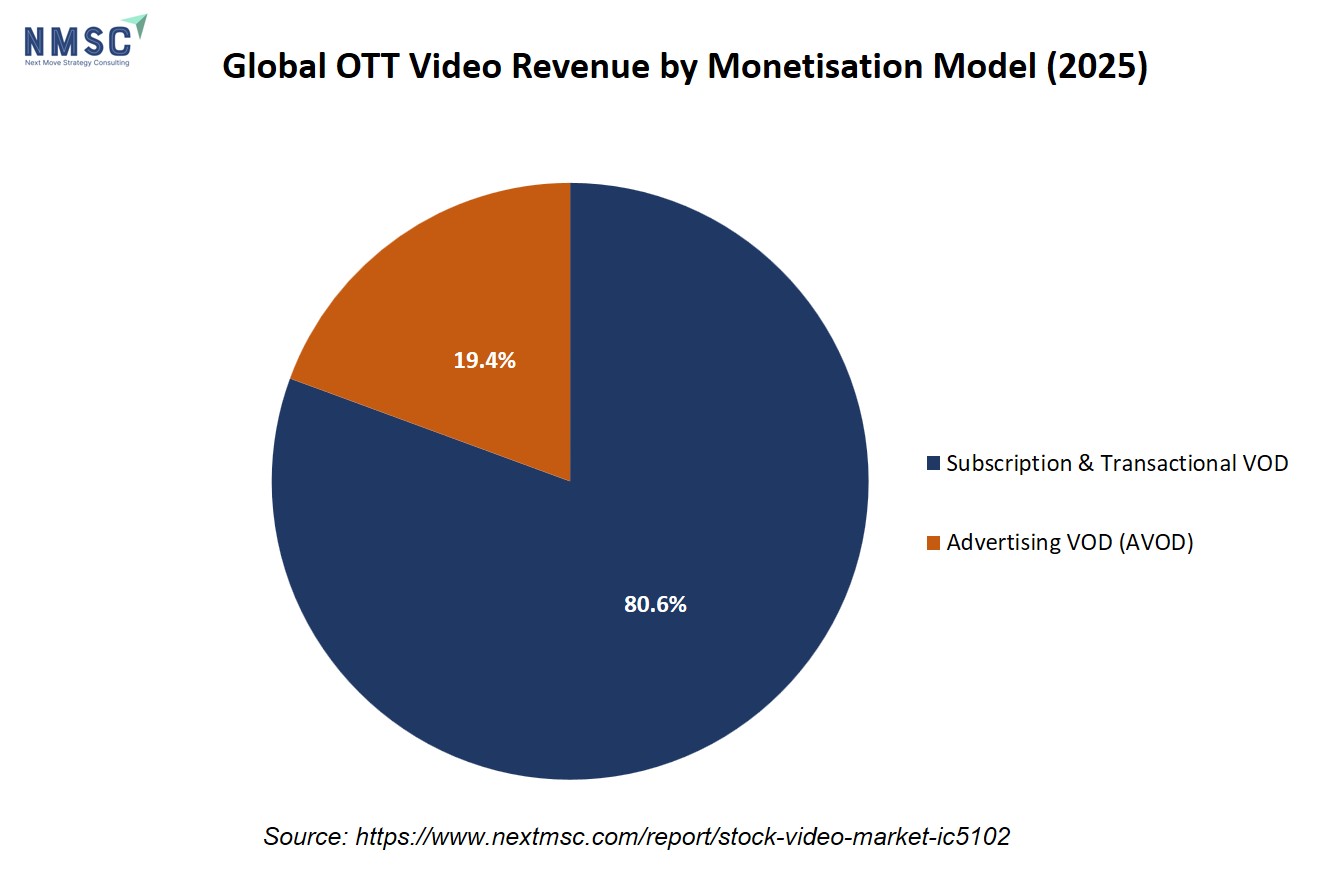
The market is segmented by application into Commercial and Editorial categories, and by geography across North America, Europe, Asia Pacific, Latin America, and the Middle East & Africa. Key players operating across these segments include Adobe Inc., Getty Images Inc., Shutterstock Inc., Pond5 Inc., Depositphotos Inc., Dreamstime.com LLC, Envato Pty Ltd., Thomson Reuters Corp., and Inmagine Group.
Strategic Themes Defining the Stock Video Market Through 2035
1. The AI Licensing Economy Will Expand Rapidly
The Getty–OpenAI partnership is the first of what NMSC expects to be a wave of licensing agreements between stock video platforms and AI developers. As AI companies seek to train and operate their models on legally compliant content, the demand for licensed stock video libraries will grow substantially. Platforms that can offer comprehensive, rights-cleared, and metadata-rich video libraries will command significant licensing premiums and establish durable, recurring revenue streams.
2. Editorial Content Will Command a Strategic Premium
The UK CMA's intervention in the Getty–Shutterstock merger — specifically its focus on editorial content — signals that regulators view authentic, real-world footage as a distinct and strategically important asset class. As AI-generated synthetic content proliferates, the provenance and authenticity of editorial stock video will become increasingly valuable to media organizations, legal teams, and brand safety-conscious advertisers.
3. Short-Form and Vertical Video Will Drive Volume Growth
The IAB's finding that social video is outpacing CTV growth for the first time — driven by AI-powered personalization and creator economy investment — will drive significant volume growth in the stock video market. Platforms that can offer extensive libraries of vertical, mobile-optimized, short-duration clips will capture disproportionate share of this growth.
4. Asia Pacific Will Emerge as a Primary Growth Engine
Mobile-first content consumption, the rapid expansion of digital advertising in India and Southeast Asia, and the growth of short-form video platforms in the region position Asia Pacific as the fastest-growing market for stock video through 2035. Platforms with localized content libraries and regional licensing capabilities will be best positioned to capture this opportunity.
5. AI-Powered Discovery Will Become a Core Competitive Differentiator
As stock video libraries grow in scale and complexity, AI-powered search, tagging, and recommendation capabilities will become essential competitive differentiators. Platforms that invest in semantic search, computer vision, and predictive trend analysis will deliver superior buyer experiences and command higher retention rates among enterprise clients.
Section Summary:
The stock video market is positioned for sustained, structurally supported growth through 2035, driven by digital advertising expansion, AI licensing demand, and the growing premium on authentic visual content.
-
NMSC projects the Stock Video Market to grow from USD 1.8 billion in 2025 to USD 4.6 billion by 2035, at a CAGR of approximately 9.8%.
-
The AI licensing economy, editorial content premium, and short-form video growth are the three primary structural drivers of market expansion through the forecast period.
-
Asia Pacific is the fastest-growing regional market, while North America remains the largest by revenue.
-
Platforms that invest in AI-powered discovery, rights-cleared content libraries, and regional licensing capabilities will capture disproportionate market share through 2035.
Next Steps for Stakeholders
For C-Level Executives at Stock Video Platforms:
-
Prioritize the development of AI licensing frameworks that enable content libraries to be integrated into AI platforms while protecting contributor rights and maintaining revenue integrity. The Getty–OpenAI model provides a replicable template.
-
Invest in editorial content acquisition and curation as a strategic differentiator against AI-generated synthetic content, particularly in light of the UK CMA's regulatory signals.
-
Accelerate the development of AI-powered search and discovery capabilities to improve buyer experience, reduce time-to-content, and increase enterprise client retention.
-
Evaluate regional expansion strategies in Asia Pacific, where mobile-first consumption and digital advertising growth are creating significant demand for localized stock video content.
For Institutional Investors:
-
Monitor the competitive dynamics between Getty Images and Shutterstock following the merger collapse, with particular attention to Shutterstock's strategic response to its weakened standalone position and the long-term revenue implications of Getty's AI licensing model.
-
Assess exposure to the broader digital video advertising ecosystem, which the IAB projects will surpass $80 billion in the U.S. alone in 2026, growing nearly 20% faster than the total ad market.
-
Evaluate the long-term revenue potential of AI licensing agreements for leading stock video platforms, including the possibility of recurring, high-margin licensing revenue streams that are structurally distinct from traditional subscription models.
For Brand and Agency Decision-Makers:
-
Develop a dual-track content strategy that leverages AI-generated content for high-volume, generic applications while maintaining investment in licensed, rights-cleared stock video for brand-sensitive and legally compliant use cases.
-
Prioritize platforms that offer comprehensive indemnification for licensed content, particularly as AI copyright litigation continues to evolve and regulatory frameworks mature.
-
Align stock video procurement strategies with the growing dominance of short-form, vertical video formats across social and CTV platforms, ensuring library access to mobile-optimized, short-duration clip formats.
For Content Creators and Contributors:
-
Specialize in high-value content categories — including editorial, drone, documentary, and industry-specific footage — that are structurally difficult to replicate with AI generation tools.
-
Engage with platforms that offer transparent AI licensing terms and equitable contributor compensation for AI training use cases, and monitor the evolving regulatory landscape for favorable rulings that could enhance the commercial value of licensed content.
-
Diversify across specialist agencies and platforms rather than concentrating on generalist microstock libraries, which face the greatest displacement pressure from AI-generated content.
Conclusion
The stock video market is navigating a period of profound structural transformation, driven by forces that are simultaneously disrupting legacy business models and creating new, high-value opportunities. The collapse of the Getty–Shutterstock merger, the emergence of AI licensing as a primary revenue model, and the sustained surge in digital video advertising are collectively redefining the competitive landscape, the value chain, and the strategic priorities of every participant in this market.
According to Next Move Strategy Consulting, the stock video market is projected to grow from USD 1.8 billion in 2025 to USD 4.6 billion by 2035, reflecting a CAGR of approximately 9.8% — a trajectory underpinned by the IAB's confirmation that U.S. digital video ad spending will surpass $80 billion in 2026 and PwC's projection that global E&M revenues will reach USD 4.2 trillion by 2030.
For executives, investors, and strategists operating in or adjacent to the stock video market, the imperative is clear: the organizations that will lead this market through 2035 are those that move decisively to establish AI licensing frameworks, invest in differentiated and authentic content categories, and build the technological infrastructure to deliver superior buyer experiences at scale. The window for establishing first-mover advantage in the AI licensing economy is open — but it will not remain so indefinitely.
About the Author
 Sanyukta Deb
— Sanyukta Deb is Digital Marketing Team Lead at Next Move Strategy Consulting, where she has led content strategy and technical SEO for the firm's B2B market research publications for over 2 years. Her editorial process translates NextMSC's primary and secondary research — spanning technology, industrial, and consumer sectors — into commercial narratives, backed by search-intent, keyword, and competitive analysis. She brings 5 years of overall experience in digital marketing and content strategy.
Sanyukta Deb
— Sanyukta Deb is Digital Marketing Team Lead at Next Move Strategy Consulting, where she has led content strategy and technical SEO for the firm's B2B market research publications for over 2 years. Her editorial process translates NextMSC's primary and secondary research — spanning technology, industrial, and consumer sectors — into commercial narratives, backed by search-intent, keyword, and competitive analysis. She brings 5 years of overall experience in digital marketing and content strategy.
About the Reviewer
 Debashree Dey
— Debashree Dey is Assistant Manager at Next Move Strategy Consulting, where she supports cross-vertical market content and communications across diverse industries for 6 years. Her professional background includes senior content writing, communications, and published manuscript authorship, with experience developing audience-focused business narratives and maintaining clear, consistent messaging. Her role supports research-led content development and editorial quality across NextMSC publications.
Debashree Dey
— Debashree Dey is Assistant Manager at Next Move Strategy Consulting, where she supports cross-vertical market content and communications across diverse industries for 6 years. Her professional background includes senior content writing, communications, and published manuscript authorship, with experience developing audience-focused business narratives and maintaining clear, consistent messaging. Her role supports research-led content development and editorial quality across NextMSC publications.


















Add Comment