Open Banking Market: 7 Powerful Trends Reshaping Global Finance in 2026

Introduction
The open banking market is undergoing its most consequential structural transformation since the European Union's Payment Services Directive 2 (PSD2) first mandated API-based data sharing in 2018. Eight years on, the industry has moved decisively beyond regulatory compliance as its primary growth engine. In 2026, account-to-account payment adoption, AI-enabled financial personalization, and the global expansion of open finance frameworks are collectively redefining how banks, fintechs, and enterprises compete for the financial services customer.
According to Next Move Strategy Consulting (NMSC), the global open banking market was valued at USD 27.85 billion in 2025 and is estimated at USD 34.21 billion in 2026, with a forecast to reach USD 217.20 billion by 2035, expanding at a 22.8% CAGR between 2026 and 2035. This represents an absolute dollar opportunity of USD 182.99 billion over the forecast period — a figure that reflects not a single technology cycle, but a fundamental restructuring of the global financial data infrastructure. The regulatory, commercial, and technological developments of the past six months have accelerated this trajectory in ways that demand immediate strategic attention from C-level executives, institutional investors, and fintech operators alike.
For More Information: Download FREE Sample on Open Banking Market Report
From Regulatory Mandate to Market Infrastructure: The Defining Trends of 2026
The U.S. Open Banking Regulatory Landscape Enters a Critical Inflection Point
The most consequential development in the global open banking market in 2026 is not a product launch or a commercial partnership — it is a regulatory crisis that is simultaneously creating risk and opportunity across the world's largest financial market. As of June 2026, the U.S. Consumer Financial Protection Bureau's (CFPB) final rules implementing Section 1033 of the Dodd-Frank Act remain codified in the Code of Federal Regulations but are effectively unenforceable. A federal court in Kentucky enjoined the CFPB from enforcing the rules, finding that they likely exceeded the Bureau's statutory authority and were arbitrary and capricious. That decision has been appealed to the Sixth Circuit but the case has been stayed while the CFPB undertakes an effort to revise the existing rules.
The CFPB issued an Advance Notice of Proposed Rulemaking in August 2025 seeking comments on whether data providers should be permitted to charge fees for access, the scope of consumer representatives permitted to access data, and whether security and privacy issues are adequately addressed. The latest reporting indicates that the CFPB intends to propose rules that would eliminate the total ban on data provider fees and instead permit fees after a certain number of requests for data have been fulfilled for free.
Against this backdrop of federal regulatory limbo, states are beginning to fill the void. New York Assembly Bill 10640, introduced on March 13, 2026, and its companion New York Senate Bill 9483, introduced on March 17, 2026, represent the most significant state-level open banking legislation in U.S. history. If enacted, the New York legislation would require financial institutions to create a developer interface for machine-readable financial data, prohibit fees for data access, and extend data access rights to small business accounts — going further than the federal framework in both scope and penalty structure, with a maximum penalty of USD 10,000 per violation enforced by the Superintendent of Financial Services.
Simultaneously, the GUARD Financial Data Act, currently under consideration in Congress, would modernize the Gramm-Leach-Bliley Act by applying data minimization principles and codifying credential-based access and screen scraping as a parallel track to API-based open banking — a development that could reshape the competitive dynamics between aggregators and banks if enacted.
In Europe, the regulatory trajectory is more structured but equally transformative. The EU's Payment Services Regulation (PSR) and Third Payment Services Directive (PSD3), which have reached provisional agreement, are designed to replace the current PSD2 framework with stronger fraud protections, enforceable API standards, and greater fee transparency. The EU's proposed Financial Data Access (FiDA) regulation, if adopted, would extend open banking principles to mortgages, savings, investments, insurance, pensions, and crypto-assets by 2027 — creating a comprehensive open finance ecosystem that would dwarf the current payment-account-only scope of PSD2.
In the United Kingdom, the Financial Conduct Authority published a research note in October 2025 confirming 13.3 million open banking users and rising transaction volumes, while announcing the UK Payments Initiative (UKPI) in December 2025 — a framework consolidating open banking progress and setting reliability and availability expectations for APIs, with first live payments under the UKPI scheme targeted for Q1 2026.
NMSC's Strategic Perspective: Regulatory Divergence Is Reshaping Competitive Positioning
From NMSC's analytical standpoint, the current phase of the open banking market is defined by a decisive divergence between regulatory maturity levels across geographies — and this divergence is creating asymmetric competitive advantages that will compound through 2035. Europe's structured PSD2/PSD3 framework and the UK's OBIE standards have produced the world's most advanced open banking ecosystem, with Mastercard's platform connecting to nearly 3,000 European banks. The U.S. regulatory impasse, by contrast, is creating a window for FDX-aligned compliance platform providers to capture recurring revenue from banks transitioning away from legacy screen-scraping arrangements — regardless of whether the CFPB's revised rules are ultimately enforced.
NMSC's analysis indicates that banks and fintechs are increasingly consolidating around standardized, regulator-endorsed API frameworks such as FDX in the United States over proprietary connections, a shift that favors platform providers with broad, verified institutional coverage as compliance-driven adoption accelerates through 2035. The card network strategic divergence — Mastercard's continued platform investment contrasted with Visa's reported August 2025 discontinuation of standalone U.S. open banking operations under the Tink brand — is not a market contraction signal; it is a consolidation signal that will concentrate market share among providers with durable institutional relationships and multi-market API coverage.
Section Summary: The open banking market's 2026 trajectory is defined by a U.S. regulatory inflection point — federal enforcement suspended, state legislation advancing, and the GUARD Financial Data Act reshaping the data-sharing landscape — while Europe accelerates toward PSD3 and FiDA. These divergent regulatory paths are creating asymmetric competitive opportunities that will define market leadership through 2035.
Key Takeaways:
-
The CFPB's Section 1033 rules remain unenforceable as of June 2026, with revised rulemaking anticipated but without a firm timeline.
-
New York's "Mini-1033" legislation (March 2026) could catalyze a patchwork of state-level open banking laws if enacted.
-
The EU's FiDA regulation, if adopted, would extend open banking to mortgages, pensions, insurance, and investments by 2027.
-
The UK's FCA confirmed 13.3 million open banking users and launched the UKPI framework in December 2025.
Industry Impact Analysis
Account-to-Account Payments Are Displacing Card Rails at Scale
The most commercially significant trend in the open banking market in 2026 is the mainstream adoption of account-to-account (A2A) payment initiation as a genuine alternative to card-based transactions. The EU's Instant Payments Regulation (IPR) reached its first reporting milestone in April 2026, with payment service providers required to demonstrate compliance with instant settlement standards. The practical impact is transformative: bank transfers that previously required one to two working days are now processed within seconds, around the clock, including weekends.
In Germany, 75% of users who have tried Pay by Bank plan to use it again, with security (89%), low fees (88%), and ease of use (86%) cited as the primary adoption drivers. Consumer expectations are also shifting on the refund side: 43.6% of German consumers expect to receive refunds within 60 seconds of initiating the process, and over 99% of SEPA Instant Payments are settled in seconds.
At the institutional level, Mastercard and Deutsche Bank announced a strategic partnership in June 2025 to accelerate open banking payments across Europe, integrating Mastercard's open banking technology into Deutsche Bank's Merchant Solutions platform to enable Pay by Bank, Request-to-Pay (R2P), and faster A2A payments with quicker settlement and improved payment transparency for merchants. In July 2026, TrueLayer announced the acquisition of Zimpler to expand its European Pay by Bank network, strengthening its open banking payment capabilities and supporting broader adoption of A2A payment solutions across European merchants and consumers.
NMSC's analysis confirms that Payments is the fastest-growing service type in the open banking market, expanding at a 26.5% CAGR from 2026 to 2035, as A2A payment initiation scales rapidly following Visa and Mastercard's expanding pay-by-bank infrastructure.
AI-Enabled Personalization Is Becoming the Primary Value Differentiator
The open banking market's value proposition is shifting from raw data access to AI-driven financial intelligence. Lloyds Banking Group announced in June 2026 that it is accelerating its use of AI, investing in new tools, talent, and training to embed AI-enabled, open banking-connected services across its business — a signal that the UK's largest retail bank views AI-layered open banking as a core competitive differentiator rather than a compliance obligation.
This trend reflects a broader market recognition that raw data access alone provides limited differentiation as API connectivity becomes standardized. Providers that cannot extend beyond basic account information services risk commoditization as the technical infrastructure underlying open banking becomes a utility. NMSC's analysis indicates that Fintech and Third-Party Developers are the fastest-growing end user segment at a 23.9% CAGR from 2026 to 2035, reflecting the accelerating pace at which lending, personal finance, and payment startups build AI-powered products on top of standardized bank data access.
Digital Identity Integration Is Unlocking the Next Generation of Open Banking Use Cases
The EU's eIDAS 2.0 framework requires all EU Member States to make the European Digital Identity Wallet (EUDIW) available by November 2026. When combined with A2A payment initiation, the EUDIW creates seamless, near-instant checkout experiences where verified credentials — including IBANs, age confirmation, and proof of eligibility — can be used to securely pre-fill payment and verification fields, reducing fraud and friction simultaneously. This convergence of digital identity and open banking payments represents the most significant expansion of the open banking market's addressable use case set since PSD2's introduction.
Asia-Pacific's Regulatory Expansion Is Creating the Market's Fastest-Growing Region
Mastercard launched Open Finance Business Solutions in Australia in December 2025 to help SMEs leverage secure real-time financial data under the Consumer Data Right (CDR) framework, supporting faster onboarding, smarter payments, improved lending, and automated financial insights. Australia's CDR is designed as an economy-wide framework extending beyond banking to energy and telecommunications, with non-bank lenders and buy-now-pay-later providers incorporated from 2025. India's Account Aggregator framework, overseen by the Reserve Bank of India, is driving the fastest country-level growth in the open banking market at a 31.0% CAGR from 2026 to 2035.
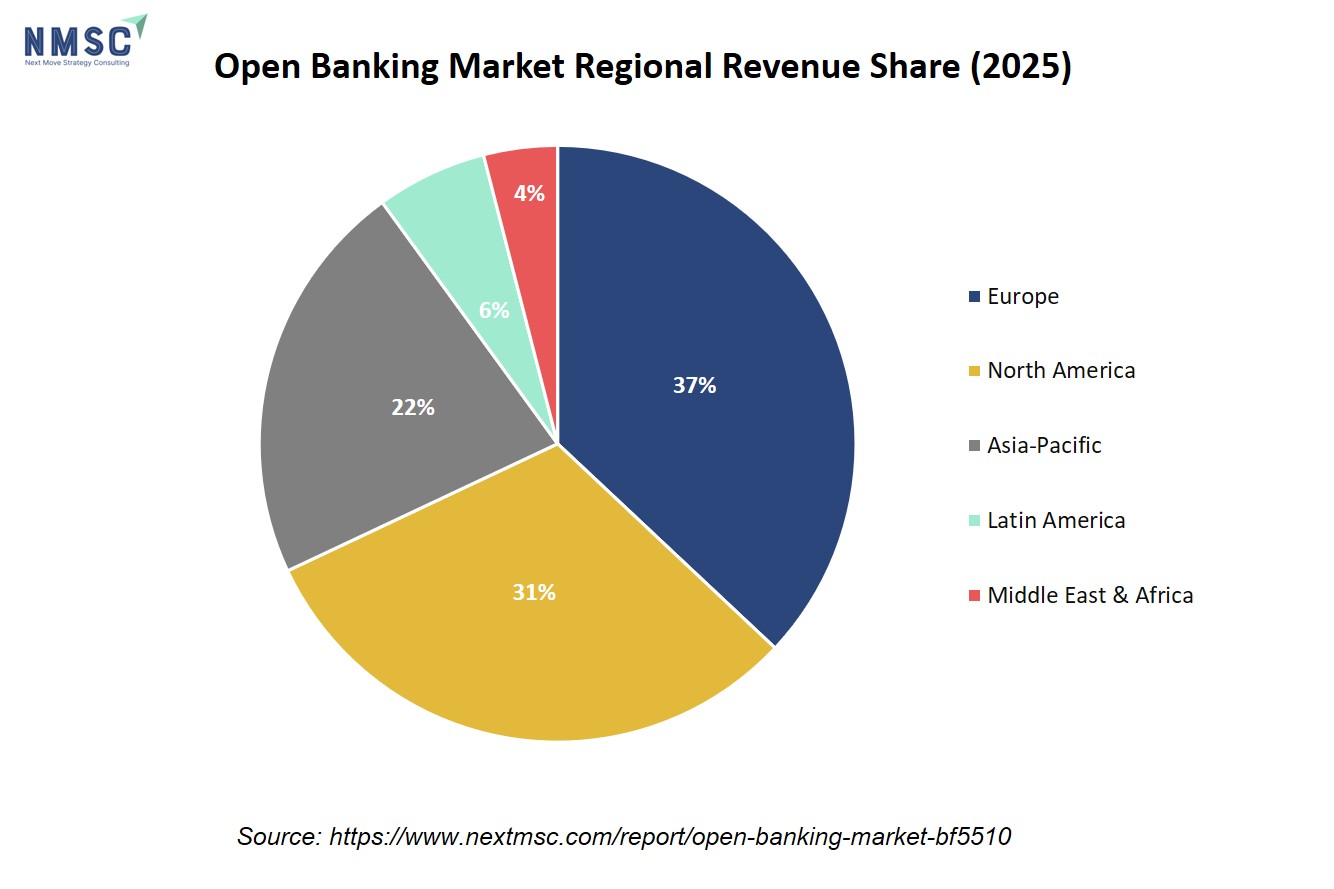
Section Summary: The open banking market's industry impact in 2026 is concentrated across four structural shifts: A2A payment adoption displacing card rails, AI personalization becoming the primary value differentiator, digital identity integration expanding the addressable use case set, and Asia-Pacific's regulatory expansion creating the market's fastest-growing regional opportunity.
Key Takeaways:
-
The EU's IPR reached its first reporting milestone in April 2026, making instant A2A settlement the new standard for European payments.
-
TrueLayer's acquisition of Zimpler (July 2026) and the Mastercard-Deutsche Bank partnership (June 2025) signal accelerating consolidation in European open banking payments.
-
Lloyds Banking Group's June 2026 AI investment announcement confirms that AI-layered open banking is becoming a core competitive differentiator for incumbent banks.
-
India is the fastest-growing open banking country at a 31.0% CAGR from 2026 to 2035, per NMSC.
Pros and Cons of Recent Market Developments
|
Recent Development |
Pros |
Cons |
|
U.S. CFPB Section 1033 Regulatory Limbo (2026) |
Creates a window for FDX-aligned compliance platforms to capture market share ahead of formal enforcement; bilateral data agreements continue to evolve independently |
Federal enforcement suspended; revised rulemaking timeline uncertain; risk of fragmented state-by-state regulatory patchwork if New York legislation is enacted |
|
New York "Mini-1033" Legislation (March 2026) |
Extends data access rights to small business accounts; imposes enforceable penalties of USD 10,000 per violation; could serve as a national template |
Lacks specifics on data elements, API technical requirements, and exception handling; preemption challenges from federal banking powers likely |
|
EU PSD3/PSR Provisional Agreement |
Stronger fraud protections; enforceable API standards; greater fee transparency; harmonizes cross-border open banking operations |
Transition from PSD2 creates compliance complexity for multi-market operators; timeline for full implementation remains subject to legislative process |
|
TrueLayer Acquisition of Zimpler (July 2026) |
Expands European Pay by Bank network; strengthens A2A payment capabilities; supports broader merchant adoption |
Consolidation reduces competitive diversity in European open banking payments; integration risk during transition period |
|
Mastercard-Deutsche Bank Partnership (June 2025) |
Integrates open banking technology into a major European merchant solutions platform; accelerates A2A payment adoption at scale |
Deepens card network dependency for open banking infrastructure; smaller independent aggregators face competitive pressure |
|
Visa Discontinuation of U.S. Tink Operations (August 2025) |
Signals market rationalization; reduces overcrowding in U.S. open banking aggregation |
Reduces competitive pressure on Mastercard and independent aggregators; may slow U.S. open banking adoption in the near term |
|
EU eIDAS 2.0 EUDIW Deadline (November 2026) |
Creates a standardized digital identity layer for open banking payments across all EU member states; reduces fraud and onboarding friction |
Implementation complexity for banks and PSPs; consumer awareness of the EUDIW remains low ahead of the November 2026 deadline |
Key Data & Statistics
Table 1: NMSC Open Banking Market Segmentation by Service Type (2025–2035)
|
Service Type |
2025 Market Size (USD) |
2035 Forecast (USD) |
CAGR (2026–2035) |
|
Banking and Capital Markets |
USD 12.81 Billion |
USD 91.22 Billion |
22.0% |
|
Payments |
USD 8.61 Billion |
USD 76.02 Billion |
26.5% |
|
Value Added Services |
USD 4.25 Billion |
USD 30.41 Billion |
22.0% |
|
Digital Currencies |
USD 1.67 Billion |
USD 15.19 Billion |
24.6% |
|
Other Services |
USD 0.49 Billion |
USD 4.36 Billion |
24.5% |
|
Total |
USD 27.85 Billion |
USD 217.20 Billion |
22.8% |
Table 2: NMSC Open Banking Market Segmentation by End User (2025–2035)
|
End User |
2025 Market Size (USD) |
2035 Forecast (USD) |
CAGR (2026–2035) |
|
Banks and Traditional Financial Institutions |
USD 11.14 Billion |
USD 78.19 Billion |
21.7% |
|
Fintech and Third-Party Developers |
USD 9.74 Billion |
USD 82.54 Billion |
23.9% |
|
Enterprises |
USD 5.29 Billion |
USD 42.36 Billion |
23.1% |
|
Other End Users |
USD 1.67 Billion |
USD 14.11 Billion |
23.7% |
|
Total |
USD 27.85 Billion |
USD 217.20 Billion |
22.8% |
Table 3: NMSC Open Banking Market Segmentation by Component (2025–2035)
|
Component |
2025 Market Size (USD) |
2035 Forecast (USD) |
CAGR (2026–2035) |
|
APIs |
USD 17.82 Billion |
USD 141.18 Billion |
23.3% |
|
Services |
USD 10.02 Billion |
USD 76.02 Billion |
22.0% |
|
Total |
USD 27.85 Billion |
USD 217.20 Billion |
22.8% |
Table 4: NMSC Open Banking Market Regional Outlook (2025–2035)
|
Region |
2025 Market Size (USD) |
2035 Forecast (USD) |
CAGR (2026–2035) |
Key Driver |
|
Europe |
USD 10.30 Billion |
USD 76.02 Billion |
22.1% |
PSD2 maturity and evolving EU Open Finance framework |
|
North America |
USD 8.61 Billion |
USD 65.16 Billion |
22.6% |
CFPB Section 1033 rule and FDX standardization |
|
Asia-Pacific |
USD 6.13 Billion |
USD 56.47 Billion |
27.5% |
Consumer Data Right expansion and fintech lending growth |
|
Latin America |
USD 1.67 Billion |
USD 12.19 Billion |
22.0% |
Growing fintech adoption and open finance pilot programs |
|
Middle East & Africa |
USD 1.13 Billion |
USD 7.36 Billion |
20.6% |
Digital banking expansion and regulatory sandboxes |
|
Total |
USD 27.85 Billion |
USD 217.20 Billion |
22.8% |
— |
Table 5: NMSC Open Banking Market — Key Country Snapshots (2025 vs. 2035)
|
Country |
2025 Market Size (USD) |
2035 Forecast (USD) |
CAGR (2026–2035) |
|
United Kingdom |
USD 5.02 Billion |
USD 36.20 Billion |
21.9% |
|
United States |
USD 7.31 Billion |
USD 55.19 Billion |
22.5% |
|
China |
USD 2.02 Billion |
USD 21.31 Billion |
27.0% |
|
Germany |
USD 1.96 Billion |
USD 14.23 Billion |
22.0% |
|
India |
USD 0.98 Billion |
USD 13.05 Billion |
31.0% |
|
Australia |
USD 0.55 Billion |
USD 5.13 Billion |
25.0% |
|
Brazil |
USD 0.94 Billion |
USD 6.86 Billion |
22.0% |
|
South Korea |
USD 0.61 Billion |
USD 5.36 Billion |
24.4% |
Future Outlook & Forecast
A USD 217.20 Billion Market Built on Three Structural Growth Pathways
According to NMSC's proprietary analysis, the open banking market is projected to expand from USD 34.21 billion in 2026 to USD 217.20 billion by 2035, at a 22.8% CAGR — representing an absolute dollar opportunity of USD 182.99 billion over the forecast period. This growth is broad-based across every segmentation axis, with three structural pathways converging to define the market's long-term trajectory.
Pathway 1: Account-to-Account Payment Infrastructure Scaling. Payments is the fastest-growing service type at a 26.5% CAGR from 2026 to 2035, projected to reach USD 76.02 billion by 2035. The EU's IPR, the UK's UKPI framework, and Mastercard's expanding European bank connectivity are collectively compressing the timeline for A2A payment adoption from a decade-long transition to a three-to-five-year mainstream shift. The Fintech Channel is the fastest-growing distribution channel at approximately 25.0% CAGR, reflecting the accelerating pace at which payment-focused fintechs build merchant-facing A2A products on top of open banking rails.
Pathway 2: FDX-Aligned Compliance Infrastructure in North America. North America is projected to grow from USD 8.61 billion in 2025 to USD 65.16 billion by 2035 at a 22.6% CAGR. The Financial Data Exchange continues expanding its FDX API standard adoption among U.S. financial institutions, providing common technical infrastructure that reduces integration costs for aggregators and banks alike — regardless of whether the CFPB's revised Section 1033 rules are ultimately enforced. The U.S. market's transition from screen-scraping to OAuth-based API access is a structural shift that will proceed independently of the regulatory timeline, driven by bank risk management and consumer data security imperatives.
Pathway 3: Asia-Pacific Open Finance Expansion. Asia-Pacific is the fastest-growing region at a 27.5% CAGR, projected to reach USD 56.47 billion by 2035 — nearly matching North America's absolute market size despite starting from a significantly smaller base. India's Account Aggregator framework, China's expanding fintech lending platforms, and Australia's CDR expansion to non-bank financial products are collectively creating the most dynamic open banking growth environment in the world. India's 31.0% CAGR — the highest of any covered country — reflects the compounding effect of a large unbanked population, a mature digital payments infrastructure (UPI), and a rapidly scaling fintech lending sector.
The Services component — spanning integration, compliance consulting, and managed operations — is the fastest-growing component sub-segment at a 24.5% CAGR, as banks increasingly outsource the technical complexity of API management and regulatory compliance work associated with multi-market open banking deployments.
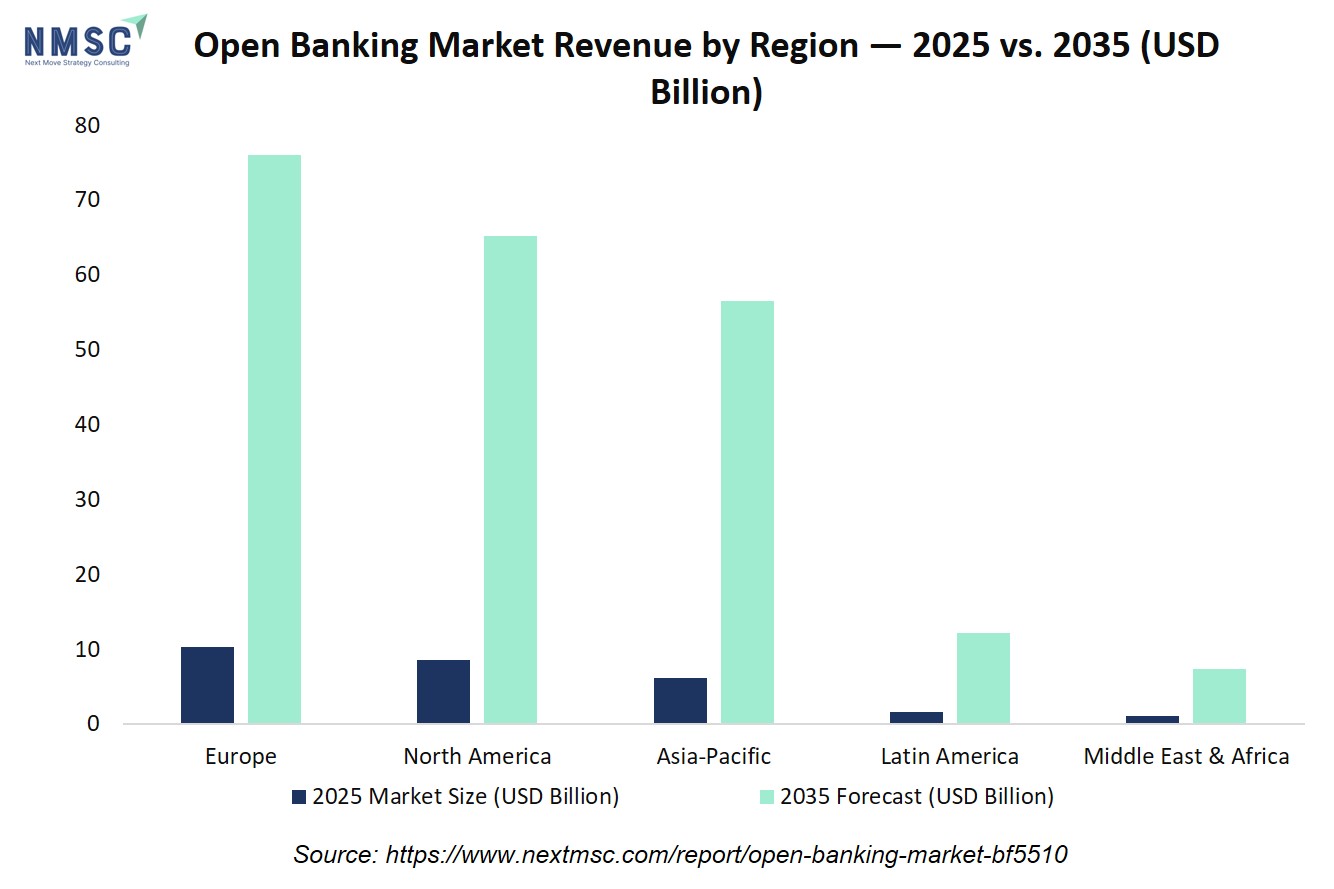
Section Summary: The open banking market's USD 217.20 billion forecast by 2035 is underpinned by three converging structural pathways: A2A payment infrastructure scaling, FDX-aligned compliance platform adoption in North America, and Asia-Pacific open finance expansion. The market's 22.8% CAGR reflects a durable, regulation-anchored structural transformation rather than a cyclical technology upturn.
Key Takeaways:
-
The open banking market is projected to reach USD 217.20 billion by 2035, growing at a 22.8% CAGR from 2026, per NMSC.
-
Payments is the fastest-growing service type at a 26.5% CAGR, driven by A2A payment initiation scaling across Europe and North America.
-
Asia-Pacific is the fastest-growing region at a 27.5% CAGR, with India registering the highest country-level CAGR of 31.0%.
-
The absolute dollar opportunity between 2026 and 2035 is USD 182.99 billion, with above-average growth concentrated in Payments, Fintech end users, and Asia-Pacific.
Next Steps for Stakeholders
For C-Level Executives at Banks and Traditional Financial Institutions:
The transition from screen-scraping to FDX-aligned API connectivity is no longer a regulatory compliance exercise — it is a competitive positioning decision. Banks that invest early in standardized, audit-ready API infrastructure will capture recurring revenue from fintech aggregators and enterprise clients while reducing the legal and reputational risk associated with legacy data-sharing arrangements. NMSC's analysis indicates that Banks and Traditional Financial Institutions held a 40% share of the open banking market in 2025 but are growing at the slowest end user CAGR (21.7%), signaling that the competitive advantage is shifting toward fintech-native operators unless incumbents accelerate their API investment timelines.
For Institutional Investors and Private Equity:
Capital allocation should prioritize providers at the intersection of three high-growth vectors: A2A payment infrastructure (26.5% CAGR service type), Fintech and Third-Party Developer end users (23.9% CAGR), and Asia-Pacific regional exposure (27.5% CAGR). The TrueLayer-Zimpler acquisition (July 2026) and the Mastercard-Deutsche Bank partnership (June 2025) confirm that consolidation is accelerating in European open banking payments — a pattern that typically precedes premium valuation multiples for remaining independent operators with differentiated institutional coverage.
For Fintech Operators and Third-Party Developers:
The open banking market's fastest-growing opportunity is not in account information services — it is in AI-enabled data personalization layered on top of standardized API access. Providers that build proprietary AI models on top of open banking data to deliver proactive financial insights, alternative credit underwriting, and real-time affordability assessments will command premium pricing as basic data access becomes commoditized. The Fintech Channel's approximately 25.0% CAGR confirms that distribution through fintech-native channels is outpacing both bank and enterprise channels.
For Regulatory and Government Bodies:
The U.S. regulatory impasse is the single largest risk to the open banking market's North American growth trajectory. The CFPB's revised rulemaking, the New York "Mini-1033" legislation, and the GUARD Financial Data Act are three concurrent regulatory processes that could produce conflicting obligations for financial institutions operating across state lines. Regulatory bodies should prioritize coordination between federal and state frameworks to avoid the compliance fragmentation that has historically slowed open banking adoption in markets without unified mandates.
For Enterprise Technology and Procurement Teams:
Cloud deployment held a 68% share of the open banking market in 2025, and On-Premise is the fastest-growing deployment mode at approximately 20.0% CAGR — reflecting enterprise demand for data sovereignty and compliance control in regulated industries. Enterprise procurement teams should evaluate hybrid deployment architectures that combine cloud-native API connectivity with on-premise data governance controls, particularly in jurisdictions with strict data residency requirements such as Germany and Australia.
Conclusion
The open banking market's transition from a regulatory compliance framework to a global financial infrastructure is now irreversible. The convergence of the U.S. regulatory inflection point, the EU's PSD3/FiDA advancement, the UK's UKPI framework, Asia-Pacific's CDR and Account Aggregator expansion, and the commercial acceleration of A2A payment adoption has created the structural foundation for the market's projected expansion from USD 34.21 billion in 2026 to USD 217.20 billion by 2035.
The risks are real and material: U.S. regulatory uncertainty could delay North American adoption, rising data-access fee structures are increasing aggregator costs, and consumer data privacy concerns remain a persistent restraint on consent-based data sharing at scale. However, for stakeholders who position themselves at the intersection of A2A payment infrastructure, FDX-aligned compliance platforms, and Asia-Pacific fintech lending growth, the USD 182.99 billion absolute dollar opportunity between 2026 and 2035 represents one of the most structurally durable investment cases in the global financial technology sector. The open banking market is no longer a regulatory experiment — it is the infrastructure layer on which the next generation of financial services will be built.
About the Author
 Sanyukta Deb
— Sanyukta Deb is Digital Marketing Team Lead at Next Move Strategy Consulting, where she has led content strategy and technical SEO for the firm's B2B market research publications for over 2 years. Her editorial process translates NextMSC's primary and secondary research — spanning technology, industrial, and consumer sectors — into commercial narratives, backed by search-intent, keyword, and competitive analysis. She brings 5 years of overall experience in digital marketing and content strategy.
Sanyukta Deb
— Sanyukta Deb is Digital Marketing Team Lead at Next Move Strategy Consulting, where she has led content strategy and technical SEO for the firm's B2B market research publications for over 2 years. Her editorial process translates NextMSC's primary and secondary research — spanning technology, industrial, and consumer sectors — into commercial narratives, backed by search-intent, keyword, and competitive analysis. She brings 5 years of overall experience in digital marketing and content strategy.
About the Reviewer
 Debashree Dey
— Debashree Dey is Assistant Manager at Next Move Strategy Consulting, where she supports cross-vertical market content and communications across diverse industries for 6 years. Her professional background includes senior content writing, communications, and published manuscript authorship, with experience developing audience-focused business narratives and maintaining clear, consistent messaging. Her role supports research-led content development and editorial quality across NextMSC publications.
Debashree Dey
— Debashree Dey is Assistant Manager at Next Move Strategy Consulting, where she supports cross-vertical market content and communications across diverse industries for 6 years. Her professional background includes senior content writing, communications, and published manuscript authorship, with experience developing audience-focused business narratives and maintaining clear, consistent messaging. Her role supports research-led content development and editorial quality across NextMSC publications.

















Add Comment