Open Banking Market Size, Share, Trends and Growth Analysis, By Service Type (Banking and Capital Markets, Payments, Digital Currencies, Value Added Services, and Other Services), By Component (APIs and Services), By Deployment Mode (Cloud, On-Premise, and Hybrid), By Distribution Channel (Bank, Fintech, and Enterprise Channel), By End User (Banks and Traditional Financial Institutions, Fintech and Third-Party Developers, and Others), and Region — Global Industry Report and Forecast, 2026–2035
Industry: BFSI | Publishing Date: August 1, 2026 | Last Updated: August 1, 2026 | No of Pages: N/A | No. of Tables: N/A | No. of Figures: N/A | Format: PDF | Report Code: BF5510
What Is the Open Banking Market Size?
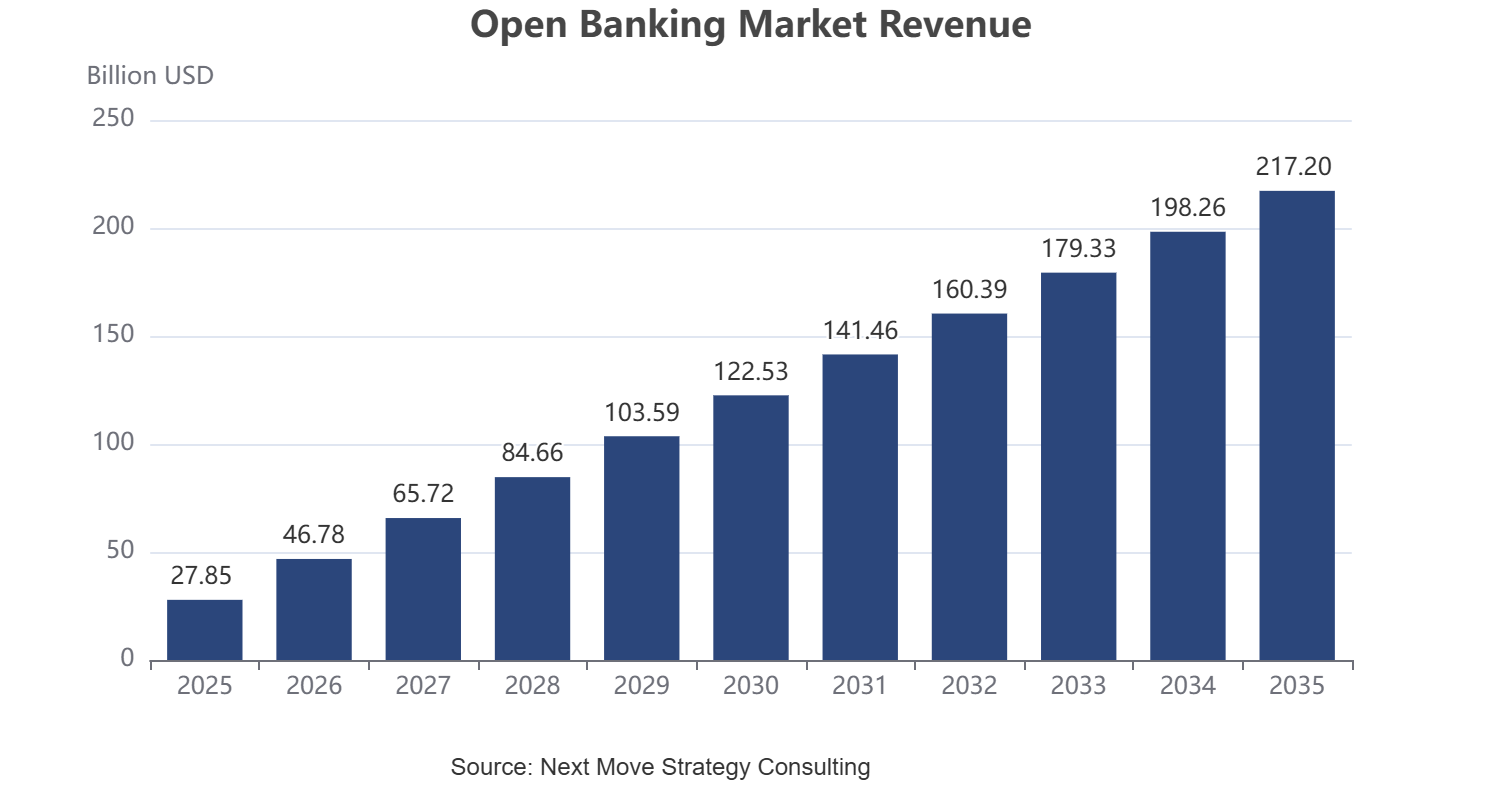
The global Open Banking Market size was valued at USD 27.85 Billion in 2025 and is estimated at USD 34.21 Billion in 2026, forecast to reach USD 217.20 Billion by 2035, expanding at a 22.8% CAGR between 2026 and 2035. Europe leads with approximately 37% share, while Banking and Capital Markets dominates all other service type categories with approximately 46% share.
We observed that growth is broad-based across every segmentation axis, with account-to-account payment adoption and regulatory-driven API standardization in the United States and European Union driving the dominant structural shifts through 2035, even as individual card network strategies diverge on geographic priorities.
|
Key Takeaways |
|||
|
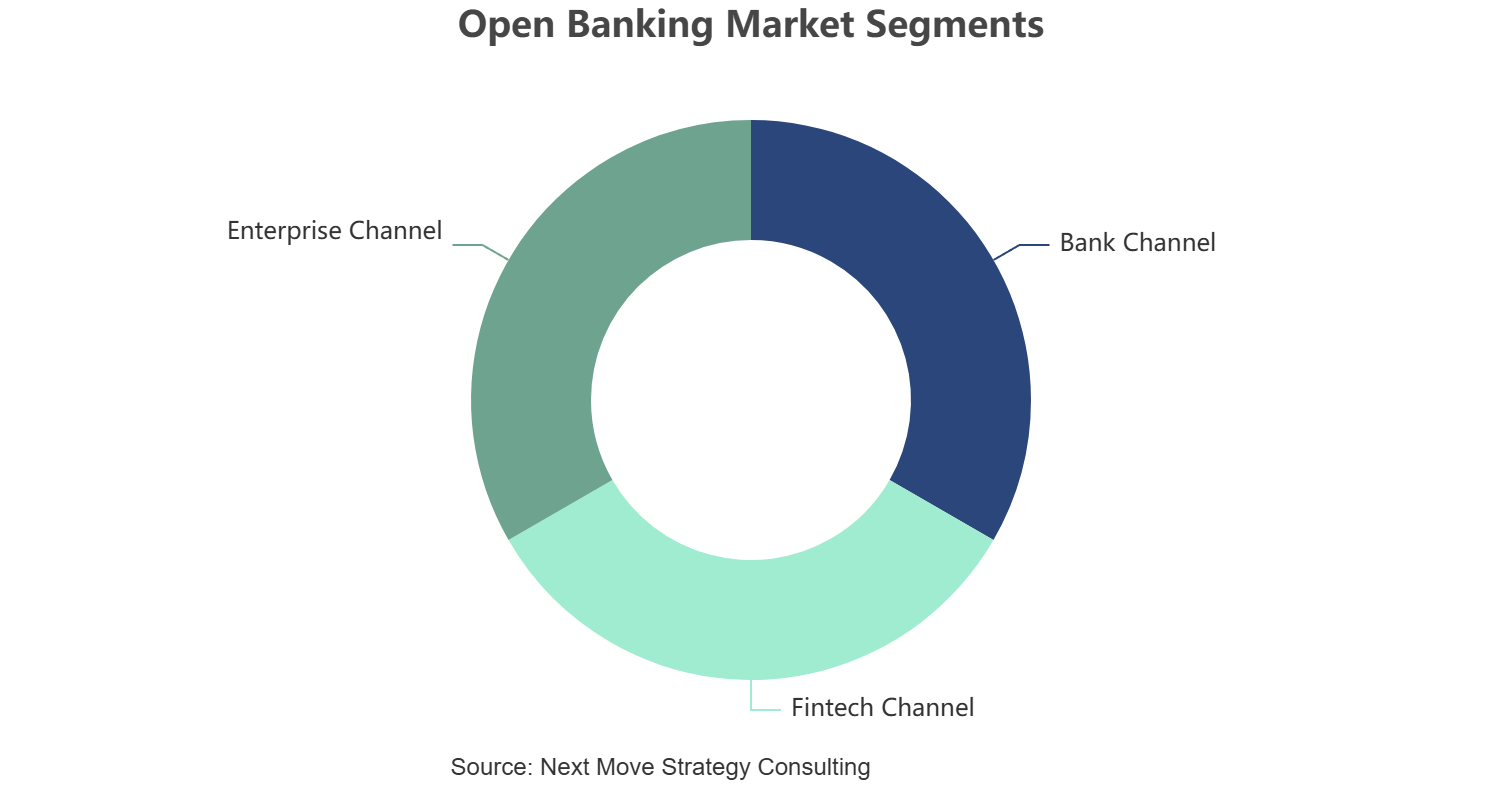
By Service Type: Banking and Capital Markets held the largest share of approximately 46% (USD 12.81 billion) in 2025; Payments is the fastest-growing sub-segment at 26.5% CAGR from 2026–2035. By Component: APIs held the largest share of approximately 64% (USD 17.82 billion) in 2025; Services is the fastest-growing sub-segment at 24.5% CAGR from 2026–2035. By Deployment Mode: Cloud held the largest share of approximately 68% (USD 18.94 billion) in 2025; On-Premise is the fastest-growing sub-segment at approximately 20.0% CAGR from 2026–2035, off a smaller base. By Distribution Channel: Bank Channel held the largest share of approximately 44% (USD 12.25 billion) in 2025; Fintech Channel is the fastest-growing sub-segment at approximately 25.0% CAGR from 2026–2035. By End User: Banks and Traditional Financial Institutions held the largest share of approximately 40% (USD 11.14 billion) in 2025; Fintech and Third-Party Developers is the fastest-growing sub-segment at approximately 25.5% CAGR from 2026–2035. Dominant Region: Europe dominated with approximately 37% revenue share (USD 10.30 billion) in 2025. Fastest-Growing Region: Asia-Pacific is expected to register the highest CAGR of 27.5% during 2026–2035. Dominant Country: The UK led with approximately USD 5.02 billion in 2025. Fastest-Growing Country: India is the fastest-growing country at approximately 31.0% CAGR from 2026–2035. |
Market Opportunity: The Open Banking Market is expected to create an absolute dollar opportunity of USD 182.99 Billion between 2026 and 2035, presenting significant investment potential across account-to-account payment rails, data aggregation platforms, and API infrastructure.
According to NMSC analysis, banks and fintechs are increasingly consolidating around standardized, regulator-endorsed API frameworks such as FDX in the United States over proprietary connections, a shift that favors platform providers with broad, verified institutional coverage as compliance-driven adoption in the United States accelerates through 2035.
Ecosystem Analysis of the Open Banking Industry
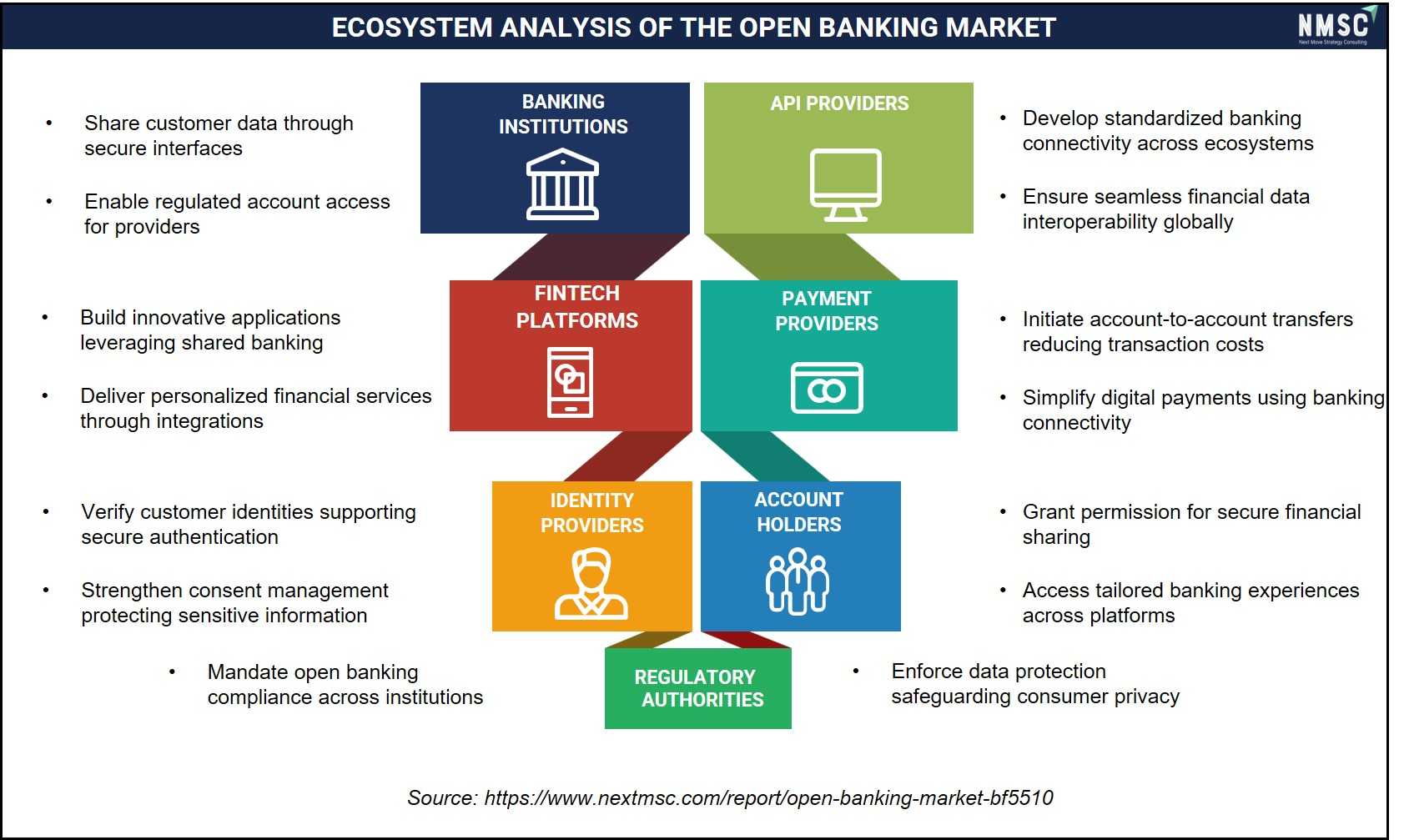
The above infographic presents an ecosystem analysis of the open banking market, where banking institutions and API providers are developing standardized interfaces to enable secure data sharing and interoperability. Fintech platforms and payment providers are building innovative applications for personalized services and account-to-account transfers, while identity providers verify customers and manage consent. Account holders access tailored banking experiences, and regulatory authorities further enforce data protection and compliance standards. Looking ahead, we observed that these interconnected elements collectively shape the market's evolution across the financial services sector.
What Does the Open Banking Market Encompass?
The Open Banking Market encompasses APIs, software platforms, and services that allow banks to securely share customer-permissioned financial data and initiate payments on behalf of third-party providers, including fintechs, lenders, and other financial institutions. Our assessment indicates that the scope spans account information services, payment initiation services, data enrichment, and identity verification capabilities delivered to banks, fintech developers, and enterprises seeking to build personalized financial products on top of standardized, consent-based data access.
Regulatory frameworks such as the European Union's Payment Services Directive 2 and the U.S. Consumer Financial Protection Bureau's Personal Financial Data Rights rule under Section 1033, finalized in July 2024, are reshaping data-sharing obligations across the industry. We observed that technology adoption is shifting toward API-based, FDX-aligned connectivity that replaces legacy screen-scraping methods. NMSC's analysis indicates that this structural shift, combined with divergent card network strategies on geographic focus, is redefining competitive positioning across the market.
|
Parameters |
Details |
|
Market Size in 2025 |
USD 27.85 Billion |
|
Market Size in 2026 |
USD 34.21 Billion |
|
Revenue Forecast in 2035 |
USD 217.20 Billion |
|
Growth Rate |
CAGR of 22.8% from 2026 to 2035 |
|
Analysis Period |
2025–2035 |
|
Base Year Considered |
2025 |
|
Forecast Period |
2026–2035 |
|
Market Size Estimation |
USD Billion |
|
Companies Profiled |
20 |
|
Countries Covered |
38 |
|
Market Share |
Available for Top 10 Companies |
Key Emerging Trends
Based on research conducted by NMSC, we found that four structural trends are reshaping technology adoption, business models, and stakeholder engagement across the industry.
How Is Account-to-Account Payment Adoption Transforming Checkout Flows?
Account-to-account payment initiation is transforming checkout experiences by allowing consumers to pay directly from bank accounts without card intermediation. We observed that Visa announced in June 2025 that its Visa A2A pay-by-bank solution is ready for market in the UK, giving consumers greater choice, control, and protection over bank-transfer payments. Merchants and payment processors are positioning A2A rails as a lower-cost, faster-settlement alternative to traditional card networks for domestic transactions.
Why Is Regulatory Standardization Accelerating U.S. Open Banking Adoption?
Regulatory standardization is accelerating adoption as the U.S. moves from fragmented, bilateral data-sharing agreements toward a unified compliance framework. Our findings suggest that the Consumer Financial Protection Bureau finalized its Personal Financial Data Rights rule in July 2024, establishing standardized API management-based data-sharing obligations for financial institutions. This trend reflects a broader shift toward regulator-endorsed technical standards such as FDX replacing proprietary bank-by-bank integration requirements.
How Is Card Network Strategy Diverging on Geographic Focus?
Card networks are increasingly diverging in their open banking geographic strategy rather than pursuing uniform global expansion. We observed that Visa reportedly discontinued its standalone U.S. open banking operations under the Tink brand in August 2025, redirecting focus toward European and international markets, while Mastercard continues expanding its open banking platform connectivity across nearly 3,000 European banks and the substantial majority of U.S. deposit accounts. This trend reflects differing assessments of near-term U.S. monetization potential between the two networks.
What Role Does AI-Enabled Personalization Play in Open Banking Value Creation?
AI-enabled personalization is emerging as a primary value driver as banks and fintechs move beyond basic account aggregation toward proactive financial insights. Our analysis shows that Lloyds Banking Group announced in June 2026 that it is accelerating its use of AI, investing in new tools, talent, and training to embed AI-enabled, open banking-connected services across its business. This trend reflects growing recognition that raw data access alone provides limited differentiation without AI-driven interpretation layered on top.
Growth Drivers and Restraints
Growth Catalyst and Risk Assessment Matrix
|
Factors |
Type |
(+/−) % Impact on CAGR |
Geographic Relevance |
Impact Timeline |
|
U.S. CFPB Section 1033 data-sharing rule implementation |
Driver |
+4.8% |
North America |
2026-2032 |
|
Account-to-account payment initiation adoption |
Driver |
+4.1% |
Europe, North America |
2026-2035 |
|
EU PSD2 and evolving Open Finance framework |
Driver |
+3.6% |
Europe |
2026-2035 |
|
Rising fintech lending and underwriting data demand |
Driver |
+2.9% |
Global |
2026-2035 |
|
Australia Consumer Data Right expansion to Open Finance |
Driver |
+1.8% |
Asia-Pacific |
2026-2032 |
|
AI-enabled personalization layered on aggregated data |
Driver |
+1.6% |
North America, Europe |
2026-2035 |
|
Data-access fee structures raising aggregator costs |
Restraint |
-1.9% |
North America |
2026-2032 |
|
Card network strategic divergence on market focus |
Restraint |
-1.2% |
North America |
2026-2030 |
|
Consumer data privacy and consent fatigue concerns |
Restraint |
-1.0% |
Global |
2026-2035 |
|
Limited standardization across non-U.S., non-EU markets |
Restraint |
-0.8% |
Latin America, Middle East & Africa |
2026-2032 |
What Is the Primary Growth Driver of the Open Banking Market?
The U.S. Consumer Financial Protection Bureau's Section 1033 data-sharing rule implementation is the primary driver of the market. The rule, finalized in July 2024, establishes standardized personal financial data rights and API-based data-sharing obligations for financial institutions operating in the United States. We observed that this regulatory mandate is compelling banks to move away from legacy screen-scraping arrangements toward standardized, FDX-aligned API connectivity, directly expanding addressable demand for compliant open banking infrastructure.
How Is Account-to-Account Payment Initiation Driving Market Growth?
Account-to-account payment initiation is accelerating market growth as merchants and consumers seek lower-cost alternatives to card-based transactions. Visa's A2A pay-by-bank solution, market-ready in the UK since June 2025, and Mastercard's continued open banking platform expansion both reflect this shift toward bank-transfer-based payment rails. Our assessment indicates that this transition is compressing adoption timelines as payment processors integrate A2A capability alongside traditional card acceptance.
What Is Restraining Open Banking Market Expansion?
Data-access fee structures raising aggregator costs restrain the pace of open banking expansion, particularly in the United States where large banks have introduced fees for third-party data access. Visa's reported discontinuation of standalone U.S. open banking operations under the Tink brand in August 2025 reflects how looming data-access fees and regulatory uncertainty have affected card network commitment to the U.S. market. We found that smaller fintech aggregators face particular exposure to these rising cost structures relative to larger, better-capitalized platform providers.
Segmentation Analysis
Segment Sizing: By Service Type
|
Segment |
2025 (USD) |
2035 (USD) |
CAGR% (2026–2035) |
|
Banking and Capital Markets |
USD 12.81 Billion |
USD 91.22 Billion |
22.0% |
|
Payments |
USD 8.61 Billion |
USD 76.02 Billion |
26.5% |
|
Value Added Services |
USD 4.25 Billion |
USD 30.41 Billion |
22.0% |
|
Digital Currencies |
USD 1.67 Billion |
USD 15.19 Billion |
24.6% |
|
Other Services |
USD 0.49 Billion |
USD 4.36 Billion |
24.5% |
|
Total |
USD 27.85 Billion |
USD 217.20 Billion |
22.8% |
Which Service Type Segment Dominates the Open Banking Market?
Banking and Capital Markets, encompassing account information services for retail banking, lending, and wealth management applications, led the market with USD 12.8110 billion in 2025, reflecting the segment's foundational role as the earliest and most standardized open banking use case. We observed that Payments is the fastest-growing service type, expanding at a 26.5% CAGR from 2026 to 2035, as account-to-account payment initiation scales rapidly following Visa and Mastercard's expanding pay-by-bank infrastructure.
Segment Sizing: By Component
|
Segment |
2025 (USD) |
2035 (USD) |
CAGR% (2026–2035) |
|
APIs |
USD 17.82 Billion |
USD 141.18 Billion |
23.3% |
|
Services |
USD 10.02 Billion |
USD 76.02 Billion |
22.0% |
|
Total |
USD 27.85 Billion |
USD 217.20 Billion |
22.8% |
Which Component Leads Open Banking Market Demand?
APIs remained the leading component within the market, valued at USD 17.8240 billion in 2025, as account and payment connectivity forms the core technical infrastructure underlying every open banking use case. Our findings suggest that Services, spanning integration, compliance consulting, and managed operations, is scaling steadily as banks increasingly outsource the technical complexity of API management and regulatory compliance work associated with multi-market open banking deployments.
Segment Sizing: By End User
|
Segment |
2025 (USD) |
2035 (USD) |
CAGR% (2026–2035) |
|
Banks and Traditional Financial Institutions |
USD 11.14 Billion |
USD 78.19 Billion |
21.7% |
|
Fintech and Third-Party Developers |
USD 9.74 Billion |
USD 82.54 Billion |
23.9% |
|
Enterprises |
USD 5.29 Billion |
USD 42.36 Billion |
23.1% |
|
Other End Users |
USD 1.67 Billion |
USD 14.11 Billion |
23.7% |
|
Total |
USD 27.85 Billion |
USD 217.20 Billion |
22.8% |
Which End User Segment Is Most Widely Served in Open Banking?
Banks and Traditional Financial Institutions remained the dominant end user across the market, reaching USD 11.1400 billion in 2025 due to their role as both data holders and consumers of aggregated financial insights for lending and risk assessment. Based on research conducted by NMSC, we found that Fintech and Third-Party Developers are the fastest-growing end user at a 23.9% CAGR from 2026 to 2035, reflecting the accelerating pace at which lending, personal finance, and payment startups build products on top of standardized bank data access.
Growth Opportunities
Our analysis shows that three forward-looking opportunities stand out for stakeholders positioning within the Open Banking Market over the 2026-2035 forecast period.
How Can FDX-Aligned Compliance Platforms Unlock Value for U.S. Banks?
Standardized, FDX-aligned compliance infrastructure presents a whitespace opportunity as U.S. banks transition away from legacy screen-scraping arrangements under the CFPB's Section 1033 rule. Vendors that package validated, audit-ready API connectivity into turnkey compliance offerings stand to capture recurring revenue across the Banks and Traditional Financial Institutions segment as smaller regional and community banks seek cost-effective compliance pathways.
Where Does Account-to-Account Payment Infrastructure Create New Merchant Demand?
Merchants seeking lower-cost checkout alternatives represent an underpenetrated opportunity for pay-by-bank infrastructure built on account-to-account rails. Vendors that combine instant settlement with fraud protection comparable to card networks can capture long-term contracts with the Payments service type segment as retailers and payment processors expand bank-transfer acceptance alongside traditional card rails.
How Can Emerging Market Regulatory Frameworks Benefit Fintech Developers?
Fintech developers targeting Asia-Pacific and Latin American markets represent an opportunity as regulatory frameworks mature toward Open Finance in jurisdictions such as Australia and Brazil. Early movers that secure validated, multi-market API coverage can differentiate with the Fintech and Third-Party Developers end user segment pursuing unified data access across less standardized regulatory environments through the forecast period.
Regional Outlook
Geographic Performance Snapshot
|
Region |
2025 (USD) |
2035 (USD) |
CAGR% (2026–2035) |
Key Driver |
|
Europe |
USD 10.30 Billion |
USD 76.02 Billion |
22.1% |
PSD2 maturity and evolving EU Open Finance framework |
|
North America |
USD 8.61 Billion |
USD 65.16 Billion |
22.6% |
CFPB Section 1033 rule and FDX standardization |
|
Asia-Pacific |
USD 6.127 Billion |
USD 56.47 Billion |
27.5% |
Consumer Data Right expansion and fintech lending growth |
|
Latin America |
USD 1.67 Billion |
USD 12.19 Billion |
22.0% |
Growing fintech adoption and open finance pilot programs |
|
Middle East & Africa |
USD 1.13 Billion |
USD 7.36 Billion |
20.6% |
Digital banking expansion and regulatory sandboxes |
|
Total |
USD 27.85 Billion |
USD 217.20 Billion |
22.8% |
— |
Europe
Europe leads the Open Banking Market, anchored by the maturity of the Payment Services Directive 2 framework and the UK's dedicated Open Banking Implementation Entity. We observed that Mastercard's open banking platform connects to nearly 3,000 European banks, reflecting the region's advanced institutional coverage. Regulatory influence remains the strongest globally as the European Commission develops a broader Open Finance framework, and technology adoption favors standardized account information and payment initiation services among established regional providers.
North America
North America's market reflects a rapidly maturing, regulation-driven landscape following the CFPB's finalization of the Section 1033 rule in July 2024. Our findings suggest that Plaid, Fiserv, and MX Technologies are positioning FDX-aligned API connectivity to replace legacy screen-scraping arrangements. Technology adoption is accelerating despite Visa's reported strategic pullback from standalone U.S. open banking operations, as Mastercard and independent aggregators continue expanding institutional coverage.
Asia-Pacific
Asia-Pacific is the fastest-growing region, propelled by Australia's Consumer Data Right expansion toward Open Finance and rising fintech lending demand across China and India. We found that regulatory frameworks remain less harmonized than in Europe, giving fintech developers flexibility to deploy API management platforms rapidly across less standardized markets. Technology adoption is accelerating as regional banks digitize account information and payment initiation services to meet expanding digital banking demand.
Latin America
Latin America's market is supported by growing fintech adoption and emerging open finance pilot programs in Brazil and Argentina. We observed that regulatory frameworks remain less developed than in Europe or North America, though multinational aggregators including Belvo are expanding regional API coverage. Technology adoption remains centered on account information services, with competitive intensity increasing as regional fintechs partner with global platform providers.
Middle East & Africa
The Open Banking Market in the Middle East & Africa is in an early growth stage, supported by digital banking expansion and regulatory sandbox programs in the UAE and Saudi Arabia. Our analysis shows that regional investment remains limited relative to other regions, with technology adoption gradually emerging through partnerships with established international API providers. Regulatory influence remains developing, while strategic outlook improves as regional central banks explore open finance frameworks.
U.S.
Based on our estimates, the U.S. market was valued at approximately USD 7.31 billion in 2025 and is projected to reach USD 55.19 billion by 2035, growing at a 22.5% CAGR. Demand is anchored by the CFPB's Section 1033 rule and expanding FDX-aligned API adoption among major banks. Technology penetration favors standardized account information services, and competitive intensity remains high among aggregators including Plaid, Fiserv, and MX Technologies serving lenders and fintech developers.
Canada
The market in Canada reached roughly USD 1.30 billion in 2025 and is forecast to hit USD 9.97 billion by 2035 at a 22.7% CAGR. Demand structure mirrors U.S. regulatory momentum, reinforced by Canada's own developing consumer-driven banking framework. Technology penetration is rising as national programs digitize account and payment data sharing, with competitive intensity moderate given close integration with U.S.-based platform providers.
UK
As per our estimate, the UK market stood at about USD 5.02 billion in 2025, advancing toward USD 36.20 billion by 2035 at a 21.9% CAGR. Demand is driven by the UK's pioneering Open Banking Implementation Entity framework and mature institutional API coverage. Regulatory influence is the strongest globally, technology penetration favors payment initiation services, and competitive intensity remains steady among domestic and multinational providers including TrueLayer and Yapily.
Germany
According to our analysis, Germany's market was valued at USD 1.96 billion in 2025 and is set to reach USD 14.23 billion by 2035, expanding at a 22.0% CAGR. Demand structure benefits from Germany's position as Europe's largest economy and PSD2's harmonized regulatory framework. Regulatory influence from EU directives is notable, while technology penetration favors account information services among established regional banks.
France
Based on our estimates, France's market reached approximately USD 1.34 billion in 2025, projected to climb to USD 9.73 billion by 2035 at a 22.0% CAGR. Demand is supported by France's growing fintech lending sector and PSD2-aligned regulatory compliance requirements. Regulatory influence from French and EU trade policy is notable, and competitive intensity remains moderate given reliance on both domestic and multinational open banking providers.
China
The market in China stood at roughly USD 2.02 billion in 2025 and is forecast to reach USD 21.31 billion by 2035, registering a 27.0% CAGR. Demand is fueled by expanding fintech lending platforms and rising digital banking adoption. Regulatory influence is increasing gradually, technology penetration is accelerating through domestic API platform adoption, and competitive intensity remains elevated among regional financial technology providers.
India
As per our estimate, India's market was valued at about USD 0.98 billion in 2025, projected to reach USD 13.05 billion by 2035 at a 31.0% CAGR, the fastest among covered countries. Demand structure reflects India's expanding fintech lending sector and Unified Payments Interface-adjacent account aggregator framework. Regulatory influence remains developing, while technology penetration is rising quickly as fintech developers adopt cloud-native API platforms to manage growing transaction volumes.
Japan
According to our analysis, Japan's market reached close to USD 0.86 billion in 2025 and is expected to hit USD 6.66 billion by 2035, growing at a 22.6% CAGR. Demand is supported by Japan's gradual regulatory push toward API-based banking connectivity. Regulatory influence is developing, technology penetration is advancing among large financial institutions, and competitive intensity remains moderate among established domestic banking technology vendors.
South Korea
Based on our estimates, South Korea's market stood at approximately USD 0.61 billion in 2025, forecast to reach USD 5.36 billion by 2035 at a 24.4% CAGR. Demand structure benefits from South Korea's advanced digital banking infrastructure and government-backed open banking network established by the Financial Services Commission. Technology penetration is high, and competitive intensity remains pronounced amid rapid fintech platform innovation.
Australia
The Open Banking Market in Australia reached about USD 0.55 billion in 2025 and is projected to reach USD 5.13 billion by 2035, expanding at a 25.0% CAGR. Demand is supported by the Consumer Data Right framework's expansion toward Open Finance, encompassing non-bank lenders and buy-now-pay-later providers from 2025. Regulatory influence stems from Australia's structured CDR rollout, while technology penetration favors account information services among established domestic banks.
UAE
As per our estimate, the UAE market was valued at USD 0.46 billion in 2025, projected to reach USD 3.19 billion by 2035 at a 21.5% CAGR. Demand structure is shaped by the UAE's digital banking strategy and regulatory sandbox programs encouraging fintech experimentation. Regulatory influence remains moderate, technology penetration is improving through partnerships with global API providers, and competitive intensity is rising as distributors expand product portfolios to serve Gulf markets.
Saudi Arabia
According to our analysis, Saudi Arabia's market reached roughly USD 0.40 billion in 2025 and is expected to hit USD 2.66 billion by 2035, growing at a 21.0% CAGR. Demand is driven by Vision 2030-linked financial sector digitization and the Saudi Central Bank open banking framework rollout. Regulatory influence is developing under national digital finance guidelines, and technology penetration is advancing as domestic integrators scale API-based adoption.
South Africa
Based on our estimates, South Africa's market stood at about USD 0.11 billion in 2025, forecast to reach USD 0.68 billion by 2035 at a 20.0% CAGR. Demand structure reflects a developing open banking technology base serving regional Southern African markets. Regulatory influence remains moderate, technology penetration is gradually improving, and competitive intensity is limited given reliance on imported API platforms from Europe and North America.
Brazil
The market in Brazil reached approximately USD 0.94 billion in 2025 and is projected to reach USD 6.86 billion by 2035, registering a 22.0% CAGR. Demand is underpinned by Brazil's advanced Open Finance regulatory framework overseen by the Central Bank of Brazil. Regulatory influence stems from national open finance policy, technology penetration favors account information and payment initiation services, and competitive intensity remains moderate among regional and multinational vendors including Belvo.
Argentina
As per our estimate, Argentina's market was valued at near USD 0.20 billion in 2025, projected to reach USD 1.30 billion by 2035 at a 20.5% CAGR. Demand structure is supported by steady fintech lending adoption despite macroeconomic volatility. Regulatory influence remains limited relative to Brazil, technology penetration is modest, and competitive intensity is centered on a small number of regional aggregators serving national fintech developers.
Regulatory Framework Impacting the Open Banking Industry
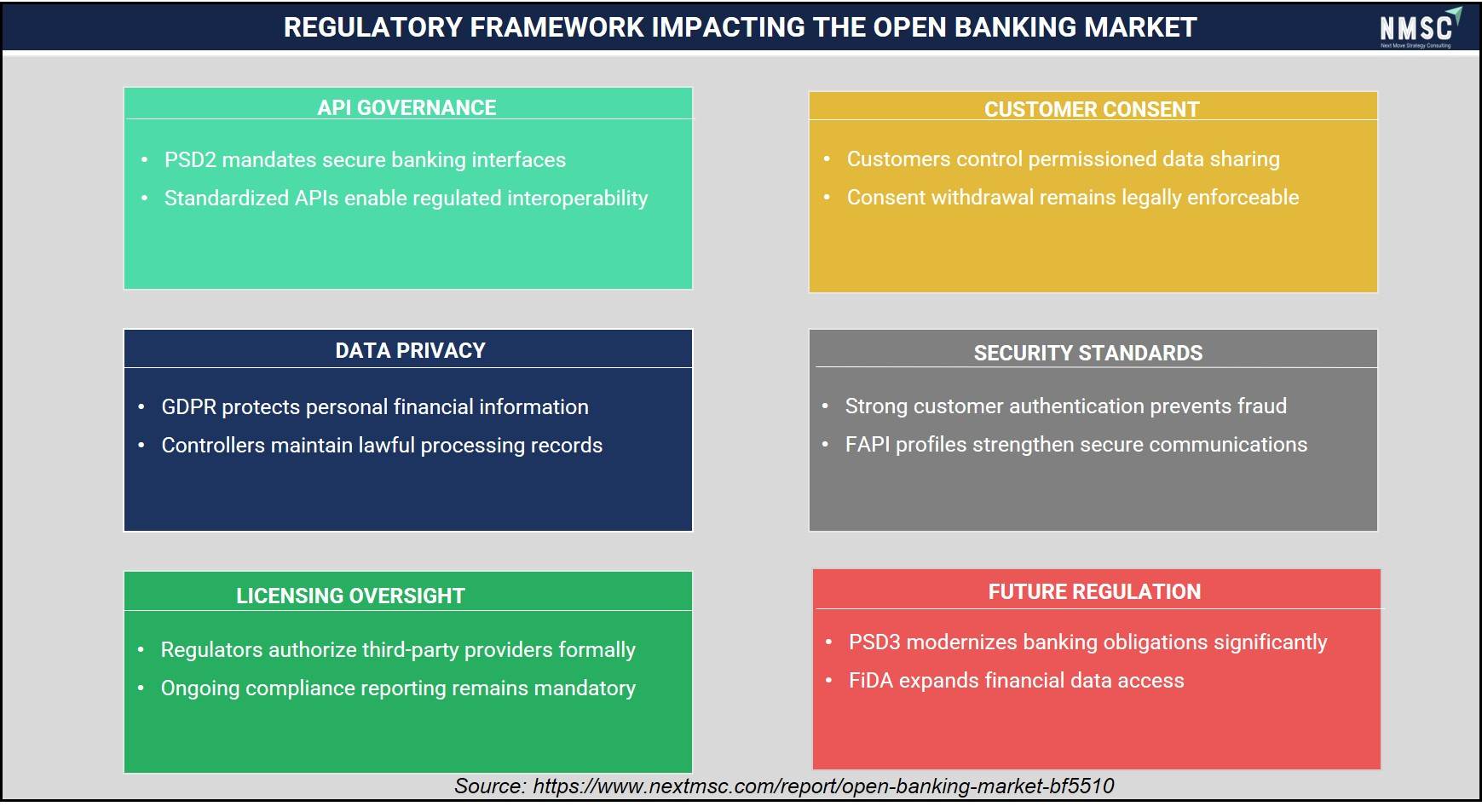
The above infographic presents a regulatory framework impacting the open banking market, where PSD2 and standardized APIs mandate secure banking interfaces and regulated interoperability. At the same time, GDPR safeguards personal financial information, and customers retain control over permissioned data sharing with legally enforceable consent withdrawal. Security is reinforced through strong customer authentication and FAPI profiles, while regulators authorize third-party providers and enforce ongoing compliance reporting. Looking ahead, we observed that PSD3 and FiDA are set to modernize banking obligations and further expand financial data access across the market.
Competitive Landscape
We observed that the Open Banking Market features a moderately fragmented competitive landscape, with global card networks competing alongside independent data aggregators and specialized regional API providers on institutional coverage depth.
|
Key Takeaways |
|
|
Market Structure |
Moderately fragmented; global card networks including Mastercard and Visa compete alongside independent aggregators such as Plaid, TrueLayer, and MX Technologies, while banking software vendors including Finastra and Temenos supply underlying core banking connectivity. |
|
Innovation Focus |
Account-to-account payment rails, AI-enabled data personalization, and FDX-aligned compliance infrastructure dominate current innovation pipelines across leading providers. |
|
M&A Activity |
Selective and strategically divergent, exemplified by Mastercard's continued investment following its 2020 Finicity acquisition contrasted with Visa's reported August 2025 pullback from standalone U.S. open banking operations under the Tink brand. |
How Do Companies Compete in the Open Banking Market?
Companies compete primarily on verified institutional coverage breadth, regulatory compliance depth, and payment initiation capability across the industry. Global card networks such as Mastercard leverage existing bank relationships to scale open banking connectivity quickly, while independent aggregators including Plaid and TrueLayer compete on developer experience and specialized regional depth in either U.S. or European markets.
Which Competitive Archetypes Dominate the Open Banking Market?
Two archetypes dominate the market: card network-backed platforms leveraging existing bank relationships for rapid multi-market scale, and independent, venture-backed aggregators competing on developer experience and API design quality. Mastercard exemplifies the card network archetype through its acquired Finicity and Aiia platforms, while Plaid and TrueLayer exemplify the independent aggregator archetype through developer-first API design and targeted regional depth.
How Are Companies Differentiating Through Innovation in Open Banking?
Innovation and differentiation strategy increasingly center on account-to-account payment capability and AI-enabled data insight layers. Mastercard's Connect Plus platform and Visa's A2A pay-by-bank solution both extend beyond basic data aggregation into payment initiation, while independent aggregators compete on identity verification accuracy and fraud protection layered on top of raw account data. Our analysis shows that providers unable to extend beyond basic account information services risk commoditization as data access itself becomes standardized.
What M&A and Expansion Activity Is Shaping the Open Banking Market?
Strategic activity is increasingly divergent rather than uniformly consolidative within the industry. Mastercard's continued platform investment following its 2020 Finicity and 2021 Aiia acquisitions contrasts with Visa's reported August 2025 discontinuation of standalone U.S. open banking operations under the Tink brand, illustrating differing card network conclusions about near-term U.S. monetization potential even as both continue pursuing international expansion.
Key Market Players
Our assessment indicates that the following 20 companies are actively shaping product innovation, institutional coverage expansion, and regulatory compliance strategy within the global Open Banking Market.
-
Mastercard Incorporated
-
Visa Inc.
-
Plaid Inc.
-
Envestnet, Inc.
-
TrueLayer Ltd.
-
Yapily Ltd.
-
Token.io
-
Finastra
-
Temenos AG
-
ACI Worldwide, Inc.
-
MX Technologies Inc.
-
Salt Edge Inc.
-
Akoya LLC
-
Belvo
-
Trustly Group AB
-
Klarna Group plc
-
Volt.io Limited
Latest Developments
We found that recent regulatory milestones and strategic developments within the Open Banking Market are concentrated on U.S. compliance standardization and diverging card network strategy, reflecting the industry's transitional phase.
|
Date |
Event |
|
July 2026 |
TrueLayer announced the acquisition of Zimpler to expand its European Pay by Bank network. The transaction strengthens the company's open banking payment capabilities and supports broader adoption of account-to-account payment solutions across European merchants and consumers. |
|
December 2025 |
Mastercard launched Open Finance Business Solutions in Australia to help SMEs leverage secure real-time financial data. The platform supports faster onboarding, smarter payments, improved lending, and automated financial insights using the country's Consumer Data Right framework. |
|
June 2025 |
Mastercard and Deutsche Bank announced a strategic partnership to accelerate open banking payments across Europe. The collaboration integrates Mastercard's open banking technology into Deutsche Bank's Merchant Solutions platform, enabling Pay by Bank, Request-to-Pay (R2P), faster account-to-account (A2A) payments, quicker settlement, and improved payment transparency for merchants. |
Expert Insights
 “Real-time access to business data and automation are critical for SMEs to save time and ultimately money. By reducing friction in onboarding, payments, business accounting and lending, we are helping businesses boost productivity and focus on what matters — serving their customers and growing sustainably. In a time when working smarter is more important than working harder, Open Finance is a key lever for economic efficiency and resilience.”
— Brenton Charnley, Vice President and Head of Open Finance, Australasia at Mastercard
Statement made during the launch of Mastercard's Open Finance Business Solutions in Australia.
Market Interpretation
The insight highlights the growing role of open finance and open banking in improving business efficiency through secure, consent-based data sharing. By enabling real-time access to financial data, organizations can streamline onboarding, payments, accounting, and lending processes while reducing operational friction. As adoption of API-driven financial ecosystems accelerates, Open Banking platforms are expected to support greater automation, enhance customer experiences, and drive innovation across digital financial services, particularly for SMEs.
Investment Opportunities
What Capital Inflows Are Targeting the Open Banking Market?
Capital inflows into the Open Banking Market are increasingly selective, favoring providers with validated regulatory compliance depth over broad, undifferentiated coverage claims. We observed that card networks continue committing platform investment despite diverging geographic strategies, with Mastercard maintaining and expanding its Finicity- and Aiia-based infrastructure while Visa redirects U.S. resources internationally. Investors increasingly favor providers demonstrating durable institutional relationships over rapid geographic expansion alone.
How Is Infrastructure Investment Supporting Open Banking API Standardization?
Infrastructure investment is expanding standardized API connectivity as the industry moves away from fragmented, proprietary integration methods. Our findings suggest that the Financial Data Exchange continues expanding its FDX API standard adoption among U.S. financial institutions following the CFPB's Section 1033 rule finalization, providing common technical infrastructure that reduces integration costs for aggregators and banks alike.
What ESG Considerations Are Shaping Open Banking Investment Decisions?
Environmental, social, and governance considerations in the Open Banking Market center primarily on financial inclusion and data governance rather than environmental factors. Expanding account information services support underbanked populations' access to credit through alternative data-based underwriting, aligning with broader financial inclusion objectives. We found that investors increasingly favor providers with transparent consent management and data governance practices as regulatory scrutiny of consumer data handling intensifies.
Key Benefits for Stakeholders
How Does This Report Benefit Enterprise and Industry Leaders?
Enterprise and industry leaders gain access to validated segmentation, competitive benchmarking, and regional demand forecasts that support sourcing and partnership decisions across the Open Banking industry. Our analysis shows that detailed service type, component, and end user breakdowns help banking and fintech teams align API vendor selection with regulatory compliance timelines and payment initiation capability requirements.
How Does This Report Benefit Investors and Financial Analysts?
Investors and financial analysts benefit from consistent, single-point market size and CAGR estimates that support valuation and capital-allocation decisions across the Open Banking supply chain. We observed that the report's regional and segment-level growth differentials help identify which providers and geographies are best positioned to capture above-market growth in payments and Asia-Pacific categories through 2035.
How Does This Report Benefit Technology Vendors and Product Teams?
Technology vendors and product teams gain insight into emerging design requirements, including FDX-aligned API architecture, account-to-account payment rails, and AI-enabled data personalization, that are reshaping the industry. Our findings suggest that this analysis helps R&D teams prioritize development roadmaps around regulatory compliance depth increasingly required by bank and fintech procurement processes.
Key Market Segments
By Service Type
-
Banking and Capital Markets
-
Payments
-
Digital Currencies
-
Value Added Services
-
Other Services
By Component
-
APIs
-
Account and Payment APIs
-
Data Enrichment APIs
-
Identity Verification APIs
-
Services
-
Professional Services
-
Managed Services
By Deployment Mode
-
Cloud
-
On-Premise
-
Hybrid
By Distribution Channel
-
Bank Channel
-
Fintech Channel
-
Enterprise Channel
By End User
-
Banks and Traditional Financial Institutions
-
Fintech and Third-Party Developers
-
Enterprises
-
Other End Users
By Region
-
North America: U.S., Canada, Mexico
-
Europe: UK, Germany, France, Italy, Spain, Sweden, Denmark, Finland, Netherlands, Rest of Europe
-
Asia-Pacific: China, India, Japan, South Korea, Taiwan, Indonesia, Vietnam, Australia, Philippines, Malaysia, Rest of APAC
-
Middle East & Africa: Saudi Arabia, UAE, Egypt, Israel, Turkey, Nigeria, South Africa, Rest of MEA
-
Latin America: Brazil, Argentina, Chile, Colombia, Rest of LATAM
Conclusion and Recommendations
What Is the Long-Term Outlook for the Open Banking Market?
The long-term outlook for the market remains strongly positive, with global revenue projected to expand more than sevenfold from USD 27.85 Billion in 2025 to USD 217.20 Billion by 2035 at a 22.8% CAGR. We observed that U.S. regulatory standardization, account-to-account payment adoption, and Asia-Pacific fintech lending growth will continue underpinning demand across Banking and Capital Markets and Payments service categories through the forecast period, even as individual card network strategies continue to diverge on geographic priorities.
What Strategic Positioning Should Open Banking Vendors Pursue?
Vendors should prioritize FDX-aligned compliance infrastructure and account-to-account payment capability to secure long-term bank and fintech contracts. Our assessment indicates that providers investing early in AI-enabled data personalization and durable, multi-market institutional relationships will be best positioned to capture premium pricing within the market as basic data access becomes increasingly commoditized.
How Attractive Is the Open Banking Market for New Investment?
The Open Banking industry presents a highly attractive investment case, supported by a USD 182.99 Billion absolute dollar opportunity between 2026 and 2035 and above-average growth in Asia-Pacific and Payments categories. We found that investment attractiveness is highest for providers combining validated regulatory compliance depth with durable institutional relationships, positioning them to withstand card network strategic shifts that have already reshaped competitive dynamics in the United States.
What Market Shifts and Key Risks Should Stakeholders Monitor?
Stakeholders should monitor rising data-access fee structures, diverging card network geographic strategies, and consumer data privacy concerns as key risks to the Open Banking Market. Our analysis shows that providers unable to secure durable institutional relationships risk exposure to strategic pullbacks similar to Visa's reported August 2025 discontinuation of standalone U.S. open banking operations, particularly as data-access economics continue evolving.
What Are the Key Growth Pathways for the Open Banking Market?
Key growth pathways include expanding account-to-account payment infrastructure, scaling FDX-aligned compliance platforms, and deepening penetration into Asia-Pacific fintech lending and Latin American open finance categories. NMSC's analysis indicates that vendors pursuing these pathways while maintaining durable, multi-market institutional relationships will be best positioned to capture the Open Banking Market's projected growth through 2035.
About the Author
 Mayurima Roy
— Mayurima Roy is Research Analyst at Next Move Strategy Consulting, where she has spent 4 years working across the firm's full industry coverage rather than a single fixed vertical. Her work centers on structured research, ongoing trend tracking, competitive assessment, and insight-led content development, translating complex market data into clear, decision-ready narratives that support informed client decision-making across diverse global industries, market sectors, and world regions every day.
Mayurima Roy
— Mayurima Roy is Research Analyst at Next Move Strategy Consulting, where she has spent 4 years working across the firm's full industry coverage rather than a single fixed vertical. Her work centers on structured research, ongoing trend tracking, competitive assessment, and insight-led content development, translating complex market data into clear, decision-ready narratives that support informed client decision-making across diverse global industries, market sectors, and world regions every day.
About the Reviewer
 Supradip Baul
— Supradip Baul is an accomplished business consultant and strategist with over a decade of rich experience in market intelligence, strategy, technology, and business transformation. His work has included rigorous qualitative and quantitative analysis across multiple industries, helping clients shape investment decisions and long-term roadmaps. Earlier in his career, he was associated with Gartner, where he contributed to industry-leading reports and market share analyses. He has worked with leading global companies and holds an MBA with a dual specialization in Marketing and Finance.
Supradip Baul
— Supradip Baul is an accomplished business consultant and strategist with over a decade of rich experience in market intelligence, strategy, technology, and business transformation. His work has included rigorous qualitative and quantitative analysis across multiple industries, helping clients shape investment decisions and long-term roadmaps. Earlier in his career, he was associated with Gartner, where he contributed to industry-leading reports and market share analyses. He has worked with leading global companies and holds an MBA with a dual specialization in Marketing and Finance.
At Next Move Strategy Consulting, we understand that insightful market research is the cornerstone of successful business decisions. That's why we employ a robust and multifaceted approach, combining various methodologies to deliver the most accurate and actionable data for our clients.

Research Landscape
We navigate the world of research with two primary approaches:
Qualitative Approach
Our qualitative research methodologies involve immersive techniques such as in-depth interviews, focus groups, and observational studies. By engaging directly with individuals and stakeholders, we uncover valuable insights that quantitative data alone may overlook.

Quantitative Research
In tandem with qualitative methodologies, NMSC leverages the power of Quantitative Research to provide a robust foundation of numerical insights. Through systematic data collection and analysis, we quantify patterns, preferences, and market trends, offering a comprehensive view of the business landscape.
Our quantitative research approach employs diverse tools, including surveys, experiments, and statistical modelling. These methodologies enable us to gather data from a large and representative sample, ensuring the statistical significance of our findings. By employing structured questionnaires and standardized data collection methods, we guarantee the reliability and validity of the information we present to our clients.
Quantitative research is particularly effective in measuring the prevalence of trends, assessing market size, and gauging the impact of various factors on consumer behavior. The numerical precision attained through this approach equips our clients with actionable insights, facilitating data-driven decision-making and strategy formulation.


Our Specialized Toolbox for Industry-Specific Market Research
We deploy a specialized arsenal of techniques tailored to meet your unique requirements. Here's a glimpse into our comprehensive toolbox:

Information Procurement
The stage entails acquiring market data or relevant information through various sources and methodologies.


Market Research Approach
We utilize both top-down and bottom-up approaches in market research analysis to achieve a comprehensive understanding of the market dynamics, leveraging the broad perspective of industry trends and macroeconomic factors alongside detailed insights from specific segments and individual companies.

Porters Five Forces Analysis
We conduct Porter's Five Forces analysis to evaluate the competitive landscape of an industry, providing us with insights into factors that affect profitability and strategic positioning.

SWOT Analysis

Forecasting
We utilize a forecasting model to predict future consumption by considering parameters like population, economics, regulations, market competition, drivers, constraints, technology, and pricing. We also employ statistical techniques such as multilinear regression, exponential smoothing, moving average, ARIMA, and Monte Carlo simulations for accurate predictions. In econometric forecasting, we analyzed short-term and long-term event impacts, attributing values based on regulatory frameworks, economic factors, and market events.





 Speak to Our Analyst