Top-Rated Shops for Premium Sanitary Processing Equipment
A supplier can put “sanitary” on every page of its catalog, but that word alone proves nothing. What actually protects a food, dairy, beverage, or pharmaceutical plantand a hospital sterile processing department, for that matteris documented compliance with standards like 3-A, ASME BPE, and FDA cGMP, not a label. That distinction sits at the center of the Clean-in-Place (CIP) Systems Market, where 2026 has brought a wave of digital product launches, billion-dollar acquisitions, and capacity investments across the suppliers that make automated, validated cleaning possible.
This piece looks at what has actually changed: the size and trajectory of the market itself, the material moves from twenty of its largest suppliers over the past several months, and the verified data behind why validated cleaning keeps getting more scrutiny, not less.
Clean-in-Place (CIP) Systems Market Snapshot: Size, Forecast, and Growth Drivers
The global Clean-in-Place (CIP) Systems Market was valued at USD 8.6 billion in 2025 and is estimated at USD 9.0 billion in 2026, forecast to reach USD 13.9 billion by 2035 at a CAGR of 5.0%. Growth is concentrated around tightening sterilization and contamination-control regulation, rising adoption of automated and digitally documented CIP cycles, expanding biopharmaceutical manufacturing capacity, and growing infection-prevention investment across healthcare systems. High capital requirements for fully validated CIP installations, and the partial displacement of upstream cleaning cycles by single-use bioprocessing technology, remain the market's clearest restraints.
CIP Systems Market Snapshot, 2026–2035
|
Parameter |
Detail |
|
Market Size, 2026 |
USD 9.0 billion |
|
Revenue Forecast, 2035 |
USD 13.9 billion |
|
Growth Rate |
CAGR of 5.0% from 2026 to 2035 |
|
Base Year |
2025 (USD 8.6 billion) |
|
Forecast Period |
2026–2035 |
|
Companies Profiled |
20 |
|
Countries Covered |
33 |
Section summary: the market's growth case rests on regulatory and compliance pressure that keeps mounting across both industrial processing and healthcare settings.
-
USD 9.0B (2026) → USD 13.9B (2035) at a 5.0% CAGR
-
GMP compliance, infection-prevention mandates, and biopharma capacity growth are the primary drivers
-
High capital costs and single-use bioprocessing adoption are the clearest restraints
Current Trends Reshaping the CIP Systems Market
The clearest theme across this year's product launches is software layering on top of existing hardware. Ecolab introduced Ecolab CIP IQ, an AI-enhanced digital platform that gives food and beverage plants real-time wash-conformance scoring and exception alerts; in a Kraft Heinz deployment, the tool reportedly cut wash time by 2,041 hours, saving roughly $204,100. GEA Group and Ecolab have also introduced cloud-connected CIP solutions that transmit conductivity, temperature, and chemical-concentration data to centralized platforms, supporting the generation and management of electronic process records where applicable. These digital systems can be designed to support the data integrity, validation, audit-trail, and access controls relevant to FDA 21 CFR Part 11 and EU GMP Annex 11 when regulated records are maintained electronically.
Alfa Laval took a more mechanical approach in June, launching Controlled Rotating Retractors that clean hard-to-reach surfaces inside hygienic spray-drying vessels without breaching the sealed processing environmenta design built to satisfy EHEDG and 3-A cleanability criteria. Bürkert, recognized as GEA's 2025 “Supplier of the Year,” has extended its low-flow control technology into purified-water and water-for-injection sub-loops, a pharmaceutical application where biofilm risk is a persistent challenge.
For engineering and procurement teams sourcing standard hygienic components rather than a full custom build, distributor-fabricators that combine certified in-house welding with online component ordering have become a middle path between big-supplier lead times and one-off local fabrication.
Section summary: digital documentation and mechanical hygienic design are advancing together, both aimed at the same underlying goalproving a cleaning cycle actually worked.
-
Ecolab's CIP IQ platform delivered a documented 2,041-hour wash-time saving at a single Kraft Heinz plant
-
GEA and Ecolab are advancing cloud-connected CIP systems that can support electronic process records and the data-integrity controls relevant to FDA 21 CFR Part 11 and EU GMP Annex 11, where applicable.
-
Alfa Laval and Bürkert are targeting the hardest-to-validate surfaces: spray-drying vessels and WFI sub-loops
Industry Impact: Consolidation Reshapes Equipment Supply
2026 has also been a year of major ownership change among CIP-adjacent equipment makers. SPX FLOW, whose APV and Waukesha Cherry-Burrell brands supply hygienic pumps, valves, and heat exchangers, was acquired by ITT Inc. for $4.775 billion in a deal that closed in March, joining ITT's Industrial Process segment. Donaldson, a filtration and contamination-control supplier, agreed to be acquired by Filtration Group, though the transaction value was not disclosed. Veolia bought out CDPQ's remaining 30% stake in its Water Technologies and Solutions unit for $1.75 billion, taking full ownership of a business central to CIP-adjacent water treatment. Pentair acquired pump maker Taco Group for $1.4 billion even as its own second-quarter sales fell 17% amid a broader water-technology demand slowdowna reminder that consolidation and organic softness are running side by side across the sector.
As outsourced reprocessing and validated cleaning increasingly get bundled with equipment sales, that consolidation is also reshaping demand for the broader sterilization services market that CIP equipment feeds into.
Recent Strategic Developments Among Key CIP Systems Companies
|
Company |
Most Recent Material Move |
Date |
Source |
|
Ecolab |
Launched Ecolab CIP IQ, an AI-enhanced digital CIP platform for food and beverage manufacturers, with a Kraft Heinz deployment saving 2,041 wash hours. |
Sept. 2025 |
ecolab.com; Food Business News |
|
GEA Group |
Posted record Q2 margins (17.4% EBITDA) and order intake growth of 14.2%; announced a €500M buyback and acquired water-tech firm Hydract. |
Aug. 2026 |
GEA Group Q2 2026 results |
|
Alfa Laval |
Launched Controlled Rotating Retractors for hygienic spray-drying lines and a new Food & Pharma Division, both aimed at hard-to-clean processing surfaces. |
June 2026 |
Alfa Laval; Food Process & Packaging Automation |
|
SPX FLOW |
Acquired by ITT Inc. for $4.775 billion, joining ITT's Industrial Process segment alongside its APV and Waukesha Cherry-Burrell hygienic brands. |
March 2026 |
ITT; Pumps & Systems |
|
Tetra Pak |
Invested €60M in a Lund, Sweden pilot plant for paper-based aseptic carton barriers that reduce reliance on aluminum foil layers. |
Jan. 2026 |
Tetra Pak; Packaging Strategies |
|
Krones |
Reported H1 order intake up 4.5% to €2.85B; is opening new plant capacity in India (Q3) and China (Q4) to meet Asia demand. |
July 2026 |
Krones H1 2026 results |
|
Sidel |
Introduced the Cermex RoboSELEX robotic case-packing system at Interpack 2026, extending its hygienic packaging line portfolio. |
March 2026 |
Sidel; FoodInfoTech |
|
Inoxpa |
Continued expansion of its hygienic valve, pump, and fitting range for food, dairy, and pharmaceutical processing customers across its European plants. |
2026 |
inoxpa.com |
|
Pierre Guérin |
Continued supplying hygienic mixing and process vessels for pharmaceutical and biotech manufacturers as part of the Fristam Group. |
2026 |
pierreguerin.com |
|
STERIS |
Reported record FY26 revenue of $5.9B (+9%), approved a $1B buyback, and committed $600M to a new chemistries manufacturing center in North Carolina. |
Aug 5, 2026 |
STERIS FY2026 results |
|
Veolia |
Completed full ownership of its Water Technologies and Solutions unit, buying out CDPQ's remaining stake for $1.75 billion. |
2025–2026 |
veolia.com |
|
KHS |
Broke ground on a dedicated new production hall in Hamburg for its InnoPET FreshSafe barrier technology after demand quadrupled in five years. |
May 2026 |
Asia Food Journal |
|
Pentair |
Acquired pump maker Taco Group for $1.4 billion, though Q2 2026 sales fell 17% amid a broader water-technology demand slowdown. |
2026 |
Pentair; Yahoo Finance |
|
Donaldson |
Agreed to be acquired by Filtration Group, expanding the buyer's contamination-control and filtration portfolio. |
Feb. 2026 |
SignalBase M&A tracker |
|
Fristam Pumpen |
Continued supplying positive displacement and centrifugal hygienic pumps for dairy, food, and pharmaceutical CIP circuits globally. |
2026 |
fristam.com |
|
Bürkert |
Won GEA's “Supplier of the Year” award and introduced hygienic flow-control technology for purified-water and WFI pharmaceutical sub-loops. |
Nov. 2025–2026 |
Bürkert press releases |
|
Paul Mueller Company |
Continued manufacturing stainless steel CIP-compatible tanks and process systems for dairy and pharmaceutical customers from its Missouri plant. |
2026 |
paulmueller.com |
|
Sani-Matic |
Continued expanding SaniTrend Cloud, its SaaS platform automating CIP cycle documentation for FSMA compliance, across food and pharma customers. |
2026 |
sanimatic.com |
|
Central States Industrial |
Continued combining certified in-house fabrication with online distribution of sanitary components from its Springfield, MO facilities. |
2026 |
csidesigns.com |
|
AxFlow Holding |
Continued distributing hygienic pumps, valves, and fluid-handling equipment across its European distribution network. |
2026 |
axflow.com |
Section summary: scale is increasingly coming through acquisition rather than organic build-out, even as demand growth itself stays uneven.
-
SPX FLOW's $4.775B sale to ITT and Veolia's $1.75B WTS buyout were the two largest deals of the year
-
Donaldson's sale to Filtration Group extends the buyer's contamination-control reach
-
Not all organic demand is keeping pace: Pentair's water-technology sales fell 17% even while it kept acquiring
Competitive Landscape: From Global Platforms to Regional Specialists
Capacity investment is concentrated where demand is growing fastest. Krones reported first-half order intake up 4.5% to €2.85 billion and is opening new plant capacity in India and China to meet Asia-Pacific demand, while KHS broke ground on a dedicated new production hall in Hamburg for its InnoPET FreshSafe barrier technology after demand for the line quadrupled over five years. Sidel used Interpack 2026 to introduce the Cermex RoboSELEX robotic case packer, extending automation further into hygienic secondary packaging. Tetra Pak continued its own €60 million investment in paper-based aseptic carton barriers, part of a broader industry shift toward reducing aluminum content in hygienic packaging.
Below the largest platforms, a tier of specialistsInoxpa, Pierre Guérin, Fristam Pumpen, Paul Mueller Company, AxFlow, Sani-Matic, and Central States Industrial continue to supply the hygienic valves, pumps, tanks, and CIP skids that the larger platforms don't always reach, typically through deeper regional service relationships rather than global scale. Sani-Matic's SaniTrend Cloud platform, for instance, brings the same kind of automated cycle documentation that Ecolab and GEA are building at enterprise scale to mid-sized food and pharmaceutical plants.
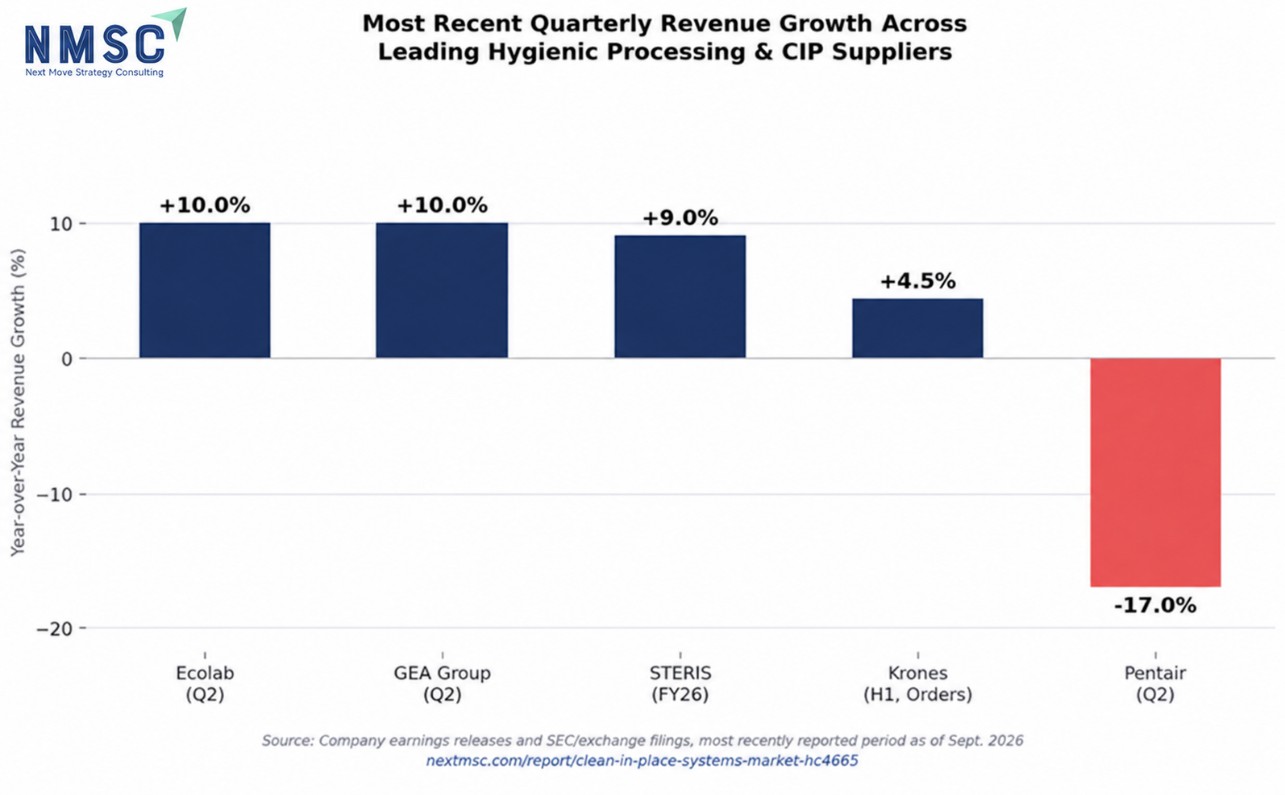
Section summary: the largest suppliers are growing through a mix of digital differentiation and acquisition, while regional specialists compete on service depth and faster response times.
-
Ecolab and GEA Group posted approximately 9.7% and 10.0% year-over-year total revenue growth, respectively, in their most recent quarters, while STERIS reported 7.0% total revenue growth.
-
Krones, KHS, and Sidel are all investing in new capacity or automation ahead of demand
-
Regional specialists remain essential for mid-sized plants that need fast parts access and local technical support
Healthcare Sterile Processing: Why Reprocessing Compliance Keeps Growing
Dairy CIP systems and hospital sterile processing both rely on validated cleaning, but their cleaning methods, chemistries, validation procedures, and target contaminants differ. A 2023 CDC point-prevalence survey across 218 U.S. acute care hospitals found that 2.6% of patients had at least one healthcare-associated infection on their survey day, and identified where those infections actually occur:
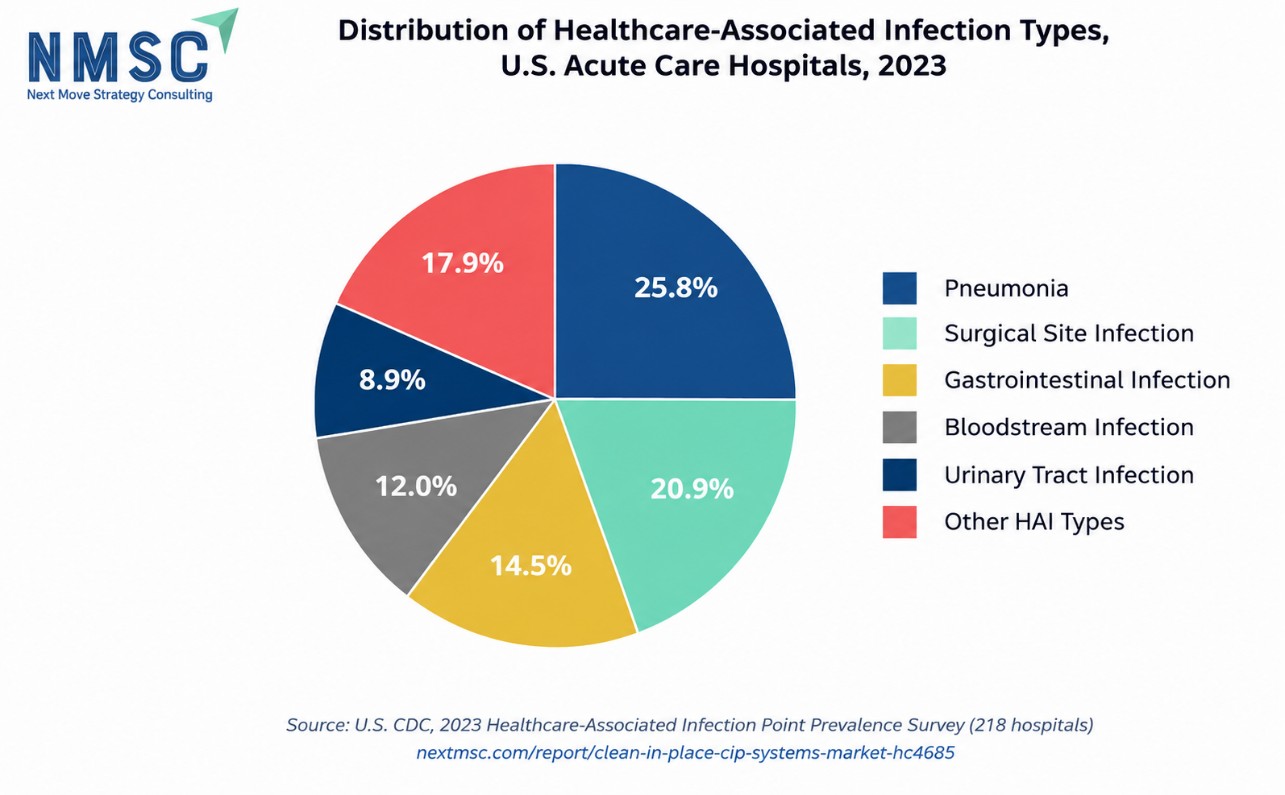
Surgical site infections and device-associated infections together account for a substantial share of that total, which is exactly why endoscopy device reprocessing and UV disinfection equipment have become such active investment categories for hospital sterile services departments. STERIS, which reported record fiscal 2026 revenue of $5.9 billion and committed $600 million to a new chemistries manufacturing center in North Carolina, sits squarely at that intersection of industrial-grade validated cleaning and hospital-grade sterility assurance.
Section summary: healthcare reprocessing and industrial CIP are converging on the same compliance logic, which is widening the addressable market for suppliers that can serve both.
-
2.6% of U.S. hospital patients had a healthcare-associated infection on a given survey day in 2023
-
Pneumonia and surgical site infections together account for nearly half of documented HAI types
-
STERIS's $600M North Carolina investment reflects the scale of demand for validated cleaning chemistries
Future Outlook: CIP Systems Market Heads Toward Full Digital Compliance
With the market forecast to grow from USD 9.0 billion in 2026 to USD 13.9 billion by 2035, the next phase looks less like new hardware categories and more like a documentation upgrade cycle. Software that ties CIP cycle data, biological indicator results, and sterile release decisions into a single audit-ready recordthe approach Ecolab, GEA, and Sani-Matic are all building towardis likely to become a standard purchasing requirement rather than a differentiator. Expect further consolidation among mid-sized equipment makers that lack the balance sheet to build both validated hardware and compliant software in-house, following the pattern already set by SPX FLOW's sale to ITT and Donaldson's sale to Filtration Group.
Section summary: expect digital validation to move from competitive advantage to baseline requirement, accelerating consolidation among suppliers that can't keep pace on software.
-
Market forecast to reach USD 13.9B by 2035 at a 5.0% CAGR
-
Electronic batch records and cloud-based cycle documentation are moving from differentiator to requirement
-
Further M&A is likely among mid-sized suppliers without in-house software capability
Conclusion
The Clean-in-Place (CIP) systems market's next chapter will be written by whichever suppliers can prove their cleaning cycles work, not just claim it. For a full breakdown of market sizing, segmentation, and vendor share, Download Free Sample of the complete Next Move Strategy Consulting report.
About the Author
 Sanyukta Deb
— Sanyukta Deb is Digital Marketing Team Lead at Next Move Strategy Consulting, where she has led content strategy and technical SEO for the firm's B2B market research publications for over 2 years. Her editorial process translates NextMSC's primary and secondary research — spanning technology, industrial, and consumer sectors — into commercial narratives, backed by search-intent, keyword, and competitive analysis. She brings 5 years of overall experience in digital marketing and content strategy.
Sanyukta Deb
— Sanyukta Deb is Digital Marketing Team Lead at Next Move Strategy Consulting, where she has led content strategy and technical SEO for the firm's B2B market research publications for over 2 years. Her editorial process translates NextMSC's primary and secondary research — spanning technology, industrial, and consumer sectors — into commercial narratives, backed by search-intent, keyword, and competitive analysis. She brings 5 years of overall experience in digital marketing and content strategy.
About the Reviewer
 Debashree Dey
— Debashree Dey is Assistant Manager at Next Move Strategy Consulting, where she supports cross-vertical market content and communications across diverse industries for 6 years. Her professional background includes senior content writing, communications, and published manuscript authorship, with experience developing audience-focused business narratives and maintaining clear, consistent messaging. Her role supports research-led content development and editorial quality across NextMSC publications.
Debashree Dey
— Debashree Dey is Assistant Manager at Next Move Strategy Consulting, where she supports cross-vertical market content and communications across diverse industries for 6 years. Her professional background includes senior content writing, communications, and published manuscript authorship, with experience developing audience-focused business narratives and maintaining clear, consistent messaging. Her role supports research-led content development and editorial quality across NextMSC publications.















Add Comment