Clean-in-Place (CIP) Systems Market Size, Share, Growth & Forecast by Offering (Cleaning Equipment, Consumables, Inspection and Monitoring, Packaging and Storage, Sterilization and Assurance, Software, Services), End User (Hospitals and ASCs, Dental and Specialty Clinics, Medical Device Manufacturers, Pharma and Biotech, Laboratories and Research), Channel (Direct Sales, Distributors and Dealers, E-commerce) — Global Analysis 2026–2035
Industry: Healthcare | Publishing Date: June 16, 2026 | Last Updated: September 10, 2026 | No of Pages: N/A | No. of Tables: N/A | No. of Figures: N/A | Format: PDF | Report Code: HC4685
What Is the Clean-in-Place (CIP) Systems Market Size?
The global Clean-in-Place (CIP) Systems Market was valued at USD 8.6 billion in 2025 and is projected to reach USD 9.0 billion in 2026. Sustained demand for hygienic processing in pharmaceutical manufacturing, food and beverage production, and healthcare facilities is expected to propel the market to USD 13.9 billion by 2035, advancing at a CAGR of 5.0% from 2026 to 2035. Key growth drivers include tightening regulatory frameworks governing sterilization and contamination control, rising adoption of automated and digital CIP solutions, expanding pharmaceutical bioproduction capacity, and growing emphasis on infection prevention across healthcare settings globally.
|
Parameters |
Details |
|
Market Size in 2025 |
USD 8.6 Billion |
|
Market Size in 2026 |
USD 9.0 Billion |
|
Revenue Forecast in 2035 |
USD 13.9 Billion |
|
Growth Rate |
CAGR of 5.0% from 2026 to 2035 |
|
Analysis Period |
2025–2035 |
|
Base Year Considered |
2025 |
|
Forecast Period |
2026–2035 |
|
Market Size Estimation |
Billion USD |
|
Companies Profiled |
20 |
|
Countries Covered |
33 |
|
Market Share |
Top 10 |
Clean-in-Place (CIP) Systems Market Overview
What Is the Clean-in-Place (CIP) Systems Market?
The Clean-in-Place (CIP) Systems Market encompasses the full spectrum of equipment, consumables, inspection and monitoring tools, packaging and storage solutions, sterilization and assurance technologies, software, and professional services deployed to clean and sterilize processing equipment without disassembly. NMSC's analysis indicates that CIP systems are foundational to hygienic operations across pharmaceutical, food and beverage, dairy, biotech, and healthcare sectors. The market supports compliance with globally recognized sanitation and contamination control standards by automating repeatable, validated cleaning cycles across fixed processing assets.
How Has the Clean-in-Place (CIP) Systems Market Evolved?
The Clean-in-Place (CIP) Systems Market has undergone significant structural transformation over the past two decades. Initial deployments focused on mechanical and chemical cleaning of dairy and beverage pipelines using manually programmed sequence controllers. From our research, we found that the market subsequently evolved to incorporate programmable logic controllers (PLCs), conductivity sensors, and automated chemical dosing systems enabling greater process control and documentation. The current phase is characterized by the integration of Industry 4.0 technologies, including IoT-connected sensors, digital twin validation, and cloud-based workflow management software, elevating CIP from a reactive operational function to a proactively managed compliance asset.
How Do Regulations Influence the Clean-in-Place (CIP) Systems Market?
Regulatory frameworks have become a primary structural driver of the Clean-in-Place (CIP) Systems Market. The U.S. Food and Drug Administration's Current Good Manufacturing Practice (cGMP) regulations, the European Medicines Agency's GMP guidelines, and international standards including ISO 15883 for washer disinfectors and ISO 13485 for medical devices mandate validated and documented cleaning and sterilization processes. Based on our market evaluation, we noticed that compliance requirements are compelling pharmaceutical manufacturers, medical device companies, and food processors to invest in digitally traceable CIP solutions with integrated qualification documentation and electronic batch records.
How Is Technology Adoption Expanding Across the Clean-in-Place (CIP) Systems Market?
Technology adoption across the Clean-in-Place (CIP) Systems Market is accelerating as manufacturers and healthcare facilities adopt automated, connected, and data-driven cleaning architectures. Through our assessment, we found that demand for instrument tracking software, workflow management platforms, and quality and compliance software is rising sharply as organizations seek to replace paper-based validation records with electronic systems. Simultaneously, advances in low-temperature sterilization and ethylene oxide alternatives are expanding application ranges. The convergence of automation, digitalization, and regulatory compliance is redefining CIP system procurement from a capital expenditure decision to a strategic operational investment.
|
Key Takeaways |
|
By Offering, the Sterilization and Assurance segment held the largest share of the Clean-in-Place (CIP) Systems Market, generating approximately USD 2.8 billion in 2025, driven by rigorous sterilization validation requirements across pharmaceutical manufacturing and hospital central sterile services departments. The Software segment is the fastest-growing sub-segment within the global market, projected to expand at a CAGR of 8.2% from 2026 to 2035, fueled by adoption of instrument tracking, workflow management, and quality and compliance software across healthcare and pharmaceutical facilities. |
|
By End User, Hospitals and Ambulatory Surgery Centers (ASCs) accounted for the largest revenue share at approximately USD 2.9 billion in 2025, reflecting the high volume of surgical instruments, endoscopes, and reusable medical devices requiring daily validated reprocessing cycles. Pharma and Biotech is the fastest-growing end user segment in the Clean-in-Place (CIP) Systems Market at a CAGR of 6.4% from 2026 to 2035, driven by rapid expansion of biologics manufacturing capacity, mRNA vaccine production, and cell and gene therapy processing facilities. |
|
By Channel, Direct Sales held the dominant position in the Clean-in-Place (CIP) Systems Market at approximately USD 5.2 billion in 2025, as large healthcare institutions and pharmaceutical manufacturers prefer vendor-managed relationships for complex system integration, validation support, and long-term service contracts. E-commerce is the fastest-growing distribution channel in the global market at a CAGR of 8.2% from 2026 to 2035, as consumable replenishment categories including biological indicators, chemical indicators, sterilization wrap, and pouches and reels migrate to digital procurement platforms. |
|
North America held the largest regional share at USD 3.4 billion in 2025, projected to reach USD 5.39 billion by 2035, anchored by the highest concentration of pharmaceutical manufacturing sites, hospital systems with central sterile services departments, and the most stringent regulatory enforcement environment globally. |
|
Asia-Pacific is the fastest-growing major region in the Clean-in-Place (CIP) Systems Market at a CAGR of 6.2% from 2026 to 2035, driven by healthcare infrastructure expansion in China, India, and Southeast Asia, combined with pharmaceutical manufacturing capacity growth and rising compliance with international GMP standards. |
|
The United States is the single largest country market in the Clean-in-Place (CIP) Systems Market, representing over 75% of North American revenue in 2025, underpinned by the world's highest concentration of FDA-regulated pharmaceutical and medical device manufacturing sites. |
|
India is the fastest-growing national market in Asia-Pacific within the Clean-in-Place (CIP) Systems Market at a CAGR of 8.4% from 2026 to 2035, propelled by rapid expansion of pharmaceutical manufacturing capacity, growing medical tourism-driven hospital construction, and strengthened Central Drugs Standard Control Organisation (CDSCO) enforcement. |
Key Emerging Trends in the Clean-in-Place (CIP) Systems Market
How Is the Integration of IoT and Digital Connectivity Transforming Clean-in-Place (CIP) Systems?
IoT-enabled CIP systems are fundamentally reshaping the Clean-in-Place (CIP) Systems Market by embedding real-time monitoring, predictive maintenance, and automated process documentation into cleaning cycles. Based on NMSC's research, we found that manufacturers such as Ecolab and GEA Group have introduced cloud-connected CIP skids that transmit conductivity, temperature, flow rate, and chemical concentration data to centralized control platforms. This connectivity enables pharmaceutical and dairy manufacturers to generate automated electronic batch records, reducing manual documentation burden while improving regulatory compliance traceability under FDA 21 CFR Part 11 and EU Annex 11 frameworks.
What Role Is Single-Use and Disposable Technology Playing in Reshaping CIP System Demand?
The growing adoption of single-use bioprocessing technologies is creating a bifurcated demand dynamic within the Clean-in-Place (CIP) Systems Market. Through NMSC's assessment, we found that while single-use bioreactors, bags, and tubing reduce CIP cycle frequency in upstream bioprocessing, they simultaneously increase demand for CIP validation services for hybrid facilities where stainless steel and single-use systems coexist. Additionally, endoscope reprocessing and surgical instrument reprocessing in healthcare settings represent structurally resilient CIP demand categories unaffected by single-use trends, maintaining consistent volume growth for washer disinfectors and ultrasonic cleaners.
How Is Regulatory Tightening Around Endoscope Reprocessing Driving Clean-in-Place (CIP) Market Growth?
Endoscope reprocessing standards are among the most actively regulated segments within the Clean-in-Place (CIP) Systems Market, following several high-profile infection outbreaks linked to inadequate flexible endoscope cleaning. Our assessment indicates that the U.S. Centers for Disease Control and Prevention (CDC) and ANSI/AAMI ST91 guidelines have substantially elevated performance requirements for automated endoscope reprocessors (AERs), creating replacement cycles for legacy equipment. European standard EN ISO 15883-4 similarly mandates comprehensive validation of washer disinfectors used for endoscope reprocessing, driving investment in compliant equipment across hospital endoscopy units across Europe and Asia-Pacific.
How Is the Transition Toward Environmentally Sustainable CIP Chemistry Influencing the Clean-in-Place (CIP) Systems Market?
Environmental sustainability is emerging as a measurable design and procurement criterion within the Clean-in-Place (CIP) Systems Market, particularly in the food and beverage and dairy sectors. Our findings suggest that pressure from regulatory bodies, including the European Union's Green Deal and national waste water regulations, is compelling manufacturers to adopt enzyme-based and biodegradable cleaning formulations that reduce chemical oxygen demand (COD) in effluent streams. STERIS and Ecolab have both introduced low-phosphorus and concentrated enzymatic cleaner formulations designed to reduce water and chemical consumption per CIP cycle without compromising cleaning efficacy.
What Are the Key Market Drivers, Breakthroughs, and Investment Opportunities that Will Shape the Clean-in-Place (CIP) Systems Market in the Next Decade?
|
Drivers / Trends / Restraints |
(+/-) % Impact on CAGR Forecast |
Geographic Relevance |
Impact Timeline |
|
Pharmaceutical GMP Regulatory Compliance Demand |
+1.2% |
Global (led by North America, Europe) |
2025–2035 |
|
Healthcare-Associated Infection (HAI) Prevention Initiatives |
+0.9% |
North America, Europe, Asia-Pacific |
2025–2030 |
|
Expansion of Biopharmaceutical Manufacturing Capacity |
+0.8% |
North America, Asia-Pacific, Europe |
2025–2035 |
|
Digitalization of Sterile Processing Departments |
+0.7% |
North America, Europe |
2026–2035 |
|
Endoscope Reprocessing Regulatory Tightening |
+0.6% |
North America, Europe, Australia |
2025–2030 |
|
High Capital Investment Requirements for CIP Automation |
-0.6% |
SMBs globally, emerging markets |
2025–2028 |
|
Single-Use Technology Displacing Reusable Bioprocessing Assets |
-0.4% |
North America, Europe |
2025–2032 |
|
ESG-Driven Sustainable Chemistry Transition |
+0.5% |
Europe, North America |
2026–2035 |
|
Growth of Outsourced Reprocessing Services |
+0.4% |
North America, Europe |
2026–2035 |
|
Emerging Market Healthcare Infrastructure Expansion |
+0.7% |
Asia-Pacific, MEA, Latin America |
2026–2035 |
What Are the Growth Drivers of the Clean-in-Place (CIP) Systems Market?
How Is Global Pharmaceutical GMP Compliance Demand Driving Clean-in-Place (CIP) Systems Market Growth?
Pharmaceutical and biopharmaceutical manufacturers operating under Current Good Manufacturing Practice (cGMP) regulations are among the most significant demand drivers in the Clean-in-Place (CIP) Systems Market. Based on our market evaluation, we noticed that the U.S. FDA's 21st Century Pharmaceutical Quality initiative and the European Medicines Agency's Guidelines on GMP for Medicinal Products mandate validated cleaning procedures, documented chemical residue testing, and electronically traceable batch records for all shared manufacturing equipment. As global pharmaceutical production capacity expands, including dedicated facilities for mRNA vaccines, monoclonal antibodies, and cell therapies, the requirement for validated CIP cycles across processing equipment is structurally growing.
How Is the Imperative to Reduce Healthcare-Associated Infections (HAIs) Fueling Clean-in-Place (CIP) Market Expansion?
Healthcare-associated infections represent a significant public health burden that is structurally driving investment in reprocessing equipment within the Clean-in-Place (CIP) Systems Market. According to the U.S. CDC, approximately 1 in 31 hospital patients has at least one healthcare-associated infection on any given day in the United States, motivating hospital administrators and sterile services departments to invest in higher-performance washer disinfectors, ultrasonic cleaners, and steam sterilizers. The World Health Organization's (WHO) Global Action Plan on Infection Prevention and Control similarly establishes international benchmarks that compel healthcare systems worldwide to upgrade reprocessing infrastructure to meet current evidence-based standards.
How Is the Expansion of Biopharmaceutical Manufacturing Creating Structural Demand in the Clean-in-Place (CIP) Systems Market?
The global expansion of biopharmaceutical manufacturing capacity is generating sustained and growing demand across multiple segments of the Clean-in-Place (CIP) Systems Market. Our analysis shows that the U.S. Biomedical Advanced Research and Development Authority (BARDA) and the European Health Emergency Preparedness and Response Authority (HERA) have both committed multi-billion dollar investments in domestic biomanufacturing resilience following pandemic preparedness mandates. New bioreactor-scale facilities require comprehensive CIP and sterilization systems for fermenters, chromatography skids, filling lines, and cleanroom environments, creating capital expenditure cycles that benefit equipment, consumable, and validation service providers across the CIP ecosystem.
What Are the Growth Inhibitors of the Clean-in-Place (CIP) Systems Market?
How Do High Capital Investment Requirements Constrain Clean-in-Place (CIP) Systems Market Penetration Among Smaller Facilities?
The significant upfront capital requirements associated with fully automated CIP systems represent a structural constraint on market expansion, particularly among smaller pharmaceutical manufacturers, independent specialty clinics, and healthcare facilities in emerging markets. Based on our research, we found that validated CIP skid installations for pharmaceutical applications can require substantial investment inclusive of equipment procurement, installation qualification (IQ), operational qualification (OQ), and performance qualification (PQ) activities, extending payback periods for smaller buyers. The U.S. Small Business Administration has documented that capital intensity in regulated manufacturing environments disproportionately burdens smaller enterprises, limiting adoption timelines and compressing near-term market penetration rates.
How Is the Transition to Single-Use Bioprocessing Technologies Affecting Demand in the Clean-in-Place (CIP) Systems Market?
The accelerating adoption of single-use bioreactors, mixing systems, and fluid transfer assemblies in bioprocessing environments presents a near-term demand headwind for CIP equipment in upstream pharmaceutical manufacturing. Through our market assessment, we observed that the U.S. FDA's guidance documents on single-use technology in pharmaceutical manufacturing acknowledge the reduced cleaning validation burden associated with disposable process contact surfaces. As contract development and manufacturing organizations (CDMOs) increasingly adopt single-use platforms for clinical and commercial manufacturing, the addressable equipment base for CIP systems in upstream bioprocessing is partially constrained, though downstream processing, filling, and healthcare reprocessing applications maintain robust structural demand.
What Are the Growth Opportunities in the Clean-in-Place (CIP) Systems Market?
How Does the Digitalization of Sterile Processing Departments Create a Multi-Segment Opportunity in the Clean-in-Place (CIP) Systems Market?
The digitalization of hospital central sterile services departments (CSSDs) represents one of the most transformative growth opportunities within the Clean-in-Place (CIP) Systems Market. Our findings suggest that the U.S. Joint Commission's accreditation standards and the Association for the Advancement of Medical Instrumentation (AAMI) ST79 guidelines are compelling hospitals to replace paper-based tracking with electronic instrument tracking systems that log sterilization cycle parameters, biological indicator results, and load release decisions. This creates substantial demand for integrated software platforms including instrument tracking software, workflow management software, and quality and compliance software that overlay and enhance existing CIP and sterilization hardware investments.
How Do Growth in Outsourced Reprocessing Services Present New Revenue Opportunities in the CIP Market?
Outsourced reprocessing services represent a structurally growing segment within the Clean-in-Place (CIP) Systems Market as healthcare facilities, particularly smaller community hospitals and ambulatory surgery centers, seek to transfer operational complexity and compliance risk to specialized third-party service providers. According to evaluations aligned with U.S. Centers for Medicare and Medicaid Services (CMS) reimbursement policy developments, ambulatory surgery centers face increasing regulatory scrutiny of their reprocessing compliance without the staffing capacity of large hospital systems. This dynamic is creating demand for third-party reprocessing service providers who bring validated CIP systems, trained reprocessing technicians, and compliance documentation frameworks to smaller healthcare facility clients.
How Is Emerging Market Healthcare Infrastructure Investment Generating Long-Term Demand for Clean-in-Place (CIP) Systems?
Emerging market healthcare infrastructure investment programs are creating significant long-term demand opportunities for the Clean-in-Place (CIP) Systems Market, particularly across Asia-Pacific, the Middle East, and Africa. Based on NMSC's research, we found that the World Health Organization and World Bank have both tracked sustained increases in hospital bed capacity and healthcare facility construction across low- and middle-income countries. Saudi Arabia's Vision 2030 healthcare expansion program, India's Ayushman Bharat Health Infrastructure Mission, and China's 14th Five-Year Plan for Healthcare all target substantial increases in hospital capacity, creating durable demand for CIP equipment, consumables, and validation services in markets that are transitioning from basic to internationally compliant infection control standards.
Ecosystem Analysis of the Clean-in-Place (CIP) Systems Market
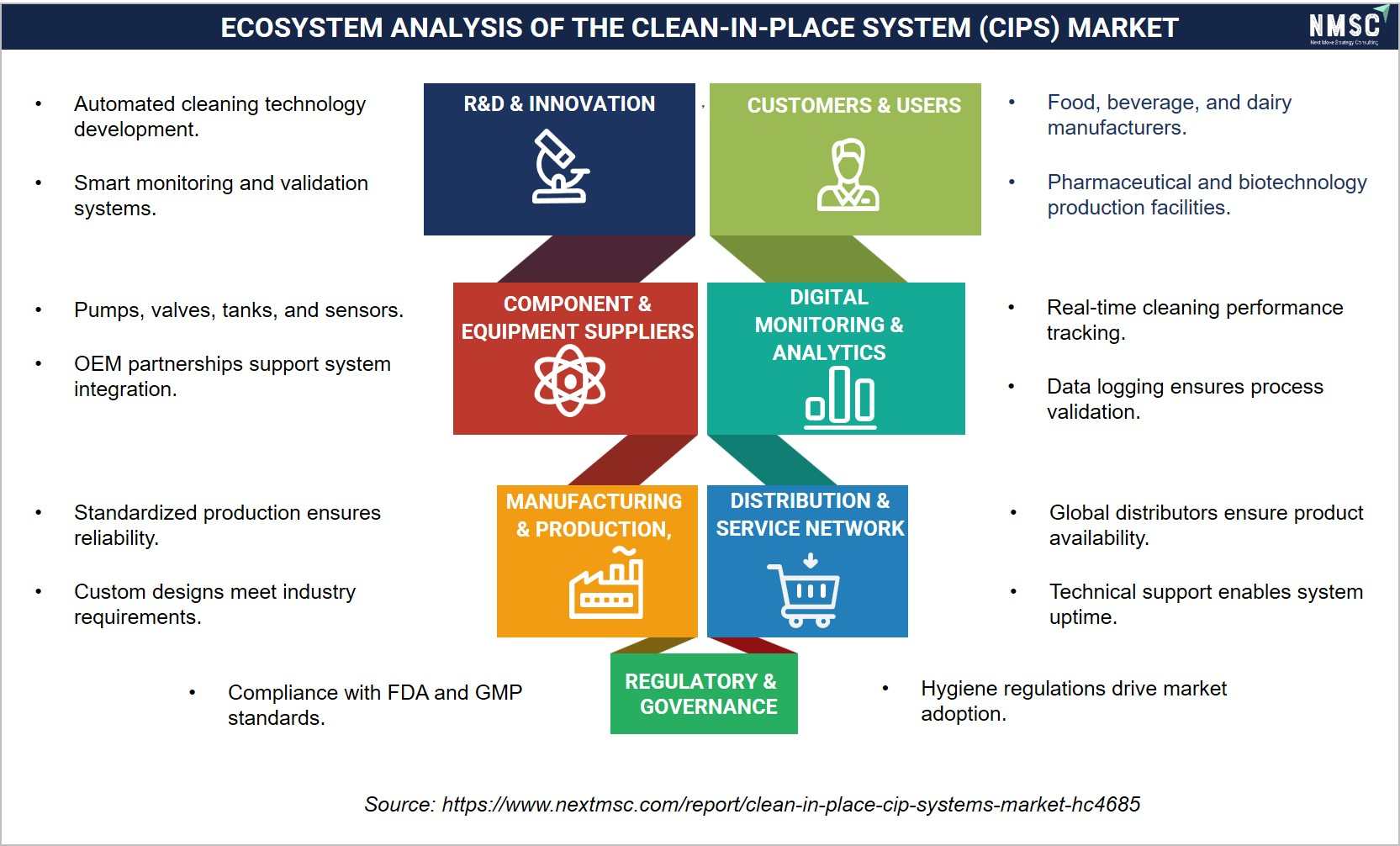
The Clean-in-Place (CIP) Systems Market ecosystem comprises a network of technology innovators, equipment manufacturers, component suppliers, service providers, regulatory authorities, and end-user industries. Research and development activities drive advancements in automation, water efficiency, and hygienic system design, while component and equipment suppliers provide pumps, valves, sensors, tanks, and control systems essential for CIP operations. Digital monitoring and analytics platforms enhance process optimization, compliance, and operational visibility. Food, beverage, dairy, pharmaceutical, and biotechnology manufacturers represent the primary customer base, supported by distribution and service networks that ensure installation, maintenance, and system upgrades. Regulatory and governance bodies play a critical role in establishing hygiene, safety, and quality standards that guide market development and technology adoption.
How Is the Clean-in-Place (CIP) Systems Market Segmented in This Report, and What Are the Key Insights from the Segmentation Analysis?
How Does Cleaning Equipment and Consumables Shape the Revenue Foundation of the Clean-in-Place (CIP) Systems Market?
|
Cleaning Sub-Segment |
2025 (USD Bn) |
2035 (USD Bn) |
CAGR (%) |
|
Washer Disinfectors |
0.92 |
1.52 |
5.2% |
|
Ultrasonic Cleaners |
0.54 |
0.88 |
5.0% |
|
Cart Washers |
0.31 |
0.50 |
4.9% |
|
Endoscope Reprocessors |
0.68 |
1.18 |
5.8% |
|
Drying Cabinets |
0.22 |
0.35 |
4.8% |
|
Water Treatment Systems |
0.28 |
0.47 |
5.3% |
|
Other Cleaning Equipment |
0.18 |
0.28 |
4.5% |
|
Detergents & Enzymatic Cleaners |
0.41 |
0.67 |
5.0% |
|
Lubricants and Additives |
0.12 |
0.18 |
4.1% |
|
Descaling Agents |
0.09 |
0.14 |
4.5% |
|
Other Cleaning Consumables |
0.07 |
0.11 |
4.6% |
Based on our market assessment, we observed that the Cleaning segment encompasses washer disinfectors, ultrasonic cleaners, cart washers, endoscope reprocessors, drying cabinets, water treatment systems, and associated consumables including detergents and enzymatic cleaners, lubricants and additives, and descaling agents. Washer disinfectors hold the dominant position within this segment due to their broad deployment across hospital central sterile services departments and their integration into standardized surgical instrument reprocessing workflows. Endoscope reprocessors represent the fastest-growing equipment sub-category within Cleaning, driven by regulatory tightening around flexible endoscope decontamination standards and increasing endoscopy procedure volumes globally.
What Is Driving Adoption Across Inspection and Monitoring Equipment and Consumables in the CIP Market?
|
Inspection & Monitoring Sub-Segment |
2025 (USD Bn) |
2035 (USD Bn) |
CAGR (%) |
|
Visual Inspection Systems |
0.38 |
0.62 |
5.0% |
|
Leak Testers |
0.24 |
0.41 |
5.7% |
|
Other Inspection Equipment |
0.11 |
0.17 |
4.4% |
|
Process Challenge Devices |
0.18 |
0.30 |
5.5% |
|
Test Strips and Swabs |
0.21 |
0.34 |
4.9% |
|
Reagent Cartridges |
0.16 |
0.28 |
5.7% |
|
Other Inspection Consumables |
0.08 |
0.12 |
4.1% |
Through our analysis, we found that the Inspection and Monitoring segment covers visual inspection systems, leak testers, process challenge devices, test strips and swabs, and reagent cartridges used to verify the efficacy of cleaning, disinfection, and sterilization processes. Process challenge devices and reagent cartridges represent the fastest-growing consumable categories within this segment, driven by accelerating adoption of automated sterility assurance verification systems that generate electronically documented test records. Visual inspection systems are gaining adoption as digital imaging and AI-assisted defect detection technologies replace manual inspection steps in pharmaceutical and medical device reprocessing environments, improving throughput and documentation consistency.
How Does Packaging and Storage Infrastructure Contribute to the Clean-in-Place (CIP) Systems Market?
|
Packaging & Storage Sub-Segment |
2025 (USD Bn) |
2035 (USD Bn) |
CAGR (%) |
|
Heat Sealers |
0.19 |
0.31 |
5.0% |
|
Tray Sealers |
0.14 |
0.23 |
5.1% |
|
Sterile Storage Cabinets |
0.21 |
0.35 |
5.2% |
|
Other Packaging Equipment |
0.09 |
0.14 |
4.5% |
|
Sterilization Wrap |
0.28 |
0.43 |
4.4% |
|
Pouches and Reels |
0.32 |
0.52 |
5.0% |
|
Rigid Containers |
0.24 |
0.42 |
5.8% |
|
Sterile Barrier Labels |
0.11 |
0.18 |
5.0% |
|
Other Packaging Consumables |
0.06 |
0.09 |
4.1% |
From our assessment, we analyzed that the Packaging and Storage segment encompasses heat sealers, tray sealers, sterile storage cabinets, and consumables including sterilization wrap, pouches and reels, rigid containers, and sterile barrier labels. Pouches and reels represent the largest consumable sub-category within packaging due to their universal use in heat-sealed sterile barrier packaging for surgical instruments across virtually all healthcare settings. Rigid containers are the fastest-growing packaging sub-segment, reflecting hospital preferences for durable, reusable rigid container systems that offer long-term cost savings and reduced packaging waste compared to single-use wrap and pouch systems.
Which Sterilization and Assurance Technologies Are Dominating the Clean-in-Place (CIP) Systems Market?
|
Sterilization & Assurance Sub-Segment |
2025 (USD Bn) |
2035 (USD Bn) |
CAGR (%) |
|
Steam Sterilizers |
0.98 |
1.60 |
5.0% |
|
Low Temperature Sterilizers |
0.44 |
0.78 |
6.1% |
|
Ethylene Oxide Sterilizers |
0.22 |
0.33 |
4.1% |
|
Dry Heat Sterilizers |
0.14 |
0.21 |
4.1% |
|
Other Sterilization Equipment |
0.09 |
0.14 |
4.5% |
|
Biological Indicators |
0.29 |
0.49 |
5.4% |
|
Chemical Indicators |
0.24 |
0.39 |
5.0% |
|
Sterilant Chemicals |
0.18 |
0.28 |
4.5% |
|
Bowie-Dick Packs |
0.12 |
0.18 |
4.1% |
|
Other Sterilization Consumables |
0.08 |
0.13 |
5.0% |
NMSC's analysis indicates that the Sterilization and Assurance segment is the largest revenue-generating category within the Clean-in-Place (CIP) Systems Market, encompassing steam sterilizers, low temperature sterilizers, ethylene oxide sterilizers, dry heat sterilizers, and associated consumables including biological indicators, chemical indicators, sterilant chemicals, and Bowie-Dick packs. Steam sterilizers dominate equipment revenues due to their broad applicability, cost effectiveness, and recognized efficacy for heat-stable instruments across both healthcare and pharmaceutical settings. Low temperature sterilizers represent the fastest-growing equipment sub-segment, driven by expanding reprocessing requirements for heat-sensitive surgical instruments, robotic surgery components, and complex flexible endoscopes that cannot withstand high-temperature steam cycles.
How Is Software Becoming the Most Strategically Important Growth Layer in the Clean-in-Place (CIP) Systems Market?
|
Software Sub-Segment |
2025 (USD Bn) |
2035 (USD Bn) |
CAGR (%) |
|
Instrument Tracking Software |
0.28 |
0.61 |
8.4% |
|
Workflow Management Software |
0.19 |
0.41 |
8.5% |
|
Quality and Compliance Software |
0.22 |
0.50 |
9.0% |
|
Other Software |
0.06 |
0.12 |
7.9% |
Based on our market evaluation, we noticed that the Software segment is the fastest-growing category within the Clean-in-Place (CIP) Systems Market, driven by healthcare and pharmaceutical industry mandates to replace manual paper-based documentation with electronic systems. Instrument tracking software holds the largest revenue share within this segment, as hospitals and surgical centers invest in RFID and barcode-enabled tracking platforms that record every instrument's reprocessing history from point-of-use to sterilization release. Quality and compliance software is emerging as the highest-growth sub-category, reflecting the growing need for integrated platforms that link CIP process data, biological indicator results, and sterile release documentation into audit-ready compliance records.
What Is Driving Demand Across Professional Services in the Clean-in-Place (CIP) Systems Market?
|
Services Sub-Segment |
2025 (USD Bn) |
2035 (USD Bn) |
CAGR (%) |
|
Maintenance and Repair |
0.38 |
0.61 |
4.8% |
|
Validation and Qualification |
0.29 |
0.51 |
5.8% |
|
Training and Education |
0.16 |
0.26 |
5.0% |
|
Outsourced Reprocessing |
0.21 |
0.39 |
6.7% |
|
Other Services |
0.09 |
0.14 |
4.5% |
Our findings suggest that the Services segment encompasses maintenance and repair, validation and qualification, training and education, outsourced reprocessing, and other professional support activities integral to sustaining compliant CIP operations. Maintenance and repair services hold the largest revenue share within this segment as hospitals and pharmaceutical manufacturers increasingly opt for vendor-managed service contracts to ensure equipment uptime and regulatory compliance. Outsourced reprocessing is the fastest-growing services sub-segment, reflecting a structural shift among smaller ambulatory surgery centers and specialty clinics toward third-party reprocessing service models that transfer compliance burden to specialized service providers with validated CIP systems and certified reprocessing technicians.
How Does End User Segmentation Reflect the Diverse Application Landscape of the Clean-in-Place (CIP) Systems Market?
|
End User Segment |
2025 (USD Bn) |
2035 (USD Bn) |
CAGR (%) |
|
Hospitals and ASCs |
2.90 |
4.61 |
4.8% |
|
Dental and Specialty Clinics |
0.62 |
0.99 |
4.8% |
|
Medical Device Manufacturers |
1.08 |
1.78 |
5.1% |
|
Pharma and Biotech |
1.94 |
3.55 |
6.4% |
|
Laboratories and Research |
1.22 |
1.99 |
5.0% |
|
Other End Users |
0.84 |
0.93 |
0.6% |
Based on our research, we found that the Clean-in-Place (CIP) Systems Market serves Hospitals and ASCs, Dental and Specialty Clinics, Medical Device Manufacturers, Pharma and Biotech organizations, Laboratories and Research institutions, and Other End Users. Hospitals and ASCs retain the dominant end user position due to the high volume of reusable surgical instruments, endoscopes, and implantable devices requiring validated daily reprocessing across sterile services departments. Pharma and Biotech represents the fastest-growing end user segment, as expansion of biologics and cell and gene therapy manufacturing facilities creates substantial demand for validated CIP equipment and process qualification services across newly commissioned production lines.
Which Distribution Channels Are Reshaping Commercial Access Strategies in the Clean-in-Place (CIP) Systems Market?
|
Channel Segment |
2025 (USD Bn) |
2035 (USD Bn) |
CAGR (%) |
|
Direct Sales |
5.20 |
8.08 |
4.5% |
|
Distributors and Dealers |
2.74 |
4.37 |
4.8% |
|
E-commerce |
0.40 |
0.85 |
8.2% |
|
Other Channels |
0.26 |
0.54 |
7.9% |
Through our analysis, we assessed that the Clean-in-Place (CIP) Systems Market is distributed through Direct Sales, Distributors and Dealers, E-commerce, and Other Channels. Direct Sales dominates channel revenues as large hospital systems, pharmaceutical manufacturers, and medical device companies rely on vendor-managed relationships for complex equipment integration, validation support, and multi-year service agreements. Distributors and Dealers maintain a substantial role in servicing mid-tier healthcare and laboratory customers requiring localized technical support and competitive pricing access. E-commerce represents the fastest-growing channel at a CAGR of 8.2%, driven by consumable replenishment purchasing migrating to digital procurement platforms in healthcare group purchasing organization (GPO) frameworks.
Regional Outlook
Geographic Performance Snapshot
|
Region |
2025 (USD Bn) |
2035 (USD Bn) |
CAGR (%) |
Key Driver |
|
North America |
3.40 |
5.39 |
4.7% |
FDA cGMP enforcement, pharma capacity |
|
Europe |
2.58 |
4.02 |
4.5% |
EU GMP regulation, hospital modernization |
|
Asia-Pacific |
1.72 |
3.09 |
6.2% |
Pharma growth, healthcare infrastructure |
|
Middle East & Africa |
0.43 |
0.69 |
4.9% |
Healthcare expansion, Vision 2030 |
|
Latin America |
0.47 |
0.71 |
4.2% |
Hospital construction, GMP compliance |
North America Clean-in-Place (CIP) Systems Market
North America is the global market leader in the Clean-in-Place (CIP) Systems Market, contributing USD 3.40 billion in 2025 and forecast to reach USD 5.39 billion by 2035 at a CAGR of 4.7%. The region benefits from the world's highest concentration of FDA-regulated pharmaceutical and biopharmaceutical manufacturing sites, the largest installed base of hospital central sterile services departments, and the most mature regulatory enforcement environment governing sterile processing compliance. Capital investment in domestic biomanufacturing resilience, supported by federal programs including BARDA's domestic manufacturing initiatives, is sustaining equipment replacement and upgrade cycles across the region.
U.S. Clean-in-Place (CIP) Systems Market
Based on our engagements, we found that the United States represents over 75% of North American Clean-in-Place (CIP) Systems Market revenue, driven by the world's highest concentration of FDA-regulated pharmaceutical manufacturing facilities, academic medical centers, and ambulatory surgery centers. The FDA's Center for Drug Evaluation and Research (CDER) and Center for Devices and Radiological Health (CDRH) enforce robust cleaning validation and sterile processing requirements that mandate regular equipment qualification activities. The U.S. Joint Commission's hospital accreditation standards and the Centers for Medicare and Medicaid Services (CMS) Conditions of Participation also drive consistent investment in validated reprocessing infrastructure across the hospital sector.
Canada Clean-in-Place (CIP) Systems Market
Through our analysis, Canada accounts for approximately 13% of North American Clean-in-Place (CIP) Systems Market revenue, with steady demand from pharmaceutical manufacturing facilities concentrated in Ontario and Quebec, and from hospital sterile services departments across major urban healthcare systems. Health Canada's drug GMP guidelines, aligned with ICH Q7 standards, mandate validated cleaning procedures for shared pharmaceutical equipment. The Government of Canada's Biomanufacturing and Life Sciences Strategy has committed targeted investments in domestic pharmaceutical production capacity, creating incremental demand for validated CIP systems and qualification services across newly commissioned facilities.
Mexico Clean-in-Place (CIP) Systems Market
From our assessment, Mexico demonstrates growing momentum within the North American Clean-in-Place (CIP) Systems Market, supported by an expanding pharmaceutical manufacturing sector serving both domestic and export markets across Latin America and the United States. COFEPRIS, Mexico's Federal Commission for the Protection against Sanitary Risk, enforces GMP regulations aligned with international standards, driving pharmaceutical manufacturers to invest in validated CIP equipment and cleaning verification systems. Mexico's growing medical device manufacturing cluster in the Monterrey and Juarez regions is also generating demand for CIP and sterilization equipment within medical device production and reprocessing environments.
Europe Clean-in-Place (CIP) Systems Market
Europe is the second-largest region in the Clean-in-Place (CIP) Systems Market, contributing USD 2.58 billion in 2025 and forecast to reach USD 4.02 billion by 2035 at a CAGR of 4.5%. The region's pharmaceutical manufacturing base, anchored by Germany, Switzerland, France, and the UK, generates consistent demand for validated CIP equipment and qualification services. The European Medicines Agency's GMP guidelines, Annex 15 on qualification and validation, and the EU Medical Device Regulation (MDR) collectively mandate rigorous cleaning verification and documented sterile processing procedures across pharmaceutical and medical device sectors.
UK Clean-in-Place (CIP) Systems Market
Based on our engagements, the United Kingdom represents one of Europe's largest individual country markets for Clean-in-Place (CIP) Systems, supported by a robust pharmaceutical manufacturing sector, the National Health Service's extensive hospital network, and a globally significant medical device industry. The Medicines and Healthcare products Regulatory Agency (MHRA) enforces GMP standards aligned with EU and ICH frameworks, maintaining rigorous cleaning validation and sterile processing compliance requirements across pharmaceutical facilities. The NHS's Healthcare Technical Memoranda (HTM 01-01 and HTM 01-06) establish national standards for decontamination and sterile services that drive consistent equipment investment across NHS trusts.
Germany Clean-in-Place (CIP) Systems Market
According to evaluation, Germany is Europe's largest pharmaceutical and biotech manufacturing hub and a primary demand center within the European Clean-in-Place (CIP) Systems Market. Germany's Federal Institute for Drugs and Medical Devices (BfArM) enforce EU GMP compliance across a dense base of pharmaceutical manufacturers, including global leaders such as Bayer, Boehringer Ingelheim, and Merck KGaA. Germany's Krones AG and GEA Group, both headquartered domestically, contribute to a highly competitive local CIP equipment manufacturing and service ecosystem. Hospital demand for CIP systems across Germany's approximately 1,900 hospitals also provides structurally stable reprocessing equipment and consumables demand.
France Clean-in-Place (CIP) Systems Market
Through our analysis, we noticed that France maintains a strong position within the European Clean-in-Place (CIP) Systems Market, underpinned by a well-established pharmaceutical manufacturing sector and one of Europe's largest hospital networks. The French National Agency for the Safety of Medicines and Health Products (ANSM) enforces GMP requirements consistent with EMA guidelines, driving investment in validated CIP systems across domestic pharmaceutical manufacturers. France's hospital sterilization sector is subject to French health authority standards that mandate documented decontamination protocols, supporting consistent demand for washer disinfectors, low temperature sterilizers, and sterility assurance consumables across the public hospital system.
Italy Clean-in-Place (CIP) Systems Market
From our assessment, Italy is a significant mid-tier European market within the Clean-in-Place (CIP) Systems Market, characterized by a well-developed pharmaceutical manufacturing sector in the Milan-Turin corridor and a large public hospital network overseen by the Italian National Health Service (Servizio Sanitario Nazionale). The Italian Medicines Agency (AIFA) enforces EU GMP requirements across pharmaceutical manufacturers, maintaining consistent demand for CIP validation and equipment qualification services. Italy's food and beverage processing sector, including a globally significant dairy industry, also generates demand for CIP cleaning equipment and enzymatic cleaning consumables aligned with EU food hygiene regulations.
Spain Clean-in-Place (CIP) Systems Market
Based on our market evaluation, Spain demonstrates consistent demand within the European Clean-in-Place (CIP) Systems Market through its pharmaceutical manufacturing sector and Spain's National Health System (Sistema Nacional de Salud), which operates a network of over 800 public hospitals. The Spanish Agency of Medicines and Medical Devices (AEMPS) enforces EU GMP requirements that mandate validated cleaning procedures across pharmaceutical manufacturing facilities. Spain's food and beverage processing sector, including significant wine, olive oil, and dairy industries, provides additional industrial CIP equipment demand for cleaning systems deployed across production lines and fermentation vessels in accordance with EU food safety and hygiene regulations.
Sweden Clean-in-Place (CIP) Systems Market
Through our analysis, we assessed that Sweden maintains a technically advanced position within the Scandinavian Clean-in-Place (CIP) Systems Market, supported by a pharmaceutical sector anchored by AstraZeneca and a sophisticated medical technology manufacturing cluster. The Swedish Medical Products Agency (Läkemedelsverket) enforces EU GMP and MDR compliance requirements that drive investment in validated CIP equipment and sterile processing infrastructure. Sweden's highly developed hospital sector, operating under national decontamination guidelines from the Swedish Association of Local Authorities and Regions (SKR), generates consistent demand for high-performance washer disinfectors and low temperature sterilization systems.
Denmark Clean-in-Place (CIP) Systems Market
From our assessment, Denmark occupies a specialized niche within the European Clean-in-Place (CIP) Systems Market, primarily driven by a globally significant pharmaceutical manufacturing sector anchored by Novo Nordisk, which operates some of the world's largest insulin and GLP-1 manufacturing facilities. Novo Nordisk's ongoing capacity expansion programs represent a concentrated and substantial source of CIP equipment and validation demand within the Danish market. The Danish Medicines Agency (DKMA) enforces EU GMP requirements, maintaining high cleaning validation standards across the domestic pharmaceutical sector. Denmark's food and beverage processing industry, including world-class dairy and brewing sectors, also contributes to industrial CIP equipment and consumable demand.
Finland Clean-in-Place (CIP) Systems Market
According to our evaluation, Finland represents a smaller but technically sophisticated segment of the European Clean-in-Place (CIP) Systems Market, supported by a growing pharmaceuticals and diagnostics manufacturing sector and a well-organized public healthcare system. The Finnish Medicines Agency (Fimea) enforces EU GMP requirements across domestic pharmaceutical manufacturers. Finland's food processing industry, including significant dairy, meat, and beverage sectors, generates industrial CIP demand for cleaning systems deployed in production environments subject to EU food hygiene regulation. Public hospital investment in decontamination infrastructure under Finnish national health service guidelines provides consistent demand for sterile processing equipment and consumables.
Netherlands Clean-in-Place (CIP) Systems Market
Based on our engagements, the Netherlands represents one of Europe's key pharmaceutical manufacturing and logistics hubs within the Clean-in-Place (CIP) Systems Market. The country's pharmaceutical sector, anchored by major facilities operated by companies including MSD (Merck), Organon, and Janssen, generates significant demand for validated CIP equipment and qualification services. The Dutch Medicines Evaluation Board (CBG-MEB) enforces EU GMP standards, maintaining rigorous cleaning validation requirements. The Netherlands' major seaport and distribution infrastructure, including Rotterdam, also positions it as a critical distribution node for CIP equipment and consumable suppliers serving the broader European market.
Rest of Europe Clean-in-Place (CIP) Systems Market
Through our analysis, we observed that the Rest of Europe category within the Clean-in-Place (CIP) Systems Market encompasses Switzerland, Belgium, Poland, Czech Republic, Portugal, Austria, Hungary, Romania, and other European markets. Switzerland, despite its small population, is a disproportionately significant CIP market due to the headquarters and major manufacturing operations of Roche, Novartis, and Lonza concentrated in the Basel and Visp regions. Belgium's pharmaceutical cluster, anchored by UCB and Johnson and Johnson's Janssen division, also generates concentrated CIP equipment and validation demand, while Central and Eastern European pharmaceutical manufacturing is growing in line with EU accession-driven GMP compliance requirements.
Asia-Pacific Clean-in-Place (CIP) Systems Market
Asia-Pacific is the fastest-growing major region in the Clean-in-Place (CIP) Systems Market, contributing USD 1.72 billion in 2025 and forecast to reach USD 3.09 billion by 2035 at a CAGR of 6.2%. The region's growth is underpinned by rapid pharmaceutical manufacturing capacity expansion in China and India, accelerating healthcare infrastructure investment across Southeast Asia, and strengthening regulatory enforcement of GMP and sterile processing standards across national medicines agencies aligned with WHO GMP guidelines. Growing domestic pharmaceutical industries seeking export market access to regulated markets are particularly driving investment in validated CIP systems to achieve and maintain international quality certifications.
China Clean-in-Place (CIP) Systems Market
Based on our engagements, China represents the single largest country market within the Asia-Pacific Clean-in-Place (CIP) Systems Market, driven by a pharmaceutical manufacturing sector that has undergone comprehensive GMP reforms under the National Medical Products Administration (NMPA). China's revised GMP standards, aligned with international ICH guidelines, mandate validated cleaning procedures and electronic documentation systems across Chinese pharmaceutical manufacturers, creating substantial and growing demand for CIP equipment, validation services, and quality and compliance software. China's ambitious hospital construction pipeline and expansion of Class III hospital capacity under the 14th Five-Year Health Plan are also generating consistent demand for sterile processing and reprocessing equipment.
India Clean-in-Place (CIP) Systems Market
Through our analysis, India is the fastest-growing national market in Asia-Pacific within the Clean-in-Place (CIP) Systems Market at a CAGR of 8.4% from 2026 to 2035. India's status as the world's largest generic pharmaceutical manufacturer by volume, combined with strengthening CDSCO enforcement of Schedule M GMP standards aligned with WHO guidelines, is compelling domestic pharmaceutical manufacturers to invest in validated CIP systems and electronic documentation infrastructure. India's Ayushman Bharat Health Infrastructure Mission is funding construction of new district hospitals and critical care facilities that require compliant sterile processing departments, creating sustained demand for CIP equipment and reprocessing consumables across the public healthcare sector.
Japan Clean-in-Place (CIP) Systems Market
From our assessment, Japan represents a mature and technically advanced segment of the Asia-Pacific Clean-in-Place (CIP) Systems Market, characterized by a well-established pharmaceutical manufacturing sector and a globally recognized hospital quality infrastructure. Japan's Pharmaceuticals and Medical Devices Agency (PMDA) enforces GMP standards aligned with ICH guidelines, maintaining rigorous cleaning validation and sterile processing requirements. Japan's aging demographic profile is driving sustained expansion of hospital capacity and surgical procedure volumes, supporting consistent demand for high-quality washer disinfectors, steam sterilizers, and sterile processing consumables across the country's approximately 8,200 hospitals.
South Korea Clean-in-Place (CIP) Systems Market
According to evaluation, South Korea demonstrates strong growth momentum within the Asia-Pacific Clean-in-Place (CIP) Systems Market, driven by a rapidly expanding biopharmaceutical manufacturing sector anchored by Samsung Biologics, Celltrion, and SK Bioscience. The Ministry of Food and Drug Safety (MFDS) enforces GMP requirements that mandate validated CIP systems across pharmaceutical and biopharmaceutical manufacturing facilities. South Korea's medical tourism sector, served by internationally accredited hospitals and medical centers, also drives demand for high-performance sterile processing equipment and compliance management software among healthcare facilities seeking and maintaining Joint Commission International (JCI) accreditation.
Taiwan Clean-in-Place (CIP) Systems Market
Based on our engagements, Taiwan maintains a focused position within the Asia-Pacific Clean-in-Place (CIP) Systems Market, supported by a growing pharmaceutical manufacturing sector and a well-developed medical device manufacturing industry. The Taiwan Food and Drug Administration (TFDA) enforces GMP standards aligned with ICH guidelines across pharmaceutical manufacturers. Taiwan's National Health Insurance (NHI) system operates one of Asia's most comprehensive healthcare coverage frameworks, supporting consistent hospital procedure volumes and corresponding demand for sterile processing equipment and reprocessing consumables across accredited healthcare facilities.
Indonesia Clean-in-Place (CIP) Systems Market
Through our analysis, Indonesia represents a rapidly growing market within the Southeast Asian Clean-in-Place (CIP) Systems Market, supported by government healthcare infrastructure investment under the JKN national health insurance program. The National Agency of Drug and Food Control (BPOM) enforce GMP requirements for domestic pharmaceutical manufacturers, driving investment in CIP equipment and cleaning validation systems. Indonesia's national hospital development program, targeting expanded public hospital capacity in Tier 2 and Tier 3 cities, is generating growing demand for sterile processing equipment from healthcare facilities transitioning to internationally compliant reprocessing standards.
Vietnam Clean-in-Place (CIP) Systems Market
From our assessment, Vietnam is an emerging high-growth market within the Southeast Asian Clean-in-Place (CIP) Systems Market, reflecting the country's rapidly expanding pharmaceutical manufacturing sector and growing hospital infrastructure investment. The Drug Administration of Vietnam enforces GMP-WHO standards across pharmaceutical manufacturers increasingly seeking international export market access. Vietnam's government-funded hospital construction program, combined with growing private healthcare investment, is creating demand for sterile processing and decontamination equipment from newly commissioned hospital facilities. The country's food and beverage processing sector, including significant dairy and brewing industries, also generates industrial CIP equipment demand.
Australia Clean-in-Place (CIP) Systems Market
Based on our engagements, Australia represents a mature, highly regulated Clean-in-Place (CIP) Systems Market, characterized by rigorous compliance requirements enforced by the Therapeutic Goods Administration (TGA). Australian pharmaceutical manufacturers, research institutions, and hospital networks operate under internationally aligned GMP and sterile processing standards. The Australian Commission on Safety and Quality in Health Care (ACSQHC) National Standards for decontamination in healthcare settings create consistent regulatory drivers for investment in compliant CIP equipment and sterile processing infrastructure. Australia's concentration of international pharmaceutical manufacturing sites and significant private hospital sector provide structurally stable demand across equipment, consumables, and validation services categories.
Philippines Clean-in-Place (CIP) Systems Market
Through our analysis, the Philippines demonstrates growing demand within the Southeast Asian Clean-in-Place (CIP) Systems Market, driven by healthcare infrastructure investment under the Universal Health Care Act and expansion of the country's pharmaceutical manufacturing sector. The Food and Drug Administration of the Philippines enforces GMP-WHO standards that are driving compliance-driven investment in validated CIP equipment across domestic pharmaceutical manufacturers. The Philippines' medical tourism sector, centered on internationally accredited hospitals in Metro Manila and Cebu, is generating demand for high-performance sterile processing equipment from healthcare facilities seeking and maintaining international quality accreditations.
Malaysia Clean-in-Place (CIP) Systems Market
From our assessment, Malaysia occupies a growing position within the Asia-Pacific Clean-in-Place (CIP) Systems Market, supported by a well-developed pharmaceutical manufacturing sector and the Ministry of Health's structured hospital development program. The National Pharmaceutical Regulatory Agency (NPRA) enforces GMP standards that mandate validated cleaning procedures, driving investment in CIP equipment and qualification services. Malaysia's medical tourism hub status, anchored by Penang and Kuala Lumpur healthcare facilities, generates consistent demand for internationally compliant sterile processing equipment. The country's food and beverage processing sector, including significant dairy and beverage manufacturing, contributes industrial CIP equipment and consumable demand.
Rest of Asia-Pacific Clean-in-Place (CIP) Systems Market
According to evaluation, the Rest of Asia-Pacific category encompasses Bangladesh, Pakistan, Thailand, Singapore, New Zealand, and other markets within the broader Asia-Pacific region. Singapore functions as a specialized high-value market within this group due to its concentrated biopharmaceutical manufacturing sector and the Health Sciences Authority's (HSA) rigorous GMP enforcement. Thailand's growing pharmaceutical manufacturing sector and medical tourism industry generate consistent CIP demand, while Bangladesh and Pakistan represent early-stage but rapidly developing markets where GMP compliance investment is being driven by domestic pharmaceutical export growth ambitions and WHO GMP certification requirements.
Middle East and Africa Clean-in-Place (CIP) Systems Market
The Middle East and Africa Clean-in-Place (CIP) Systems Market contributed USD 0.43 billion in 2025 and is projected to reach USD 0.69 billion by 2035 at a CAGR of 4.9%. Growth is driven by healthcare infrastructure expansion programs across the GCC, government investment in domestic pharmaceutical manufacturing to reduce import dependency, and rising compliance requirements from national medicines regulatory authorities aligned with international GMP standards. Saudi Arabia's Vision 2030 healthcare transformation and the UAE's National Strategy for Advanced Technology are the primary policy frameworks supporting CIP market development across the region.
Saudi Arabia Clean-in-Place (CIP) Systems Market
Based on our engagements, Saudi Arabia is the largest and fastest-growing market within the Middle East Clean-in-Place (CIP) Systems Market, driven by Vision 2030 healthcare transformation goals targeting hospital bed capacity expansion, domestic pharmaceutical manufacturing development, and food safety infrastructure investment. The Saudi Food and Drug Authority (SFDA) enforces GMP standards for pharmaceutical manufacturers aligned with ICH guidelines, driving investment in validated CIP equipment across the growing domestic pharmaceutical sector. Saudi Arabia's hospital construction program, including new facility development under the Ministry of Health and military hospital networks, is generating strong demand for sterile processing equipment and reprocessing infrastructure.
UAE Clean-in-Place (CIP) Systems Market
Through our analysis, the United Arab Emirates represents a technologically advanced segment of the Middle East Clean-in-Place (CIP) Systems Market, characterized by a well-developed private healthcare sector serving both domestic patients and medical tourists. The UAE's Health Authority and Dubai Health Authority enforce sterile processing standards for healthcare facilities, driving investment in high-performance washer disinfectors, low temperature sterilizers, and digital tracking systems. The UAE's growing pharmaceutical manufacturing sector, supported by free zone incentives, and its major food and beverage processing industry generate additional industrial CIP equipment demand aligned with SFDA-equivalent regulatory frameworks.
Egypt Clean-in-Place (CIP) Systems Market
From our assessment, Egypt is a significant emerging market within the Africa Clean-in-Place (CIP) Systems Market, supported by the largest pharmaceutical manufacturing sector on the African continent and a substantial government hospital network. The Egyptian Drug Authority (EDA) enforces GMP requirements for pharmaceutical manufacturers, creating consistent demand for validated CIP systems and cleaning consumables. Egypt's national healthcare development programs, supported by Universal Health Insurance Authority expansion, are investing in hospital infrastructure upgrades that require compliant sterile processing departments. Egypt's food processing sector, including significant dairy and processed food industries, also generates industrial CIP equipment demand.
Israel Clean-in-Place (CIP) Systems Market
According to evaluation, Israel maintains a highly sophisticated position within the Middle East Clean-in-Place (CIP) Systems Market, supported by a globally recognized pharmaceutical, biotechnology, and medical device manufacturing sector. The Israeli Ministry of Health enforces GMP requirements aligned with FDA and EMA standards, maintaining rigorous cleaning validation requirements across Israeli pharmaceutical and biotech manufacturers. Israel's advanced medical device manufacturing sector, concentrated in the Tel Aviv and Haifa regions, generates demand for CIP systems integrated into device manufacturing and reprocessing environments. Israel's well-developed hospital network, served by both public sick funds and private institutions, provides consistent sterile processing equipment demand.
Turkey Clean-in-Place (CIP) Systems Market
Based on our engagements, Turkey represents a growing and strategically positioned market within the broader Middle East and Europe Clean-in-Place (CIP) Systems Market. The Turkish Medicines and Medical Devices Agency (TITCK) enforces GMP requirements aligned with EU standards following Turkey's EU accession candidacy, compelling pharmaceutical manufacturers to invest in validated CIP systems and electronic documentation infrastructure. Turkey's significant food and beverage processing sector, including one of the world's largest dairy and fruit juice processing industries, generates substantial industrial CIP equipment and consumable demand for cleaning systems deployed in production environments subject to EU-equivalent food safety regulations.
Nigeria Clean-in-Place (CIP) Systems Market
Through our analysis, Nigeria is West Africa's primary market within the African Clean-in-Place (CIP) Systems Market, supported by the continent's largest pharmaceutical manufacturing sector and a growing hospital network serving a population of over 200 million. The National Agency for Food and Drug Administration and Control (NAFDAC) enforces GMP requirements for domestic pharmaceutical manufacturers, creating compliance-driven demand for CIP equipment and cleaning validation services. Nigeria's government-funded hospital expansion programs and significant beverage and dairy processing sectors contribute to industrial and healthcare sector CIP equipment demand, though market penetration remains relatively limited compared to North African and Middle Eastern peers.
South Africa Clean-in-Place (CIP) Systems Market
From our assessment, South Africa is the most developed market within Sub-Saharan Africa for the Clean-in-Place (CIP) Systems Market, benefiting from the continent's most sophisticated pharmaceutical manufacturing sector, a well-developed private hospital network, and a significant food and beverage processing industry. The South African Health Products Regulatory Authority (SAHPRA) enforces GMP requirements aligned with international standards, compelling pharmaceutical manufacturers to invest in validated CIP systems and compliance documentation infrastructure. South Africa's private hospital groups, operating internationally accredited facilities, drive demand for high-performance sterile processing equipment, and the country's major dairy and brewery sectors generate consistent industrial CIP equipment demand.
Rest of MEA Clean-in-Place (CIP) Systems Market
According to evaluation, the Rest of MEA category within the Clean-in-Place (CIP) Systems Market encompasses Kuwait, Qatar, Bahrain, Oman, Jordan, Morocco, Kenya, Ethiopia, Ghana, and other markets across the region. GCC markets including Kuwait, Qatar, and Bahrain are experiencing healthcare infrastructure expansion aligned with national development visions that are creating demand for sterile processing equipment in newly commissioned hospitals and healthcare facilities. North African markets including Morocco and Tunisia are investing in domestic pharmaceutical manufacturing capacity under national industrial development programs, creating incremental CIP equipment and validation demand as these facilities pursue international GMP certifications.
Latin America Clean-in-Place (CIP) Systems Market
The Latin America Clean-in-Place (CIP) Systems Market contributed USD 0.47 billion in 2025 and is forecast to reach USD 0.71 billion by 2035 at a CAGR of 4.2%. Growth is driven by hospital infrastructure expansion, strengthening GMP enforcement by national medicines regulatory authorities, and growing domestic pharmaceutical manufacturing sectors seeking international export market compliance. Brazil and Mexico represent the two largest country markets in the region, collectively accounting for approximately 70% of Latin American CIP market revenue in 2025.
Brazil Clean-in-Place (CIP) Systems Market
Based on our engagements, Brazil is the largest country market within the Latin American Clean-in-Place (CIP) Systems Market, supported by the largest pharmaceutical manufacturing sector in South America and an extensive public hospital network overseen by the Unified Health System (SUS). The Brazilian Health Surveillance Agency (ANVISA) enforces GMP requirements aligned with international standards for pharmaceutical manufacturers, and its RDC regulations governing hospital sterile processing services mandate validated reprocessing procedures in healthcare settings. Brazil's large food and beverage processing sector, including the world's largest beef, poultry, and sugar processing industries, generates industrial CIP equipment demand for hygienic processing systems deployed in accordance with Brazilian food safety standards.
Argentina Clean-in-Place (CIP) Systems Market
Through our analysis, Argentina maintains a consistent position within the Latin American Clean-in-Place (CIP) Systems Market, supported by a well-established domestic pharmaceutical manufacturing sector and a national healthcare system that includes both public and private hospital networks. The National Administration of Drugs, Foods and Medical Devices (ANMAT) enforces GMP requirements for pharmaceutical manufacturers, driving investment in validated CIP systems and cleaning documentation infrastructure. Argentina's significant food processing industry, including major dairy, wine, and meat processing sectors, also generates industrial CIP equipment demand for hygienic cleaning systems aligned with Argentine food safety regulations and export market compliance requirements.
Chile Clean-in-Place (CIP) Systems Market
From our assessment, Chile represents a smaller but growing market within the South American Clean-in-Place (CIP) Systems Market, characterized by a structured pharmaceutical regulatory environment governed by the Institute of Public Health (ISP) enforcing GMP requirements for domestic pharmaceutical manufacturers. Chile's well-organized private healthcare sector, including international quality-accredited hospitals in Santiago, generates demand for compliant sterile processing equipment. Chile's significant food and beverage processing industry, including the world's leading copper-free wine production sector and major salmon and fruit processing operations, generates industrial CIP equipment demand for hygienic cleaning and sanitation systems.
Colombia Clean-in-Place (CIP) Systems Market
According to evaluation, Colombia demonstrates growing demand within the Latin American Clean-in-Place (CIP) Systems Market, driven by pharmaceutical manufacturing expansion, healthcare system reform, and food processing sector growth. The National Food and Drug Surveillance Institute (INVIMA) enforces GMP requirements for Colombian pharmaceutical manufacturers, creating compliance-driven demand for CIP equipment and validation services. Colombia's national health system reform programs are driving hospital infrastructure investment, creating demand for sterile processing equipment across newly commissioned facilities. Colombia's food processing sector, including major coffee, palm oil, and dairy processing industries, also contributes industrial CIP equipment demand.
Rest of Latin America Clean-in-Place (CIP) Systems Market
Through our analysis, the Rest of Latin America category within the Clean-in-Place (CIP) Systems Market encompasses Peru, Ecuador, Venezuela, Uruguay, Costa Rica, and other markets across Central America and the Caribbean. Peru and Ecuador represent growing markets where pharmaceutical manufacturing sector development and hospital infrastructure investment are creating incremental CIP equipment demand under strengthening national GMP enforcement frameworks. Costa Rica's established medical device manufacturing sector, serving U.S. and European export markets under the U.S. FDA Quality System Regulation and EU MDR requirements, generates consistent demand for validated CIP and sterilization systems across device manufacturing facilities.
Supply Chain Structure of the Clean-in-Place (CIP) Systems Market
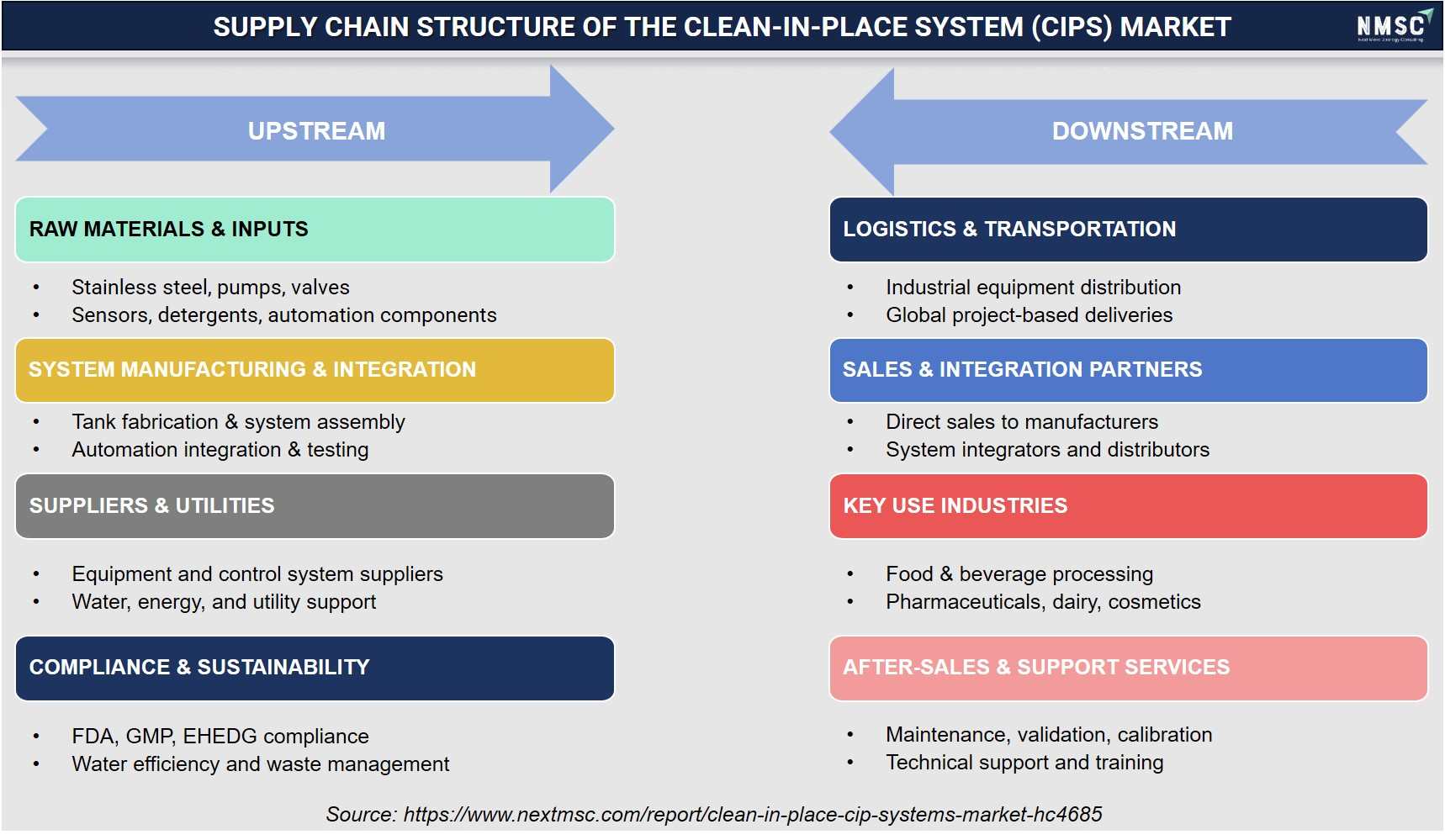
The Clean-in-Place (CIP) Systems Market supply chain encompasses a comprehensive network of raw material suppliers, system manufacturers, technology integrators, distributors, and end-user industries. Upstream activities include the supply of stainless steel, pumps, valves, sensors, automation components, and cleaning chemicals required for system construction and operation. Manufacturers and integrators assemble, test, and customize CIP systems to meet industry-specific hygiene requirements. Downstream, logistics providers, distributors, and system integration partners facilitate market delivery and deployment across food and beverage, dairy, pharmaceutical, and cosmetics industries. The ecosystem is further supported by maintenance, validation, calibration, and training services, while compliance with FDA, GMP, and EHEDG standards ensures operational safety, product quality, and sustainable resource utilization throughout the value chain.
Competitive Landscape
Competitive Dynamics and M&A Landscape
|
Key Takeaway |
Details |
|
Market Structure |
Moderately consolidated; dominated by global diversified industrial players (Ecolab, GEA, Alfa Laval, STERIS) alongside specialized CIP equipment manufacturers serving pharmaceutical and food processing verticals |
|
Innovation Focus |
IoT-connected CIP skids, digital validation documentation, sustainable chemistry formulations, and integrated workflow management software platforms |
|
M&A Activity |
Strategic acquisitions targeting pharmaceutical sterile processing, digital compliance platforms, and water treatment technology integration to expand CIP system offering completeness |
How Do Companies Compete in the Clean-in-Place (CIP) Systems Market?
The Clean-in-Place (CIP) Systems Market is characterized by a moderately consolidated competitive structure, with leading players competing across full system integration, consumable supply chain reliability, validation support expertise, and digital platform differentiation. Our analysis shows that market leaders including Ecolab, GEA Group, Alfa Laval, and STERIS leverage global manufacturing scale, established regulatory compliance credentials, and comprehensive service networks to maintain preferred supplier status with large pharmaceutical manufacturers and hospital systems. Competition intensifies in specialized segments such as endoscope reprocessors and pharmaceutical CIP skids, where technical performance validation, regulatory clearance history, and service response times represent primary selection criteria.
Which Kind of Companies Dominate the Clean-in-Place (CIP) Systems Market?
The Clean-in-Place (CIP) Systems Market is dominated by three distinct categories of competitors. Large diversified industrial and life sciences companies including Ecolab, GEA Group, Alfa Laval, and STERIS compete across multiple CIP categories with full ecosystem offerings. Specialized healthcare and pharmaceutical CIP solution providers including Sani-Matic and Paul Mueller Company focus on validated pharmaceutical-grade systems with deep application expertise. Chemical and consumable specialists including Veolia Environnement and Donaldson Company compete in water treatment, filtration, and chemical formulation sub-segments that are integral to CIP cycle performance. NMSC's analysis indicates that full ecosystem providers with validated pharmaceutical-grade CIP portfolios and digital compliance capabilities maintain the strongest competitive positioning.
AI-Native Differentiation and Open Standards Drive Market Success in the Clean-in-Place (CIP) Systems Market
Digital differentiation through IoT connectivity, cloud-based cycle documentation, and AI-assisted process optimization is emerging as a primary competitive differentiator within the Clean-in-Place (CIP) Systems Market. Based on our research, we found that vendors integrating OPC-UA and ISA-88 open communication standards into CIP skids are gaining preference among pharmaceutical manufacturers seeking vendor-neutral automation architectures. Ecolab's advanced CIP monitoring platforms and GEA Group's digital equipment intelligence capabilities represent early-mover advantages in the transition toward data-driven, compliance-integrated CIP system management.
Market Players to Opt for Merger and Acquisition Strategies to Expand Their Presence in the Clean-in-Place (CIP) Systems Market
Merger and acquisition activity within the Clean-in-Place (CIP) Systems Market is increasingly focused on expanding digital compliance capabilities, broadening pharmaceutical sterile processing portfolios, and acquiring regional distribution networks in Asia-Pacific and Latin America. Our assessment indicates that STERIS's historical acquisition strategy, which included the purchase of Synergy Health to expand outsourced reprocessing capabilities, illustrates the consolidation trend toward full-service CIP and sterilization management offerings. Buyers are targeting companies with established instrument tracking software platforms, validated endoscope reprocessing programs, and water treatment technology to complete end-to-end CIP offering portfolios.
Who Are the Key Market Players in the Clean-in-Place (CIP) Systems Market?
-
Ecolab Inc.
-
GEA Group AG
-
Alfa Laval AB
-
SPX FLOW, Inc.
-
Tetra Pak International S.A.
-
Krones AG
-
Sidel Participations SAS
-
Inoxpa, S.A.U.
-
Pierre Guérin SAS
-
STERIS plc
-
Veolia Environnement S.A.
-
KHS GmbH
-
Pentair plc
-
Donaldson Company, Inc.
-
Fristam Pumpen KG
-
Bürkert GmbH & Co. KG
-
Paul Mueller Company
-
Sani-Matic, Inc.
-
Central States Industrial Equipment & Service, Inc.
-
AxFlow Holding AB
What Are the Latest Developments in the Clean-in-Place (CIP) Systems Market ?
|
Date |
Event |
|
Sep 2025 |
Ecolab launched Ecolab CIP IQ, an AI-enhanced clean-in-place (CIP) digital solution for food and beverage manufacturers. The platform combines advanced analytics, real-time monitoring, and sensor technologies to optimize CIP cycles, improve production capacity, and reduce water consumption by up to 20%. |
|
Sep 2025 |
Ecolab highlighted the deployment of its CIP IQ platform for food and beverage manufacturers, providing AI-driven insights, exception alerts, and automated wash optimization to improve cleaning effectiveness while reducing resource consumption. |
What Are the Investment Opportunities in the Clean-in-Place (CIP) Systems Market?
Capital Inflows and Infrastructure Investment
The Clean-in-Place (CIP) Systems Market is attracting sustained capital inflows driven by pharmaceutical manufacturing capacity expansion programs across North America, Europe, and Asia-Pacific. BARDA's domestic biopharmaceutical manufacturing initiatives in the United States and HERA's investments in European biodefense manufacturing capacity are creating publicly funded demand for validated CIP infrastructure across newly commissioned facilities. Our findings suggest that private pharmaceutical manufacturers are simultaneously investing in CIP system upgrades as part of broader facility modernization programs designed to achieve continuous GMP compliance readiness under FDA and EMA inspection frameworks, generating multi-year capital expenditure cycles for leading CIP system vendors.
ESG Considerations and Sustainable CIP Chemistry
Environmental, Social, and Governance (ESG) considerations are emerging as a measurable investment theme within the Clean-in-Place (CIP) Systems Market, particularly among food and beverage and pharmaceutical manufacturers operating under European Green Deal compliance obligations. Our analysis shows that investment in water-efficient CIP skids, concentrated enzymatic detergents, and heat recovery systems is being driven by both regulatory pressure and corporate sustainability commitments. Companies such as Ecolab and GEA Group are developing CIP solutions with measurably lower water consumption, chemical usage, and energy requirements that support corporate ESG reporting objectives while reducing operational costs over equipment lifecycle periods.
Digital Transformation and Software Platform Investment
Digital transformation represents one of the highest-return investment themes within the Clean-in-Place (CIP) Systems Market, as healthcare and pharmaceutical organizations transition from paper-based to electronic sterile processing documentation systems. Based on NMSC's research, we found that venture capital and strategic corporate investment is flowing into instrument tracking software, workflow management platforms, and quality and compliance software that overlay and enhance existing CIP hardware investments. Software platforms that integrate CIP cycle data, biological indicator results, and sterile release decisions into a single audit-ready system offer compelling ROI through reduced labor costs, lower non-conformance rates, and simplified regulatory inspection preparation.
Private Equity and M&A Activity
Private equity and strategic M&A activity within the Clean-in-Place (CIP) Systems Market is focused on consolidating specialized pharmaceutical sterile processing, digital compliance software, and outsourced reprocessing service businesses. Our assessment indicates that the outsourced reprocessing services sub-segment represents an attractive PE investment target given its recurring revenue model, high switching costs, regulatory expertise barriers to entry, and structural growth driven by smaller healthcare facilities seeking to transfer compliance burden to specialized providers. Strategic buyers from diversified industrial and life sciences sectors are evaluating acquisitions targeting validated instrument tracking software platforms and regional CIP service companies with established pharmaceutical and healthcare customer relationships.
Key Benefits for Stakeholders
For Manufacturing Companies and End Users
Manufacturing companies and end users gain comprehensive, vendor-neutral insights into the Clean-in-Place (CIP) Systems Market, including quantitative sizing across system types, automation levels, end-use industries, and cleaning applications. This intelligence supports capital expenditure planning, equipment modernization strategies, and operational efficiency initiatives. The competitive landscape analysis enables procurement teams to benchmark supplier capabilities, compare automation features, and evaluate lifecycle cost considerations when selecting CIP solutions for food processing, dairy, beverage, pharmaceutical, and chemical production facilities.
For Investors and Financial Analysts
Investors and financial analysts gain access to a structured, data-driven assessment of the Clean-in-Place (CIP) Systems Market's growth outlook, competitive environment, investment activity, and segment-level revenue forecasts through 2035. CAGR analysis across system configurations, end-user industries, and geographic regions supports informed valuation modeling and portfolio development. Detailed company profiles of key market participants, combined with tracking of technology advancements and strategic developments, provide valuable insight for identifying growth opportunities, acquisition prospects, and emerging market leaders within the global CIP systems ecosystem.
For CIP System Manufacturers and Technology Providers
CIP system manufacturers, automation vendors, and technology providers gain actionable intelligence on market opportunities, competitive positioning, and high-growth application segments within the Clean-in-Place (CIP) Systems Market. System type and automation analysis reveal demand trends for fully automated, water-efficient, and Industry 4.0-enabled cleaning solutions. Regional market assessments highlight expansion opportunities based on industrial growth, food safety regulations, and pharmaceutical manufacturing investments. Insights into customer purchasing behavior and operational requirements help suppliers refine product development strategies, strengthen service offerings, and optimize go-to-market approaches across direct sales, engineering partners, and industrial distribution channels.
For Government Agencies and Regulatory Bodies
Government agencies, food safety authorities, and regulatory organizations gain a structured understanding of how hygiene standards, environmental regulations, and manufacturing compliance requirements are shaping the Clean-in-Place (CIP) Systems Market. Analysis of regulatory frameworks, including food safety standards, pharmaceutical GMP requirements, and water conservation initiatives, provides policymakers with evidence-based insights into industry adoption trends and technology investment patterns. Market intelligence on sustainable cleaning technologies, resource efficiency, and automated sanitation systems supports the development of policies that enhance industrial hygiene, environmental performance, and manufacturing competitiveness.
Key Market Segments
By Offering
-
Cleaning
-
Equipment
-
Washer Disinfectors
-
Ultrasonic Cleaners
-
Cart Washers
-
Endoscope Reprocessors
-
Drying Cabinets
-
Water Treatment Systems
-
Other Cleaning Equipment
-
-
Consumables
-
Detergents and Enzymatic Cleaners
-
Lubricants and Additives
-
Descaling Agents
-
Other Cleaning Consumables
-
-
-
Inspection and Monitoring
-
Equipment
-
Visual Inspection Systems
-
Leak Testers
-
Other Inspection Equipment
-
-
Consumables
-
Process Challenge Devices
-
Test Strips and Swabs
-
Reagent Cartridges
-
Other Inspection Consumables
-
-
-
Packaging and Storage
-
Equipment
-
Heat Sealers
-
Tray Sealers
-
Sterile Storage Cabinets
-
Other Packaging Equipment
-
-
Consumables
-
Sterilization Wrap
-
Pouches and Reels
-
Rigid Containers
-
Sterile Barrier Labels
-
Other Packaging Consumables
-
-
-
Sterilization and Assurance
-
Equipment
-
Steam Sterilizers
-
Low Temperature Sterilizers
-
Ethylene Oxide Sterilizers
-
Dry Heat Sterilizers
-
Other Sterilization Equipment
-
-
Consumables
-
Biological Indicators
-
Chemical Indicators
-
Sterilant Chemicals
-
Bowie-Dick Packs
-
Other Sterilization Consumables
-
-
-
Software
-
Instrument Tracking Software
-
Workflow Management Software
-
Quality and Compliance Software
-
Other Software
-
-
Services
-
Maintenance and Repair
-
Validation and Qualification
-
Training and Education
-
Outsourced Reprocessing
-
Other Services
-
By Channel
-
Direct Sales
-
Distributors and Dealers
-
E-commerce
-
Other Channels
By End User
-
Hospitals and ASCs
-
Dental and Specialty Clinics
-
Medical Device Manufacturers
-
Pharma and Biotech
-
Laboratories and Research
-
Other End Users
By Region
-
North America: U.S., Canada, and Mexico.
-
Europe: UK, Germany, France, Italy, Spain, Sweden, Denmark, Finland, the Netherlands, and the rest of Europe.
-
Asia Pacific: China, India, Japan, South Korea, Taiwan, Indonesia, Vietnam, Australia, Philippines, Malaysia and the rest of APAC.
-
Middle East & Africa (MEA): Saudi Arabia, UAE, Egypt, Israel, Turkey, Nigeria, South Africa, and the rest of MEA.
-
Latin America: Brazil, Argentina, Chile, Colombia, and the rest of LATAM.
Conclusion and Recommendations
Long-Term Outlook
The Clean-in-Place (CIP) Systems Market is entering a structurally supportive growth decade driven by the convergence of pharmaceutical manufacturing expansion, healthcare infection control imperatives, and digital compliance transformation. The market is forecast to grow from USD 9.0 billion in 2026 to USD 13.9 billion by 2035, at a CAGR of 5.0%. NMSC's analysis indicates that this growth reflects both expanding end user demand across pharmaceutical and healthcare sectors and a qualitative upgrade cycle driven by mandatory transitions from paper-based to electronic cleaning documentation and validated cycle management systems.
Strategic Positioning Recommendations
CIP system vendors should prioritize pharmaceutical sterile processing specialization, digital compliance software development, and geographic expansion into Asia-Pacific markets where regulatory tightening is creating adoption cycles. Companies that integrate CIP equipment with validated electronic batch record platforms and offer lifecycle compliance support from IQ/OQ/PQ through periodic re-qualification will command pricing premiums and build high-retention customer relationships. Sustainable chemistry and water-efficient CIP system designs aligned with corporate ESG commitments represent a differentiation opportunity, particularly for food and beverage and European pharmaceutical buyers operating under Green Deal compliance frameworks.
Investment Attractiveness
The Clean-in-Place (CIP) Systems Market offers a compelling investment case characterized by regulatory-mandated recurring consumable and service demand, high customer switching costs in validated pharmaceutical applications, and an accelerating software overlay opportunity. Our assessment indicates that the highest-conviction investment themes include Software segment growth (8.2–9.0% CAGR), Outsourced Reprocessing Services expansion (6.7% CAGR), Pharma and Biotech end user investment (6.4% CAGR), and Asia-Pacific geographic penetration (6.2% CAGR). The Sterilization and Assurance equipment and consumables categories offer stable recurring revenue streams underpinned by mandatory sterility assurance verification requirements in both healthcare and pharmaceutical operating environments.
Market Shifts and Key Risks
The most significant market shift underway in the Clean-in-Place (CIP) Systems Market is the transition from standalone hardware procurement toward integrated CIP ecosystem purchasing that bundles equipment, validated consumables, digital compliance software, and lifecycle qualification services within a single vendor relationship. This shift benefits full-ecosystem providers such as Ecolab and STERIS at the expense of point-solution equipment vendors without complementary software and service capabilities. Key risks include single-use technology adoption constraining upstream pharmaceutical CIP equipment demand, healthcare budget pressures delaying sterile processing equipment replacement cycles, and competitive pressure from lower-cost Asian CIP equipment manufacturers gaining acceptance in emerging market healthcare applications.
Growth Pathways
Organizations seeking to maximize value from the Clean-in-Place (CIP) Systems Market should pursue a three-horizon strategy. In the near term from 2025 to 2027, prioritize digital CIP documentation platform deployment and endoscope reprocessing compliance upgrades to capture regulatory-driven replacement cycles. In the mid-term from 2027 to 2031, invest in outsourced reprocessing service expansion and Asia-Pacific market development aligned with pharmaceutical GMP enforcement strengthening in India, China, and Southeast Asia. In the long term from 2031 to 2035, position for full digital sterile processing lifecycle management as IoT-connected CIP systems, AI-assisted process validation, and cloud-based compliance documentation become standard operating requirements across regulated pharmaceutical and healthcare markets globally.


About the Author
 Tushmi Dutta
— Tushmi Dutta is a focused researcher specializing in detailed analysis and insight-driven research across diverse business landscapes. She supports strategic initiatives through structured data interpretation, thorough validation, and clear communication of findings that aid informed decision-making. With a strong interest in writing, she enjoys presenting research insights in an engaging and accessible manner. Beyond work, she enjoys traveling, reading, painting, and continuously learning new skills that contribute to her creative and professional growth.
Tushmi Dutta
— Tushmi Dutta is a focused researcher specializing in detailed analysis and insight-driven research across diverse business landscapes. She supports strategic initiatives through structured data interpretation, thorough validation, and clear communication of findings that aid informed decision-making. With a strong interest in writing, she enjoys presenting research insights in an engaging and accessible manner. Beyond work, she enjoys traveling, reading, painting, and continuously learning new skills that contribute to her creative and professional growth.
About the Reviewer
 Supradip Baul
— Supradip Baul is an accomplished business consultant and strategist with over a decade of rich experience in market intelligence, strategy, technology, and business transformation. His work has included rigorous qualitative and quantitative analysis across multiple industries, helping clients shape investment decisions and long-term roadmaps. Earlier in his career, he was associated with Gartner, where he contributed to industry-leading reports and market share analyses. He has worked with leading global companies and holds an MBA with a dual specialization in Marketing and Finance.
Supradip Baul
— Supradip Baul is an accomplished business consultant and strategist with over a decade of rich experience in market intelligence, strategy, technology, and business transformation. His work has included rigorous qualitative and quantitative analysis across multiple industries, helping clients shape investment decisions and long-term roadmaps. Earlier in his career, he was associated with Gartner, where he contributed to industry-leading reports and market share analyses. He has worked with leading global companies and holds an MBA with a dual specialization in Marketing and Finance.
At Next Move Strategy Consulting, we understand that insightful market research is the cornerstone of successful business decisions. That's why we employ a robust and multifaceted approach, combining various methodologies to deliver the most accurate and actionable data for our clients.

Research Landscape
We navigate the world of research with two primary approaches:
Qualitative Approach
Our qualitative research methodologies involve immersive techniques such as in-depth interviews, focus groups, and observational studies. By engaging directly with individuals and stakeholders, we uncover valuable insights that quantitative data alone may overlook.

Quantitative Research
In tandem with qualitative methodologies, NMSC leverages the power of Quantitative Research to provide a robust foundation of numerical insights. Through systematic data collection and analysis, we quantify patterns, preferences, and market trends, offering a comprehensive view of the business landscape.
Our quantitative research approach employs diverse tools, including surveys, experiments, and statistical modelling. These methodologies enable us to gather data from a large and representative sample, ensuring the statistical significance of our findings. By employing structured questionnaires and standardized data collection methods, we guarantee the reliability and validity of the information we present to our clients.
Quantitative research is particularly effective in measuring the prevalence of trends, assessing market size, and gauging the impact of various factors on consumer behavior. The numerical precision attained through this approach equips our clients with actionable insights, facilitating data-driven decision-making and strategy formulation.


Our Specialized Toolbox for Industry-Specific Market Research
We deploy a specialized arsenal of techniques tailored to meet your unique requirements. Here's a glimpse into our comprehensive toolbox:

Information Procurement
The stage entails acquiring market data or relevant information through various sources and methodologies.


Market Research Approach
We utilize both top-down and bottom-up approaches in market research analysis to achieve a comprehensive understanding of the market dynamics, leveraging the broad perspective of industry trends and macroeconomic factors alongside detailed insights from specific segments and individual companies.

Porters Five Forces Analysis
We conduct Porter's Five Forces analysis to evaluate the competitive landscape of an industry, providing us with insights into factors that affect profitability and strategic positioning.

SWOT Analysis

Forecasting
We utilize a forecasting model to predict future consumption by considering parameters like population, economics, regulations, market competition, drivers, constraints, technology, and pricing. We also employ statistical techniques such as multilinear regression, exponential smoothing, moving average, ARIMA, and Monte Carlo simulations for accurate predictions. In econometric forecasting, we analyzed short-term and long-term event impacts, attributing values based on regulatory frameworks, economic factors, and market events.





 Speak to Our Analyst