What Xero’s Report Reveals About Payment Preferences

The Payment Gateway Market is being pulled in two directions at once. On one side, artificial intelligence is turning fraud prevention and checkout routing into a genuine competitive battleground between providers. On the other, the industry's biggest names are actively trying to buy each other most visibly in this year's on-again, off-again pursuit of PayPal by Stripe and Advent International. Both threads point to the same underlying story: payment gateways have stopped being commodity plumbing and become strategic infrastructure that merchants, banks, and investors are fighting over.
Payment Gateway Market Size and Growth Outlook
According to Next Move Strategy Consulting's Payment Gateway Market analysis, the market is estimated at USD 52.40 billion in 2025, on its way to USD 146.28 billion by 2030 a compound annual growth rate of 22.79% across the 2025–2030 forecast window.
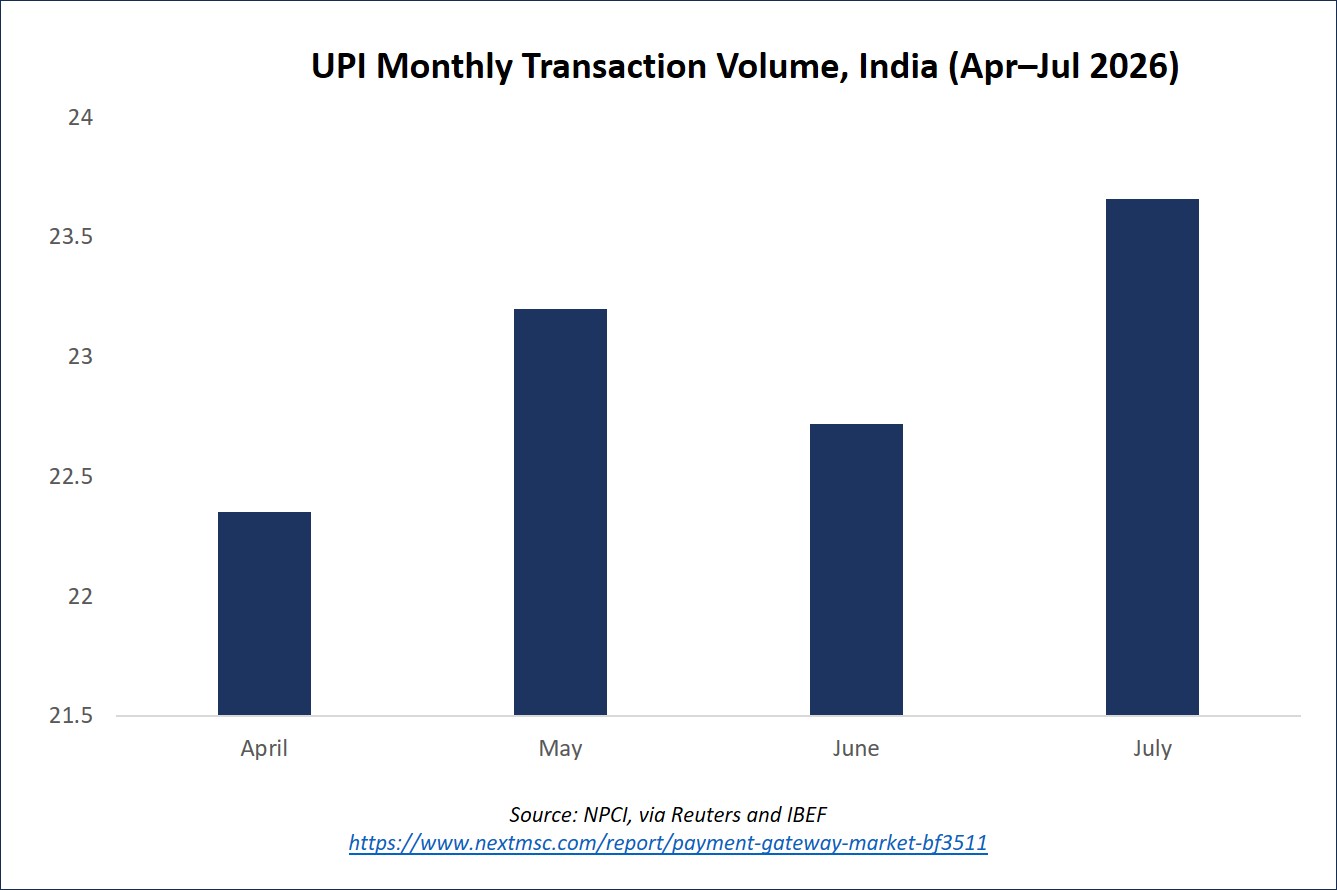
That trajectory shows up in the transaction data payment authorities are already publishing. India's National Payments Corporation of India (NPCI) recorded four straight months of near-record volume on its Unified Payments Interface (UPI) rail through the second quarter of 2026, with July setting a new high, per Reuters and India Brand Equity Foundation (IBEF), a Government of India trade body.
That growth curve isn't happening in a vacuum. It's being shaped in real time by two forces worth unpacking: an AI arms race among providers, and a wave of consolidation attempts among the biggest names in payments.
Section summary:
-
NMSC values the market at USD 52.40 billion in 2025, growing to USD 146.28 billion by 2030.
-
Independent NPCI data shows India's UPI rail hitting a new monthly transaction-volume record in July 2026, illustrating the real-world scale behind that forecast.
-
Growth is increasingly driven by AI capability and provider consolidation rather than payment-method proliferation alone.
How Is AI Reshaping Payment Gateway Fraud Prevention?
AI has moved from a nice-to-have to a switching factor. In Zoho's Indian Merchant Payments Survey 2026, covering more than 700 businesses ranging from small merchants to large enterprises, 78% of respondents said they would change their primary payment gateway if a competitor offered better AI capabilities. Roughly 60% of businesses surveyed were already using AI in their payment operations, with another 20% evaluating it and AI-driven fraud detection came out as the single most sought-after capability, ahead of automated reconciliation and smart payment routing.
That pressure is showing up on the provider side too. Adyen's Agentic product suite, launched alongside its H1 2026 results, is built specifically to let AI shopping agents transact with merchants directly, while fraud-focused vendors are increasingly pooling anonymized signals across regions and industries so that a new attack pattern spotted in one market can be blocked in another before it spreads. For gateways still running purely rules-based fraud checks, this is quickly becoming a competitive liability rather than a compliance checkbox. NMSC's own related coverage of how emerging technology is transforming mobile payments digs further into how AI and biometric authentication are reshaping the mobile checkout experience specifically.
Section summary:
-
AI capability is now a stated switching factor for the majority of merchants surveyed, not just a differentiator.
-
Adoption is already mainstream: roughly 8 in 10 businesses in the Zoho survey are either using or evaluating AI in payments.
-
Fraud detection, not automation or UX, is merchants' top-priority AI use case.
Consolidation Reshapes the Payment Processing Landscape
The clearest sign that payment gateways have become strategic assets rather than back-office utilities is the scale of M&A activity in 2026. Stripe and private equity firm Advent International offered PayPal $60.50 a share a bid valuing the company above $53 billion in mid-July, financed with roughly $50 billion in committed bank support, according to Reuters and Bloomberg reporting. PayPal's board initially judged the offer too low, and by mid-August the two sides were reportedly negotiating a higher price. By late August, however, Stripe and Advent walked away from the table, and PayPal's shares fell sharply the following morning, per Axios's reporting on the collapsed talks.
Whatever the ultimate outcome, the willingness of a developer-first payments platform to attempt a takeover of a legacy consumer wallet and PayPal's board pushing back on price rather than principal signals how much strategic value the market now places on owning the full payment stack, not just processing transactions on someone else's rails. Adyen, meanwhile, is pursuing the same ambition organically: its H1 2026 results showed processed volume of €803.8 billion, up 24% year-over-year, alongside acquisitions of incentives platform Talon.One and billing platform Orb, as it builds what the company describes as a full financial operating system rather than a narrower gateway. Our related look at the role payment gateways and other technologies play in business scalability covers how this kind of platform consolidation affects merchants choosing infrastructure today.
Section summary:
-
Stripe and Advent's pursuit of PayPal a $53 billion-plus bid made and later withdrawn in 2026 is the largest live consolidation story in payments.
-
Adyen is pursuing similar ambitions organically, growing processed volume 24% year-over-year in H1 2026 while acquiring adjacent platforms.
-
The common thread is providers racing to own the full payment stack rather than compete purely on transaction fees.
Market Segmentation and Regional Dynamics
NMSC segments the market by gateway architecture (hosted, on-site integrated, API-based, and direct bank connectors), enterprise size, payment method, end-use industry, and region each mapping to a distinct competitive dynamic rather than a single "one size fits all" buyer.
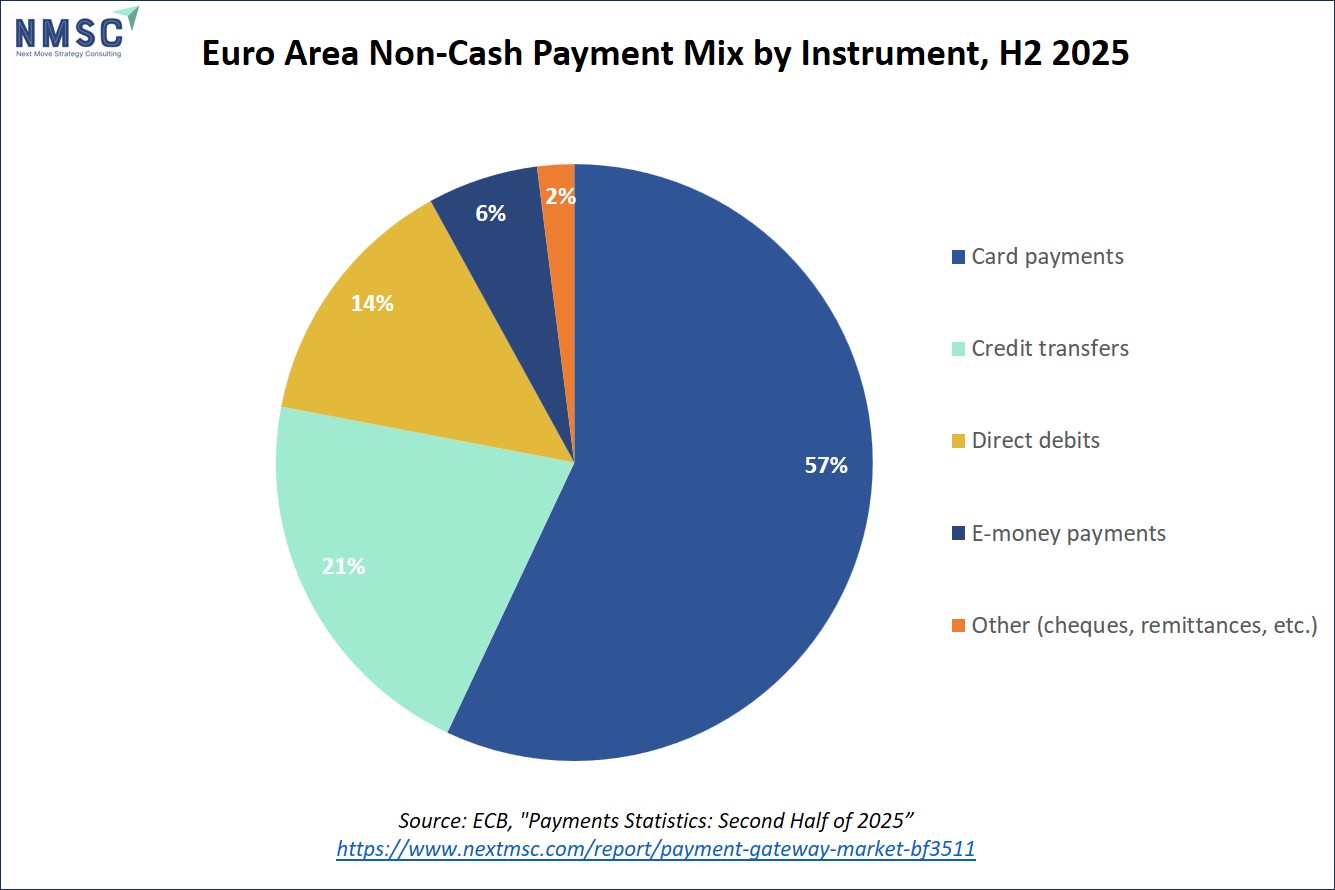
The payment-method piece of that picture shows up clearly in official European transaction data. Consumer payment preferences are also influencing how businesses approach payment acceptance, with Xero highlighting a gap between the payment methods customers prefer and those small businesses currently accept. Xero's payment preferences report explores payment preferences and the role of different payment options in supporting cash flow and customer satisfaction. The European Central Bank's semi-annual payments statistics show card payments holding a steady majority of non-cash transaction volume across the euro area, with credit transfers, direct debits and e-money making up most of the rest.
Euro Area Non-Cash Payment Mix by Instrument (H1 2024–H2 2025)
|
Instrument |
H1 2024 |
H2 2024 |
H1 2025 |
H2 2025 |
|
Card payments |
56% |
57% |
57% |
57% |
|
Credit transfers |
22% |
21% |
22% |
21% |
|
Direct debits |
15% |
15% |
14% |
14% |
|
E-money payments |
6% |
6% |
6% |
6% |
|
Other (cheques, remittances, etc.) |
1% |
1% |
1% |
2% |
North America remains the largest regional market on the back of high card and digital-wallet penetration, while Asia-Pacific is the fastest-growing region as mobile-first payment habits and rising financial inclusion pull more consumers and small merchants onto digital rails a trend the UPI volumes above help illustrate. Europe sits in between: a large, card-dominated base, consistent with the ECB figures, that's gradually opening up to cross-border and multi-currency gateway capabilities. Full methodology and country-level detail on the broader market are available in NMSC's Payment Gateway Market report.
For More Information: Download FREE Sample on Payment Gateway Market Report
Section summary:
-
NMSC's segmentation splits the market by gateway architecture, enterprise size, payment method, industry, and region.
-
Independent ECB data confirms cards remain the dominant non-cash instrument in Europe, holding a steady ~57% share through H2 2025.
-
Segmentation increasingly overlaps with the AI and consolidation trends above, since larger, API-first providers are best positioned to bundle in new capabilities quickly.
Future Outlook for the Payment Gateway Market
Three threads are likely to define the next few years of this market. First, AI capability will keep converging with core gateway infrastructure rather than sitting alongside it expect fraud scoring, reconciliation, and routing to be sold as a bundled package rather than add-ons. Second, further consolidation looks likely regardless of how the Stripe-PayPal situation ultimately resolves, since scaled providers like Adyen are demonstrating that owning more of the payment stack organically drives durable volume growth. Third, agentic and machine-initiated commerce payments triggered by AI shopping agents rather than a human clicking "buy” is moving from pilot to product, with major providers already shipping dedicated infrastructure for it.
For merchants and platforms choosing a gateway partner today, the practical takeaway is to weight AI roadmap and platform breadth alongside the usual criteria of fees, uptime, and geographic coverage because on current trends, those are becoming the same decision.
Section summary:
-
AI features are converging into core gateway infrastructure rather than remaining optional add-ons.
-
Consolidation pressure is likely to persist independent of any single deal's outcome.
-
Agentic commerce is an emerging category that forward-looking gateway providers are already building for.
Conclusion
The Payment Gateway Market's growth story from an estimated USD 52.40 billion in 2025 to a projected USD 146.28 billion by 2030 is no longer just about e-commerce volume climbing steadily upward. It's increasingly about which providers can combine AI-driven fraud prevention, broader platform capability, and enough scale to make a credible run at owning the full payment stack. The next twelve months, shaped by how the AI feature race and the industry's consolidation attempts play out, will say a lot about which model wins.
About the Author
 Sanyukta Deb
— Sanyukta Deb is Digital Marketing Team Lead at Next Move Strategy Consulting, where she has led content strategy and technical SEO for the firm's B2B market research publications for over 2 years. Her editorial process translates NextMSC's primary and secondary research — spanning technology, industrial, and consumer sectors — into commercial narratives, backed by search-intent, keyword, and competitive analysis. She brings 5 years of overall experience in digital marketing and content strategy.
Sanyukta Deb
— Sanyukta Deb is Digital Marketing Team Lead at Next Move Strategy Consulting, where she has led content strategy and technical SEO for the firm's B2B market research publications for over 2 years. Her editorial process translates NextMSC's primary and secondary research — spanning technology, industrial, and consumer sectors — into commercial narratives, backed by search-intent, keyword, and competitive analysis. She brings 5 years of overall experience in digital marketing and content strategy.
About the Reviewer
 Debashree Dey
— Debashree Dey is Assistant Manager at Next Move Strategy Consulting, where she supports cross-vertical market content and communications across diverse industries for 6 years. Her professional background includes senior content writing, communications, and published manuscript authorship, with experience developing audience-focused business narratives and maintaining clear, consistent messaging. Her role supports research-led content development and editorial quality across NextMSC publications.
Debashree Dey
— Debashree Dey is Assistant Manager at Next Move Strategy Consulting, where she supports cross-vertical market content and communications across diverse industries for 6 years. Her professional background includes senior content writing, communications, and published manuscript authorship, with experience developing audience-focused business narratives and maintaining clear, consistent messaging. Her role supports research-led content development and editorial quality across NextMSC publications.

















Add Comment