The Role of Payment Gateways and Other Technologies in Your Business's Scalability
When a business adds a new payment gateway to handle more digital wallets, cards, and QR codes, it is also expanding its exposure to fraud and 2026 has made that trade-off harder to ignore. According to Next Move Strategy Consulting's Fraud Detection and Prevention Market research, global revenue in this category was valued at USD 37.97 billion in 2023 and is projected to reach USD 117.01 billion by 2030, growing at a CAGR of 16.5%. That growth is not abstract for any business scaling its payment infrastructure: every new payment method, checkout flow, or real-time transfer option is also a new surface fraudsters can target, and the technology vendors building fraud defenses have had an unusually active year.
This review updates our earlier look at payment gateways and business scalability, re-centered on the fraud detection and prevention technology that increasingly determines whether a growing payment stack is actually safe to scale.
Why Payment Scalability and Fraud Prevention Are the Same Problem
Adding more ways to pay digital wallets, cards, QR codes, real-time bank transfers improves conversion, but each new method is also a new channel fraud teams have to monitor. Modern, ready-to-use payment gateways solve half of the scalability problem by handling checkout; the fraud detection and prevention layer sitting behind them solves the other half by verifying that the transactions flowing through are legitimate. Businesses that treat these as separate purchasing decisions a payment gateway here, a fraud tool there increasingly find themselves exposed exactly where the two systems don't talk to each other.
Fraud Detection and Prevention Market Overview
The fraud detection and prevention market spans fraud analytics, authentication, and governance-risk-compliance solutions, deployed across BFSI, government, healthcare, retail, and IT/telecom end users. Money laundering, credit and debit card fraud, mobile fraud, and identity fraud are the largest application categories NMSC tracks, and North America holds the largest regional share, driven by the concentration of major vendors and early enterprise adoption there. For a business evaluating payment infrastructure, the practical takeaway is that fraud prevention is no longer a back-office compliance line item it is now sized as a global technology category growing faster than most payment infrastructure markets themselves.
The Philippines Picture: A Fast-Growing Market Under Fraud Pressure
The original context for this review Filipino businesses scaling their payment infrastructure remains a useful lens. Digital payments accounted for 57.4% of all retail transactions in the Philippines in 2024, up from 52.8% a year earlier and ahead of the central bank's own target, according to the Bangko Sentral ng Pilipinas (BSP). That growth has come with a fraud cost: BSP-handled consumer complaints surged 72.6% to more than 120,000 in 2025, up from 70,112 in 2024, with unauthorized online transactions and account-protection issues among the leading concerns. As of September 2026, the BSP is also requiring payment platforms to more closely screen merchants after discovering thousands of illegal businesses including online casinos posing as beauty salons and bakeries operating on legitimate payment rails.
Philippines Digital Payments and Fraud Trends, 2024–2026
|
Metric |
Value |
Period |
|
Digital payments share of retail transactions |
57.4% (up from 52.8%) |
2024 |
|
BSP consumer complaints handled |
120,000+ (+72.6% YoY) |
2025 |
|
Deadline to phase out SMS/email OTPs for high-risk transactions (BSP Circular 1213) |
June 30, 2026 |
2026 |
Industry Leader Moves: Who's Building the Fraud Defenses Behind Payment Growth
The fraud detection and prevention industry includes IBM Corporation, Thales Group, Oracle Corporation, SAP SE, BAE Systems, F5, Inc., SAS Institute, NICE Actimize, Fair Isaac Corporation (FICO), and ACI Worldwide. Several of the largest have shipped substantial, dated developments in 2026 not evenly, so the most consequential get the most space here.
-
IBM Corporation introduced IBM Cyber Fraud, an AI-assisted fraud investigation platform, at its Think 2026 conference (May 2026). The platform automates data collection and orchestrates investigation workflows across fraud, payment, and security systems using natural-language-driven analysis, with IBM citing up to 90% faster investigations as a result.
-
Oracle Corporation secured rights to AI agent-driven financial-crime technology from Lucinity on April 9, 2026, embedding it into the Oracle AI Investigator platform as part of its Financial Crime and Compliance Management (FCCM) portfolio. Oracle executives have pointed to a persistent industry problem the deal targets directly: roughly 90% of alerts generated by traditional rule-based fraud systems are false positives.
-
NICE Actimize launched the Actimize Insights Network on January 27, 2026, giving financial institutions real-time visibility into counterparty risk across a shared intelligence network. In April 2026, the company's own Fraud Insights Report found attempted ACH fraud value grew 52% in 2025 while total ACH payment value grew just 11% a nearly 5-to-1 divergence the report says signals fraud shifting toward previously secondary payment rails. In June 2026, DNB Bank, Norway's largest financial services group, selected NICE Actimize's X-Sight Enterprise platform to overhaul its fraud and financial-crime operations.
-
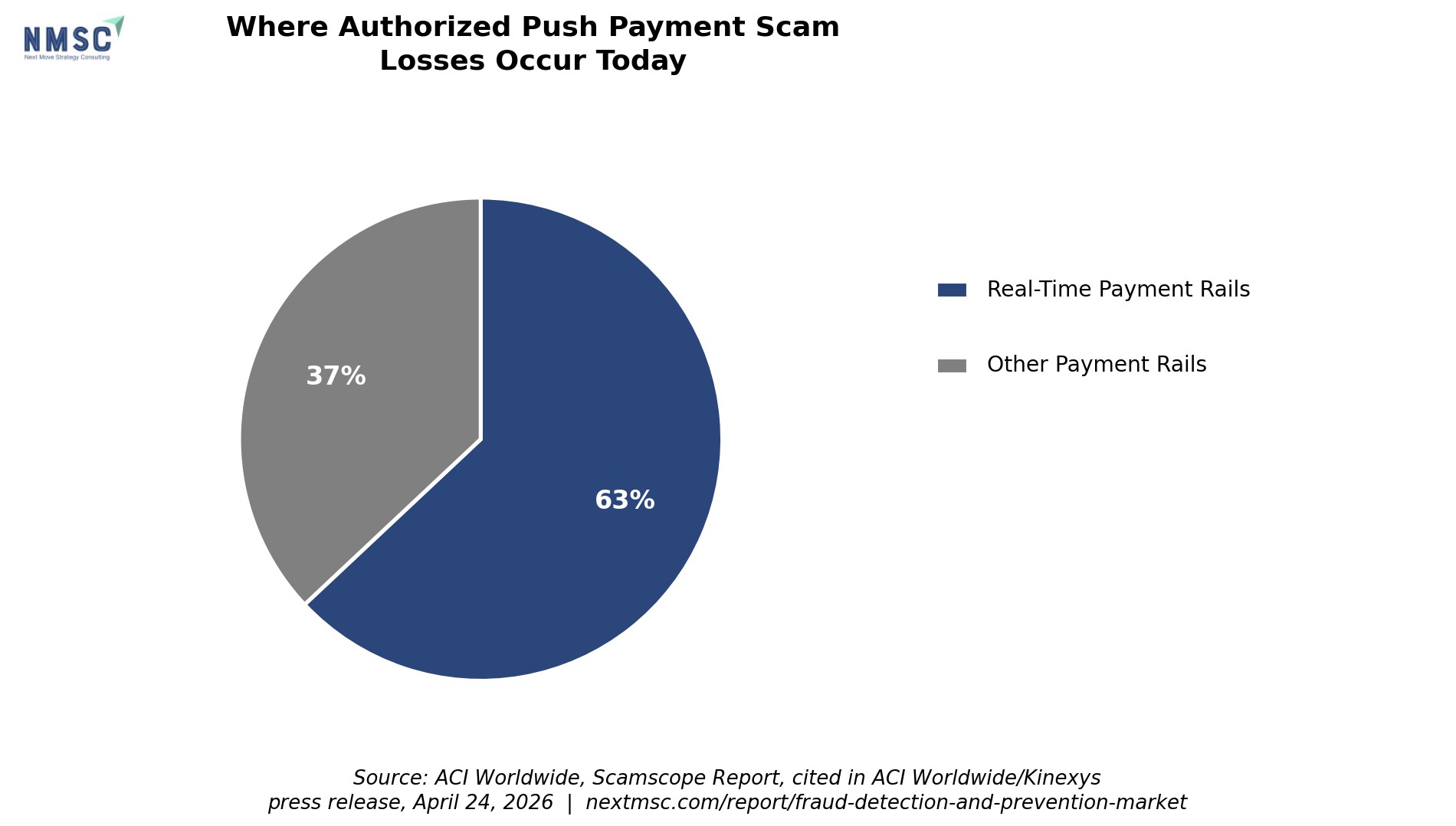
ACI Worldwide and Kinexys by J.P. Morgan announced on April 24, 2026 the integration of Kinexys Liink's Confirm application into ACI's Fraud and Financial Crime solution, embedding account and payee verification directly into real-time payment workflows. ACI's own Scamscope research, cited in the announcement, found authorized push payment (APP) scams generate USD 4.4 billion in losses globally today, projected to reach USD 7.6 billion by 2028, with 63% of those losses already occurring on real-time payment rails.
-
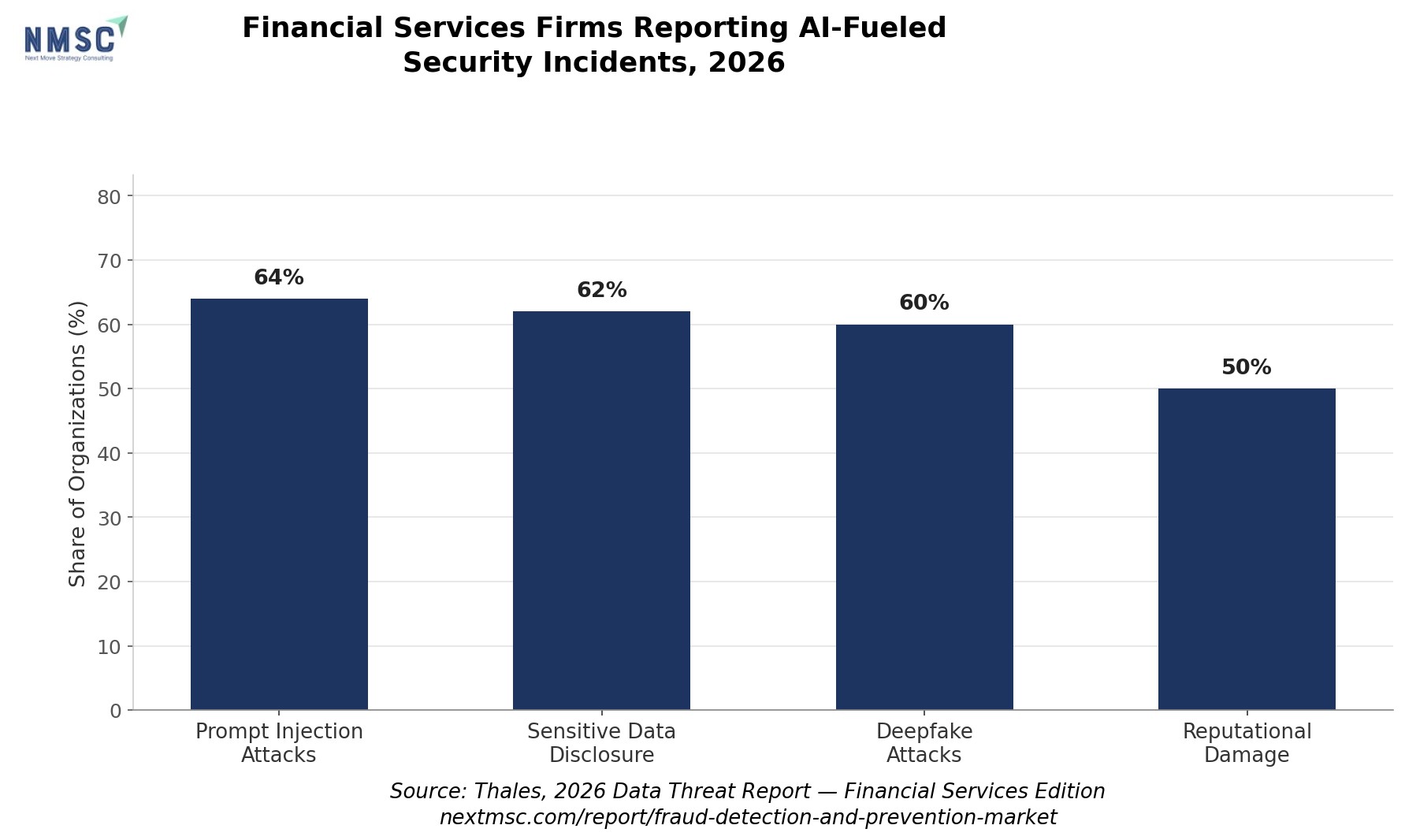
Thales Group published its 2026 Data Threat Report Financial Services Edition, surveying financial-services security leaders and finding 64% had suffered AI prompt-injection attacks, 62% experienced sensitive data disclosure, 60% faced deepfake attacks, and 50% suffered reputational damage from AI-fueled incidents. A companion 2026 Digital Trust Index found 93% of IT leaders are now using, deploying, or planning AI initiatives outpacing the trust infrastructure needed to secure them, per Thales.
-
F5, Inc. announced enhancements to F5 Distributed Cloud Bot Defense on September 15, 2026, adding device-intelligence capabilities and specialized detection for agentic AI automated AI agents now capable of completing multi-step transactions on a consumer's behalf. F5 said the update responds directly to AI agents becoming a legitimate new channel for banking and commerce interactions that older bot-blocking rules cannot safely distinguish from fraud.
Among the remaining leaders, SAP SE continues to rely on partner integrations including F5's bot-defense technology to protect its Customer Data Cloud platform from credential stuffing and account-takeover attacks, while SAS Institute, BAE Systems, and FICO continued incremental platform updates to their respective analytics and Falcon fraud-scoring products without a comparably sized disclosed development in the period reviewed.
Fraud Detection and Prevention Industry Leader Moves, 2026
|
Company |
Move |
Date |
Disclosed metric |
|
IBM Corporation |
Launched IBM Cyber Fraud AI investigation platform |
May 2026 |
Up to 90% faster investigations |
|
Oracle Corporation |
Secured Lucinity AI financial-crime technology |
Apr 9, 2026 |
Not disclosed |
|
NICE Actimize |
Launched Actimize Insights Network |
Jan 27, 2026 |
1,000+ institutions on platform |
|
NICE Actimize |
Published 2026 Fraud Insights Report |
Apr 28, 2026 |
ACH fraud value +52% YoY |
|
ACI Worldwide |
Integrated Kinexys Liink Confirm with J.P. Morgan |
Apr 24, 2026 |
APP scams: $4.4B → $7.6B by 2028 |
|
Thales Group |
Published 2026 Data Threat Report (FinServ) |
2026 |
64% suffered prompt-injection attacks |
|
F5, Inc. |
Added agentic-AI detection to Bot Defense |
Sep 15, 2026 |
Not disclosed |
Section summary
2026's fraud-technology moves cluster around two themes: real-time verification embedded directly into payment workflows, and new defenses built specifically for AI-generated fraud deepfakes, prompt injection, and autonomous AI agents completing transactions.
-
IBM and Oracle both launched AI-agent-driven investigation platforms in 2026, aiming at the false-positive problem that dominates traditional rule-based fraud detection.
-
NICE Actimize and ACI Worldwide data both point to the same shift: fraud is moving fastest onto real-time and previously secondary payment rails (ACH, instant transfers).
-
Thales's research suggests the industry's own AI adoption is outpacing its AI security readiness, with prompt injection and deepfakes now common attack vectors.
The Real-Time Payments Fraud Problem
Real-time and instant payment rails are, by design, difficult to claw back once funds move which is exactly why fraud is concentrating there. ACI Worldwide's Scamscope research puts 63% of today's authorized push payment scam losses on real-time payment rails already, a share the firm expects to approach 80% within three years as instant payments keep growing. For any business integrating real-time transfer options into its payment stack, this is the clearest signal yet that fraud controls need to run before settlement, not after it.
Section summary
Real-time payments are becoming the primary battleground for payment fraud, which is why leading vendors are moving verification earlier in the transaction flow rather than relying on post-transaction monitoring alone.
-
63% of APP scam losses already occur on real-time payment rails, according to ACI Worldwide a share projected to approach 80% within three years.
-
Total APP scam losses are projected to grow from USD 4.4 billion today to USD 7.6 billion by 2028.
-
ACI and NICE Actimize's 2026 data both show fraud value growing several times faster than legitimate payment volume on the rails it targets.
Key Considerations for Payment and Fraud Prevention Technology
-
Match payment preferences without adding fraud blind spots. Supporting more payment methods only helps if each new method is covered by the same fraud-monitoring layer as the rest.
-
Verify before settlement, not after. Real-time and instant payment rails settle irrevocably, so account and payee verification needs to happen inside the transaction flow, as ACI Worldwide and J.P. Morgan's integration illustrates.
-
Plan for AI-generated fraud specifically. Deepfakes and prompt-injection attacks are no longer edge cases Thales found more than 60% of financial services firms had already encountered them by 2026.
-
Screen merchants and partners, not just transactions. The BSP's 2026 crackdown on disguised online casinos shows fraud risk can sit at the merchant-onboarding level, not only inside individual transactions.
-
Consolidate rather than bolt on. Businesses evaluating checkout platforms increasingly favor providers that build payment breadth and fraud controls into a single stack; Whop, for instance, pairs a large built-in payment-method footprint with the account and transaction monitoring that broad payment coverage requires.
Future Outlook for the Fraud Detection and Prevention Market
NMSC's 16.5% CAGR forecast through 2030 assumes fraud and payment volumes keep growing together, and 2026's vendor activity supports that: IBM and Oracle are both racing to fix the false-positive problem with agentic AI, while F5's move into agentic-AI bot detection signals vendors are already preparing for a near-term world where AI agents not just humans initiate transactions. For businesses in fast-digitizing markets like the Philippines, where digital payments now exceed retail-transaction targets set by regulators, the fraud detection and prevention market is no longer a downstream compliance purchase it is becoming a precondition for scaling payment infrastructure at all.
Section summary
The fraud detection and prevention market's growth is increasingly driven by the same AI capabilities powering the fraud it defends against, making vendor selection a strategic decision rather than a compliance checkbox.
-
IBM, Oracle, and NICE Actimize are all deploying agentic AI to cut investigation time and false-positive rates.
-
F5's move into agentic-AI bot detection suggests the industry expects AI-agent-initiated transactions to become a mainstream fraud vector.
-
Fast-digitizing payment markets, illustrated by the Philippines' BSP data, show fraud complaint growth can outpace even rapid digital-payment adoption.
|
Segment-level forecasts, regional data, and full competitive benchmarking sit behind the figures cited in this review. |
Conclusion
The business case for a modern payment gateway hasn't changed: fewer abandoned carts, more supported payment methods, better checkout experience. What has changed is that this case can no longer be made separately from the fraud detection and prevention market sitting behind it. As 2026's vendor activity shows, the companies leading this space are moving verification earlier into the transaction, building defenses against AI-generated fraud specifically, and racing to fix the false-positive problem that has made fraud tools frustrating for legitimate customers. For any business scaling its payment infrastructure in the Philippines or anywhere else that is now part of the same decision, not a separate one.
About the Author
 Sanyukta Deb
— Sanyukta Deb is Digital Marketing Team Lead at Next Move Strategy Consulting, where she has led content strategy and technical SEO for the firm's B2B market research publications for over 2 years. Her editorial process translates NextMSC's primary and secondary research — spanning technology, industrial, and consumer sectors — into commercial narratives, backed by search-intent, keyword, and competitive analysis. She brings 5 years of overall experience in digital marketing and content strategy.
Sanyukta Deb
— Sanyukta Deb is Digital Marketing Team Lead at Next Move Strategy Consulting, where she has led content strategy and technical SEO for the firm's B2B market research publications for over 2 years. Her editorial process translates NextMSC's primary and secondary research — spanning technology, industrial, and consumer sectors — into commercial narratives, backed by search-intent, keyword, and competitive analysis. She brings 5 years of overall experience in digital marketing and content strategy.
About the Reviewer
 Debashree Dey
— Debashree Dey is Assistant Manager at Next Move Strategy Consulting, where she supports cross-vertical market content and communications across diverse industries for 6 years. Her professional background includes senior content writing, communications, and published manuscript authorship, with experience developing audience-focused business narratives and maintaining clear, consistent messaging. Her role supports research-led content development and editorial quality across NextMSC publications.
Debashree Dey
— Debashree Dey is Assistant Manager at Next Move Strategy Consulting, where she supports cross-vertical market content and communications across diverse industries for 6 years. Her professional background includes senior content writing, communications, and published manuscript authorship, with experience developing audience-focused business narratives and maintaining clear, consistent messaging. Her role supports research-led content development and editorial quality across NextMSC publications.

















Add Comment