AI Chips Rise as GPUs Become Core AI Infrastructure
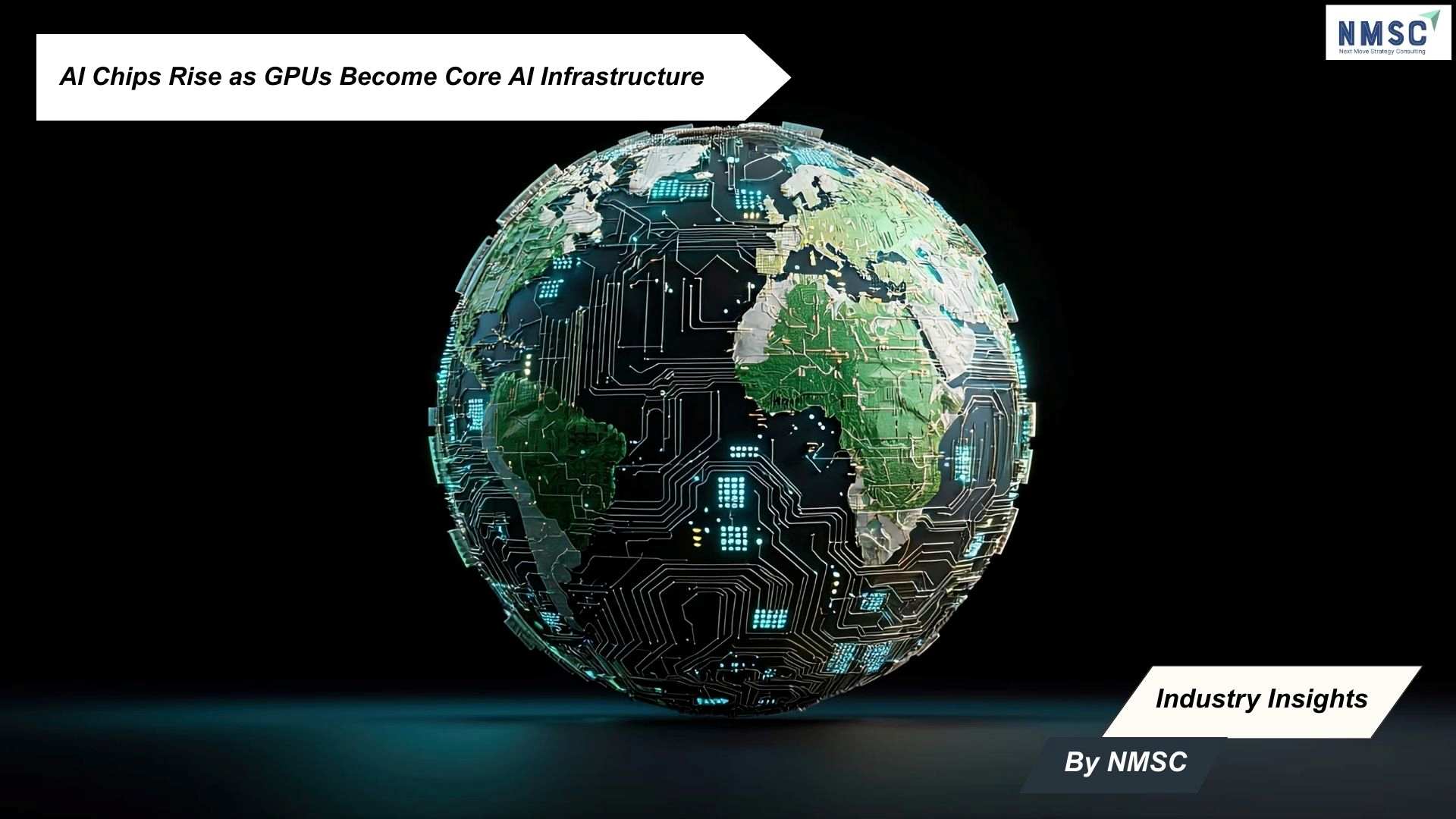
Industry Insights from Next Move Strategy Consulting
Artificial Intelligence (AI) chips are rapidly becoming the foundation of modern computing as demand for AI-driven workloads accelerates. Central to this shift are graphics processing units (GPUs), which have moved far beyond their original gaming focus to become essential hardware for artificial intelligence. NVIDIA’s GPUs, ranging from GeForce products to data center AI chips highlight how specialized processors are now shaping the direction of both consumer and enterprise computing.
A Strategic Shift Beyond Traditional Computing
For years, GPUs were primarily associated with gaming and visual performance. However, their ability to process large volumes of data simultaneously has made them ideally suited for artificial intelligence tasks. This capability has driven their adoption across AI training and inference, positioning GPUs as a critical alternative to traditional processors for compute-intensive workloads.
NVIDIA’s expansion across consumer and data center segments reflects this broader transition, as its GPUs increasingly serve as the backbone for AI applications rather than niche performance enhancers.
Powering AI at Scale
AI workloads demand exceptional processing capability, particularly as models grow larger and more complex. Data center AI chips built on GPU architecture address these requirements by enabling faster computation and greater efficiency. At the same time, GeForce GPUs continue to support consumer-driven innovation, reinforcing the dual role of GPUs across multiple computing environments.
This convergence underscores how AI chips are no longer confined to specialized use cases but are becoming standard components of modern digital infrastructure.
Market Attention and Strategic Importance
The growing reliance on AI chips has elevated their significance within the technology and investment landscape. GPUs tied to AI computing are increasingly viewed as strategic assets, reflecting confidence in the long-term expansion of artificial intelligence. Their rising prominence illustrates how closely AI chip demand is linked to broader trends in AI adoption and innovation.
Next Move Strategy Consulting’s View
From the perspective of Next Move Strategy Consulting, Artificial Intelligence (AI) Chip Market represent a structural shift in computing priorities rather than a short-term technology cycle. The expanding role of GPUs across consumer and data center environments demonstrates how parallel-processing hardware is becoming essential to AI advancement. As artificial intelligence continues to scale, AI chips that combine performance efficiency with broad applicability are expected to remain central to computing strategies, reinforcing their long-term relevance in the global technology landscape.
Defining the Future of AI Computing
As artificial intelligence becomes deeply embedded across industries, AI chips will play a decisive role in enabling performance and scalability. NVIDIA’s GPU-driven approach illustrates how AI-optimized hardware is redefining computing expectations, signaling a future where specialized AI chips are integral to digital transformation.
Source: ad-hoc-news.de
Prepared by: Next Move Strategy Consulting
About the Author
 Sanyukta Deb
— Sanyukta Deb is Digital Marketing Team Lead at Next Move Strategy Consulting, where she has led content strategy and technical SEO for the firm's B2B market research publications for over 2 years. Her editorial process translates NextMSC's primary and secondary research — spanning technology, industrial, and consumer sectors — into commercial narratives, backed by search-intent, keyword, and competitive analysis. She brings 5 years of overall experience in digital marketing and content strategy.
Sanyukta Deb
— Sanyukta Deb is Digital Marketing Team Lead at Next Move Strategy Consulting, where she has led content strategy and technical SEO for the firm's B2B market research publications for over 2 years. Her editorial process translates NextMSC's primary and secondary research — spanning technology, industrial, and consumer sectors — into commercial narratives, backed by search-intent, keyword, and competitive analysis. She brings 5 years of overall experience in digital marketing and content strategy.
About the Reviewer
 Debashree Dey
— Debashree Dey is Assistant Manager at Next Move Strategy Consulting, where she supports cross-vertical market content and communications across diverse industries for 6 years. Her professional background includes senior content writing, communications, and published manuscript authorship, with experience developing audience-focused business narratives and maintaining clear, consistent messaging. Her role supports research-led content development and editorial quality across NextMSC publications.
Debashree Dey
— Debashree Dey is Assistant Manager at Next Move Strategy Consulting, where she supports cross-vertical market content and communications across diverse industries for 6 years. Her professional background includes senior content writing, communications, and published manuscript authorship, with experience developing audience-focused business narratives and maintaining clear, consistent messaging. Her role supports research-led content development and editorial quality across NextMSC publications.
















Add Comment