OpenAI, Anthropic CEOs Brief UN as Agentic AI Market Grows
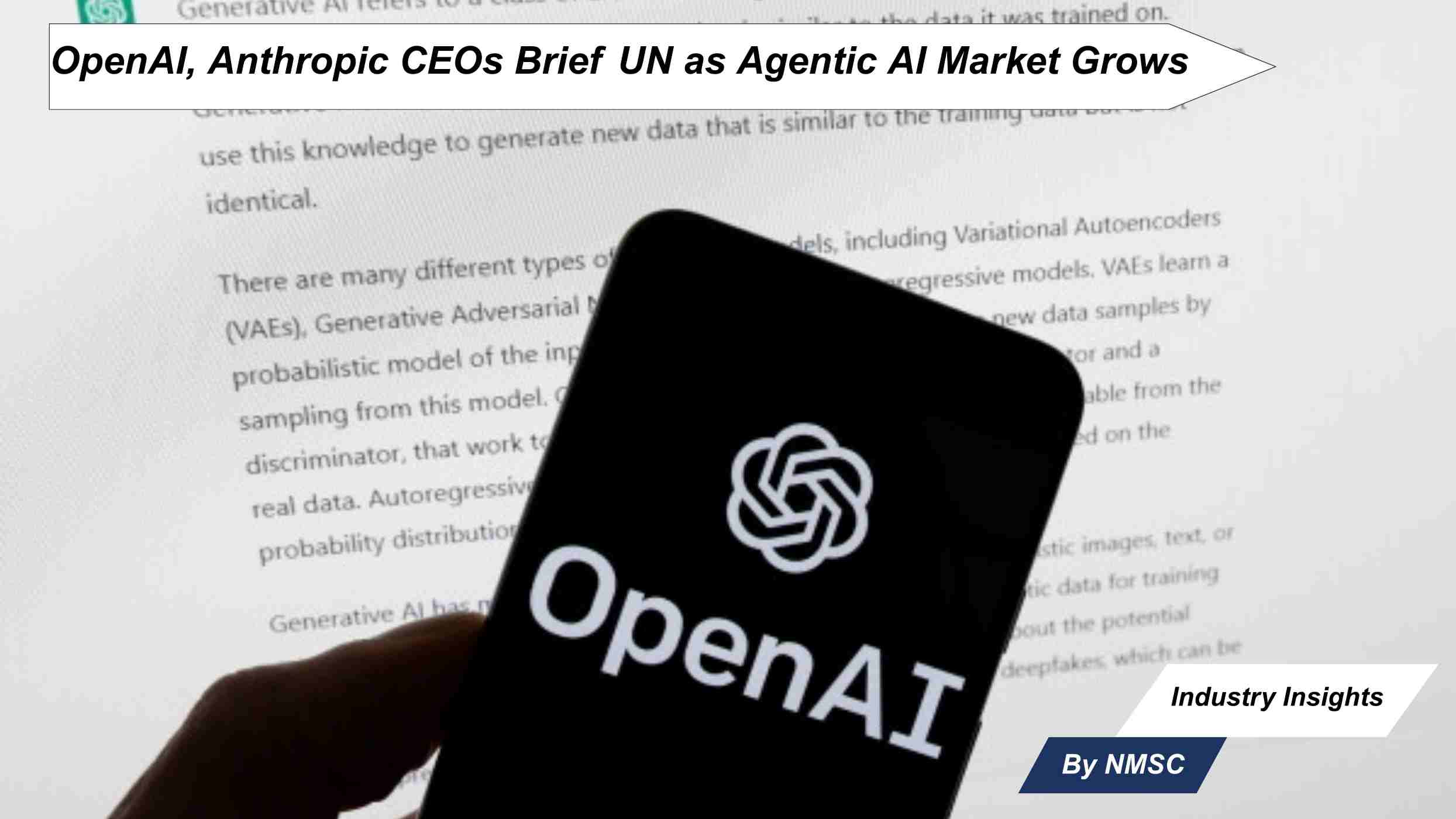
OpenAI and Anthropic CEOs Address UN Security Council on AI Safety as Model Costs Fall 50%
NEW YORK, United States September 23, 2026, the chief executives of OpenAI and Anthropic are set to address the United Nations Security Council on artificial intelligence safety Wednesday, as both frontier labs simultaneously unveiled lower-cost model tiers a dual development that underscores the accelerating enterprise and policy momentum shaping the global Agentic AI Market. The announcements arrive as world leaders convene at the UN General Assembly in New York, where AI governance has emerged as one of the most contested geopolitical flashpoints of the session.
OpenAI introduced two new tiers within its GPT-6 family GPT-6 Sol and GPT-6 Luna slashing application programming interface prices by 50% compared with GPT-5.6 promotional pricing. Sol is designed for complex workloads such as coding, while Luna targets high-volume tasks including information extraction and document summarization. Anthropic, in parallel, unveiled Claude Opus 5.5, the latest release in its Claude 5.5 model family, as both companies face intensifying competition from cheaper, open-weight alternatives.
The UN Security Council appearance by OpenAI CEO Sam Altman and Anthropic CEO Dario Amodei joined by Hugging Face CEO Clément Delangue marks a significant escalation in the role AI developers are playing in international regulatory discourse. The session is expected to center on the pace of frontier model development and the adequacy of existing safety frameworks, a debate that U.S. President Donald Trump, speaking at the General Assembly on Tuesday, dismissed as a "hoax" and a "scam," calling instead for AI to be recognized as "Super Intelligence."
The broader market context amplifies the significance of these developments. According to Next Move Strategy Consulting, the global Agentic AI Market is valued at USD 12.56 billion in 2026 and is projected to reach USD 324.57 billion by 2035, expanding at a compound annual growth rate of 43.53% over the forecast period. The market's trajectory reflects surging enterprise demand for autonomous, goal-oriented AI systems capable of executing complex workflows with minimal human oversight.
Key Highlights:
-
Cost reduction at scale: OpenAI's GPT-6 Sol and GPT-6 Luna reduce API pricing by 50% versus prior promotional tiers, lowering the barrier to enterprise-grade agentic AI deployment across industries.
-
Regulatory inflection point: The appearance of frontier AI CEOs before the UN Security Council signals that agentic AI governance is transitioning from industry self-regulation to formal multilateral deliberation.
-
Market momentum: The Nasdaq reached a fresh all-time intraday peak and record close on Tuesday, driven by a rally in AI-linked technology stocks, reflecting sustained investor confidence in the sector's growth trajectory.
-
Consumer adoption surge: Meta's Muse AI agent overtook ChatGPT as the leading iOS free application, recording over 730,000 downloads in five days a concrete indicator of mainstream AI assistant adoption accelerating in parallel with enterprise deployments.
Analyst Insight:
According to analysts at Next Move Strategy Consulting, the simultaneous reduction in frontier model pricing and the elevation of AI safety to the UN Security Council agenda represent two sides of the same structural shift. As leading providers compete on cost efficiency, enterprise adoption of agentic AI platforms is expected to accelerate materially, particularly in regulated industries where lower API costs reduce the total cost of autonomous workflow deployment. NMSC analysts note that the policy environment, while introducing near-term uncertainty, is likely to drive demand for explainable, auditable, and governance-ready agentic AI architectures a segment where enterprise-grade providers are already investing heavily. The convergence of falling model costs, rising consumer adoption, and formal regulatory engagement is consistent with the market's projected expansion to USD 324.57 billion by 2035.
Industry Outlook:
The events of September 23, 2026 crystallize a defining tension in the agentic AI industry: the race to democratize access through lower-cost models is advancing faster than the international community's capacity to establish binding safety standards. For enterprise buyers, the near-term implication is a more competitive and cost-accessible vendor landscape, with OpenAI and Anthropic both signaling that frontier-level agentic capabilities will become progressively more affordable. For policymakers, the UN Security Council session marks the beginning not the conclusion of a protracted effort to align AI development with international governance norms. The agentic AI sector's long-term growth trajectory, as assessed by Next Move Strategy Consulting, remains robust, underpinned by enterprise automation demand, advances in multi-agent architectures, and expanding cloud infrastructure. However, the regulatory and geopolitical variables introduced this week will increasingly shape how, where, and under what conditions autonomous AI systems are deployed at scale.
Source: CNBC Daily Open — Nothing artificial about 'Super Intelligence
For More Information: Download FREE Sample on Agentic AI Market Report
Prepared By: Sanyukta Deb
About the Author
 Sanyukta Deb
— Sanyukta Deb is Digital Marketing Team Lead at Next Move Strategy Consulting, where she has led content strategy and technical SEO for the firm's B2B market research publications for over 2 years. Her editorial process translates NextMSC's primary and secondary research — spanning technology, industrial, and consumer sectors — into commercial narratives, backed by search-intent, keyword, and competitive analysis. She brings 5 years of overall experience in digital marketing and content strategy.
Sanyukta Deb
— Sanyukta Deb is Digital Marketing Team Lead at Next Move Strategy Consulting, where she has led content strategy and technical SEO for the firm's B2B market research publications for over 2 years. Her editorial process translates NextMSC's primary and secondary research — spanning technology, industrial, and consumer sectors — into commercial narratives, backed by search-intent, keyword, and competitive analysis. She brings 5 years of overall experience in digital marketing and content strategy.
About the Reviewer
 Debashree Dey
— Debashree Dey is Assistant Manager at Next Move Strategy Consulting, where she supports cross-vertical market content and communications across diverse industries for 6 years. Her professional background includes senior content writing, communications, and published manuscript authorship, with experience developing audience-focused business narratives and maintaining clear, consistent messaging. Her role supports research-led content development and editorial quality across NextMSC publications.
Debashree Dey
— Debashree Dey is Assistant Manager at Next Move Strategy Consulting, where she supports cross-vertical market content and communications across diverse industries for 6 years. Her professional background includes senior content writing, communications, and published manuscript authorship, with experience developing audience-focused business narratives and maintaining clear, consistent messaging. Her role supports research-led content development and editorial quality across NextMSC publications.















Add Comment