AI Safety Software Market Surges on Regulatory Push
CompScience's NSC-Backed AI Platform Launch Signals Structural Shift in Workplace Safety Technology as BLS Reports 5,070 U.S. Occupational Fatalities in 2024 and ILO Estimates Nearly 3 Million Work-Related Deaths Annually
CompScience Deploys AI-Powered Safe Work Plan, Anchoring a New Era of Proactive Occupational Risk Management
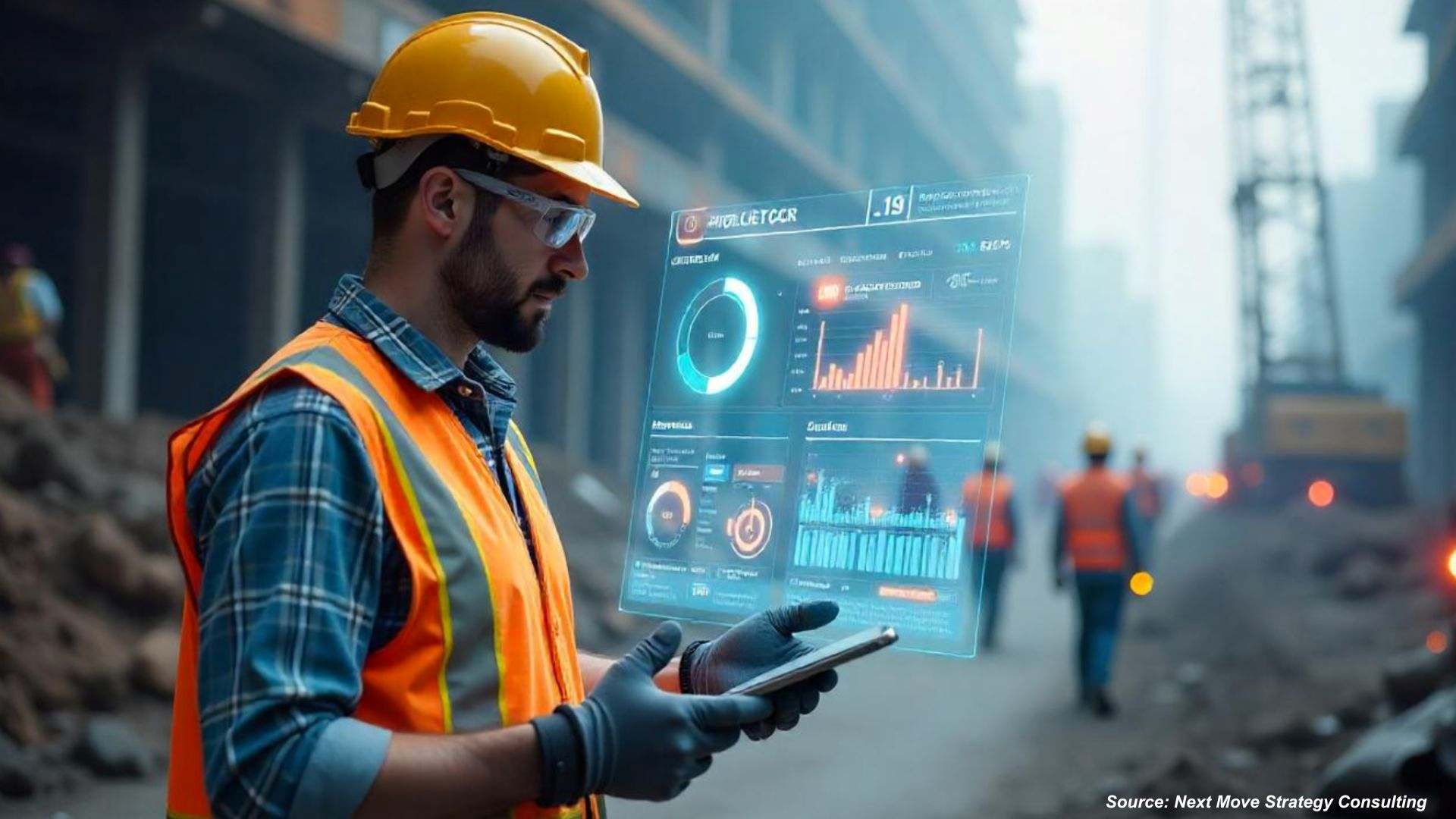
On April 14, 2026, CompScience—a technology-enabled managing general agent (MGA) specializing in workers' compensation insurance—formally launched its Safe Work Plan platform, a mobile AI application built in direct partnership with the National Safety Council (NSC) and modeled on the NSC's Serious Incident and Fatality (SIF) Prevention Model. The platform enables frontline workers to photograph a worksite using a smartphone, whereupon the AI system identifies tasks, environmental conditions, and potential hazards within seconds, generates risk scores, and produces OSHA-compliant documentation automatically.
The platform is currently being piloted by Tesla and Conagra, and CompScience has made a free version available to all employers—including small businesses—signaling a deliberate strategy to democratize AI-driven hazard analysis beyond large enterprise accounts.
"Our AI is empowering safety professionals with real-time intelligence about critical safeguards and high hazard work," said Josh Butler, CEO of CompScience. "It enables frontline workers to engage in safety planning on a deeper level, augmenting their ability to see risks earlier and act before injuries occur."
The launch arrives at a moment of acute urgency for occupational safety stakeholders globally. The U.S. Bureau of Labor Statistics (BLS), in its Census of Fatal Occupational Injuries Summary released on February 19, 2026, reported 5,070 fatal work injuries in the United States in 2024—a 4.0 percent decline from 5,283 in 2023, yet still representing a worker death every 104 minutes. The fatal work injury rate stood at 3.3 fatalities per 100,000 full-time equivalent (FTE) workers in 2024.
These developments are reshaping the competitive and investment landscape of the global AI Workplace Safety Software Market, which according to Next Move Strategy Consulting was valued at USD 1.42 billion in 2025 and is projected to reach USD 8.77 billion by 2035, expanding at a compound annual growth rate (CAGR) of 20.0 percent over the 2026–2035 forecast period.
For More Information: Download FREE Sample on AI Workplace Safety Software Market Report
Global Occupational Fatality Burden Establishes the Structural Demand Case
The scale of the global occupational safety crisis provides the foundational demand driver for AI-powered safety software. According to the International Labour Organization (ILO), nearly three million workers die every year due to work-related accidents and diseases—an increase of more than 5 percent compared to 2015. Of this total, 2.6 million deaths stem from work-related diseases, while work accidents account for an additional 330,000 deaths annually. The ILO further estimates that 395 million workers worldwide sustained non-fatal work injuries in the same reference period.
The Asia and Pacific region bears the heaviest burden, accounting for 63 percent of global work-related mortality—a direct consequence of the region's workforce scale and the concentration of high-hazard industries including agriculture, construction, and manufacturing. Agriculture, construction, forestry, fishing, and manufacturing collectively account for 200,000 fatal occupational injuries per year, representing 63 percent of all fatal occupational injuries globally. One in three fatal occupational injuries worldwide occurs among agricultural workers.
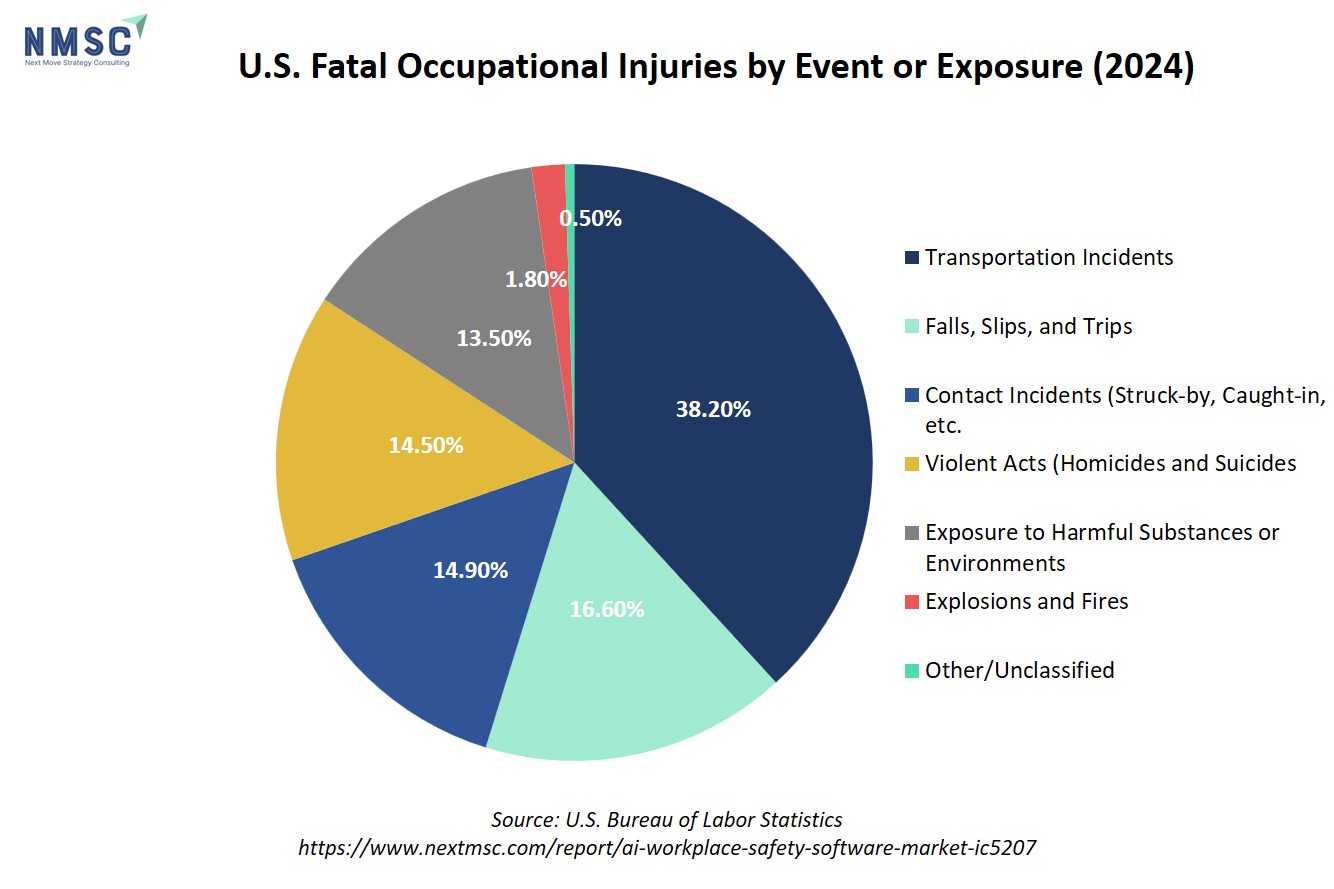
In the United States, the BLS data reveals that construction and extraction workers experienced 1,032 fatalities in 2024, while transportation incidents remained the most frequent fatal event category, accounting for 38.2 percent of all occupational fatalities. Falls, slips, and trips—a category directly addressable by AI-powered proximity monitoring and hazard detection software—accounted for 844 fatalities in 2024.
U.S. Fatal Injury Causes: Mapping the AI Intervention Opportunity
The BLS breakdown of fatal occupational injuries by event or exposure in 2024 provides a precise map of where AI workplace safety software can deliver the highest preventive impact. Transportation incidents (1,937 fatalities; 38.2% of total) remain the dominant cause, followed by falls, slips, and trips (844; 16.6%), contact incidents including struck-by events (756; 14.9%), violent acts (733; 14.5%), and exposure to harmful substances or environments (687; 13.5%). Explosions and fires accounted for 93 fatalities (1.8%).
Computer vision platforms capable of detecting proximity risks, PPE non-compliance, and unsafe behavior in real time are directly positioned to reduce fatalities in the falls, contact, and transportation categories—which together account for approximately 70 percent of all U.S. occupational fatalities. This alignment between AI capability and the leading causes of workplace death constitutes the core commercial rationale for the sector's projected sixfold revenue expansion through 2035.
Market Intelligence: Segmentation, Regional Dynamics, and Competitive Architecture
According to Next Move Strategy Consulting's analysis, the AI workplace safety software market is structured across three primary offering categories: Safety Management, Safety Monitoring, and Safety Intelligence. Safety Management—encompassing incident and case management, audit and inspection management, risk management, and training and competency management—held the largest share at approximately 45 percent (USD 639 million) in 2025. Safety Intelligence, which applies predictive analytics and generative AI copilots to leading-indicator data, is the fastest-growing sub-segment, expanding at a 25.8 percent CAGR from 2026 to 2035.
By deployment model, cloud infrastructure dominated with approximately 58 percent revenue share (USD 824 million) in 2025, reflecting its lower upfront infrastructure requirements and rapid multi-site rollout capability. Edge deployment—critical for latency-sensitive computer vision applications in remote mining, oil and gas, and construction environments—is the fastest-growing deployment model at a 27.0 percent CAGR from 2026 to 2035, as operators in connectivity-constrained environments increasingly require on-device inference without continuous cloud dependency.
North America leads the global market with approximately 38 percent revenue share (USD 540 million) in 2025, anchored by mature enterprise camera infrastructure, high computer vision vendor concentration, and OSHA recordkeeping requirements that sustain demand for automated hazard documentation. Asia-Pacific is the fastest-growing region, projected to expand at a 24.2 percent CAGR from 2026 to 2035, driven by expanding manufacturing capacity in China and India and accelerating industrial digitalization investment. India is the fastest-growing individual country market at a 28.8 percent CAGR, reflecting rapidly expanding manufacturing and construction activity alongside government-linked industrial safety mandates.
U.S. Fatal Work Injuries by Selected Private Industry — Number and Rate (2024)
|
Industry Sector |
Fatal Work Injuries (Count) |
Fatal Work Injury Rate (per 100,000 FTE Workers) |
|
Construction |
1,034 |
9.2 |
|
Transportation and Warehousing |
865 |
12.2 |
|
Agriculture, Forestry, Fishing, and Hunting |
475 |
20.9 |
|
Manufacturing |
353 |
2.4 |
|
Leisure and Hospitality |
273 |
2.4 |
|
Retail Trade |
258 |
1.8 |
|
Other Services (excl. Public Admin.) |
236 |
3.3 |
|
Educational and Health Services |
160 |
0.7 |
|
Wholesale Trade |
145 |
4.6 |
|
Mining, Quarrying, and Oil and Gas Extraction |
92 |
13.8 |
|
All Private Industry Total |
4,026 |
3.2 |
Regulatory Digitalization: OSHA, EU-OSHA, and ISO 45001 as Market Catalysts
The regulatory architecture governing occupational safety and health is undergoing a structural shift toward digital documentation, proactive hazard identification, and data-driven compliance reporting—a transition that directly expands the addressable market for AI workplace safety software.
In the United States, OSHA's recordkeeping requirements under 29 CFR Part 1904 mandate that employers maintain accurate logs of work-related injuries and illnesses, with electronic submission requirements for establishments above specified size thresholds. AI-powered EHS platforms that automate OSHA 300/300A log generation, incident classification, and regulatory reporting are increasingly positioned as compliance infrastructure rather than discretionary technology investments. OSHA conducted 34,696 total federal inspections in fiscal year 2024, maintaining enforcement pressure that incentivizes proactive digital safety management adoption.
In Europe, the EU Framework Directive on Occupational Safety and Health (Directive 89/391/EEC) and the growing adoption of ISO 45001—the international standard for occupational health and safety management systems—are compelling enterprises across Germany, France, and the United Kingdom to implement structured, auditable safety management workflows. Privacy-by-design computer vision architectures that comply with the General Data Protection Regulation (GDPR) are emerging as a procurement prerequisite in European enterprise tenders, creating a differentiation axis that favors vendors with certified anonymization capabilities.
The ILO's Global Strategy on Occupational Safety and Health for 2024–2030, launched in November 2023, further reinforces the regulatory momentum by encouraging member states to improve national OSH frameworks, strengthen coordination and investment in occupational safety, and enhance workplace OSH management systems aligned with ILO-OSH 2001 principles.
Technology Trends: Computer Vision, Generative AI Copilots, and Edge Deployment
Four structural technology trends are reshaping product development and vendor positioning across the AI workplace safety software sector.
Computer Vision Integration with Existing CCTV Infrastructure: Platforms that deploy across existing camera networks without requiring new hardware investment are displacing periodic manual safety walkthroughs with continuous, real-time hazard detection. Vendors such as Voxel AI and Intenseye have demonstrated deployment timelines of 48 hours or less across multi-site manufacturing and logistics facilities, enabling proactive detection of PPE violations, unsafe behavior, and proximity risks at scale.
Generative AI Safety Copilots: The emergence of generative AI tools capable of summarizing incidents, drafting corrective actions, and responding to natural-language safety queries is addressing a critical operational bottleneck for EHS teams facing growing documentation workloads. Protex AI's Copilot tool—which analyzes visual data to deliver contextual safety recommendations—exemplifies this trend, with enterprise customers reporting measurable reductions in incident rates and improvements in near-miss reporting consistency.
Privacy-Preserving Architecture as a Procurement Requirement: Worker privacy and surveillance concerns are compelling vendors to embed anonymization, role-based access controls, and non-facial-recognition detection into their platforms by design. Enterprises in North America and Europe are increasingly treating privacy-by-design architecture as a mandatory procurement criterion rather than an optional feature, creating a competitive barrier for vendors unable to demonstrate credible data governance frameworks.
Wearable and Sensor Fusion for Remote Operations: Wearable analytics combining location tracking, fatigue monitoring, and environmental exposure sensing are extending AI safety coverage beyond camera-dependent facilities into mining, oil and gas, and outdoor construction environments where fixed-camera coverage is limited. This trend is broadening the addressable market for AI workplace safety software into sectors with historically low technology penetration.
Competitive Landscape: Venture Capital Inflows and Strategic Consolidation
The competitive landscape of the AI workplace safety software market is characterized by a fragmented but rapidly consolidating structure, with venture-backed computer vision specialists competing alongside established EHS software platforms on detection accuracy, workflow integration depth, and privacy credentials.
Significant venture capital inflows have targeted the sector's leading computer vision specialists. Voxel AI secured a USD 44 million Series B round, with strategic investment from Ericsson Ventures extending its connectivity and AI research capabilities. Protex AI raised a USD 36 million Series B, with investors citing customer-validated injury-reduction outcomes as the primary investment thesis. CompScience's April 2026 Safe Work Plan launch—backed by its integrated insurance and AI risk mitigation model—represents a distinct commercial architecture that aligns underwriting incentives with safety technology adoption, potentially accelerating enterprise procurement decisions by embedding safety software within workers' compensation coverage structures.
Strategic consolidation is also evident at the platform level. Hexagon AB's acquisition of ETQ broadened its quality and EHS software portfolio, while Protex AI's technical partnerships with Cority, Intelex, and Benchmark Gensuite illustrate how computer vision specialists are integrating with established EHS platforms to expand distribution reach and workflow depth across enterprise accounts.
The NSC's endorsement of CompScience's Safe Work Plan platform carries particular institutional significance. Lorraine Martin, NSC CEO, stated: "Serious incident and fatality prevention, which seeks to proactively prevent hazards from leading to incidents, is a vital framework to protect workers and advance workplace safety. The Safe Work Plan, informed by the NSC SIF Prevention Model, offers a concrete tool for employers to assess the safety of a work environment, identify potential hazards, insert critical controls, and save lives."
Strategic Implications: Investment Pathways and Risk Considerations
The convergence of persistent global occupational fatality rates, accelerating regulatory digitalization, and maturing AI detection technology creates a structurally favorable investment environment for the AI workplace safety software sector through 2035. Several strategic considerations merit attention from institutional investors and industry participants.
The Insurance-Safety Technology Nexus: CompScience's model—pairing workers' compensation coverage with AI-powered risk mitigation—represents an emerging commercial architecture that could accelerate enterprise adoption by aligning financial incentives with technology deployment. Insurance-linked incentive programs for AI safety monitoring adoption are identified by NMSC as contributing a positive 1.9 percent impact on market CAGR, concentrated in North America.
Asia-Pacific as the Highest-Growth Opportunity: With a projected 24.2 percent CAGR through 2035 and India registering the fastest individual country growth at 28.8 percent CAGR, Asia-Pacific represents the most significant geographic expansion opportunity for AI workplace safety software vendors. The ILO's data confirming that the Asia-Pacific region accounts for 63 percent of global work-related mortality—combined with rapidly expanding manufacturing capacity and rising industrial digitalization spending—establishes a compelling demand foundation.
Edge AI as a Differentiation Vector: The 27.0 percent CAGR projected for edge deployment—the fastest-growing deployment model in the sector—reflects the strategic importance of latency-sensitive, connectivity-independent AI inference for remote and hazardous site operations. Vendors and investors targeting mining, oil and gas, and large-format construction applications should prioritize edge AI capability as a core product and portfolio criterion.
Privacy Governance as a Competitive Moat: Worker privacy concerns represent the primary restraint on market expansion, with NMSC estimating a negative 1.4 percent impact on CAGR from surveillance-related adoption resistance in North America and Europe. Vendors that invest in certified anonymization, transparent governance policies, and ethical AI frameworks are positioned to convert this restraint into a durable competitive advantage in regulated enterprise procurement processes.
The Mid-Market Whitespace: Generative AI safety copilots present a significant untapped opportunity among mid-market manufacturers lacking dedicated EHS analytics staff. Vendors that commercialize natural-language incident summarization and corrective-action drafting at accessible price points stand to capture recurring subscription revenue from a large, underserved segment of the global manufacturing base.
Bottom Line
The global AI workplace safety software market is entering a period of accelerated structural expansion, underpinned by three converging forces: the persistent scale of global occupational fatalities—nearly 3 million annually per ILO estimates and 5,070 in the United States alone in 2024—the intensifying digitalization of regulatory compliance frameworks across OSHA, EU-OSHA, and ISO 45001, and the rapid maturation of computer vision, generative AI, and edge inference technologies that are transforming safety management from retrospective incident logging to real-time predictive hazard prevention. CompScience's April 2026 launch of the NSC-backed Safe Work Plan platform exemplifies the sector's commercial evolution, embedding AI safety intelligence within insurance structures to align financial and operational incentives. With the market projected to expand from USD 1.42 billion in 2025 to USD 8.77 billion by 2035 at a 20.0 percent CAGR, the absolute dollar opportunity of USD 7.07 billion over the forecast period is substantial. Investment attractiveness is highest for vendors combining validated injury-reduction outcomes with privacy-by-design architectures, scalable edge deployment capabilities, and deep integration with established EHS management platforms—particularly those positioned to capture disproportionate growth in Asia-Pacific and the Safety Intelligence sub-segment, which is projected to expand at a 25.8 percent CAGR through 2035.
About Next Move Strategy Consulting
Next Move Strategy Consulting is a premier market research and management consulting firm that has been committed to provide strategically analysed well documented latest research reports to its clients. The research industry is flooded with many firms to choose from, what makes NMSC different from the rest is its top-quality research and the obsession of turning data into knowledge by dissecting every bit of it and providing fact-based research recommendation that is supported by information collected from over 500 million websites, paid databases, industry journals and one on one consultations with industry experts across a diverse range of industry sectors. The high-quality customized research reports with actionable insights and excellent end-to-end customer service help our clients to take critical business decisions that enables them to move beyond time and have competitive edge in the industry.
We have been servicing over 1000 customers globally that includes 90% of the Fortune 500 companies over a decade. Our analysts are constantly tracking various high growth markets and identifying hidden opportunities in each sector or the industry. We provide one of the industry's best quality syndicate as well as custom research reports across 10 different industry verticals. We are committed to deliver high quality research solutions in accordance to your business needs. Our industry standard delivery solutions that ranges from the pre consultation to after-sales services, provide an excellent client experience and ensure right strategic decision making for businesses.
For more information, please contact:
Next Move Strategy Consulting
5th Floor 867 Boylston St, STE 500,
Boston, MA 02116, U.S.
E-Mail: [email protected]
Direct: +1-217-650-7991
Website: www.nextmsc.com
About the Author
 Sanyukta Deb
— Sanyukta Deb is Digital Marketing Team Lead at Next Move Strategy Consulting, where she has led content strategy and technical SEO for the firm's B2B market research publications for over 2 years. Her editorial process translates NextMSC's primary and secondary research — spanning technology, industrial, and consumer sectors — into commercial narratives, backed by search-intent, keyword, and competitive analysis. She brings 5 years of overall experience in digital marketing and content strategy.
Sanyukta Deb
— Sanyukta Deb is Digital Marketing Team Lead at Next Move Strategy Consulting, where she has led content strategy and technical SEO for the firm's B2B market research publications for over 2 years. Her editorial process translates NextMSC's primary and secondary research — spanning technology, industrial, and consumer sectors — into commercial narratives, backed by search-intent, keyword, and competitive analysis. She brings 5 years of overall experience in digital marketing and content strategy.
About the Reviewer
 Debashree Dey
— Debashree Dey is Assistant Manager at Next Move Strategy Consulting, where she supports cross-vertical market content and communications across diverse industries for 6 years. Her professional background includes senior content writing, communications, and published manuscript authorship, with experience developing audience-focused business narratives and maintaining clear, consistent messaging. Her role supports research-led content development and editorial quality across NextMSC publications.
Debashree Dey
— Debashree Dey is Assistant Manager at Next Move Strategy Consulting, where she supports cross-vertical market content and communications across diverse industries for 6 years. Her professional background includes senior content writing, communications, and published manuscript authorship, with experience developing audience-focused business narratives and maintaining clear, consistent messaging. Her role supports research-led content development and editorial quality across NextMSC publications.
















Add Comment