Airbus Accelerates Aircraft Production with 3D Printing
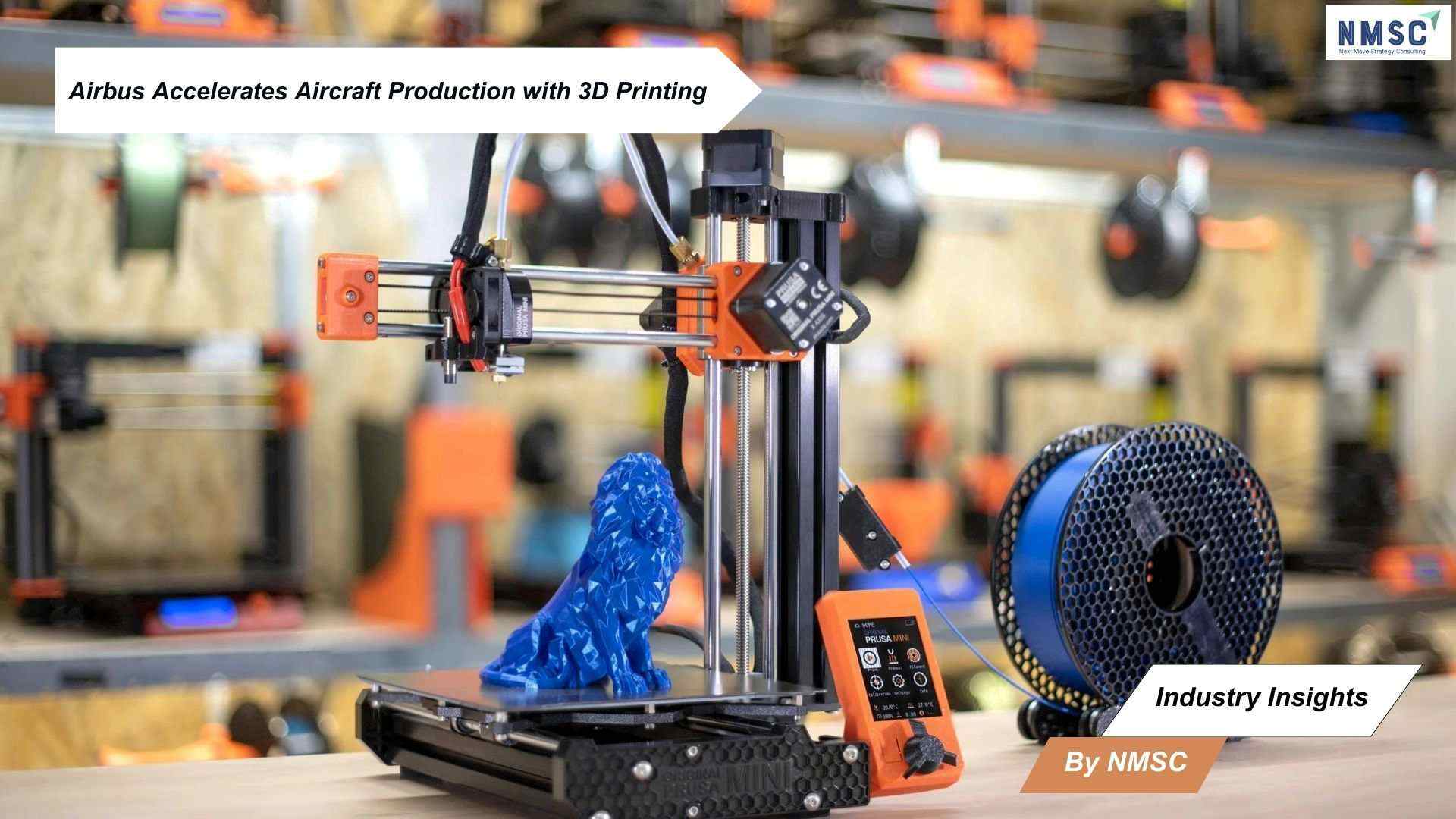
Industry Insights from Next Move Strategy Consulting
As persistent supply chain disruptions continue to challenge global aircraft manufacturers, Airbus is increasingly turning to 3D printing to sustain production momentum and meet delivery commitments. By integrating additive manufacturing into its supply network, the aerospace major is addressing component shortages while reshaping how aircraft parts are produced, certified, and deployed.
Overcoming Supply Chain Constraints with Additive Manufacturing
Since the COVID-19 pandemic, delays in the availability of critical components have slowed aircraft production across the industry. Airbus has responded by adopting 3D-printed parts as a practical solution to mitigate these bottlenecks. The company now relies extensively on additive manufacturing to keep production lines operational and ensure timely deliveries to customers.
Working with Minnesota-based technology firm Stratasys, Airbus produces more than 25,000 flight-ready 3D-printed parts each year. This approach has enabled the manufacturer to maintain delivery schedules while reducing dependence on traditional supply chains.
Scaling Certified 3D-Printed Parts Across Aircraft Programs
Airbus’ adoption of additive manufacturing has expanded significantly since its initial engagement with Stratasys for spare seat components. Today, more than 200,000 certified polymer parts supplied by Stratasys are in active service with airlines and air forces worldwide.
These components are currently used across three Airbus production lines, including the A320neo family, the A350 long-haul aircraft, and the A400M military transport. The parts are produced using Certified Grade filament materials on industrial-grade Stratasys printers, meeting stringent aerospace standards.
Weight Reduction and Faster Lead Times
The integration of 3D-printed parts has delivered measurable performance benefits. In the Airbus A350 program, the use of additive manufacturing has resulted in a 43% reduction in component weight. Additionally, Airbus eliminated minimum order quantity requirements and achieved an 85% reduction in lead time compared with conventional manufacturing methods.
According to Airbus, these gains enhance production flexibility while supporting cost efficiency and faster response to customer requirements.
Supporting Sustainability and Operational Flexibility
“Stratasys’ additive manufacturing technology is an integral part of our commitment to safe and sustainable aviation,” said Serge Senac, Airbus Industrial Leader for Polymer Additive Manufacturing. He noted that the ability to produce certified and repeatable parts more quickly reduces reliance on complex supply chains and improves response times globally. Senac also highlighted that additive manufacturing supports Airbus’ roadmap toward carbon neutrality by 2050.
Stratasys adds that distributed additive manufacturing allows parts to be produced where and when they are needed, reducing aircraft downtime, minimizing inventory storage, and avoiding costly delays.
Industry Momentum for 3D Printing in Aerospace
The progress achieved by Airbus reflects a broader acceleration in aerospace adoption of 3D printing. With tens of thousands of certified parts already flying, Stratasys views the collaboration as evidence that additive manufacturing is moving into full-scale production across the sector, driven by demand for lighter structures and more resilient supply chains.
Next Move Strategy Consulting’s View
According to Next Move Strategy Consulting, Airbus’ large-scale use of certified 3D-printed components underscores a pivotal shift in the 3D Printing Market, particularly within aerospace manufacturing. The growing reliance on additive manufacturing to address supply chain disruptions, reduce lead times, and enable lightweight design is positioning 3D printing as a mainstream production method rather than a niche solution. As more OEMs follow Airbus’ model, certified additive manufacturing is expected to play an increasingly strategic role in future aircraft production and maintenance ecosystems.
Source: Aerospace Global News
Prepared by: Next Move Strategy Consulting
About the Author
 Sanyukta Deb
— Sanyukta Deb is Digital Marketing Team Lead at Next Move Strategy Consulting, where she has led content strategy and technical SEO for the firm's B2B market research publications for over 2 years. Her editorial process translates NextMSC's primary and secondary research — spanning technology, industrial, and consumer sectors — into commercial narratives, backed by search-intent, keyword, and competitive analysis. She brings 5 years of overall experience in digital marketing and content strategy.
Sanyukta Deb
— Sanyukta Deb is Digital Marketing Team Lead at Next Move Strategy Consulting, where she has led content strategy and technical SEO for the firm's B2B market research publications for over 2 years. Her editorial process translates NextMSC's primary and secondary research — spanning technology, industrial, and consumer sectors — into commercial narratives, backed by search-intent, keyword, and competitive analysis. She brings 5 years of overall experience in digital marketing and content strategy.
About the Reviewer
 Debashree Dey
— Debashree Dey is Assistant Manager at Next Move Strategy Consulting, where she supports cross-vertical market content and communications across diverse industries for 6 years. Her professional background includes senior content writing, communications, and published manuscript authorship, with experience developing audience-focused business narratives and maintaining clear, consistent messaging. Her role supports research-led content development and editorial quality across NextMSC publications.
Debashree Dey
— Debashree Dey is Assistant Manager at Next Move Strategy Consulting, where she supports cross-vertical market content and communications across diverse industries for 6 years. Her professional background includes senior content writing, communications, and published manuscript authorship, with experience developing audience-focused business narratives and maintaining clear, consistent messaging. Her role supports research-led content development and editorial quality across NextMSC publications.

















Add Comment