Dual-Cell LCD Market Set for Accelerated Growth
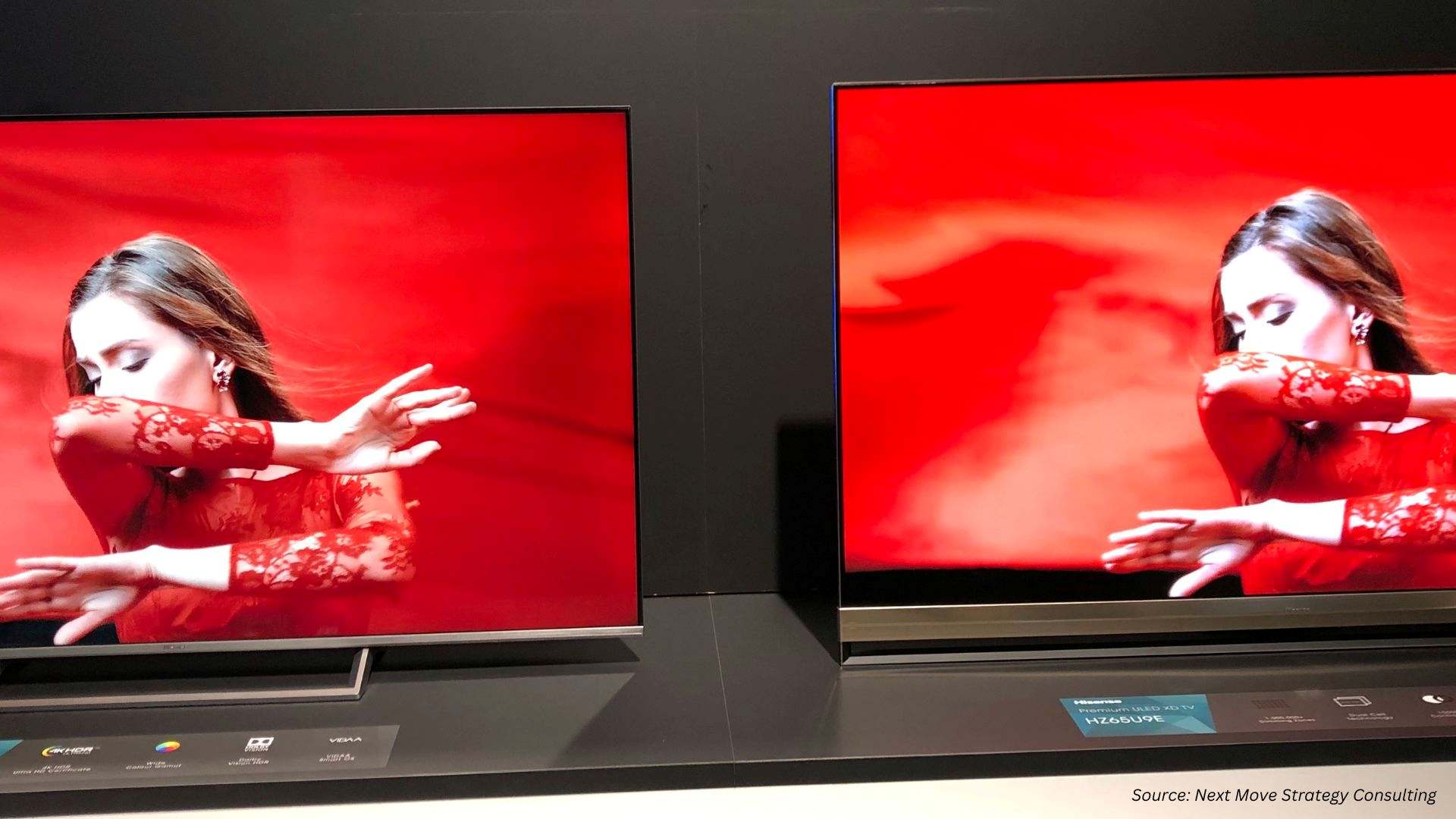
Record EV Adoption and Premium Display Demand Propel Dual-Cell LCD Technology Toward a USD 2 Billion Milestone
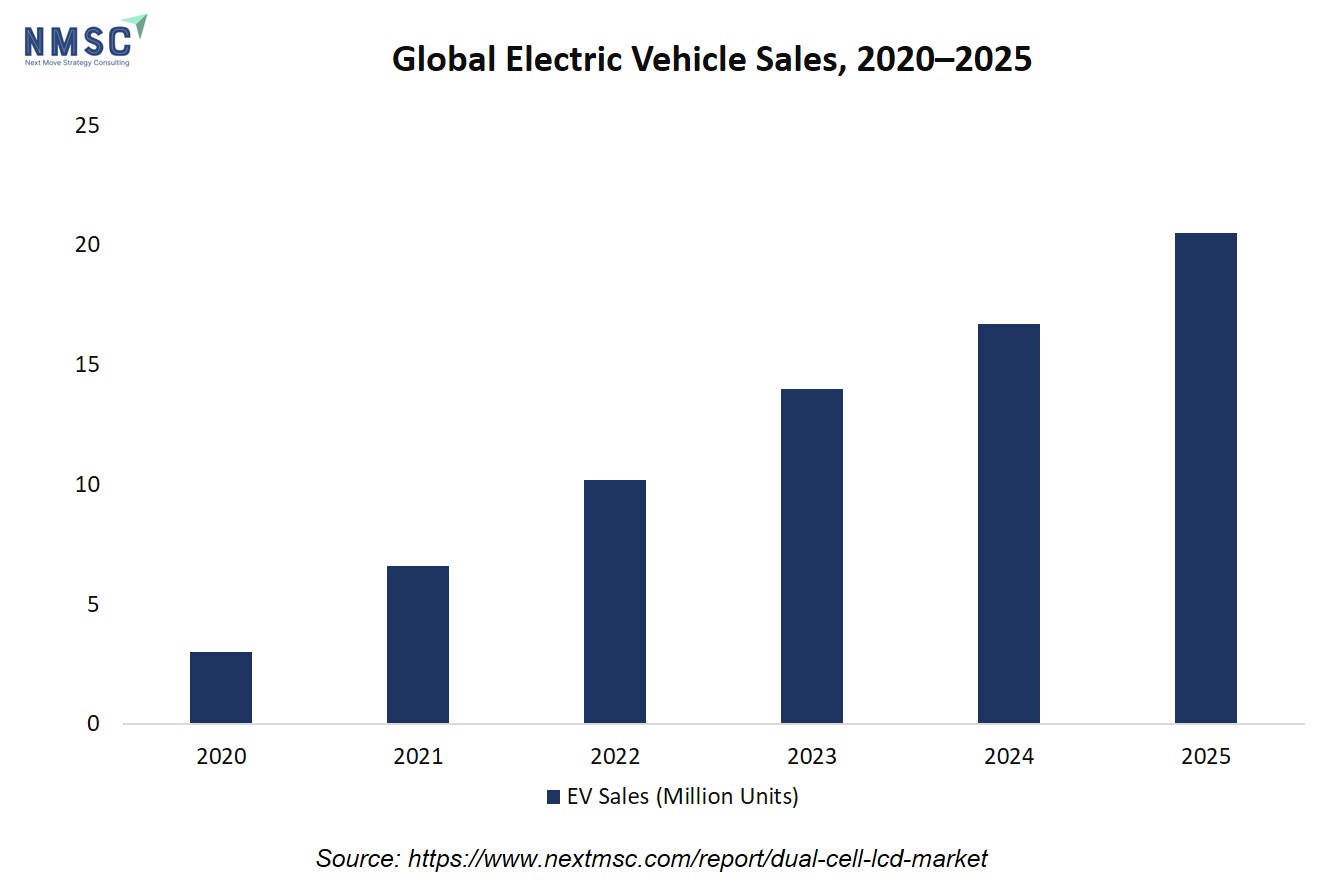
The International Energy Agency's Global EV Outlook 2026, published earlier this year, confirmed that global electric car sales exceeded 20 million units in 2025 — a 20% increase from the prior year — with one in four new cars sold worldwide now being electric. This landmark threshold, representing the fifth consecutive year of approximately 3.5 million incremental annual additions to the global EV fleet, is reshaping demand across the entire automotive supply chain — and few sectors stand to benefit more directly than advanced display technology.
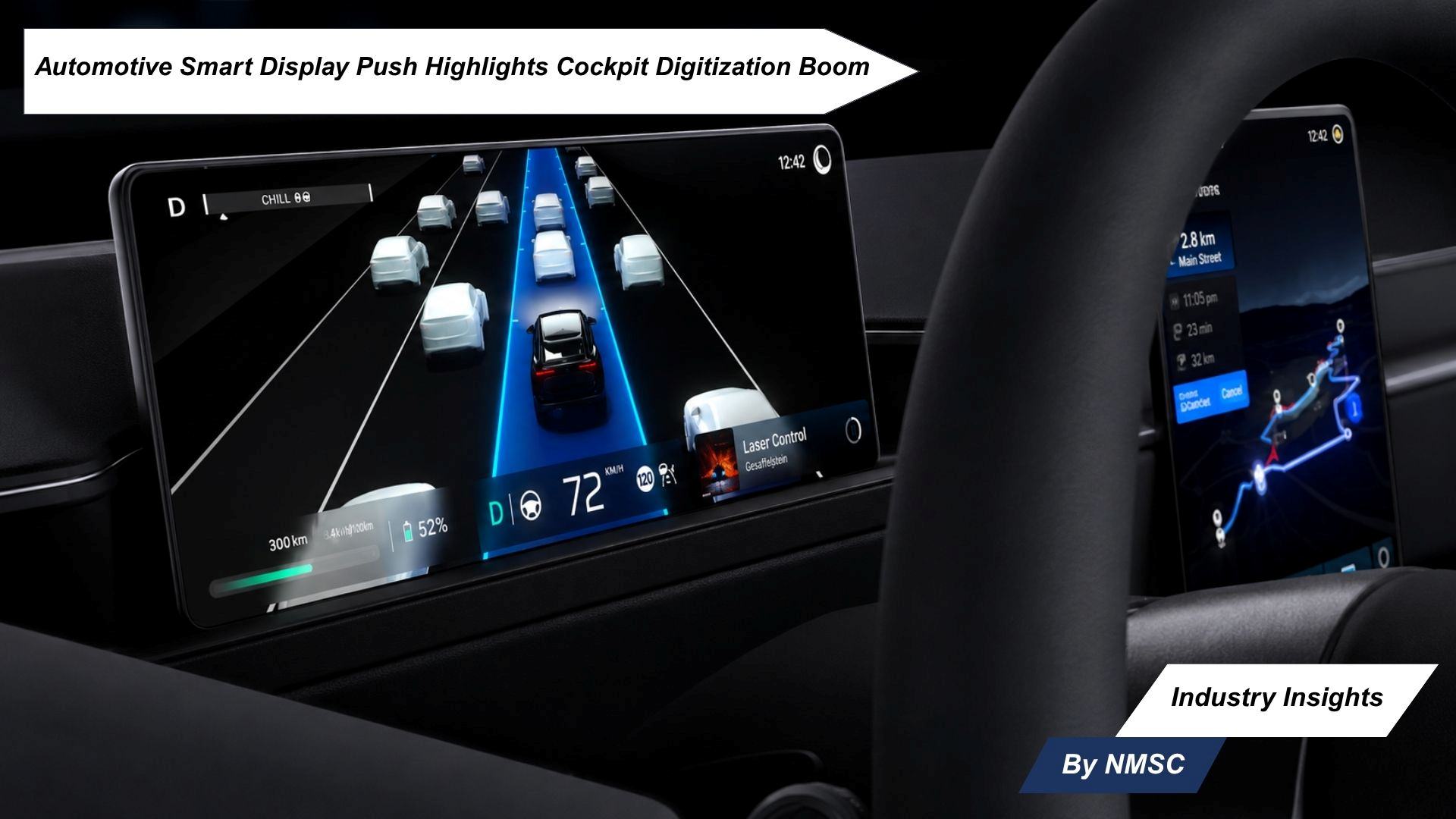
As electric vehicles grow more sophisticated, automakers are integrating increasingly complex digital cockpit architectures, multi-zone infotainment systems, and high-contrast dashboard displays. These requirements are creating a structural tailwind for dual-cell LCD technology, which delivers superior contrast ratios, deeper blacks, and enhanced energy efficiency compared to conventional single-layer LCD panels — characteristics that are particularly well-suited to the demanding optical environments of modern vehicle interiors.
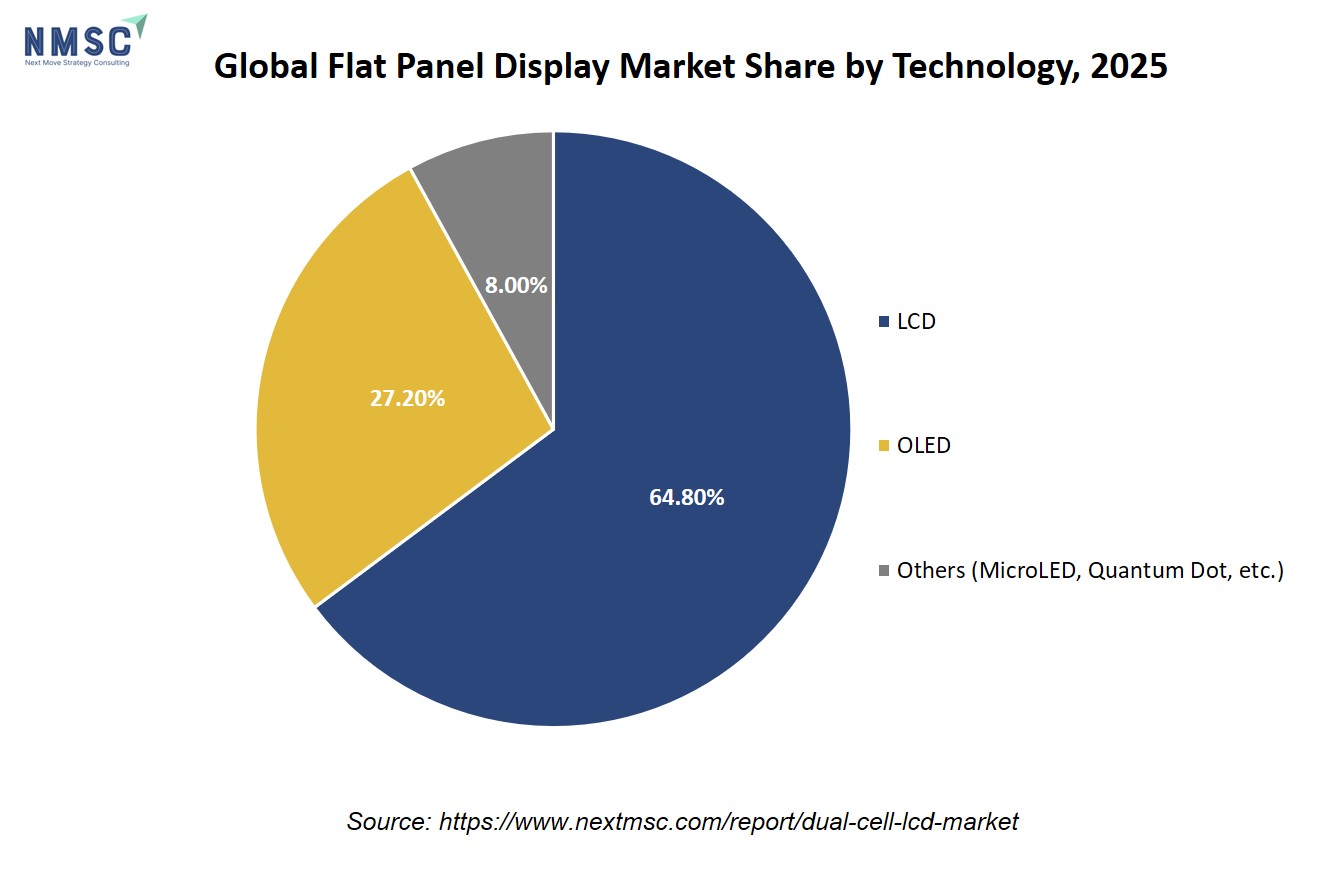
The global Dual-cell LCD Market was valued at USD 745.5 million in 2023 and is projected to reach USD 2,044.2 million by 2030, expanding at a compound annual growth rate (CAGR) of 15.5% during the forecast period from 2024 to 2030, according to Next Move Strategy Consulting. The market's trajectory reflects a convergence of structural demand drivers spanning automotive electrification, premium consumer electronics, and the proliferation of high-performance gaming and professional monitor applications.
For More Information: Download FREE Sample on Dual-Cell LCD Market Report
Automotive Electrification as a Primary Demand Catalyst
The IEA's 2026 data reveals a global EV market that has reached a decisive inflection point. China alone accounted for more than 13 million electric car sales in 2025, representing approximately 55% of global EV volume, with the electric car sales share reaching nearly 55% of total new car sales in the country. Europe recorded a 30% surge in EV sales to 4.2 million units, driven by the step-change in EU CO2 standards that came into effect in 2025, while the United States maintained approximately 10% EV penetration across full-year 2025 despite a sharp fourth-quarter contraction following the elimination of federal tax credits.
This accelerating EV adoption is directly translating into demand for advanced in-vehicle display systems. Dual-cell LCD panels — which employ a dual-layer liquid crystal architecture, with a front layer dedicated to shadow and dark-area rendering and a rear layer modulating brighter regions — offer automakers a cost-effective pathway to achieve OLED-comparable contrast performance without the burn-in risks or elevated manufacturing costs associated with organic light-emitting diode panels. The technology's ability to perform reliably across extreme temperature ranges makes it particularly attractive for automotive-grade applications.
LG Display, one of the market's leading participants, demonstrated the strategic importance of automotive display innovation when it received two CES 2026 Innovation Awards in November 2025 for its world-first Dual View OLED and Under Display Camera-infrared (UDC-IR) OLED automotive display technologies — both recognized in the In-Vehicle Entertainment category for delivering superior picture quality, space efficiency, and safety-grade reliability. The recognition underscores the intensifying competition among display manufacturers to capture the growing automotive display segment — a dynamic that simultaneously elevates the commercial profile of dual-cell LCD as a scalable, cost-competitive alternative.
Market Segmentation: Technology and Application Landscape
The dual-cell LCD market is segmented by technology into IPS (In-Plane Switching), VA (Vertical Alignment), OLED, and other panel types. VA technology, known for its superior contrast ratios and deep black reproduction, is particularly well-aligned with the core value proposition of dual-cell architecture, making it a dominant segment within the market. IPS panels, favored for their wide viewing angles and color accuracy, are gaining traction in professional monitor, medical imaging, and broadcast display applications.
By application, the market spans smartphones, televisions, monitors, laptops, tablets, automotive systems, and other end-use categories. The automotive segment is emerging as one of the fastest-growing application verticals, driven by the proliferation of digital instrument clusters, center-stack infotainment displays, and rear-seat entertainment systems in both battery electric and plug-in hybrid vehicles. The television segment continues to represent a significant revenue base, as premium TV manufacturers seek to differentiate their product lines through enhanced contrast and HDR performance without transitioning entirely to OLED manufacturing processes.
The smartphone segment remains a substantial volume driver. According to IDC, global smartphone shipments reached 1.26 billion units in 2025, representing 1.9% year-over-year growth, with Q4 2025 shipments rising 2.3% year-over-year to 336.3 million units. The sustained volume of global smartphone production sustains demand for high-performance display panels, including dual-cell configurations deployed in premium device tiers where display quality is a primary purchase driver.
Regional Analysis: Asia-Pacific Leads, North America Accelerates
Asia-Pacific commands the dominant position in the global dual-cell LCD display market, a leadership position underpinned by the region's concentration of display panel manufacturing capacity and its status as the world's largest consumer electronics and electric vehicle market. China's role as both the primary manufacturer and the largest EV market globally creates a self-reinforcing demand loop for advanced display technologies. The country's 1.84 billion cellular IoT connections as of 2022, reported by China's Ministry of Industry and Information Technology, further amplify demand for display-enabled connected devices across industrial and consumer applications.
Japan, South Korea, and Taiwan contribute significant manufacturing expertise and technological innovation to the regional ecosystem. Key display manufacturers — including Samsung Display, LG Display, BOE Technology Group, AU Optronics, Innolux, Japan Display Inc., Sharp Corporation, Tianma Microelectronics, HannStar Display, and CSOT — are all headquartered or maintain primary manufacturing operations within the Asia-Pacific region, reinforcing the area's structural dominance in global display supply chains.
North America represents the market's most dynamic growth frontier. The region's gaming industry — which generated USD 60.42 billion in commercial gaming revenue in 2022, a 13.9% increase over 2021, according to the American Gaming Association — sustains robust demand for high-refresh-rate, high-contrast gaming monitors, a segment where dual-cell LCD technology offers compelling performance advantages over conventional LCD alternatives. The simultaneous expansion of EV adoption in the United States, where electric cars represented approximately 10% of new car sales across full-year 2025, further reinforces the automotive display demand narrative in the region.
Europe, while a smaller market by display manufacturing volume, is emerging as a significant demand center driven by the continent's accelerating EV transition and the EU's stringent energy efficiency regulations governing consumer electronics. The 30% surge in European EV sales in 2025, reaching 4.2 million units, is directly expanding the addressable market for automotive-grade dual-cell LCD displays across the region.
Global Electric Vehicle Sales by Major Region, 2025
|
Region |
EV Sales (Million Units) |
EV Share of New Car Sales |
YoY Growth (2024–2025) |
|
China |
13.0+ |
~55% |
~20% |
|
Europe |
4.2 |
~28% |
~30% |
|
United States |
~1.5 |
~10% |
Slight decline (Q4 impact) |
|
Rest of World |
~2.0 |
Varies by market |
~50% |
|
Global Total |
>20.0 |
~25% |
~20% |
Notes: "Rest of World" includes Southeast Asia, Latin America, Middle East, and other emerging markets. China and Rest of World figures are approximate based on IEA regional analysis. US figure reflects full-year 2025 including sharp Q4 decline following elimination of federal EV tax credits.
Competitive Landscape and Strategic Developments
The dual-cell LCD display market is characterized by a concentrated competitive structure, with a small number of large-scale panel manufacturers controlling the majority of global production capacity. Samsung Display Co., Ltd. and LG Display Co., Ltd. lead the market in terms of technological innovation and premium segment positioning. BOE Technology Group Co., Ltd. and CSOT have emerged as formidable competitors, leveraging China's manufacturing scale advantages to compete aggressively on cost and volume across mid-range and high-volume display segments.
Samsung's strategic investments in next-generation display technologies were prominently showcased at Display Week 2026, where the company demonstrated its ELQD (Electroluminescent Quantum Dot) technology and other advanced panel architectures. Samsung Display also presented AI-optimized OLED technologies at MWC 2026, signaling the company's intent to integrate artificial intelligence into display performance optimization — a development with direct implications for dual-cell LCD's competitive positioning against OLED alternatives in premium consumer electronics.
In February 2023, Samsung launched a new dual UHD curved display for gamers, delivering 7,680×2,160 resolution and a 32:9 aspect ratio in a single screen — a product that demonstrated the commercial viability of dual-panel display architectures in the high-performance gaming segment. AU Optronics Corp. has similarly advanced its display technology portfolio, launching eyecare displays with proprietary anti-reflection and anti-glare technology designed to deliver reading-quality image performance for professional users.
The introduction of mini-LED backlighting and quantum dot technology represents both a competitive challenge and a complementary opportunity for dual-cell LCD manufacturers. Mini-LED backlighting, which enables more precise local dimming zones, can be integrated with dual-cell architecture to further enhance contrast performance, potentially creating a hybrid technology pathway that extends the competitive viability of LCD-based displays against OLED in premium applications.
Global Smartphone Shipments, 2025
|
Period |
Shipments (Million Units) |
YoY Growth |
|
Q2 2025 |
~320.0 |
+3.0% |
|
Q3 2025 |
320.1 |
+3.0% |
|
Q4 2025 |
336.3 |
+2.3% |
|
Full Year 2025 |
1,260.0 |
+1.9% |
Notes: Q2 2025 figure is approximate, based on Counterpoint Research reporting of 3% YoY growth. Full-year figure of 1.26 billion confirmed by IDC. Q1 2025 data not independently verified and is excluded from this table.
Energy Efficiency and Regulatory Tailwinds
The dual-cell LCD market is also benefiting from the global regulatory push toward energy-efficient consumer electronics. Dual-cell LCD displays achieve improved energy efficiency relative to conventional single-layer LCD panels by more effectively blocking backlight leakage, thereby reducing overall power consumption — a characteristic that aligns with increasingly stringent energy efficiency standards being implemented across major markets in North America, Europe, and Asia-Pacific.
The European Union's Ecodesign Regulation and the United States' ENERGY STAR program continue to raise minimum efficiency thresholds for televisions, monitors, and other display-equipped consumer electronics. Manufacturers that can demonstrate superior energy performance through dual-cell architecture gain a regulatory compliance advantage that translates into meaningful commercial differentiation, particularly in the enterprise and institutional procurement segments where total cost of ownership is a primary evaluation criterion.
Emerging Opportunities: IoT, Healthcare, and Industrial Displays
Beyond the automotive and consumer electronics segments, dual-cell LCD technology is finding expanding application in industrial displays, medical imaging systems, and IoT-enabled devices. The technology's ability to deliver high contrast and color accuracy in ambient lighting conditions — including direct sunlight — makes it well-suited for outdoor digital signage, industrial control panels, and point-of-sale systems. In medical imaging, where accurate grayscale reproduction and high contrast are clinical requirements, dual-cell LCD's performance characteristics offer a cost-effective alternative to dedicated medical-grade OLED displays.
The rapid expansion of cellular IoT connectivity — with China recording 1.84 billion cellular IoT connections in 2022 according to the Ministry of Industry and Information Technology — is creating a growing installed base of display-equipped connected devices across manufacturing, logistics, healthcare, and smart city applications. As IoT device manufacturers seek to balance display performance with power consumption constraints, dual-cell LCD's energy efficiency advantages position it as a preferred display technology for battery-powered and energy-constrained IoT applications.
Bottom Line
The dual-cell LCD market is entering a period of accelerated structural growth, underpinned by the global EV revolution, the sustained expansion of premium consumer electronics, and the rising demand for energy-efficient display solutions. With the market projected to more than double from USD 745.5 million in 2023 to USD 2,044.2 million by 2030 at a CAGR of 15.5%, the investment and strategic opportunity is substantial. Asia-Pacific will remain the dominant regional market, driven by China's unparalleled manufacturing scale and EV adoption, while North America and Europe offer high-value growth opportunities in automotive, gaming, and professional display applications. The primary risk — accelerating OLED adoption across premium display segments, with OLED monitor panel shipments projected to reach 5.4 million units in 2026 at 60% year-over-year growth — is real but manageable, given dual-cell LCD's structural cost advantages, automotive-grade reliability, and compatibility with next-generation backlighting technologies including mini-LED and quantum dot. For display manufacturers, component suppliers, automotive OEMs, and technology investors, the dual-cell LCD market represents a compelling intersection of structural demand growth and technological differentiation. Strategic positioning in automotive display supply chains and premium monitor segments will be critical to capturing the market's full growth potential through 2030.
About Next Move Strategy Consulting
Next Move Strategy Consulting is a premier market research and management consulting firm that has been committed to provide strategically analysed well documented latest research reports to its clients. The research industry is flooded with many firms to choose from, what makes NMSC different from the rest is its top-quality research and the obsession of turning data into knowledge by dissecting every bit of it and providing fact-based research recommendation that is supported by information collected from over 500 million websites, paid databases, industry journals and one on one consultations with industry experts across a diverse range of industry sectors. The high-quality customized research reports with actionable insights and excellent end-to-end customer service help our clients to take critical business decisions that enables them to move beyond time and have competitive edge in the industry.
We have been servicing over 1000 customers globally that includes 90% of the Fortune 500 companies over a decade. Our analysts are constantly tracking various high growth markets and identifying hidden opportunities in each sector or the industry. We provide one of the industry's best quality syndicate as well as custom research reports across 10 different industry verticals. We are committed to deliver high quality research solutions in accordance to your business needs. Our industry standard delivery solutions that ranges from the pre consultation to after-sales services, provide an excellent client experience and ensure right strategic decision making for businesses.
For more information, please contact:
Next Move Strategy Consulting
5th Floor 867
Boylston St, STE 500,
Boston, MA 02116, U.S.
E-Mail: [email protected]
Direct: +1-217-650-7991
Website: www.nextmsc.com
About the Author
 Sanyukta Deb
— Sanyukta Deb is Digital Marketing Team Lead at Next Move Strategy Consulting, where she has led content strategy and technical SEO for the firm's B2B market research publications for over 2 years. Her editorial process translates NextMSC's primary and secondary research — spanning technology, industrial, and consumer sectors — into commercial narratives, backed by search-intent, keyword, and competitive analysis. She brings 5 years of overall experience in digital marketing and content strategy.
Sanyukta Deb
— Sanyukta Deb is Digital Marketing Team Lead at Next Move Strategy Consulting, where she has led content strategy and technical SEO for the firm's B2B market research publications for over 2 years. Her editorial process translates NextMSC's primary and secondary research — spanning technology, industrial, and consumer sectors — into commercial narratives, backed by search-intent, keyword, and competitive analysis. She brings 5 years of overall experience in digital marketing and content strategy.
About the Reviewer
 Debashree Dey
— Debashree Dey is Assistant Manager at Next Move Strategy Consulting, where she supports cross-vertical market content and communications across diverse industries for 6 years. Her professional background includes senior content writing, communications, and published manuscript authorship, with experience developing audience-focused business narratives and maintaining clear, consistent messaging. Her role supports research-led content development and editorial quality across NextMSC publications.
Debashree Dey
— Debashree Dey is Assistant Manager at Next Move Strategy Consulting, where she supports cross-vertical market content and communications across diverse industries for 6 years. Her professional background includes senior content writing, communications, and published manuscript authorship, with experience developing audience-focused business narratives and maintaining clear, consistent messaging. Her role supports research-led content development and editorial quality across NextMSC publications.















Add Comment