Aircraft Flight Control Systems: Defense Surge Reshapes Market
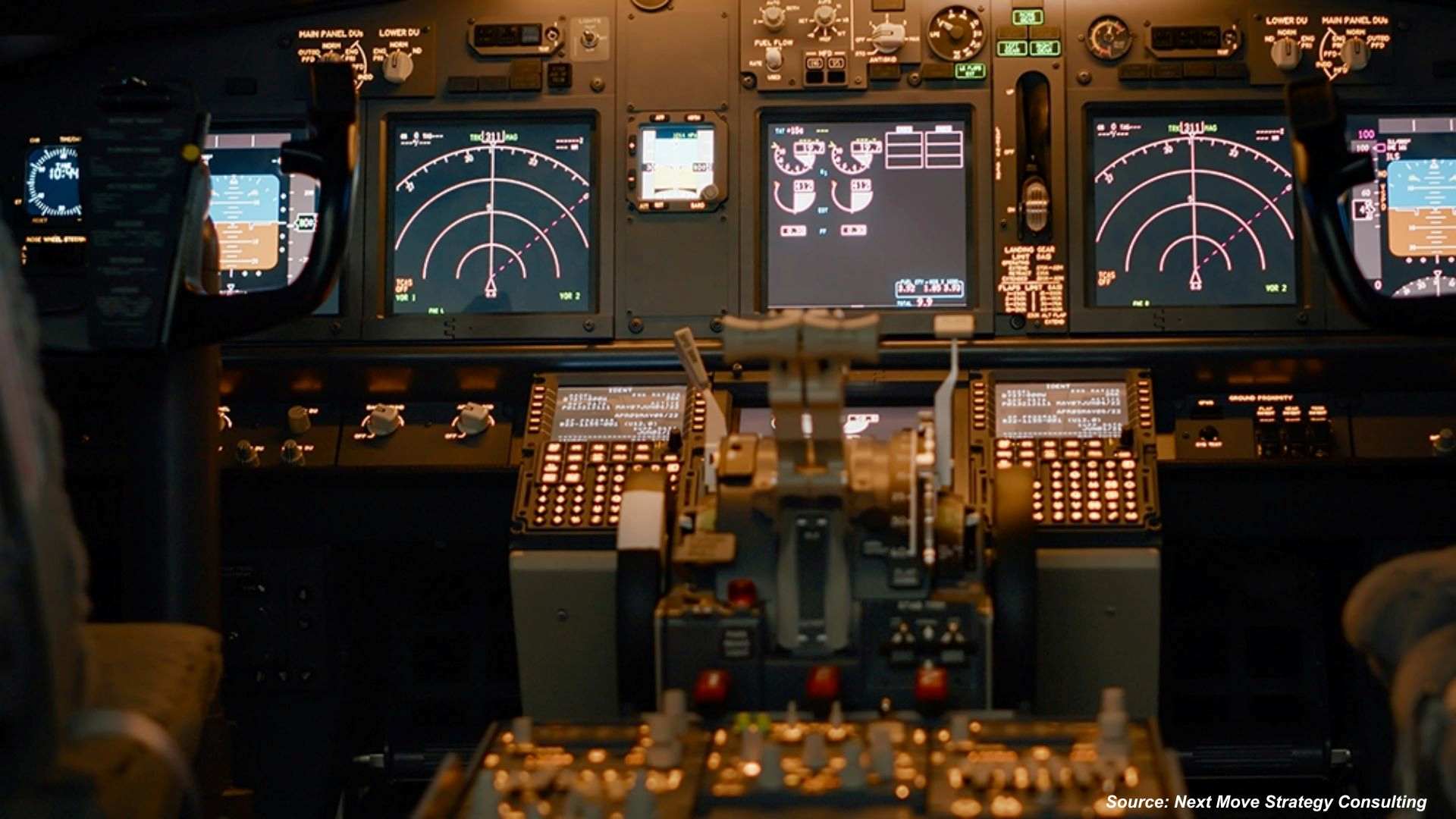
Pentagon's $131 Billion Boeing F-15 Contract Signals a Structural Shift in Global Aircraft Flight Control System Demand
On August 24, 2026, the United States Air Force awarded The Boeing Company a sole-source, indefinite-delivery/indefinite-quantity contract with a ceiling value of $131.23 billion — formally designated the F-15 Eagle Crest program — to produce, modernize, and sustain F-15 fighter jets for both domestic and foreign military customers through 2037. The contract, confirmed by the U.S. Department of Defense and reported by Defense News and Reuters, encompasses aircraft production, systems integration, avionics upgrades, flight control system retrofits, and the establishment of organic depot maintenance capabilities. Foreign military sales under the framework extend to Japan, Israel, Saudi Arabia, South Korea, Singapore, Indonesia, and Poland.
The Eagle Crest award is the largest single-program defense aviation contract in recent history and carries direct implications for the global aircraft flight control system supply chain. The contract explicitly covers radar modernization, mission computer refresh, electronic warfare suite upgrades, and engine enhancements for the F-15EX fleet — all of which are deeply integrated with advanced fly-by-wire and digital flight control architectures. The U.S. Air Force Life Cycle Management Center at Wright-Patterson Air Force Base, Ohio, serves as the contracting authority. The U.S. Air Force has separately expanded its F-15EX procurement to 268 aircraft through fiscal year 2031, requiring a comprehensive refresh of radar, mission computers, electronic warfare suites, and engines.
This landmark procurement event arrives at a pivotal moment for the global Aircraft Flight Control System Market, which is navigating simultaneous demand pressures from accelerating military modernization programs, a recovering commercial aviation sector, and the rapid integration of artificial intelligence into avionics platforms.
For More Information: Download FREE Sample on Aircraft Flight Control System Market Report
Military Modernization: The Primary Demand Catalyst
The Boeing F-15 Eagle Crest contract is not an isolated procurement event. It reflects a broader, sustained escalation in global defense spending that is directly translating into demand for advanced flight control technologies across combat aircraft, military transport platforms, and rotary-wing assets.
According to the Stockholm International Peace Research Institute (SIPRI), world military expenditure reached $2,718 billion in 2024 — a 9.4 percent increase in real terms from 2023 and the steepest year-on-year rise since at least the end of the Cold War. The United States remained the world's largest military spender at $997 billion, representing 37 percent of global military expenditure. China followed at an estimated $314 billion, with Russia at $149 billion, Germany at $88.5 billion, and India at $86.1 billion. The top five military spenders collectively accounted for 60 percent of the global total, with combined spending of $1,635 billion.
In 2025, global military expenditure rose further to $2,887 billion — the 11th consecutive year of consecutive growth — even as U.S. spending declined, offset by sharp increases in European and Asia-Pacific defense budgets. Global spending has risen by 41 percent over the decade from 2016 to 2025.
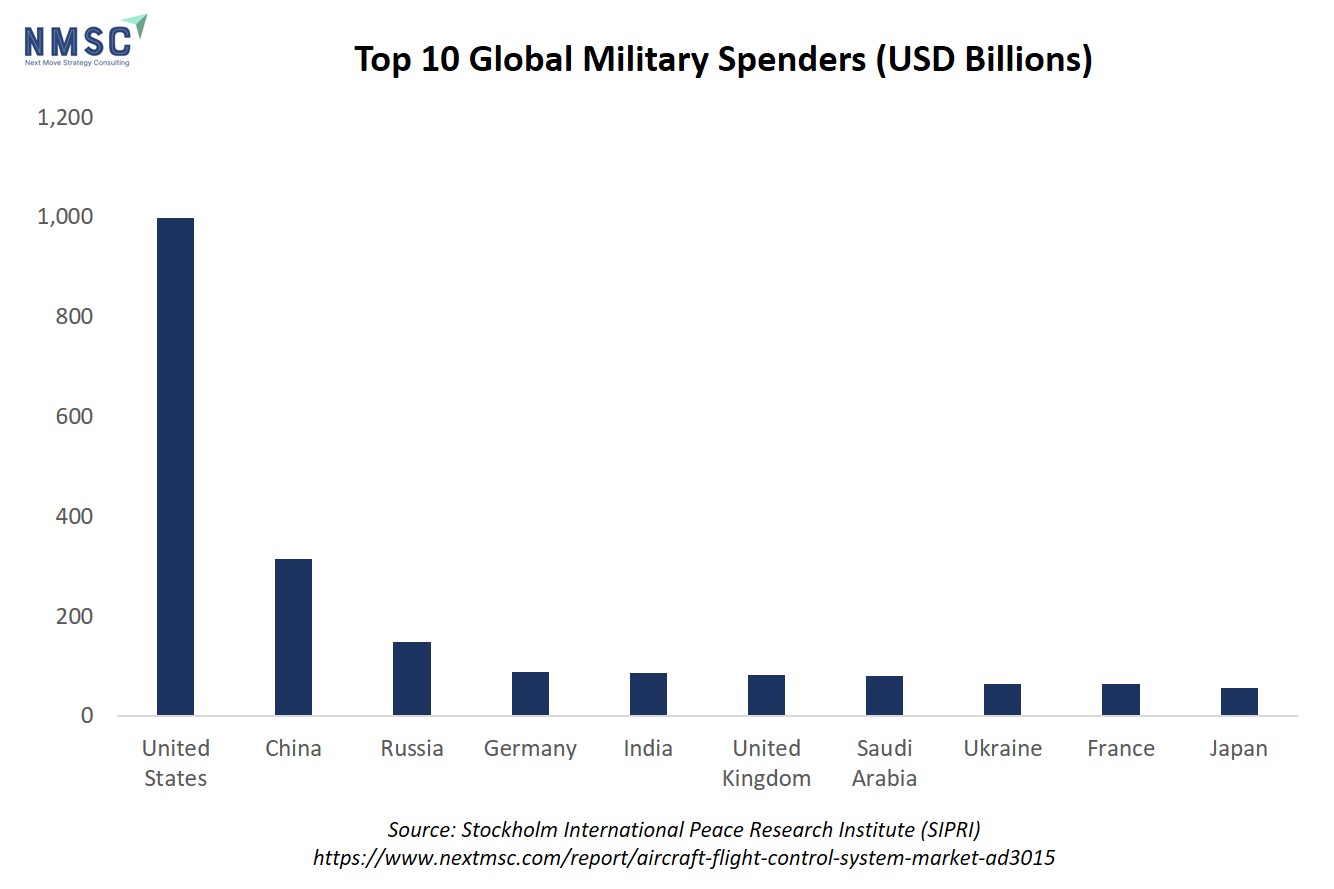
This sustained defense spending trajectory is generating structural demand for advanced flight control systems. Separately, in January 2026, the U.S. Air Force awarded Boeing a $266 million sole-source contract through 2031 to replace the flight deck of the C-17 Globemaster III airlifter. The avionics redesign addresses four critical Line Replaceable Units — including the mission computer (CIP/RCIP/MRCIP) and multifunction displays — that have become obsolete, with spares projected to sustain the fleet only through fiscal year 2027. The mission computer interfaces with approximately 36 flight-critical and safety-critical LRUs on the aircraft's mission buses, underscoring the systemic importance of flight control system modernization across legacy military platforms.
Commercial Aviation Recovery Amplifies Demand
The military sector's demand surge is being reinforced by a robust commercial aviation recovery that is expanding the global aircraft fleet and driving procurement of new-generation avionics.
According to IATA's 2025 World Air Transport Statistics (WATS) report, released on July 16, 2026, the United States remained the world's largest passenger market with 890.1 million passengers in 2025, followed by China with 776.1 million. Global premium-class travel reached 109.7 million passengers in 2025, up 4.5 percent year-on-year. Narrowbody aircraft continued to dominate global operations: Boeing 737 variants operated 10.8 million flights in 2025 — up 12.0 percent from 2024 — while the Airbus A320 family recorded 8.7 million flights. The Boeing 787 and Airbus A350 widebody platforms recorded significantly more flights in 2025 than in 2019, up 40.8 percent and 117.4 percent respectively, reflecting the accelerating adoption of new-generation aircraft equipped with advanced fly-by-wire flight control architectures.
Top 10 Global Passenger Markets by Country, 2025
|
Country |
Passenger Numbers (Millions) |
YoY Change (%) |
|
United States |
890.1 |
+1.6 |
|
China (People's Republic of) |
776.1 |
+4.8 |
|
United Kingdom |
269.7 |
+3.4 |
|
Spain |
252.7 |
+5.0 |
|
Japan |
223.5 |
+9.2 |
|
India |
218.2 |
+3.3 |
|
Italy |
187.3 |
+5.8 |
|
Germany |
163.8 |
+3.4 |
|
France |
152.6 |
+2.2 |
|
Türkiye |
129.3 |
+2.9 |
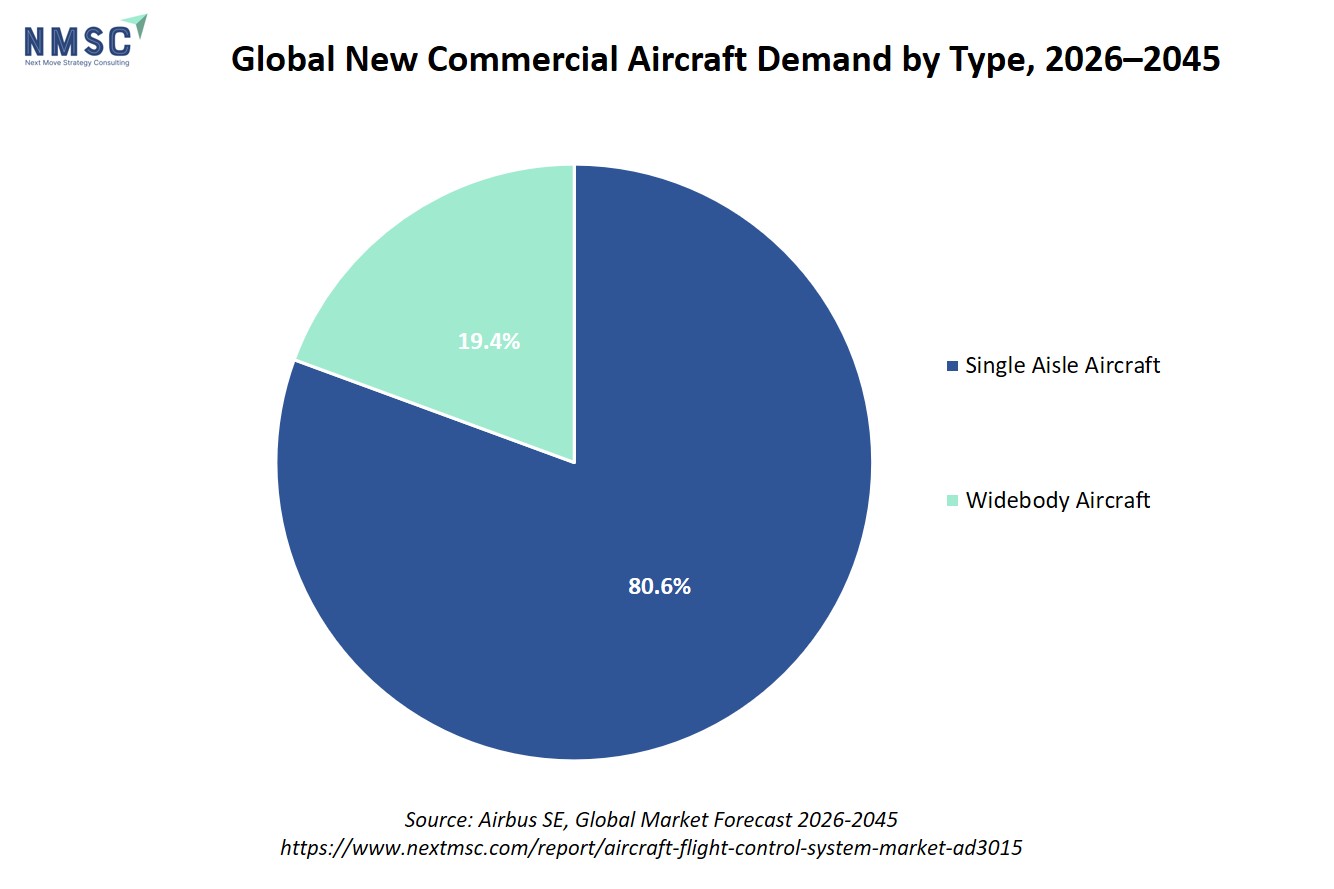
The Airbus Global Market Forecast 2026-2045, published in July 2026, projects global passenger traffic to grow at 3.9 percent annually, supported by global GDP growth of 2.6 percent, with air traffic more than doubling to approximately 10 billion passengers per year by 2045. Airbus anticipates demand for 42,060 new aircraft over the 20-year period — comprising 33,920 single-aisle and 8,140 widebody aircraft — as the global fleet nearly doubles from 23,310 aircraft at end-2025 to 45,550 aircraft by 2045. By 2045, the percentage of the global fleet made up of the newest-generation aircraft is forecast to reach almost 100 percent, up from approximately 39 percent in 2026. Each new-generation aircraft delivery represents a direct procurement opportunity for advanced flight control systems, avionics suites, and fly-by-wire architectures.
Regulatory Convergence: FAA-EASA Digitalization Mandate
The regulatory environment is simultaneously accelerating the adoption of advanced flight control technologies. The 2026 FAA-EASA International Aviation Safety Conference, held June 16-18 in Washington, D.C., placed digitalization and software-intensive systems at the center of its agenda. The joint conference — attended by approximately 400 senior aviation professionals from regulatory bodies, manufacturers, and airlines — addressed advanced avionics certification, digital maintenance practices, and the integration of autonomous systems into certified airspace.
The FAA has separately indicated plans to modernize its aircraft certification framework for new commercial airplanes and engines, with proposals targeting regulatory modernization that would directly affect the certification pathways for next-generation fly-by-wire and digital flight control systems. The EASA has concurrently issued airworthiness directives targeting flight control system components on Airbus A350 variants, reflecting the regulatory intensity surrounding digital avionics integrity.
Technology Segmentation: Fly-by-Wire Dominance and AI Integration
Within the aircraft flight control system market, fly-by-wire technology — which uses computers to process pilot inputs and transmit commands electronically rather than through mechanical linkages — has become the dominant architecture across both commercial and military platforms. According to market intelligence from Next Move Strategy Consulting, the technology segmentation spans fly-by-wire, digital fly-by-wire, hydro-mechanical, and power fly-by-wire systems, with digital fly-by-wire gaining accelerating adoption across new-generation platforms.
The integration of artificial intelligence into flight control architectures represents the market's most significant emerging opportunity. AI-enabled systems offer real-time data analysis, dynamic decision-making, and predictive maintenance capabilities that reduce human error and enhance operational efficiency. BAE Systems, one of the market's leading participants, introduced an upgrade program in August 2024 for fly-by-wire flight control computers on F-15EX Eagle II and F/A-18E/F Super Hornet fighter jets, specifically targeting computational strength and cybersecurity resilience.
Cybersecurity, however, represents the market's most consequential structural risk. As flight control systems migrate to digital and networked architectures, potential vulnerabilities in digital networks raise concerns about system breaches, creating hesitation among operators and regulators that could constrain the pace of advanced technology adoption.
Global Commercial Aircraft Fleet — Number of Flights by Aircraft Type, 2025 vs. 2019
|
Aircraft Type / Model |
Flights in 2025 |
Flights in 2019 |
Change 2019–2025 (%) |
|
Narrow Body / Boeing 737 (all variants) |
10.8 million |
10.5 million |
+3.1 |
|
Narrow Body / Airbus A320 |
8.7 million |
8.1 million |
+7.6 |
|
Narrow Body / Airbus A321 |
4.2 million |
2.6 million |
+61.6 |
|
Narrow Body / Embraer ERJ170/190 |
2.7 million |
2.6 million |
+2.8 |
|
Narrow Body / Airbus A319 |
1.4 million |
2.1 million |
-34.3 |
|
Wide Body / Boeing 787 |
795,000 |
564,000 |
+40.8 |
|
Narrow Body / Airbus A220 |
530,000 |
61,000 |
+770.4 |
|
Wide Body / Airbus A350 |
434,000 |
200,000 |
+117.4 |
|
Wide Body / Airbus A380 |
90,000 |
119,000 |
-24.4 |
Competitive Landscape and Strategic Positioning
The aircraft flight control system market features a concentrated competitive landscape dominated by established aerospace and defense primes. Key participants identified in the NMSC market analysis include Honeywell International Inc., Moog Inc., Safran S.A., BAE Systems plc, Parker Hannifin Corporation, Thales Group, Collins Aerospace, Embraer S.A., Liebherr, Airbus SE, Nabtesco Technology Ventures AG, Quest Global, Bombardier Inc., Dassault Aviation SA, and Bell Textron Inc.
These participants are pursuing product development, system integration, and strategic partnership strategies to capture demand across both the military modernization cycle and the commercial fleet renewal wave. The market's cybersecurity dimension is emerging as a critical competitive differentiator, as digital flight control networks present potential vulnerability surfaces that regulators and operators are increasingly scrutinizing.
North America maintains the largest regional market share, driven by the scale of U.S. defense procurement — exemplified by the F-15 Eagle Crest contract — and the density of commercial aviation operations. The Asia-Pacific region is projected to record the fastest growth trajectory, supported by surging air cargo demand and next-generation avionics development programs. IATA data confirms that Asia-Pacific airlines posted 17.6 percent air cargo traffic expansion in July 2024, creating sustained pressure on operators to upgrade aircraft systems for enhanced operational efficiency. Japan's 2024 initiative for next-generation hydrogen and hybrid-electric powered passenger aircraft further signals the region's commitment to advanced avionics investment.
Bottom Line
The global aircraft flight control system market is entering a period of structurally elevated demand, driven by the convergence of three independent but mutually reinforcing forces: an unprecedented military modernization cycle, a sustained commercial aviation fleet expansion, and accelerating regulatory and technological pressure toward digital and AI-integrated avionics architectures.
The U.S. Air Force's $131.23 billion F-15 Eagle Crest contract — the largest single-program defense aviation award in recent history — establishes a clear directional signal for defense-oriented flight control system procurement through 2037. Simultaneously, Airbus's forecast of 42,060 new aircraft deliveries through 2045 defines the commercial demand horizon. According to Next Move Strategy Consulting, the global aircraft flight control system market is projected to grow from USD 21.38 billion in 2024 to USD 34.56 billion by 2030, at a CAGR of 8.3 percent.
Key risks include cybersecurity vulnerabilities in digital flight control networks, supply chain constraints affecting avionics component availability, and potential regulatory delays in certifying next-generation autonomous systems. For investors and strategic planners, the market presents compelling opportunities in fly-by-wire technology providers, AI-integrated avionics developers, and defense-grade flight control system integrators with established relationships across NATO and allied procurement frameworks. The intersection of rising global military budgets — which reached $2,887 billion in 2025 — and a commercial fleet renewal cycle of historic scale positions the aircraft flight control system market as one of the aerospace sector's most durable structural growth opportunities through the end of the decade.
About Next Move Strategy Consulting:
Next Move Strategy Consulting is a premier market research and management consulting firm that has been committed to provide strategically analysed well documented latest research reports to its clients. The research industry is flooded with many firms to choose from, what makes NMSC different from the rest is its top-quality research and the obsession of turning data into knowledge by dissecting every bit of it and providing fact-based research recommendation that is supported by information collected from over 500 million websites, paid databases, industry journals and one on one consultations with industry experts across a diverse range of industry sectors. The high-quality customized research reports with actionable insights and excellent end-to-end customer service help our clients to take critical business decisions that enables them to move beyond time and have competitive edge in the industry.
We have been servicing over 1000 customers globally that includes 90% of the Fortune 500 companies over a decade. Our analysts are constantly tracking various high growth markets and identifying hidden opportunities in each sector or the industry. We provide one of the industry's best quality syndicate as well as custom research reports across 10 different industry verticals. We are committed to deliver high quality research solutions in accordance to your business needs. Our industry standard delivery solutions that ranges from the pre consultation to after-sales services, provide an excellent client experience and ensure right strategic decision making for businesses.
For more information, please contact:
Next Move Strategy Consulting
5th Floor 867
Boylston St, STE 500,
Boston, MA 02116, U.S.
E-Mail: [email protected]
Direct: +1-217-650-7991
Website: www.nextmsc.com
About the Author
 Sanyukta Deb
— Sanyukta Deb is Digital Marketing Team Lead at Next Move Strategy Consulting, where she has led content strategy and technical SEO for the firm's B2B market research publications for over 2 years. Her editorial process translates NextMSC's primary and secondary research — spanning technology, industrial, and consumer sectors — into commercial narratives, backed by search-intent, keyword, and competitive analysis. She brings 5 years of overall experience in digital marketing and content strategy.
Sanyukta Deb
— Sanyukta Deb is Digital Marketing Team Lead at Next Move Strategy Consulting, where she has led content strategy and technical SEO for the firm's B2B market research publications for over 2 years. Her editorial process translates NextMSC's primary and secondary research — spanning technology, industrial, and consumer sectors — into commercial narratives, backed by search-intent, keyword, and competitive analysis. She brings 5 years of overall experience in digital marketing and content strategy.
About the Reviewer
 Debashree Dey
— Debashree Dey is Assistant Manager at Next Move Strategy Consulting, where she supports cross-vertical market content and communications across diverse industries for 6 years. Her professional background includes senior content writing, communications, and published manuscript authorship, with experience developing audience-focused business narratives and maintaining clear, consistent messaging. Her role supports research-led content development and editorial quality across NextMSC publications.
Debashree Dey
— Debashree Dey is Assistant Manager at Next Move Strategy Consulting, where she supports cross-vertical market content and communications across diverse industries for 6 years. Her professional background includes senior content writing, communications, and published manuscript authorship, with experience developing audience-focused business narratives and maintaining clear, consistent messaging. Her role supports research-led content development and editorial quality across NextMSC publications.
















Add Comment