WealthTech Deals Surge as U.S. Dominates Global Market

U.S. Captures 54% of Global WealthTech Deals in Q2 2026 as Global AuM Trajectory Toward $200 Trillion Reshapes Digital Wealth Management; GENIUS Act Regulatory Framework Accelerates Institutional Adoption
U.S. Extends Structural Dominance in Global WealthTech Deal Activity
On July 23, 2026, Fintech Global published its quarterly WealthTech market analysis confirming that the United States extended its dominance as the world's most active WealthTech deal market in the second quarter of 2026, capturing 54% of all global WealthTech transactions. Global WealthTech recorded 213 deals in Q2 2026 — down 7% from 230 transactions in Q1 2026 but up 10% from 193 deals recorded in Q2 2025, signaling a year-over-year recovery in deal activity. Across the full first half of 2026, the U.S. retained its position as the most active global WealthTech market, recording 233 deals and a 53% share of all transactions — a structural concentration that reflects the depth of the American digital wealth management ecosystem and the regulatory clarity introduced by the GENIUS Act.
This deal activity data arrives against a backdrop of transformative macroeconomic and regulatory forces reshaping the global WealthTech Market. Global assets under management (AuM) held by asset and wealth managers are projected to surge from $139 trillion in 2024 to $200 trillion by 2030, according to PwC's 2025 Global Asset & Wealth Management Report — a trajectory that is creating an unprecedented addressable market for digital wealth management platforms, robo-advisory services, portfolio analytics tools, and AI-driven financial planning solutions.
For More Information: Download FREE Sample on WealthTech Market Report
GENIUS Act: A Structural Inflection Point for WealthTech and Digital Asset Integration
The single most consequential regulatory development for the WealthTech sector in the past twelve months was the enactment of the Guiding and Establishing National Innovation for U.S. Stablecoins (GENIUS) Act on July 18, 2025. The legislation established the first comprehensive federal regulatory framework for payment stablecoins in the United States, providing institutional investors, wealth managers, and WealthTech platforms with the regulatory certainty required to integrate digital assets into mainstream wealth management offerings.
The Office of the Comptroller of the Currency (OCC) and the U.S. Department of the Treasury published proposed rulemaking under the GENIUS Act in the Federal Register on August 18, 2026, with the regulatory framework expected to take full effect on January 18, 2027. The KPMG Pulse of Fintech H2 2025 report, published in February 2026, identified the GENIUS Act as a primary catalyst for the near-doubling of global digital asset investment — from $11.2 billion in 2024 to $19.1 billion in 2025 — and noted that the legislation "shifted the dial on digital assets," giving banks and wealth managers the clarity and confidence to invest in digital asset infrastructure at scale.
The implications for WealthTech are direct and material. BlackRock announced plans to tokenize its top-performing exchange-traded funds (ETFs) in September 2025, while Fidelity launched its Fidelity Digital Interest Token (FDIT) money market fund in the same month — both developments representing the integration of tokenized asset infrastructure into mainstream wealth management platforms. PwC projects that tokenized fund AuM will grow at a compound annual growth rate (CAGR) of 41% — from approximately $90 billion in 2024 to $715 billion by 2030 — driven by the maturation of blockchain infrastructure, institutional adoption, and the democratization of private markets.
Global Fintech Investment Rebounds to $116 Billion in 2025
The broader fintech investment environment — within which WealthTech operates — recorded a significant recovery in 2025 after three consecutive years of decline. According to KPMG's Pulse of Fintech H2 2025 report, total global fintech investment rose from a seven-year low of $95.5 billion in 2024 to $116 billion in 2025, despite deal volume falling for a fourth consecutive year to an eight-year low of 4,719 transactions. The recovery was driven by a concentration of capital in large, late-stage deals — particularly in the digital assets and AI subsectors — rather than a broad-based expansion of deal volume.
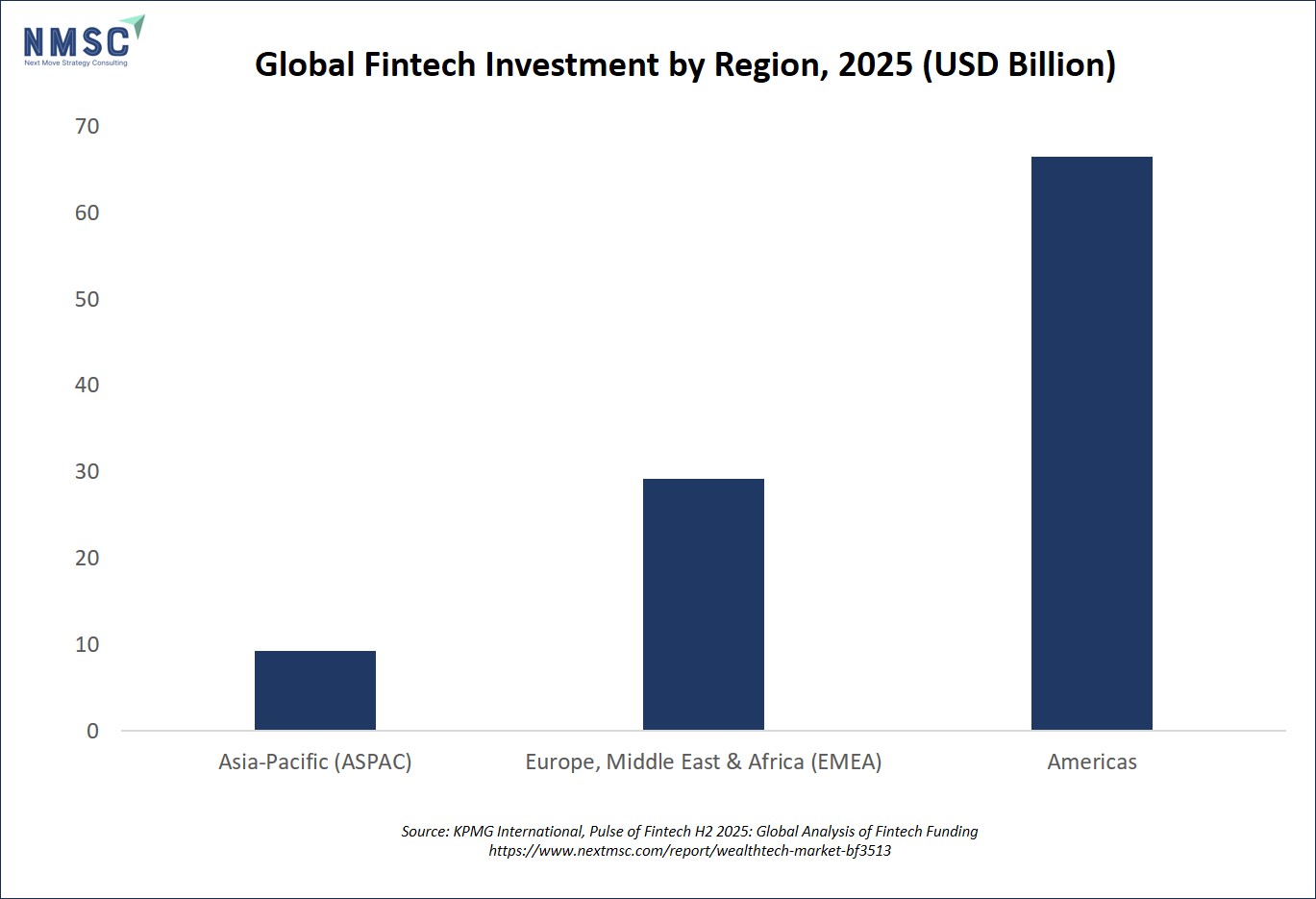
The Americas accounted for the largest share of global fintech investment in 2025, attracting $66.5 billion across 2,409 deals — of which the United States alone accounted for $56.6 billion across 1,977 deals. The EMEA region attracted $29.2 billion across 1,484 deals, while the Asia-Pacific region recorded $9.3 billion across 763 deals.
WealthTech Investment: Recalibration After a Record Year
Within the WealthTech subsector specifically, 2025 represented a year of significant recalibration. After rising to a record $4.9 billion in 2024 — driven by a small number of outlier transactions — total global WealthTech investment fell to a three-year low of $1.4 billion in 2025, despite deal volume remaining broadly stable year-over-year. KPMG attributed this contraction to a combination of factors: the absence of emergent use cases in the sector, the rapidly shifting focus of corporate investors toward the AI subsector, and a broader investor posture of evaluating where artificial intelligence fits within wealth management business models before committing capital.
The most significant WealthTech transaction of H2 2025 was the $538 million equity funding round secured by Canada-based digital wealth management platform Wealthsimple, co-led by Dragoneer Investment Group and Singapore's GIC at a post-money valuation of CAD $10 billion. Wealthsimple, which reported profitability in both 2024 and 2025 and serves over 4 million clients, represents the archetype of the next-generation WealthTech platform: a full-service digital wealth management ecosystem combining robo-advisory, self-directed investing, tax optimization, and banking services within a single mobile-first interface.
In the Americas, Institutional Capital Network — a New York-based WealthTech platform — secured $820 million in PE growth funding in H2 2025, ranking as the sixth-largest fintech deal in the Americas during the period. In the Asia-Pacific region, India-based Raise Fintech Ventures secured $120 million in a Series B round, ranking among the top 10 fintech deals in ASPAC during H2 2025.
Notable Global WealthTech Investment Transactions, H2 2025
|
Company |
Headquarters |
Deal Value (USD) |
Deal Type |
Investor(s) / Notes |
|
Institutional Capital Network |
New York, USA |
$820 million |
PE Growth |
Ranked 6th largest fintech deal in Americas H2'25 |
|
Wealthsimple |
Toronto, Canada |
~$538 million (CAD $750M) |
Series E (Equity) |
Co-led by Dragoneer Investment Group and GIC; $10B post-money valuation |
|
Raise Fintech Ventures |
Mumbai, India |
$120 million |
Series B |
Ranked top 10 fintech deal in ASPAC H2'25 |
|
Neo Asset Management |
India |
$64 million |
Early-stage VC |
Follow-on round led by Crystal Investment Advisors |
|
GeoWealth |
USA |
$38 million |
PE Growth (Series C) |
Led by Apollo; turnkey asset management platform |
The $200 Trillion AuM Opportunity: Structural Demand Drivers for WealthTech
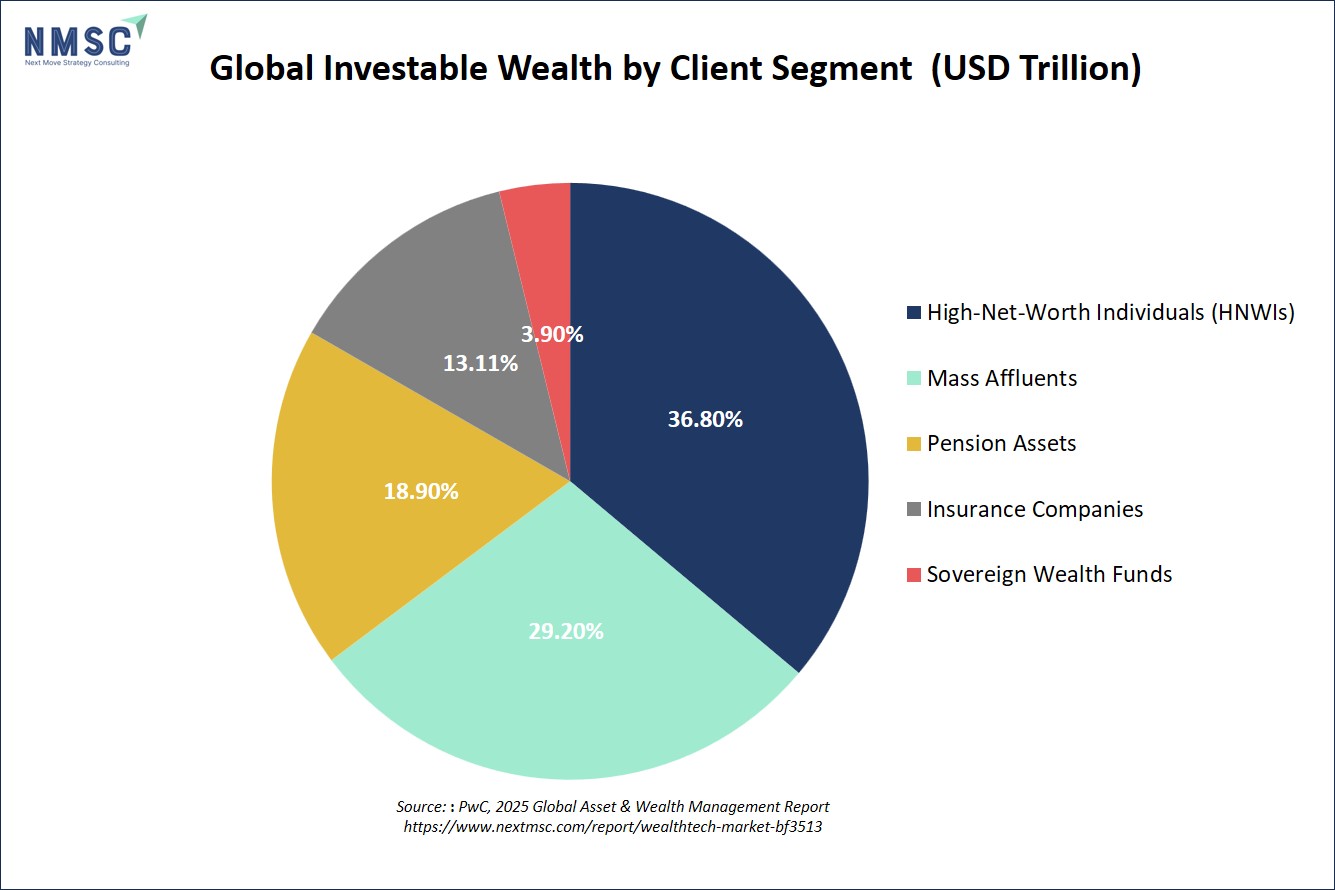
The macroeconomic foundation underpinning WealthTech's long-term growth trajectory is the projected expansion of global assets under management from $139 trillion in 2024 to $200 trillion by 2030 — a CAGR of 6.2% — alongside a parallel expansion of total global investable wealth from $344.9 trillion in 2024 to $481.8 trillion by 2030. This wealth expansion is being driven by structural and demographic shifts across five primary client segments: high-net-worth individuals (HNWIs), mass affluents, pension funds, insurance companies, and sovereign wealth funds.
HNWIs represent the fastest-growing and most strategically significant client segment for WealthTech platforms, with investable assets expanding from $127.0 trillion in 2024 to a projected $185.7 trillion by 2030 at a CAGR of 6.5%. Mass affluent clients — the primary target segment for digital-first WealthTech platforms — hold $100.6 trillion in investable assets in 2024, growing at a CAGR of 5.7% to reach $140.5 trillion by 2030. The democratization of wealth management — enabled by AI-driven personalization, mobile-first platforms, and declining advisory costs — is the central value proposition that WealthTech platforms are deploying to capture this expanding mass affluent segment.
North America will remain the dominant market for global AuM, growing at a CAGR of 6.2%, while Asia-Pacific is projected to grow fastest at a CAGR of 6.8% — driven by new wealth creation in India, intergenerational wealth transfers across the region, and Japan's structural efforts to channel household savings into investment products. Asia-Pacific AuM stood at $23.2 trillion in 2024 and is projected to reach $34.5 trillion by 2030.
Profitability Paradox: Rising Revenues, Compressing Margins
A structural tension is defining the competitive landscape for both traditional wealth managers and WealthTech platforms: revenues are rising, but profitability is under sustained pressure. PwC's 2025 Global Asset & Wealth Management Report found that 89% of asset managers surveyed reported profitability pressure over the past five years, with profit per AuM declining approximately 19% since 2018 and a further 9% decline projected by 2030. The industry's cost-to-income ratio remains stubbornly elevated at approximately 68%, meaning expenses consume more than two-thirds of every dollar earned.
This profitability paradox is the primary commercial driver of WealthTech adoption among established financial institutions. Half of asset managers surveyed by PwC identified convergence with wealth management and fintech players as the most significant factor expected to impact their revenue growth by 2030, ahead of tokenization and digital asset adoption (38%). Two-thirds (69%) of institutional investors signaled a likelihood to allocate capital to asset managers developing technology capabilities to offer enhanced products and services.
The NMSC WealthTech Market report identifies this convergence dynamic as a core structural driver of market expansion, noting that the integration of AI and machine learning into advisory services enables WealthTech platforms to deliver hyper-personalized investment recommendations — from asset allocation to tax optimization — at scale and with minimal human intervention. The report projects the global WealthTech market to expand from $22.99 billion in 2025 to $71.59 billion by 2030, at a CAGR of 25.5%.
AI and Agentic Intelligence: The Next Competitive Frontier
Artificial intelligence has emerged as the defining technology investment theme across the global fintech and WealthTech landscape. KPMG's Pulse of Fintech H2 2025 report recorded $16.8 billion in total global investment in AI-focused fintech companies in 2025 — up from $12.1 billion in 2024 — with deal volume growing from 1,183 to 1,334 transactions. Corporate investors were particularly active in the AI space, focusing on solutions capable of driving operational efficiencies and improvements in existing processes.
Within WealthTech specifically, KPMG noted that investors in H2 2025 showed growing interest in the use of agentic AI as a mechanism for advancing digital wealth management solutions — deploying AI agents to better understand client needs, conduct more complex portfolio analysis, and deliver more relevant, higher-value digital advice at scale. PwC's research corroborates this trajectory: asset managers identified AI integration and automation as the most important actions they are taking to transform and future-proof their business models for 2030, with AI investment expected to increase several-fold over the current decade.
The NMSC WealthTech Market report highlights that AI-powered algorithms analyzing vast datasets to deliver predictive investment insights, risk assessments, and personalized portfolio recommendations in real time represent the most consequential opportunity for WealthTech providers to differentiate their offerings and attract both retail and institutional investors. The incorporation of natural language processing, sentiment analysis, and behavioral finance into advisory platforms is enabling a new generation of intelligent, adaptive wealth management experiences that were previously accessible only to ultra-high-net-worth clients.
Key Companies and Strategic Developments
The global WealthTech competitive landscape is defined by a diverse ecosystem of enterprise technology providers, digital-native platforms, and incumbent financial institutions deploying proprietary technology. Key players identified in the NMSC WealthTech Market report include FIS (Fidelity National Information Services), Fiserv, SS&C Technologies, Broadridge Financial Solutions, BlackRock, LSEG (London Stock Exchange Group), SEI Investments, FNZ Group, Envestnet, Temenos, SimCorp, Avaloq, FactSet Research Systems, Addepar, Morningstar, Pershing (a BNY Pershing company), Iress, InvestCloud, Orion Advisor Solutions, and Tata Consultancy Services.
Recent strategic developments among key players include:
-
SS&C Technologies expanded its digital wealth management capabilities in August 2025 through the enhancement of its Black Diamond Wealth Platform, integrating portfolio management, reporting, and advisor workflow automation tools into a unified ecosystem designed to improve operational efficiency and client experience for financial advisors and wealth managers.
-
BlackRock expanded the reach of its Aladdin investment management platform in June 2025 through strategic collaborations and technology integration initiatives, providing advanced analytics, portfolio risk management, and data-driven investment decision-making tools for institutional and wealth management clients globally. BlackRock's September 2025 announcement of plans to tokenize its top-performing ETFs represents a landmark step in the integration of blockchain infrastructure into mainstream asset management.
-
FIS partnered with leading payment and banking technology providers in June 2025 to expand digital payment infrastructure and integrated financial service offerings for banking institutions, supporting faster transaction processing, embedded finance capabilities, and enhanced digital banking experiences.
-
Fiserv expanded its cloud-native banking and wealth management solutions portfolio in December 2024 through the launch of integrated digital financial planning and payment processing technologies designed to improve customer engagement and support digital transformation across financial institutions.
Global AuM Projections by Region, 2024–2030 (Base Case)
|
Region |
AuM 2024 (USD Trillion) |
AuM 2030 Projected (USD Trillion) |
CAGR 2024–2030 |
Strategic Notes |
|
North America |
Dominant market |
~$111T by 2030 |
6.2% |
Largest single market; U.S. accounts for majority of WealthTech deal activity |
|
Asia-Pacific |
$23.2T |
$34.5T |
6.8% (fastest) |
Driven by India wealth creation, Japan household savings mobilization, intergenerational transfers |
|
Europe |
Significant market |
Expanding |
5.6% |
ESG integration and regulatory harmonization key growth drivers |
|
Latin America |
Emerging |
Expanding |
6.6% |
Digital payments infrastructure and financial inclusion driving WealthTech adoption |
|
Middle East & Africa |
Emerging |
Expanding |
6.3% |
UAE emerging as real-world asset tokenization hub; sovereign wealth fund activity |
|
Global Total AuM |
$139T |
$200T |
6.2% |
Total investable wealth projected to reach $481.8T by 2030 |
Regional Analysis: North America, Europe, and Asia-Pacific
-
North America remains the structural anchor of the global WealthTech market, driven by a well-developed digital infrastructure, widespread smartphone penetration, a tech-savvy investor population, and a mature financial services sector that provides strong regulatory support for fintech innovation. The GENIUS Act has materially accelerated institutional confidence in digital asset integration, with the OCC's proposed rulemaking published in August 2026 providing a clear implementation pathway for WealthTech platforms seeking to incorporate stablecoin and tokenized asset capabilities.
-
Europe is experiencing a distinct WealthTech growth dynamic driven by rising demand for ESG-focused investment solutions. The European Parliament's November 2025 agreement on both the Payment Services Regulation (PSR) and the Third Payment Services Directive (PSD3) — aimed at harmonizing payment services across the EU and enhancing consumer protections — is providing a more predictable regulatory environment for WealthTech platforms seeking to expand across member states. A consortium of major European banks — including ING, BNP Paribas, KBC, and UniCredit — announced the creation of Qivalis in December 2025, a new entity mandated to launch a euro-pegged stablecoin by end of 2026, signaling the integration of digital asset infrastructure into European wealth management ecosystems.
-
Asia-Pacific represents the most consequential long-term growth frontier for WealthTech, with AuM projected to expand from $23.2 trillion in 2024 to $34.5 trillion by 2030 at the fastest regional CAGR of 6.8%. KPMG noted that new wealth in the Asia-Pacific region is driving demand for digital-native, on-demand, and self-directed WealthTech solutions at a pace that significantly exceeds mature markets such as the U.S. and EMEA. India's Raise Fintech Ventures ($120 million Series B) and Neo Asset Management ($64 million follow-on round) represent the vanguard of a rapidly expanding domestic WealthTech ecosystem in the world's most populous nation.
Private Markets, Tokenization, and the Retailization of Wealth
Private markets are emerging as the most profitable engine of the global asset management industry and a critical growth vector for WealthTech platforms. PwC projects that private markets revenues will reach $432.2 billion by 2030 — growing at a CAGR of 8.2% and delivering over half of total asset management industry revenues. Private markets currently generate approximately four times more profit per billion dollars of AuM than traditional managers, creating a powerful incentive for WealthTech platforms to develop capabilities that democratize access to private equity, private credit, and infrastructure investments for retail and mass affluent investors.
Tokenization is the technological mechanism enabling this democratization. By fractionalizing ownership of private market assets and lowering barriers to entry, tokenized investment products are extending access to asset classes previously available only to institutional and ultra-high-net-worth investors. PwC's projection of 41% CAGR growth in tokenized fund AuM — from $90 billion in 2024 to $715 billion by 2030 — represents one of the most significant structural opportunities in the WealthTech market over the current decade. More than 40% of asset managers surveyed by PwC identified tokenization as their most important product innovation priority.
The NMSC WealthTech Market report identifies blockchain and tokenization as one of five core technology pillars — alongside AI and machine learning, API-first developer tools, cloud-native architecture, and encryption and key management — that are defining the next generation of WealthTech platform capabilities. The report's segmentation of the market by technology reflects the convergence of these capabilities into integrated platform ecosystems that serve retail investors, mass affluent and high-net-worth individuals, financial advisors and registered investment advisors (RIAs), and institutional investors and wealth managers.
Cybersecurity and Regulatory Technology: Critical Infrastructure for WealthTech
As WealthTech platforms handle increasingly sensitive financial and personal data at scale, cybersecurity and regulatory technology (RegTech) have become critical infrastructure components rather than ancillary services. The NMSC WealthTech Market report's segmentation includes a dedicated Security & Regulatory Technology category encompassing cybersecurity and fraud prevention, identity verification and authentication, and compliance automation and regulatory reporting — reflecting the market's recognition that data protection and regulatory compliance are foundational to investor trust and platform viability.
KPMG's Pulse of Fintech H2 2025 report noted that many large banks and financial institutions began consolidating their data into protected environments in H2 2025 to better leverage agentic AI solutions, while simultaneously exploring how agentic cybersecurity models could drive operating expense reductions and improve security outcomes. The GENIUS Act's regulatory framework for stablecoins also introduces new compliance requirements for WealthTech platforms integrating digital asset capabilities, creating demand for automated compliance and regulatory reporting solutions.
Bottom Line
The global WealthTech market is at a structural inflection point defined by three converging forces: the expansion of global AuM toward $200 trillion by 2030, the regulatory clarity introduced by the GENIUS Act enabling digital asset integration into mainstream wealth management, and the accelerating deployment of AI and agentic intelligence across advisory, portfolio management, and compliance functions. The U.S. market's sustained dominance — capturing 54% of global WealthTech deals in Q2 2026 — reflects the depth of its digital wealth management ecosystem and the first-mover advantage conferred by the GENIUS Act's regulatory framework. The NMSC WealthTech Market report's projection of 25.5% CAGR growth to $71.59 billion by 2030 is supported by the macroeconomic fundamentals documented by PwC and KPMG: a $481 trillion global investable wealth pool, a $715 billion tokenized fund AuM opportunity, and $16.8 billion in annual AI-focused fintech investment. Key risks include margin compression driven by fee competition and rising operational costs — with 89% of asset managers reporting profitability pressure — alongside cybersecurity vulnerabilities, regulatory fragmentation across jurisdictions, and the challenge of translating AI investment into demonstrable client outcomes. For institutional investors and strategic planners, the WealthTech market presents a compelling long-term growth opportunity, with the highest-value positions accruing to platforms that successfully integrate AI-driven personalization, tokenized private market access, and regulatory compliance automation into cohesive, scalable digital wealth management ecosystems.
About Next Move Strategy Consulting
Next Move Strategy Consulting is a premier market research and management consulting firm that has been committed to provide strategically analysed well documented latest research reports to its clients. The research industry is flooded with many firms to choose from, what makes NMSC different from the rest is its top-quality research and the obsession of turning data into knowledge by dissecting every bit of it and providing fact-based research recommendation that is supported by information collected from over 500 million websites, paid databases, industry journals and one on one consultations with industry experts across a diverse range of industry sectors. The high-quality customized research reports with actionable insights and excellent end-to-end customer service help our clients to take critical business decisions that enables them to move beyond time and have competitive edge in the industry.
We have been servicing over 1000 customers globally that includes 90% of the Fortune 500 companies over a decade. Our analysts are constantly tracking various high growth markets and identifying hidden opportunities in each sector or the industry. We provide one of the industry's best quality syndicate as well as custom research reports across 10 different industry verticals. We are committed to deliver high quality research solutions in accordance to your business needs. Our industry standard delivery solutions that ranges from the pre consultation to after-sales services, provide an excellent client experience and ensure right strategic decision making for businesses.
For more information, please contact:
Next Move Strategy Consulting
5th Floor 867 Boylston St, STE 500,
Boston, MA 02116, U.S.
E-Mail: [email protected]
Direct: +1-217-650-7991
Website: www.nextmsc.com
About the Author
 Sanyukta Deb
— Sanyukta Deb is Digital Marketing Team Lead at Next Move Strategy Consulting, where she has led content strategy and technical SEO for the firm's B2B market research publications for over 2 years. Her editorial process translates NextMSC's primary and secondary research — spanning technology, industrial, and consumer sectors — into commercial narratives, backed by search-intent, keyword, and competitive analysis. She brings 5 years of overall experience in digital marketing and content strategy.
Sanyukta Deb
— Sanyukta Deb is Digital Marketing Team Lead at Next Move Strategy Consulting, where she has led content strategy and technical SEO for the firm's B2B market research publications for over 2 years. Her editorial process translates NextMSC's primary and secondary research — spanning technology, industrial, and consumer sectors — into commercial narratives, backed by search-intent, keyword, and competitive analysis. She brings 5 years of overall experience in digital marketing and content strategy.
About the Reviewer
 Debashree Dey
— Debashree Dey is Assistant Manager at Next Move Strategy Consulting, where she supports cross-vertical market content and communications across diverse industries for 6 years. Her professional background includes senior content writing, communications, and published manuscript authorship, with experience developing audience-focused business narratives and maintaining clear, consistent messaging. Her role supports research-led content development and editorial quality across NextMSC publications.
Debashree Dey
— Debashree Dey is Assistant Manager at Next Move Strategy Consulting, where she supports cross-vertical market content and communications across diverse industries for 6 years. Her professional background includes senior content writing, communications, and published manuscript authorship, with experience developing audience-focused business narratives and maintaining clear, consistent messaging. Her role supports research-led content development and editorial quality across NextMSC publications.
















Add Comment