Aluminium Architectural Systems Market Faces Tariff Crossroads
Section 232 Tariff Escalation and Surging Global Construction Demand Redefine the Competitive Landscape for Aluminium Architectural Systems
On April 2, 2026, the Trump administration announced a significant adjustment to Section 232 tariffs on metals, raising duties to as high as 50% on goods made almost entirely of aluminium, steel, or copper, while imposing a 25% levy on derivative goods "substantially made" of those metals. The measures, which took effect immediately, represent the latest escalation in a tariff regime that has fundamentally altered the cost structure of aluminium-intensive industries—none more so than the building envelope and architectural systems sector, where aluminium extrusions, curtain walls, façade cladding, and thermally broken window and door systems constitute the primary material input across commercial, institutional, and mega-project construction globally.
The tariff action follows a trajectory of sustained escalation. Section 232 aluminium duties were first imposed at 10% in 2018, raised to 25% in March 2025, and doubled to 50% effective June 4, 2025—a move that Boston Consulting Group estimated would add USD 50 billion in total tariff costs, doubling the estimated impact of the earlier 25% rate. The April 2026 adjustment extended the scope further, capturing a broader range of derivative aluminium products—including fabricated structural components and architectural systems—under the 50% duty umbrella. For architects, developers, and façade system fabricators operating across the North American market, the cumulative effect of these measures has been a material cost environment of unprecedented complexity.
The global Aluminium Architectural Systems Market, valued at USD 51.2 billion in 2025 and projected to reach USD 115.1 billion by 2035 at an 8.4% compound annual growth rate, is navigating this tariff-driven disruption from a position of structural strength. Long-term demand fundamentals—anchored by rising non-residential construction investment, tightening building energy codes, and expanding mega-project activity across Asia-Pacific and the Middle East—remain intact. However, the near-term cost and sourcing environment is compelling a strategic reassessment across the entire value chain, from primary aluminium smelters to integrated façade system houses.
For More Information: Download FREE Sample on Aluminium Architectural Systems Market Report
Section 232 Escalation: Architectural Systems in the Crossfire
The construction sector's exposure to Section 232 tariffs is both direct and layered. Aluminium extrusions—the foundational input for curtain wall frames, window profiles, door systems, and glazing assemblies—are among the most tariff-sensitive products in the building materials supply chain. Unlike structural steel, which accounts for approximately 8% to 9% of the total cost of a typical commercial building, aluminium architectural systems are embedded throughout the building envelope, making cost pass-through more complex and project-level impact more variable.
The August 2025 expansion of Section 232 coverage to more than 400 additional Harmonized Tariff Schedule codes—including fabricated structural components and architectural hardware—brought a wider range of aluminium architectural system inputs under the tariff regime. Construction procurement's reliance on distributors and bundled materials further complicates tariff mitigation strategies such as the First Sale Rule, which requires a level of supply chain transparency and documentation that most construction-sector procurement models cannot readily provide.
The price differential between U.S. and European aluminium markets widened by 139% between February 7 and May 27, 2025—a direct consequence of the tariff escalation—creating a structural cost disadvantage for U.S.-based fabricators reliant on imported aluminium billet and extrusion profiles. European system houses, including several of the dominant players in the aluminium architectural systems market, are reassessing their U.S. export strategies in response, with some pivoting toward higher-value-added specialty products where tariff exposure is proportionally lower relative to total system value.
Global Aluminium Supply: Record Production, Concentrated Geography
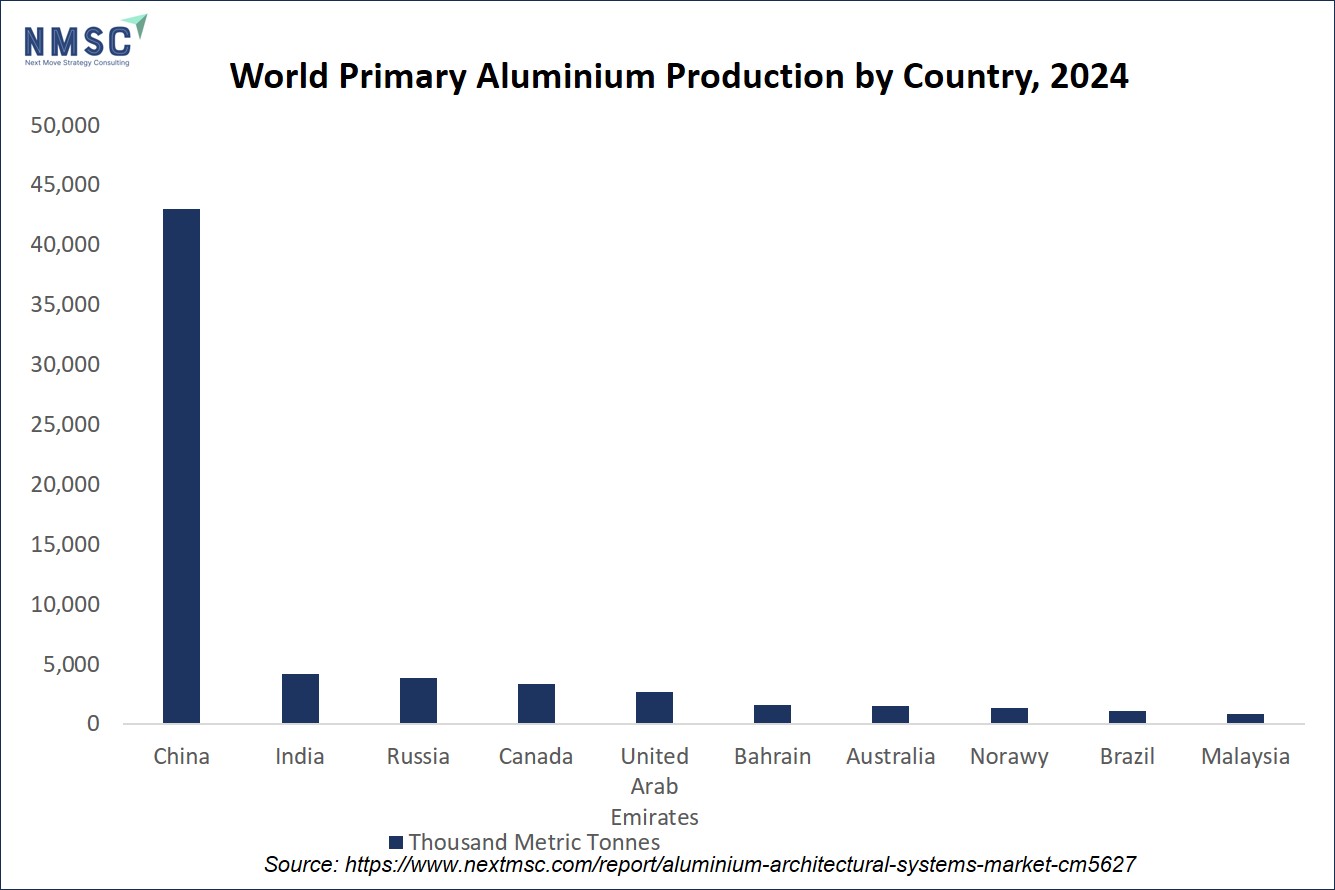
The tariff environment is unfolding against a backdrop of record global primary aluminium production. Global output reached an estimated 72 million tonnes in 2024, with China accounting for 43 million tonnes—equivalent to 60% of total world production. India ranked second at 4.2 million tonnes, followed by Russia at 3.8 million tonnes and Canada at 3.3 million tonnes. Global demand for primary aluminium reached an estimated 71.4 million tonnes in 2024, a 2.1% increase from 2023, with China accounting for 59% of global consumption by region.
The International Aluminium Institute's monthly production data for June 2026 recorded total global output of 5,980 thousand metric tonnes, with China contributing 3,712 thousand tonnes, Europe (including Russia) 619 thousand tonnes, Asia excluding China 409 thousand tonnes, the Gulf Cooperation Council 332 thousand tonnes, and North America 324 thousand tonnes.
The geographic concentration of primary aluminium production—with China commanding 60% of global output—has significant implications for the aluminium architectural systems supply chain. Section 232 tariffs, combined with Section 301 duties targeting Chinese aluminium imports specifically, have effectively closed the U.S. market to Chinese-origin aluminium at competitive price points. The Aluminum Association has documented that more than USD 10 billion has been invested in U.S. aluminium facilities over the past decade, with the U.S. industry supporting nearly 700,000 jobs and USD 228 billion in total economic impact. Nevertheless, domestic production capacity remains insufficient to fully substitute for imported aluminium across the full range of architectural-grade extrusion profiles required by the façade and window system fabrication sector.
World Primary Aluminium Production by Country, 2024
|
Rank |
Country |
Production (Thousand Tonnes) |
Share of Global Total (%) |
|
1 |
China |
43,000 |
60.0% |
|
2 |
India |
4,200 |
5.9% |
|
3 |
Russia |
3,800 |
5.3% |
|
4 |
Canada |
3,300 |
4.6% |
|
5 |
United Arab Emirates |
2,700 |
3.8% |
|
6 |
Bahrain |
1,600 |
2.2% |
|
7 |
Australia |
1,500 |
2.1% |
|
8 |
Norway |
1,300 |
1.8% |
|
9 |
Brazil |
1,100 |
1.5% |
|
10 |
Malaysia |
870 |
1.2% |
|
— |
Other Countries |
8,250 |
11.5% |
|
— |
World Total (Rounded) |
72,000 |
100.0% |
Notes: (p) = preliminary estimates. Totals may differ due to rounding. Global primary aluminium demand reached an estimated 71.4 million tonnes in 2024, a 2.1% increase from 2023.
Construction Sector: The Dominant Demand Driver
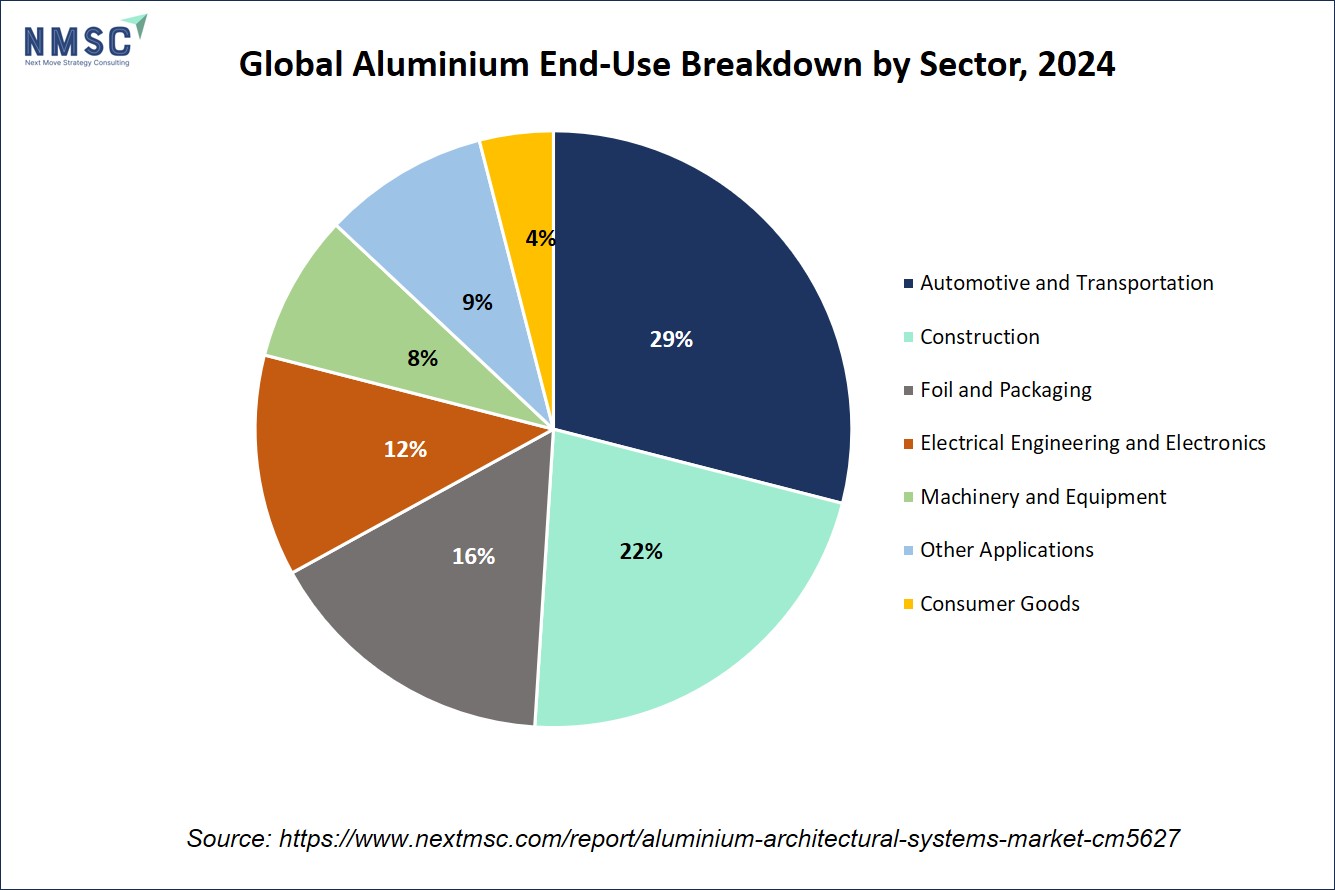
Construction remains the second-largest end-use sector for aluminium globally, accounting for 22% of total global aluminium consumption in 2024, behind only automotive and transportation at 29%. The International Aluminium Institute projects that the construction sector will require an additional 4.6 million tonnes of aluminium by 2030, with urbanisation in Asia excluding China accounting for 44% of that growth.
In the United States specifically, a market study commissioned by the Aluminum Association and conducted by Ducker Carlisle projected that aluminium usage in the building and construction sector would grow approximately 9% by 2027 compared to 2022 levels—representing an annual shipment increase of more than 200 million pounds. In 2022, nonresidential construction dominated the sector, accounting for more than 60% of the 2.5 billion pounds of aluminium shipped, with extruded aluminium profiles maintaining the highest share due to strong demand for window frames. Notably, 62% of building and construction professionals—including 79% of architects—anticipated increased aluminium use in future projects, ranking it as the material most likely to see growth among twelve building materials surveyed.
These demand fundamentals underpin the structural growth trajectory of the aluminium architectural systems market. According to Next Move Strategy Consulting's analysis, façade and cladding systems—encompassing unitized and stick-built curtain walls, rainscreen cladding, and window wall systems—held the largest system category share at approximately 36% of the market (USD 18.43 billion) in 2025. Thermally broken systems, driven by tightening building energy codes across North America and Europe, accounted for approximately 64% of the market by thermal performance category (USD 32.77 billion) in 2025, and are projected to expand at a 9.7% CAGR through 2035.
Regional Dynamics: Asia-Pacific Leads, Middle East Accelerates
Asia-Pacific's dominance in the aluminium architectural systems market reflects the region's position as the world's most active high-rise and mega-project construction zone. The region accounted for approximately 33% of global market revenue (USD 16.90 billion) in 2025, driven by expanding construction activity in China and India. China's aluminium architectural systems market alone was valued at approximately USD 6.08 billion in 2025, supported by a dense base of regional fabricators and accelerating domestic production capacity expansion. India, the fastest-growing country in the market at a projected 12.1% CAGR through 2035, reflects the rapid commercial and institutional construction growth underpinning the country's urbanisation trajectory.
The Middle East and Africa region is the fastest-growing globally, projected to expand at an 11.1% CAGR from 2026 to 2035. Saudi Arabia's Vision 2030-linked giga-project development pipeline—anchored by projects such as NEOM and the Red Sea Project—is generating substantial demand for high-performance façade and specialty aluminium systems. The UAE, valued at approximately USD 1.91 billion in 2025, is similarly positioned as a regional mega-project and landmark architecture hub, with system houses expanding portfolios to serve Gulf construction demand.
In March 2026, ALUMIL S.A. announced that the European Bank for Reconstruction and Development approved a loan of up to €13.7 million for its Egyptian subsidiary, Alumil Misr for Trade & Industry SAE, to finance the construction and installation of a new aluminium extrusion line at its plant in the Polaris Industrial Zone, Cairo—a development that illustrates the strategic importance of regional manufacturing capacity expansion in serving Middle East and Africa construction demand. In April 2026, YKK Corporation completed the acquisition of an 80% stake in Panasonic Housing Solutions Co., Ltd. from Panasonic Holdings Corporation, combining YKK AP's architectural products expertise with Panasonic's interior and exterior housing equipment manufacturing and sales in Japan—a transaction that signals continued consolidation among leading system houses seeking to broaden their product and geographic reach.
Global Aluminium End-Use Sector Breakdown, 2024
|
End-Use Sector |
Global Share (%) |
Key Application Areas |
|
Automotive and Transportation |
29% |
Vehicle bodies, chassis, EV battery enclosures, rail, aerospace |
|
Construction |
22% |
Façade systems, window and door profiles, curtain walls, structural components |
|
Foil and Packaging |
16% |
Beverage cans, food packaging, pharmaceutical foil |
|
Electrical Engineering and Electronics |
12% |
Power cables, transformers, heat sinks, consumer electronics |
|
Machinery and Equipment |
8% |
Industrial machinery, agricultural equipment, HVAC systems |
|
Other Applications |
9% |
Marine, defense, sporting goods, and miscellaneous |
|
Consumer Goods |
4% |
Household appliances, furniture, cookware |
|
Total |
100% |
— |
Notes: (p) = preliminary estimates for 2024. Construction sector is the second-largest end-use globally. Global primary aluminium demand reached an estimated 71.4 million tonnes in 2024.
Sustainability Mandates and the Low-Carbon Specification Imperative
Concurrent with the tariff-driven cost pressures, the aluminium architectural systems market is being reshaped by an accelerating sustainability mandate. The EU's Ecodesign for Sustainable Products Regulation, which entered into force in 2026, is compelling developers and system houses to document embodied carbon performance across building envelope materials—a requirement that is elevating demand for low-carbon and recycled-content aluminium in façade and window system specification.
The Aluminum Association's decarbonisation roadmap, released in 2024, identified that achieving net-zero targets for the North American aluminium industry will require production emissions declines of 24% by 2030, 63% by 2040, and 92% by 2050 relative to a 2021 baseline. North American aluminium production is already approximately 50% less carbon-intensive than global averages, providing a competitive sustainability advantage for domestically sourced architectural-grade aluminium. More than 90% of the aluminium used in construction applications is recyclable, and secondary aluminium production requires 95% less energy than primary production—attributes that are increasingly central to green building certification programme requirements.
Within the aluminium architectural systems market, leading system houses are translating these sustainability imperatives into product differentiation strategies. Schüco International KG has introduced low-carbon aluminium as a standard material option across its product range, while Reynaers Aluminium NV's MasterLine 8 window and door series holds Cradle to Cradle Certified status. Reynaers also introduced a 35mm façade system achieving a UK-first dual certification for structural and thermal performance—a development that illustrates how slim-profile engineering and sustainability certification are converging as the primary axes of competitive differentiation in premium commercial and institutional project specification.
The International Aluminium Institute projects that global aluminium demand will increase by approximately 40% by 2030—from 86.2 million tonnes in 2020 to 119.5 million tonnes—with transportation, construction, packaging, and electrical sectors collectively accounting for 75% of the total additional metal required. The construction sector's share of this growth—an additional 4.6 million tonnes by 2030—will be disproportionately concentrated in Asia excluding China, where urbanisation-driven infrastructure spending is the primary demand catalyst.
Competitive Landscape: European System Houses and Regional Fabricators
The aluminium architectural systems market remains moderately fragmented, led by European system houses and diversified regional fabricators competing for turnkey mega-project and commercial façade contracts. The 20 companies profiled in Next Move Strategy Consulting's analysis include ALUMIL S.A., Hydro Building Systems Germany GmbH, Reynaers Aluminium NV, YKK AP Inc., Aluprof S.A., Schüco International KG, Kawneer Company Inc., heroal, METRA S.p.A., AluK Group S.p.A., CORTIZO S.L., RAICO Bautechnik GmbH, ETEM Gestamp, Exlabesa Building Systems, Capral Limited, Ponzio S.r.l., Metal Technology Ltd, Senior Architectural Systems Ltd, Hueck System GmbH & Co. KG, and Gutmann AG.
Two competitive archetypes dominate the market: European system houses offering deeply engineered, certified façade and window platforms—exemplified by Schüco and AluK Group—and regional European and Asia-Pacific fabricators focused on large-scale turnkey project delivery, exemplified by Metal Technology Ltd and Ponzio S.r.l. The tariff environment is creating a bifurcation in competitive strategy: European system houses with established U.S. distribution networks are absorbing tariff-related cost pressures through pricing adjustments and supply chain reconfiguration, while regional fabricators in Asia-Pacific and the Middle East are expanding production capacity to serve growing domestic and regional construction demand insulated from U.S. tariff exposure.
The Specialty Systems segment—encompassing railings, balustrades, and building-integrated photovoltaic (BIPV) façade systems—is the fastest-growing category in the market, projected to expand at a 12.1% CAGR from 2026 to 2035. BIPV systems, which integrate photovoltaic capability into curtain wall and rainscreen cladding assemblies, are gaining specification share on commercial projects pursuing net-zero energy targets—a trend that is attracting capital from both system houses and clean energy investors seeking to position at the intersection of building envelope and renewable energy generation.
Bottom Line
The global aluminium architectural systems market is at a structural inflection point, shaped by the convergence of escalating U.S. Section 232 tariffs, tightening EU sustainability regulation, and record-level global aluminium demand growth. The April 2026 tariff adjustment—raising duties to 50% on aluminium-intensive goods—has introduced significant near-term cost pressure for North American façade fabricators and system integrators, while simultaneously incentivising domestic capacity investment and supply chain reconfiguration toward tariff-exempt Western Hemisphere sourcing corridors. Despite these headwinds, the market's long-term growth trajectory remains compelling: a USD 59.6 billion absolute dollar opportunity between 2026 and 2035, anchored by sustained non-residential construction investment, expanding mega-project activity in Asia-Pacific and the Middle East, and accelerating demand for thermally broken and low-carbon façade systems. Investors should prioritise system houses with validated sustainability credentials, slim-profile engineering capability, and regional fabrication scale in high-growth markets. Key risks to monitor include primary aluminium price volatility, construction demand cyclicality tied to interest rate conditions, and the pace of EU regulatory implementation for embodied carbon disclosure requirements.
About Next Move Strategy Consulting
Next Move Strategy Consulting is a premier market research and management consulting firm that has been committed to provide strategically analysed well documented latest research reports to its clients. The research industry is flooded with many firms to choose from, what makes NMSC different from the rest is its top-quality research and the obsession of turning data into knowledge by dissecting every bit of it and providing fact-based research recommendation that is supported by information collected from over 500 million websites, paid databases, industry journals and one on one consultations with industry experts across a diverse range of industry sectors. The high-quality customized research reports with actionable insights and excellent end-to-end customer service help our clients to take critical business decisions that enables them to move beyond time and have competitive edge in the industry.
We have been servicing over 1000 customers globally that includes 90% of the Fortune 500 companies over a decade. Our analysts are constantly tracking various high growth markets and identifying hidden opportunities in each sector or the industry. We provide one of the industry's best quality syndicate as well as custom research reports across 10 different industry verticals. We are committed to deliver high quality research solutions in accordance to your business needs. Our industry standard delivery solutions that ranges from the pre consultation to after-sales services, provide an excellent client experience and ensure right strategic decision making for businesses.
For more information, please contact:
Next Move Strategy Consulting
5th Floor 867
Boylston St, STE 500,
Boston, MA 02116, U.S.
E-Mail: [email protected]
Direct: +1-217-650-7991
Website: www.nextmsc.com
About the Author
 Sanyukta Deb
— Sanyukta Deb is Digital Marketing Team Lead at Next Move Strategy Consulting, where she has led content strategy and technical SEO for the firm's B2B market research publications for over 2 years. Her editorial process translates NextMSC's primary and secondary research — spanning technology, industrial, and consumer sectors — into commercial narratives, backed by search-intent, keyword, and competitive analysis. She brings 5 years of overall experience in digital marketing and content strategy.
Sanyukta Deb
— Sanyukta Deb is Digital Marketing Team Lead at Next Move Strategy Consulting, where she has led content strategy and technical SEO for the firm's B2B market research publications for over 2 years. Her editorial process translates NextMSC's primary and secondary research — spanning technology, industrial, and consumer sectors — into commercial narratives, backed by search-intent, keyword, and competitive analysis. She brings 5 years of overall experience in digital marketing and content strategy.
About the Reviewer
 Debashree Dey
— Debashree Dey is Assistant Manager at Next Move Strategy Consulting, where she supports cross-vertical market content and communications across diverse industries for 6 years. Her professional background includes senior content writing, communications, and published manuscript authorship, with experience developing audience-focused business narratives and maintaining clear, consistent messaging. Her role supports research-led content development and editorial quality across NextMSC publications.
Debashree Dey
— Debashree Dey is Assistant Manager at Next Move Strategy Consulting, where she supports cross-vertical market content and communications across diverse industries for 6 years. Her professional background includes senior content writing, communications, and published manuscript authorship, with experience developing audience-focused business narratives and maintaining clear, consistent messaging. Her role supports research-led content development and editorial quality across NextMSC publications.

















Add Comment