Serve Robotics’ $29M Diligent Deal Reshapes Service Robotics Market
Serve Robotics' $29M Acquisition of Diligent Robotics Signals a Structural Shift as Hospital and Delivery Robots Converge on a Single Autonomy Platform
In one of the most consequential consolidation moves in the service robotics sector this year, Serve Robotics Inc. (Nasdaq: SERV) announced on January 20, 2026, its agreement to acquire Diligent Robotics, Inc. — the Austin-based developer of the Moxi hospital delivery robot — for USD 29.0 million in stock consideration, plus a potential earn-out of up to USD 5.3 million tied to specified performance milestones. The transaction, which closed in Q1 2026, is not merely a corporate finance event — it is a structural signal that the boundary separating outdoor last-mile delivery robots from indoor clinical-service robots is dissolving, and that operators capable of running a unified autonomy stack across both environments will command disproportionate commercial advantage in the years ahead.
According to Next Move Strategy Consulting's Service Robotics Market report, the global service robotics market is projected to reach USD 173.39 billion by 2030, growing at a CAGR of 21.40% from 2024 to 2030. This trajectory — compounding at more than one-fifth annually — reflects a market where the convergence of agentic AI, autonomous mobile robot (AMR) hardware maturation, and acute labor shortages across healthcare and logistics is simultaneously expanding the addressable use-case universe and compressing the time-to-deployment for new robotic applications.
For More Information: Download FREE Sample on Service Robotics Market Report
The Serve–Diligent Deal: What the Numbers Reveal about Market Direction
The strategic logic of the Serve–Diligent transaction is grounded in operational economics that are specific to the hospital robotics segment. At the time of the acquisition announcement, Diligent's Moxi robot was deployed across more than 25 hospital facilities in the United States, representing one of the largest commercial deployments of mobile manipulation robots operating alongside clinical staff. The Moxi fleet had completed over 1.25 million autonomous deliveries — transporting medications, lab samples, and supplies — with each hospital facility generating between USD 200,000 and USD 400,000 in annual revenue for Diligent.
"This acquisition accelerates Serve's evolution from a robotic delivery company into a full-stack autonomy platform," said Dr. Ali Kashani, Co-founder and CEO of Serve Robotics, in the company's January 20, 2026 press release. "We've proven we can deploy robots safely and reliably at scale in complex urban environments. By extending our platform beyond sidewalks and into hospitals, we're expanding where our Physical AI can operate, learn, and create value. Over time, Serve and Moxi will share one autonomy stack, one data flywheel, and one operating system for robots that work alongside people across city sidewalks and critical institutions. This is how autonomy becomes infrastructure."
"Diligent was founded to help healthcare teams do more with their limited resources," said Andrea Thomaz, CEO of Diligent Robotics, in the same announcement. "By joining Serve, we can build on the autonomy and AI we've deployed across live hospital fleets and scale it faster, enabling more intelligent, capable robots in care environments."
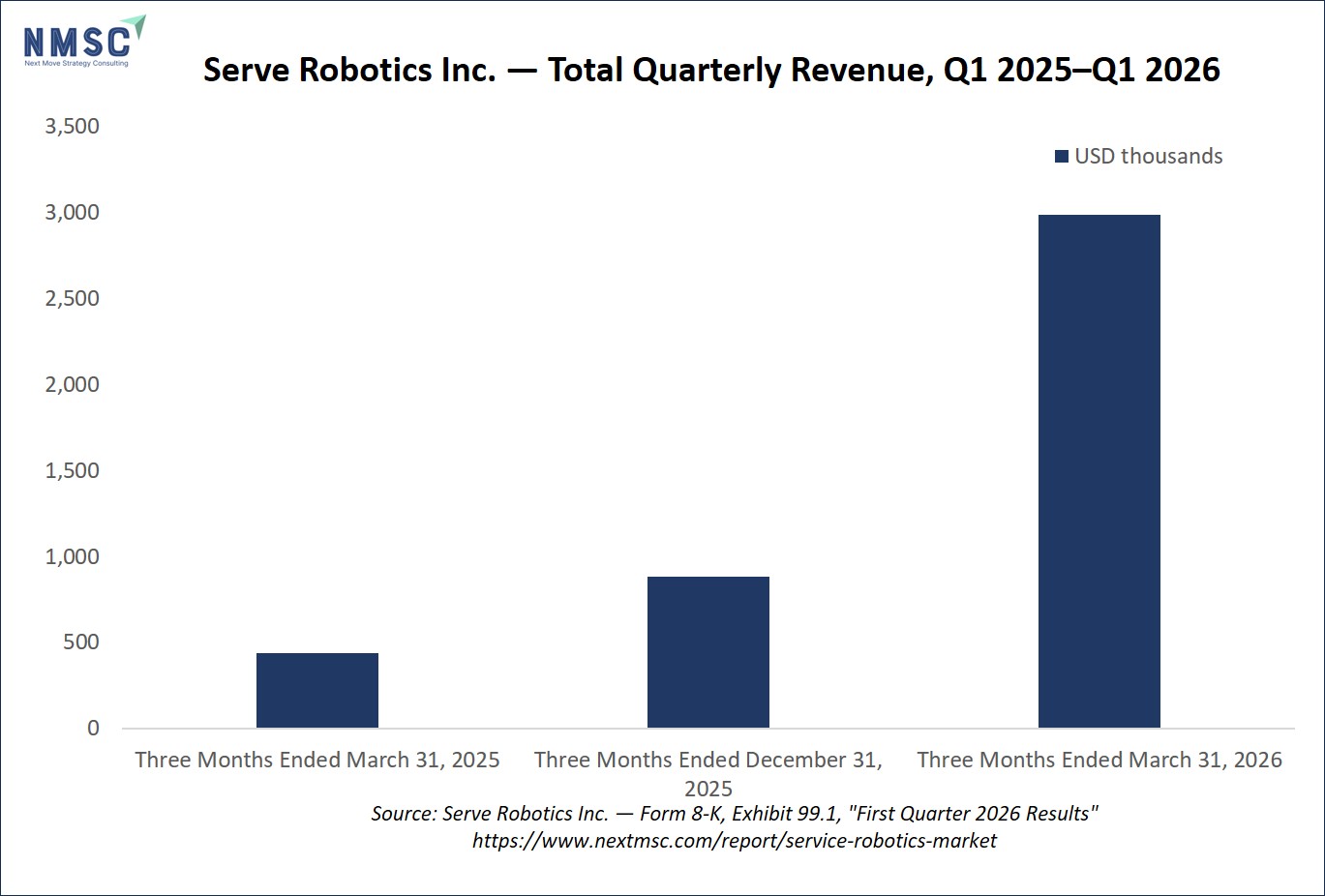
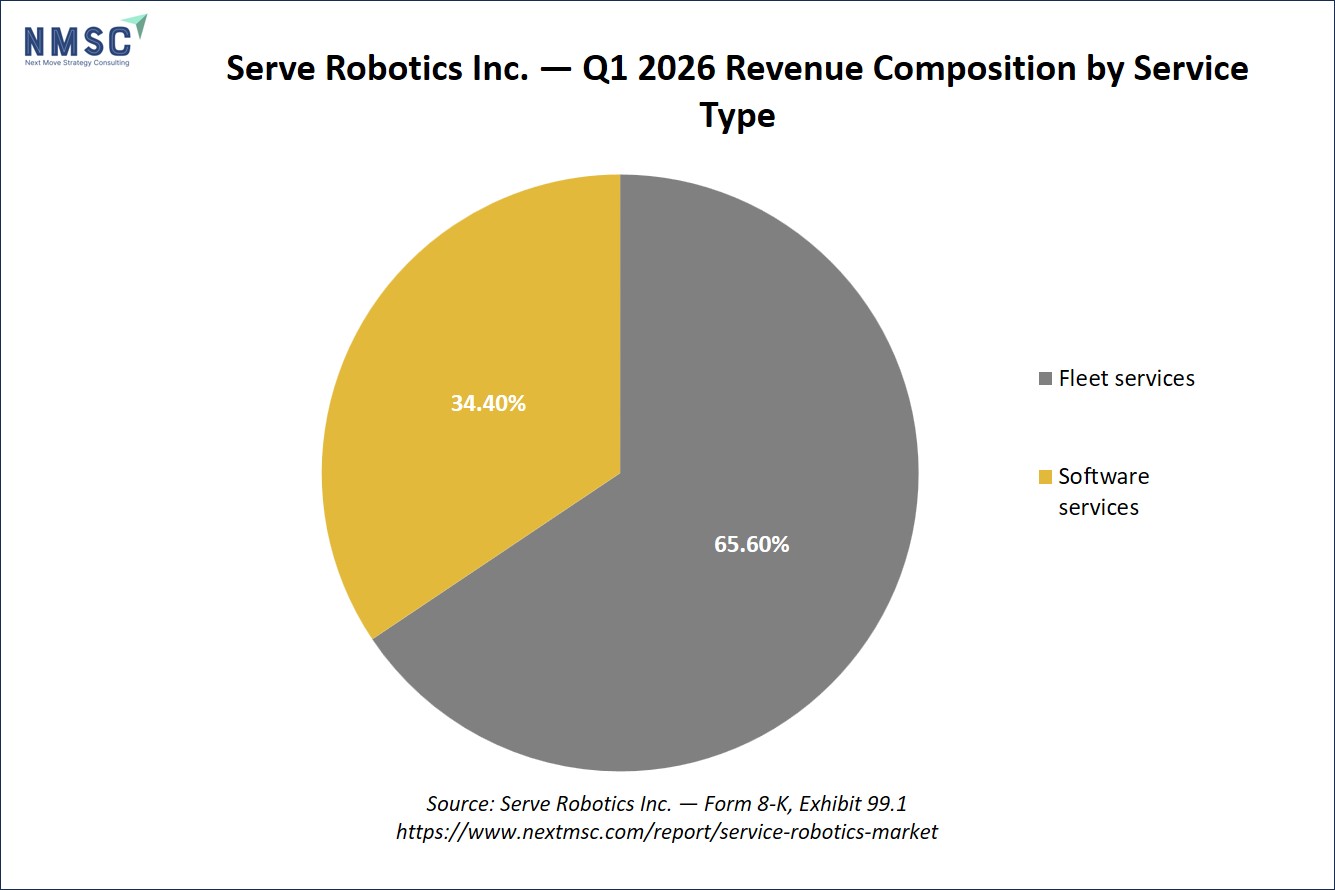
By Q1 2026, the combined entity had expanded its operating footprint to 44 cities across 14 U.S. states, with a fleet of approximately 2,000 robots approaching 2 million cumulative deliveries across indoor and outdoor environments. Q1 2026 revenue reached USD 3.0 million — a 578% increase year-over-year and a 238% sequential increase — with software services contributing approximately one-third of total revenue, signaling a shift toward a more durable, recurring revenue model.
Peer-Reviewed Evidence: Hospital Logistics Robots Deliver Measurable Clinical and Financial Returns
The commercial momentum behind hospital service robots is now supported by rigorous peer-reviewed evidence. A six-month parallel-controlled study published in Scientific Reports (Nature Portfolio) in April 2026, conducted at Shaanxi Provincial People's Hospital in China, evaluated a fleet of 10 autonomous mobile robots deployed across 22 open wards for pharmaceutical and specimen delivery.
The findings are operationally significant for any healthcare system evaluating service robot procurement:
-
The 10-robot fleet completed 7.3 times more delivery trips than 19 manual logistics workers over the same six-month period.
-
Robot delivery reduced average delivery time by 32% to 36% compared to manual operations (p < 0.001).
-
The robot group achieved 100% verification accuracy and 100% item integrity rate, with a significantly lower omission rate than the manual group (p = 0.011).
-
Over a 10-year lifecycle, the robotic system generated cumulative cost savings of 6.928 million RMB relative to manual staffing, with a payback period of 3.4 years.
-
Both nurse and patient satisfaction scores were significantly higher in the robot group (p < 0.05).
These results directly validate the commercial thesis behind the Serve–Diligent acquisition: hospital environments generate dense, repeatable task flows that sharpen autonomous navigation models faster than most outdoor settings, while simultaneously delivering revenue per robot that justifies the capital outlay.
IFR Identifies Five Structural Forces Reshaping The Robotics Industry In 2026
The International Federation of Robotics (IFR), in its January 8, 2026 press release on the Top 5 Global Robotics Trends for 2026, confirmed that the global market value of industrial robot installations has reached an all-time high of USD 16.7 billion, with future demand driven by a set of converging technological and labor-market forces that are equally applicable to the service robotics segment.
The IFR identified five trends with direct implications for service robotics market growth:
-
AI and Autonomy: Agentic AI — combining analytical AI for structured decision-making with generative AI for adaptability — is enabling robots to operate independently in complex, real-world environments, directly expanding the range of tasks that service robots can perform without human intervention.
-
IT/OT Convergence: The merger of information technology's data-processing power with operational technology's physical control capabilities is enhancing robotics versatility through real-time data exchange and advanced analytics — a foundational element of Industry 4.0 that is accelerating AMR deployment in logistics and healthcare.
-
Humanoid Robots Proving Reliability: Companies and researchers are moving beyond prototypes to deploy humanoids in real-world settings, with automotive, warehousing, and manufacturing applications coming into focus globally.
-
Safety and Security Governance: As robots increasingly operate alongside humans in service settings, AI-driven autonomy is fundamentally changing the safety landscape, prompting calls for clear ISO-aligned certification frameworks and liability governance.
-
Robots as Labor Gap Allies: Employers across all sectors are adopting robotics to address unfilled skilled-labor positions, with governments and companies pushing skilling and upskilling programs to help workers adapt to an automation-driven economy.
Competitive Landscape: Key Developments Across the Service Robotics Ecosystem
The service robotics competitive landscape is undergoing rapid consolidation and platform expansion, with leading players pursuing multi-domain autonomy strategies rather than single-application deployments.
Selected Service Robotics Market — Key Competitive Developments, 2025–2026
|
Company |
Development |
Date |
|
Serve Robotics (Nasdaq: SERV) |
Acquired Diligent Robotics for USD 29M in stock; expanded to 44 cities across 14 U.S. states with ~2,000-robot fleet |
January 20, 2026 (announced); Q1 2026 (closed) |
|
Serve Robotics (Nasdaq: SERV) |
Launched robot delivery with Wonder and Grubhub; expanded to San Jose and Washington, D.C.; introduced micro-depot model in Miami |
August 17, 2026 |
|
Intuitive Surgical, Inc. |
FDA cleared a new curved vessel sealer designed for use with the da Vinci surgical system |
July 10, 2025 |
|
Ecovacs Robotics Co., Ltd. |
Launched DEEBOT X8 PRO OMNI (18,000 Pa suction, smart mapping), DEEBOT T50 PRO OMNI (TÜV-certified hygiene), and WINBOT MINI (compact window-cleaning robot) at CES |
January 2025 |
|
Boston Dynamics |
Unveiled all-new Electric Atlas enterprise humanoid robot at CES 2026; began commercial leasing |
January 2026 |
Regional Dynamics: Asia-pacific Leads, North America Accelerates
According to NextMSC primary research and analysis, Asia-Pacific dominated the global service robotics market through the recent historical period and is expected to maintain its leadership position throughout the forecast horizon. This dominance is anchored in the manufacturing and robotics export capabilities of Japan, China, and South Korea. The International Federation of Robotics has documented that Japan is the world's largest industrial robot manufacturer, delivering 45% of global supply, with an export ratio of 78% when 136,069 industrial robots were shipped in the reference period.
North America is projected by NextMSC proprietary research and estimates to be the fastest-growing regional market during the 2024–2030 forecast period. The Serve Robotics Q1 2026 results — with the combined Serve–Diligent fleet now active across 44 U.S. cities — provide a concrete, real-time illustration of this acceleration. The U.S. market benefits from a favorable investment environment for assistive and autonomous technologies, a growing contactless-delivery infrastructure, and a healthcare system under sustained pressure to reduce labor costs — all of which are creating simultaneous pull for both professional and domestic service robots.
NMSC Strategic Perspective: The Platform Consolidation Thesis and what it means for Market Structure
The Serve–Diligent transaction is the clearest market-level evidence yet that the service robotics industry is entering a platform consolidation phase — one that will structurally advantage operators who can amortize their autonomy stack development costs across multiple deployment environments rather than a single vertical.
NextMSC primary research and analysis identifies three specific mechanisms through which this consolidation dynamic will accelerate market growth toward the USD 173.39 billion forecast by 2030:
1. Shared Autonomy Stacks Compress Time-to-Market for New Verticals. When a robot operating on city sidewalks and a robot navigating hospital corridors share the same underlying AI models, every delivery completed in either environment improves navigation performance in both. Serve's explicit articulation of this "data flywheel" — where every robot learns from every other robot — means that the marginal cost of entering a new service robotics vertical falls with each additional deployment domain. This compresses the timeline between proof-of-concept and commercial scale in ways that single-vertical operators cannot replicate.
2. Revenue-Per-Robot Economics Are Shifting the Investment Case. The Diligent Moxi model — generating USD 200,000 to USD 400,000 per hospital facility annually — represents a fundamentally different revenue architecture than per-delivery pricing models. As software services grow as a proportion of total revenue — reaching approximately one-third of Serve's Q1 2026 revenue — the market is transitioning from hardware-sale economics toward recurring-subscription economics, which supports higher valuation multiples and more predictable capital allocation for fleet expansion.
3. Peer-Reviewed Clinical Evidence Is Removing the Procurement Barrier in Healthcare. The publication of rigorous, multi-metric hospital logistics robot studies — such as the April 2026 Scientific Reports study demonstrating a 3.4-year payback period and 6.928 million RMB in 10-year savings — provides hospital procurement committees with the evidence-based justification required to approve capital expenditure on autonomous systems. This evidence base did not exist at scale three years ago; its emergence in 2026 is a demand-side catalyst that NMSC's proprietary model identifies as a key driver of the healthcare sub-segment's above-average contribution to overall market CAGR.
The IFR's identification of labor-gap mitigation as a top-five global robotics trend for 2026 reinforces this analysis. Healthcare systems worldwide face structural nursing shortages, and the documented ability of a 10-robot fleet to replace 19 full-time logistics personnel — while simultaneously improving delivery accuracy to 100% and reducing delivery time by up to 36% — makes the service robotics value proposition in clinical settings quantifiably superior to the status quo.
The primary risk to this trajectory is not demand — it is governance. The IFR's explicit identification of AI safety certification, ISO compliance, and liability framework clarity as a top-five trend reflects the reality that regulatory ambiguity around autonomous systems operating in human-centric environments remains the most consequential constraint on deployment velocity. Companies that invest in proactive regulatory engagement and third-party safety certification — as Ecovacs did with TÜV certification for its DEEBOT T50 PRO OMNI — will be positioned to capture first-mover advantage in regulated deployment environments.
Market Segmentation Overview
According to NextMSC primary research and analysis, the global service robotics market is segmented by component (hardware, software, and support services), type (domestic service robots and professional service robots), mobility platform (ground, aerial, and marine/aquatic), autonomy level (teleoperated, semi-autonomous, and fully autonomous), and end-user (consumers/households, commercial, and public sector).
The professional service robots segment — encompassing healthcare, logistics and supply chain, field operations, and public and commercial services — represents the primary growth engine within the market, driven by the documented labor-cost economics and operational efficiency gains that are now supported by peer-reviewed evidence. The fully autonomous sub-segment within the autonomy level classification is expected to register the highest growth rate, consistent with the IFR's identification of agentic AI as the defining technological trend of 2026.
Bottom Line
The service robotics market is undergoing a structural transformation that is simultaneously broadening its addressable scope and deepening its commercial viability. The Serve Robotics acquisition of Diligent Robotics — closing in Q1 2026 at USD 29 million — is the most consequential consolidation event in the sector this year, demonstrating that the most durable competitive positions will belong to operators who can deploy a unified autonomy platform across outdoor delivery and indoor clinical environments. Peer-reviewed evidence published in Scientific Reports in April 2026 has quantified the hospital logistics robot value proposition with institutional precision: a 10-robot fleet outperforms 19 manual workers by a factor of 7.3 in delivery throughput, achieves 100% accuracy, and generates a 3.4-year payback period. The IFR's confirmation that global industrial robot installations have reached an all-time high of USD 16.7 billion, combined with its identification of labor-gap mitigation and agentic AI as the defining trends of 2026, provides the macro context within which NextMSC's forecast of a USD 173.39 billion service robotics market by 2030 — growing at a 21.40% CAGR — is not only credible but may prove conservative if regulatory frameworks for autonomous systems in clinical and public-sector environments are resolved ahead of schedule.
About Next Move Strategy Consulting
Next Move Strategy Consulting is a premier market research and management consulting firm that has been committed to provide strategically analysed well documented latest research reports to its clients. The research industry is flooded with many firms to choose from, what makes NMSC different from the rest is its top-quality research and the obsession of turning data into knowledge by dissecting every bit of it and providing fact-based research recommendation that is supported by information collected from over 500 million websites, paid databases, industry journals and one on one consultations with industry experts across a diverse range of industry sectors. The high-quality customized research reports with actionable insights and excellent end-to-end customer service help our clients to take critical business decisions that enables them to move beyond time and have competitive edge in the industry.
We have been servicing over 1000 customers globally that includes 90% of the Fortune 500 companies over a decade. Our analysts are constantly tracking various high growth markets and identifying hidden opportunities in each sector or the industry. We provide one of the industry's best quality syndicate as well as custom research reports across 10 different industry verticals. We are committed to deliver high quality research solutions in accordance to your business needs. Our industry standard delivery solutions that ranges from the pre consultation to after-sales services, provide an excellent client experience and ensure right strategic decision making for businesses.
For more information, please contact:
Next Move Strategy Consulting
5th Floor 867 Boylston St, STE 500,
Boston, MA 02116, U.S.
E-Mail: [email protected]
Direct: +1-217-650-7991
Website: www.nextmsc.com
About the Author
 Sanyukta Deb
— Sanyukta Deb is Digital Marketing Team Lead at Next Move Strategy Consulting, where she has led content strategy and technical SEO for the firm's B2B market research publications for over 2 years. Her editorial process translates NextMSC's primary and secondary research — spanning technology, industrial, and consumer sectors — into commercial narratives, backed by search-intent, keyword, and competitive analysis. She brings 5 years of overall experience in digital marketing and content strategy.
Sanyukta Deb
— Sanyukta Deb is Digital Marketing Team Lead at Next Move Strategy Consulting, where she has led content strategy and technical SEO for the firm's B2B market research publications for over 2 years. Her editorial process translates NextMSC's primary and secondary research — spanning technology, industrial, and consumer sectors — into commercial narratives, backed by search-intent, keyword, and competitive analysis. She brings 5 years of overall experience in digital marketing and content strategy.
About the Reviewer
 Debashree Dey
— Debashree Dey is Assistant Manager at Next Move Strategy Consulting, where she supports cross-vertical market content and communications across diverse industries for 6 years. Her professional background includes senior content writing, communications, and published manuscript authorship, with experience developing audience-focused business narratives and maintaining clear, consistent messaging. Her role supports research-led content development and editorial quality across NextMSC publications.
Debashree Dey
— Debashree Dey is Assistant Manager at Next Move Strategy Consulting, where she supports cross-vertical market content and communications across diverse industries for 6 years. Her professional background includes senior content writing, communications, and published manuscript authorship, with experience developing audience-focused business narratives and maintaining clear, consistent messaging. Her role supports research-led content development and editorial quality across NextMSC publications.

















Add Comment