ASML Flags AI-Driven Capacity Gap in Semiconductor Equipment Market
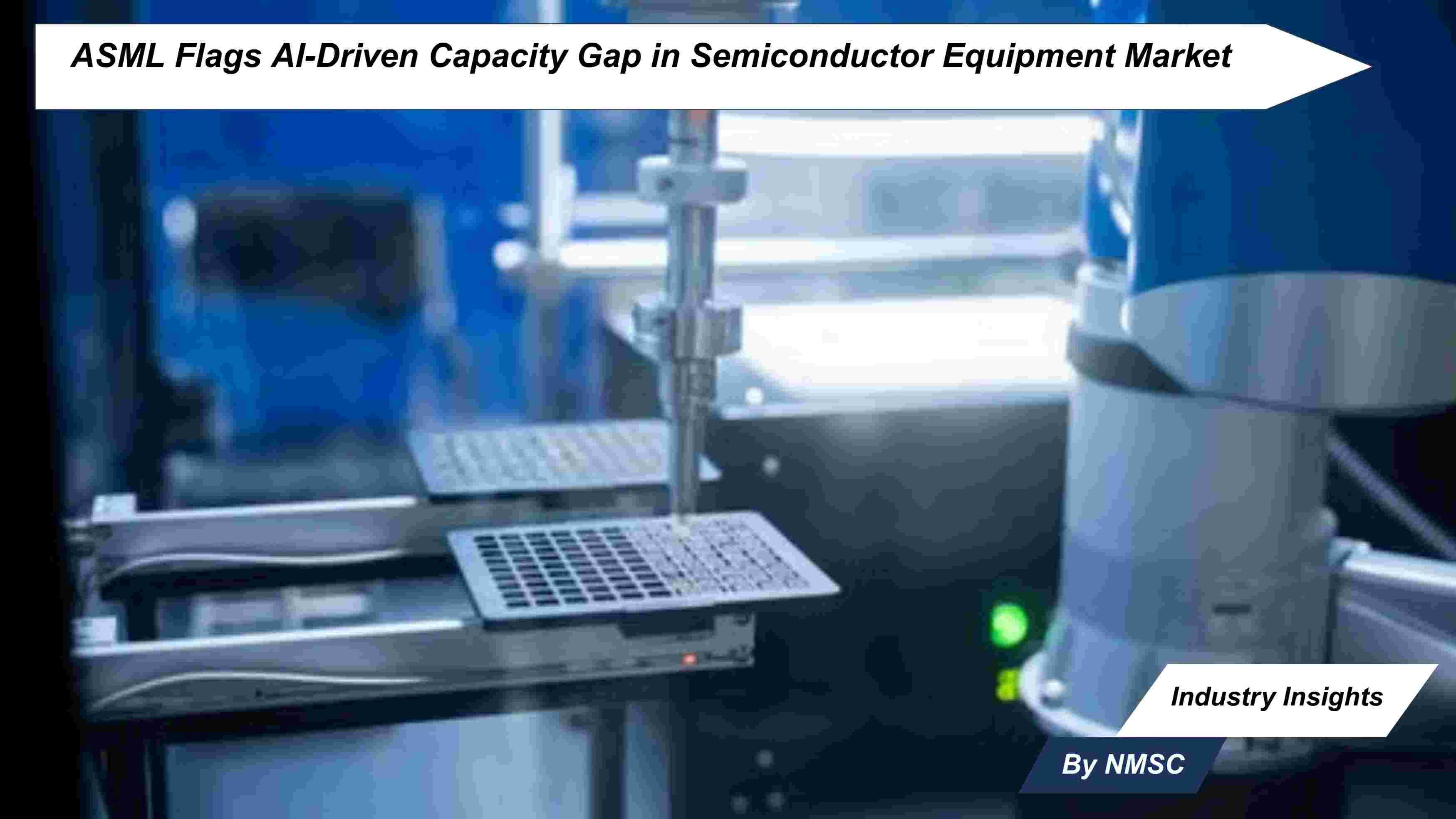
ASML Warns AI Demand Will Outpace Chipmaking Equipment Capacity Through 2028, Raises Sales Outlook
AMSTERDAM, Netherlands — October 14, 2026 — ASML Holding N.V., the world's leading supplier of lithography systems for semiconductor fabrication, warned on Wednesday that surging artificial intelligence demand will exceed its chipmaking equipment supply capacity through 2028, as the Dutch company simultaneously raised its full-year sales forecast. The announcement underscores mounting structural supply constraints within the global Semiconductor Manufacturing Equipment Market, which is projected to reach USD 180.45 billion by 2030, growing at a CAGR of 8.4%.
ASML Chief Executive Officer Christophe Fouquet stated that despite the company's previously announced plans to expand production capacity by 30% in 2027 and a further 30% in 2028, those measures will not be sufficient to meet customer demand. Fouquet noted that the company is now receiving "a lot of order intake for 2028," with customers also expressing strong interest in placing orders for 2029 and, in some cases, 2030 a forward booking horizon that reflects the unprecedented scale of AI-driven infrastructure investment.
The demand surge is being driven primarily by the rapid global expansion of AI data centres, with major customers including TSMC which manufactures chips for Nvidia alongside Samsung, Intel, SK Hynix, Micron, and Elon Musk's newly established TeraFab, all of which have announced significant capacity expansion programmes. ASML shares rose nearly 3% in early Amsterdam trading on Wednesday and have gained approximately 70% year-to-date, reflecting investor confidence in the company's long-term demand visibility.
For the third quarter, ASML reported net profit of €4.96 billion on net sales of €11.7 billion, surpassing analyst expectations. The company now forecasts fourth-quarter sales of €14.2 billion to €15.2 billion above prior analyst consensus with a gross margin of approximately 57%. Consequently, ASML lifted the lower bound of its full-year sales guidance to a range of €44 billion to €45 billion. To address the capacity shortfall ahead of the completion of its major Eindhoven expansion in 2029, the company said it will also upgrade existing tools and introduce higher-throughput machine variants, with price increases taking effect from 2027 and their full impact materialising from 2028.
Key Highlights:
-
Capacity Shortfall Confirmed: ASML's CEO acknowledged that planned 30% capacity expansions in both 2027 and 2028 will be insufficient to meet AI-driven customer demand, with order discussions now extending to 2029 and 2030.
-
Upgraded Financial Guidance: ASML raised its Q4 2026 sales forecast to €14.2–€15.2 billion and lifted its full-year revenue outlook to €44–€45 billion, reflecting robust order momentum.
-
Multi-Pronged Capacity Response: The company is pursuing a combination of new facility construction in Eindhoven, tool upgrades, and higher-throughput machine introductions to partially bridge the supply gap before 2029.
-
Broad Customer Base Expansion: Key customers spanning foundries, memory manufacturers, and emerging AI infrastructure players including TSMC, Samsung, Intel, SK Hynix, Micron, and TeraFab are all actively seeking additional equipment allocations.
Analyst Insight:
According to analysts at Next Move Strategy Consulting, ASML's disclosure of demand visibility extending to 2030 is a significant indicator of the structural, long-cycle nature of AI-driven semiconductor capital expenditure. The company's unique position as the sole provider of Extreme Ultraviolet (EUV) lithography systems means that any capacity constraint at ASML directly translates into a bottleneck across the entire advanced chip supply chain, with downstream implications for AI accelerator availability and data centre build-out timelines.
NMSC analysts further note that the semiconductor manufacturing equipment market's projected trajectory from USD 102.74 billion in 2023 to USD 180.45 billion by 2030 at an 8.4% CAGR is likely to face upward revision pressure as AI infrastructure investment continues to accelerate beyond initial forecasting assumptions. The convergence of government-backed semiconductor initiatives, hyperscaler capital expenditure cycles, and the proliferation of AI workloads is creating a demand environment that equipment manufacturers are structurally challenged to address within conventional capacity planning horizons.
Industry Outlook:
ASML's October 14 earnings disclosure marks a pivotal moment for the semiconductor manufacturing equipment sector, confirming that the AI-driven demand cycle is not a short-term phenomenon but a multi-year structural shift. The company's decision to raise prices from 2027 onward, combined with its exploration of additional capacity expansion pathways beyond the Eindhoven facility, signals that equipment suppliers are recalibrating their long-term investment frameworks in response to sustained demand pressure.
For chipmakers and technology infrastructure investors, the supply-demand imbalance in advanced lithography equipment is expected to remain a defining constraint through at least 2028, influencing chip production timelines, capital allocation strategies, and the competitive positioning of foundries and integrated device manufacturers globally. The broader semiconductor equipment industry will be closely monitoring ASML's capacity expansion progress as a leading indicator of when supply conditions may begin to normalise.
Source: Reuters
For More Information: Download FREE Sample on Semiconductor Manufacturing Equipment Market Report
Prepared By: Sanyukta Deb
About the Author
 Sanyukta Deb
— Sanyukta Deb is Digital Marketing Team Lead at Next Move Strategy Consulting, where she has led content strategy and technical SEO for the firm's B2B market research publications for over 2 years. Her editorial process translates NextMSC's primary and secondary research — spanning technology, industrial, and consumer sectors — into commercial narratives, backed by search-intent, keyword, and competitive analysis. She brings 5 years of overall experience in digital marketing and content strategy.
Sanyukta Deb
— Sanyukta Deb is Digital Marketing Team Lead at Next Move Strategy Consulting, where she has led content strategy and technical SEO for the firm's B2B market research publications for over 2 years. Her editorial process translates NextMSC's primary and secondary research — spanning technology, industrial, and consumer sectors — into commercial narratives, backed by search-intent, keyword, and competitive analysis. She brings 5 years of overall experience in digital marketing and content strategy.
About the Reviewer
 Debashree Dey
— Debashree Dey is Assistant Manager at Next Move Strategy Consulting, where she supports cross-vertical market content and communications across diverse industries for 6 years. Her professional background includes senior content writing, communications, and published manuscript authorship, with experience developing audience-focused business narratives and maintaining clear, consistent messaging. Her role supports research-led content development and editorial quality across NextMSC publications.
Debashree Dey
— Debashree Dey is Assistant Manager at Next Move Strategy Consulting, where she supports cross-vertical market content and communications across diverse industries for 6 years. Her professional background includes senior content writing, communications, and published manuscript authorship, with experience developing audience-focused business narratives and maintaining clear, consistent messaging. Her role supports research-led content development and editorial quality across NextMSC publications.
















Add Comment