Australia's Renewable Energy Storage Market Hits Record Grid Connections in FY26
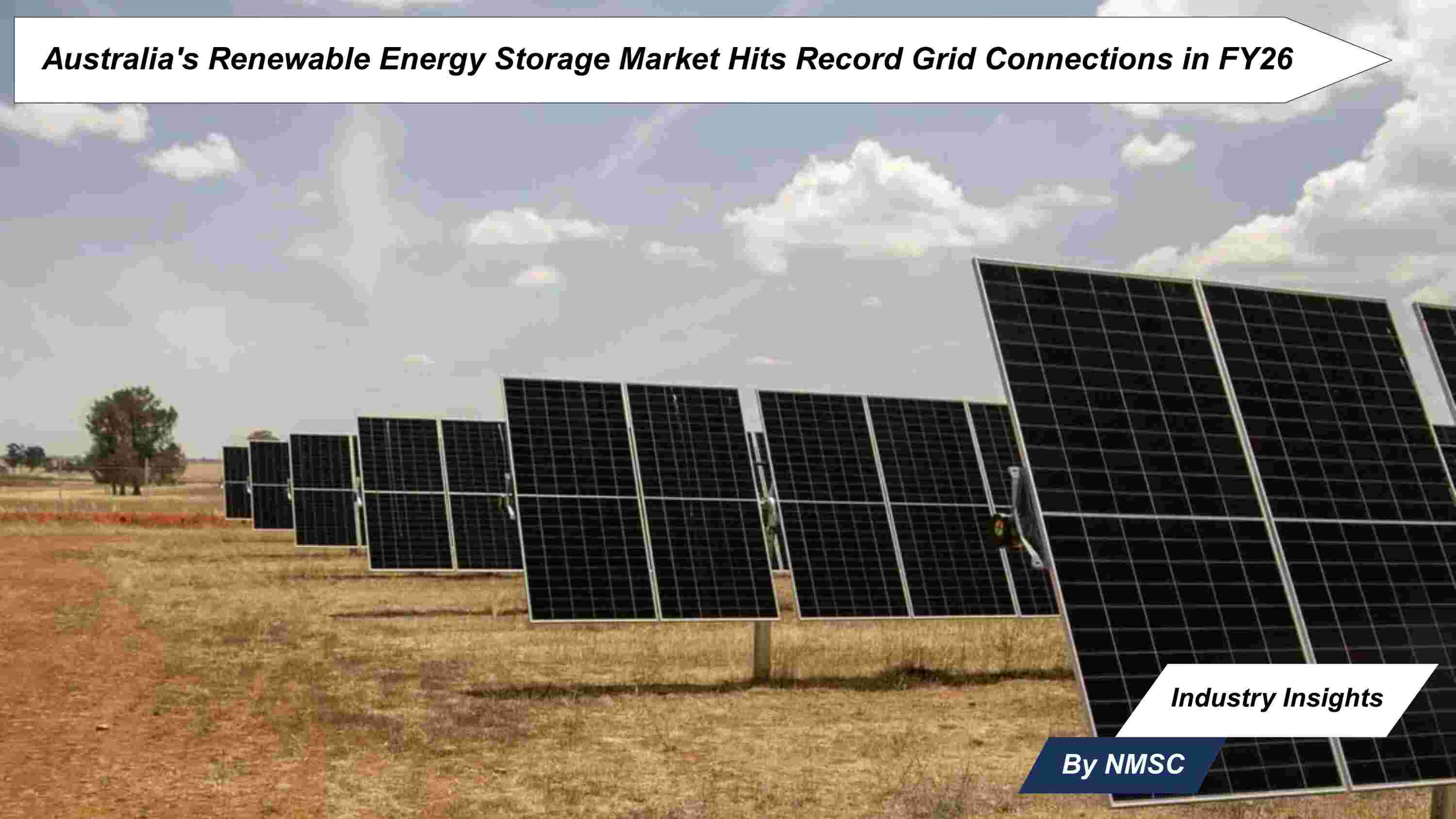
AEMO Reports Record 9.1GW Renewable Energy and Storage Connections to Australia's NEM in FY26
MELBOURNE, Australia September 25, 2026 The Australian Energy Market Operator (AEMO) has confirmed that a record 9.1GW of new capacity connected to the National Electricity Market (NEM) during FY26, more than double the volume achieved in FY25, marking a landmark milestone for the global renewable energy storage market and reinforcing Australia's position as one of the fastest-growing deployment environments for battery storage infrastructure worldwide.
AEMO's FY26 annual report details that registration and application approvals reached 7.4GW and 14.2GW respectively, while the broader connections pipeline expanded 42% over the year, growing from 53GW to 75.4GW. Capacity in the application stage more than doubled, and the developer-led implementation stage grew by 30%, reflecting accelerating private-sector commitment to grid-scale storage and renewable generation assets.
Renewable energy generation, including rooftop solar, accounted for 46% of total NEM generation over the year, exceeding 50% in Q2 of FY26 and setting a new instantaneous renewable energy contribution record of almost 80% for a half-hour period on 11 October 2025. The expanding capacity of battery storage both grid-scale and residential is shifting excess renewable energy generated during the day into evening peak periods, reducing reliance on coal and gas-fired generation while providing essential system services. Gas-fired generation on the east coast reached historically low levels during the first half of 2026, with batteries cited as a key factor behind lower wholesale electricity prices and reduced price volatility.
AEMO's 2026 Integrated System Plan (ISP) reaffirms that renewable energy, firmed with storage and backed by gas, represents the least-cost pathway to secure and reliable electricity supply as coal plants retire and electricity consumption doubles. The ISP sets a storage requirement of nearly 40GW comprising 35GW of short- and medium-duration storage for daily firming and 5GW of long-duration storage for seasonal reliability with the Step Change scenario, considered most likely at 46% probability, requiring AU$106 billion (approximately US$73 billion) of investment by 2050.
Key Highlights:
-
Record connections: 9.1GW of new renewable energy and storage capacity connected to Australia's NEM in FY26, more than double the FY25 volume, with the connections pipeline growing 42% to 75.4GW.
-
Efficiency gains: Average AEMO application review duration improved 9% to 8.6 months, while commissioning reforms delivered a 10% reduction in commissioning time to 4.5 months.
-
Data centre demand surge: Data centre electricity consumption is forecast to grow from approximately 3% of NEM operational consumption today to approximately 8% by 2030, with 17 proposed data centre projects representing a combined maximum connection capacity of 9GW progressing through the transmission connection process.
-
Western Australia milestone: The Wholesale Electricity Market (WEM) recorded 835MW of new capacity commissioned during FY26, including three new grid-scale battery storage projects, bringing total installed grid-scale battery capacity to 1.4GW across the market.
Analyst Insight:
According to analysts at Next Move Strategy Consulting, Australia's record FY26 grid connections reflect a structural acceleration that is consistent with the broader global trajectory for the renewable energy storage market, which was valued at USD 88.42 billion in 2025 and is estimated at USD 104.87 billion in 2026, forecast to reach USD 428.63 billion by 2035 at a 16.9% CAGR.
NMSC analysts note that Australia's market, valued at approximately USD 2.02 billion in 2025 and projected to reach USD 11.32 billion by 2035 at an 18.8% CAGR, is benefiting from a convergence of utility-scale procurement mandates, rising data centre electricity demand, and grid-code reforms that increasingly require storage co-location alongside new renewable capacity. The AEMO report's emphasis on advance investment rather than reactive deployment aligns with the firm's observation that grid operators globally are tightening dispatchability requirements, favouring integrated technology providers over standalone hardware suppliers through 2035.
Industry Outlook:
AEMO's FY26 report makes clear that the record connection volumes, while significant, represent only the early phase of a much larger infrastructure build. The operator has explicitly cautioned that reliability depends on the investment pipeline delivering on time, and that new investments in system security must precede, rather than follow, known transition points such as coal plant retirements.
The identification of data centres as a distinct and fast-growing demand category in AEMO's planning framework signals a structural shift in how grid operators are approaching storage procurement. With 17 data centre projects representing up to 9GW of potential connection capacity in the pipeline, battery storage is increasingly positioned not only as a renewable firming tool but as a critical enabler of digital infrastructure expansion.
For the broader Asia-Pacific region which leads the global renewable energy storage market with approximately 38% revenue share Australia's regulatory and operational milestones in FY26 are likely to inform procurement frameworks and grid-code design across neighbouring markets through the remainder of the decade.
Source: Energy-Storage.News
For More Information: Download FREE Sample on Renewable Energy Storage Market Report
Prepared By: Sanyukta Deb
About the Author
 Sanyukta Deb
— Sanyukta Deb is Digital Marketing Team Lead at Next Move Strategy Consulting, where she has led content strategy and technical SEO for the firm's B2B market research publications for over 2 years. Her editorial process translates NextMSC's primary and secondary research — spanning technology, industrial, and consumer sectors — into commercial narratives, backed by search-intent, keyword, and competitive analysis. She brings 5 years of overall experience in digital marketing and content strategy.
Sanyukta Deb
— Sanyukta Deb is Digital Marketing Team Lead at Next Move Strategy Consulting, where she has led content strategy and technical SEO for the firm's B2B market research publications for over 2 years. Her editorial process translates NextMSC's primary and secondary research — spanning technology, industrial, and consumer sectors — into commercial narratives, backed by search-intent, keyword, and competitive analysis. She brings 5 years of overall experience in digital marketing and content strategy.
About the Reviewer
 Debashree Dey
— Debashree Dey is Assistant Manager at Next Move Strategy Consulting, where she supports cross-vertical market content and communications across diverse industries for 6 years. Her professional background includes senior content writing, communications, and published manuscript authorship, with experience developing audience-focused business narratives and maintaining clear, consistent messaging. Her role supports research-led content development and editorial quality across NextMSC publications.
Debashree Dey
— Debashree Dey is Assistant Manager at Next Move Strategy Consulting, where she supports cross-vertical market content and communications across diverse industries for 6 years. Her professional background includes senior content writing, communications, and published manuscript authorship, with experience developing audience-focused business narratives and maintaining clear, consistent messaging. Her role supports research-led content development and editorial quality across NextMSC publications.















Add Comment