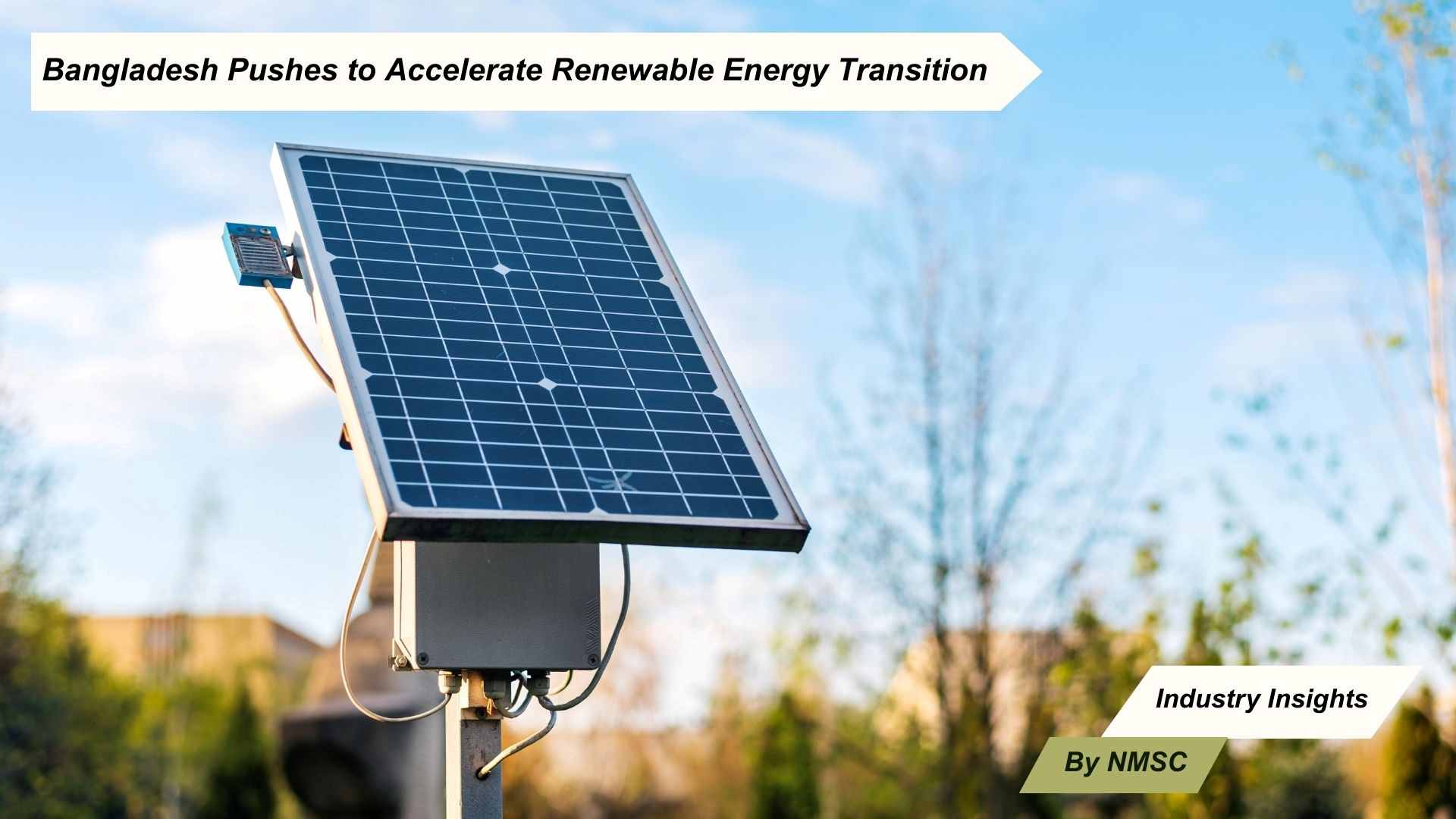
Bangladesh Pushes to Accelerate Renewable Energy Transition
Industry Insights from Next Move Strategy Consulting
Bangladesh’s transition toward renewable energy remains significantly behind its stated ambitions, keeping the country heavily reliant on costly fossil fuel imports. Despite the clear economic and environmental advantages of clean energy, limited progress in domestic renewable deployment has intensified financial pressure across the energy sector and underscored the urgency for structural reforms.
The country’s dependence on imported commercial energy has reached 57 percent, amplifying exposure to global fuel price volatility. Cost-competitive renewable energy, particularly solar paired with battery storage, presents an immediate opportunity to curb expensive oil-based peak power generation during both daytime and nighttime hours. Large industries and corporates, driven by sustainability commitments, are also positioned to play a decisive role by shifting away from fossil fuels.
Mounting Financial Strain in the Energy Sector
The financial stress facing Bangladesh’s power sector has become increasingly evident. Payment arrears owed by the Bangladesh Power Development Board to independent power producers exceeded Tk270 billion (USD 2.21 billion) in November 2025. This pressure has been compounded by a downgrade of the country’s credit rating to B2 in November 2024, complicating the financing of fuel imports.
To manage immediate supply needs, international support has been mobilized. The World Bank extended a repayment guarantee to facilitate liquefied natural gas imports, while a USD 2.75 billion financing deal with the International Islamic Trade Finance Corporation was signed to ease fossil fuel procurement. These measures, while necessary in the short term, highlight the structural vulnerability created by delayed renewable energy expansion.
Slow Progress Against Long-Term Targets
Bangladesh approved its first renewable energy policy in December 2008, when total renewable capacity stood at around 244.4 megawatts, largely driven by hydropower and solar home systems. By December 2025, renewable capacity had reached only 1,690.7 megawatts, reflecting a pace of growth that falls well short of national targets.
To achieve the goal of sourcing 20 percent of electricity from renewables by 2030, Bangladesh must deploy approximately 760 megawatts of renewable capacity each year between 2026 and 2030. This would require scaling total capacity to nearly 5,851 megawatts, taking into account projects already under construction.
Unlocking Utility-Scale Solar Through Land Allocation
Land scarcity remains one of the most persistent barriers to utility-scale renewable projects in densely populated Bangladesh. However, planned economic zones offer a viable pathway forward. The government-owned National Special Economic Zone spans more than 33,000 acres, with nearly 18 percent designated as free space.
Within this zone, a proposed 100–200 megawatt solar project supported by battery energy storage is already under advisory development. Further allocation of land under a public-private partnership model could enable up to 350 megawatts of additional solar capacity, raising total utility-scale solar generation in the zone to around 550 megawatts. Similar approaches across other economic zones, combined with systematic land-resource mapping, could attract private investment and ease land-related constraints. Additionally, previously identified char areas in Jamalpur district offer the potential to host solar installations of up to 6,000 megawatts.
Corporate Power Purchase Agreements Gain Momentum
Corporate power purchase agreements are emerging as a critical mechanism for accelerating clean energy adoption. With industries seeking to decarbonize operations amid limited green power on the national grid, CPPAs provide a direct route to renewable sourcing. Several initiatives are already taking shape. Pran-RFL, supported by the International Finance Corporation, is planning a solar plant to supply renewable power to selected apparel suppliers of H&M. Telecom operator Robi is also moving forward with plans for a 100-megawatt solar project in partnership with FloSolar Solutions Ltd and GreenPower Asia to offset carbon emissions. The introduction of the Merchant Power Policy has created a broader framework for CPPAs. Finalizing service-level agreements, including provisions for wheeling charges and dispute resolution, is expected to unlock implementation. Successful early projects could significantly expand on-grid renewable capacity while enabling industries to meet sustainability targets.
Rooftop Solar as a Strategic Complement
Rooftop solar represents a vital solution to Bangladesh’s land limitations, yet deployment has been constrained by high import duties and financing challenges. Solar panels and inverters face import duties of 28.73 percent for many projects, raising costs under operational expenditure models. Access to low-cost green financing is further slowed by multi-stage approval processes and limited appetite among financial institutions for small-scale projects.
Policy adjustments could rapidly change this trajectory. Temporary duty waivers on rooftop solar equipment and the creation of a dedicated, single-stage approval fund through Bangladesh Bank could accelerate adoption. A single 1-megawatt rooftop solar installation has the potential to save approximately Tk22.4 million annually in fuel import costs, excluding capacity charges.
Next Move Strategy Consulting Viewpoint
According to Next Move Strategy Consulting’s view, Bangladesh’s Renewable Energy Market transition has reached a decisive inflection point. The current energy sector challenges reveal not a lack of opportunity, but a need for coordinated policy execution, private sector engagement, and financial reform. By simultaneously advancing utility-scale solar, enabling CPPAs, and removing barriers to rooftop deployment, Bangladesh can reduce import dependence, stabilize its power sector, and set a credible course toward its 2030 renewable energy targets.
With targeted interventions and sustained momentum, renewable energy can shift from a peripheral contributor to a central pillar of Bangladesh’s energy security and economic resilience.
Source: The Business Standard
Prepared by: Next Move Strategy Consulting
About the Author
 Sanyukta Deb
— Sanyukta Deb is Digital Marketing Team Lead at Next Move Strategy Consulting, where she has led content strategy and technical SEO for the firm's B2B market research publications for over 2 years. Her editorial process translates NextMSC's primary and secondary research — spanning technology, industrial, and consumer sectors — into commercial narratives, backed by search-intent, keyword, and competitive analysis. She brings 5 years of overall experience in digital marketing and content strategy.
Sanyukta Deb
— Sanyukta Deb is Digital Marketing Team Lead at Next Move Strategy Consulting, where she has led content strategy and technical SEO for the firm's B2B market research publications for over 2 years. Her editorial process translates NextMSC's primary and secondary research — spanning technology, industrial, and consumer sectors — into commercial narratives, backed by search-intent, keyword, and competitive analysis. She brings 5 years of overall experience in digital marketing and content strategy.
About the Reviewer
 Debashree Dey
— Debashree Dey is Assistant Manager at Next Move Strategy Consulting, where she supports cross-vertical market content and communications across diverse industries for 6 years. Her professional background includes senior content writing, communications, and published manuscript authorship, with experience developing audience-focused business narratives and maintaining clear, consistent messaging. Her role supports research-led content development and editorial quality across NextMSC publications.
Debashree Dey
— Debashree Dey is Assistant Manager at Next Move Strategy Consulting, where she supports cross-vertical market content and communications across diverse industries for 6 years. Her professional background includes senior content writing, communications, and published manuscript authorship, with experience developing audience-focused business narratives and maintaining clear, consistent messaging. Her role supports research-led content development and editorial quality across NextMSC publications.















Add Comment