BEAD Approvals Clear the Way for Fiber Builds and Cable Blowing Demand
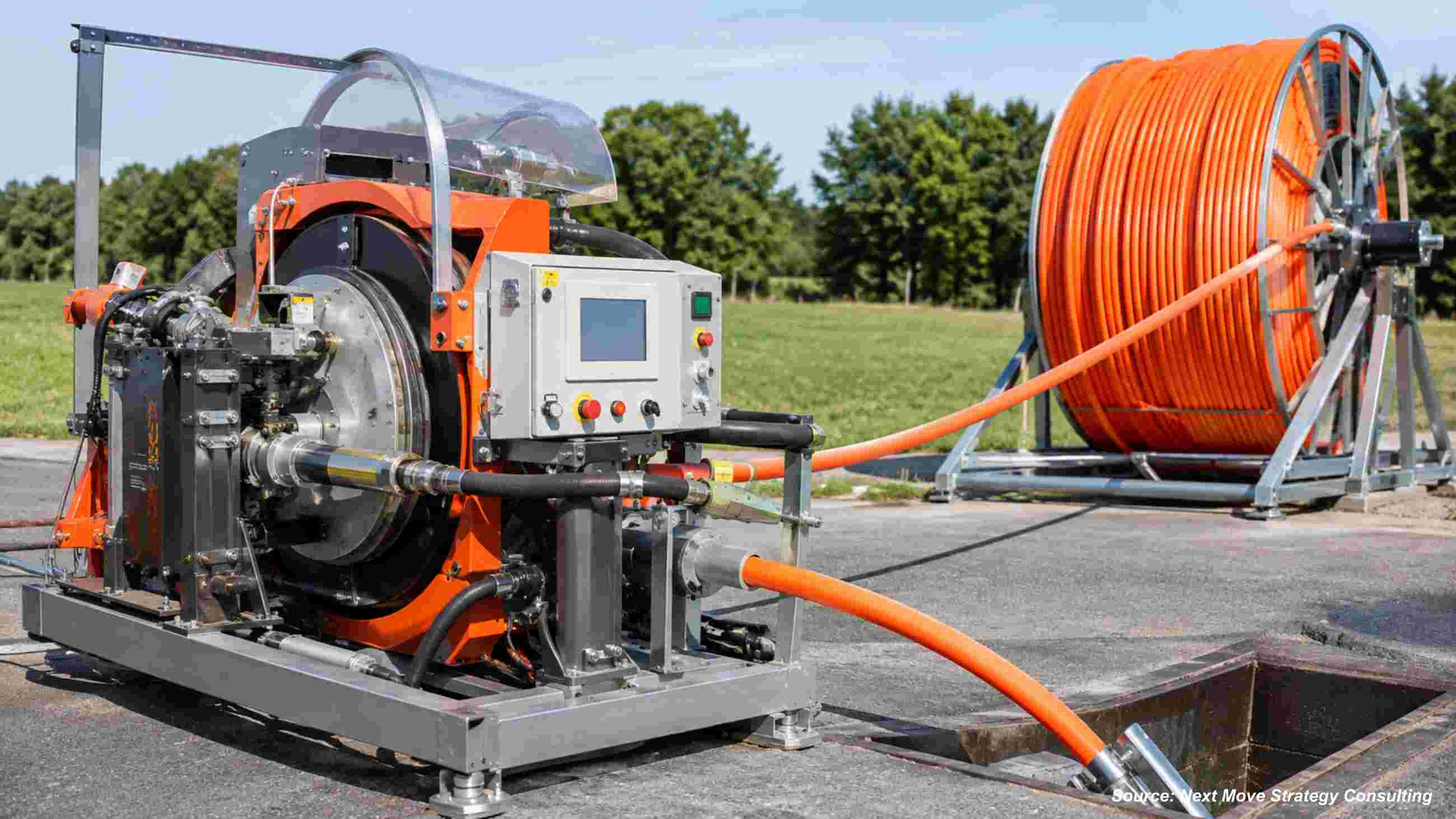
With NTIA's last BEAD sign-off on August 25, states hold approved plans to spend $18.19 billion on deployment and reach 3.79 million locations, 62.9% of them by fiber
On August 25, 2026, the U.S. National Telecommunications and Information Administration (NTIA) approved the last of 56 state and territorial Final Proposals under the $42.45 billion Broadband Equity, Access, and Deployment (BEAD) program, ending a review that NTIA had originally aimed to finish by May 2026, according to NTIA's announcement and Wireless Estimator's report of August 28, 2026. Broadband Breakfast reported on August 28, 2026 that the approved plans commit states and territories to spend $18.19 billion on deployment and to serve 3.79 million locations, 62.9% of which are slated for fiber.
According to Next Move Strategy Consulting's Cable Blowing Equipment Market report, the global cable blowing equipment market was valued at USD 114.1 million in 2024 and is projected to reach USD 152.8 million by 2030, growing at a CAGR of 5.0% from 2025 to 2030. NextMSC primary research and analysis places the 2025 value at USD 119.8 million, which implies an addition of USD 33.0 million across the five-year forecast window.
For More Information: Download FREE Sample on Cable Blowing Equipment Market Report
Approval is a planning milestone rather than a disbursement. Wireless Estimator reported on August 28, 2026 that the National Institute of Standards and Technology, which serves as BEAD's grants manager, must separately clear each plan before funds can be drawn, and that it had cleared 54 of the 56 NTIA-approved proposals at the time of NTIA's latest dashboard update. Broadband Breakfast added that states are still finalizing contracts with grant winners, that some providers have declined to sign and had their locations rebid, and that at least 54,000 locations had been affected by a provider withdrawal as of the end of June 2026.
The Financial Logic: Where the BEAD Money Is Headed
The technology split inside the approved plans matters for anyone who sells installation equipment. Broadband Breakfast's tally of the 56 plans shows 62.9% of locations in line for fiber, 21.9% for satellite, 13.3% for fixed wireless and 1.9% for cable. The outlet noted that the program's location counts include community anchor institutions such as schools and hospitals, and that the proportions can still move slightly while states settle their contracts.
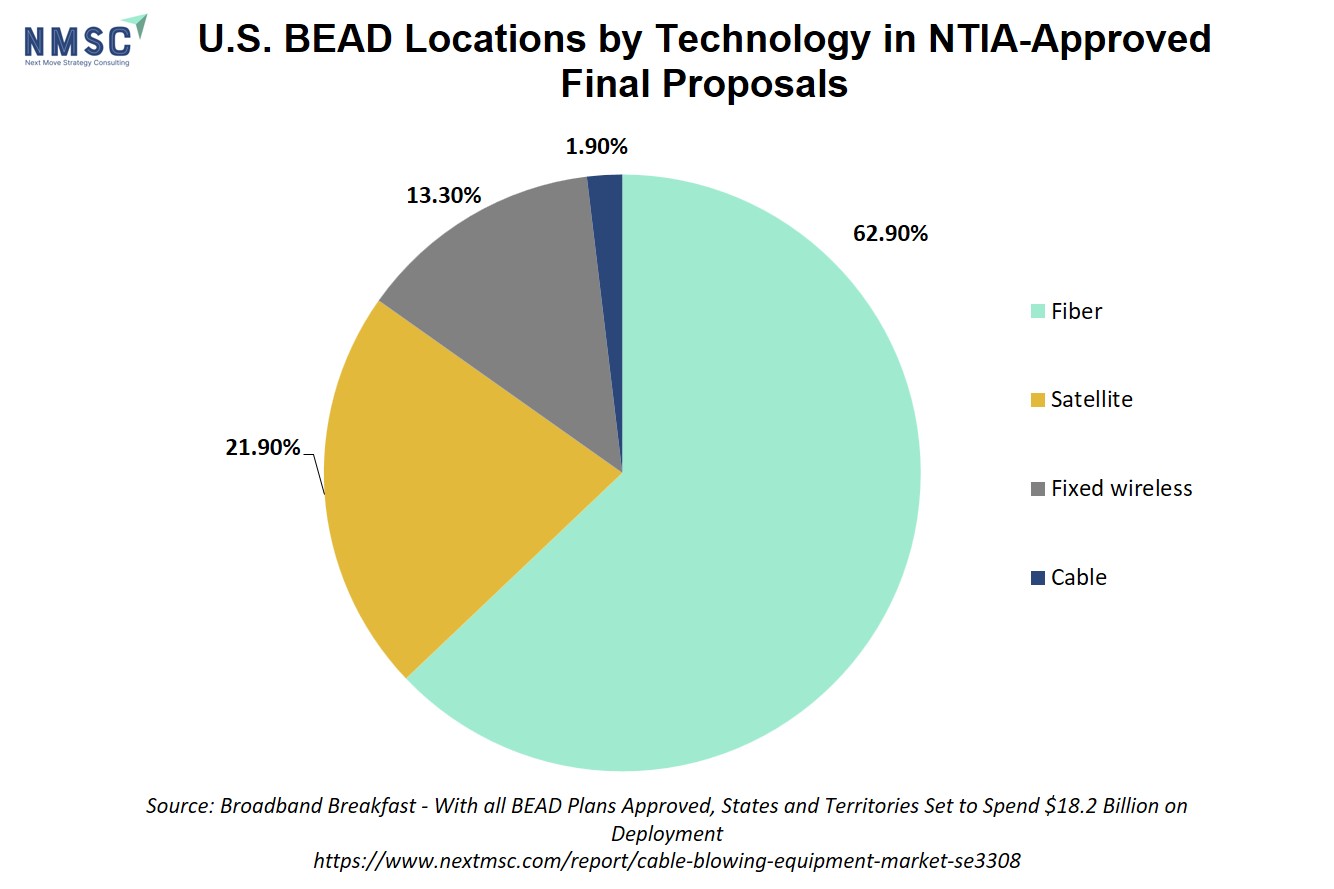
The shares come from Broadband Breakfast's tally of the 56 approved plans, which cover 3.79 million locations including community anchor institutions. States are still finalizing contracts, so the proportions can shift.
Location share is not the same as dollar share. Broadband Breakfast reported that fixed wireless and especially satellite are cheaper to deploy, so fiber projects are likely to hold a larger share of the money than the 62.9% location figure suggests. It also reported that, based on states' draft spending plans, satellite providers SpaceX and Amazon were in line for a combined $1 billion while serving 22% of the program's locations.
The mix also varies sharply by state. Wireless Estimator reported that Illinois, the last plan approved, directs funding toward fiber for 68% of its locations, fixed wireless for nearly 24% and satellite for about 8%, while New York's approved plan assigns nearly 44% of locations to fixed wireless, roughly 31% to fiber and about 25% to low-earth-orbit satellite. Broadband Breakfast also reported that NTIA has asked states to reduce their satellite awards, a directive that came down in July 2026, citing new federal maps that show expanded terrestrial networks or misclassified buildings, although states cannot unilaterally alter contracts already signed.
BEAD After the Final Approval: Program Scorecard
|
Indicator |
Figure |
As of |
|
State and territorial Final Proposals approved by NTIA |
56 of 56 |
August 25, 2026 |
|
Total BEAD program funding |
$42.45 billion |
August 2026 |
|
Locations to be served under approved plans |
3.79 million |
August 28, 2026 |
|
Planned deployment spending across all plans |
$18.19 billion |
August 28, 2026 |
|
Share of locations slated for fiber |
62.9% |
August 28, 2026 |
|
Funds left for non-deployment uses after the 2% administrative allocation |
About $22.5 billion (Broadband Breakfast calculation) |
August 28, 2026 |
|
Taxpayer savings credited to the Benefit of the Bargain overhaul |
$21 billion (NTIA estimate) |
February 2026 update |
|
NTIA-approved proposals cleared by the National Institute of Standards and Technology |
54 of 56 |
NTIA dashboard, as reported August 28, 2026 |
Key Industry Developments
“BEAD's core mission is to ensure universal broadband availability across our country.”
— Arielle Roth, Assistant Secretary of Commerce for Communications and Information and NTIA Administrator, National Telecommunications and Information Administration, NTIA press release, Closing the Digital Divide Once and for All: NTIA Announces All 56 BEAD Final Proposals Now Approved, August 25, 2026.
Supplier filings show the fiber supply chain responding. Hexatronic Group, a Swedish fiber infrastructure supplier that the NextMSC report lists among its profiled key players, reported on October 22, 2026 that third-quarter net sales rose 33% to SEK 2,498 million, the highest quarterly sales in its history, with organic growth of 17%. Its Fiber Solutions business area grew organically by 13%, driven by the U.S. market, and the company reversed an earlier decision to downsize a facility in South Carolina because U.S. demand was running ahead of its plan. Hexatronic said its North American business has now passed Europe as its largest region, while its European FTTH business continued to face challenging conditions, especially in the UK and the DACH region.
Hexatronic Group Net Sales by Business Area, Third Quarter 2026
|
Business area |
Q3 2026 (SEK million) |
Q3 2025 (SEK million) |
Organic growth |
|
Fiber Solutions |
1,414 |
1,236 |
13% |
|
Harsh Environment |
393 |
314 |
6% |
|
Data Center |
692 |
334 |
44% |
|
Group total |
2,499 |
1,884 |
17% |
The same filing carries a warning for contractors planning builds. Hexatronic said fiber and transportation costs are rising, that some segments, particularly glass fiber and certain connector types, are beginning to see growth restrictions, and that longer backlogs and lead times are sometimes unavoidable. Resin costs, by contrast, stabilized at lower levels during the quarter, and the group's order book at the end of September 2026 stood at about four months of net sales.
Skills are being formalized alongside hardware. On April 30, 2026, SCTE introduced its first Fiber-Optic Cable Blowing Microcredential. The exam covers worksite preparation and safety, duct preparation and proofing, fiber blowing operations, troubleshooting, and project handoff documentation.
In Europe, the European Commission's Digital Decade 2026 connectivity report, published on June 17, 2026, found that fibre-to-the-premises coverage reached 74.1% of EU27 households as of mid-2025, making FTTP the most widespread single fixed technology in Europe for the first time. The Commission's wider State of the Digital Decade assessment said FTTP deployment still lags behind the 2030 targets.
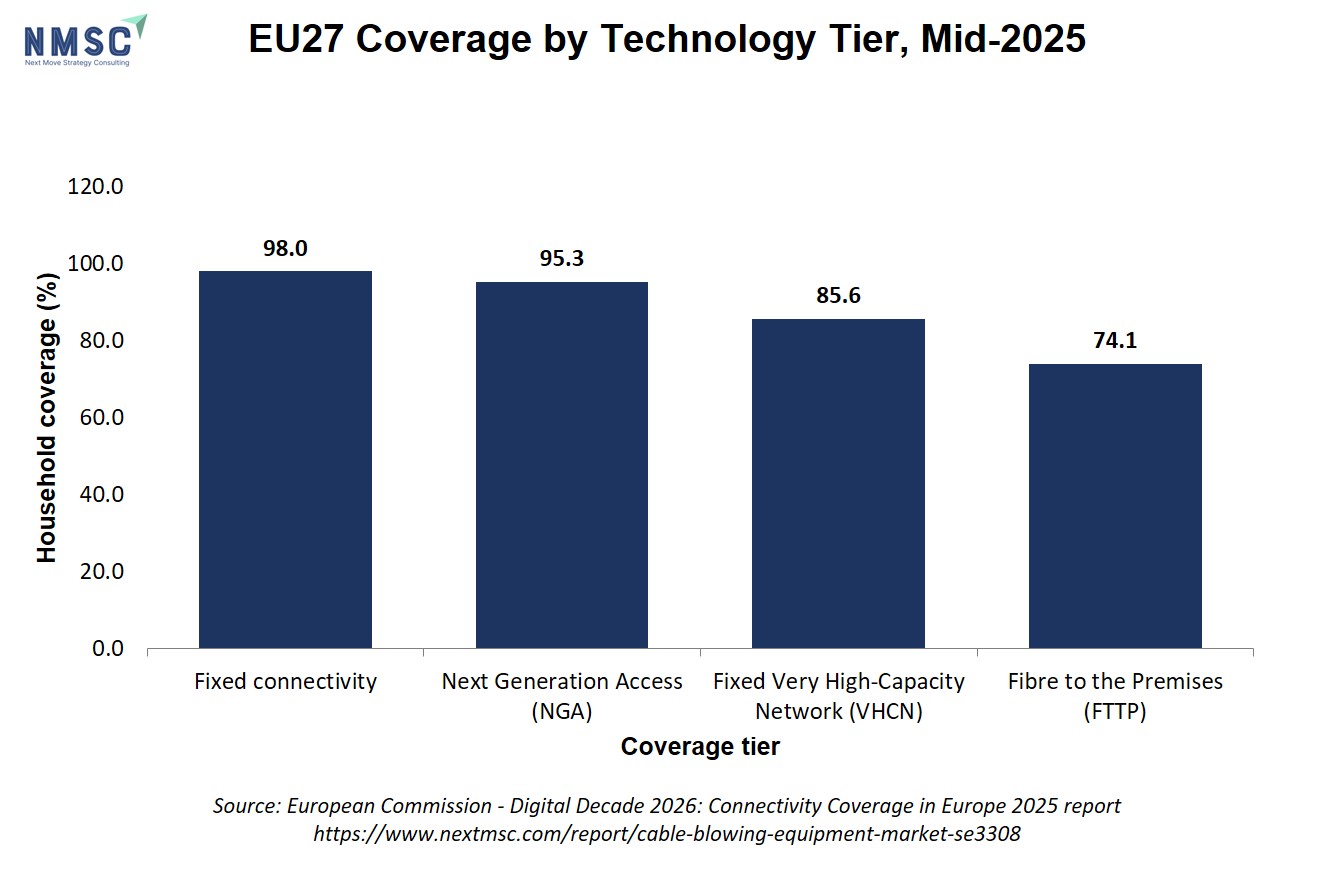
The Commission's report measures coverage across the 27 EU Member States as of mid-2025. FTTP coverage of 74.1% sits 11.5 percentage points below fixed VHCN coverage of 85.6%.
In India, the government told the Lok Sabha on July 29, 2026 that 43,908 km of optical fibre had been laid and 13,494 Gram Panchayats upgraded under the Amended BharatNet Programme as of June 2026, according to The Tribune's report of Communications Minister Jyotiraditya M. Scindia's written reply. The programme provides for optical fibre to about 2.65 lakh Gram Panchayats and about 3.8 lakh non-Gram Panchayat villages on a demand basis. The reply also said the average time to dispose of right-of-way applications fell from 80.63 days in 2024-25 to 35.62 days in 2025-26.
India: Amended BharatNet and Rural Connectivity Indicators
|
Indicator |
Figure |
Reference period |
|
Optical fibre cable laid under the Amended BharatNet Programme |
43,908 km |
As of June 2026 |
|
Gram Panchayats upgraded under the Amended BharatNet Programme |
13,494 |
As of June 2026 |
|
Gram Panchayats provided for under the programme |
About 2.65 lakh |
Programme provision |
|
Non-Gram Panchayat villages provided for, on a demand basis |
About 3.8 lakh |
Programme provision |
|
Rural internet subscribers per 100 population |
48.31 (from 45.03) |
2025-26 |
|
National average fixed broadband download speed |
60.85 Mbps |
March 31, 2026 |
|
Average time to dispose of right-of-way applications |
35.62 days (from 80.63) |
2025-26 versus 2024-25 |
Segment Dynamics
NextMSC's report segments the market by power type (hydraulic powered, pneumatically powered, electric and drill driven), cable type (microduct and normal cable), tube diameter (3-16 mm, 7-12 mm and 12-63 mm), end user (commercial, defense, telecom operators, utility, construction firms, government and municipalities, and others) and region. The study covers 28 countries and profiles 15 companies, with market share data available for 10 of them. NextMSC primary research and analysis identifies fiber optic expansion, smart city and infrastructure digitization projects, and rural connectivity initiatives as the demand factors behind the 5.0% CAGR.
The end-user split is where the external evidence is most relevant. BEAD awards flow to state-selected providers, India's amended programme relies on contractors who must secure rights of way, and European operators are working through the rural gap in fibre coverage. Each of these buyer groups sits inside the telecom operator, utility, construction firm and government and municipal categories that the NextMSC report tracks.
Regional Outlook
North America. NextMSC primary research and analysis links the region's demand to broadband and 5G deployments, with BEAD named among the government-funded initiatives supporting fiber rollouts in underserved and rural areas. The August 2026 approvals move that funding from state plans toward contract signing and construction, but Broadband Breakfast's reporting on provider withdrawals and rebids shows the timing is not uniform across states.
Europe. NextMSC's report ties regional demand to fibre-to-the-home projects under the European Union's Digital Decade strategy and to operator interest in low-emission jetting systems. The European Commission's mid-2025 coverage figure of 74.1% for FTTP shows how much of the build is already complete, while Hexatronic's comment on subdued European FTTH conditions in the UK and the DACH region indicates that near-term equipment demand may be uneven.
Asia-Pacific. NextMSC's report points to large-scale fiber rollouts in China, India and South Korea, including India's BharatNet and China's 5G fiber backhaul expansion. The Indian government's data show cumulative laying under the amended programme at 43,908 km as of June 2026, with permitting times falling to 35.62 days in 2025-26, and Hexatronic reported robust growth in APAC during the third quarter of 2026.
Rest of the World. NextMSC's report points to smart city and connectivity programs in Brazil, South Africa and the UAE, where global brands are partnering with local integrators. No external dataset in this article tracks that region, so NextMSC's view is presented as its own analysis rather than as confirmed external fact.
Growth Drivers and Restraints
The matrix below draws only on external sources. It separates the factors that support installation activity from those that can delay equipment purchases.
Evidence Matrix: Factors Supporting and Constraining Cable Installation Activity
|
Factor |
Type |
Evidence |
Source and date |
|
Fiber share of BEAD locations |
Driver |
62.9% of 3.79 million locations slated for fiber |
Broadband Breakfast, August 28, 2026 |
|
U.S. supplier demand |
Driver |
Hexatronic Fiber Solutions grew organically by 13% in Q3 2026, led by the U.S. |
Hexatronic Group, October 22, 2026 |
|
European fibre coverage |
Driver |
FTTP reached 74.1% of EU27 households by mid-2025 |
European Commission, June 17, 2026 |
|
Installer skills |
Driver |
First Fiber Blowing Certification introduced |
SCTE, April 30, 2026 |
|
Faster permitting in India |
Driver |
Right-of-way disposal fell from 80.63 to 35.62 days |
The Tribune, July 29, 2026 |
|
Disbursement gating |
Restraint |
54 of 56 plans cleared by NIST; provider withdrawals affected at least 54,000 locations |
Wireless Estimator and Broadband Breakfast, August 28, 2026 |
|
Input costs and lead times |
Restraint |
Fiber and transportation costs rising; longer backlogs and lead times |
Hexatronic Group, October 22, 2026 |
|
Soft European FTTH demand |
Restraint |
Challenging conditions in the UK and the DACH region |
Hexatronic Group, October 22, 2026 |
NMSC Strategic Perspective: Approvals Move the Market From Planning to Procurement
NextMSC primary research and analysis reads the August 25, 2026 approval as the point at which BEAD shifts from a planning exercise to a procurement exercise, but it does not read it as an order signal. Equipment purchases follow signed contracts and cleared funding, and the evidence shows two gates still open: NIST clearance, which stood at 54 of 56 plans, and contract finalization, where provider withdrawals had, by the end of June 2026, required NTIA to help about a dozen states find backup plans. NextMSC therefore expects equipment orders linked to BEAD to track contract signings state by state rather than arriving as a single wave.
Scale is the second consideration. NextMSC projects the global cable blowing equipment market at USD 152.8 million in 2030, which is under 1% of the $18.19 billion that states plan to spend on BEAD deployment alone. The arithmetic shows that blowing equipment is a small line item inside fiber build budgets, so demand for it depends on how many crews are in the field and how they choose to install cable, not on program size by itself. NextMSC's report flags high upfront and maintenance costs of advanced machines as a barrier for smaller contractors and internet service providers, and that barrier becomes relevant if smaller firms take on BEAD-funded routes.
The third consideration is technology mix. With 62.9% of locations slated for fiber nationally but only about 31% in New York's approved plan, state outcomes diverge, and NTIA's July 2026 request to trim satellite awards could shift some locations toward terrestrial networks. NextMSC's view is that any added upside for fiber-related equipment materializes only where states and providers confirm the change in contracts, which Broadband Breakfast reports cannot be imposed unilaterally.
Finally, the forecast is global. A 5.0% CAGR reflects a market with several funding streams, including BEAD in North America, Digital Decade targets in Europe and the Amended BharatNet Programme in India. Hexatronic's report that North America has overtaken Europe as its largest region, alongside rising fiber and transportation costs, indicates that regional demand and input costs are moving at different speeds. NextMSC's 2025 to 2030 forecast of steady growth rather than a surge is consistent with that mixed picture.
Competitive Landscape
NextMSC's report profiles 15 companies: Stanlay, Allame Makina Fiber Optic Cable Blowing Machines, Upcom Telekomunikasyon, Fremco A/S, Condux International, Adishwar Tele-Networks, Altec, Jetting AB, Katimex Cielker GmbH, Plumettaz S.A., CBS Product, Jakob Thaler GmbH, Lancier Cable GmbH, Hexatronic Group and Anfkom Telecom. NextMSC primary research and analysis finds that leading players are competing on energy-efficient and digitally controlled jetting systems, lubricant-free operation and lower air consumption, while manufacturers contend with fluctuating raw material costs, supply chain disruptions and skilled labor shortages.
Hexatronic's October 22, 2026 filing is the most recent dated company disclosure in this article, and it supports two of those themes directly: input cost pressure on fiber and transportation, and a skills agenda that SCTE's April 2026 certification addresses from the training side. No other dated company disclosure was verified for this article, so no further company events are reported.
Bottom Line
The completion of NTIA's review on August 25, 2026 gives states approved plans to serve 3.79 million locations with $18.19 billion of planned deployment spending, and 62.9% of those locations are slated for fiber. That is a meaningful signal for installation equipment, but it is a signal about future procurement, not current orders: NIST clearance, contract finalization and provider withdrawals still determine when crews reach the field. NextMSC's forecast of USD 114.1 million in 2024 rising to USD 152.8 million by 2030 at a 5.0% CAGR reflects a multi-region market in which BEAD, the European Commission's fibre targets and India's rural programme all contribute. Hexatronic's third-quarter results show U.S. demand running ahead of plan while European FTTH remains soft and input costs rise. Buyers and suppliers should watch state contract signings, NTIA's handling of satellite awards and supplier lead times in the coming quarters.
About Next Move Strategy Consulting
Next Move Strategy Consulting is a premier market research and management consulting firm that has been committed to provide strategically analysed well documented latest research reports to its clients. The research industry is flooded with many firms to choose from, what makes NMSC different from the rest is its top-quality research and the obsession of turning data into knowledge by dissecting every bit of it and providing fact-based research recommendation that is supported by information collected from over 500 million websites, paid databases, industry journals and one on one consultations with industry experts across a diverse range of industry sectors. The high-quality customized research reports with actionable insights and excellent end-to-end customer service help our clients to take critical business decisions that enables them to move beyond time and have competitive edge in the industry.
We have been servicing over 1000 customers globally that includes 90% of the Fortune 500 companies over a decade. Our analysts are constantly tracking various high growth markets and identifying hidden opportunities in each sector or the industry. We provide one of the industry’s best quality syndicate as well as custom research reports across 10 different industry verticals. We are committed to deliver high quality research solutions in accordance to your business needs. Our industry standard delivery solutions that ranges from the pre consultation to after-sales services, provide an excellent client experience and ensure right strategic decision making for businesses.
For more information, please contact:
Next Move Strategy Consulting
5th Floor 867 Boylston St, STE 500,
Boston, MA 02116, U.S.
E-Mail: [email protected]
Direct: +1-217-650-7991
Website: www.nextmsc.com
About the Author
 Priyanshu Das
— Priyanshu Das is SEO Executive at Next Move Strategy Consulting, where he has led on-page and off-page SEO, keyword research, and SEO audits for the firm's B2B market research publications for 2 years. His audit process combines technical crawl analysis, backlink profile review, and competitor keyword gap mapping — using tools including Screaming Frog and Google Search Console — to prioritize fixes by organic search-visibility impact, informed by his own prior in-house and agency SEO experience.
About the Reviewer
 Sanyukta Deb
— Sanyukta Deb is Digital Marketing Team Lead at Next Move Strategy Consulting, where she has led content strategy and technical SEO for the firm's B2B market research publications for over 2 years. Her editorial process translates NextMSC's primary and secondary research — spanning technology, industrial, and consumer sectors — into commercial narratives, backed by search-intent, keyword, and competitive analysis. She brings 5 years of overall experience in digital marketing and content strategy.















Add Comment