Bean Bag Chair Market: Tariffs, Trends & Growth

US Furniture Tariffs Trigger Industry Consolidation as IKEA Commits $2.2 Billion to US Expansion, Reinforcing Structural Demand Across the Global Bean Bag Chair Market
US Furniture Tariffs Accelerate Industry Restructuring
The United States furniture industry entered 2026 under acute financial pressure. A 25% import duty on upholstered furniture — imposed under Section 232 of the Trade Expansion Act in October 2025 — remained firmly in place even after the Supreme Court struck down the administration's broader "reciprocal tariffs" in February 2026, according to CNBC's reporting on the ruling. The furniture-specific levies, which had been scheduled to escalate to 50% in January 2026 before being deferred to 2027, created a structural cost shock that disproportionately affected smaller importers with limited supply chain flexibility.
The consequences were immediate and measurable. American Signature Furniture — the parent company of Value City Furniture, with nearly 80 years of operating history — declared bankruptcy and commenced liquidation of its 89 remaining stores. Court filings cited a 27% decline in sales between 2023 and 2025, with net operating losses expanding from $18 million to $70 million over the same period, further exacerbated by the introduction of new tariff policies. A CNBC review of federal bankruptcy filings identified at least 10 additional furniture businesses that declared bankruptcy over the preceding year.
"This is a very, very difficult time to manage your business," said Peter Theran, CEO of the Home Furnishings Association. "The No. 1 driver of the difficulty of managing your business is unpredictability and an inability to make alternative plans and invest in those plans, because you don't know what tomorrow will be."
Yet the same tariff environment that is eliminating smaller operators is simultaneously accelerating market share consolidation among well-capitalized incumbents — a dynamic with direct implications for the global Bean Bag Chair Market and the broader casual seating segment.
For More Information: Download FREE Sample on Bean Bag Chair Market Report
IKEA Commits $2.2 Billion to US Expansion Amid Sector Headwinds
On February 17, 2026, IKEA U.S. released its FY25 Annual Summary and announced plans to open 10 new US stores in 2026, including city-center locations in Los Angeles (Culver City), Tulsa, Fort Collins, and the Chicago area (Gurnee Mills), in addition to six previously announced locations. The company reported $5.3 billion in total US sales for FY25, including $1.9 billion in e-commerce revenue, and welcomed nearly 61 million in-store visitors and over 457 million online visitors.
IKEA is investing $2.2 billion in omnichannel capabilities to improve delivery, pickup, and digital integration, while its IKEA Family loyalty program reached 25 million members — a 17% increase from FY24 — accounting for 56% of total US sales. Simultaneously, Wayfair reported $11 billion in full-year 2025 revenue, with US net revenue growth of 7.4% in the fourth quarter reaching $2.9 billion, and is expanding into physical retail with large-format stores planned for Atlanta and Denver in 2026.
The home furnishings sector ended 2025 with sales up 2.3% to $135.8 billion — a modest gain that lagged broader core retail growth of 4%, with much of the increase reflecting higher prices rather than stronger underlying demand. Consumer Edge data showed mid-single-digit spending declines across income groups during 2025, with sharper pullbacks in the fourth quarter, as elevated mortgage rates and the housing lock-in effect continued to suppress household moves — a key trigger for furniture purchases.
Bean Bag Chair Market: Steady Growth Within a Challenged Sector
Against this backdrop of tariff-driven consolidation and demand softness in the broader furniture sector, the global bean bag chair market is demonstrating resilient, if measured, growth. According to analysis by Next Move Strategy Consulting, the global bean bag chair market was at USD 4.11 billion by the end of 2025, before expanding to USD 5.10 billion by 2030 at a compound annual growth rate of 4.4% from 2025 to 2030.
This trajectory reflects the segment's structural advantages relative to conventional furniture categories: bean bag chairs are lightweight, cost-effective, and adaptable to a wide range of settings — from residential living spaces and home offices to commercial environments including co-working spaces, gaming lounges, cafes, and educational institutions. Their ability to conform to the body enhances relaxation and postural support, contributing to sustained consumer preference across demographic cohorts.
The market's resilience is further supported by three converging demand drivers identified in the NMSC analysis: the proliferation of co-working spaces and informal work environments, the accelerating expansion of digital marketing and e-commerce platforms, and the ongoing global construction boom in both residential and commercial real estate.
Co-Working Expansion and the Commercial Seating Opportunity
The rise of flexible work environments represents one of the most consequential structural demand drivers for the bean bag chair market. As businesses — particularly in technology and creative sectors — shift toward open-plan, collaborative office designs, bean bag chairs are increasingly favored for their versatility, portability, and aesthetic alignment with informal work cultures.
Government initiatives are amplifying this trend. India's Startup India initiative, which promotes entrepreneurship and flexible workspaces, has fueled the expansion of co-working spaces across the country, increasing demand for adaptable furniture solutions. Similarly, European government programs supporting innovation through startup funding have contributed to the proliferation of informal work environments across the United Kingdom, Germany, and the Nordic countries.
The US Census Bureau reported that residential construction spending reached a seasonally adjusted annual rate of $877.1 billion in June 2026, reflecting continued investment in new housing stock that generates downstream demand for home furnishings across all price points. This construction activity, combined with urbanization trends across Asia-Pacific and Latin America, is creating a sustained pipeline of new residential and commercial spaces requiring cost-effective, flexible seating solutions.
E-Commerce as a Structural Growth Accelerator
The expansion of digital marketing and e-commerce platforms is materially reshaping the distribution landscape for bean bag chairs. Online platforms leverage targeted digital campaigns, social media influencer marketing, and search engine optimization to showcase product versatility and customization options to millennial and Gen Z consumers who prioritize both style and functionality.
IKEA's FY25 results illustrate the scale of this digital shift: the company recorded $1.9 billion in US e-commerce revenue, with online visits rising 4% to 458 million in 2025, and remote sales increasing 6% — with planning appointments alone generating over $100 million in incremental sales. Wayfair, which holds just over 15% US market share in home furnishings, reported that nearly 80% of its orders came from repeat customers and approximately two-thirds were placed via mobile devices.
For bean bag chair manufacturers and retailers, the e-commerce channel offers a particularly compelling value proposition: the product's relatively compact shipping profile compared to conventional upholstered furniture reduces last-mile logistics costs, while the visual and tactile appeal of diverse designs, materials, and customization options translates effectively to digital merchandising formats.
The China International Furniture Fair (CIFF) Guangzhou 2026, held in March 2026 under the theme "CONNECT · CREATE," identified cross-border e-commerce and the transition from OEM to OBM (Original Brand Manufacturer) as defining structural shifts in the global furniture supply chain, with data suggesting that over 20% of global furniture retail will be conducted through online platforms by 2026.
US Furniture Import Tariff Rates by Geography — Upholstered Furniture (as of October 2025)
|
Geography |
Base Tariff Rate on Upholstered Furniture |
Additional Tariffs |
Effective Rate |
|
Global Base Rate |
25% |
None |
25% |
|
European Union |
10% |
None (negotiated separately) |
10% |
|
Japan |
15% |
None (negotiated separately) |
15% |
|
United Kingdom |
15% |
None (negotiated separately) |
15% |
|
China |
25% |
Additional duties in effect |
Up to 70% (combined) |
Sustainability: The Emerging Competitive Differentiator
Environmental concerns related to traditional bean bag fillings — particularly non-biodegradable polystyrene beads — represent a material restraint on market expansion and an increasingly prominent factor in consumer purchasing decisions. The growing demand for sustainable and eco-friendly materials presents a significant strategic opportunity for manufacturers willing to invest in alternative filling technologies.
The CIFF Guangzhou 2026 reported a 30% increase in the presence of bamboo-based composites, recycled plastics, and zero-VOC coatings at the fair, reflecting the industry's accelerating pivot toward sustainable materials. The global eco-friendly furniture market was valued at $53.7 billion in 2025 and is projected to grow from $58.3 billion in 2026 to $113.9 billion by 2033, according to Grand View Research.
Within the bean bag chair segment, companies are responding to this demand with concrete product innovations. White Lotus Home's organic bean bags, introduced in 2023, are manufactured with shredded natural latex and GOTS-certified cotton covers. The Big Beanbag Company has adopted BioFoam — a plant-based, compostable filling — aligned with the US Environmental Protection Agency's emphasis on sustainable materials to reduce environmental impact. These developments signal a broader industry transition that is creating differentiation opportunities for manufacturers capable of credibly positioning their products within the sustainability narrative.
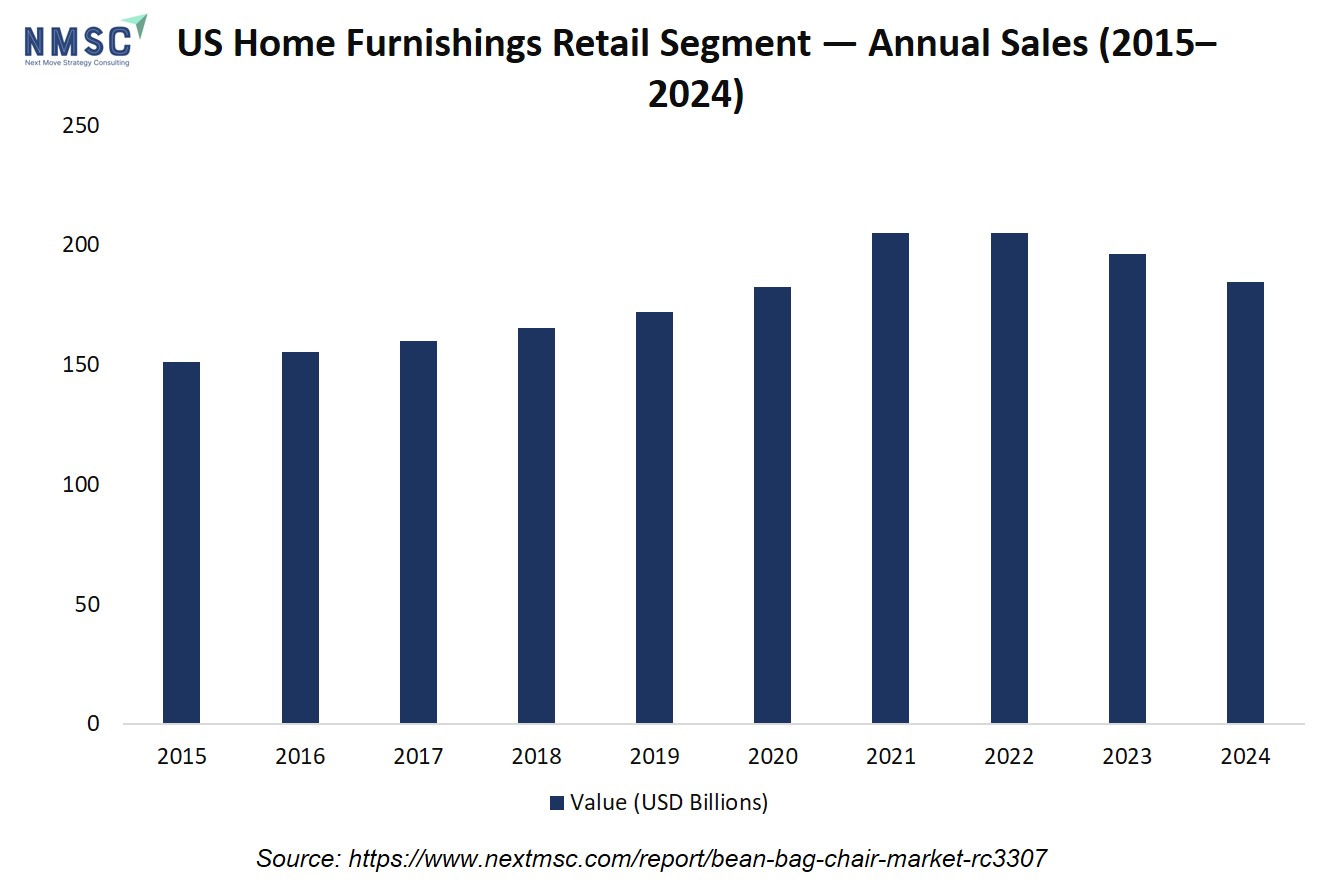
US Home Furnishings Retail Segment — Annual Sales and Year-over-Year Change (2015–2024)
|
Year |
Annual Sales (USD Billions) |
Year-over-Year Change (%) |
|
2015 |
$151.0B |
— |
|
2016 |
$155.1B |
+2.7% |
|
2017 |
$160.0B |
+3.2% |
|
2018 |
$165.3B |
+3.3% |
|
2019 |
$172.0B |
+4.1% |
|
2020 |
$182.4B |
+6.0% |
|
2021 |
$204.8B |
+12.3% |
|
2022 |
$205.0B |
+0.1% |
|
2023 |
$196.4B |
−4.2% |
|
2024 |
$184.5B |
−6.1% |
Regional Dynamics: North America Leads, Asia-Pacific Accelerates
North America retains the largest share of the global bean bag chair market, driven by strong consumer preference for casual and comfortable home furnishings, open-plan living spaces, and a growing emphasis on multifunctional furniture in modern interior design. The US Census Bureau reported that residential construction spending in the US reached USD 963.8 billion in 2023, reflecting a strong housing market that supports demand for innovative home furnishings, particularly among millennials and Gen Z seeking affordable, stylish seating solutions.
Europe is witnessing evolving applications for bean bag chairs beyond traditional residential settings, with growing adoption in educational institutions, libraries, and co-working spaces. The European Urban Initiative notes that approximately 75% of the EU's population — around 447 million people — resides in urban areas with limited space, driving demand for space-saving furniture that aligns with modern, flexible interior design trends.
Asia-Pacific is emerging as the fastest-growing regional market, characterized by unique product innovations tailored to local needs. Japan's introduction of wearable bean bags exemplifies the region's emphasis on novelty, functionality, and compact living solutions. In India and China, rising disposable incomes, rapid urbanization, and changing lifestyle preferences are driving demand for affordable, space-saving furniture. India's per capita income rose to USD 2,544 in 2022-23, reflecting increased purchasing power among the growing middle class. The global furniture market's Asia-Pacific segment held the largest revenue share of 38.5% of the global market in 2025, according to Grand View Research.
Rest of World markets — including Latin America, the Middle East, and Africa — represent developing but high-potential growth territories. Brazil's e-commerce market is projected to grow at 14.3% annually, reaching over USD 200 billion by 2026, according to the International Trade Administration, enhancing access to furniture products and supporting market expansion in urbanizing regions.
Key Players and Strategic Positioning
The global bean bag chair market features a diverse competitive landscape spanning premium lifestyle brands, mass-market manufacturers, and niche innovators. Key players identified in the NMSC analysis include Lovesac, Yogibo LLC, Sumo Lounge International, MUJI, Fatboy, Comfy Sacks, CordaRoy, Jaxx Bean Bags, Big Joe, The Fluffy Company, Ultimate Sack, Relax Sacks, Chill Sack, Big Bertha Original, and Sofa Sack.
Strategic differentiation is increasingly centered on three axes: licensed product collaborations (exemplified by PM&J's November 2024 launch of Squishmallows bean bag chairs featuring 30-inch designs based on popular characters), material innovation toward sustainable and eco-friendly alternatives, and expansion into niche commercial segments including gaming lounges, educational settings, and hospitality environments.
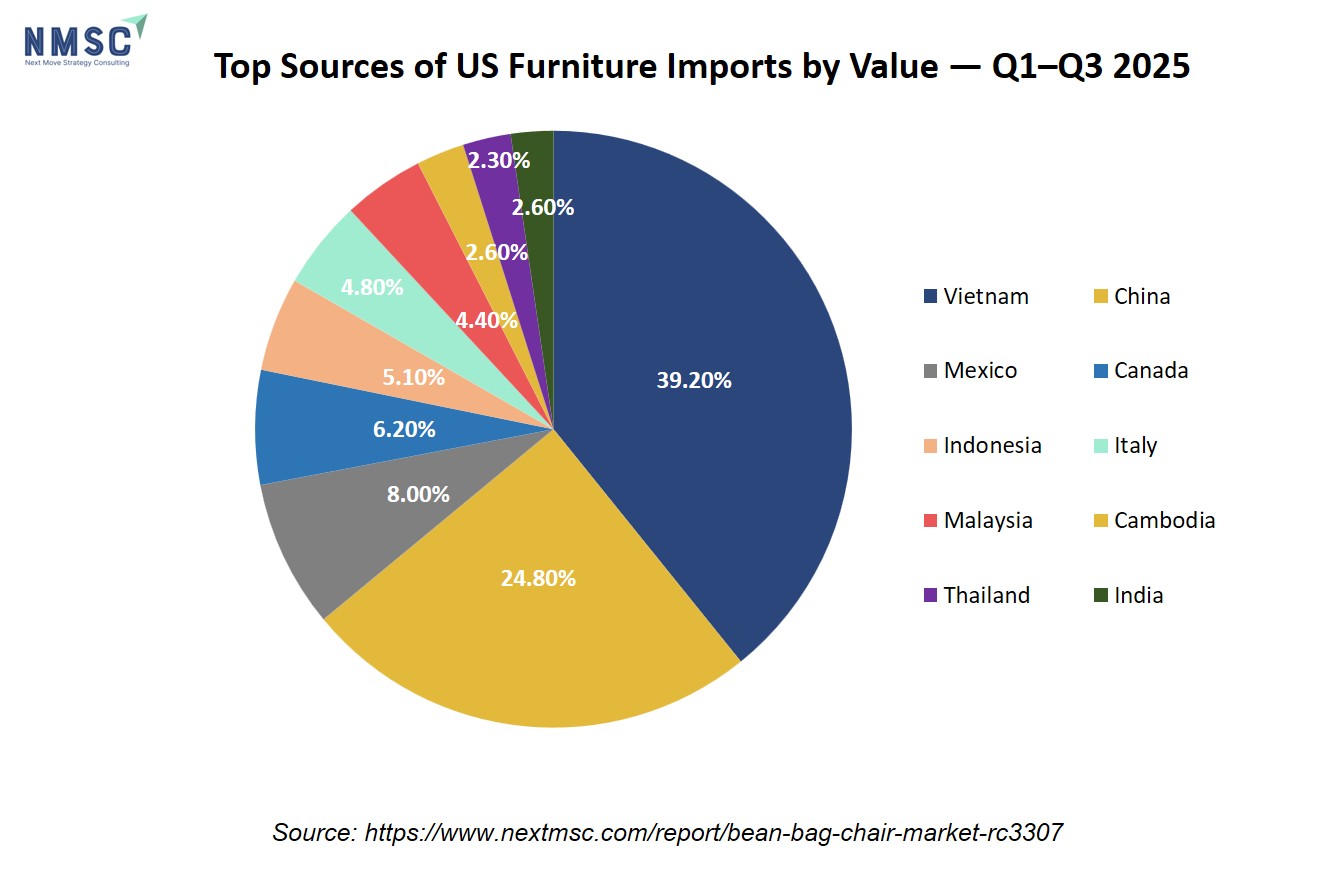
The tariff environment is creating a bifurcated competitive dynamic. Larger, well-capitalized players with diversified supply chains — including sourcing from Vietnam, Mexico, and India — are better positioned to absorb or redirect tariff costs, while smaller manufacturers with concentrated China-sourcing exposure face margin compression and potential market exit. This consolidation dynamic mirrors the broader pattern observed across the furniture sector, where RH, Williams-Sonoma, and Wayfair all grew sales and margins in 2025 even as smaller competitors declared bankruptcy.
Bottom Line
The global bean bag chair market is navigating a complex operating environment defined by the intersection of tariff-driven supply chain disruption, shifting consumer spending patterns, and durable structural demand drivers. The 25% US import duty on upholstered furniture — which remains in force despite the Supreme Court's February 2026 ruling against broader reciprocal tariffs — is accelerating industry consolidation, eliminating undercapitalized operators while creating market share opportunities for larger, more resilient players. IKEA's $2.2 billion US investment commitment and Wayfair's physical retail expansion signal institutional confidence in the long-term trajectory of the home furnishings sector, even as near-term demand remains constrained by elevated mortgage rates and subdued consumer confidence.
For the bean bag chair segment specifically, the 4.4% CAGR trajectory toward USD 5.10 billion by 2030 reflects a market that is structurally insulated from the worst of the tariff headwinds by its affordability positioning, e-commerce compatibility, and expanding commercial applications. The primary investment opportunities lie in sustainable material innovation, Asia-Pacific market penetration, and digital-first distribution strategies. Key risks include continued tariff policy uncertainty, polystyrene-related environmental regulation, and the perception challenge of repositioning bean bag chairs as premium, durable furniture rather than low-cost novelty items. Companies that successfully combine eco-friendly product credentials with strong e-commerce execution and commercial segment diversification are best positioned to capture disproportionate value in this expanding market.
About Next Move Strategy Consulting
Next Move Strategy Consulting is a premier market research and management consulting firm that has been committed to provide strategically analysed well documented latest research reports to its clients. The research industry is flooded with many firms to choose from, what makes NMSC different from the rest is its top-quality research and the obsession of turning data into knowledge by dissecting every bit of it and providing fact-based research recommendation that is supported by information collected from over 500 million websites, paid databases, industry journals and one on one consultations with industry experts across a diverse range of industry sectors. The high-quality customized research reports with actionable insights and excellent end-to-end customer service help our clients to take critical business decisions that enables them to move beyond time and have competitive edge in the industry.
We have been servicing over 1000 customers globally that includes 90% of the Fortune 500 companies over a decade. Our analysts are constantly tracking various high growth markets and identifying hidden opportunities in each sector or the industry. We provide one of the industry's best quality syndicate as well as custom research reports across 10 different industry verticals. We are committed to deliver high quality research solutions in accordance to your business needs. Our industry standard delivery solutions that ranges from the pre consultation to after-sales services, provide an excellent client experience and ensure right strategic decision making for businesses.
For more information, please contact:
Next Move Strategy Consulting
5th Floor 867
Boylston St, STE 500,
Boston, MA 02116, U.S.
E-Mail: [email protected]
Direct: +1-217-650-7991
Website: www.nextmsc.com
About the Author
 Sanyukta Deb
— Sanyukta Deb is Digital Marketing Team Lead at Next Move Strategy Consulting, where she has led content strategy and technical SEO for the firm's B2B market research publications for over 2 years. Her editorial process translates NextMSC's primary and secondary research — spanning technology, industrial, and consumer sectors — into commercial narratives, backed by search-intent, keyword, and competitive analysis. She brings 5 years of overall experience in digital marketing and content strategy.
Sanyukta Deb
— Sanyukta Deb is Digital Marketing Team Lead at Next Move Strategy Consulting, where she has led content strategy and technical SEO for the firm's B2B market research publications for over 2 years. Her editorial process translates NextMSC's primary and secondary research — spanning technology, industrial, and consumer sectors — into commercial narratives, backed by search-intent, keyword, and competitive analysis. She brings 5 years of overall experience in digital marketing and content strategy.
About the Reviewer
 Debashree Dey
— Debashree Dey is Assistant Manager at Next Move Strategy Consulting, where she supports cross-vertical market content and communications across diverse industries for 6 years. Her professional background includes senior content writing, communications, and published manuscript authorship, with experience developing audience-focused business narratives and maintaining clear, consistent messaging. Her role supports research-led content development and editorial quality across NextMSC publications.
Debashree Dey
— Debashree Dey is Assistant Manager at Next Move Strategy Consulting, where she supports cross-vertical market content and communications across diverse industries for 6 years. Her professional background includes senior content writing, communications, and published manuscript authorship, with experience developing audience-focused business narratives and maintaining clear, consistent messaging. Her role supports research-led content development and editorial quality across NextMSC publications.
















Add Comment