Beta Bionics' Mint FDA Clearance Signals Smarter Insulin Delivery | NextMSC
Beta Bionics' Mint Patch Pump FDA Clearance Signals a New Era for Intelligent Insulin Delivery Devices
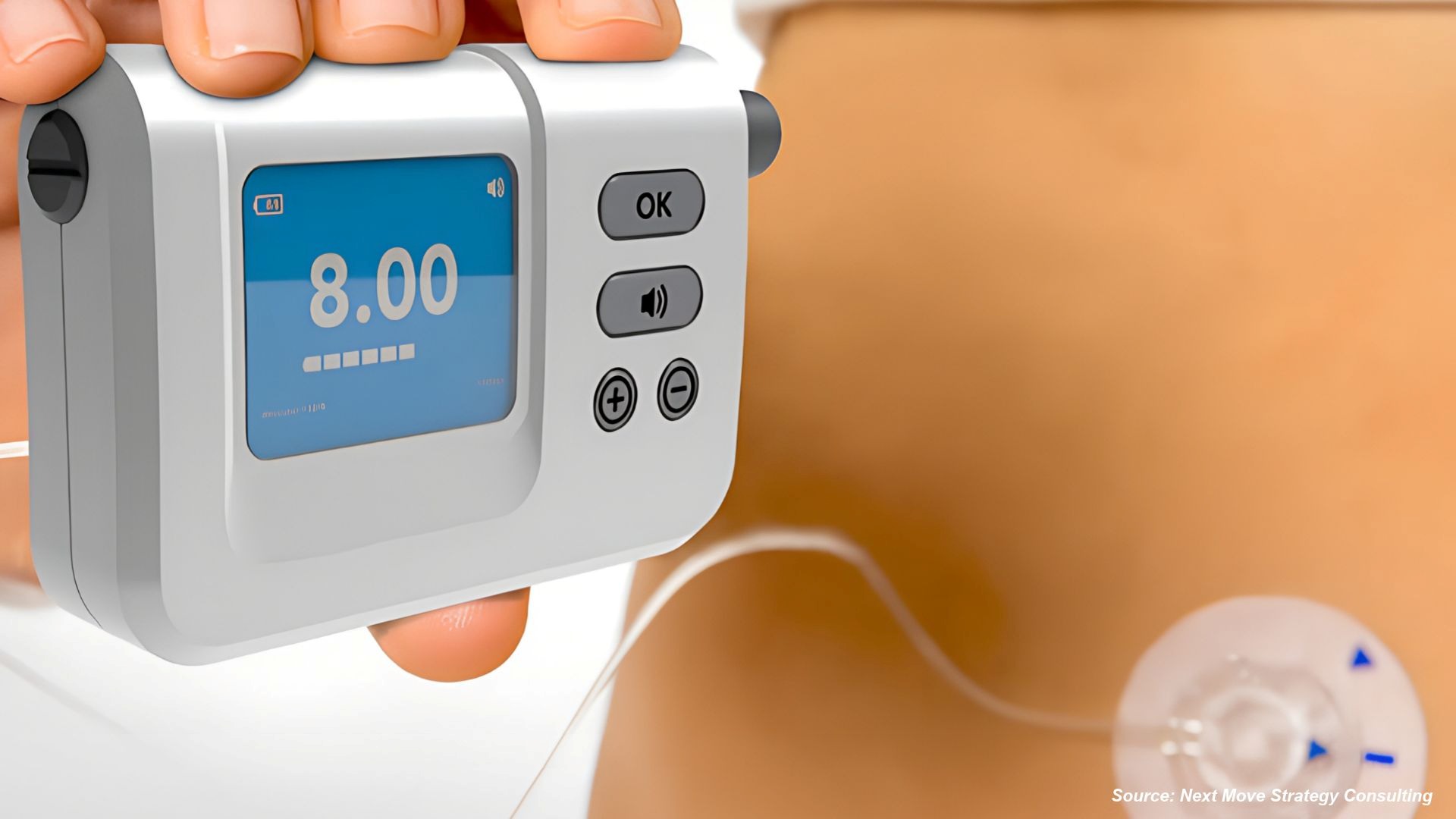
On September 14, 2026, Beta Bionics, Inc. (Nasdaq: BBNX) announced U.S. Food and Drug Administration (FDA) clearance of Mint™, the company's first insulin patch pump — a reusable-and-disposable architecture device that requires no recharging, integrates with industry-leading continuous glucose monitors (CGMs), and enables full smartphone control for both iOS and Android users. The clearance is not an isolated regulatory milestone — it is the most recent in a sequence of FDA decisions in 2026 that collectively demonstrate how the drug delivery devices sector is being structurally redefined by the convergence of adaptive algorithms, miniaturized hardware, and pharmacy-channel distribution. Full U.S. commercialization of Mint is expected to begin in Q1 2027, with manufacturing capacity projected to produce at least 1.5 million disposable units during that year.
According to Next Move Strategy Consulting's Drug Delivery Devices Market report, the global drug delivery devices market is projected to reach USD 236.63 billion by 2030, growing at a CAGR of 7.0% from 2024 to 2030. NMSC's proprietary research and analysis attributes this sustained expansion to the accelerating clinical adoption of intelligent, patient-centric delivery platforms — precisely the category that the Mint clearance, along with a series of parallel regulatory and capital events in 2026, is now reshaping at scale.
For More Information: Download FREE Sample on Drug Delivery Devices Report
The Chronic Disease Imperative: Why Delivery Innovation Is Non-Negotiable
The structural demand underpinning the drug delivery devices market is rooted in the global burden of noncommunicable diseases (NCDs). According to the World Health Organization's September 2025 NCD Fact Sheet, NCDs killed at least 43 million people in 2021 — equivalent to 75% of all non-pandemic-related deaths globally. Cardiovascular diseases alone accounted for at least 19 million of those deaths, followed by cancers (10 million), chronic respiratory diseases (4 million), and diabetes (over 2 million, including kidney disease deaths caused by diabetes). In the United States specifically, the Centers for Disease Control and Prevention (CDC) reported that more than 850,000 Americans died of heart disease or stroke in 2024 alone — more than one in four deaths.
These mortality figures translate directly into device demand. Patients managing diabetes, cancer, autoimmune disorders, and cardiovascular conditions require long-duration, precision-dosed pharmacotherapy — and the clinical and commercial evidence of 2026 confirms that the industry is responding with a generation of devices that embed intelligence directly into the delivery mechanism, rather than relying on patient recall or manual titration.
2026's Regulatory Cascade: Three FDA Clearances That Redrew the Insulin Delivery Landscape
The Mint clearance is the third major FDA decision in the insulin delivery sub-segment in 2026, and each clearance has expanded the addressable market in a distinct and measurable way.
January 12, 2026 — Medtronic MiniMed Go™ Smart MDI System: Medtronic (NYSE: MDT) announced FDA 510(k) clearance of its MiniMed Go™ app, creating the first and only smart multiple daily injection (MDI) system that automatically integrates insulin dosing and glucose data in a single application. The system connects the InPen™ smart insulin pen with Abbott's Instinct sensor — the world's smallest and thinnest integrated CGM — through the MiniMed Go™ app, delivering real-time missed dose alerts, a dose calculator, and CareLink™ software reporting for provider collaboration. The system is cleared for individuals with insulin-requiring type 1 and type 2 diabetes aged 7 years and older.
"For too long, people using injections have carried the weight of diabetes management without access to the algorithms that make automated insulin delivery systems so powerful," said Que Dallara, Executive Vice President and President of Medtronic Diabetes and CEO-designate of MiniMed, in the company's January 12, 2026 press release. "MiniMed Go™ is designed to change that — bringing the smarts of an AID system to individuals who prefer an insulin pen."
March 18, 2026 — MiniMed Flex™: MiniMed (Nasdaq: MMED) announced FDA clearance of MiniMed Flex™, the company's smallest insulin pump — approximately half the size of the previous-generation MiniMed™ 780G system — featuring a screenless, smartphone-controlled design and a 300-unit insulin reservoir. Powered by the SmartGuard™ algorithm with Meal Detection™ technology, the device achieved 80% Time in Range in real-world settings with recommended settings.
"MiniMed Flex™ embodies that promise. It's designed to work quietly and reliably in the background — advanced automation wrapped in a compact, smartphone-controlled pump," said Que Dallara, Chief Executive Officer of MiniMed, in the company's March 18, 2026 press release.
September 14, 2026 — Beta Bionics Mint™: The Mint clearance extends the competitive frontier into the patch pump form factor. Unlike conventional tubed pumps, Mint's two-piece reusable-and-disposable architecture eliminates recharging, supports a 200-unit insulin reservoir, carries an IPX8 waterproof rating (up to 5 feet for 60 minutes), and delivers firmware-over-the-air updates. Beta Bionics simultaneously submitted its next-generation 3D Intelligence™ dosing algorithm to the FDA via a 510(k) application, with commercialization of iLet 3D™ expected by end of 2026.
"We believe that our next-generation AID platform, consisting of Mint 3D and iLet 3D, will represent a transformational advancement for people living with diabetes," said Sean Saint, President and Chief Executive Officer of Beta Bionics, in the company's September 14, 2026 press release.
AbbVie's $10 Billion Manufacturing Commitment: Reshaping the U.S. Drug Delivery Device Supply Chain
While the regulatory calendar has dominated headlines, the capital investment side of the drug delivery devices market has been equally consequential in 2026. On January 12, 2026, AbbVie (NYSE: ABBV) and West Pharmaceutical Services (NYSE: WST) announced a definitive agreement for AbbVie to acquire a device manufacturing facility in Tempe, Arizona, along with associated intellectual property. The transaction — which includes multiple production lines and 3.5 mL on-body injector technology — is designed to significantly expand AbbVie's drug delivery device manufacturing capabilities and capacity, with AbbVie committing more than USD 175 million to acquire, modernize, and integrate the site into its global manufacturing network.
"Over the next decade, AbbVie is investing more than $10 billion in capital to broadly support innovation and expand our manufacturing capabilities and capacity in the U.S.," said Robert A. Michael, Chairman and Chief Executive Officer of AbbVie, in the company's January 12, 2026 press release.
The Arizona acquisition was followed on April 22, 2026, by AbbVie's announcement of a USD 1.4 billion investment to build a 185-acre pharmaceutical manufacturing campus in North Carolina, and on February 23, 2026, by a USD 380 million commitment to build two new active pharmaceutical ingredient (API) manufacturing facilities in North Chicago. Taken together, these three capital commitments — totalling more than USD 1.955 billion in announced U.S. investments in the first four months of 2026 alone — signal that the largest pharmaceutical manufacturers are treating drug delivery device manufacturing capacity as a strategic asset, not a commodity input.
Market Segmentation Snapshot
|
Segment Dimension |
Key Categories |
Notable 2026 Development |
|
Route of Administration |
Injectable, Oral, Pulmonary, Implantable, Topical, Nasal, Transmucosal, Ocular, Others |
Injectable segment anchored by Mint™, MiniMed Flex™, and MiniMed Go™ FDA clearances |
|
Application |
Diabetes, Cancer, Autoimmune Diseases, CNS Disorders, Respiratory Diseases, Infectious Diseases, Others |
Diabetes sub-segment saw three major FDA clearances in nine months (Jan–Sep 2026) |
|
End User |
Hospitals, Ambulatory Surgery Centers, Home Care Settings, Diagnostic Centers, Others |
Pharmacy-channel distribution expanding; Beta Bionics targets ≥50% insured U.S. lives within first year of Mint launch |
|
Region |
North America, Europe, Asia-Pacific, Rest of World |
North America retains largest share; AbbVie's USD 1.955Bn+ U.S. capital commitments in 2026 reinforce regional dominance |
NMSC Strategic Perspective: What the 2026 Regulatory and Capital Cluster Means for the Market
Next Move Strategy Consulting's analysis of the drug delivery devices market identifies three structural shifts that the events of 2026 have materially accelerated:
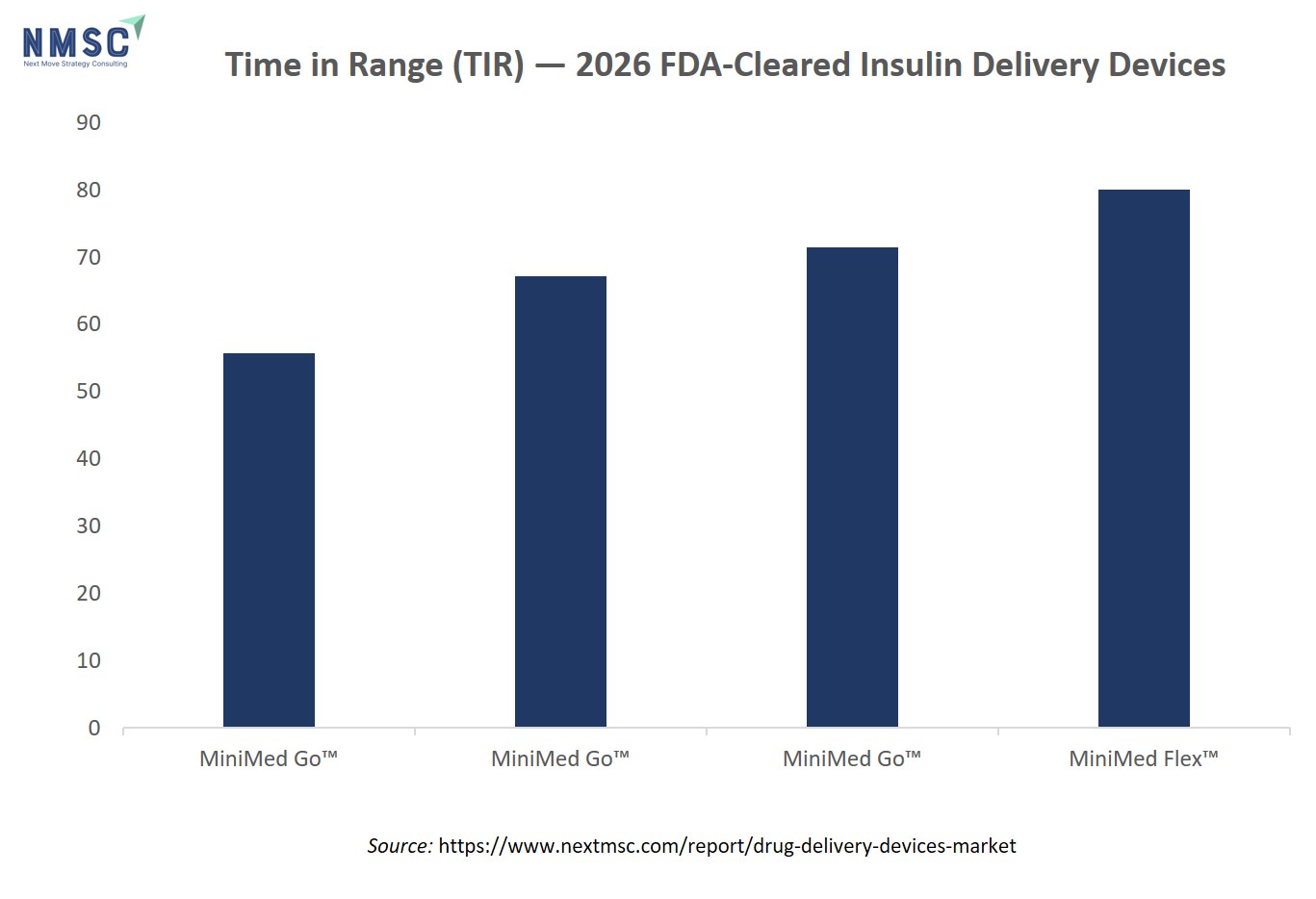
1. The Algorithm Is Now the Device. The three 2026 FDA clearances — MiniMed Go™, MiniMed Flex™, and Beta Bionics Mint™ — share a defining characteristic: the clinical value proposition is no longer the hardware alone, but the adaptive dosing algorithm embedded within it. Medtronic's real-world data showed that MiniMed Go™ users who responded to more than 75% of Missed Dose alerts within an hour achieved a Time in Range increase from 55.7% to 67.2%; those who also responded to Correct High Glucose alerts reached 71.5% TIR. This shifts the competitive moat from manufacturing precision to software differentiation — a dynamic that NMSC's proprietary research and analysis identifies as a primary driver of premium pricing power and recurring revenue in the injectable drug delivery segment through 2030.
2. Pharmacy-Channel Distribution Is Redefining the Addressable Market. Beta Bionics' decision to launch Mint exclusively through the pharmacy channel — with approximately 40% of insured U.S. lives expected to access it via pharmacy benefit at launch, rising to at least 50% within the first year — represents a structural departure from the traditional durable medical equipment (DME) reimbursement pathway. NMSC's proprietary research and analysis indicates that pharmacy-channel access materially lowers the patient acquisition cost for device manufacturers while simultaneously expanding the pool of eligible users — a combination that directly supports the market's projected trajectory toward USD 236.63 billion by 2030.
3. Domestic Manufacturing Capacity Is Becoming a Competitive Differentiator. AbbVie's acquisition of the West Pharmaceutical Services facility in Tempe, Arizona — specifically for its 3.5 mL on-body injector technology — illustrates that large-cap pharmaceutical companies are internalizing drug delivery device manufacturing rather than relying on contract device organizations. NMSC's proprietary research and analysis identifies this vertical integration trend as a supply-chain resilience response that will compress the time-to-market for next-generation combination products — particularly in the immunology and neuroscience therapeutic areas — and will likely intensify competitive pressure on pure-play contract device manufacturers through the forecast period.
Competitive Landscape: Key Players and Strategic Posture
The drug delivery devices market features a diverse competitive field spanning large-cap pharmaceutical manufacturers, dedicated medical device companies, and emerging technology-driven entrants. Key players identified in NMSC's proprietary research and analysis include Pfizer Inc., Johnson & Johnson Services, Inc., F. Hoffmann-La Roche Ltd, Novartis AG, Becton, Dickinson and Company, Bayer AG, uniQure NV, Sibiono GeneTech Co. Ltd., Kindeva Drug Delivery, and Baxter.
The events of 2026 have introduced a new competitive dynamic: the race to own the full-stack insulin delivery ecosystem — sensor, pen or pump hardware, dosing algorithm, and app — is now being contested simultaneously by Medtronic/MiniMed, Beta Bionics, and their CGM partners (Abbott and Dexcom). The clinical outcome data generated by these integrated systems will increasingly serve as the primary basis for formulary placement and payer coverage decisions, creating a feedback loop in which real-world evidence becomes the most durable form of competitive advantage.
Bottom Line
The drug delivery devices market is undergoing a structural transformation that the events of 2026 have made impossible to ignore. Three FDA clearances in nine months — Medtronic's MiniMed Go™ in January, MiniMed Flex™ in March, and Beta Bionics' Mint™ in September — have collectively demonstrated that the insulin delivery sub-segment has moved from hardware differentiation to algorithm-driven, pharmacy-accessible, full-stack ecosystem competition. Simultaneously, AbbVie's USD 1.955 billion-plus in announced U.S. manufacturing investments in the first four months of 2026 signals that the largest pharmaceutical companies are treating drug delivery device capacity as a strategic asset requiring vertical integration. Against a backdrop of at least 43 million NCD deaths globally in 2021 — a figure that underscores the irreversible demand for precision pharmacotherapy — NMSC's proprietary research and analysis projects the global drug delivery devices market to grow from USD 147.17 billion in 2023 to USD 236.63 billion by 2030 at a 7.0% CAGR. The market's next inflection point will be determined by which platforms can convert regulatory clearance into durable payer coverage, pharmacy-channel scale, and real-world clinical evidence — the three variables that will separate category leaders from followers through the end of the decade.
About Next Move Strategy Consulting
Next Move Strategy Consulting is a premier market research and management consulting firm that has been committed to provide strategically analysed well documented latest research reports to its clients. The research industry is flooded with many firms to choose from, what makes NMSC different from the rest is its top-quality research and the obsession of turning data into knowledge by dissecting every bit of it and providing fact-based research recommendation that is supported by information collected from over 500 million websites, paid databases, industry journals and one on one consultations with industry experts across a diverse range of industry sectors. The high-quality customized research reports with actionable insights and excellent end-to-end customer service help our clients to take critical business decisions that enables them to move beyond time and have competitive edge in the industry.
We have been servicing over 1000 customers globally that includes 90% of the Fortune 500 companies over a decade. Our analysts are constantly tracking various high growth markets and identifying hidden opportunities in each sector or the industry. We provide one of the industry's best quality syndicate as well as custom research reports across 10 different industry verticals. We are committed to deliver high quality research solutions in accordance to your business needs. Our industry standard delivery solutions that ranges from the pre consultation to after-sales services, provide an excellent client experience and ensure right strategic decision making for businesses.
For more information, please contact:
Next Move Strategy Consulting
5th Floor 867 Boylston St, STE 500,
Boston, MA 02116, U.S.
E-Mail: [email protected]
Direct: +1-217-650-7991
Website: www.nextmsc.com
About the Author
 Sanyukta Deb
— Sanyukta Deb is Digital Marketing Team Lead at Next Move Strategy Consulting, where she has led content strategy and technical SEO for the firm's B2B market research publications for over 2 years. Her editorial process translates NextMSC's primary and secondary research — spanning technology, industrial, and consumer sectors — into commercial narratives, backed by search-intent, keyword, and competitive analysis. She brings 5 years of overall experience in digital marketing and content strategy.
Sanyukta Deb
— Sanyukta Deb is Digital Marketing Team Lead at Next Move Strategy Consulting, where she has led content strategy and technical SEO for the firm's B2B market research publications for over 2 years. Her editorial process translates NextMSC's primary and secondary research — spanning technology, industrial, and consumer sectors — into commercial narratives, backed by search-intent, keyword, and competitive analysis. She brings 5 years of overall experience in digital marketing and content strategy.
About the Reviewer
 Debashree Dey
— Debashree Dey is Assistant Manager at Next Move Strategy Consulting, where she supports cross-vertical market content and communications across diverse industries for 6 years. Her professional background includes senior content writing, communications, and published manuscript authorship, with experience developing audience-focused business narratives and maintaining clear, consistent messaging. Her role supports research-led content development and editorial quality across NextMSC publications.
Debashree Dey
— Debashree Dey is Assistant Manager at Next Move Strategy Consulting, where she supports cross-vertical market content and communications across diverse industries for 6 years. Her professional background includes senior content writing, communications, and published manuscript authorship, with experience developing audience-focused business narratives and maintaining clear, consistent messaging. Her role supports research-led content development and editorial quality across NextMSC publications.















Add Comment