California’s Crab Season Delay Puts Whale-Safe Trap Gear at Center Stage
California’s Delay of Commercial Dungeness Fishing to at Least January 1, 2027 and Alaska’s 40.61 Million-Pound Bering Sea Quota Pull Crab Pot Demand in Two Directions
On October 30, 2026, the California Department of Fish and Wildlife delayed the commercial Dungeness crab season from the California-Oregon border to Point Conception until at least January 1, 2027, citing the number of humpback whale entanglements recorded during 2026 and the time whales need to migrate out of California waters. The same announcement restricted recreational crab traps in Fishing Zones 1 through 5 when the recreational season opened on November 7, 2026, while hoop nets and crab snares stayed unrestricted. ABC7 News reported on November 2, 2026 that the lines tethering traditional crab traps to the surface are the entanglement risk behind the decision, and that the commercial season had already been delayed twice in the previous season for the same reason.
According to Next Move Strategy Consulting’s Crab Pots Market report, the global crab pots market was valued at USD 780 million in 2025 and is projected to reach USD 1,176.99 million by 2035, growing at a CAGR of 4.2% during the 2026-2035 forecast period. NextMSC primary research and analysis puts the absolute opportunity between 2026 and 2035 at USD 364.23 million.
For More Information: Download FREE Sample on Crab Pots Market Report
Why a Whale-Safety Decision Reaches the Gear Shed
Preliminary National Marine Fisheries Service data cited by ABC7 News showed 37 whale entanglements off California, Oregon and Washington in the first nine months of 2026, including 30 humpbacks, the highest count since 2016. Against that record, California has tightened the pot itself and not only the calendar. According to CDFW’s Whale Safe Fisheries page, the Director continued a 15% gear reduction in Zones 1 and 2 and a 40% reduction in Zone 3 on March 13, 2026, and set a 30-fathom depth constraint in Zones 1 and 2 effective April 30, 2026. Each measure changes how many pots a vessel may carry, where they may sit or how they are rigged, which ties the regulatory calendar directly to the replacement and retrofit decisions of pot owners.
CDFW expects its next risk assessment in mid-December 2026, when the Director will review available data, including a recommendation from the Dungeness Crab Fishing Gear Working Group, to decide when the commercial fishery can open and when trap restrictions can be lifted. The outcome of that assessment decides when pots already staged in California can fish. Gear loss is also priced into the rules: CDFW’s March 13, 2026 news release allowed commercial vessels in Zones 4 and 5 to retrieve an unlimited number of lost or derelict commercial crab traps from April 3, 2026.
Key Industry Developments: Pop-Up Gear, Line Marking and Pot Limits
On March 13, 2026, CDFW authorized alternative, or pop-up, gear in the commercial Dungeness fishery for the first time. The gear still uses a cage with a buoy and line, but the buoy and line stay coiled on the seafloor until a remote signal releases the buoy to the surface so the trap can be found and retrieved, according to CDFW’s news release of that date. Two alternative gear types were approved for all commercial permit holders, and CDFW’s Whale Safe Fisheries page records a conditional Sub Sea Sonics gear authorization posted the same day. Use began on April 3, 2026 in Zones 4 and 5 and reached Zone 3 on May 7, 2026 after an April 17 authorization. When Zones 3 to 5 closed for the rest of the season on May 15, 2026, alternative gear remained authorized.
“An exciting new development in California fisheries management”
- Meghan Hertel, Director, California Department of Fish and Wildlife, CDFW news release on pop-up gear authorization, March 13, 2026.
Rope specifications are changing on a fixed schedule as well. CDFW’s Whale Safe Fisheries page states that commercial line-marking requirements began in November 2025, and that by November 2028 dual-colored purple and black line will be required on all surface line and the upper 15 fathoms of vertical lines. Oregon requires yellow and black lines starting December 1, 2026, and Washington uses red and black, while California prohibits the use of another state’s assigned markings, so the same rope cannot serve every state’s fishery.
California Commercial Dungeness Line-Marking Phase-In
|
Season |
Marking requirement for deployed gear |
|
2025-26 |
All surface gear marked |
|
2026-27 |
All surface lines, plus the upper 15 fathoms of 25% of deployed gear |
|
2027-28 |
All surface lines, plus the upper 15 fathoms of 50% of deployed gear |
|
2028-29 |
All surface lines, plus the upper 15 fathoms of 100% of deployed gear |
Washington has acted on pot counts and rigging. The Washington Department of Fish and Wildlife filed emergency rule WSR 26-01-202 (Order 25-312) on December 23, 2025, effective December 28, 2025. It caps the line from the main buoy to the last trailer buoy at 36 feet and limited the first days of the season to 400 pots for a license with 500 permanent pots and 250 pots for a license with 300 permanent pots. The filing states that pot limits are meant to reduce effort and crowding at the season start.
Alaska’s Reset Bering Sea Quotas Pull Pot Demand the Other Way
While California holds pots ashore, Alaska is putting more fishing opportunity in front of its fleet. On October 6, 2026, the Alaska Department of Fish and Game announced total allowable catches for the 2026/27 Bering Sea crab fisheries, with every season opening at noon on October 15, 2026. Bristol Bay red king crab was set at 3,410,000 pounds, Bering Sea snow crab at 5,100,000 pounds and Bering Sea Tanner crab at 32,100,000 pounds, of which 27,200,000 pounds sit west of 166° W and 4,900,000 pounds between 166° W and 163° W.
2026/27 Bering Sea Crab Quotas and Season Dates
|
Fishery |
Total TAC (lb) |
IFQ (lb) |
CDQ (lb) |
Opens |
Closes |
|
Bristol Bay red king crab |
3,410,000 |
3,069,000 |
341,000 |
Oct 15, 2026 |
Jan 15, 2027 |
|
Bering Sea snow crab |
5,100,000 |
4,590,000 |
510,000 |
Oct 15, 2026 |
May 15, 2027 (east of 173° W); May 31, 2027 (west of 173° W) |
|
Western Bering Sea Tanner crab |
27,200,000 |
24,480,000 |
2,720,000 |
Oct 15, 2026 |
Mar 31, 2027 |
|
Eastern Bering Sea Tanner crab |
4,900,000 |
4,410,000 |
490,000 |
Oct 15, 2026 |
Mar 31, 2027 |
Baird Maritime, reporting the limits on October 8, 2026, put the 2025-26 totals at 2.68 million pounds for red king crab, 9.3 million pounds for snow crab, which included an extra 1 million pounds for hybrid Chionoecetes crab, and 11.25 million pounds for Tanner crab. Adding the three announced limits gives 40.61 million pounds for 2026/27 against 23.23 million pounds a season earlier. The mix matters as much as the total: Tanner crab accounts for 32.1 million pounds of this season’s quota, while the snow crab limit fell from 9.3 million to 5.1 million pounds.
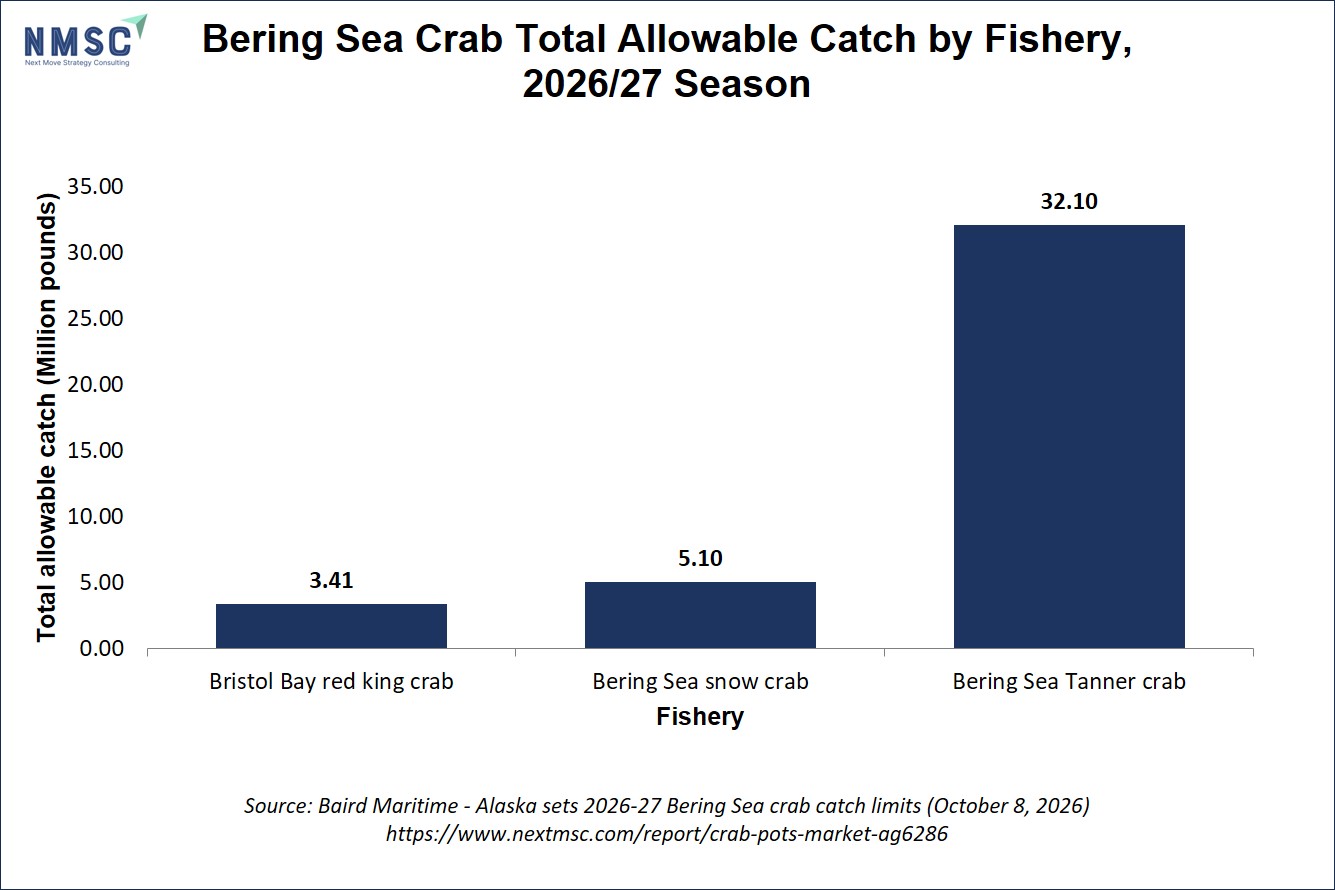
Bering Sea Crab Total Allowable Catch, 2025-26 and 2026-27
|
Fishery |
2025-26 TAC (million lb) |
2026-27 TAC (million lb) |
|
Bristol Bay red king crab |
2.68 |
3.41 |
|
Bering Sea snow crab |
9.3 (includes an extra 1 for hybrid Chionoecetes crab) |
5.1 |
|
Bering Sea Tanner crab |
11.25 |
32.1 |
|
Sum of the three announced limits |
23.23 |
40.61 |
“Really refreshing to hear that the harvest levels are up for most species”
- Jamie Goen, Executive Director, Alaska Bering Sea Crabbers, Alaska Public Media (KUCB), “Bering Sea crabbers buoyed by increased catch limits this season”, October 12, 2026.
These are quota-managed fisheries, and the season lengths in the Alaska Department of Fish and Game releases, running to January 15, 2027 for red king crab, March 31, 2027 for Tanner crab and May 15 or May 31, 2027 for snow crab, set how long vessels have to fish their allocations. NextMSC primary research and analysis treats that quota cycle as a demand signal for pot replacement and fleet expansion in the Bering Sea, with the 2026/27 Tanner crab limit the largest single swing.
Segment Dynamics: Steel Holds the Base While Hybrid and Collapsible Designs Grow Faster
According to NextMSC primary research and analysis, galvanized steel frame pots are the largest material segment at USD 341.4 million in 2025, rising to USD 493.2 million by 2035 at a 3.7% CAGR. Wood and hybrid pots are the fastest-growing material at a 5.4% CAGR, expanding from USD 87.8 million in 2025 to USD 149.0 million in 2035. Polyethylene mesh pots grow at 4.6% from USD 151.6 million to USD 237.4 million, and PVC-coated wire pots at 4.1% from USD 199.3 million to USD 297.4 million.
On design, NextMSC primary research and analysis shows rectangular box pots as the largest category at USD 338.05 million in 2025, rising to USD 470.19 million by 2035, while collapsible pots are the fastest-growing design at a 5.7% CAGR. Commercial crab fishing is the largest application at USD 377.01 million in 2025, moving to USD 539.79 million by 2035, whereas research and monitoring grows fastest at 6%. Commercial fishing fleets are the largest end user at USD 358.6 million in 2025 and reach USD 575.28 million by 2035 at a 4.8% CAGR.
Regional Outlook
North America is the largest regional market at USD 265.2 million in 2025, about 34% of global value, according to NextMSC primary research and analysis, and the United States accounts for USD 206.86 million of that total. The West Coast rules above and the Bering Sea quota reset sit inside this region, which is why North American gear specifications carry weight beyond its share of demand.
Asia-Pacific is the fastest-growing region at a 6.9% CAGR and is projected to reach USD 411.95 million by 2035, based on NextMSC primary research and analysis. That growth rate is above the 4.2% global CAGR, which means the region adds share even as North America keeps the largest base.
Growth Drivers and Restraints
NextMSC primary research and analysis identifies escape ring mandates and biodegradable panel requirements as high-impact, immediate growth drivers, with cull ring rules a medium-term driver. The external record supports the direction of travel: California’s line-marking schedule moves from all surface gear in 2025-26 to the upper 15 fathoms of 100% of deployed gear in 2028-29, and Washington’s Order 25-312 sets a 36-foot limit on buoy line length. Each rule changes a component specification and gives pot owners a dated reason to replace or modify gear.
The same analysis names gear loss and recovery costs as a high-impact, immediate restraint, seasonal closure requirements as a medium-term restraint and raw material price volatility as a long-term, low-impact restraint. California’s October 30, 2026 delay is the clearest current example of a closure requirement, since pots cannot earn revenue until at least January 1, 2027, and the unlimited derelict-trap retrieval allowed in Zones 4 and 5 from April 3, 2026 shows that lost gear is a recurring cost the state is trying to contain. Alaska’s snow crab limit falling from 9.3 million to 5.1 million pounds is a quota-side restraint on that fishery.
NMSC Strategic Perspective: Pots Are Becoming Compliance Equipment
NextMSC primary research and analysis reads the 2026 rule changes as a shift in what a crab pot is bought for. In the past, pot demand tracked abundance and ex-vessel price. California’s staged line-marking schedule and its pop-up gear authorization add a second purchase trigger: a pot, its rope and its retrieval mechanism must now pass a regulator’s test before they can fish. A dated mandate, unlike a good season, arrives on a known schedule, which gives manufacturers more predictable replacement volumes.
The analysis also indicates a two-speed market. West Coast pots face delays and gear limits that defer revenue, while Bering Sea fleets face a 2026/27 quota of 40.61 million pounds across three fisheries, up from 23.23 million pounds. Suppliers that serve both coasts can balance these cycles, whereas single-region suppliers carry more exposure to one regulator’s calendar.
The segment data points the same way. Wood and hybrid pots at a 5.4% CAGR and collapsible pots at a 5.7% CAGR both outgrow galvanized steel frames at 3.7%, a pattern consistent with buyers valuing deck space, recovery of lost gear and lower-impact materials alongside durability. For investors, NextMSC primary research and analysis frames the USD 364.23 million opportunity between 2026 and 2035 as a compliance-led replacement cycle layered on top of quota-driven fleet demand, with Asia-Pacific at a 6.9% CAGR the main source of incremental volume outside North America.
Competitive Landscape
NextMSC’s report profiles 20 manufacturers and suppliers, including Promar International Limited, Frabill Inc., Rigid Net Crab Pots (Rigid Net Inc.), Duo Manufacturing, Inc., Gear Trade Inc., Bay Trap Supply, Inc., Netting Supply Co., Inc., Crab Pots Direct, Inc., Eagle Claw (Wright & McGill Co.) and Hi-Lo Industries, Inc. The list mixes catalog-scale gear brands with regional pot builders, which fits a market where specifications are set state by state.
The sources reviewed for this article do not tie any of those companies to the October 2026 rule changes. The one named equipment supplier in the regulatory record is Sub Sea Sonics, whose conditional gear authorization CDFW posted on March 13, 2026 as part of the alternative gear framework. Pop-up gear suppliers that win authorization are the entrants most likely to alter supplier rankings in California, because their product sits where the regulator’s requirements are changing fastest.
Bottom Line
The global crab pots market, valued at USD 780 million in 2025 and projected to reach USD 1,176.99 million by 2035 at a 4.2% CAGR, is being pulled by rules and quotas more than by any single season. California’s October 30, 2026 delay of commercial Dungeness fishing to at least January 1, 2027 keeps conventional pots ashore, while its line-marking schedule, pop-up gear authorization and Washington’s buoy-line and pot limits turn gear specifications into compliance items with dates attached. In the Bering Sea, the 2026/27 quota of 40.61 million pounds, up from 23.23 million pounds, widens fishing opportunity, led by a 32.1 million-pound Tanner crab limit. Wood and hybrid pots at 5.4%, collapsible designs at 5.7% and Asia-Pacific at 6.9% are the fastest-growing parts of the market. The next test is CDFW’s mid-December risk assessment, which will decide when California pots can fish.
About Next Move Strategy Consulting
Next Move Strategy Consulting is a premier market research and management consulting firm that has been committed to provide strategically analysed well documented latest research reports to its clients. The research industry is flooded with many firms to choose from, what makes NMSC different from the rest is its top-quality research and the obsession of turning data into knowledge by dissecting every bit of it and providing fact-based research recommendation that is supported by information collected from over 500 million websites, paid databases, industry journals and one on one consultations with industry experts across a diverse range of industry sectors. The high-quality customized research reports with actionable insights and excellent end-to-end customer service help our clients to take critical business decisions that enables them to move beyond time and have competitive edge in the industry.
We have been servicing over 1000 customers globally that includes 90% of the Fortune 500 companies over a decade. Our analysts are constantly tracking various high growth markets and identifying hidden opportunities in each sector or the industry. We provide one of the industry’s best quality syndicate as well as custom research reports across 10 different industry verticals. We are committed to deliver high quality research solutions in accordance to your business needs. Our industry standard delivery solutions that ranges from the pre consultation to after-sales services, provide an excellent client experience and ensure right strategic decision making for businesses.
For more information, please contact:
Next Move Strategy Consulting
5th Floor 867 Boylston St, STE 500,
Boston, MA 02116, U.S.
E-Mail: [email protected]
Direct: +1-217-650-7991
Website: www.nextmsc.com
About the Author
 Priyanshu Das
— Priyanshu Das is SEO Executive at Next Move Strategy Consulting, where he has led on-page and off-page SEO, keyword research, and SEO audits for the firm's B2B market research publications for 2 years. His audit process combines technical crawl analysis, backlink profile review, and competitor keyword gap mapping — using tools including Screaming Frog and Google Search Console — to prioritize fixes by organic search-visibility impact, informed by his own prior in-house and agency SEO experience.
About the Reviewer
 Sanyukta Deb
— Sanyukta Deb is Digital Marketing Team Lead at Next Move Strategy Consulting, where she has led content strategy and technical SEO for the firm's B2B market research publications for over 2 years. Her editorial process translates NextMSC's primary and secondary research — spanning technology, industrial, and consumer sectors — into commercial narratives, backed by search-intent, keyword, and competitive analysis. She brings 5 years of overall experience in digital marketing and content strategy.













Add Comment