Crab Pots Market Global Industry Analysis and Forecast (2026–2035)

Crab Pots Market size was USD 780 Million in 2025, projected to reach USD 1176.99 Million by 2035, growing at a CAGR of 4.2% from 2026 to 2035. Key drivers include escape ring mandates, biodegradable panel requirements, and cull ring rules, with North America leading the global market.

Download Free Sample PDF
Base Year (2025)
$780.0 Million
Forecast (2035)
$1,177.0 Million
CAGR (2026-2035)
4.2%
Top Region
North America

What Is the Crab Pots Market Size?

The global Crab Pots Market reached USD 780 Million in 2025 and is estimated at USD 812.76 Million in 2026. It is forecast to reach USD 1176.99 Million by 2035 at a CAGR of 4.2% between 2026 and 2035. North America leads with approximately 34% revenue share in 2025, while Galvanized Steel Frame Pots is the dominant material, holding approximately 44% of total market revenue.

We observed that material science is changing how crab pots perform at sea. Manufacturers are moving toward corrosion-resistant polymers and rigid net frames that resist storm damage. Biodegradable panels are also gaining attention because they allow trapped crustaceans to escape if a pot is lost. Operational scale is expanding as fishing cooperatives and commercial operators buy larger fleets of pots. Based on our market analysis, we identified that scale purchasing increasingly favors suppliers capable of maintaining consistent production volumes and dependable regional delivery schedules.

Crab Pots Market Global Industry Analysis and Forecast (2026–2035) Revenue Forecast

Values in USD Million

2025 $780.0 Million
2025
2026 $812.8 Million
2026
2027 $846.9 Million
2027
2028 $882.5 Million
2028
2029 $919.5 Million
2029
2030 $958.1 Million
2030
2031 $998.4 Million
2031
2032 $1,040.3 Million
2032
2033 $1,084.0 Million
2033
2034 $1,129.5 Million
2034
2035 $1,177.0 Million
2035

Key Takeaways

By Material: Galvanized Steel Frame Pots held the largest share, expanding from USD 341.37 Million in 2025 to USD 493.19 Million by 2035; Wood & Hybrid Pots is the fastest-growing at 5.4% CAGR from 2026–2035.

By Pot Design: Rectangular (Box) Pots held the largest share, expanding from USD 338.05 Million in 2025 to USD 470.19 Million by 2035; Collapsible Pots is the fastest-growing at 5.7% CAGR from 2026–2035.

By Application: Commercial Crab Fishing held the largest share, expanding from USD 377.01 Million in 2025 to USD 539.79 Million by 2035; Research & Monitoring is the fastest-growing at 6% CAGR from 2026–2035.

By End User: Commercial Fishing Fleets held the largest share, expanding from USD 358.6 Million in 2025 to USD 575.28 Million by 2035, while also expanding at 4.8% CAGR from 2026–2035.

Dominant Region: North America dominated the market with approximately 34% revenue share (USD 265.2 Million) in 2025, anchored by established blue crab, Dungeness crab, and Tanner crab fisheries and strict gear regulations.

Fastest-Growing Region: Asia-Pacific is expected to register the highest CAGR of 6.9% during 2026–2035, driven by expanding coastal fleets, rising seafood demand, and growing gear-loss and bycatch awareness.

Dominant Country: The U.S. led the market with an estimated USD 206.86 Million in 2025 (~78% of North America), supported by established Chesapeake Bay and Alaskan crab fisheries, dense supplier presence, and state-level gear regulations.

The Crab Pots market presents an absolute dollar opportunity of USD 364.23 Million between 2026 and 2035. This increase reflects rising demand for compliant, durable, and trackable pots across major fishing regions. Growth will not come evenly, as regional regulations and fleet structures differ widely. Suppliers that align product portfolios with escape-ring mandates and biodegradable panel requirements can capture a larger share of this expansion. We observed that manufacturers offering certified designs are better positioned to convert new regulatory demand into long-term contracts.

The Crab Pots competitive landscape includes specialized manufacturers, gear distributors, and niche netting suppliers. Larger players are pursuing partnerships with original equipment manufacturers to secure component supply. Shared sourcing of netting, frames, and hardware helps reduce unit costs. Supply chain scale is becoming a practical advantage for firms serving multiple coastal states. Smaller regional suppliers may face pressure to merge or form alliances. Our assessment indicates that consolidation will favor firms able to meet certification and traceability standards.

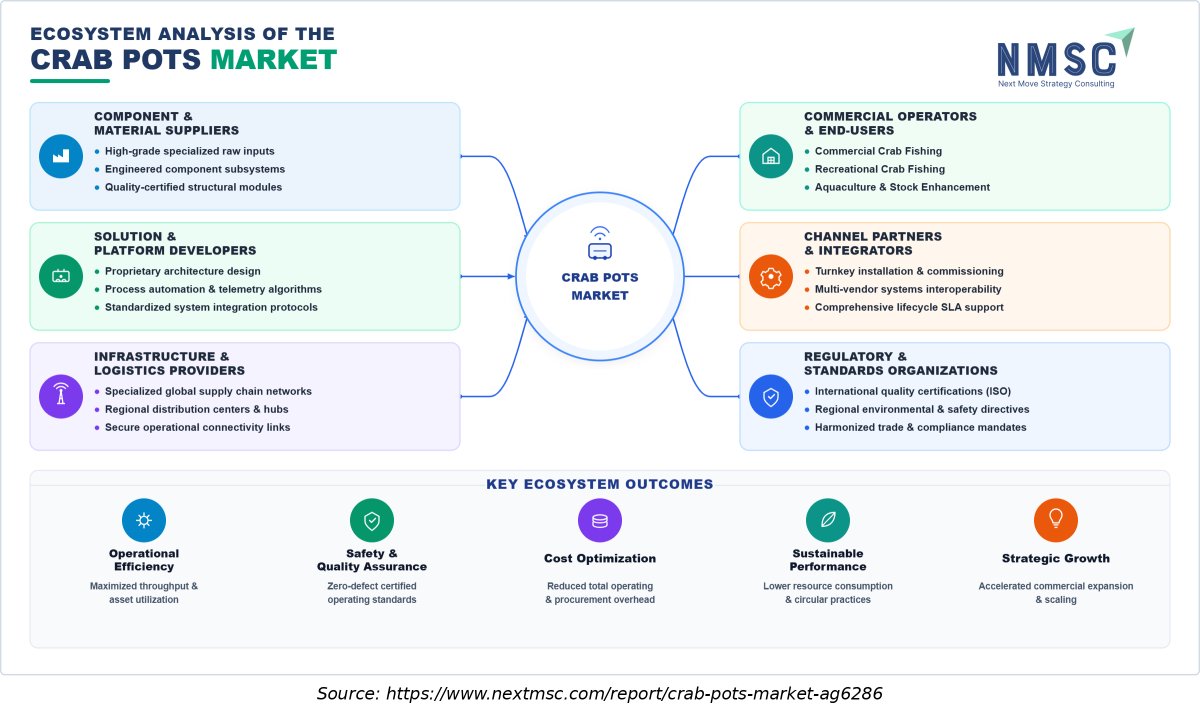
Ecosystem Analysis of the Crab Pots Industry

The above infographic illustrates the Crab Pots Market ecosystem through six key stakeholder groups. These include component and material suppliers, solution and platform developers, infrastructure and logistics providers, commercial operators and end-users, channel partners and integrators, and regulatory and standards organizations. It highlights their roles in supplying raw materials, supporting product development, managing distribution, integrating fishing equipment, and ensuring regulatory compliance. The ecosystem contributes to five key outcomes: operational efficiency, safety and quality assurance, cost optimization, sustainable performance, and strategic growth across commercial crab fishing, recreational fishing, and aquaculture applications.

What Does the Crab Pots Market Encompass?

The Crab Pots market covers traps used to catch crabs in commercial and recreational fisheries. Product types include rectangular (box) pots, pyramid pots, round/dome pots, and collapsible pots. Core technologies include mesh construction, weighting systems, escape mechanisms, and buoy attachment points. Some designs now integrate location markers to help operators recover lost gear. The scope also includes replacement parts such as doors, bait containers, and tie-off hardware. These components support daily fishing operations across coastal regions.

Design specifications vary by species, water depth, and local regulation. Mesh size determines which crabs can escape, and frame strength influences durability in rough seas. Material innovations include polyethylene netting, stainless hardware, and biodegradable escape panels. Certifications often address escape ring dimensions, cull ring counts, and tending requirements. Manufacturers must confirm that each product meets the rules of its target jurisdiction. Clear labeling helps buyers verify compliance before deployment.

Market Drivers & Dynamics

Interactive Dataset
Escape Ring Mandates driver High Pots must be redesigned with escape rings in South Carolina and other states Immediate
Biodegradable Panel Requirements driver High New Jersey rules create demand for panels that release trapped crabs Immediate
Cull Ring Rules driver Medium North Carolina cull ring standards support steady replacement demand Medium-term
Gear Loss and Recovery Costs restraint High Lost pots raise operating costs and limit fleet investment Immediate
Seasonal Closure Requirements restraint Medium New Jersey seasonal pot-setting windows reduce annual equipment usage Medium-term
Raw Material Price Volatility restraint Low Netting and polymer costs affect pricing for manufacturers Long-term
Source: Next Move Strategy Consulting

Growth Drivers

What Is the Primary Growth Driver in the Crab Pots Industry?

Compliance-driven equipment replacement is the main catalyst in the Crab Pots market. Fleets must upgrade older pots to meet escape, cull, and biodegradable panel rules. This creates recurring purchases across many coastal states. Replacement demand is steady, which supports predictable revenue for suppliers. Furthermore, the expanding fleet modernization across Asia-Pacific growing at a 6.9% CAGR further reinforces how regional regulatory shifts drive continuous pot replacement. Our assessment indicates that compliance upgrades will remain the strongest near-term catalyst.

How Are Industry Standards and Directives Driving the Market?

Regulation shapes product design across the market. North Carolina requires three cull rings per pot. Alaska limits sport Tanner crab fishing in Southeast Alaska to four crab pots per vessel. Washington requires line weighting and biodegradable escape cord to limit lost-gear impacts. These directives set clear specifications that manufacturers must follow. Suppliers offering certified designs can win contracts from regulated fleets. Standards therefore act as both a compliance floor and a source of demand.

Growth Inhibitors

What Is Restraining the Crab Pots Market?

Lost and abandoned pots are the primary commercial restraint. Each lost pot represents an unrecovered asset and an ongoing environmental concern. Operators must invest in weighting, tracking, and escape features to limit losses. These additions raise unit costs for buyers with thin margins. Smaller fishers may delay upgrades when budgets are tight. Consequently, our market observations indicate that heightened equipment cost sensitivity will moderate the pace of voluntary gear upgrades among independent operators.

What Are the Growth Opportunities?

Can Escape Ring Compliant Pots Capture High-Density Deployments?

High-density fishing zones require large numbers of pots in limited areas. Escape ring compliant designs help these fleets meet strict rules without reducing catch. Manufacturers that supply bulk orders for dense deployments can secure long contracts. Standardized components lower production costs for large orders. Fleet managers also value consistent sizing across mixed equipment inventories. Suppliers that offer volume pricing can strengthen their position in busy coastal corridors.

Does Small Operator Adoption of Tracking Services Represent an Untapped Volume Opportunity?

Many small operators still rely on manual logs to track pot positions. Affordable tracking tags and simple digital dashboards could reduce gear losses. Suppliers can bundle hardware with service plans to lower entry barriers. Recreational crabbers in Washington and North Carolina may also adopt these tools. Such bundles create recurring revenue beyond initial equipment sales. This segment remains underserved in many coastal markets.

Can Specialized Biodegradable Designs Become Distinct Premium Markets?

Biodegradable panel requirements in New Jersey create demand for specialized materials. Buyers concerned with environmental responsibility may pay more for certified panels. Premium products can target conservation programs and eco-focused fisheries. Manufacturers that validate panel performance through testing can justify higher prices. Clear certification helps distinguish these products from standard offerings. Such differentiation supports margin improvement for innovative suppliers.

Segmentation Analysis

2025 (USD Million)
2035 (USD Million)
Galvanized Steel Frame Pots 2025: $341.4 Million | 2035: $493.2 Million
Galvanized S
PVC-Coated Wire Pots 2025: $199.3 Million | 2035: $297.4 Million
PVC-Coated W
Polyethylene Mesh Pots 2025: $151.6 Million | 2035: $237.4 Million
Polyethylene
Wood & Hybrid Pots 2025: $87.8 Million | 2035: $149.0 Million
Wood & Hybri
Galvanized Steel Frame Pots $341.4 Million $493.2 Million 3.7%
PVC-Coated Wire Pots $199.3 Million $297.4 Million 4.1%
Polyethylene Mesh Pots $151.6 Million $237.4 Million 4.6%
Wood & Hybrid Pots $87.8 Million $149.0 Million 5.4%

Which Material Segment Dominates the Market?

Galvanized Steel Frame Pots hold the largest share at about 44% and generated USD 341.37 Million in 2025. Their dominance reflects durability in harsh saltwater conditions and proven resistance to repeated handling. Commercial operators favor these pots because they withstand heavy catch loads over long fishing seasons. Wood & Hybrid Pots expand at the fastest CAGR of 5.4% through 2035, driven by demand for lighter, more traditional designs.

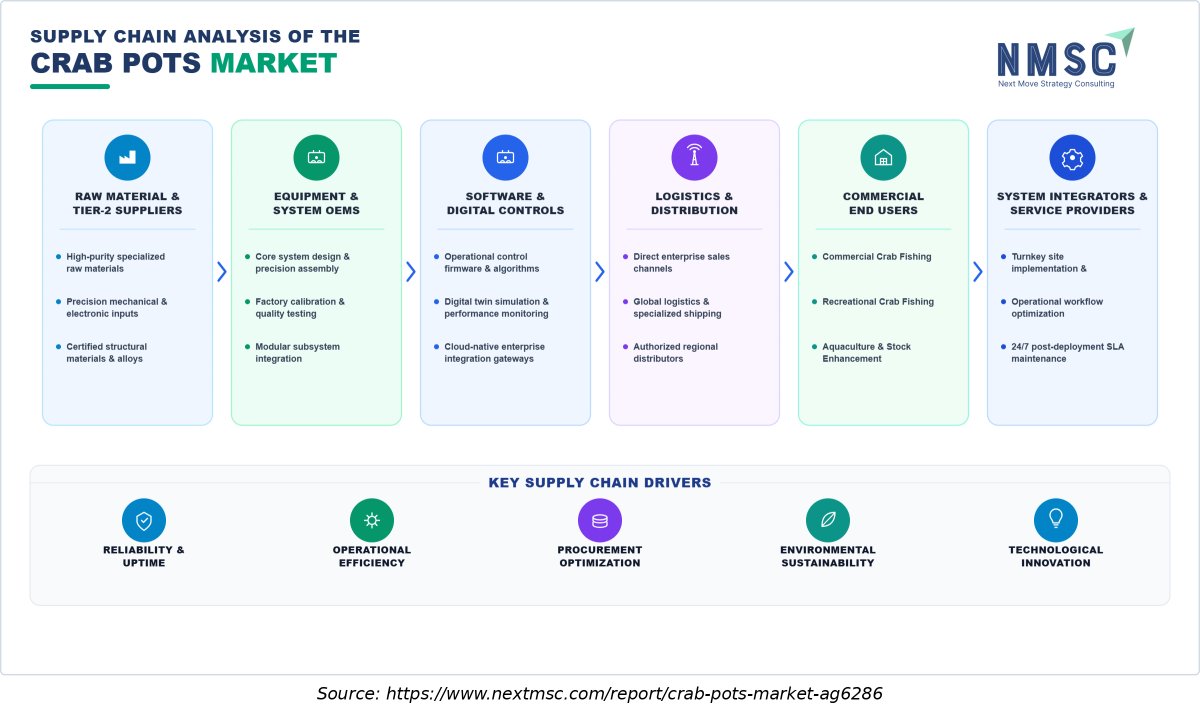
Supply Chain Analysis of the Crab Pots Industry

Supply Chain Analysis of the Crab Pots Industry
The Crab Pots Market supply chain encompasses raw material and tier-2 suppliers, equipment and system manufacturers, software and digital control providers, logistics and distribution networks, commercial fishing operators, and system integrators. The value chain focuses on specialized raw materials, precision manufacturing, product assembly, digital monitoring, and efficient distribution. Key supply chain drivers include product reliability, operational efficiency, procurement optimization, environmental sustainability, and technological innovation, supporting diverse commercial and recreational fishing applications.

Growth Opportunities

Our analysis shows that three structural whitespace opportunities are positioned to generate meaningful commercial returns in the market through 2035:

Can Escape Ring Compliant Pots Capture High-Density Deployments?

High-density fishing zones require large numbers of pots in limited areas. Escape ring compliant designs help these fleets meet strict rules without reducing catch. Manufacturers that supply bulk orders for dense deployments can secure long contracts. Standardized components lower production costs for large orders. Fleet managers also value consistent sizing across mixed equipment inventories. Suppliers that offer volume pricing can strengthen their position in busy coastal corridors.

Does Small Operator Adoption of Tracking Services Represent an Untapped Volume Opportunity?

Many small operators still rely on manual logs to track pot positions. Affordable tracking tags and simple digital dashboards could reduce gear losses. Suppliers can bundle hardware with service plans to lower entry barriers. Recreational crabbers in Washington and North Carolina may also adopt these tools. Such bundles create recurring revenue beyond initial equipment sales. This segment remains underserved in many coastal markets.

Can Specialized Biodegradable Designs Become Distinct Premium Markets?

Biodegradable panel requirements in New Jersey create demand for specialized materials. Buyers concerned with environmental responsibility may pay more for certified panels. Premium products can target conservation programs and eco-focused fisheries. Manufacturers that validate panel performance through testing can justify higher prices. Clear certification helps distinguish these products from standard offerings. Such differentiation supports margin improvement for innovative suppliers.

Regional Outlook

2025 (USD Million)
2035 (USD Million)
North Americ
Europe
Asia-Pacific
Latin Americ
Middle East
Region 2025 (USD Million) 2035 (USD Million) CAGR (%)
North America $10.0 USD Million $40.0 USD Million 9.0%
Europe $17.1 USD Million $51.1 USD Million 27.0%
Asia-Pacific $24.2 USD Million $62.2 USD Million 25.0%
Latin America $31.3 USD Million $73.3 USD Million 23.0%
Middle East & Africa $38.4 USD Million $84.4 USD Million 12.0%

Regional data is locked

Unlock complete regional numbers for this market.

Unlock Full Data

Competitive Landscape

The Crab Pots market features a mix of established manufacturers and specialized distributors. Promar International Limited, Frabill Inc., Rigid Net Crab Pots, Duo Manufacturing, Inc., and Eagle Claw (Wright & McGill Co.) represent prominent participants across product categories. Competition centers on durability, compliance with state and national rules, and dependable supply. Smaller suppliers such as Bay Trap Supply, Inc., Netting Supply Co., Inc., Gear Trade Inc., Crab Pots Direct, Inc., and Hi-Lo Industries, Inc. compete through niche product lines and responsive service.

How Do Companies Compete in the Crab Pots Market?

Manufacturers differentiate through frame strength, coating quality, and compliance-ready features such as escape rings and biodegradable panels. Pricing reflects material costs and order volume, with commercial buyers negotiating bulk terms. Distribution relies on marine supply retailers, online channels, and direct sales to fleets and agencies. Companies that align product updates with new state rules gain faster adoption among procurement teams.

Which Competitive Archetypes Dominate the Crab Pots Market?

Market participants fall into four archetypes. Scaled manufacturers produce high volumes of galvanized steel and coated wire pots for commercial fleets. Specialty designers focus on collapsible and hybrid models for recreational and research users. Regional distributors supply local fishing communities with fast delivery and custom configurations. Component and netting suppliers provide mesh, frames, and fittings that support broader pot assembly across the value chain.

What Innovation and Differentiation Strategies Are Companies Pursuing?

Sustainable advantages come from proven durability, regulatory readiness, and dependable supply continuity. Manufacturers that document material certifications and compliance records build trust with government buyers. Brand reputation within commercial fishing communities supports repeat orders. Investment in lightweight yet robust designs strengthens long-term customer retention across both commercial and recreational segments.

What M&A and Partnership Activity Is Shaping the Market?

Merger and acquisition activity in the Crab Pots market is expected to center on consolidating specialty manufacturing and distribution capabilities. Acquirers seek access to established dealer networks and regional fishing customer bases. Asset deals may target netting production lines and galvanized fabrication capacity. Strategic buyers also pursue companies with certified materials and compliance expertise to meet tightening state and national requirements.

Key Market Players

Based on research conducted by NMSC, the following 20 companies represent the validated leadership set across Crab Pots Market developers, manufacturers, and solution providers:

Promar International Limited Frabill Inc. Rigid Net Crab Pots (Rigid Net Inc.) Duo Manufacturing, Inc. Gear Trade Inc. Bay Trap Supply, Inc. Netting Supply Co., Inc. Crab Pots Direct, Inc. Eagle Claw (Wright & McGill Co.) Hi-Lo Industries, Inc. Hawaiian Crab Pot Company Northwest Trawl Supply, Inc. Maine Lobster & Crab Gear Co., Inc. Pacific Fishing Gear Ltd. Atlantic Pot Manufacturers, Inc. Alaska Gear & Supply, Inc. Seaboard Fishing Supply, Inc. Cape Fear Pot Works, Inc. Chesapeake Crab Trap Co., Inc. Gulf Coast Fishing Gear, Inc.

Latest Developments

During our market evaluation, we noticed that recent commercial activities, platform introductions, and partnerships within the industry reflect the latest market developments:

Date Event
February 2026 EdgeTech received authorization under the California Department of Fish and Wildlife (CDFW) experimental gear program for its on-demand acoustic buoy system in restricted Dungeness crab fishing areas, enabling location tracking and gear status monitoring.

Investment Opportunities

Where Are Capital Inflows Concentrating in the Crab Pots Market?

Capital inflows concentrate in galvanized steel fabrication and coated wire production. These materials anchor the largest share of demand. Investors also direct funds toward collapsible and hybrid designs that serve high-growth segments. Technology investments focus on welding automation and coating quality. Such spending improves output consistency and supports rising commercial and research orders across the forecast period.

How Is Infrastructure Investment Shaping Market Capacity?

Infrastructure investment is concentrating on fabrication capacity, netting production lines, and regional distribution hubs to expand throughput. Product standardization represents a core capital allocation priority, as manufacturers invest in modular pot components and tracking-tag compatibility capable of supporting multi-jurisdiction compliance and dependable supply.

What ESG Considerations Are Influencing Market Investment?

Environmental priorities increasingly shape investment decisions across the Crab Pots ecosystem. New state rules require escape rings and biodegradable panels to reduce bycatch and lost-gear impacts. Manufacturers invest in circular materials and recyclable components to meet these expectations. Energy-efficient production and documented regulatory compliance also strengthen supplier credibility with government and commercial buyers.

Key Benefits for Stakeholders

How Does This Report Benefit Industry Leaders and Fleet Operators?

Operational executives and procurement directors gain empirical benchmarks for planning pot fleet inventories. The report quantifies segment shares, including Galvanized Steel Frame Pots at about 44% and Commercial Fishing Fleets at about 46%. These figures support budgeting and supplier negotiations. Commercial operators can align replacement schedules with forecast growth in high-demand categories.

How Does This Report Benefit Investors and Financial Analysts?

The market is projected to expand from USD 780 Million in 2025 to USD 1176.99 Million by 2035. Analysts can use the 4.2% CAGR and the USD 364.23 Million absolute opportunity to model revenue trajectories. Regional data, including North America at USD 265.2 Million in 2025, supports valuation benchmarking. Segment growth trends in galvanized and collapsible segments inform portfolio allocation decisions.

How Does This Report Benefit Product Developers and Equipment Manufacturers?

Product teams can prioritize roadmaps around collapsible designs, which record the fastest CAGR at 5.7%. Research & Monitoring applications, growing at 6% CAGR, present targeted opportunities for instrumented or standardized pot solutions. Competitive differentiation improves when vendors align features with state compliance requirements. The report helps teams focus development resources on the segments with the strongest forward momentum.

Key Market Segments Evaluated

By Material

  • Galvanized Steel Frame Pots 
    • Heavy-Duty Commercial Pots
    • Light-Duty Recreational Pots
  • PVC-Coated Wire Pots 
    • Vinyl-Coated Wire
    • Epoxy-Coated Wire
  • Polyethylene Mesh Pots 
    • Collapsible Mesh
    • Rigid Mesh
  • Wood & Hybrid Pots

By Pot Design

  • Rectangular (Box) Pots
  • Pyramid Pots 
    • Single-Entry Pyramid
    • Two-Entry Pyramid
  • Round/Dome Pots
  • Collapsible Pots 
    • Fold-Flat Steel
    • Fold-Flat Polymer

By Application

  • Commercial Crab Fishing 
    • Dungeness Crab
    • King Crab
    • Blue Crab
    • Snow Crab
  • Recreational Crab Fishing 
    • Shore-Based Use
    • Boat-Based Use
  • Aquaculture & Stock Enhancement
  • Research & Monitoring

By End User

  • Commercial Fishing Fleets 
    • Large Offshore Fleets
    • Small Coastal Operators
  • Recreational Anglers
  • Aquaculture Operators
  • Government & Research Agencies

By Sales Channel

  • Direct OEM Sales
  • Marine Supply Distributors
  • Online Retail 
    • Brand Websites
    • Marketplaces
  • Fishing Tackle Retail

By Region

  • North America 
    • U.S.
    • Canada
    • Mexico.
  • Europe 
    • UK
    • Germany
    • France
    • Italy
    • Rest of Europe.
  • Asia-Pacific 
    • China
    • India
    • Japan
    • South Korea
    • Australia
    • Rest of APAC.
  • Latin America 
    • Brazil
    • Argentina
    • Rest of Latin America.
  • Middle East & Africa 
    • UAE
    • Saudi Arabia
    • South Africa
    • Rest of MEA.

Conclusion & Recommendations

What Is the Long-Term Outlook for the Crab Pots Market?

The long-term outlook for the Crab Pots Market is positive, with revenue expanding from USD 812.76 Million in 2026 to USD 1176.99 Million by 2035 at a 4.2% CAGR. Growth is underpinned by durable commercial demand expansion, the structural shift toward high-performance specialized solutions, and continuous technological innovation across pot design and fabrication. Regulatory updates will keep reshaping product requirements throughout the forecast period.

What Strategic Positioning Recommendations Does NMSC Offer?

Market participants should prioritize galvanized steel and collapsible product lines to balance baseline demand with faster expansion. OEMs should embed escape rings and biodegradable panels into standard designs to meet evolving state rules. Distributors should strengthen regional inventory and delivery speed for coastal fleets. Documenting material certifications will help suppliers win government and research contracts.

How Attractive Is the Crab Pots Market for Investment?

Investment attractiveness is moderate, supported by the USD 364.23 Million absolute growth opportunity between 2026 and 2035 and recurring replacement demand from compliance upgrades that enable predictable cash flows. Asia-Pacific at 6.9% CAGR represents the highest relative growth, while North America offers the largest absolute revenue base with the most mature buyer population and established compliance requirements that sustain subsequent replacement procurement.

What Are the Key Market Shifts and Risks in the Crab Pots Market?

Key market shifts include the transition from standard pots to compliance-certified designs, the migration from outright purchases to lease and service-bundle models, and the expansion of tracking-enabled gear across commercial and recreational fisheries. Primary risks include gear loss and recovery costs that raise operating expenses, seasonal closure requirements that reduce annual equipment usage, and upfront capital requirements that moderate upgrade pace among independent operators.

What Are the Primary Growth Pathways Through 2035?

The most reliable pathway is serving commercial fishing fleets, which hold about 46% share and sustain recurring replacement demand. Collapsible pots offer a second pathway, growing at 5.7% CAGR as operators seek storage efficiency. Research & Monitoring applications, expanding at 6% CAGR, provide a third route through agency procurement. Together, these pathways position participants to capture a meaningful share of the USD 364.23 Million opportunity.

Delivered Customizations

We have successfully delivered the following deep-dive customizations:

Client Request Customization Delivered Value Adds
Historical Market & Sales Analysis
  • Historical crab pot sales and market revenue analysis, 2018 to latest year, by material type.
  • Identifies which material categories are growing or declining, guiding product mix and capacity decisions.
Material Share Benchmarking
  • Company-level share analysis of crab pot manufacturers by material category (plastic, metal, wood, wire mesh).
  • Shows competitive positioning by material and highlights share gaps that support targeted product launches.
Material Trade Flow Assessment
  • Country-wise import and export analysis of crab pots and trap components using relevant HS codes, sourced from UN Comtrade and WITS.
  • Reveals sourcing and export opportunities and helps assess tariff and supply-chain exposure by material.
Fishery-Specific Material Demand Mapping
  • Demand mapping of crab pot materials by target crab species (e.g., king, snow, Dungeness, blue crab) and fishing region, using fishery landing and licensing data.
  • Pinpoints the material specifications each fishery requires, supporting customized product development and regional targeting.
Ghost-Gear Regulation & Biodegradable Compliance Assessment
  • Tracking of ghost-gear rules, biodegradable escape-panel mandates, and related material requirements across major crab fishing jurisdictions.
  • Anticipates regulatory-driven shifts toward compliant materials and helps prioritize certified or biodegradable product lines.
Material Lifecycle Cost & Replacement Analysis
  • Comparative analysis of service life, corrosion or degradation resistance, and replacement cycles for each crab pot material in saltwater fishing conditions.
  • Supports total cost of ownership messaging and material innovation investments that extend pot lifespan and win fleet contracts.

FAQs

About the Author

Liza Phukan

Liza Phukan

Liza Phukan is Research Associate at Next Move Strategy Consulting, where she has covered emerging industries and market research across sectors for 3.5 years. Her work includes analyzing industry developments, validating market data, and developing structured business content from research findings. She uses secondary research and data-validation practices to turn complex market information into clear decision-useful market analysis for business audiences and support report development and B2B.

About the Reviewer

Supradip Baul

Supradip Baul

Supradip Baul is an accomplished business consultant and strategist with over a decade of rich experience in market intelligence, strategy, technology, and business transformation. His work has included rigorous qualitative and quantitative analysis across multiple industries, helping clients shape investment decisions and long-term roadmaps. Earlier in his career, he was associated with Gartner, where he contributed to industry-leading reports and market share analyses. He has worked with leading global companies and holds an MBA with a dual specialization in Marketing and Finance.

Download Free Sample

Henri Knyphausen

HENRI KNYPHAUSEN

Partner at Singulier [Ex-BCG]
Singulier

I recently engaged NEXTMSC.com for a commercial due diligence project within the intralogistics sector, and I am pleased to provide a reference based on my experience. In utilizing NEXTMSC.com's services, I found their report to offer valuable insights into market dynamics and key industry players. The initial report provided a solid foundation for our analysis. However, as we were investigating a smaller target in the market, and I had specific customization requests requiring additional research. These requests included detailed information on product portfolios of various players and sub-market sizes, both inclusive and exclusive of certain product categories. NEXTMSC.com demonstrated commendable responsiveness and agility in accommodating these customization requests. Within a timeframe of 1-2 weeks, they delivered a revised report that met our specific needs. Furthermore, they were receptive to my follow-up inquiries, ensuring clarity and understanding of the data provided. The final deliverable significantly contributed to our due diligence efforts. One of NEXTMSC.com's notable strengths lies in their qualitative research capabilities. However, for future engagements, I would recommend the inclusion of a quantified market model in Excel format. Such a model would offer the ability to conduct in-depth analyses and explore various market segments, including country-specific data and subcomponent breakdowns. Based on my positive experience, I would not hesitate to work with NEXTMSC.com again. Their responsiveness, willingness to accommodate customization requests, and commitment to delivering actionable insights make them a reliable partner for commercial research projects.


Amos Chang

AMOS CHANG

Strategy Consultant

Kardex Group

I have bought the intralogistics market reports from NMSC two times so far. Joseph and his team are always very helpful and flexible in responding to any customization requirements on the report. Their expertise in market reports really helps us steer the day-to-day business. I will definitely recommend and come back myself whenever there is a need.

Ross J Mckenzie

ROSS J MCKENZIE

Business Insight Manager

Staysure Group

“Next MSC have been incredibly helpful in providing detailed & robust information on our market, alongside quantifying growth by different segments. The process to procure was simple and easy, with sample reports and regular contact to ensure we had what we needed. Succinct detail on their sources & methodologies is also greatly received, allowing transparency in this respect helps build trust in the detail you pay for. Joseph in particular was fantastic, and helped ensure efficient provision of the insight pack – thank you NMSC!”.

Kishu Kanda

KISHU KANDA

Strategy Analyst

Accenture

We purchased the AI Consumer Market Report from this company. Not only did they customize the report to meet our specific requirements, but they also showed great flexibility in accommodating our budget. The report we received fully met our expectations. Additionally, they provided prompt and thorough responses to both our pre-purchase and follow-up questions. We look forward to working with this company again in the future.

Semih Kavaklioglu

SEMIH KAVAKLIOGLU

Co-Founder & Sales Manager

Decortie

I work a lot in the marketing industry and I know that research is an essential part of any campaign. I have used Market research reports for my own products and I found them to be very informative and well-researched. The team here produces insightful reports for a good price

Custom Market Research Services

We will customize the research for you if the listed report does not fully match your requirements.

Get 30% Free Customization

Select License

This website uses cookies to ensure you get the best experience on our website. Learn more

✖