Can AI Displays Redefine Classrooms and Smart Spaces?
Lede
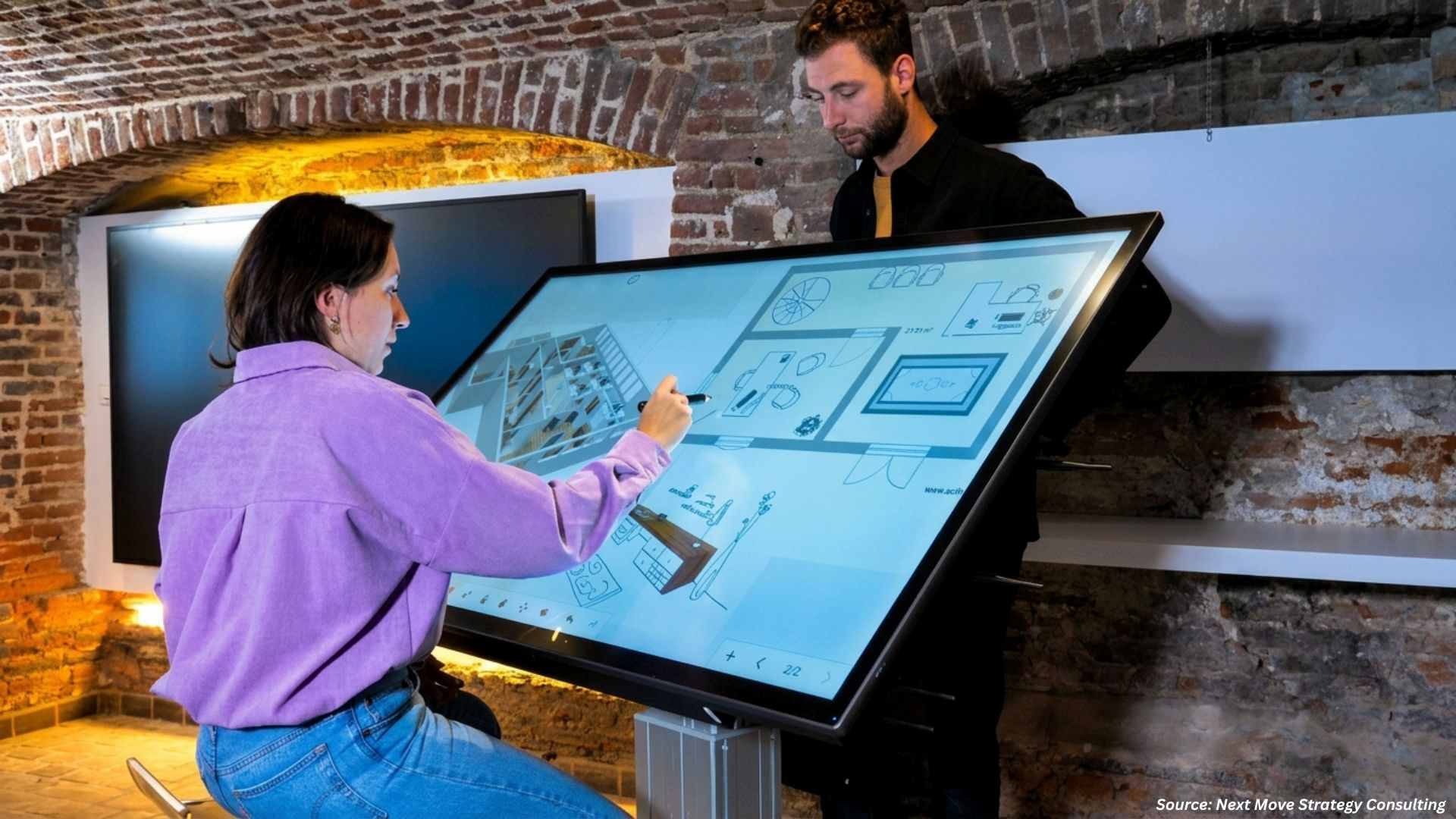
Interactive Display Market are no longer just large screens mounted on walls. They are becoming AI-enabled collaboration systems for classrooms, retail environments, offices, hospitality venues and public infrastructure. That shift became clearer after two Samsung announcements: the January 2025 launch of the WAFX-P Interactive Display at Bett 2025 in the United Kingdom, and the June 2024 unveiling of SmartThings Pro and next-generation commercial displays at InfoComm in the United States.
We see these developments as part of a broader transition in enterprise and education technology, where display makers compete not only on image quality and size, but on software ecosystems, AI functionality, energy efficiency and lifecycle support.

Samsung Launches AI-Powered Interactive Display at Bett 2025
Samsung introduced its WAFX-P Interactive Display at Bett 2025, positioning the product as an AI-enabled classroom hub. The display includes Samsung AI Assistant with features such as Circle to Search, AI Summary and Live Transcript. According to Samsung, the device is available in 65-inch, 75-inch and 86-inch formats and runs on Android 15.
Hardware specifications are notable for the education segment. The product includes an NPU capable of up to 4.8 trillion operations per second, 16GB RAM, 128GB SSD storage, an octa-core CPU, 450-nit brightness, a built-in 4K camera, microphone and 20W speakers. Samsung also said the system is Google EDLA-certified, enabling access to services such as Google Classroom and Google Drive.
At Next Move Strategy Consulting, we observe that the real significance is not the screen itself, but the bundling of AI tools directly into classroom workflows. Schools increasingly evaluate products based on teacher productivity, accessibility, remote learning support and software compatibility rather than display hardware alone.
WAFX-P Key Product Snapshot
|
Feature |
Specification / Capability |
|
Sizes |
65”, 75”, 86” |
|
Operating System |
Android 15 |
|
Processing |
4.8 TOPS NPU |
|
Memory |
16GB RAM |
|
Storage |
128GB SSD |
|
Collaboration Tools |
4K camera, mic, 20W speaker |
|
Google Access |
EDLA-certified |
SmartThings Pro and New Commercial Displays Debut at InfoComm 2024

At InfoComm 2024 in Las Vegas, Samsung expanded beyond education by launching SmartThings Pro, a business-focused platform for managing connected devices and environments. The system offers APIs for enterprise integration, AI Energy Mode for power optimization and dashboard-based monitoring of connected devices.
Samsung also introduced the Color E-Paper (EMDX model), a 32-inch low-power display with QHD resolution (2,560 x 1,440), 60,000-color gamut and reported 0.00W power draw when showing static images. The company said the unit weighs 2.9kg and measures 17.9mm thick.
The same event featured AI upgrades to the Interactive Whiteboard (WAD series), including automatic transcription, lesson summaries and quiz generation. Samsung also highlighted the Business TV BED series in sizes from 43 inches to 85 inches.
Our analysis indicates Samsung is building a layered strategy: education displays for schools, connected systems for enterprises, ultra-low-power signage for retailers, and business TVs for SMBs. That widens total addressable demand while reinforcing one software ecosystem.
How AI Displays Are Reshaping Modern Environments
AI-enabled displays are creating new opportunities across education, business and retail sectors. In classrooms, intelligent screens support collaborative learning through automated notes, live captions and interactive content tools. In offices, connected displays improve meetings, space management and energy monitoring through centralized controls. Retailers are benefiting from digital signage that updates instantly while consuming less power than traditional systems. We believe this convergence of AI, connectivity and sustainability will make smart displays a core part of future workplaces and learning spaces.

Key Trends Shaping the Future of AI Displays
The next generation of displays is being defined by intelligence, connectivity and efficiency. AI-powered classroom screens are enabling real-time transcription, lesson summaries and interactive search tools that improve learning outcomes. In enterprise environments, connected display ecosystems are helping businesses automate device management, reduce energy consumption and streamline operations through IoT integration. Retailers are adopting ultra-low-power digital signage to lower operating costs while maintaining dynamic customer engagement. We observe that as hardware becomes more advanced, the strongest competitive advantage will come from software ecosystems, recurring service models and long-term support capabilities.

Samsung Multi-Segment Display Strategy
|
Launch Area |
Product |
Primary Use Case |
|
Education |
WAFX-P |
Smart classrooms |
|
Education |
WAD Whiteboard |
Teaching automation |
|
Enterprise |
SmartThings Pro |
Device orchestration |
|
Retail / Signage |
Color E-Paper |
Low-power promotions |
|
SMB / Hospitality |
Business TV BED |
Affordable commercial displays |
Long-Term Industry Impact and NMSC Perspective
1. Displays Become Software Platforms: We expect future procurement decisions to prioritize app ecosystems, AI assistants, device management and integrations over panel specifications alone.
2. Education Technology Procurement May Shift: Schools often face staffing and budget constraints. Features like auto summaries, transcription and content conversion can improve teacher efficiency and support multilingual or hybrid classrooms.
3. Sustainability Gains Importance: Color E-Paper and AI Energy Mode indicate growing demand for lower operating costs and ESG-aligned infrastructure, especially in retail chains, campuses and hospitality networks.
4. Recurring Revenue Models Could Expand: As displays become connected endpoints, vendors can monetize subscriptions for management tools, analytics, collaboration apps and security services.
5. Competitive Pressure Will Increase: Global display brands, enterprise AV firms, EdTech providers and collaboration software vendors are likely to intensify competition through partnerships and bundled solutions.
Market Analysis
Latest developments show AI features moving from cloud add-ons into embedded display products, while commercial displays are increasingly integrated with IoT systems. Education buyers are also seeking interoperable tools tied to existing platforms such as Google services.
Regional demand remains diverse. North America continues to show strong enterprise and AV channel demand. Europe is focused on education modernization and public digitalization initiatives. Asia-Pacific is witnessing rapid smart campus, retail and office expansion.
Key competitive themes include partnerships with AI software providers, subscription-based management platforms, sustainability-led product differentiation and cross-selling across education and enterprise segments.
What to Do Next
For schools and universities, pilot AI displays in high-usage classrooms before full rollout. Prioritize compatibility with existing learning management systems and cloud tools. Evaluate training needs for teachers and IT teams.
For enterprises, use connected displays with energy management dashboards. Integrate APIs with meeting, booking and facility systems. Standardize hardware across locations to reduce maintenance costs.
For retailers, test low-power signage in stores with frequent content changes and measure engagement uplift versus printed signage.
For investors and vendors, watch recurring software revenue rather than only hardware shipments, and track partnerships in AI, collaboration software and IoT security.
Conclusion
Samsung’s 2024–2025 product launches show how the display industry is evolving into an intelligent systems market. From AI-powered classroom boards to connected enterprise platforms and ultra-low-power retail signage, the next growth phase appears driven by software, automation and measurable operational value. At Next Move Strategy Consulting, we expect adoption to accelerate as organizations seek smarter, more efficient and more connected environments.
About Next Move Strategy Consulting:
Next Move Strategy Consulting is a premier market research and management consulting firm that has been committed to provide strategically analysed well documented latest research reports to its clients. The research industry is flooded with many firms to choose from, what makes Next Move different from the rest is its top-quality research and the obsession of turning data into knowledge by dissecting every bit of it and providing fact-based research recommendation that is supported by information collected from over 500 million websites, paid databases, industry journals and one on one consultations with industry experts across a diverse range of industry sectors. The high-quality customized research reports with actionable insights and excellent end-to-end customer service help our clients to take critical business decisions that enables them to move beyond time and have competitive edge in the industry.
We have been servicing over 1000 customers globally that includes 90% of the Fortune 500 companies over a decade. Our analysts are constantly tracking various high growth markets and identifying hidden opportunities in each sector or the industry. We provide one of the industry’s best quality syndicate as well as custom research reports across 10 different industry verticals. We are committed to deliver high quality research solutions in accordance to your business needs. Our industry standard delivery solutions that ranges from the pre consultation to after-sales services, provide an excellent client experience and ensure right strategic decision making for businesses.
For more information, please contact:
Next Move Strategy Consulting
5th Floor 867
Boylston St, STE 500,
Boston, MA 02116, U.S.
E-Mail: [email protected]
Direct: +1-217-650-7991
Website: www.nextmsc.com
About the Author
 Sanyukta Deb
— Sanyukta Deb is Digital Marketing Team Lead at Next Move Strategy Consulting, where she has led content strategy and technical SEO for the firm's B2B market research publications for over 2 years. Her editorial process translates NextMSC's primary and secondary research — spanning technology, industrial, and consumer sectors — into commercial narratives, backed by search-intent, keyword, and competitive analysis. She brings 5 years of overall experience in digital marketing and content strategy.
Sanyukta Deb
— Sanyukta Deb is Digital Marketing Team Lead at Next Move Strategy Consulting, where she has led content strategy and technical SEO for the firm's B2B market research publications for over 2 years. Her editorial process translates NextMSC's primary and secondary research — spanning technology, industrial, and consumer sectors — into commercial narratives, backed by search-intent, keyword, and competitive analysis. She brings 5 years of overall experience in digital marketing and content strategy.
About the Reviewer
 Debashree Dey
— Debashree Dey is Assistant Manager at Next Move Strategy Consulting, where she supports cross-vertical market content and communications across diverse industries for 6 years. Her professional background includes senior content writing, communications, and published manuscript authorship, with experience developing audience-focused business narratives and maintaining clear, consistent messaging. Her role supports research-led content development and editorial quality across NextMSC publications.
Debashree Dey
— Debashree Dey is Assistant Manager at Next Move Strategy Consulting, where she supports cross-vertical market content and communications across diverse industries for 6 years. Her professional background includes senior content writing, communications, and published manuscript authorship, with experience developing audience-focused business narratives and maintaining clear, consistent messaging. Her role supports research-led content development and editorial quality across NextMSC publications.

















Add Comment