Can New Collaborations, AI Integration, and Cost-Efficient Technologies Accelerate the Next Phase of Industrial 3D Printing?
LEDE:
The global additive manufacturing ecosystem is witnessing renewed momentum as technology providers, research institutions, and industrial partners intensify efforts to scale digital manufacturing. Recent developments from new industrial 3D printing solutions introduced by HP Inc. at Formnext 2025 to research-driven innovations highlighted at the Fraunhofer Direct Digital Manufacturing Conference 2025 signal a broader shift toward cost-efficient production, AI-driven manufacturing processes, and sustainable materials. These advancements reflect a growing industry focus on transforming additive manufacturing from a prototyping tool into a scalable industrial production technology.
HP Expands Additive Manufacturing Capabilities with New Materials and Industrial Systems
At Formnext 2025 in Frankfurt, HP unveiled a series of developments aimed at accelerating the industrial adoption of additive manufacturing. The company announced portfolio expansions, material innovations, and ecosystem collaborations designed to improve productivity while reducing manufacturing costs.
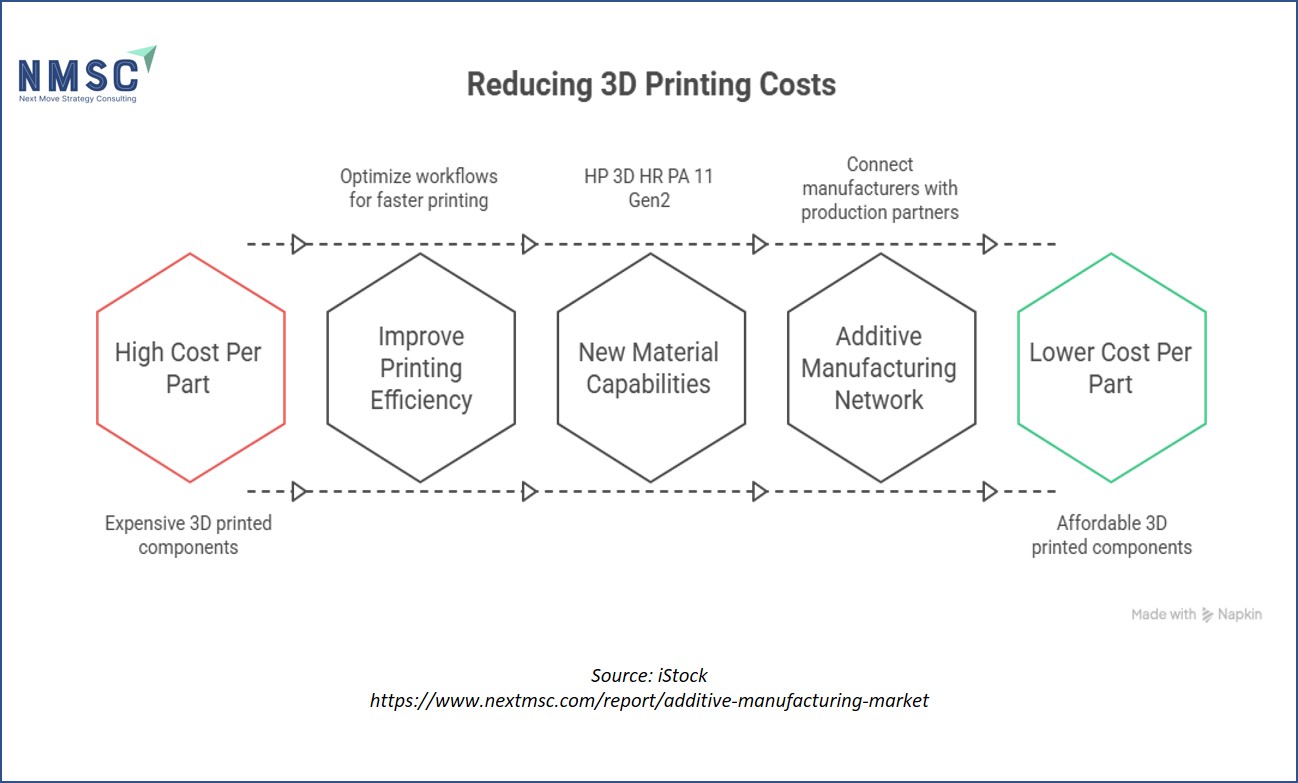
One of HP’s major goals is to lower the cost per printed component across its industrial 3D printing portfolio. Building on its Multi Jet Fusion platform, the company is targeting up to a 20% reduction in cost per part by 2026, supported by improvements in printing efficiency, optimized workflows, and new material capabilities.
A notable addition is the HP 3D HR PA 11 Gen2, a polymer material engineered to deliver high performance while improving sustainability. The material offers up to 80% powder reusability and significantly lower variable production costs, making it particularly suitable for high-volume industrial applications.
To simplify adoption for manufacturers, HP also introduced the Additive Manufacturing Network (AMN) Program, a framework designed to connect manufacturers seeking 3D-printed parts with qualified production partners. By linking demand with a global ecosystem of production providers, the program aims to streamline digital manufacturing workflows and improve supply chain responsiveness.
The company also continues to expand its metal additive manufacturing capabilities. Collaborations with organizations such as Continuum Powders and GKN Powder Metallurgy are enabling the qualification of new materials for the HP Metal Jet platform. These materials including advanced nickel-based superalloys and copper are expected to support demanding sectors such as aerospace, energy, data centers, and electrification technologies.
Industrial Filament Systems Target High-Performance Manufacturing Applications
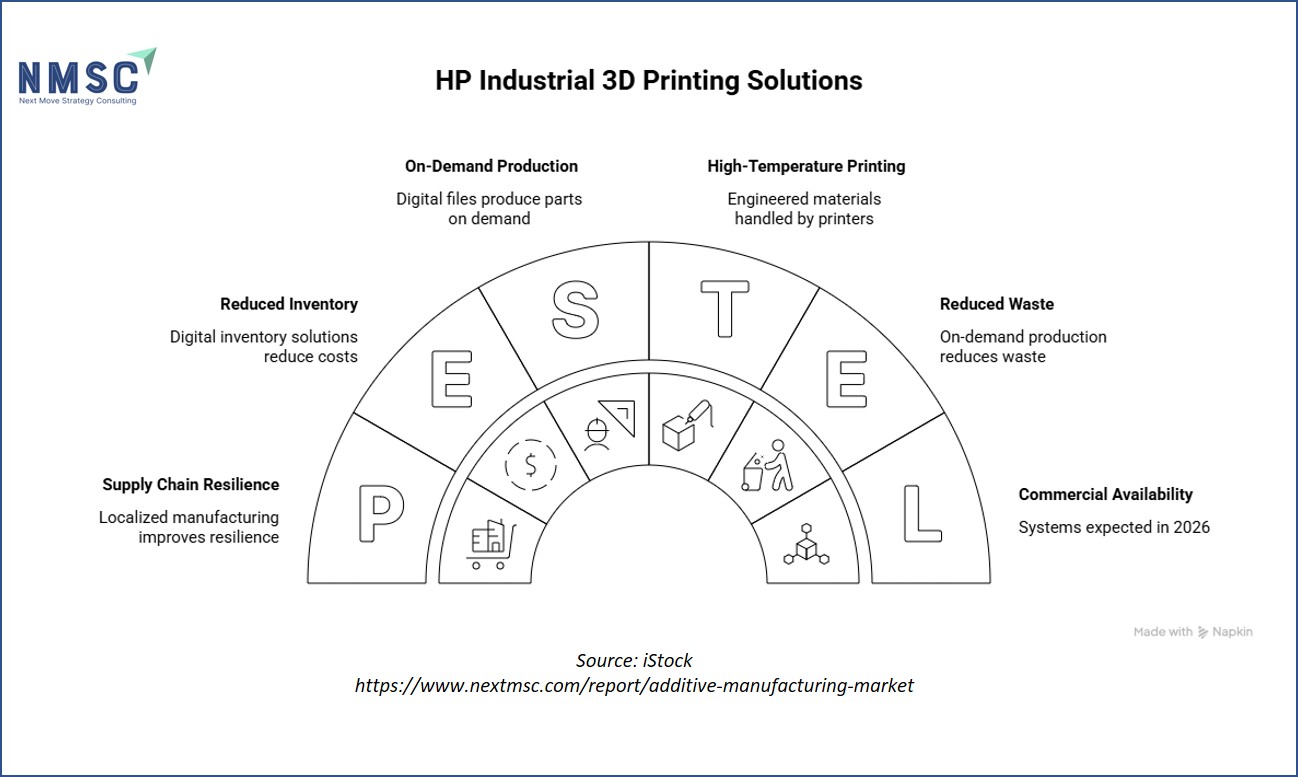
In addition to its existing platforms, HP announced the launch of a new Industrial Filament 3D Printer Solutions portfolio, marking its entry into high-temperature filament printing for industrial applications.
The first system, the HP Industrial Filament 3D Printer 600 High Temperature (IF 600HT), is designed to handle engineered materials used in sectors such as aerospace, automotive, oil and gas, medical technology, and railways. The printer is expected to become commercially available in the first half of 2026.
A second system, the HP IF 1000 XL, is planned for late 2026 and will focus on producing larger industrial components. Together, these systems aim to expand the range of production-grade applications that can be manufactured using additive techniques.
HP is also collaborating with Würth Additive Group to introduce digital inventory solutions that allow companies to store spare parts as digital files and produce them on demand. This approach can reduce physical inventory requirements while improving supply chain resilience through localized manufacturing.
Global Research Community Highlights AI and Sustainable Manufacturing at DDMC 2025
Alongside industry-led initiatives, the research community is actively exploring the next generation of additive manufacturing technologies. The Fraunhofer Direct Digital Manufacturing Conference 2025, hosted by Fraunhofer Society in Berlin, brought together researchers, engineers, and industry leaders from more than thirteen countries.
The event featured over sixty lectures and multiple technical sessions covering key developments in additive manufacturing, including:
-
New materials for metal, polymer, and ceramic printing
-
Post-processing technologies to improve structural performance
-
Artificial intelligence integration in manufacturing workflows
-
Digital process chains and quality assurance systems
-
Sustainability strategies for additive production
Keynote speakers included experts from leading institutions such as Massachusetts Institute of Technology, Siemens Energy, TU Berlin, and Politecnico di Milano, highlighting the growing intersection between digital engineering, AI-driven design, and industrial production.
The conference also showcased research addressing sustainability and design optimization. For example, work presented by researchers from the German Aerospace Center explored how design for additive manufacturing can align with sustainability goals while maintaining structural performance.
By bringing together academic research and industrial expertise, the conference demonstrated how collaborative innovation is shaping the future of digital manufacturing.
Long-Term Industry Impact and Technology Outlook
The developments highlighted by HP and the global research community reflect several structural shifts underway in additive manufacturing market:
-
Transition from prototyping to production: Industrial-grade systems and improved materials are enabling companies to produce functional parts at scale rather than relying solely on additive technologies for prototypes.
-
AI-driven manufacturing optimization: The integration of artificial intelligence into design processes, printing workflows, and quality monitoring is expected to enhance efficiency and reduce production errors.
-
Digital supply chains and localized manufacturing: Digital inventory systems allow organizations to store parts as digital files and produce them when needed, reducing logistics costs and improving supply chain flexibility.
-
Sustainability and material efficiency: New materials with higher recyclability and lower waste levels are helping reduce the environmental footprint of additive manufacturing processes.
These developments collectively point toward a future where additive manufacturing plays a larger role in distributed production networks and advanced industrial design.
Next Move Strategy Consulting Perspective on the Additive Manufacturing Ecosystem
According to insights from Next Move Strategy Consulting, the ongoing convergence of advanced materials, AI-driven process control, and digital supply chain solutions is accelerating the industrialization of additive manufacturing.
From a strategic perspective, several trends are expected to shape the sector’s long-term evolution:
-
Enterprise adoption will increasingly focus on cost-per-part efficiency, particularly as manufacturers compare additive production with traditional machining or casting methods.
-
Digital manufacturing ecosystems—such as networked production partners and digital part libraries—will likely redefine how spare parts and customized components are produced globally.
-
Cross-industry collaboration between hardware manufacturers, materials developers, and research institutions will remain critical for unlocking new applications in aerospace, energy, healthcare, and electronics.
-
Sustainability considerations will become a key competitive factor, pushing companies to develop recyclable materials and energy-efficient printing processes.
Next Move Strategy Consulting also notes that additive manufacturing is gradually evolving into a core pillar of Industry 4.0, where intelligent machines, digital twins, and AI-enabled design tools enable highly flexible and decentralized production environments.
As innovations continue to emerge from both industry leaders and research institutions, additive manufacturing is poised to move beyond experimental use cases toward becoming a mainstream manufacturing technology in the coming decade.
About Next Move Strategy Consulting:
Next Move Strategy Consulting is a premier market research and management consulting firm that has been committed to providing strategically analysed well documented latest research reports to its clients. The research industry is flooded with many firms to choose from, what makes NMSC different from the rest is its top-quality research and the obsession of turning data into knowledge by dissecting every bit of it and providing fact-based research recommendation that is supported by information collected from over 500 million websites, paid databases, industry journals and one on one consultations with industry experts across a diverse range of industry sectors. The high-quality customized research reports with actionable insights and excellent end-to-end customer service help our clients to take critical business decisions that enables them to move beyond time and have competitive edge in the industry.
We have been servicing over 1000 customers globally that includes 90% of the Fortune 500 companies over a decade. Our analysts are constantly tracking various high growth markets and identifying hidden opportunities in each sector or the industry. We provide one of the industry’s best quality syndicate as well as custom research reports across 10 different industry verticals. We are committed to deliver high quality research solutions in accordance to your business needs. Our industry standard delivery solutions that ranges from the pre consultation to after-sales services, provide an excellent client experience and ensure right strategic decision making for businesses.
For more information, please contact:
Next Move Strategy Consulting
5th Floor 867
Boylston St, STE 500
Boston, MA 02116, U.S.
E-Mail: [email protected]
Direct: +1 857 758 5017
Website: www.nextmsc.com
About the Author
 Sanyukta Deb
— Sanyukta Deb is Digital Marketing Team Lead at Next Move Strategy Consulting, where she has led content strategy and technical SEO for the firm's B2B market research publications for over 2 years. Her editorial process translates NextMSC's primary and secondary research — spanning technology, industrial, and consumer sectors — into commercial narratives, backed by search-intent, keyword, and competitive analysis. She brings 5 years of overall experience in digital marketing and content strategy.
Sanyukta Deb
— Sanyukta Deb is Digital Marketing Team Lead at Next Move Strategy Consulting, where she has led content strategy and technical SEO for the firm's B2B market research publications for over 2 years. Her editorial process translates NextMSC's primary and secondary research — spanning technology, industrial, and consumer sectors — into commercial narratives, backed by search-intent, keyword, and competitive analysis. She brings 5 years of overall experience in digital marketing and content strategy.
About the Reviewer
 Debashree Dey
— Debashree Dey is Assistant Manager at Next Move Strategy Consulting, where she supports cross-vertical market content and communications across diverse industries for 6 years. Her professional background includes senior content writing, communications, and published manuscript authorship, with experience developing audience-focused business narratives and maintaining clear, consistent messaging. Her role supports research-led content development and editorial quality across NextMSC publications.
Debashree Dey
— Debashree Dey is Assistant Manager at Next Move Strategy Consulting, where she supports cross-vertical market content and communications across diverse industries for 6 years. Her professional background includes senior content writing, communications, and published manuscript authorship, with experience developing audience-focused business narratives and maintaining clear, consistent messaging. Her role supports research-led content development and editorial quality across NextMSC publications.
















Add Comment