Canada's Open Banking Law Reshapes Global Fintech Landscape

Canada Enacts Consumer-Driven Banking Regulations as Global Open Banking Market Accelerates Toward USD 217 Billion by 2035
On June 27, 2026, the Government of Canada published the proposed Consumer-Driven Banking Regulations in the Canada Gazette, Part I, initiating a 60-day public consultation period that marks the most consequential regulatory milestone in North American open banking since the U.S. Consumer Financial Protection Bureau finalized its Section 1033 rule in October 2024. The Canadian framework, established under the Consumer-Driven Banking Act — which received royal assent in March 2026 — creates a comprehensive, government-led data-sharing regime overseen by the Bank of Canada, covering deposit accounts, payment products, investment accounts, and lending accounts. The Department of Finance Canada estimates the proposed regulations will generate CAD 13.2 billion in total present value benefits over a 10-year period from 2027 to 2036, against a compliance cost of CAD 457.7 million, yielding a net benefit of approximately CAD 12.7 billion.
The Canadian regulatory action arrives at a pivotal moment for the global Open Banking Market, which is undergoing simultaneous regulatory acceleration across multiple major jurisdictions while confronting strategic divergence among its largest institutional participants.
For More Information: Download FREE Sample on Open Banking Market Report
Regulatory Convergence Accelerates Across G7 Economies
Canada's Consumer-Driven Banking Act mandates participation by large federally regulated banks based on retail volume thresholds, while allowing credit unions, payment service providers registered under the Retail Payment Activities Act, and other entities to opt in through an accreditation process administered by the Bank of Canada. The framework prohibits data-access fees — a provision that directly contrasts with the evolving U.S. regulatory posture, where the CFPB issued an Advance Notice of Proposed Rulemaking in August 2025 exploring whether data providers should be permitted to charge fees for third-party access.
In the United States, the regulatory landscape remains in a state of legal uncertainty. A federal court in Kentucky enjoined the CFPB from enforcing its Section 1033 rules, finding they likely exceeded the Bureau's statutory authority. The case remains stayed in the Sixth Circuit while the CFPB undertakes revisions. Against this federal impasse, state-level action is accelerating: New York introduced Assembly Bill 10640 in March 2026, proposing a "mini-1033" framework that would extend data-sharing rights beyond the federal rule's scope to cover all consumer financial products and small business accounts, with penalties of up to USD 10,000 per violation.
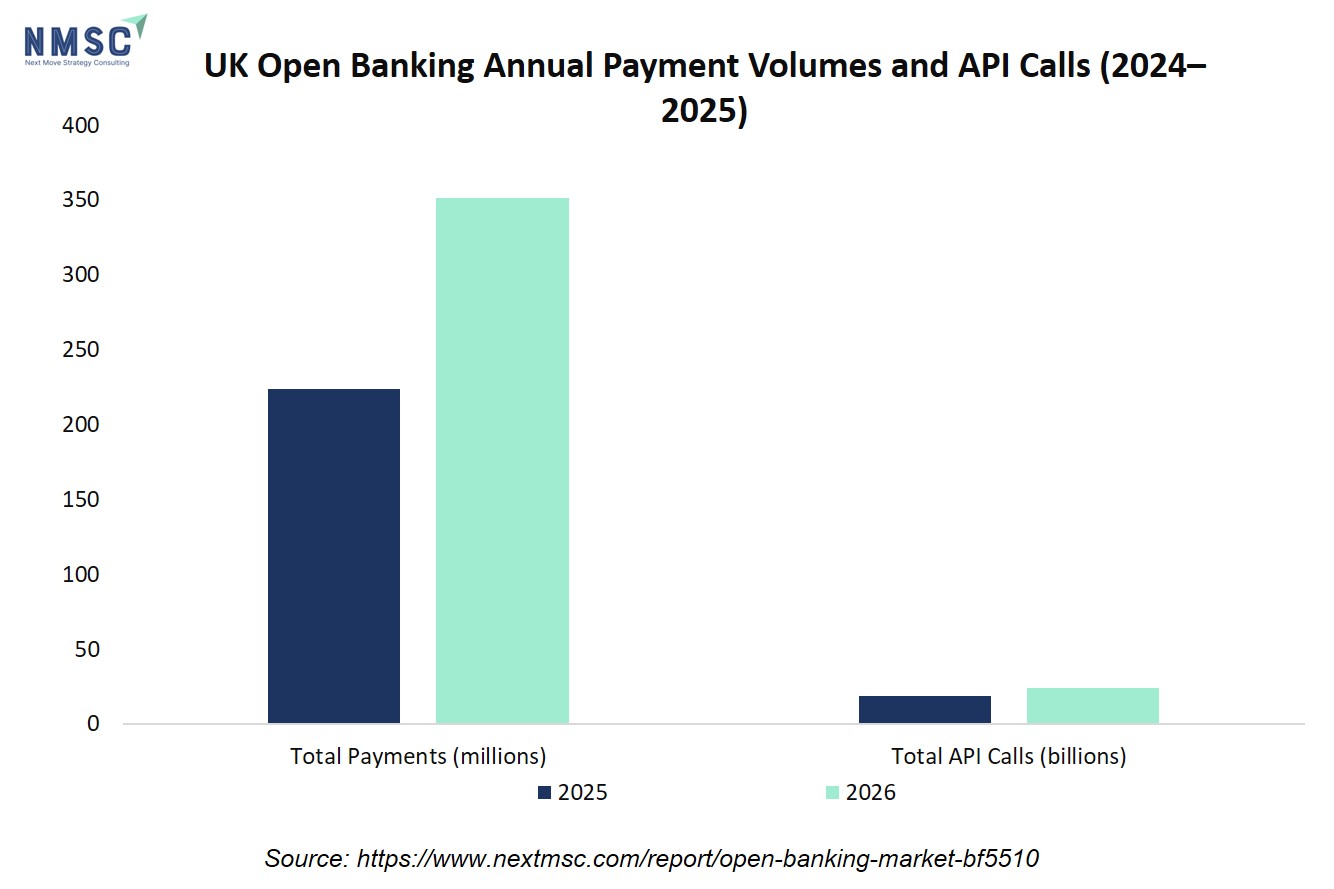
In the United Kingdom, the Open Banking Implementation Entity reported that open banking payments reached 351 million transactions in 2025 — a 57% year-on-year increase — while API calls rose to 24 billion, up 27% from 2024, and user connections reached 16.5 million by December 2025, a 36% annual increase. Weighted system availability remained above 99.50% throughout the year, with average API response times improving to 324 milliseconds, the fastest on record.
Market Scale and Structural Growth Drivers
According to analysis by Next Move Strategy Consulting, the global open banking market was valued at USD 27.85 billion in 2025 and is estimated at USD 34.21 billion in 2026, with a forecast to reach USD 217.20 billion by 2035, expanding at a compound annual growth rate of 22.8% over the 2026–2035 period. The market presents an absolute dollar opportunity of USD 182.99 billion between 2026 and 2035.
The primary structural driver is regulatory standardization. The U.S. CFPB's Section 1033 rule — even in its currently enjoined state — has compelled major financial institutions to accelerate API infrastructure investment in anticipation of eventual compliance. Canada's Consumer-Driven Banking Act adds a second major North American regulatory catalyst, with the Department of Finance projecting that approximately 9 million Canadians will adopt consumer-driven banking services at framework launch, generating benefits across lending affordability, SME administration, savings optimization, and subscription management.
The Payments service type is the fastest-growing segment within the market, driven by the rapid scaling of account-to-account payment rails. Visa announced in June 2025 that its A2A pay-by-bank solution was market-ready in the United Kingdom, while Mastercard and Deutsche Bank announced a strategic partnership in June 2025 to integrate Mastercard's open banking technology into Deutsche Bank's Merchant Solutions platform, enabling Pay by Bank, Request-to-Pay, and faster account-to-account settlement for European merchants. In July 2026, TrueLayer announced the acquisition of Zimpler to expand its European Pay by Bank network, reinforcing the consolidation trend among independent aggregators seeking to deepen payment initiation capabilities alongside traditional account information services.
UK Open Banking Performance Metrics: 2024 vs. 2025
UK Open Banking Key Performance Metrics, 2024–2025
|
Metric |
2024 |
2025 |
Year-on-Year Change |
|
Total Payments (millions) |
~224 |
351 |
+57% |
|
Total API Calls (billions) |
~18.9 |
24.0 |
+27% |
|
User Connections (millions, December) |
12.1 |
16.5 |
+36% |
|
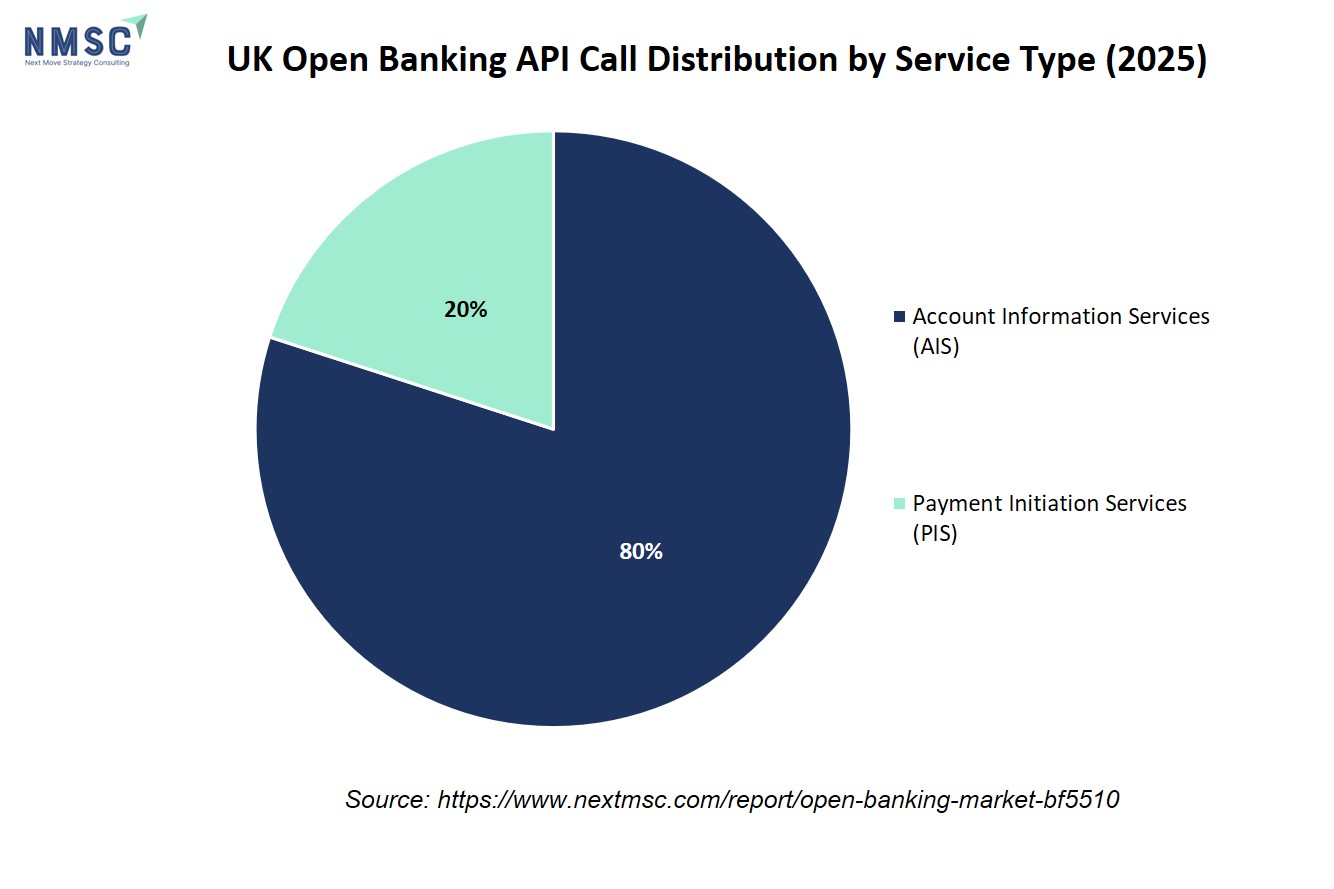
AIS Share of Total API Calls |
~80% |
~80% |
Stable |
|
PIS Share of Total API Calls |
~20% |
~20% |
+53% volume growth |
|
Weighted System Availability |
>99.50% |
>99.50% |
Stable |
|
Average API Response Time (ms) |
— |
324 |
Fastest on record |
|
Sweeping VRP Growth (YoY) |
— |
+98% |
— |
|
Single Domestic Payment Growth (YoY) |
— |
+52% |
— |
Notes: 2024 payment and API call figures are derived from stated year-on-year growth rates. User connections are counted per bank brand and are not deduplicated across brands. Data covers the 20 CMA9 brands reporting to OBL.
API Infrastructure Dominates Component Demand
APIs constitute the foundational technical layer of the open banking ecosystem, accounting for approximately 64% of total market revenue in 2025. The shift from legacy screen-scraping arrangements toward OAuth-based, FDX-aligned API connectivity is accelerating across both the United States and Canada, driven by regulatory mandates and institutional risk management considerations. Canada's Consumer-Driven Banking Act includes a prohibition on screen scraping — though the provision will not be brought into force until further consultation determines an appropriate timeline — signaling the direction of regulatory travel.
In the United Kingdom, Account Information Services (AIS) constituted approximately four out of every five API calls in 2025, while Payment Initiation Services (PIS) grew at 53% year-on-year — more than double the AIS growth rate of 24% — signaling an accelerating shift toward payment-driven interactions within the open banking ecosystem.
Regional Dynamics: Asia-Pacific Emerges as Growth Frontier
Europe retains market leadership, anchored by the maturity of the Payment Services Directive 2 framework and the UK's Open Banking Implementation Entity. Mastercard's open banking platform connects to nearly 3,000 European banks, reflecting the region's advanced institutional coverage. The European Commission's forthcoming Financial Data Access (FiDA) regulation is expected to extend open banking principles to a broader range of financial products by 2027, according to the Open Banking Tracker.
Asia-Pacific is the fastest-growing region, with India registering the highest country-level growth rate among all markets covered. Australia's Consumer Data Right framework expanded to cover non-bank lenders and buy-now-pay-later providers from 2025, while Mastercard launched Open Finance Business Solutions in Australia in December 2025 to support SME financial data access under the CDR framework. Brenton Charnley, Vice President and Head of Open Finance, Australasia at Mastercard, stated at the launch: "Real-time access to business data and automation are critical for SMEs to save time and ultimately money. By reducing friction in onboarding, payments, business accounting and lending, we are helping businesses boost productivity and focus on what matters."
North America's trajectory is defined by regulatory standardization. Canada's Consumer-Driven Banking Act, combined with the anticipated revision of the U.S. CFPB's Section 1033 rules, is expected to accelerate API infrastructure investment across the region through the forecast period. The World Bank's Technical Note on Open Banking, published in 2022, identified common rules on privacy, security, and liability, accreditation, and technical standards as the core elements necessary for a functioning open banking system — all of which Canada's framework now addresses through legislation and proposed regulation.
Canada Consumer-Driven Banking Regulations: Projected Benefits by Use Case
Canada Consumer-Driven Banking Regulations — Estimated Monetized Benefits by Use Case (10-Year Present Value, 2027–2036)
|
Use Case |
Total Present Value (CAD) |
Annualized Value (CAD) |
|
Streamlined SME Account Administration |
$5,332,181,230 |
$759,182,648 |
|
Reducing Cost of Recurring Services |
$3,824,856,066 |
$544,573,455 |
|
Enhanced Affordability Assessments for Lending |
$2,078,722,737 |
$295,963,352 |
|
Identification of Unused Subscriptions |
$1,113,342,216 |
$158,514,884 |
|
Optimization of Savings Accounts |
$806,978,097 |
$114,895,526 |
|
Total Monetized Benefits |
$13,156,080,347 |
$1,873,129,866 |
|
Total Compliance Costs |
$457,670,687 |
$65,162,010 |
|
Net Impact |
$12,698,409,660 |
$1,807,967,856 |
Notes: Benefits are illustrative and non-exhaustive. Estimates are based on value-transfer scenarios from UK open banking evidence, adjusted for Canadian population and exchange rates. A 27% participation rate (approximately 9 million Canadians) is assumed at framework launch. Approximately 578 of 680 affected businesses are small businesses.
Competitive Landscape: Strategic Divergence Among Card Networks
The competitive landscape is defined by a fundamental strategic divergence between the two dominant card networks. Mastercard has maintained and expanded its open banking platform following its 2020 acquisition of Finicity and 2021 acquisition of Aiia, with its platform now connecting to nearly 3,000 European banks and covering the substantial majority of U.S. deposit accounts. Visa, by contrast, reportedly discontinued its standalone U.S. open banking operations under the Tink brand in August 2025, redirecting focus toward European and international markets — a decision attributed in part to rising data-access fee structures and regulatory uncertainty in the United States.
Independent aggregators including Plaid, TrueLayer, and MX Technologies are positioning FDX-aligned API connectivity as a compliance-grade alternative to proprietary bank-by-bank integration. Lloyds Banking Group announced in June 2026 that it is accelerating its use of artificial intelligence, investing in new tools, talent, and training to embed AI-enabled, open banking-connected services across its business — reflecting the growing recognition that raw data access alone provides limited differentiation without AI-driven interpretation layered on top.
The Financial Data Exchange continues expanding its FDX API standard adoption among U.S. financial institutions following the CFPB's Section 1033 rule finalization, providing common technical infrastructure that reduces integration costs for aggregators and banks alike. Canada's Consumer-Driven Banking Act similarly requires participating entities to implement a single technical standard set by a designated technical standards body, ensuring interoperability across the framework.
Bottom Line
The global open banking market is entering a phase of accelerated institutional adoption, driven by converging regulatory mandates across North America, Europe, and Asia-Pacific. Canada's Consumer-Driven Banking Regulations — published June 27, 2026 — represent the most comprehensive government-led open banking framework enacted in the G7 outside the United Kingdom, with projected net benefits of approximately CAD 12.7 billion over a decade and an estimated 9 million Canadians adopting the framework at launch. The U.S. regulatory environment, while currently in legal limbo, is expected to resolve toward a revised Section 1033 framework that preserves core data-sharing obligations while addressing fee-structure controversies. For investors, the highest-conviction opportunities lie in FDX-aligned compliance infrastructure providers, account-to-account payment rail operators, and AI-enabled data personalization platforms — particularly those with durable, multi-market institutional relationships that can withstand card network strategic shifts. Asia-Pacific, led by India and Australia, presents the highest growth differential within the forecast period, while Europe's forthcoming FiDA regulation will extend the addressable market beyond traditional banking products. Key risks include rising data-access fee structures, consumer privacy concerns, and the potential for a fragmented patchwork of state-level regulations in the United States that increases compliance costs for aggregators operating across multiple jurisdictions. Stakeholders that invest early in validated regulatory compliance depth and durable institutional relationships will be best positioned to capture the market's projected USD 182.99 billion absolute dollar opportunity between 2026 and 2035.
About Next Move Strategy Consulting
Next Move Strategy Consulting is a premier market research and management consulting firm that has been committed to provide strategically analysed well documented latest research reports to its clients. The research industry is flooded with many firms to choose from, what makes NMSC different from the rest is its top-quality research and the obsession of turning data into knowledge by dissecting every bit of it and providing fact-based research recommendation that is supported by information collected from over 500 million websites, paid databases, industry journals and one on one consultations with industry experts across a diverse range of industry sectors. The high-quality customized research reports with actionable insights and excellent end-to-end customer service help our clients to take critical business decisions that enables them to move beyond time and have competitive edge in the industry.
We have been servicing over 1000 customers globally that includes 90% of the Fortune 500 companies over a decade. Our analysts are constantly tracking various high growth markets and identifying hidden opportunities in each sector or the industry. We provide one of the industry's best quality syndicate as well as custom research reports across 10 different industry verticals. We are committed to deliver high quality research solutions in accordance to your business needs. Our industry standard delivery solutions that ranges from the pre consultation to after-sales services, provide an excellent client experience and ensure right strategic decision making for businesses.
For more information, please contact:
Next Move Strategy Consulting
5th Floor 867
Boylston St, STE 500,
Boston, MA 02116, U.S.
E-Mail: [email protected]
Direct: +1-217-650-7991
Website: www.nextmsc.com
About the Author
 Sanyukta Deb
— Sanyukta Deb is Digital Marketing Team Lead at Next Move Strategy Consulting, where she has led content strategy and technical SEO for the firm's B2B market research publications for over 2 years. Her editorial process translates NextMSC's primary and secondary research — spanning technology, industrial, and consumer sectors — into commercial narratives, backed by search-intent, keyword, and competitive analysis. She brings 5 years of overall experience in digital marketing and content strategy.
Sanyukta Deb
— Sanyukta Deb is Digital Marketing Team Lead at Next Move Strategy Consulting, where she has led content strategy and technical SEO for the firm's B2B market research publications for over 2 years. Her editorial process translates NextMSC's primary and secondary research — spanning technology, industrial, and consumer sectors — into commercial narratives, backed by search-intent, keyword, and competitive analysis. She brings 5 years of overall experience in digital marketing and content strategy.
About the Reviewer
 Debashree Dey
— Debashree Dey is Assistant Manager at Next Move Strategy Consulting, where she supports cross-vertical market content and communications across diverse industries for 6 years. Her professional background includes senior content writing, communications, and published manuscript authorship, with experience developing audience-focused business narratives and maintaining clear, consistent messaging. Her role supports research-led content development and editorial quality across NextMSC publications.
Debashree Dey
— Debashree Dey is Assistant Manager at Next Move Strategy Consulting, where she supports cross-vertical market content and communications across diverse industries for 6 years. Her professional background includes senior content writing, communications, and published manuscript authorship, with experience developing audience-focused business narratives and maintaining clear, consistent messaging. Her role supports research-led content development and editorial quality across NextMSC publications.

















Add Comment