AI in Loan Processing Market Faces Regulatory Scrutiny
As U.S. Bank Regulators Tighten AI Oversight, Loan Origination Automation Advances Toward a Projected USD 63.3 Billion Market by 2035
U.S. banking regulators are intensifying scrutiny of how lenders deploy artificial intelligence, a development that is reshaping compliance priorities across the global lending-technology sector. According to Reuters, the Office of the Comptroller of the Currency and the Federal Reserve have begun asking banks, during routine examinations, to map out how they use AI in higher-risk functions such as lending, know-your-customer checks, and sanctions screening, with supervisors probing vendor governance, data-access controls, and the availability of human "kill switches" for automated systems. Federal Reserve Vice Chair for Supervision Michelle Bowman said in May that while banks currently rely on existing risk-management frameworks to guide AI use, regulators "should assess whether our supervisory guidance is fit for the future." In April, the OCC, the Fed, and the Federal Deposit Insurance Corporation jointly signaled plans for a formal request for information on banks' use of generative and agentic AI systems.
The regulatory tightening arrives as lenders accelerate adoption of agentic and generative AI across the loan lifecycle, intensifying the stakes for the global AI in Loan Processing Market. According to Next Move Strategy Consulting, the market was valued at USD 6.80 billion in 2025 and is estimated at USD 8.50 billion in 2026, with revenue forecast to reach USD 63.30 billion by 2035, expanding at a 25.0% compound annual growth rate between 2026 and 2035. The firm's analysis identifies Loan Origination as the leading functional segment, valued at USD 2.04 billion in 2025, while Embedded Lending is projected to be the fastest-growing function at a 33.1% CAGR through 2035. North America is estimated to account for approximately 46% of 2025 revenue, with Asia-Pacific forecast to register the fastest regional growth at 29.9% CAGR over the same period.
For More Information – Download FREE Sample on AI in Loan Processing Market Report
Regulatory Pressure Meets Rapid Technology Diffusion
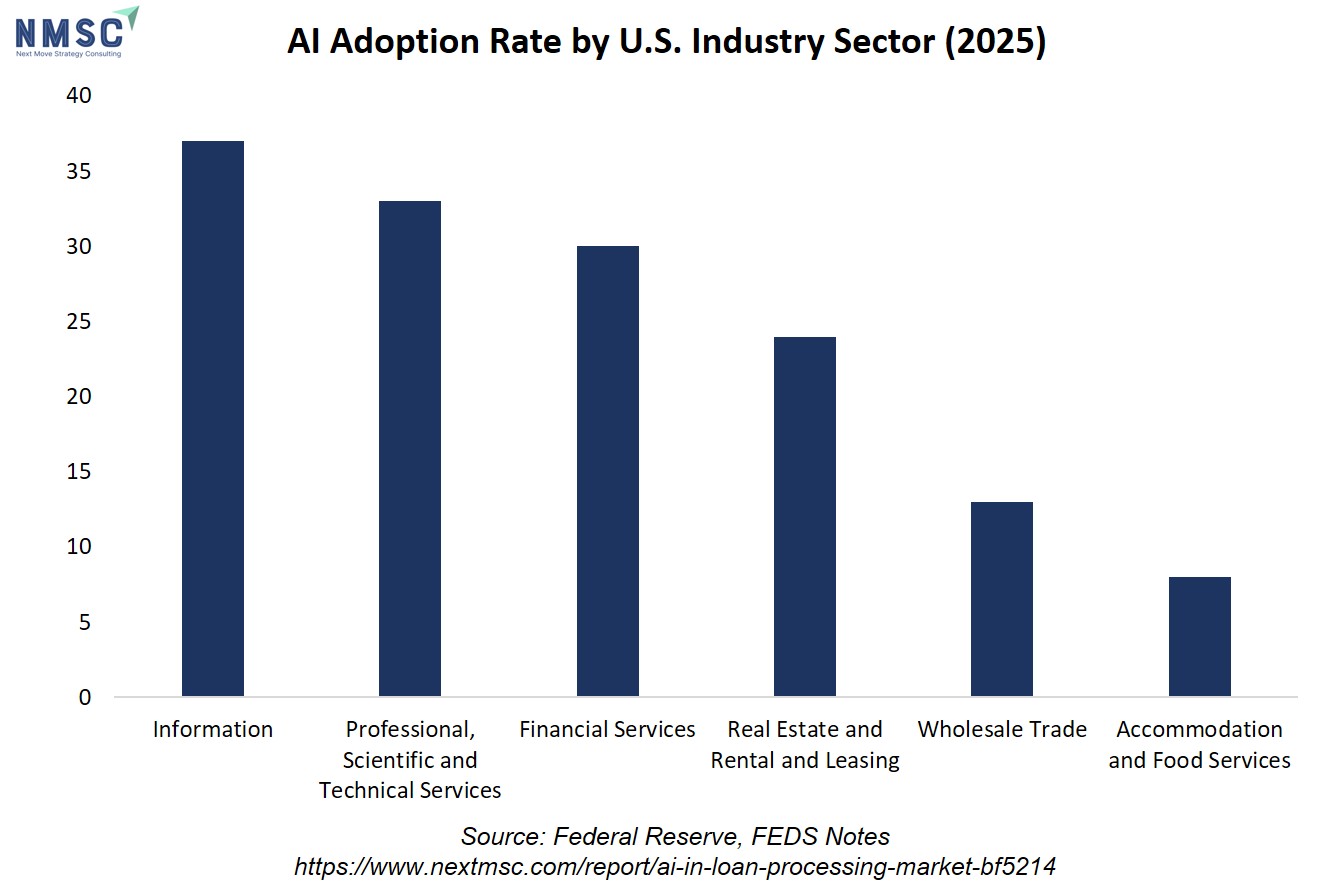
The Federal Reserve's own economic research underscores why AI use in lending has drawn heightened supervisory attention: the financial sector has emerged as one of the most active adopters of AI technology in the broader U.S. economy. Federal Reserve staff research published in April 2026 found that the financial sector's firm-level AI adoption rate stood at approximately 30% as of late 2025, trailing only professional, scientific, and technical services among major U.S. industries, while growth in adoption within the financial sector continued even as other sectors decelerated. Individual-level survey data cited in the same research show that 63% of workers in the financial sector reported using generative AI at work as of November 2025, the highest rate among the industries measured apart from the information sector.
This adoption backdrop is directly relevant to loan processing, where AI systems are increasingly embedded in origination, underwriting, and compliance workflows rather than confined to experimental pilots. NMSC's report notes that agentic AI platforms capable of executing, rather than merely assisting, discrete origination tasks are replacing bolt-on automation across the industry, citing Blend Labs' March 2026 launch of Autopilot, an agent that completes full-file loan origination reviews in 15 seconds, and its May 2026 Autopilot MCP Server, which opens the origination platform to third-party AI agents built on the Model Context Protocol.
Explainability and Governance Take Center Stage
The Reuters reporting on regulatory scrutiny aligns closely with structural themes NMSC identifies within the loan processing sector itself. The Consumer Financial Protection Bureau's guidance confirms that the Equal Credit Opportunity Act applies in full to credit decisions based on complex algorithms, requiring lenders to provide specific, accurate denial reasons regardless of model complexity, while the Federal Reserve and OCC's SR 11-7 model risk management framework, reinforced by OCC Bulletin 2025-26, anchors governance expectations for AI-based underwriting models in the United States. In Europe, the European Union's AI Act designates credit scoring as a high-risk use case under Annex III, with conformity assessment and human oversight obligations becoming enforceable on August 2, 2026 — a deadline NMSC's analysis identifies as a near-term restraint on the region's market expansion, given the documentation burden facing smaller lending-technology vendors.
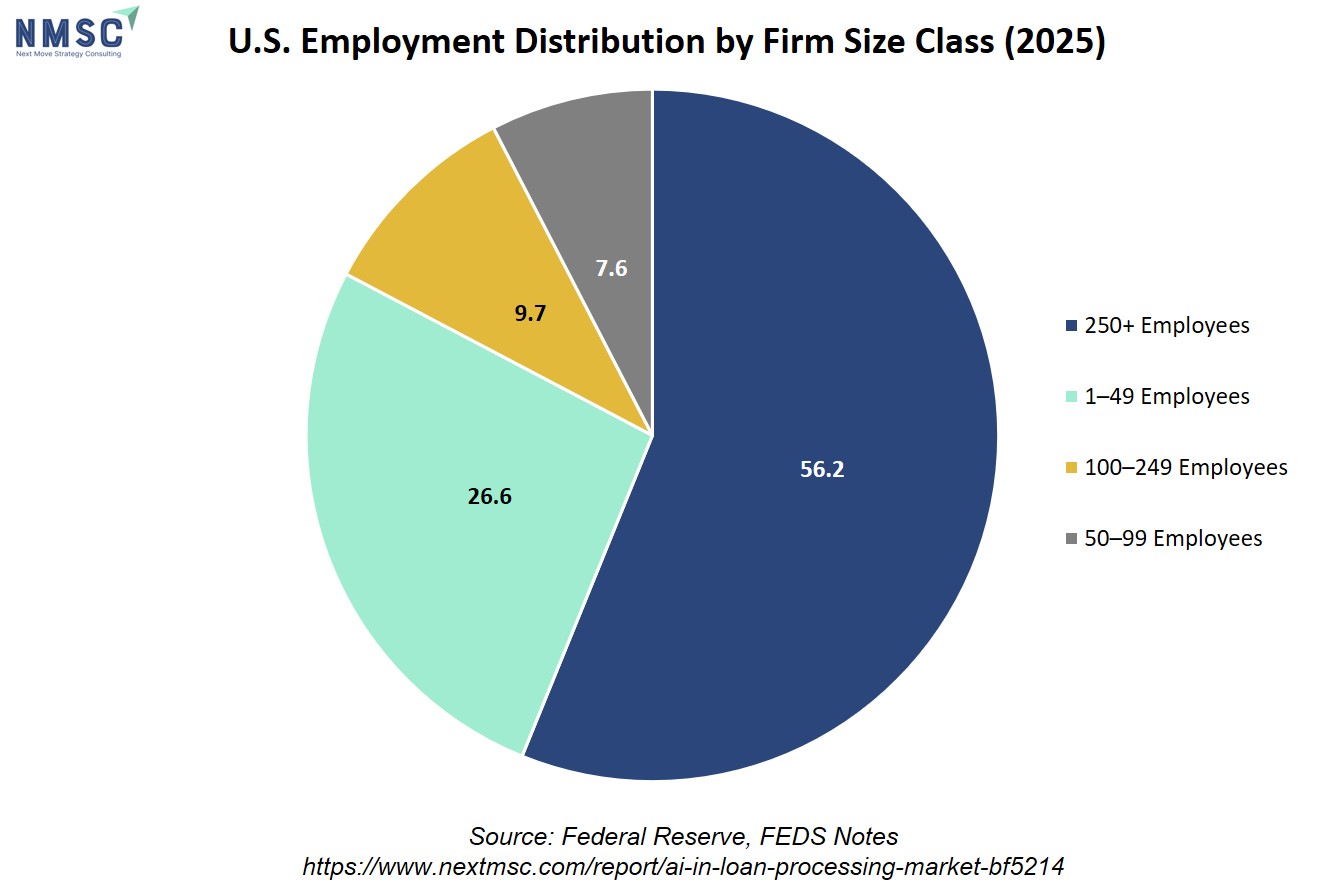
This concentration of U.S. employment within large firms — which the Federal Reserve's research shows are consistently the heaviest AI adopters — mirrors dynamics NMSC observes in loan processing, where large banks and diversified core-banking groups such as Finastra Group Holdings Limited and Temenos AG dominate procurement of full-lifecycle origination-to-servicing platforms, while smaller institutions increasingly pursue cooperative technology models to close the adoption gap. NMSC's report cites the Commonwealth Credit Union and Zest AI partnership forming the CU Lending Collective, a credit-union service organization created specifically to help small credit unions adopt AI-powered lending technology without the capital outlay required for independent deployment.
Survey Evidence on U.S. AI Adoption Intensity
AI Adoption Rate Estimates Across U.S. Survey Sources (2025)
|
Survey |
Unit of Analysis |
Estimation Type |
Adoption Rate (%) |
|
Business Trends and Outlook Survey (BTOS) |
Firms |
Firm-weighted percentage |
18 |
|
Survey of Business Uncertainty (SBU) — AI |
Firms |
Employment-weighted percentage |
78 |
|
Real-Time Population Survey (RPS) — GenAI |
Individuals |
Share of labor force |
41 |
|
Survey of Business Uncertainty (SBU) — LLM |
Firms |
Employment-weighted percentage |
54 |
Source: Federal Reserve, FEDS Notes, "Monitoring AI Adoption in the U.S. Economy," April 3, 2026 (data from U.S. Census Bureau BTOS; Real-Time Population Survey; Federal Reserve Bank of Atlanta SBU)
AI Adoption Rate by Industry Sector — Firm-Level vs. Individual-Level Estimates (2025)
|
Sector |
BTOS Firm-Level Adoption (%) |
RPS Individual-Level GenAI Adoption (%) |
|
Information |
37 |
70 |
|
Professional, Scientific and Technical Services |
33 |
62 |
|
Financial Services |
30 |
63 |
|
Real Estate and Rental and Leasing |
24 |
58 |
|
Wholesale Trade |
13 |
48 |
|
Accommodation and Food Services |
8 |
21 |
Source: Federal Reserve, FEDS Notes, "Monitoring AI Adoption in the U.S. Economy," April 3, 2026 (data from U.S. Census Bureau BTOS; Real-Time Population Survey)
The financial sector's standing among the most active adopters of AI — evident across both firm-level and individual-level survey measures — provides economic context for why regulators are prioritizing lending-specific oversight ahead of other applications. NMSC's assessment indicates that fair-lending and adverse-action explainability requirements are already limiting black-box model deployment across North America and Europe, a restraint the firm estimates has a negative 0.9 percentage-point impact on market CAGR through 2035, second only to the EU AI Act's Annex III compliance burden in Europe.
Company Activity and Capital Flows
Competitive activity within the AI in Loan Processing Market has concentrated on explainability credentials and agentic execution capability. NMSC's report notes that Fair Isaac Corporation launched its Focused Foundation Model for Financial Services in September 2025, featuring patent-pending Trust Scores that risk-rank generative AI outputs to satisfy adverse-action and fair-lending requirements, while Provenir Group introduced agentic AI features within its Decision Intelligence platform in February 2026, including pre-integrated access to large language model providers for fintech and marketplace lenders. On the capital markets side, Zest AI completed an oversubscribed, customer-led financing round in November 2025, led by Citi Ventures alongside multiple credit unions — a transaction NMSC characterizes as reflecting investor preference for vendors with validated explainability and regulatory-readiness credentials.
Bottom Line
The convergence of intensifying U.S. regulatory scrutiny and rapid agentic AI adoption is redefining competitive positioning across the global AI in Loan Processing Market, projected by Next Move Strategy Consulting to expand from USD 8.50 billion in 2026 to USD 63.30 billion by 2035 at a 25.0% CAGR. Growth is anchored by agentic origination platforms, embedded lending integrations, and rising Buy Now Pay Later volumes, with North America leading current revenue share and Asia-Pacific set to post the fastest regional growth. Risks are concentrated around the EU AI Act's Annex III conformity deadline in August 2026 and evolving U.S. supervisory expectations for model governance, vendor oversight, and human-in-the-loop controls. For investors and technology vendors, the market presents an attractive opportunity, but one increasingly contingent on demonstrable explainability, auditability, and fair-lending compliance rather than raw automation capability alone. Stakeholders unable to meet these evolving governance thresholds risk exclusion from bank and credit union procurement shortlists as the compliance bar continues to rise.
About Next Move Strategy Consulting
Next Move Strategy Consulting is a premier market research and management consulting firm that has been committed to provide strategically analysed well documented latest research reports to its clients. The research industry is flooded with many firms to choose from, what makes NMSC different from the rest is its top-quality research and the obsession of turning data into knowledge by dissecting every bit of it and providing fact-based research recommendation that is supported by information collected from over 500 million websites, paid databases, industry journals and one on one consultations with industry experts across a diverse range of industry sectors. The high-quality customized research reports with actionable insights and excellent end-to-end customer service help our clients to take critical business decisions that enables them to move beyond time and have competitive edge in the industry.
We have been servicing over 1000 customers globally that includes 90% of the Fortune 500 companies over a decade. Our analysts are constantly tracking various high growth markets and identifying hidden opportunities in each sector or the industry. We provide one of the industry's best quality syndicate as well as custom research reports across 10 different industry verticals. We are committed to deliver high quality research solutions in accordance to your business needs. Our industry standard delivery solutions that ranges from the pre consultation to after-sales services, provide an excellent client experience and ensure right strategic decision making for businesses.
For more information, please contact:
Next Move Strategy Consulting
5th Floor 867
Boylston St, STE 500,
Boston, MA 02116, U.S.
E-Mail: [email protected]
Direct: +1-217-650-7991
Website: www.nextmsc.com
About the Author
 Sanyukta Deb
— Sanyukta Deb is Digital Marketing Team Lead at Next Move Strategy Consulting, where she has led content strategy and technical SEO for the firm's B2B market research publications for over 2 years. Her editorial process translates NextMSC's primary and secondary research — spanning technology, industrial, and consumer sectors — into commercial narratives, backed by search-intent, keyword, and competitive analysis. She brings 5 years of overall experience in digital marketing and content strategy.
Sanyukta Deb
— Sanyukta Deb is Digital Marketing Team Lead at Next Move Strategy Consulting, where she has led content strategy and technical SEO for the firm's B2B market research publications for over 2 years. Her editorial process translates NextMSC's primary and secondary research — spanning technology, industrial, and consumer sectors — into commercial narratives, backed by search-intent, keyword, and competitive analysis. She brings 5 years of overall experience in digital marketing and content strategy.
About the Reviewer
 Debashree Dey
— Debashree Dey is Assistant Manager at Next Move Strategy Consulting, where she supports cross-vertical market content and communications across diverse industries for 6 years. Her professional background includes senior content writing, communications, and published manuscript authorship, with experience developing audience-focused business narratives and maintaining clear, consistent messaging. Her role supports research-led content development and editorial quality across NextMSC publications.
Debashree Dey
— Debashree Dey is Assistant Manager at Next Move Strategy Consulting, where she supports cross-vertical market content and communications across diverse industries for 6 years. Her professional background includes senior content writing, communications, and published manuscript authorship, with experience developing audience-focused business narratives and maintaining clear, consistent messaging. Her role supports research-led content development and editorial quality across NextMSC publications.

















Add Comment