China Approves 5G Autonomous Driving Standards
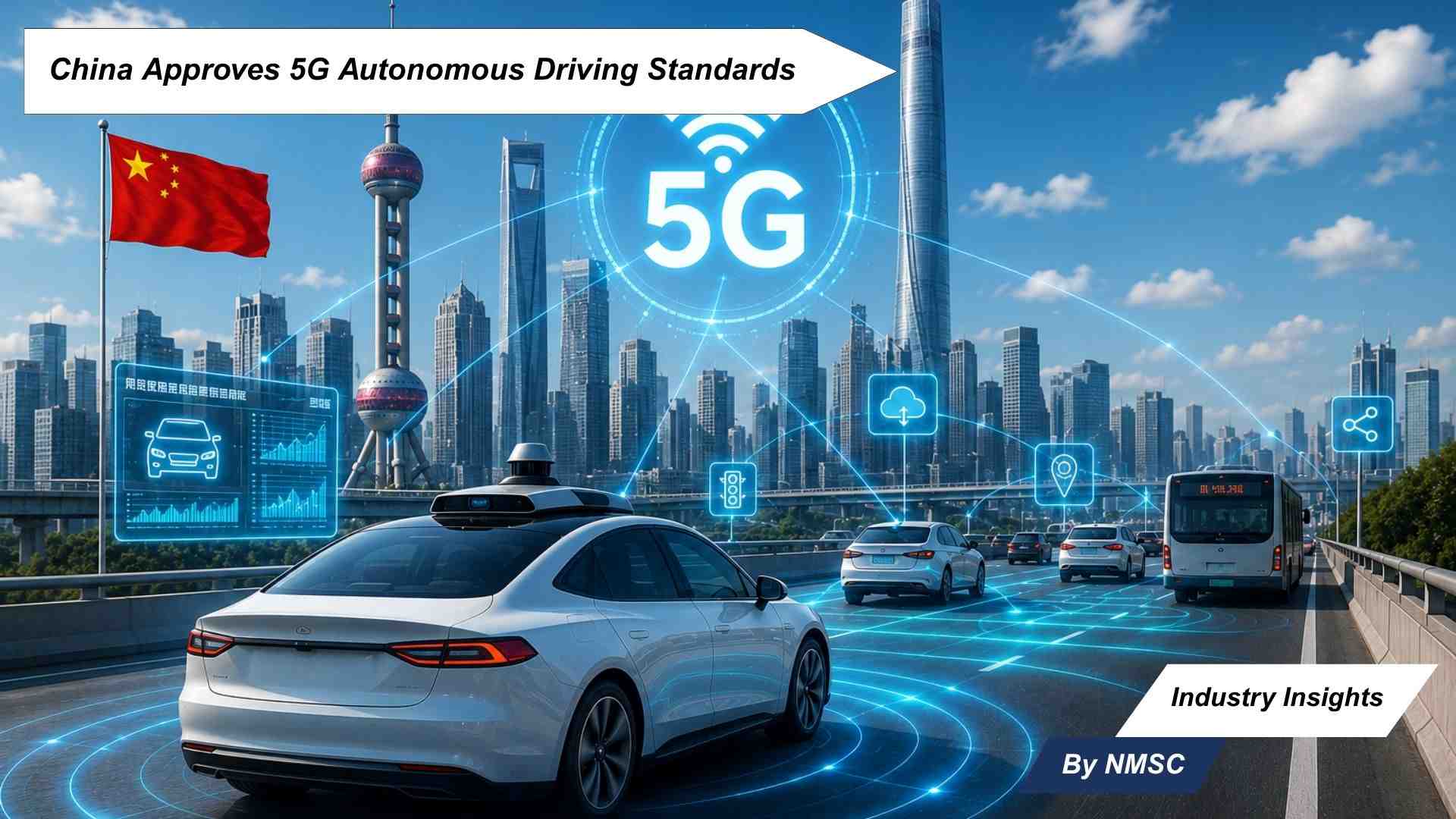
China's MIIT Approves Two 5G Network Standards for High-Level Autonomous Driving, Effective September
Munich, Germany — June 26, 2026 — China's Ministry of Industry and Information Technology (MIIT) has approved two new 5G network communication standards designed to support high-level autonomous driving, establishing the country's first unified industry benchmark for assessing 5G network quality in autonomous vehicle scenarios. The standards, which take effect on September 1, 2026, matter to automakers, telecom operators, and intelligent connected vehicle developers seeking a consistent framework for network deployment and performance verification.
The two documents are titled "5G Network Deployment and Test Methods for Supporting High-Level Autonomous Driving" and "5G Network Performance Requirements for Supporting High-Level Autonomous Driving." They were led by the Shanghai Communications Administration, China Mobile, and the China Academy of Information and Communications Technology (CAICT), with input from more than 20 organizations.
Work on the standards began as early as March 31, 2023, spanning more than three years of refinement, industry-level drafting, and regulatory approval. The standards define specific 5G network rules across multiple high-level autonomous driving application scenarios.
The framework covers network service capabilities, signal coverage planning, key performance indicators, on-site testing procedures, and communication security constraints. According to the ministry, this marks the first time China has released industry standards specifically addressing 5G network performance and engineering acceptance for high-level autonomous driving, filling a long-standing gap in the sector.
Key Highlights:
-
MIIT approved two 5G network standards for high-level autonomous driving, effective September 1, 2026.
-
The standards were led by the Shanghai Communications Administration, China Mobile, and CAICT, with input from over 20 organizations.
-
They establish China's first unified benchmark for 5G network quality in autonomous driving, covering coverage planning, KPIs, testing, and security.
-
The rules provide Shanghai a compliance framework for intelligent connected vehicle demonstration roads and vehicle-to-everything (V2X) projects.
Analyst Insight:
NMSC analysts note that unified national standards for 5G-enabled autonomous driving are expected to reduce design fragmentation and lower network debugging and acceptance costs, strengthening the foundation for scaled deployment of intelligent connected vehicle services across regions. According to analysts at Next Move Strategy Consulting, the global 5G Technology Market is projected to reach USD 620.72 billion by 2030, expanding at a CAGR of 58.6 percent over the forecast period.
Industry Outlook:
By preventing a fragmented landscape of inconsistent network schemes and metrics, the standards are positioned to facilitate coordinated rollout of internet-of-vehicles infrastructure across China. The move signals deeper integration between 5G connectivity and the automotive sector, where connected vehicles remain a core application driving long-term 5G market expansion.
Source: Gasgoo
Prepared By: Sanyukta Deb
For More Information – Download FREE Sample on 5G Technology Market Report
About the Author
 Sanyukta Deb
— Sanyukta Deb is Digital Marketing Team Lead at Next Move Strategy Consulting, where she has led content strategy and technical SEO for the firm's B2B market research publications for over 2 years. Her editorial process translates NextMSC's primary and secondary research — spanning technology, industrial, and consumer sectors — into commercial narratives, backed by search-intent, keyword, and competitive analysis. She brings 5 years of overall experience in digital marketing and content strategy.
Sanyukta Deb
— Sanyukta Deb is Digital Marketing Team Lead at Next Move Strategy Consulting, where she has led content strategy and technical SEO for the firm's B2B market research publications for over 2 years. Her editorial process translates NextMSC's primary and secondary research — spanning technology, industrial, and consumer sectors — into commercial narratives, backed by search-intent, keyword, and competitive analysis. She brings 5 years of overall experience in digital marketing and content strategy.
About the Reviewer
 Debashree Dey
— Debashree Dey is Assistant Manager at Next Move Strategy Consulting, where she supports cross-vertical market content and communications across diverse industries for 6 years. Her professional background includes senior content writing, communications, and published manuscript authorship, with experience developing audience-focused business narratives and maintaining clear, consistent messaging. Her role supports research-led content development and editorial quality across NextMSC publications.
Debashree Dey
— Debashree Dey is Assistant Manager at Next Move Strategy Consulting, where she supports cross-vertical market content and communications across diverse industries for 6 years. Her professional background includes senior content writing, communications, and published manuscript authorship, with experience developing audience-focused business narratives and maintaining clear, consistent messaging. Her role supports research-led content development and editorial quality across NextMSC publications.

















Add Comment