Grass Valley’s AVORA Launch Splits Video Switchers into Two Distinct Lanes
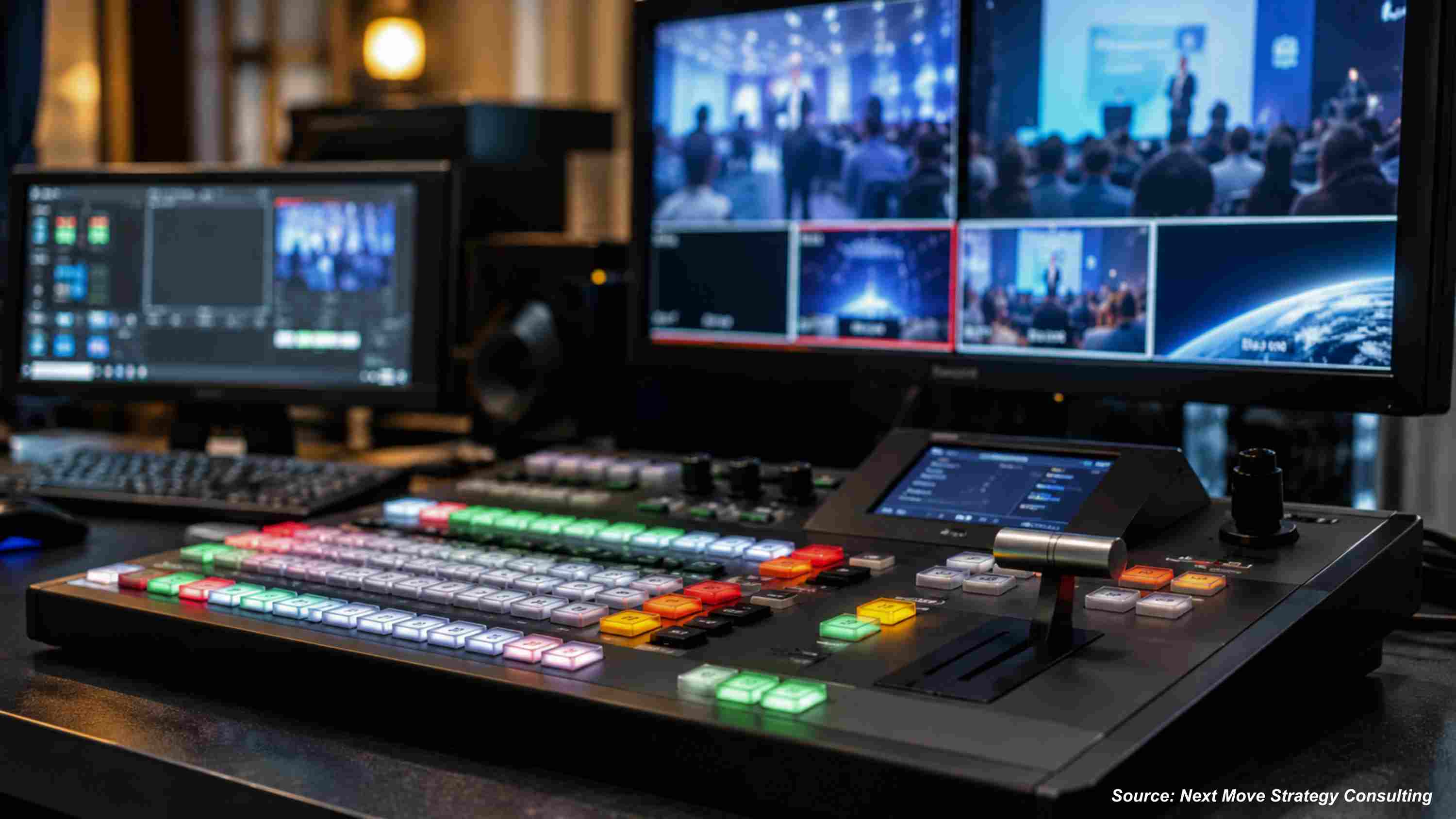
Grass Valley’s September 10 AVORA Debut and Ross Video’s Ultrix FR30 Show Live Switching Dividing Between Enterprise Hardware Frames and Software-Led Systems
On September 10, 2026, Grass Valley announced AVORA, a standalone all-in-one live production system that combines switching, graphics, audio, remote guests, replay, recording, monitoring, playout and delivery in a single platform, ahead of its showcase at IBC2026 in Amsterdam from September 11 to 14. SVG Europe reported on September 11, 2026 that commercial availability is planned for later this year. The same week, Ross Video used IBC2026 to introduce the Ultrix FR30, a hyperconverged platform that supports up to 576 UHD inputs and outputs in a single frame, while Blackmagic Design had already introduced two SMPTE 2110-native ATEM 4 M/E Constellation IP switchers at the NAB Show in April 2026. Read together, the three launches show professional video switching dividing into two lanes: enterprise-scale hardware frames for facilities that must run SDI alongside IP, and software-led systems that let a small crew operate a complete show from one interface.
According to Next Move Strategy Consulting’s Video Switchers Market report, the global video switchers market was valued at USD 4.90 billion in 2026 and is projected to reach USD 8.63 billion by 2035, growing at a CAGR of 6.5% from 2026 to 2035. NextMSC primary research and analysis sizes the market at USD 4.60 billion in 2025 and counts production, master-control, presentation and matrix or routing switchers, together with separately identifiable switching software and directly attributable integration and support services. General-purpose network switches, standalone converters, cameras and displays sit outside that definition. NextMSC rates its confidence in the aggregate figure as low, because no manufacturer reports a consolidated revenue line for the full product set, so the estimate is best read as a directional model rather than audited industry revenue.
For More Information: Download FREE Sample on Video Switchers Market Report
The Financial Logic: Remote Production, Budget Pressure and a Gradual IP Transition
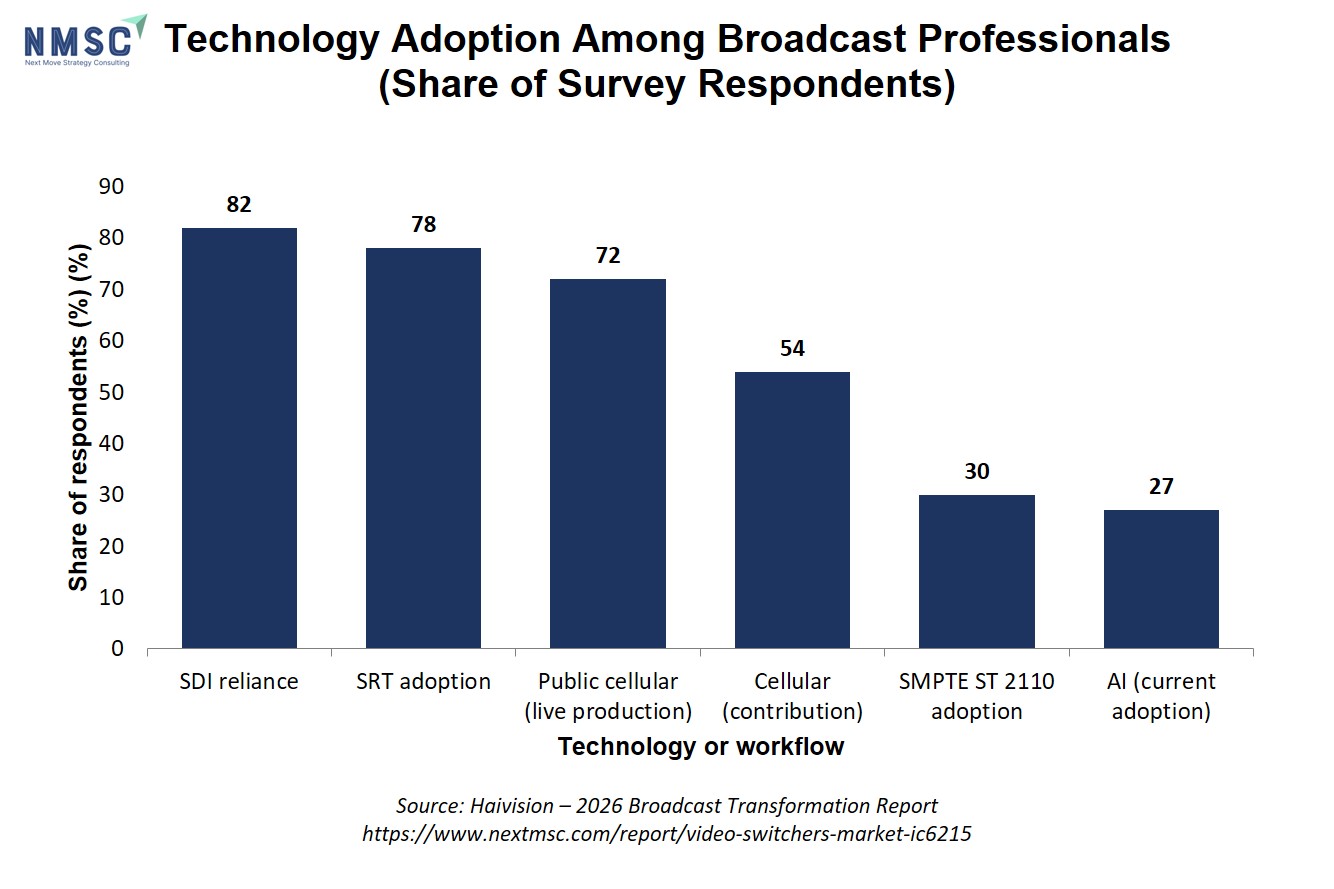
Buyer behavior in 2026 explains why vendors are launching both kinds of product at once. Haivision’s 2026 Broadcast Transformation Report, released on March 4, 2026 and based on a survey of more than 1,300 broadcast professionals conducted from October to December 2025, found that 41% of respondents named enabling remote production as their leading technology priority, the fourth consecutive year it has topped the list. The same report found that 82% of respondents still rely on SDI infrastructure, while 30% have adopted SMPTE ST 2110, up four points from 2025. NextMSC primary research and analysis reads those two figures together: a facility that must serve an SDI majority today and an IP minority that is growing every year needs switching equipment that carries both signal types, which is the engineering requirement behind the hybrid roadmaps now visible in launches from Grass Valley, Ross Video and Blackmagic Design.
Budget pressure tempers the pace of that change. TVBEurope reported on March 5, 2026 that budgetary constraints, cited as a top challenge by 45% of Haivision’s respondents in 2025, rose to 49% in 2026. In NextMSC primary research and analysis, that pressure favors upgrade paths that preserve installed SDI frames over wholesale replacement, and it is consistent with the long equipment lifecycles that NextMSC lists as a restraint on replacement demand.
Adjacent demand data points the same way outside broadcast. AVIXA’s Industry Outlook and Trends Analysis, published on August 26, 2025, projects pro AV revenue rising from USD 332 billion in 2025 to USD 402 billion by 2030, with the five-year growth projection lowered from 5.3% to 3.9% a year because of tariff, geopolitical and interest-rate uncertainty. AVIXA’s perimeter covers non-broadcast and non-media-production installations, so it measures the corporate, education and venue demand that presentation and matrix switchers serve rather than switcher revenue itself. Its 3.9% rate covers a different perimeter and is not directly comparable with NextMSC’s 6.5% modeled CAGR for video switchers.
NextMSC’s base-case forecast implies a modeled revenue opportunity of approximately USD 3.73 billion between 2026 and 2035, the difference between the 2035 forecast and the 2026 value. The forecast assumes a steady annual growth rate for comparability, and NextMSC primary research and analysis expects actual annual demand to vary with replacement cycles, event calendars, broadcaster capital expenditure, system integration projects and the pace of IP adoption.
NextMSC Revenue Forecast for the Video Switchers Market, 2025 to 2035
|
Year |
Revenue (USD Billion) |
Basis |
|
2025 |
4.60 |
Modeled value |
|
2026 |
4.90 |
Modeled value |
|
2027 |
5.22 |
Base-case forecast |
|
2028 |
5.56 |
Base-case forecast |
|
2029 |
5.92 |
Base-case forecast |
|
2030 |
6.30 |
Base-case forecast |
|
2031 |
6.71 |
Base-case forecast |
|
2032 |
7.15 |
Base-case forecast |
|
2033 |
7.61 |
Base-case forecast |
|
2034 |
8.11 |
Base-case forecast |
|
2035 |
8.63 |
Base-case forecast |
Key Industry Developments: Three Product Cycles That Define the Switcher Calendar
Grass Valley’s AVORA is built on the company’s GV AMPP technology and operates as a standalone solution, according to SVG Europe’s September 11, 2026 report. Production resources can be saved, duplicated and recalled as a complete show for recurring events, the system supports both shot-based production and traditional program and preset operation through a web-based interface, and remote guests join through private invitation links with low-latency connectivity, mix-minus and talkback. Grass Valley positions AVORA as a complement to K-Frame for dedicated hardware switching and to Maverik X and AMPP for enterprise-scale software-defined production. NextMSC primary research and analysis reads the launch as a segmentation move inside one vendor’s catalog rather than a replacement of its hardware line.
“AVORA answers a very clear market need”
— Jonathan Lyth, Product Director for Live Applications, Grass Valley, SVG Europe, September 11, 2026.
Ross Video’s IBC2026 lineup, published by TV Tech on September 11, 2026, takes the opposite route on scale. The Ultrix FR30, described as the company’s newest and largest Ultrix platform, supports up to 576 UHD inputs and outputs in a single frame. Ultrix Flexible Licensing lets processing licenses be shared and allocated across Ultrix frames as production requirements change, and Carbonite v12.2 unifies the Carbonite range on a common software platform. The first customer is TV Skyline, a German broadcast and media services provider. Wolfgang Reeh, founder, owner and CEO of TV Skyline, said in a Ross Video announcement reported by TV Tech on September 11, 2026 that combining routing, audio and video processing and production switching in a software-defined ecosystem has been a major advantage for the company’s outside broadcast productions.
Blackmagic Design’s April 2026 launch addressed the entry end of the IP transition. The ATEM 4 M/E Constellation IP, priced from US$7,995 and scheduled for availability in June, and the ATEM 4 M/E Constellation IP Plus, priced from US$14,295 and scheduled for July, are both SMPTE 2110-native. They retain the features of the SDI-based Constellation line, allowing a transition between SMPTE 2110 and SDI switchers when both are in a facility, and each 100G Ethernet port carries eight video inputs and outputs, so four cables replace 60 BNC connections on an SDI switcher, according to the company’s announcement as reported by SVG on April 19, 2026.
“…we realized we needed a whole new design”
— Grant Petty, CEO, Blackmagic Design, SVG (Sports Video Group), April 19, 2026.
Three 2026 Switching Launches at a Glance
|
Launch |
Date |
Scale and positioning |
|
Grass Valley AVORA |
September 10, 2026 |
Standalone all-in-one live production system built on GV AMPP; commercial availability planned for later this year |
|
Ross Video Ultrix FR30 |
September 11, 2026 (IBC2026) |
Up to 576 UHD inputs and outputs in a single frame; TV Skyline is the first customer |
|
Blackmagic Design ATEM 4 M/E Constellation IP and IP Plus |
April 2026 |
SMPTE 2110-native; from US$7,995 (June availability) and US$14,295 (July availability) |
The IP shift is not confined to switchers. In August 2026, Riedel Communications said it would present at IBC2026 SimplyLive Production Suite Flex server configurations with SMPTE ST 2110 support and the MediorNet HorizoN ST 2110 MultiViewer App, adding native IP capability to its live production platform and to multiviewing in IP environments.
Segment Dynamics: Hardware, Software and Hybrid Architectures
NextMSC primary research and analysis segments the market by product type (production, master-control, presentation, and matrix and routing switchers), technology architecture (hardware-based, software-based or virtualized, and hybrid), signal transport (baseband-only, IP-native, and hybrid baseband and IP), resolution capability and deployment topology. NextMSC does not assign a leading product type, because public primary-source disclosures do not support a defensible revenue split across the four types, and this article follows the same restraint. The 2026 launches still map onto those categories. AVORA is built on Grass Valley’s AMPP software technology, the Ultrix FR30 brings routing, processing and production switchers together on one hyperconverged platform, and Blackmagic Design’s Constellation IP models are SMPTE 2110-native switchers. NextMSC’s view is that hardware remains relevant where deterministic performance, input and output density, redundancy and predictable latency are priorities, while software-based systems offer flexibility for distributed teams and smaller production crews.
Regional Outlook: Where the Upgrade Cycles Are Being Written
NextMSC primary research and analysis does not publish a ranked regional revenue split for this market, because a comparable split across the full product scope was not available from public sources. Qualitatively, North America combines national and regional broadcasters, sports and entertainment production, corporate AV, universities and large venues, with demand tied to replacement cycles and the pace of IP modernization. Europe pairs established public and commercial broadcasters, outside-broadcast providers and live-event operators in a multi-country environment that places weight on interoperability, service coverage and standards-based workflows. Asia-Pacific spans a wide range of broadcast maturity and live-event activity, Middle East and Africa purchasing is more project-based and sensitive to import access and local technical support, and Latin America is shaped by currency volatility, import costs and uneven project cycles. The IBC2026 launches, staged at the RAI Amsterdam and led by a first customer in Germany, are consistent with Europe’s weight on interoperability and outside-broadcast investment, although a single customer announcement does not establish a regional trend.
Growth Drivers and Restraints
NextMSC primary research and analysis weighs four drivers and four restraints for 2026 to 2035, shown below. The table records the direction of impact only; NextMSC does not publish a quantified CAGR impact for individual factors.
Drivers and Restraints in the Video Switchers Market
|
Factor |
Type |
Direction |
Timeline |
|
Expansion of live sports, entertainment and event production creates demand for multi-source switching and show control |
Driver |
Positive |
2026–2035 |
|
IP migration and hybrid SDI and IP refreshes create upgrade opportunities in production and routing infrastructure |
Driver |
Positive |
2026–2035 |
|
Remote and distributed production increases demand for network-aware switching and remote operation |
Driver |
Positive |
2026–2035 |
|
Corporate, education and venue AV modernization supports presentation and matrix-switching requirements |
Driver |
Positive |
2026–2035 |
|
Long equipment lifecycles and installed SDI infrastructure can defer replacement investment |
Restraint |
Negative |
Near to medium term |
|
Integration complexity across signal formats, networks, timing and control systems increases deployment cost |
Restraint |
Negative |
2026–2035 |
|
Capital expenditure cyclicality and event or broadcast budget constraints can delay large projects |
Restraint |
Negative |
Near to medium term |
|
Interoperability, cybersecurity, support coverage and skills requirements complicate IP-based deployments |
Restraint |
Negative |
2026–2035 |
NMSC Strategic Perspective: Hybrid Roadmaps Decide the Refresh Cycle
NextMSC primary research and analysis draws three conclusions from the 2026 launch cycle. First, the buyer’s binding constraint is migration risk rather than feature scarcity. With 82% of Haivision’s respondents still relying on SDI and 30% on SMPTE ST 2110, the products most likely to be specified are those that let a facility move in stages. Ross Video’s flexible licensing across Ultrix frames and Blackmagic Design’s feature parity between its SDI-based and SMPTE 2110-native Constellation switchers both lower the cost of staging that move.
Second, software-defined switching widens the buyer base more than it displaces existing hardware revenue. AVORA packages switching, graphics, remote guests, replay and delivery in one web-operated system, which targets productions that would otherwise buy a separate switcher, graphics engine and replay server. That is consistent with NextMSC’s observation that software-defined production can lower barriers for smaller broadcasters, production companies and event operators, while hardware platforms keep mission-critical, high-density work. The evidence is product positioning, not sales data: the sources reviewed for this article do not report AVORA order volumes, and commercial availability is planned for later this year.
Third, the evidence base for sizing remains thin, which is why NextMSC assigns low confidence to the aggregate estimate. Vendors report switcher revenue inside broader broadcast and AV segments, so investors and suppliers should validate addressable revenue against product-level shipment, pricing, installed-base and channel data before building company-specific forecasts. Three items are worth tracking: the commercial release of AVORA, the delivery schedule for the Ultrix FR30, and the June and July availability of the ATEM 4 M/E Constellation IP models.
Competitive Landscape: A Fragmented Supplier Field Without a Published Ranking
NextMSC primary research and analysis does not publish a market-share ranking for video switchers, because public evidence does not support a consistent ranking across the defined scope. The eligible supplier universe includes Sony, Ross Video, Blackmagic Design, Panasonic, Grass Valley, Evertz Microsystems, Imagine Communications, FOR-A, AJA Video Systems, Barco, Analog Way, Extron Electronics, Kramer Electronics, Lightware Visual Engineering, Roland Corporation, Datavideo, RGB Spectrum, RGBlink, Utah Scientific and Vizrt, spanning specialist production-switcher makers, broadcast infrastructure vendors and presentation and matrix-switching suppliers.
The company events cited in this article come from named announcements: Blackmagic Design’s April 2026 ATEM Constellation IP launch, Grass Valley’s September 10, 2026 AVORA announcement, and Ross Video’s IBC2026 Ultrix FR30 and Carbonite v12.2 releases. Riedel Communications’ August 2026 SMPTE ST 2110 additions show adjacent infrastructure suppliers moving in the same direction. Product announcements document supplier strategy; they do not by themselves establish market penetration or incremental revenue, a limit NextMSC applies to its own market model.
Bottom Line
The September 2026 launch cycle at IBC2026 confirms that professional video switching is dividing into enterprise hardware frames and software-led systems, with hybrid SDI and IP compatibility as the shared requirement. Grass Valley’s AVORA, Ross Video’s Ultrix FR30 and Blackmagic Design’s SMPTE 2110-native ATEM Constellation IP models each address a different buyer, from small crews to outside-broadcast fleets. Haivision’s survey data explains the pattern: 82% of respondents still rely on SDI, 30% have adopted SMPTE ST 2110, and remote production remains the top technology priority at 41%. NextMSC primary research and analysis values the global video switchers market at USD 4.90 billion in 2026 and projects USD 8.63 billion by 2035 at a 6.5% CAGR, while rating confidence in the aggregate figure as low. Suppliers with credible migration paths, flexible licensing and strong integration support are best placed for the refresh cycle, and AVORA’s commercial availability will be the first measurable test of the software-led lane.
About Next Move Strategy Consulting
Next Move Strategy Consulting is a premier market research and management consulting firm that has been committed to provide strategically analysed well documented latest research reports to its clients. The research industry is flooded with many firms to choose from, what makes NMSC different from the rest is its top-quality research and the obsession of turning data into knowledge by dissecting every bit of it and providing fact-based research recommendation that is supported by information collected from over 500 million websites, paid databases, industry journals and one on one consultations with industry experts across a diverse range of industry sectors. The high-quality customized research reports with actionable insights and excellent end-to-end customer service help our clients to take critical business decisions that enables them to move beyond time and have competitive edge in the industry.
We have been servicing over 1000 customers globally that includes 90% of the Fortune 500 companies over a decade. Our analysts are constantly tracking various high growth markets and identifying hidden opportunities in each sector or the industry. We provide one of the industry’s best quality syndicate as well as custom research reports across 10 different industry verticals. We are committed to deliver high quality research solutions in accordance to your business needs. Our industry standard delivery solutions that ranges from the pre consultation to after-sales services, provide an excellent client experience and ensure right strategic decision making for businesses.
For more information, please contact:
Next Move Strategy Consulting
5th Floor 867 Boylston St, STE 500,
Boston, MA 02116, U.S.
E-Mail: [email protected]
Direct: +1-217-650-7991
Website: www.nextmsc.com
About the Author
 Sanyukta Deb
— Sanyukta Deb is Digital Marketing Team Lead at Next Move Strategy Consulting, where she has led content strategy and technical SEO for the firm's B2B market research publications for over 2 years. Her editorial process translates NextMSC's primary and secondary research — spanning technology, industrial, and consumer sectors — into commercial narratives, backed by search-intent, keyword, and competitive analysis. She brings 5 years of overall experience in digital marketing and content strategy.
About the Reviewer
 Debashree Dey
— Debashree Dey is Assistant Manager at Next Move Strategy Consulting, where she supports cross-vertical market content and communications across diverse industries for 6 years. Her professional background includes senior content writing, communications, and published manuscript authorship, with experience developing audience-focused business narratives and maintaining clear, consistent messaging. Her role supports research-led content development and editorial quality across NextMSC publications.
















Add Comment