China's Robot Traffic Cop Deploys on Wuhu Streets
Industry Insights from Next Move Strategy Consulting
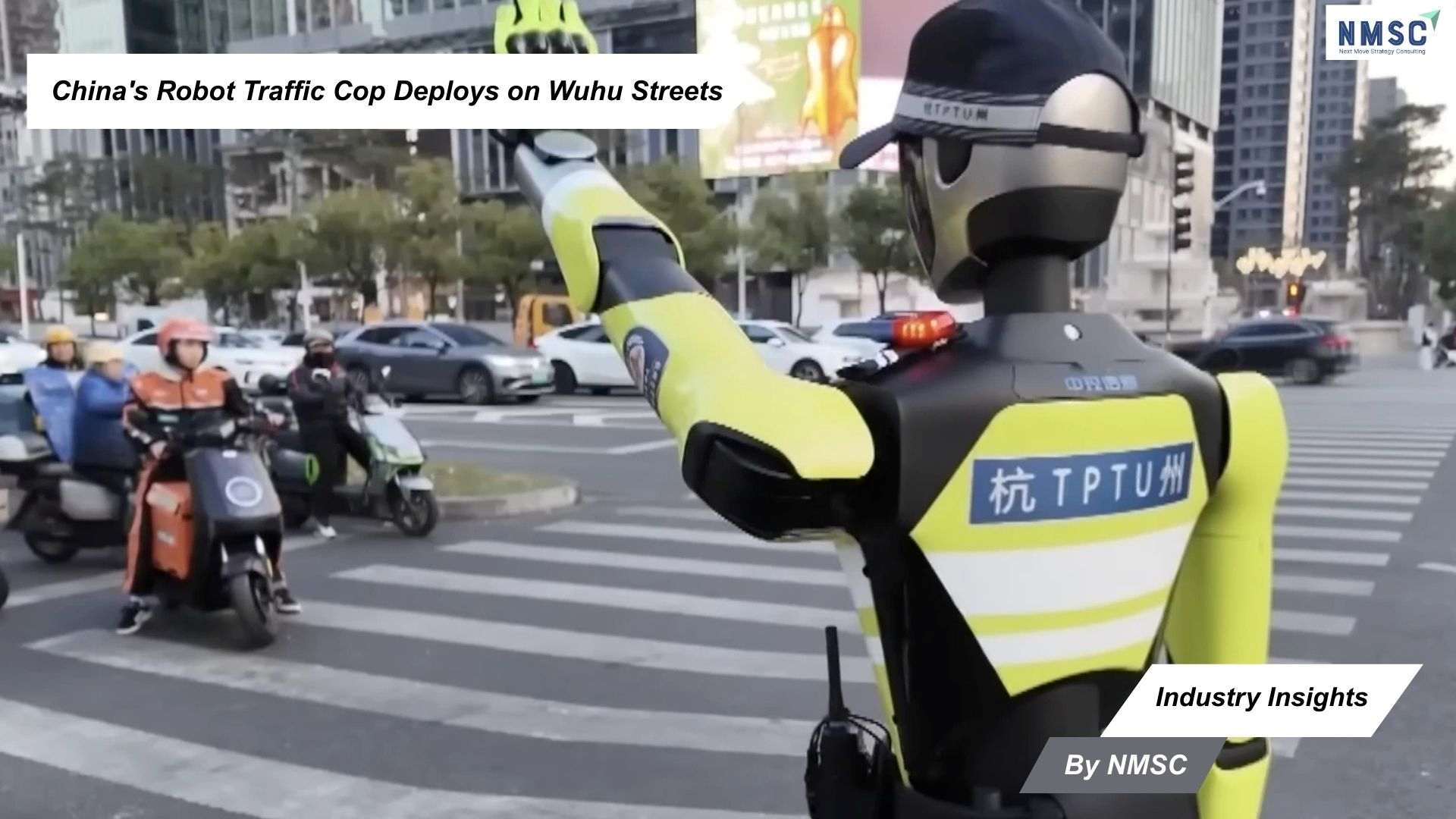
The future of urban traffic management has arrived in Anhui Province. The city of Wuhu has officially deployed a humanoid robot police officer to direct traffic and monitor violations at busy intersections, marking a significant step in the practical integration of smart robotics into public infrastructure and law enforcement.
This deployment moves beyond experimental demonstrations, placing an autonomous robotic system into the core function of daily urban regulation. The robot represents a shift from static, siloed monitoring equipment to an interactive, mobile intelligence capable of performing complex public service duties.
A Functional Leap for Robotic Integration
For years, the vision of robots seamlessly operating in public spaces has been confined to research labs and controlled environments. The Wuhu deployment shatters this barrier by introducing a robot designed for the unpredictable and demanding setting of city traffic control.
The humanoid officer is equipped with advanced capabilities for real-world application. It utilizes LiDAR sensor technology to autonomously navigate complex intersections filled with moving vehicles and pedestrians. Its core functions extend beyond simple presence to active law enforcement, including identifying traffic violations such as drivers failing to wear seatbelts.
The robot performs the traditional duties of a traffic officer directing the flow of vehicles while simultaneously acting as a mobile, intelligent surveillance platform. This dual role combines public interaction with automated monitoring, creating a new model for 24/7 traffic management.
Operational Capabilities at a Glance:
-
Autonomous Navigation: Uses LiDAR technology to safely navigate and operate within dynamic, busy urban intersections.
-
Traffic Direction: Performs the core function of directing vehicular and pedestrian traffic flow.
-
Violation Detection: Actively spots and identifies specific traffic violations, including seatbelt non-compliance.
-
Humanoid Interface: Provides an intuitive, familiar point of interaction for drivers and pedestrians in a public space.
A New Paradigm for Public Safety and Urban Mobility
This initiative points toward a future where robotics are integral to solving municipal challenges. By taking over repetitive and hazardous duties like directing traffic in all weather conditions, such technologies can augment human forces, potentially increasing overall coverage and consistency in law enforcement.
The deployment in Wuhu serves as a critical real-world test for the durability, public acceptance, and operational effectiveness of humanoid robots in essential services. The data and experience gathered will be invaluable for refining systems for broader adoption in other cities and for expanded public safety functions.
Industry Response and Strategic Outlook
The deployment has ignited discussions on the future of smart city infrastructure and the robotics market. Industry observers note this move represents a pivotal transition from industrial and logistics robotics to sophisticated service and public sector robotics.
According to Next Move Strategy Consulting, this practical application signals a maturation phase for the smart robotics sector. It moves the market narrative beyond capability demonstrations toward tangible solutions for urban efficiency and safety. This deployment is expected to accelerate investment trends in public-service robotics, with increased emphasis on outdoor operational durability, human-robot interaction, and integration with existing city management systems. The success in Wuhu could establish a blueprint for other municipalities worldwide facing similar traffic and public safety resource challenges.
Redefining the Urban Robotics Frontier
As cities globally grapple with congestion and resource constraints, Wuhu's robotic traffic cop signals a new era of intelligent urban management one where automation, continuous monitoring, and human-augmenting technology become essential tools for modern governance.
This deployment reinforces a commitment to leveraging cutting-edge robotics to address persistent civic challenges, paving the way for safer, more efficient, and technologically integrated public spaces.
Source: CGTN
Prepared By: Next Move Strategy Consulting
About the Author
 Sanyukta Deb
— Sanyukta Deb is Digital Marketing Team Lead at Next Move Strategy Consulting, where she has led content strategy and technical SEO for the firm's B2B market research publications for over 2 years. Her editorial process translates NextMSC's primary and secondary research — spanning technology, industrial, and consumer sectors — into commercial narratives, backed by search-intent, keyword, and competitive analysis. She brings 5 years of overall experience in digital marketing and content strategy.
Sanyukta Deb
— Sanyukta Deb is Digital Marketing Team Lead at Next Move Strategy Consulting, where she has led content strategy and technical SEO for the firm's B2B market research publications for over 2 years. Her editorial process translates NextMSC's primary and secondary research — spanning technology, industrial, and consumer sectors — into commercial narratives, backed by search-intent, keyword, and competitive analysis. She brings 5 years of overall experience in digital marketing and content strategy.
About the Reviewer
 Debashree Dey
— Debashree Dey is Assistant Manager at Next Move Strategy Consulting, where she supports cross-vertical market content and communications across diverse industries for 6 years. Her professional background includes senior content writing, communications, and published manuscript authorship, with experience developing audience-focused business narratives and maintaining clear, consistent messaging. Her role supports research-led content development and editorial quality across NextMSC publications.
Debashree Dey
— Debashree Dey is Assistant Manager at Next Move Strategy Consulting, where she supports cross-vertical market content and communications across diverse industries for 6 years. Her professional background includes senior content writing, communications, and published manuscript authorship, with experience developing audience-focused business narratives and maintaining clear, consistent messaging. Her role supports research-led content development and editorial quality across NextMSC publications.















Add Comment