Asda’s ESL Rollout Signals Retail Automation’s Shift Beyond Pilot Projects
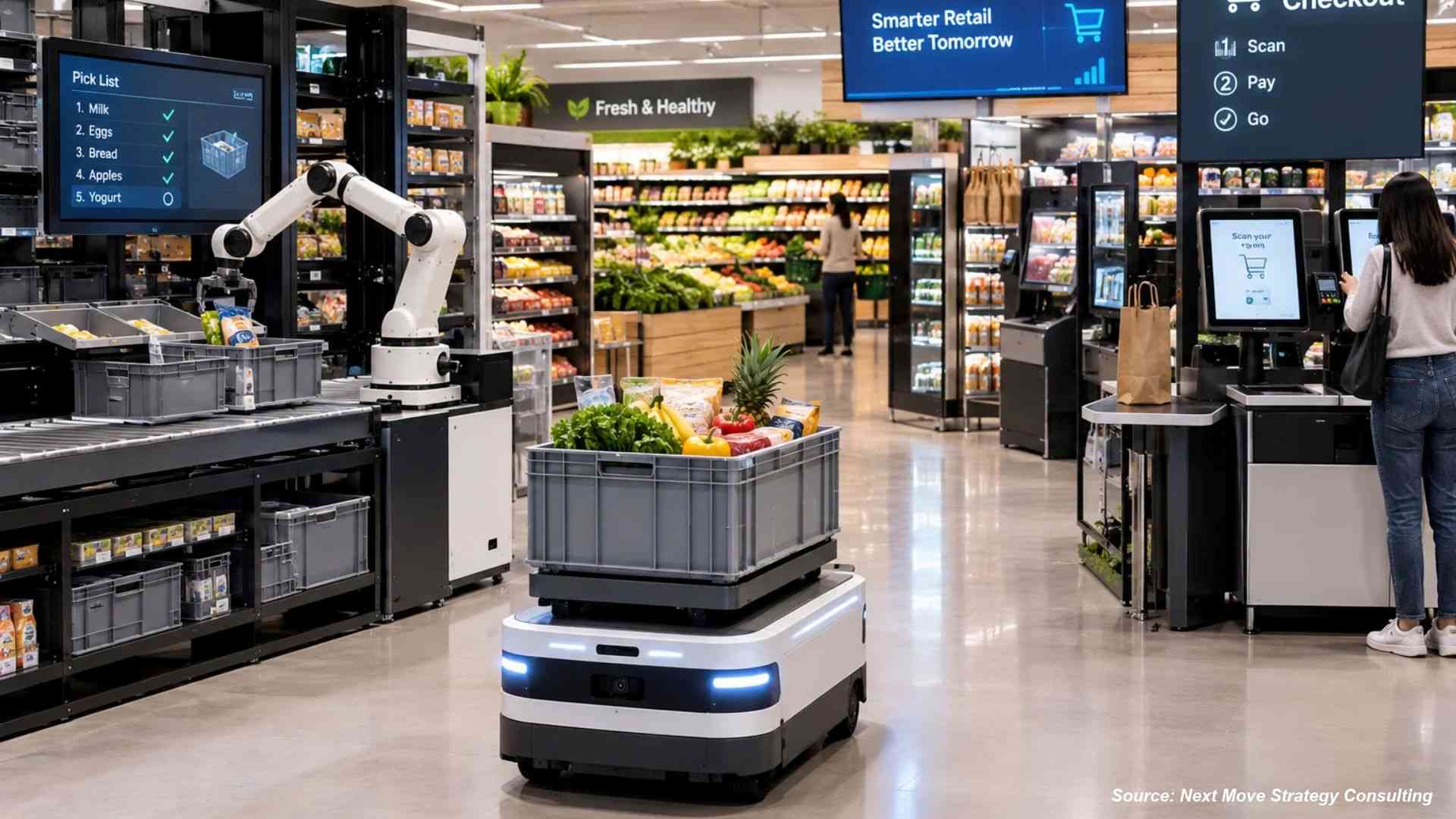
Asda's 1.2 million-Label ESL Completion and Dematic's British Columbia Deployment Signal Retail Automation's Transition from Isolated Pilots to Networked Infrastructure
In September 2026, Asda completed the installation of approximately 1.2 million VusionGroup electronic shelf-edge labels across all 517 of its Express convenience stores in the United Kingdom — a £7.5 million deployment that permanently eliminates the manual replacement of more than 120,000 paper price tickets every week and positions shelf-edge cameras for automated out-of-stock detection trials. The rollout, formally announced through Asda's corporate newsroom in February 2026 and finalized by September, represents one of the largest single-format ESL deployments in European grocery history and illustrates the structural shift now underway: retail automation is no longer a technology experiment confined to flagship stores but a capital-committed infrastructure layer being deployed at full estate scale.
According to Next Move Strategy Consulting's Retail Automation Market report, the global retail automation market was valued at USD 31.12 billion in 2025 and is projected to reach USD 80.39 billion by 2035, growing at a CAGR of 9.32% from 2026 to 2035. NMSC's proprietary research and analysis identifies rising labor cost pressures across North America and Europe, accelerating e-commerce fulfilment investment, and the expanding deployment of AI-powered inventory and shelf intelligence systems as the structural forces sustaining this trajectory — forces that are now visibly materializing in the scale and frequency of enterprise-level automation commitments being announced across the global retail sector.
For More Information: Download FREE Sample on Retail Automation Market Report
The Financial Logic: Labor Costs, Tech Budgets, and E-Commerce Volume
The economic rationale underpinning these commitments is increasingly unambiguous. Forrester's US Tech Forecast 2026 for Retail projects that U.S. retailers will increase their technology budgets to USD 113 billion in 2026, up 6.6% year over year, with automation and AI identified as the primary allocation priorities among retail technology decision-makers.
On the labor cost side, the U.S. Bureau of Labor Statistics' Employment Cost Index for June 2026 recorded wages and salaries rising 0.9% in a single quarter across private industry workers, sustaining the multi-year upward pressure on retail operating costs that is compressing ROI payback windows for checkout and fulfilment automation investments. In Europe, Eurofound's 2026 annual review of minimum wages confirms that the EU Minimum Wage Directive is clearly shaping wage-setting across member states. Germany's statutory minimum wage rose to €13.90 gross per hour from January 2026 and is scheduled to increase further to €14.60 — a trajectory that is accelerating the business case for shelf-replenishment and checkout automation among European grocery operators whose labor cost structures are directly exposed to these legislative floors.
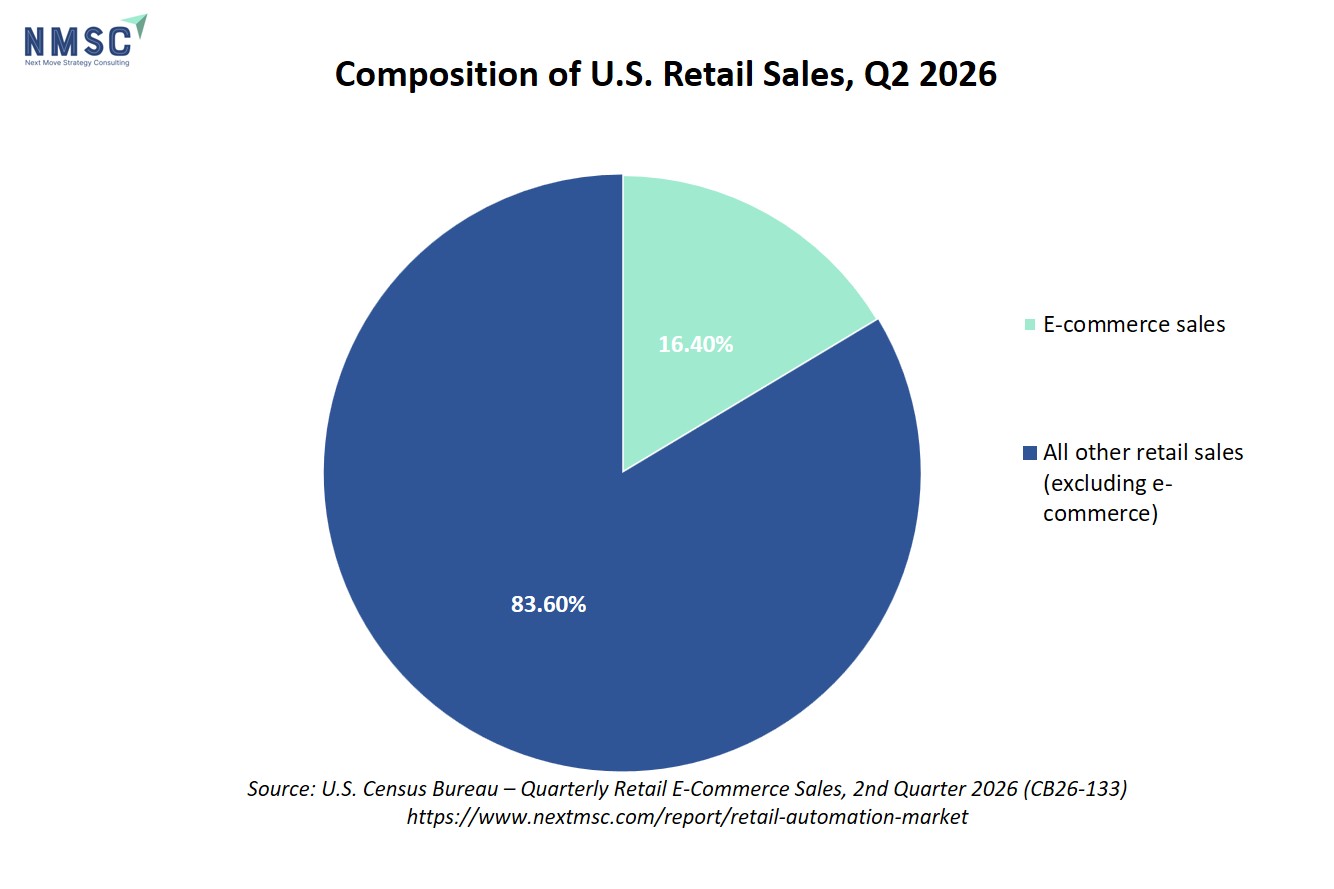
Simultaneously, e-commerce order volumes continue to expand the addressable market for fulfilment automation. The U.S. Census Bureau reported that U.S. retail e-commerce sales on a not-adjusted basis totaled USD 329.5 billion in the second quarter of 2026, sustaining the demand for robotic picking, automated storage and retrieval systems, and sortation infrastructure that pure e-commerce operators and omnichannel retailers are deploying at accelerating pace.
Key Industry Developments: Three Deployments That Define the Market's Direction
The Asda-VusionGroup completion is not an isolated event. In June 2026, Dematic announced a partnership with Pattison Food Group to automate the company's 485,000-square-foot grocery distribution center in Langley, British Columbia — a solution incorporating nearly 62,000 automated storage locations, 16 goods-to-person workstations, and integrated handling and sequencing technologies supporting approximately 11,000 grocery SKUs across nine retail banners. The deployment effectively doubled Pattison's split-case fulfilment capacity while reducing manual product handling across a facility that serves one of Canada's largest regional grocery networks.
In April 2026, Pricer AB and JRTech Solutions signed an approximately USD 51 million agreement with Canadian supermarket chain Sobeys, covering electronic shelf label hardware and store infrastructure across an estimated 300 to 350 stores, with deployment scheduled over an 18-month period beginning in May 2026. The contract scale — USD 51 million for a single grocery chain's ESL network — illustrates the capital commitment that tier-one North American grocery operators are now prepared to make for shelf digitization, and the recurring infrastructure revenue opportunity it creates for ESL platform vendors.
At NRF 2026, the retail industry's largest annual technology conference, AI-driven automation, frictionless self-checkout, and computer vision-based loss prevention were identified as no longer optional capabilities but baseline operational requirements for competitive retail operators. Honeywell's recap of NRF 2026 highlighted multi-modal checkout — combining advanced scanning and cameras with AI-driven controls — as a central theme of enterprise retail technology investment.
"We are truly in the midst of a new era for the retail sector where evolving AI capabilities will make a positive impact on the shopper's journey, the employee experience and the retailer's supply chain operation. On their journey toward autonomous operations, retailers are looking for AI and automation solutions that provide actionable data and help to upskill their employees."
— David Barker, President, Honeywell Productivity Solutions and Services, in connection with Honeywell's January 2025 research on retailers' increasing adoption of AI and automation.
Technology Segment Dynamics: Computer Vision Leads Growth, Hardware Anchors Revenue
According to NMSC's proprietary research and analysis, the Computer Vision technology segment is the fastest-growing within the retail automation market, expanding at a 13.77% CAGR from 2026 to 2035 — from USD 2.49 billion in 2025 to USD 9.03 billion by 2035. This growth is driven by the convergence of machine learning inference with edge-deployed camera hardware, which enables simultaneous loss prevention, planogram compliance monitoring, and out-of-stock detection from a single camera network investment — converting what was previously a security cost center into a revenue-enabling analytics platform for large-format retail operators. Barcode and Optical Scanning remains the largest technology segment at USD 5.60 billion in 2025, reflecting the decades-long installed base of scanning hardware across virtually every retail format globally.
On the deployment side, NMSC's analysis identifies the Hybrid Retail Fulfilment Facility as the fastest-growing deployment environment at a 16.32% CAGR, as omnichannel retailers convert portions of retail floor space into micro-fulfilment operations combining sortation systems, autonomous mobile robots, and picking automation to fulfill online orders at store proximity — compressing delivery windows without adding standalone warehouse footprint. Storefront leads all deployment environments at USD 14.00 billion in 2025, encompassing self-checkout kiosks, electronic shelf labels, RFID readers, computer vision cameras, and payment hardware deployed on the selling floor.
Hardware dominates the offering landscape at USD 18.67 billion in 2025, reflecting the capital intensity of deploying checkout hardware, RFID infrastructure, autonomous robots, electronic shelf labels, and automated storage and retrieval equipment across large retail store networks. However, Retail Automation Services is the fastest-growing offering segment at an 11.96% CAGR, driven by rising enterprise demand for managed automation infrastructure, remote monitoring, and continuous workflow optimisation services that sustain deployment performance without requiring proportional growth in internal IT headcount.
Regional Outlook
North America holds the largest share of the global retail automation market at approximately 39% in 2025, anchored by concentrated investment from Walmart, Amazon, Kroger, and Target — each deploying robotic fulfilment, self-checkout expansion, and AI inventory tools at scale. According to NMSC's proprietary research and analysis, the U.S. market alone was valued at approximately USD 9.96 billion in 2025 and is projected to reach USD 23.51 billion by 2035 at a CAGR near 9.0%.
The Middle East & Africa region is the fastest-growing globally at a 15.72% CAGR, driven by Saudi Arabia's Vision 2030 retail modernization programs, UAE smart city investments, and rapidly expanding organized retail chains in Nigeria and South Africa. NMSC's analysis indicates that government procurement in Gulf Cooperation Council states is creating structured deal flow for system integrators deploying checkout, RFID, and store intelligence solutions in newly constructed retail formats.
Asia-Pacific is expanding at a 9.92% CAGR, with China's market projected to grow from USD 3.11 billion in 2025 to USD 9.23 billion by 2035 at approximately 11.5% CAGR, driven by omnichannel fulfilment investment from Alibaba, JD.com, and Meituan. India represents the fastest-growing major Asia-Pacific economy at a 13.6% CAGR, as organized grocery chains including Reliance Retail and DMart expand alongside growing Flipkart and Amazon India fulfilment network investment.
Growth Drivers and Restraints
Retail Automation Market — Growth Catalyst & Risk Assessment Matrix
|
Factor |
Type |
Impact on CAGR |
Geography |
Timeline |
|
Rising labor costs and minimum wage legislation accelerating checkout and shelf automation investment |
Driver |
+3.1% |
North America, Europe, Asia-Pacific |
2026–2035 |
|
E-commerce fulfilment volume growth driving investment in robotic picking and sortation infrastructure |
Driver |
+2.4% |
Global |
2026–2035 |
|
ESL and real-time inventory visibility deployment expanding across grocery chains |
Driver |
+1.8% |
Europe, Asia-Pacific |
2026–2033 |
|
AI-powered demand forecasting reducing shrinkage and improving in-stock rates across store formats |
Driver |
+1.4% |
North America, Europe |
2026–2031 |
|
Government smart city and digital retail modernization programs funding store technology adoption |
Driver |
+0.9% |
Middle East & Africa, Asia-Pacific |
2026–2030 |
|
High upfront capital expenditure for robotic and ASRS systems limiting mid-market adoption |
Restraint |
−1.3% |
Global |
2026–2035 |
|
Technical integration complexity between legacy POS infrastructure and new automation layers |
Restraint |
−0.8% |
North America, Europe |
2026–2032 |
|
Consumer privacy concerns constraining full deployment of computer vision analytics in-store |
Restraint |
−0.6% |
Europe, North America |
2026–2033 |
|
Shortage of qualified automation systems integration talent in emerging markets |
Restraint |
−0.4% |
MEA, Latin America |
2026–2030 |
NMSC Strategic Perspective: The Infrastructure Inflection Point
NMSC's proprietary research and analysis identifies the current period as a structural inflection point in the retail automation market — one where the question for enterprise retail operators has shifted from whether to automate to which automation layers to prioritize and at what deployment velocity. The Asda-VusionGroup ESL completion, the Dematic-Pattison Food Group distribution center deployment, and the Pricer-Sobeys agreement collectively represent a pattern that NMSC's analysis has tracked across multiple geographies: tier-one grocery operators are no longer evaluating automation technology in isolation but are committing capital to interconnected automation ecosystems that span shelf sensing, inventory management, and fulfilment execution simultaneously.
NMSC's analysis further indicates that the competitive landscape is bifurcating between vendors who can demonstrate full-stack platform capability — spanning sensing hardware, AI analytics, and managed services — and those offering point solutions. Enterprise retail buyers are demonstrating a measurable preference for ecosystem vendors, as evidenced by the scale of multi-year contracts being awarded to vendors with integrated hardware-software-services propositions. This preference is reshaping vendor strategy: hardware-centric companies are acquiring software analytics capability, while software platform vendors are deepening hardware integration partnerships to avoid displacement by full-stack competitors.
The fastest-growing segments identified in NMSC's analysis — Computer Vision at 13.77% CAGR, Hybrid Retail Fulfilment Facility deployment at 16.32% CAGR, and Pure E-Commerce end-user at 16.91% CAGR — share a common characteristic: they are all segments where the automation investment generates continuous operational data streams that create recurring analytics and managed services revenue alongside traditional hardware replacement cycles. NMSC's strategic recommendation for vendors is to prioritize building or acquiring this data-generation capability, as it is the primary mechanism through which retail automation companies are converting one-time hardware sales into durable recurring revenue relationships with enterprise accounts.
For investors, NMSC's analysis identifies the USD 44.34 billion absolute growth opportunity between 2026 and 2035 as broadly distributed across hardware, software, and services revenue streams — with Middle East & Africa and Latin America offering the highest relative growth rates for early-stage capital deployment, and North America providing the most mature enterprise buyer pool with documented automation ROI benchmarks that de-risk capital allocation decisions.
Competitive Landscape
The retail automation competitive landscape is moderately fragmented, with distinct competitive clusters spanning checkout hardware, robotic fulfilment systems, ESL networks, and store intelligence software. According to NMSC's proprietary research and analysis, no single vendor commands cross-category dominance, creating a market structure where diversified automation platform vendors — including NCR Voyix, Zebra Technologies, and Diebold Nixdorf — compete through broad hardware and software portfolio coverage, while robotic fulfilment specialists including Symbotic, AutoStore, and Dematic compete through proprietary autonomous system architectures with deep system integrator partnerships.
ESL and digital shelf specialists including VusionGroup, Hanshow, and Pricer are differentiating on ESL network scale and shelf communication intelligence — a competitive position reinforced by the Asda and Sobeys deployments announced in 2026. In January 2025, Symbotic completed its acquisition of Walmart's Advanced Systems and Robotics business and signed an agreement to develop and deploy automated systems for Walmart's Accelerated Pickup and Delivery centers, establishing a reference deployment that is accelerating mid-market operator evaluation of robotic fulfilment technology.
NMSC's analysis indicates that M&A activity is concentrating on targeted acquisitions of software analytics and AI capability by hardware-centric vendors seeking to build recurring revenue models, alongside strategic autonomous mobile robot-to-software partnerships between robotics specialists and warehouse execution software providers.
Bottom Line
The global retail automation market is undergoing a structural transition that the scale of 2026's enterprise deployments makes difficult to misread. Asda's 1.2 million-label ESL completion across 517 stores, Dematic's 62,000-location automated storage deployment for Pattison Food Group, and Pricer's USD 51 million Sobeys agreement are not isolated capital events — they are evidence of a market where tier-one grocery operators have moved from pilot evaluation to full-estate commitment. According to NMSC's proprietary research and analysis, the global retail automation market will expand from USD 31.12 billion in 2025 to USD 80.39 billion by 2035 at a 9.32% CAGR, underpinned by sustained labor cost inflation across North America and Europe, accelerating e-commerce fulfilment investment, and the expanding deployment of AI-powered shelf intelligence and computer vision platforms. The Middle East & Africa at 15.72% CAGR and Latin America at 13.77% CAGR represent the highest relative growth opportunities, while North America's USD 12.14 billion base provides the largest absolute revenue pool. Vendors who can demonstrate full-stack platform capability spanning hardware, AI analytics, and managed services are best positioned to capture disproportionate share of the USD 44.34 billion absolute growth opportunity through 2035.
About Next Move Strategy Consulting
Next Move Strategy Consulting is a premier market research and management consulting firm that has been committed to provide strategically analysed well documented latest research reports to its clients. The research industry is flooded with many firms to choose from, what makes NMSC different from the rest is its top-quality research and the obsession of turning data into knowledge by dissecting every bit of it and providing fact-based research recommendation that is supported by information collected from over 500 million websites, paid databases, industry journals and one on one consultations with industry experts across a diverse range of industry sectors. The high-quality customized research reports with actionable insights and excellent end-to-end customer service help our clients to take critical business decisions that enables them to move beyond time and have competitive edge in the industry.
We have been servicing over 1000 customers globally that includes 90% of the Fortune 500 companies over a decade. Our analysts are constantly tracking various high growth markets and identifying hidden opportunities in each sector or the industry. We provide one of the industry's best quality syndicate as well as custom research reports across 10 different industry verticals. We are committed to deliver high quality research solutions in accordance to your business needs. Our industry standard delivery solutions that ranges from the pre consultation to after-sales services, provide an excellent client experience and ensure right strategic decision making for businesses.
For more information, please contact:
Next Move Strategy Consulting
5th Floor 867 Boylston St, STE 500,
Boston, MA 02116, U.S.
E-Mail: [email protected]
Direct: +1-217-650-7991
Website: www.nextmsc.com
About the Author
 Sanyukta Deb
— Sanyukta Deb is Digital Marketing Team Lead at Next Move Strategy Consulting, where she has led content strategy and technical SEO for the firm's B2B market research publications for over 2 years. Her editorial process translates NextMSC's primary and secondary research — spanning technology, industrial, and consumer sectors — into commercial narratives, backed by search-intent, keyword, and competitive analysis. She brings 5 years of overall experience in digital marketing and content strategy.
Sanyukta Deb
— Sanyukta Deb is Digital Marketing Team Lead at Next Move Strategy Consulting, where she has led content strategy and technical SEO for the firm's B2B market research publications for over 2 years. Her editorial process translates NextMSC's primary and secondary research — spanning technology, industrial, and consumer sectors — into commercial narratives, backed by search-intent, keyword, and competitive analysis. She brings 5 years of overall experience in digital marketing and content strategy.
About the Reviewer
 Debashree Dey
— Debashree Dey is Assistant Manager at Next Move Strategy Consulting, where she supports cross-vertical market content and communications across diverse industries for 6 years. Her professional background includes senior content writing, communications, and published manuscript authorship, with experience developing audience-focused business narratives and maintaining clear, consistent messaging. Her role supports research-led content development and editorial quality across NextMSC publications.
Debashree Dey
— Debashree Dey is Assistant Manager at Next Move Strategy Consulting, where she supports cross-vertical market content and communications across diverse industries for 6 years. Her professional background includes senior content writing, communications, and published manuscript authorship, with experience developing audience-focused business narratives and maintaining clear, consistent messaging. Her role supports research-led content development and editorial quality across NextMSC publications.
















Add Comment