Colocation Backlogs Hit Records as Power Supply Becomes the Binding Limit
Record leasing at Digital Realty, a third guidance raise at Equinix and a 565.1MW order book at NEXTDC show colocation growth is now gated by powered capacity
Digital Realty reported on October 29, 2026 that it signed record third-quarter bookings expected to generate USD 855 million of annualized GAAP base rent at 100% share, and that its backlog of signed-but-not-commenced leases reached a record USD 2.5 billion. One day earlier, on October 28, 2026, Equinix disclosed record annualized gross bookings of USD 533 million, up 35% year over year, and raised its full-year 2026 revenue guidance for the third consecutive quarter. Taken together, the two filings show tenants contracting capacity well ahead of the date it can be delivered.
According to Next Move Strategy Consulting's Colocation Data Centers Market report, the global colocation data centers market was valued at USD 39.00 billion in 2025 and is projected to reach USD 103.00 billion by 2035, growing at a CAGR of 10.0% from 2026 to 2035. NextMSC primary research and analysis puts the 2026 value at USD 43.70 billion, which means the forecast adds USD 59.30 billion of revenue over the period.
For More Information: Download FREE Sample on Colocation Data Centers Market Report
What the Third-Quarter Filings Show
Digital Realty's Third Quarter 2026 earnings release and financial supplement, dated October 29, 2026, put bookings at USD 627 million at the company's own share, including USD 130 million from leases of 1 MW or less and USD 22 million from interconnection. The company also renewed leases representing USD 261 million of annualized cash rent, at rates 11.8% higher on a cash basis and 17.0% higher on a GAAP basis, and reported portfolio occupancy of 91.1% against 90.4% a year earlier. Total operating revenues reached USD 1.9 billion, 21% above the same quarter of 2025.
The Equinix release, Equinix Reports Third-Quarter Results and Raises 2026 Guidance, dated October 28, 2026, shows the same demand pattern in a different business mix. Revenues of USD 2.571 billion rose 11% as reported and 12% on a normalized and constant-currency basis. Interconnection revenue grew 10% and Fabric revenue grew 24%. Equinix added 6,900 net interconnections, lifted full-year revenue guidance to USD 10.325 billion to USD 10.365 billion from USD 10.205 billion to USD 10.285 billion, and said nearly 40% more cabinets are planned for delivery in 2026 than it initially anticipated.
“double-digit growth across the key metrics that drive long-term value creation”
- Adaire Fox-Martin, Chief Executive Officer and President, Equinix, Inc., Equinix Reports Third-Quarter Results and Raises 2026 Guidance (Form 8-K Exhibit 99.1), October 28, 2026.
By geography, the Equinix filing reports third-quarter revenue of USD 1,148 million in the Americas, USD 878 million in EMEA and USD 545 million in Asia-Pacific, so revenue is spread across all three regions.
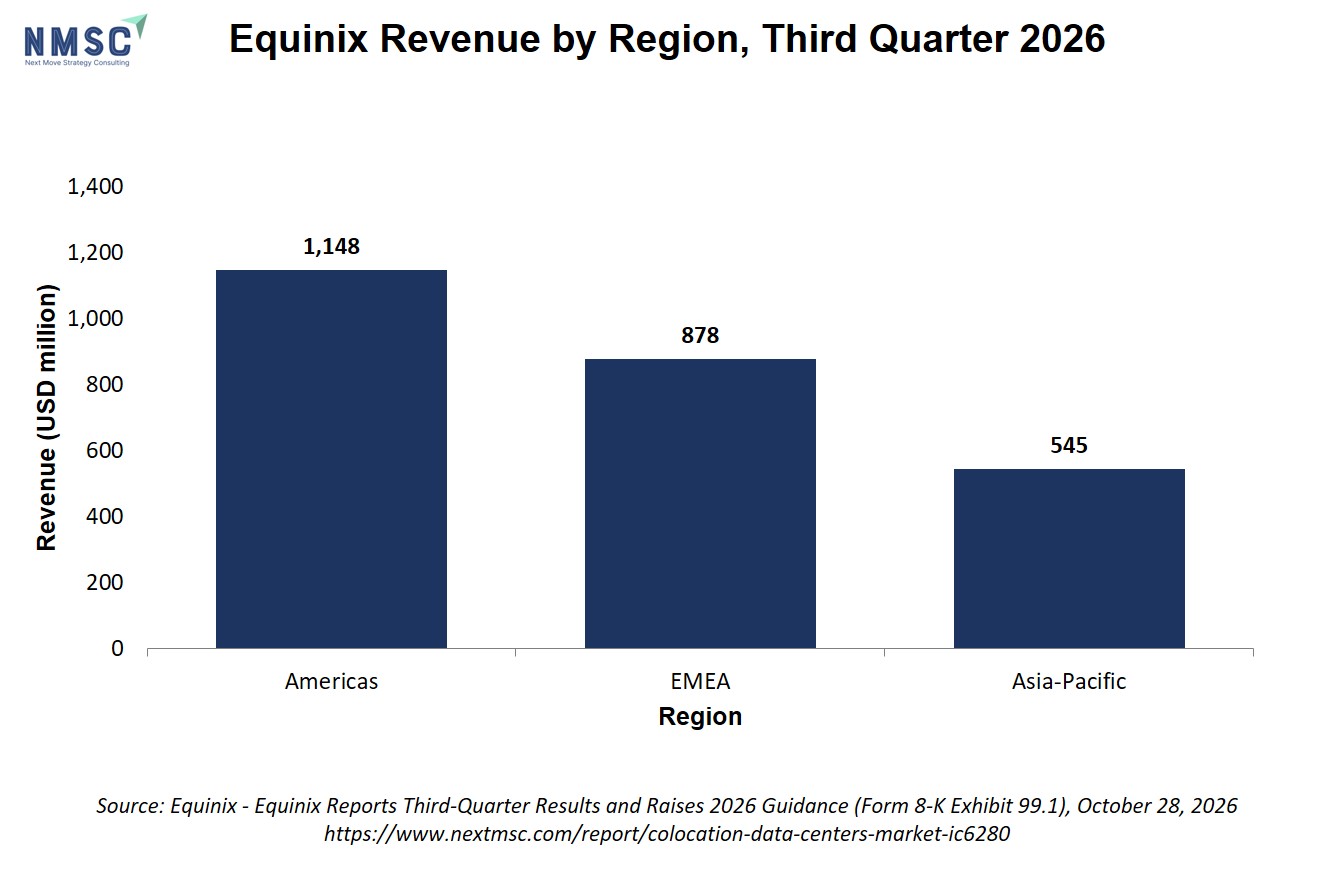
The three regions sum to the USD 2,571 million of total third-quarter revenue reported in the same filing.
Digital Realty's leasing mix shows where capacity is being committed. At the company's share, Asia Pacific led by megawatts leased at 79.7 MW, narrowly ahead of the Americas at 75.6 MW, while EMEA contributed 29.5 MW. GAAP base rent per kilowatt was USD 296 in Asia Pacific, USD 267 in the Americas and USD 220 in EMEA.
Digital Realty new leasing signed in the third quarter of 2026, by region (at Digital Realty's share)
|
Region |
Annualized GAAP base rent (USD thousand) |
Megawatts leased |
GAAP base rent per kW (USD) |
|
Americas |
242,947 |
75.6 |
267 |
|
EMEA |
78,062 |
29.5 |
220 |
|
Asia Pacific |
283,386 |
79.7 |
296 |
|
All regions |
604,395 |
184.8 |
272 |
Lease size matters as much as region. Of the 184.8 MW leased at Digital Realty's share, 143.6 MW came from leases above 1 MW, with a weighted average lease term of 17.9 years, against 41.2 MW from leases of 1 MW or less at 5.5 years. Leases above 1 MW produced USD 474.2 million of the quarter's data center bookings at Digital Realty's share, against USD 129.6 million from the smaller category.
The Financial Logic: Rent Starts After Capital Is Spent
The economics of this cycle favour operators that can fund construction before rent begins. Digital Realty reported a 17-month weighted-average lag between signing and contractual commencement for leases signed in the quarter, which places the start of rent from those bookings, on a weighted-average basis, in late 2027 or early 2028. During that gap the operator carries development cost: the supplement shows 1,464 MW under construction, 63% leased, and a 2026 outlook for net development capital expenditure of USD 4.25 billion to USD 4.75 billion. Net debt-to-Adjusted EBITDA rose to 5.2x from 4.7x at the end of June.
Equinix guides total 2026 capital expenditure of USD 5 billion to USD 6 billion and ended the quarter with USD 25.217 billion of total debt principal outstanding, while nine-month free cash flow was negative USD 801 million. Both operators are committing capital ahead of rent so that capacity exists when tenants' contracted start dates arrive.
Pricing is carrying part of that burden. Renewal rates on Digital Realty leases above 1 MW rose 26.3% on a cash basis in the quarter, against 4.7% for leases of 1 MW or less. Annualized rent of USD 1.04 billion, 20.8% of the total, expires in 2027, so about one-fifth of the rent base comes up for renewal during 2027 while renewal spreads are positive. The Equinix service-line split shows where its revenue sits.
Equinix revenue by service line, third quarter of 2026 versus third quarter of 2025 (USD million)
|
Service line |
Q3 2026 |
Q3 2025 |
|
Colocation |
1,826 |
1,637 |
|
Interconnection |
465 |
422 |
|
Managed infrastructure |
108 |
118 |
|
Other recurring |
43 |
38 |
|
Recurring revenues |
2,442 |
2,215 |
|
Non-recurring revenues |
129 |
101 |
|
Total revenues |
2,571 |
2,316 |
Key Industry Developments
On August 27, 2026, NEXTDC reported in its FY26 results announcement to the ASX that contracted utilisation rose 202% to 740.1 MW on a pro forma basis, against 175.0 MW of billing utilisation. That leaves a 565.1 MW forward order book, which the company says consists of binding contracted commitments only, and NEXTDC expects 197 MW of it to convert to billing in the 2027 financial year. Capital expenditure doubled to A$3,397 million.
“FY26 was the largest contracting year in NEXTDC's history.”
- Craig Scroggie, Chief Executive Officer and Managing Director, NEXTDC Limited, NEXTDC FY26 Results Announcement (ASX release), August 27, 2026.
NEXTDC capacity and funding metrics at 30 June 2026 versus 30 June 2025
|
Metric |
FY25 |
FY26 |
Change |
|
Contracted utilisation, pro forma (MW) |
244.8 |
740.1 |
+202% |
|
Billing utilisation (MW) |
110.9 |
175.0 |
+58% |
|
Built capacity (MW) |
207.9 |
287.9 |
+38% |
|
Forward order book, pro forma (MW) |
133.9 |
565.1 |
+322% |
|
Capital expenditure (A$ million) |
1,699 |
3,397 |
+100% |
|
Pro forma liquidity (A$ million) |
5,496 |
8,676 |
+58% |
Digital Realty is positioning land and capital for the next phase. During the quarter it acquired USD 742 million of land, including a site near Indianapolis to support more than 1 GW of IT capacity, two Chicago parcels for 360 MW and a Charlotte site for up to 600 MW. After quarter-end it agreed to acquire an additional 16% stake in Teraco for about USD 688 million, raising its ownership from 61% to about 77%, and closed USD 1.4 billion of initial cornerstone equity commitments to a perpetual capital strategy focused on stabilized North American hyperscale data centers.
Equinix completed its investment in atNorth alongside CPP Investments, strengthening its position in the Nordic market, introduced Fabric One with AWS and Google Cloud as lead integration partners, and announced Equinix Inference Exchange with NVIDIA and Together AI to support enterprise AI inferencing.
Power Is the Binding Constraint
Grid capacity is where those capital plans meet physical limits. The International Energy Agency's April 2026 update, Key Questions on Energy and AI, projects that data centre electricity consumption will roughly double from 485 TWh in 2025 to 950 TWh in 2030, about 3% of global electricity demand. Its 2025 report, Energy and AI, estimated that about 20% of planned data centre projects could be at risk of delay unless grid risks are addressed. In the United States, the Lawrence Berkeley National Laboratory's report United States Data Center Energy Usage Report: 2025 Update, published in June 2026, estimates that data centers could account for 11.8% of total U.S. electricity by 2030.
Power reference points for data center growth
|
Indicator |
Figure |
Scope and date |
|
Data centre electricity consumption, 2025 |
485 TWh |
Global, April 2026 update |
|
Data centre electricity consumption, 2030 projection |
950 TWh (about 3% of global electricity demand) |
Global, April 2026 update |
|
Planned data centre projects at risk of delay from grid constraints |
About 20% |
Global, 2025 report |
|
Data center share of total U.S. electricity by 2030 |
11.8% |
United States, June 2026 report |
Operators are answering with commercial structures as well as engineering. Equinix reports a first-of-its-kind partnership in Georgia under which it funds all grid infrastructure costs for its Hampton data center project through a 20-year commitment, and it cites more than USD 1.6 billion of long-term investment in Texas alongside state standards on grid costs, water stewardship and transparency.
Segment Dynamics
NextMSC primary research and analysis shows retail colocation, which serves cabinets and cages in interconnection-dense hubs, holding about 51% of 2026 revenue, or USD 22.40 billion. Wholesale colocation, leased in blocks of tens of megawatts to cloud, AI and enterprise tenants, is the fastest-growing type at a 13.4% CAGR from 2026 to 2035, overtakes retail in 2027 and reaches USD 66.00 billion by 2035. By service, NextMSC projects interconnection and network services to grow at an 11.8% CAGR, and cloud and hyperscale providers are the fastest-growing end users at 12.1%, rising from USD 16.80 billion in 2025 to USD 55.00 billion by 2035.
The filings are consistent with that direction. Digital Realty's leases above 1 MW carry a weighted average term of 17.9 years and supplied 143.6 of the 184.8 MW leased in the quarter, while Equinix's interconnection and Fabric revenue lines grew 10% and 24% respectively.
Regional Outlook
NextMSC primary research and analysis puts North America at USD 19.80 billion in 2026, about 45% of global revenue, with a 9.8% CAGR through 2035. Asia-Pacific is projected to grow at 10.5% from USD 11.31 billion in 2025. Europe grows at 7.5% from USD 8.19 billion, the slowest rate among regions, which NextMSC attributes to constrained grids, permitting hurdles and mandatory energy reporting. Middle East & Africa is the fastest-growing region at 16.9%, rising from USD 1.17 billion in 2025 to USD 5.50 billion by 2035, and Saudi Arabia leads countries at 18.3%. Latin America is projected to grow at 15.9%.
External data points in the same direction. Digital Realty's Asia Pacific leasing of 79.7 MW in the quarter exceeded its Americas leasing of 75.6 MW, and its Johannesburg portfolio, with 97 MW of white space, reported 80.6% occupancy at September 30, 2026.
Growth Drivers and Restraints
Large-block leasing is the clearest driver, and the evidence is in lease structure. Digital Realty's leases above 1 MW produced USD 474.2 million of data center bookings at its share in the quarter and run for 17.9 years on average, which converts a single customer decision into a long-dated revenue stream. Interconnection is the second driver: Equinix's interconnection revenue rose 10% to USD 465 million and Digital Realty booked USD 22 million of interconnection, showing that dense network hubs continue to earn premiums beside raw capacity.
Three restraints are visible in the same documents. Grid access limits delivery, as the International Energy Agency's estimate of about 20% of planned projects at risk of delay indicates. Capital intensity raises financing cost: NEXTDC doubled capital expenditure to A$3,397 million in FY26 and Digital Realty's leverage ratio rose to 5.2x. Customer concentration adds revenue risk, as the Digital Realty filing shows its 20 largest customers account for 53.5% of annualized recurring revenue.
NMSC Strategic Perspective: Deliverable Power Now Separates Operators
NextMSC primary research and analysis reads the third-quarter filings as confirmation that the binding variable in colocation has moved from demand to deliverable power. NextMSC's analysis indicates that power availability is a key consideration in site selection, alongside land availability, grid connectivity and the ability to deliver capacity on schedule. In NextMSC's driver matrix, surging AI and hyperscale leasing adds 2.6% to the forecast CAGR through 2032, while grid delays and power scarcity subtract 1.8% through 2031. They are the two largest effects in the matrix, and they pull in opposite directions.
The mechanism is visible in the reported figures. NEXTDC's forward order book is 3.2 times its billing utilisation, and Digital Realty's lag between signing and commencement is 17 months, so reported bookings describe future revenue that depends on energization. NextMSC's market evaluation found that operators with secured grid capacity convert leases faster than peers holding larger but unpowered land banks, and NextMSC's assessment is that Digital Realty's Indianapolis, Charlotte and Chicago land purchases and Equinix's Georgia grid-cost commitment should be read as attempts to secure deliverable capacity rather than simply to expand footprint.
NextMSC recommends that operators secure powered land and utility capacity before announcing campuses, preserve interconnection density in metro retail sites and use joint ventures or private credit to recycle capital. Buyers should sign renewals early in constrained metros, and vendors should design for liquid cooling and onsite power by default. The International Energy Agency's range of 700 TWh to 1,700 TWh for data centre electricity demand in 2035 across its 2025 scenarios is a reminder that demand volatility is a real downside for operators that overbuild.
Competitive Positioning
Equinix, Digital Realty and NEXTDC compete on different axes. Equinix emphasizes interconnection and ecosystem products, with Fabric revenue up 24% and 6,900 net interconnections added in the quarter. Digital Realty emphasizes large-block leasing and land, with USD 742 million of land purchased and 1,464 MW under construction. NEXTDC emphasizes contracted-capacity growth, with contracted utilisation up 202% and a 565.1 MW order book. NextMSC's analysis indicates that each strategy depends on the same input, which is power secured ahead of construction.
Customer concentration is the counterweight to scale. Digital Realty's top 20 customers account for 53.5% of annualized recurring revenue, led by a customer the filing describes as a Fortune 50 software company at 10.6% and Oracle Corporation at 9.9%. Long weighted average remaining lease terms of 8.2 years and 10.6 years for those two relationships support revenue visibility, but they also concentrate revenue in a small number of tenant relationships.
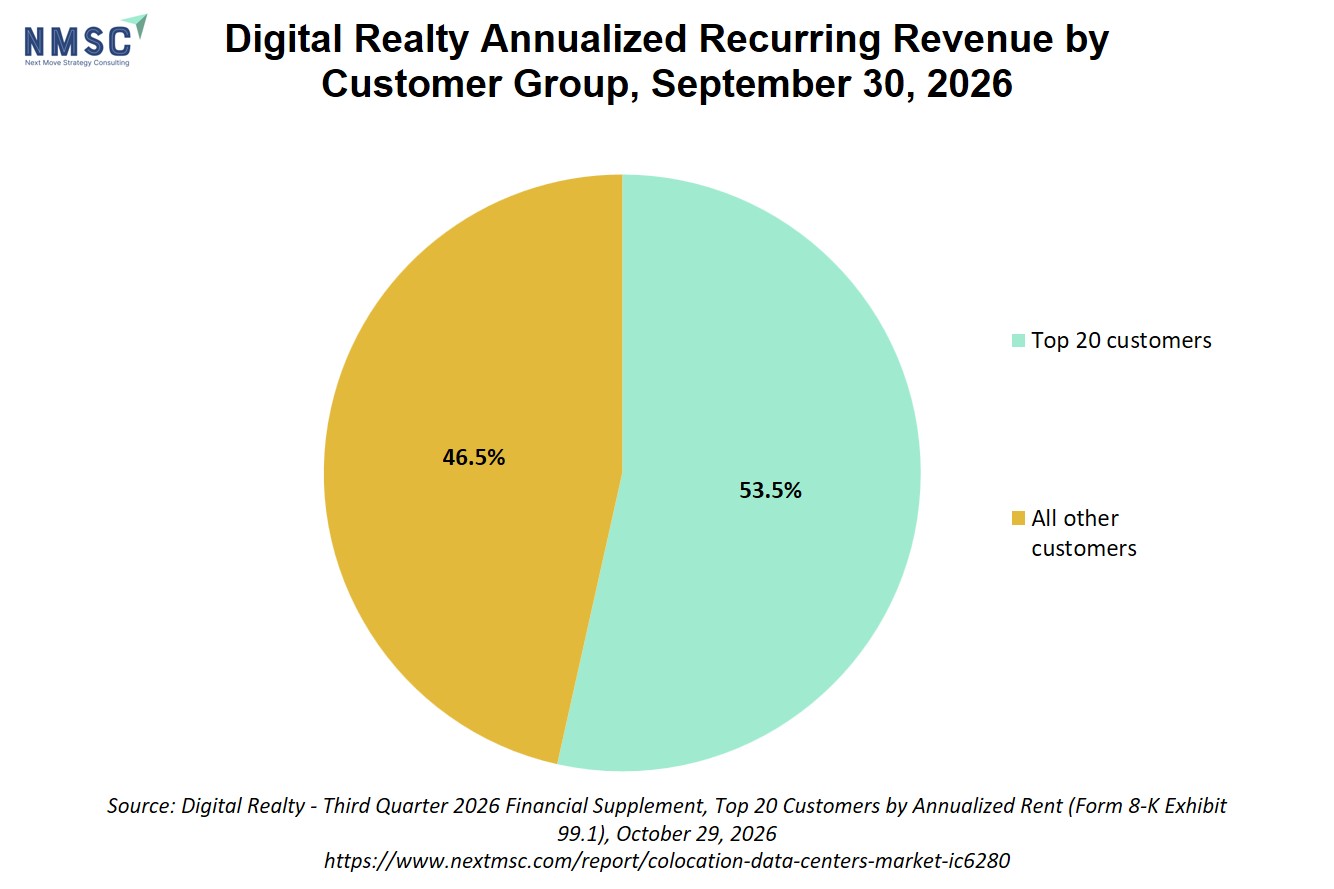
The 53.5% share for the 20 largest customers is the total reported in the Digital Realty supplement, and the remaining 46.5% is the balance of annualized recurring revenue.
Bottom Line
The third-quarter filings from Digital Realty, Equinix and NEXTDC show colocation demand contracted well ahead of delivery: record bookings of USD 855 million at Digital Realty, record annualized gross bookings of USD 533 million at Equinix and a 565.1 MW forward order book at NEXTDC. NextMSC primary research and analysis projects the market to grow from USD 39.00 billion in 2025 to USD 103.00 billion by 2035 at a 10.0% CAGR, with wholesale colocation overtaking retail in 2027 and Middle East & Africa growing fastest at 16.9%. The International Energy Agency and the Lawrence Berkeley National Laboratory both point to electricity supply as the limiting factor, so the operators best placed to turn backlog into rent are those holding secured power, funding construction at scale and managing hyperscale customer concentration. Buyers should commit capacity earlier in constrained metros, and investors should weigh backlog and power access above land holdings.
About Next Move Strategy Consulting
Next Move Strategy Consulting is a premier market research and management consulting firm that has been committed to provide strategically analysed well documented latest research reports to its clients. The research industry is flooded with many firms to choose from, what makes NMSC different from the rest is its top-quality research and the obsession of turning data into knowledge by dissecting every bit of it and providing fact-based research recommendation that is supported by information collected from over 500 million websites, paid databases, industry journals and one on one consultations with industry experts across a diverse range of industry sectors. The high-quality customized research reports with actionable insights and excellent end-to-end customer service help our clients to take critical business decisions that enables them to move beyond time and have competitive edge in the industry.
We have been servicing over 1000 customers globally that includes 90% of the Fortune 500 companies over a decade. Our analysts are constantly tracking various high growth markets and identifying hidden opportunities in each sector or the industry. We provide one of the industry’s best quality syndicate as well as custom research reports across 10 different industry verticals. We are committed to deliver high quality research solutions in accordance to your business needs. Our industry standard delivery solutions that ranges from the pre consultation to after-sales services, provide an excellent client experience and ensure right strategic decision making for businesses.
For more information, please contact:
Next Move Strategy Consulting
5th Floor 867 Boylston St, STE 500,
Boston, MA 02116, U.S.
E-Mail: [email protected]
Direct: +1-217-650-7991
Website: www.nextmsc.com
About the Author
 Sanyukta Deb
— Sanyukta Deb is Digital Marketing Team Lead at Next Move Strategy Consulting, where she has led content strategy and technical SEO for the firm's B2B market research publications for over 2 years. Her editorial process translates NextMSC's primary and secondary research — spanning technology, industrial, and consumer sectors — into commercial narratives, backed by search-intent, keyword, and competitive analysis. She brings 5 years of overall experience in digital marketing and content strategy.
About the Reviewer
 Debashree Dey
— Debashree Dey is Assistant Manager at Next Move Strategy Consulting, where she supports cross-vertical market content and communications across diverse industries for 6 years. Her professional background includes senior content writing, communications, and published manuscript authorship, with experience developing audience-focused business narratives and maintaining clear, consistent messaging. Her role supports research-led content development and editorial quality across NextMSC publications.
















Add Comment