Construction Robotics Integration Reshapes Global Jobsite Intelligence
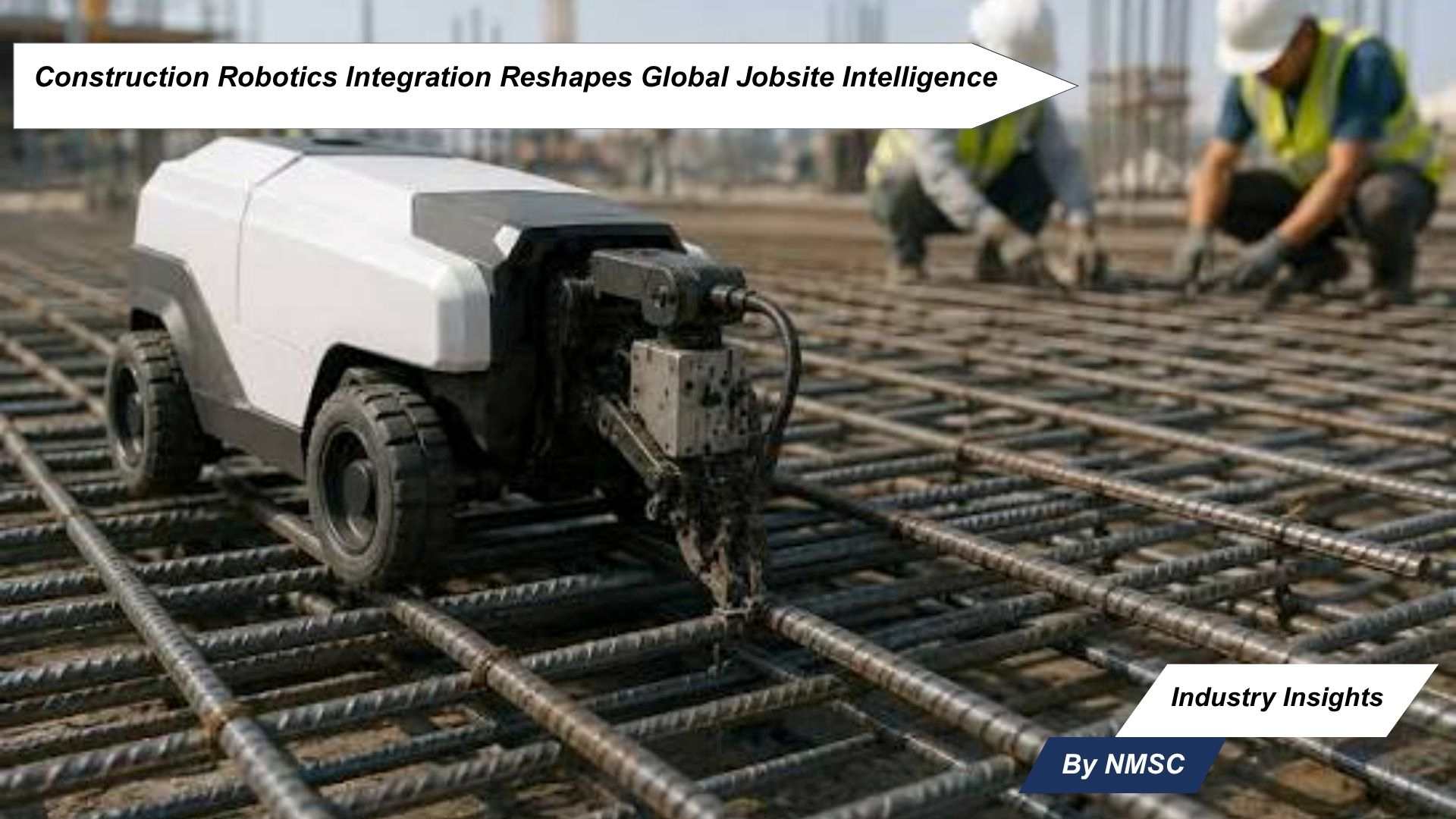
Construction Robots and AI Integration Redefine Jobsite Productivity as Industry Eyes $242M Market
LONDON, United Kingdom — August 16, 2026 — A comprehensive industry analysis published by Highways.Today has identified a fundamental shift in how construction robotics and integrated digital systems are reshaping global project delivery, signalling a pivotal moment for the Construction Robot Market as autonomous machines, AI agents, and connected sensing platforms converge into a unified operational architecture across major construction programmes worldwide.
The analysis, titled "Building the Invisible Jobsite," argues that the most consequential transformation in construction is not the arrival of any single robot or software platform, but rather the integration of autonomous machines, cloud data environments, edge computing, digital twins, and AI agents into a coordinated system — one whose intelligence is largely invisible from the project perimeter.
According to McKinsey data cited in the report, global construction output stands at approximately US$15 trillion and is projected to reach US$22 trillion by 2040. Yet construction productivity grew at only 0.4% per year between 2000 and 2022, compared with roughly 3% annually in manufacturing — a gap that industry leaders increasingly attribute to the absence of integrated digital and robotic capability rather than a shortage of individual tools.
Key Highlights:
-
Autonomous layout robots such as Dusty Robotics' FieldPrinter and HP SitePrint are delivering measurable results: on a 70,000-square-foot Skanska medical project, Dusty Robotics reported 50% faster layout that helped reduce the programme by three months, while on Turner's New Canaan Library in Connecticut, one operator completed approximately 42,000 square feet of layout in five days.
-
Heavy autonomous machines, exemplified by Built Robotics' RPD 35, are executing autonomous solar piling at up to five times conventional productivity, with onboard RTK positioning and vision processing operating independently of remote servers.
-
Connected-worker sensing has reached industrial scale, with WakeCap reporting coverage of more than 100,000 workers across 78 mega-projects at NEOM Oxagon, alongside a reported 60-percentage-point reduction in ghost-worker hours.
-
AI agents are commercially active in project documentation and controls, with Procore advertising more than 18 job-specific agents and over 90 platform connectors, while Oracle extended its Primavera Cloud platform with a new MCP Server resource in August 2026 to bring agents closer to project-control workflows.
Analyst Insight:
According to analysts at Next Move Strategy Consulting, the construction robot market —projected to reach USD 242.38 million by 2030 at a CAGR of 11.8% — is entering a phase where integration capability, rather than individual robotic hardware, will determine competitive differentiation. NMSC analysts note that the convergence of autonomous mobile robots, AI-enhanced quality assurance, and cloud-connected project platforms is accelerating adoption across both commercial and infrastructure construction segments, with North America continuing to hold the largest regional market share driven by government investment and rising demand for worker safety solutions.
Industry Outlook:
The Highways.Today analysis frames the construction robotics opportunity through what it terms an "integration dividend" — the compounding return that accrues when autonomous machines, spatial positioning systems, digital twins, and AI agents are connected through governed data architectures rather than deployed in isolation. The report identifies a sequential build order — Govern, Standardise, Digitise, Instrument, Connect, Twin, Interpret, Automate — as the framework most likely to generate durable returns, noting that programmes which stall midway still leave projects ahead of those that never began.
As the construction industry confronts persistent labour shortages, rising project complexity, and growing pressure to improve productivity, the deployment of integrated robotic and AI systems is expected to accelerate across residential, commercial, and infrastructure segments. The trajectory points toward a construction sector where autonomous capability is embedded in project operations rather than piloted at the margins — a shift that analysts and industry leaders alike regard as both commercially necessary and technically achievable within the current decade.
Source: Highways.Today
For More Information: Download FREE Sample on Construction Robot Market Report
Prepared By: Sanyukta Deb
About the Author
 Sanyukta Deb
— Sanyukta Deb is Digital Marketing Team Lead at Next Move Strategy Consulting, where she has led content strategy and technical SEO for the firm's B2B market research publications for over 2 years. Her editorial process translates NextMSC's primary and secondary research — spanning technology, industrial, and consumer sectors — into commercial narratives, backed by search-intent, keyword, and competitive analysis. She brings 5 years of overall experience in digital marketing and content strategy.
Sanyukta Deb
— Sanyukta Deb is Digital Marketing Team Lead at Next Move Strategy Consulting, where she has led content strategy and technical SEO for the firm's B2B market research publications for over 2 years. Her editorial process translates NextMSC's primary and secondary research — spanning technology, industrial, and consumer sectors — into commercial narratives, backed by search-intent, keyword, and competitive analysis. She brings 5 years of overall experience in digital marketing and content strategy.
About the Reviewer
 Debashree Dey
— Debashree Dey is Assistant Manager at Next Move Strategy Consulting, where she supports cross-vertical market content and communications across diverse industries for 6 years. Her professional background includes senior content writing, communications, and published manuscript authorship, with experience developing audience-focused business narratives and maintaining clear, consistent messaging. Her role supports research-led content development and editorial quality across NextMSC publications.
Debashree Dey
— Debashree Dey is Assistant Manager at Next Move Strategy Consulting, where she supports cross-vertical market content and communications across diverse industries for 6 years. Her professional background includes senior content writing, communications, and published manuscript authorship, with experience developing audience-focused business narratives and maintaining clear, consistent messaging. Her role supports research-led content development and editorial quality across NextMSC publications.

















Add Comment