Construction Robots Market: AI & Humanoids Driving Growth
Lede
Three major developments – a European startup raising fresh funding to automate concrete repair, industrial giants deploying AI-powered robotic micro factories to rebuild wildfire-affected homes in California, and growing industry preparation for humanoid robots on jobsites – together signal that the Construction Robots Market is shifting from experimental automation toward scalable, real-world deployment.
Collectively, these developments highlight technological progress (adaptive AI systems and mobile robotic factories), structural drivers (labour shortages and disaster recovery demands), and strategic challenges (integration, cost optimization, and workforce readiness). The result is a market that is transitioning from isolated robotics tools to end-to-end construction automation ecosystems.
1. Sitegeist Raises €4M to Automate Concrete Repair
Munich-based startup Sitegeist has secured €4 million in pre-seed funding to commercialize AI-driven modular construction robots focused on concrete renovation and repair. The company’s systems are designed to operate in complex, unstructured environments – such as aging bridges, tunnels, and industrial structures – without requiring fully digitized site models.
Concrete rehabilitation remains one of the most labour-intensive and capacity-constrained segments of global construction. Infrastructure across Europe and North America faces mounting maintenance backlogs, yet skilled labor availability continues to tighten. Sitegeist’s robotic platform aims to automate tasks such as concrete removal, surface preparation, and drilling, enabling faster turnaround while reducing physical strain and safety risks for workers.
A notable feature is the robot’s ability to adapt in real-time using embedded sensing and AI-based decision systems. Rather than relying on standardized site conditions, the platform adjusts to irregular geometries and variable material states.
This development indicates a broader trend within the Construction Robots Market: robotics is increasingly targeting renovation and infrastructure maintenance – not just new-build construction.
2. ABB and Cosmic Deploy AI-Powered Robotic Microfactories
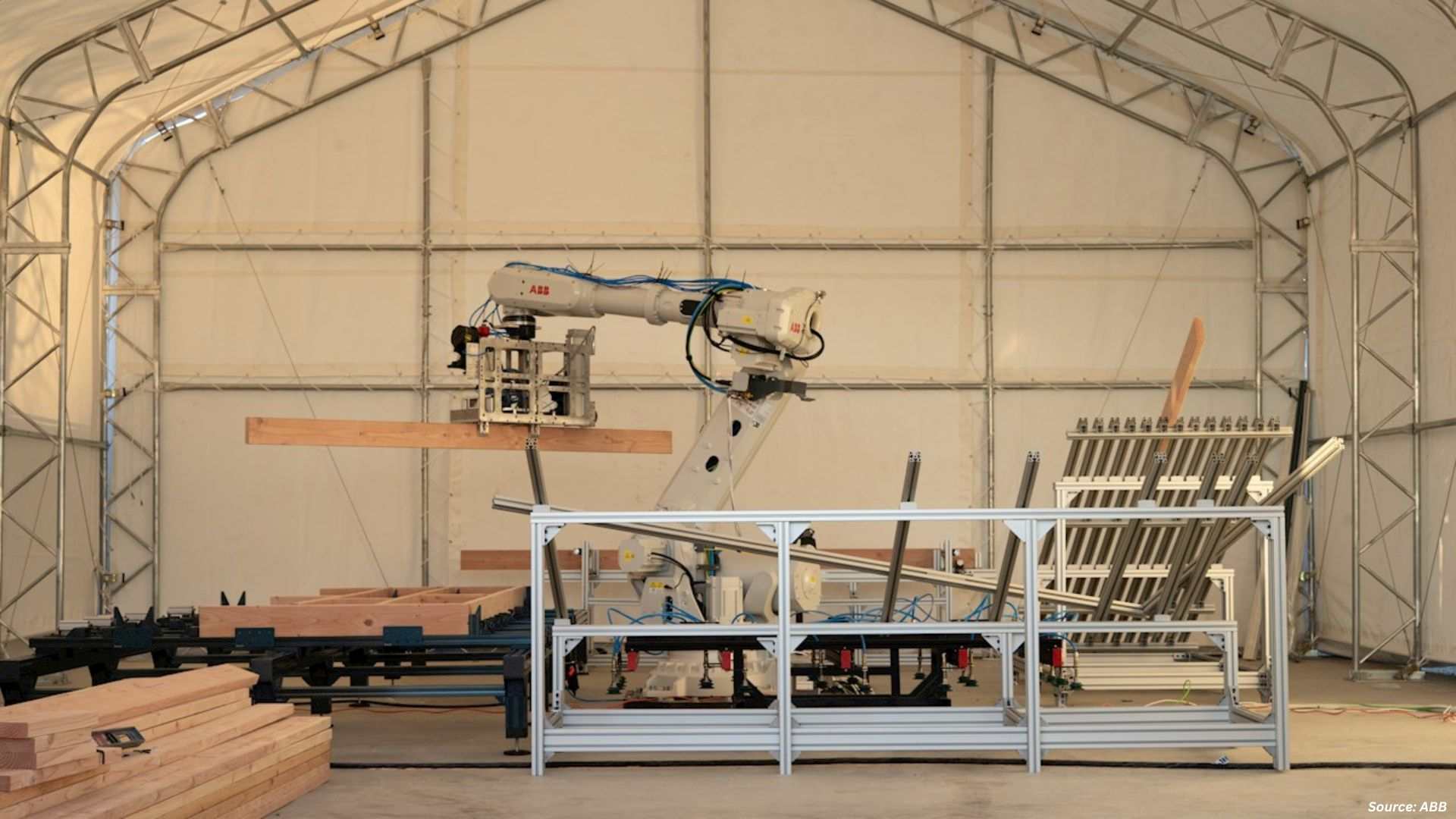
In the United States, ABB Robotics partnered with Cosmic Buildings to deploy AI-powered robotic systems to rebuild homes in wildfire-affected areas of Los Angeles.
The collaboration centers on a mobile robotic microfactory capable of manufacturing building components on-site. By integrating robotics, AI, and digital twin technologies, the system fabricates structural panels with high precision and accelerates assembly timelines. Reports indicate the approach can reduce construction time significantly while lowering costs compared to traditional site-built methods.
Beyond speed and cost efficiency, the model introduces resilience into housing reconstruction. Robotic precision improves structural consistency, while digital workflows enable optimized material use and reduced waste.
This marks an important inflection point for the Construction Robots Market. Automation is no longer confined to factory prefabrication plants; it is moving directly onto construction sites through mobile, AI-integrated systems. The shift toward “construction-as-a-platform” models could redefine how residential and disaster-recovery projects are executed globally.
3. Preparing for Humanoid Robots on Construction Sites
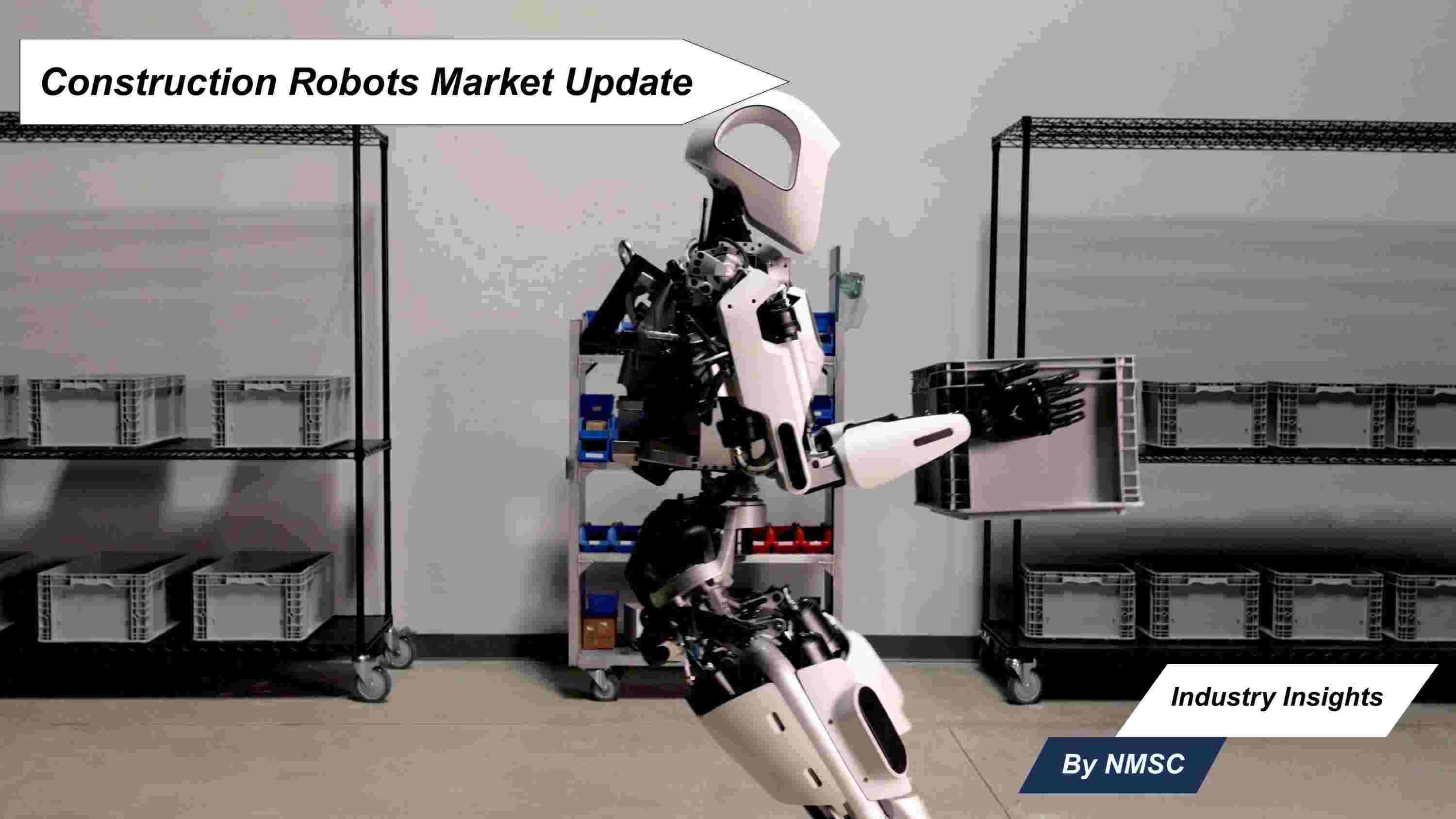
Industry discussions, including insights from McKinsey & Company, suggest that contractors should begin preparing for humanoid robots on jobsites. While widespread adoption may still be years away, early experimentation is already underway.
Humanoid systems – equipped with dexterous manipulation, vision systems, and embodied AI – could perform repetitive or hazardous tasks such as material handling, inspection, and finishing work.
The significance lies less in immediate deployment and more in strategic readiness. Construction productivity growth has historically lagged behind other sectors. With labor shortages intensifying in major markets, humanoid robotics represents a potential long-term structural solution rather than a short-term novelty.
For the Construction Robots Market, this signals a future phase where multi-functional, adaptable robots complement purpose-built machines, potentially expanding automation deeper into site workflows.
4. Next Move Strategy Consulting – Opinion, Impact and Near-Term Prospects
Next Move Strategy Consulting interprets these developments as indicators of a market entering its operational maturity phase, where value creation depends on integration capability rather than standalone hardware innovation.
-
Automation is moving beyond pilot projects: Robotics is transitioning from demonstration sites to commercial-scale applications, particularly in renovation and housing reconstruction.
-
Infrastructure rehabilitation as a growth engine: Aging assets in developed economies will drive sustained demand for robotic repair and inspection systems, creating recurring revenue models.
-
Disaster recovery and resilience as adoption accelerators: Climate-related reconstruction projects provide high-visibility use cases for robotic microfactories, accelerating acceptance among public and private stakeholders.
-
Human-robot collaboration will define the next phase: Humanoid robots and adaptive systems are expected to augment – not replace – human labor, particularly in hazardous and repetitive tasks.
-
Integration services gaining strategic importance: As robotics becomes embedded into digital construction workflows (BIM, AI analytics, IoT), value will increasingly shift toward system integration, data management, and lifecycle services.
-
Investment outlook strengthening: Companies with scalable robotic platforms, AI integration capabilities, and site-deployable manufacturing systems are likely to attract sustained investor interest and strategic partnerships.
5. Practical Suggestions for Stakeholders
-
Construction firms should pilot robotic systems in high-risk or labor-intensive workflows first, where ROI visibility is strongest.
-
Robotics manufacturers should prioritize modular, adaptable platforms that integrate with BIM and digital twin environments.
-
Investors should assess not just hardware performance but ecosystem readiness, including AI software layers and deployment scalability.
-
Policymakers should support regulatory frameworks and workforce training programs that enable safe human-robot collaboration on jobsites.

Conclusion
The convergence of AI-enabled repair robots, mobile robotic microfactories, and forward-looking humanoid systems reflects a structural shift in the Construction Robots Market. What was once experimental automation is rapidly evolving into deployable infrastructure capable of reshaping how buildings are repaired, constructed, and rebuilt.
As robotics integrates deeper into digital construction ecosystems, the competitive advantage will lie with companies that combine technical innovation with scalability, workforce alignment, and operational integration.
The Construction Robots Market is no longer defined solely by mechanization – it is increasingly defined by intelligent, adaptive systems capable of transforming construction from a labor-intensive sector into a digitally enabled industry.
About Next Move Strategy Consulting:
Next Move Strategy Consulting is a premier market research and management consulting firm that has been committed to providing strategically analysed well documented latest research reports to its clients. The research industry is flooded with many firms to choose from, what makes Next Move different from the rest is its top-quality research and the obsession of turning data into knowledge by dissecting every bit of it and providing fact-based research recommendation that is supported by information collected from over 500 million websites, paid databases, industry journals and one on one consultations with industry experts across a diverse range of industry sectors. The high-quality customized research reports with actionable insights and excellent end-to-end customer service help our clients to take critical business decisions that enables them to move beyond time and have competitive edge in the industry.
We have been servicing over 1000 customers globally that includes 90% of the Fortune 500 companies over a decade. Our analysts are constantly tracking various high growth markets and identifying hidden opportunities in each sector or the industry. We provide one of the industry’s best quality syndicate as well as custom research reports across 10 different industry verticals. We are committed to deliver high quality research solutions in accordance to your business needs. Our industry standard delivery solutions that ranges from the pre consultation to after-sales services, provide an excellent client experience and ensure right strategic decision making for businesses.
For more information please contact:
Next Move Strategy Consulting
5th Floor 867
Boylston St, STE 500,
Boston, MA 02116, U.S.
E-Mail: [email protected]
Direct: +1-857-758-5017
Website: www.nextmsc.com
About the Author
 Sanyukta Deb
— Sanyukta Deb is Digital Marketing Team Lead at Next Move Strategy Consulting, where she has led content strategy and technical SEO for the firm's B2B market research publications for over 2 years. Her editorial process translates NextMSC's primary and secondary research — spanning technology, industrial, and consumer sectors — into commercial narratives, backed by search-intent, keyword, and competitive analysis. She brings 5 years of overall experience in digital marketing and content strategy.
Sanyukta Deb
— Sanyukta Deb is Digital Marketing Team Lead at Next Move Strategy Consulting, where she has led content strategy and technical SEO for the firm's B2B market research publications for over 2 years. Her editorial process translates NextMSC's primary and secondary research — spanning technology, industrial, and consumer sectors — into commercial narratives, backed by search-intent, keyword, and competitive analysis. She brings 5 years of overall experience in digital marketing and content strategy.
About the Reviewer
 Debashree Dey
— Debashree Dey is Assistant Manager at Next Move Strategy Consulting, where she supports cross-vertical market content and communications across diverse industries for 6 years. Her professional background includes senior content writing, communications, and published manuscript authorship, with experience developing audience-focused business narratives and maintaining clear, consistent messaging. Her role supports research-led content development and editorial quality across NextMSC publications.
Debashree Dey
— Debashree Dey is Assistant Manager at Next Move Strategy Consulting, where she supports cross-vertical market content and communications across diverse industries for 6 years. Her professional background includes senior content writing, communications, and published manuscript authorship, with experience developing audience-focused business narratives and maintaining clear, consistent messaging. Her role supports research-led content development and editorial quality across NextMSC publications.

















Add Comment