UNEP Report Accelerates Living Building Materials Demand

UNEP's Landmark 2025–2026 Buildings Report Exposes a USD 5.9 Trillion Investment Gap, Catalyzing Global Demand for Living Building Materials as the Market Targets USD 136.08 Billion by 2030
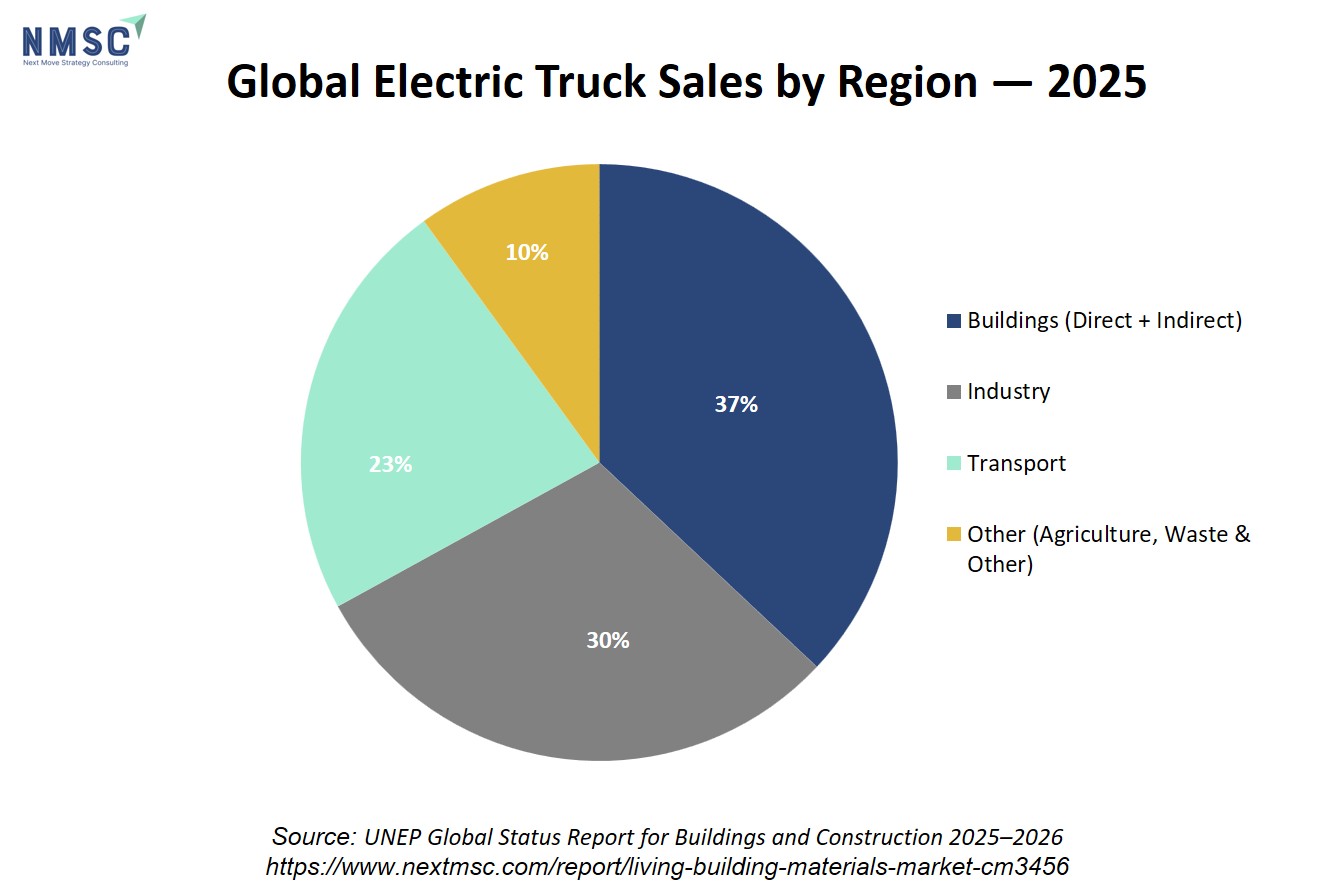
On May 19, 2026, the United Nations Environment Programme (UNEP) and the Global Alliance for Buildings and Construction (GlobalABC) released the tenth edition of the Global Status Report for Buildings and Construction 2025–2026, launched at the 13th session of the World Urban Forum in Nairobi. The report delivers an unambiguous institutional verdict: the global buildings and construction sector — responsible for 37 per cent of global CO₂ emissions, approximately 50 per cent of global material extraction, and 28 per cent of global energy consumption — is critically off track on its decarbonisation trajectory, and the gap between current investment and what is required is widening.
Buildings' operational emissions increased by 1 per cent in 2024, reaching 9.9 GtCO₂ — a figure that underscores the sector's persistent failure to decouple construction growth from carbon output. Investment in building energy efficiency reached USD 275 billion in 2024, contributing to a cumulative USD 2.3 trillion since 2015 — yet UNEP calculates that investment must reach USD 5.9 trillion by 2030, equivalent to USD 592 billion annually, to align the sector with a net-zero pathway.
"Buildings can either lock in climate risks or deliver safer, healthier, and more affordable living conditions," stated Inger Andersen, Executive Director of UNEP. "With half of the world's buildings yet to be built or renovated by 2050, governments have a critical opportunity to drive zero-emission, resilient construction through better policies, codes, and investment."
For the global Living Building Materials Market, this institutional reckoning represents a structural demand catalyst of the highest order. The UNEP report's explicit call for accelerated adoption of low-embodied-carbon, bio-based, and regenerative construction materials — combined with the scale of the investment gap it identifies — is expected to reshape procurement frameworks, regulatory standards, and capital allocation across the global construction industry for the remainder of this decade.
For More Information: Download FREE Sample on Living Building Materials Market Report
A Market at Structural Inflection: Scale, Velocity, and Biological Innovation
The living building materials industry — encompassing wood-based products, agricultural and plant-based materials, mycelium and algae-based composites, bio-concrete, natural fiber systems, and bio-polymers — is entering a decisive phase of commercial expansion. Valued at USD 33.85 billion in 2024 and projected to reach USD 42.68 billion in 2025, the market is forecast to more than triple to USD 136.08 billion by 2030, registering a compound annual growth rate (CAGR) of 21.6% over the 2025–2030 forecast period, according to analysis by Next Move Strategy Consulting (NMSC).
This trajectory is underpinned by three converging structural forces: accelerating global urbanization that is generating unprecedented demand for new construction; tightening regulatory frameworks that are mandating lower embodied carbon and higher material sustainability standards; and a wave of biological and materials science innovation that is rapidly improving the performance, scalability, and cost-competitiveness of bio-based construction alternatives.
Every day, the world builds an estimated 12.7 million square metres of floor area — roughly the equivalent of adding the entire city of Paris in new floor space nearly every week. In 2024 alone, global buildings floor area expanded by 1.7 per cent, reaching 273 billion square metres, driven largely by construction in emerging economies including India and Southeast Asia. This construction velocity is the primary demand engine for living building materials.
UNEP's Investment Gap: The Policy Imperative Driving Bio-Based Material Adoption
The UNEP 2025–2026 report's findings carry direct and measurable implications for the living building materials sector. The report identifies embodied carbon — the emissions released during the extraction, manufacturing, transportation, and installation of construction materials — as one of the most underaddressed dimensions of the buildings sector's climate impact.
The European Union has already deployed policies tackling both operational emissions and embodied emissions, while updated building energy codes have been enacted in California, Kenya, Japan, and Singapore. Green building certifications have nearly tripled globally since 2015, and national roadmaps supporting sector transformation are now active in Bangladesh, India, Indonesia, Jordan, Ghana, and Senegal.
Simultaneously, the European Commission adopted a new Strategic Framework for a Competitive and Sustainable EU Bioeconomy in November 2025, which explicitly identifies bio-based construction materials — including bamboo, hemp, straw, and mycelium composites — as a critical cluster of materials with substantial potential for reducing the construction sector's carbon footprint. The EU's revised Construction Products Regulation, effective from 2025, requires digital material passports for large infrastructure projects, creating a formal traceability and sustainability disclosure framework that bio-based material suppliers are uniquely positioned to satisfy.
UNEP Global Status Report for Buildings and Construction 2025–2026 — Key Sector Indicators
|
Indicator |
Value |
Unit |
Reference Period |
|
Buildings Sector Share of Global CO₂ Emissions |
37% |
% of global total |
2024 |
|
Buildings Sector Share of Global Material Extraction |
~50% |
% of global total |
2024 |
|
Buildings Sector Share of Global Energy Consumption |
28% |
% of global total |
2024 |
|
Buildings Sector Contribution to Global GDP |
11–13% |
% of global GDP |
2024 |
|
Buildings Sector Share of Global Workforce |
~9% |
% of world's workforce |
2024 |
|
Buildings Operational CO₂ Emissions |
9.9 |
GtCO₂ |
2024 |
|
Global Buildings Floor Area |
273 |
Billion sq metres |
2024 |
|
Daily New Floor Area Added Globally |
12.7 |
Million sq metres/day |
2024 |
|
Renewables Share of Buildings Energy Demand |
17.3% |
% of buildings energy |
2024 |
|
Investment in Buildings Energy Efficiency |
USD 275 billion |
USD Billion |
2024 |
|
Cumulative Investment in Energy Efficiency (since 2015) |
USD 2.3 trillion |
USD Trillion |
2015–2024 |
|
Investment Required by 2030 (net-zero pathway) |
USD 5.9 trillion |
USD Trillion |
By 2030 |
|
Building Energy Intensity Reduction (since 2015) |
8.5% |
% reduction |
2015–2024 |
|
Green Building Certifications Growth (since 2015) |
Nearly tripled |
Index |
2015–2024 |
Scientific Breakthrough: ETH Zurich's Carbon-Sequestering Living Material
The commercial momentum of the living building materials sector is being reinforced by a landmark scientific development. In June 2025, researchers at ETH Zurich published findings in Nature Communications demonstrating the development of a novel living construction material capable of actively capturing carbon dioxide from the atmosphere while simultaneously exhibiting self-healing properties. The material incorporates photosynthetic cyanobacteria embedded within a mineral scaffold, enabling dual carbon sequestration through both biological photosynthesis and mineral carbonation.
"Researchers are developing a living material that actively extracts carbon dioxide from the atmosphere," ETH Zurich reported, noting that the photosynthetic cyanobacteria embedded in the material enable it to function as a carbon sink rather than a carbon source — a fundamental inversion of the conventional relationship between construction materials and atmospheric CO₂.
This breakthrough directly validates the NMSC market thesis that the integration of bio-based organisms — including bacteria, algae, and fungi — into building materials represents one of the most significant near-term opportunities in the living building materials sector. The ETH Zurich research, published in a peer-reviewed journal and cited 43 times within months of publication, signals that the scientific foundation for next-generation living materials is maturing rapidly toward commercial readiness.
Urbanization as the Primary Demand Engine
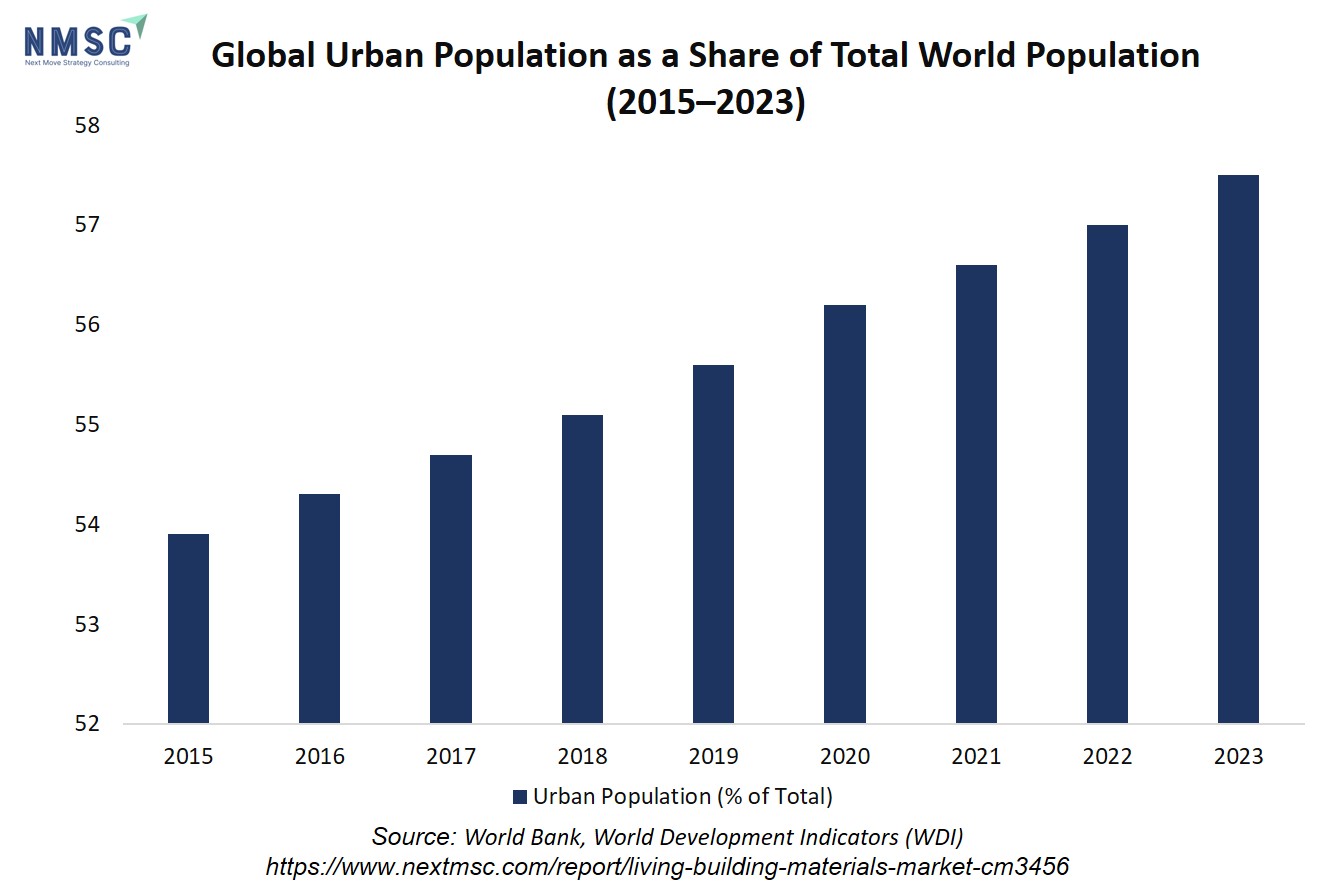
Rapid urbanization is the most powerful structural driver of the living building materials market. According to the World Bank, the global urban population now represents 57.5 per cent of the world's total population — up from 53.9 per cent in 2015 — with urban concentration particularly pronounced in key markets: 84 per cent of the United States population and 37 per cent of India's population reside in urban areas.
As urban populations expand, the demand for residential, commercial, and infrastructure development rises sharply, accelerating the need for sustainable and eco-friendly building materials. Bio-based building materials, derived from renewable resources, provide an environmentally responsible alternative to conventional materials by lowering carbon footprints and enhancing energy efficiency — directly addressing the regulatory and sustainability mandates that are increasingly embedded in urban development frameworks globally.
Global Urban Population by Region — Share of Total Regional Population (2023)
|
Region |
Urban Population (% of Total) |
Urban Population (Billions) |
|
North America |
82.7% |
0.31 |
|
Latin America & Caribbean |
81.9% |
0.54 |
|
Europe |
75.3% |
0.56 |
|
Oceania |
68.4% |
0.03 |
|
World Average |
57.5% |
4.70 |
|
Asia |
52.3% |
2.44 |
|
Africa |
44.3% |
0.63 |
Market Segmentation: Wood-Based Products Lead, Mycelium and Bio-Concrete Accelerate
The living building materials market is segmented across material type, construction type, application, distribution channel, and end user. Wood-based products currently represent the most commercially mature segment, supported by established supply chains, well-developed building codes, and broad architect and developer familiarity. Agricultural and plant-based materials — including hempcrete, bamboo composites, and straw-bale systems — are gaining rapid traction as regulatory frameworks in Europe and North America increasingly recognize their embodied carbon advantages.
Mycelium and algae-based living materials represent the highest-growth frontier segment, driven by their unique combination of self-healing properties, carbon sequestration capability, and biodegradability. Bio-concrete — which utilizes bacteria to precipitate calcium carbonate and self-repair structural cracks — is transitioning from laboratory demonstration to early commercial deployment, with applications in infrastructure, residential, and industrial construction.
By construction type, new construction currently dominates market demand, though the renovation and retrofit segment is accelerating as governments enforce stricter energy performance standards for existing building stock. By end user, the commercial segment is the largest revenue contributor, while the industrial and infrastructure segment is the fastest-growing, driven by public procurement mandates and large-scale government infrastructure programs.
Corporate Landscape: Innovation, Scale, and Strategic Positioning
The competitive structure of the living building materials industry is characterized by a mix of established specialty material suppliers, innovative bio-technology startups, and large-format construction material companies expanding their sustainable product portfolios.
Seratech has emerged as a notable innovator, unveiling progress on its carbon-neutral brick prototype developed using captured industrial CO₂ to replace traditional cement and clay inputs. The company has been conducting live technology demonstrations and engaging directly with concrete and brick manufacturers to explore commercial integration — positioning itself as an upstream decarbonization solution targeting large-scale displacement of high-emission materials.
Hempitecture Inc. and Hemp Block are advancing hempcrete and hemp-based insulation systems in the North American market, leveraging the material's superior thermal performance and negative embodied carbon profile. Sika AG, one of the world's largest specialty construction chemicals companies, is expanding its bio-based admixture and sealant portfolio to capture the growing demand for sustainable construction chemistry. Basilisk is commercializing self-healing concrete technology using bacterial agents, targeting infrastructure applications where maintenance costs and structural longevity are primary procurement criteria.
The EU's New European Bauhaus initiative has issued calls for proposals specifically targeting bio-fabricated construction materials, providing grant funding and market visibility for companies developing innovative bio-based solutions — a policy mechanism that is accelerating the commercialization pipeline across European markets.
Regional Outlook: North America Leads on Regulation, Asia-Pacific Leads on Volume
North America remains the most commercially mature regional market for living building materials, driven by strict environmental regulations, green building standards, and the widespread adoption of LEED (Leadership in Energy and Environmental Design) certification. Government programs and incentives for green building practices encourage developers to adopt eco-friendly materials, with bio-based building materials in high demand to comply with evolving state and federal sustainability mandates. Updated building energy codes in California — among the most stringent in the world — are creating durable procurement pathways for validated bio-based products.
Europe's market is shaped by the EU Green Deal, the EU Bioeconomy Strategy, and the revised Construction Products Regulation, which collectively create a comprehensive regulatory architecture favoring bio-based, low-embodied-carbon materials. The European Commission's November 2025 Strategic Framework for a Competitive and Sustainable EU Bioeconomy has elevated bio-based construction materials to a formal policy priority, with bamboo, hemp, straw, and mycelium identified as critical material clusters.
Asia-Pacific is the fastest-growing regional market, driven by the sheer scale of construction activity in China, India, and Southeast Asia. Rapid urbanization, expanding middle-class populations, and rising environmental awareness are driving strong adoption of bio-based building materials. Government sustainability mandates in Japan, South Korea, and Singapore are creating structured demand for certified green materials, while India's construction boom — underpinned by its Smart Cities Mission and affordable housing programs — is generating substantial volume demand for cost-competitive bio-based alternatives.
The Rest of the World segment, encompassing Latin America, the Middle East, and Africa, is driven by rising energy costs, growing environmental awareness, and increasing focus on energy-efficient construction. UNEP's identification of national roadmaps in Bangladesh, India, Indonesia, Jordan, Ghana, and Senegal as positive examples of sector transformation signals that emerging market governments are creating the policy infrastructure necessary to support bio-based material adoption at scale.
Restraints and Risk Factors: Expertise Costs and Standardization Gaps
Despite its compelling growth trajectory, the living building materials market faces meaningful structural headwinds. The high cost of specialized expertise required for handling, installing, and maintaining bio-based materials remains a significant restraint, particularly in cost-sensitive markets where conventional materials benefit from decades of established supply chains, contractor familiarity, and standardized building codes.
The limited availability of trained professionals who understand the unique properties of bio-based materials increases project costs and complexity, discouraging adoption among developers operating under tight margin constraints. Regulatory fragmentation — with bio-based material standards varying significantly across jurisdictions — creates compliance complexity for manufacturers seeking to scale across multiple markets. The absence of universally recognized performance benchmarks for novel materials such as mycelium composites and bio-concrete further slows procurement decision-making among risk-averse institutional buyers.
Addressing these barriers requires coordinated investment in professional training programs, accelerated development of international material standards, and the publication of robust real-world performance data that enables architects, engineers, and procurement officers to specify bio-based materials with confidence.
Bottom Line
The living building materials market stands at a structural inflection point defined by three simultaneous and mutually reinforcing forces: a landmark UNEP institutional mandate that has quantified a USD 5.9 trillion investment gap in building sector decarbonisation and placed embodied carbon reduction at the center of global construction policy; a wave of scientific breakthroughs — exemplified by ETH Zurich's carbon-sequestering living material — that are rapidly advancing the performance frontier of bio-based construction; and an accelerating global urbanization trajectory that is generating unprecedented construction volume demand across emerging and developed markets alike.
For investors, the market's projected expansion from USD 42.68 billion in 2025 to USD 136.08 billion by 2030 at a 21.6% CAGR represents a durable, policy-anchored growth opportunity with strong tailwinds from regulatory mandates, green building certification growth, and rising institutional procurement standards. The primary risks — specialized expertise costs, regulatory fragmentation, and standardization gaps — are manageable for well-capitalized players with strong technical capabilities and established regulatory relationships.
For strategic executives, the imperative is to invest in workforce development, pursue international material certification, and build the evidence base of real-world performance data that converts regulatory intent into commercial procurement. The UNEP report has effectively placed bio-based and living building materials at the center of the global construction sector's decarbonisation agenda — a development that will reshape material specifications, procurement frameworks, and capital allocation across every major geography through 2030 and beyond.
About Next Move Strategy Consulting
Next Move Strategy Consulting is a premier market research and management consulting firm that has been committed to provide strategically analysed well documented latest research reports to its clients. The research industry is flooded with many firms to choose from, what makes NMSC different from the rest is its top-quality research and the obsession of turning data into knowledge by dissecting every bit of it and providing fact-based research recommendation that is supported by information collected from over 500 million websites, paid databases, industry journals and one on one consultations with industry experts across a diverse range of industry sectors. The high-quality customized research reports with actionable insights and excellent end-to-end customer service help our clients to take critical business decisions that enables them to move beyond time and have competitive edge in the industry.
We have been servicing over 1000 customers globally that includes 90% of the Fortune 500 companies over a decade. Our analysts are constantly tracking various high growth markets and identifying hidden opportunities in each sector or the industry. We provide one of the industry's best quality syndicate as well as custom research reports across 10 different industry verticals. We are committed to deliver high quality research solutions in accordance to your business needs. Our industry standard delivery solutions that ranges from the pre consultation to after-sales services, provide an excellent client experience and ensure right strategic decision making for businesses.
For more information, please contact:
Next Move Strategy Consulting
5th Floor 867 Boylston St, STE 500,
Boston, MA 02116, U.S.
E-Mail: [email protected]
Direct: +1-217-650-7991
Website: www.nextmsc.com
About the Author
 Sanyukta Deb
— Sanyukta Deb is Digital Marketing Team Lead at Next Move Strategy Consulting, where she has led content strategy and technical SEO for the firm's B2B market research publications for over 2 years. Her editorial process translates NextMSC's primary and secondary research — spanning technology, industrial, and consumer sectors — into commercial narratives, backed by search-intent, keyword, and competitive analysis. She brings 5 years of overall experience in digital marketing and content strategy.
Sanyukta Deb
— Sanyukta Deb is Digital Marketing Team Lead at Next Move Strategy Consulting, where she has led content strategy and technical SEO for the firm's B2B market research publications for over 2 years. Her editorial process translates NextMSC's primary and secondary research — spanning technology, industrial, and consumer sectors — into commercial narratives, backed by search-intent, keyword, and competitive analysis. She brings 5 years of overall experience in digital marketing and content strategy.
About the Reviewer
 Debashree Dey
— Debashree Dey is Assistant Manager at Next Move Strategy Consulting, where she supports cross-vertical market content and communications across diverse industries for 6 years. Her professional background includes senior content writing, communications, and published manuscript authorship, with experience developing audience-focused business narratives and maintaining clear, consistent messaging. Her role supports research-led content development and editorial quality across NextMSC publications.
Debashree Dey
— Debashree Dey is Assistant Manager at Next Move Strategy Consulting, where she supports cross-vertical market content and communications across diverse industries for 6 years. Her professional background includes senior content writing, communications, and published manuscript authorship, with experience developing audience-focused business narratives and maintaining clear, consistent messaging. Her role supports research-led content development and editorial quality across NextMSC publications.


















Add Comment